[00:00:07] Speaker A: Welcome to that makes total sense, a podcast dedicated to exploring God's generosity and justice. I'm Alexis Busetti, a Christian aiming to ask good questions and encouraging you to do the same.
Every one of us is wired by God to live out generosity and justice. But the how sometimes eludes us that makes total sense is a way for us to get together, posture ourselves as learners, and challenge one another to practice generosity and justice in a tangible way every day.
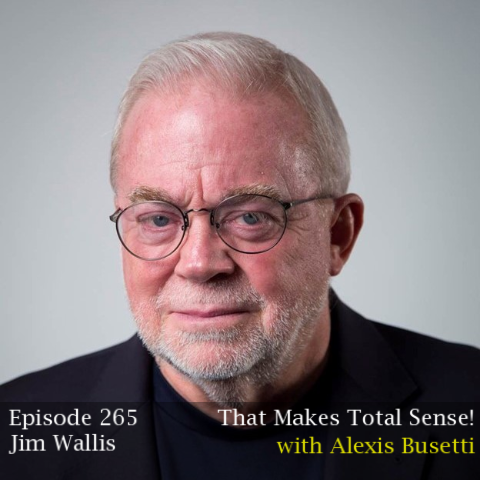
Okay, so, Jim, I was thinking earlier, somebody said, I heard someone say the other day, you know, if it's going to be a good day, by 836 in the morning. And I thought, that's kind of funny, but it's kind of true, you know, how did you sleep? They said, did you lose your keys? You probably know by that point, and I was feeling just a tiny bit under the weather this morning. And then by 836, I remember I get to sit down and talk with Jim Wallace today. Oh, you're very kind, and I'm so excited about that. So it's been a good day. Already prepping for this interview. I think it's going to be a good day. And Jim, I would say you just said you're traveling a lot with this book that we're going to talk about today, the false white gospel. And I would tell you you have your work cut out for you, but that's a real obvious statement for someone who has been working as long as you have in this space of faith and justice and politics.
You're at Georgetown right now.
[00:01:48] Speaker B: Yeah.
[00:01:49] Speaker A: You've been in DC for a long time. This is the place to be for all of this. But as you mentioned, you're traveling all over the country. Because even though we see these decisions being made in the halls of power in DC, the conversations and really, frankly, the ideologies of the american people all across the country are really what matters. So, I don't know, I'm wondering if we might even be able to just start there with what are you seeing? Who are you talking to as you're traveling across the country talking about this book and just faith in politics in general.
[00:02:27] Speaker B: Well, thanks, Alexis. Great to be here again with you.
Yeah, we're turning book events into what I call local town meetings on faith and democracy with lots of local leaders there. So it becomes a community conversation. So it isn't just about a book. It's about a moment, and it's about the faith factor in this election, which I think could be decisive. So we're going to many places, including battleground states over the next several weeks, about 20 cities, I think. So I'm teaching at Georgetown. My class is faith, race, and politics. It's my core class, but other than that class, I'll be traveling all over the place. And I think I'm hearing, like, in Grand Rapids, we had 500 people show up in Milwaukee, the same. So a lot of people are coming, and they're realizing that, as the book subtitle says, this is about rejecting christian nationalism, reclaiming true faith, and refounding democracy.
So the false white gospel is about all that. But I think, let's put it this way, a lot of people now realize that democracy is at stake in this election. It's on the ballot because of Donald Trump's love of authoritarian politics and loves being an authoritarian himself and loves other authoritarians all over the world. So a lot of people are aware of that. I don't need to make that point because it's just painfully true, which makes this election historic. But I would say christian nationalism is also on the ballot.
Religion is on the ballot.
The kind of, I would say white christian nationalism that supports Donald Trump.
This is a ballot, a vote on that, too.
Not just what kind of democracy do we want going forward, what kind of country, what kind of nation, who's a part of it, who's not all of that, but also what kind of religion do we want going forward and why? Christian nationalism. The name spells the problem. First of all, you take, in my view, the most inviting, welcoming, inclusive vision in the world, the gospel of Jesus, and you make it into a white preference, and then you take the word Christian they use, but they don't mean service or sacrifice. I mean control and dominion. In fact, there's an old dominionist theology that goes way back in history, really, since our foundings, about white control over this new nation. And so that's a very different kind of christian than I find in my gospels. And nationalist, my goodness. Jesus commission to his disciples was, go into all the world and make disciples in every nation. How does that become nationalist? American nationalist? Trump's Bible, somebody sent me a copy, and he's made, I heard, $300,000 on his Bible, but it has on the front, God bless the USA.
Now, the Bible, which I don't think he's read much of, would call that idolatry, the worship of a false God, putting the nation first. There's nothing in the Bible about America first or America greatest. It's not there. And all the biblical texts apply to this country as well. So I think we've got a religion on the ballot. So it's like we got to talk about what kind of religion do we want going forward. It's not just oppressive politics that we're facing, but oppressive religion. And a whole lot of people, particularly young people, have no interest in oppressive religion, but there's great interest in the teachings of Jesus, which is what my book is all about.
[00:07:09] Speaker A: So you've already answered the first question that I had on my list. We've touched on the third, where I want to come back to that in a little while, which is the threat of, to democracy. But my second question, it's almost like we rehearsed this, Jim. We didn't. But you're just so practiced. But my second question is right where you left off, which is you outline in this book several, I think six or something like this, scriptures that will help guide us as we begin to think and act on these things better, more faithfully. And here's my question, though, because I have had, I have seen in my feed now I will stop by saying this. There are a few folks that I keep in my social media feed, particularly because I don't want to silo myself. And that's really hard to do with our, with the algorithms and things like that. Right. It's really easy just to, you know, if I just have sojourners in my feet or red letter christians or, you know, those are the things that are people producing content that I really want to read. These are the ones that I'm aiming. I'm the amen corner.
But there are some orgs and some folks, individuals that I keep in my feed because I think they're smart, well educated, but they do not hold the same perspectives I do, particularly when it comes to christian nationalism. And what I have seen come out of these places are comments maybe like this.
Well, you know, so and so over here is using the Bible to defend their, you know, a belief about immigration policy. How is that not christian nationalism? Right. And I think, well, a, because I don't think you actually understand what the definition of christian nationalism is. But maybe to phrase it a different way, how does something, the thing that we call christian nationalism, which I think has been well defined by what you just said and also Samuel Perry and some of these guys who've done some very serious sociological research on the ideology and the concept, how does christian nationalism differ from folks maybe all over the map who would say, we want our faith and we think it's important for our faith to influence our politics. And that is what your book does here which I think is very appropriate. But I guess the question might be, for some folks, how are these things different?
[00:09:43] Speaker B: Sure. Fair question. See, I believe that our faith should shape our politics. That's good and right. And Jesus is no partisan.
God is not a republican or a democrat. But to talk about how faith should impact our politics is the right question. And religion in this country has done that for a long time, both in negative ways and some positive ways. And so I'm happy to have that discussion about not just if religion should impact politics, but how. How do we do that? And so I take, as you say, these six iconic biblical texts that are well known. I mean, they were all well known to me before I went back at them with this book in mind. And let's just take immigration, for example. One of my key texts, I lift up. I took these texts to refresh and refrain, classic texts and how they might apply to where we are right now.
And so the text in this book that refers to immigrants is Matthew 25, which is my own conversion text. It brought me out of the student movement, where I was very secular to become a follower of Jesus. And I call it the it was me text. Jesus says, I was hungry, I was thirsty, I was naked, I was a stranger. Now, the word for stranger there in the Bible means literally immigrants or refugees. That's what the biblical word means in that text. I was sick. I was in prison. And then in the text, they're all saying, lord, when did we see you hungry and thirsty and naked and sick and strange. You're in prison and sick. When do we see you? Had we known it was you, we would have done something. Maybe you formed a social action committee or something. And Jesus says, no, as you've done to the least of these.
The least of these, the poor and vulnerable, you've done to me. How you treat them is how I know you love me. It's very powerful in that text. And this was his last sermon or a speech or talk before he was crucified in Jerusalem. So it's also quite a judgmental text, which he's nothing. Jesus, normally very judgmental, but this judges the sheep and the goats, those who have treated the poor well and those who have not. It's a very judgmental text. And so, to me, there's all kinds of scriptures. I have a whole day in my class about immigration policy, and I go back to all the scriptures. How we welcome the stranger is so critical in hebrew scriptures and in the New Testament. So that's just a biblical issue. And then when you have Donald Trump saying he's going to have the biggest mass deportation in history. That's what he's saying.
That will break up families. It'll send young people who have lived their whole lives here, been in college, in the military, send them back to places they've never been, will break up families. That's completely contrary to what Jesus says about immigrants and refugees. So I want to have, with those folks you mentioned, I want to have a discussion or even a debate about faith this fall. Let's take these teachings of Jesus and ask what they mean for giving us values that we should vote with. What does that look like? What does that mean? So I'm happy to have the debate. In fact, I wish every congregation this fall would have a discussion or a debate on the teachings of Jesus and how they apply to this election.
[00:14:09] Speaker A: The issue of immigration is one that is, it's an excellent one to highlight, I think, the differences or even highlighting what one of the aims of christian nationalism is. And as I have studied this a bit more, read several books, interviewed several authors, scholars who study this. One of the outstanding things, themes for me inside of this ideology of christian nationalism is that it seeks its own, it seeks power, and it seeks power for people who look like itself. So white christians right in this space. And I wonder if when we're talking about continuing this conversation with how faith influences our politics, but also how christian nationalism is a threat to democracy. As you mentioned, this is one of those things that comes out very heavily for me. You mentioned in the book this great replacement theory, the Tucker Carlsons of the world batting about these kinds of things and how this, I don't know. I almost want to call it a boogie monster gem. But you know, how this comes in and it threatens folks who hold to christian nationalism because they're holding to power. And how does that ideology and acting on that, how does that threaten democracy? I think it does in a very real way. But how do you see that beginning to play out?
[00:16:06] Speaker B: Well, let's put boogie monster into some spiritual terms.
[00:16:10] Speaker A: Okay.
That's fair.
[00:16:13] Speaker B: Every nation has its better angels and its worst demons, every nation, ours included. So we have a battle here between our better angels and the worst of our demonstration. Our demons of race run very, very deep in this country. Very, very deep. So it's really a spiritual battle that's going on. And let's take another text. I love the way you want to turn to these texts because what the book is mostly about, everyone knows the famous story or they think they do, of the good Samaritan.
Here's this Mandev, Rob beaten, rob half dead, being left by the side of the road, and two religious leaders pass him by. Maybe they're on their way to a religious meeting, or they're too busy or they don't notice, whatever reasons. But somebody stops, one person stops, he turns out to be a samaritan. Now, let's be clear to Jesus audience. At the time, there were no good Samaritans.
They were mixed race half breeds, dangerous false worshipers. They were the others.
They were like. In fact, you know, there are cartels of Samaritans coming to us from Mexico. I don't know. That's a different group.
But there were other, like, immigrants, and others are being othered now. They were the other treated that way. And yet here is a Samaritan who's being othered by the Judeans. And I show in the book how all the jewish scholars say this man Saul wrote is jewish. So here's an other helping one who's other than him. And that's Jesus. Example of the question the lawyer asked, who is my neighbor? Now, what the text doesn't show, but I believe is true, is this lawyer was a Washington lawyer.
I mean, I know that tone of voice. You know, one saying, who is my neighbor? How can I welcome? They say, exactly, who is my neighbor? Who am I responsible for? Who am I obligated to treat this way? And Jesus chose this example of the good samaritan.
And he says to the lawyer, so which one of these three, two that passed by and one that helped would be the neighbor? And he repeats, we're told, you love the Lord your God with all your mind strength, and you love your neighbor as yourself.
And the lawyer knew that. He knew that text. But that's the summation of everything. And you can't love God if you don't love your neighbor. Loving your neighbor is a test literally in the scriptures of loving God. So in this story, who is going to love the one other good samaritan could help pave the way to a multiracial democracy in America? How do we love those who are different than ourselves? They're our neighbors, says Jesus. They probably live outside your neighborhood, and yet they're the ones who Jesus says are our neighbors. Now, that's a powerful biblical text that undermines any kind of nationalism that says, we belong, others don't belong. The racial hierarchy, which was America's original sin, which I call it, that virtually almost exterminated all the indigenous people and then kidnapped an entire race and said, they are different. They are inferior to us white people. That racial hierarchy stays embedded today, and Jesus teachings turn that literally upside down. So I'd love to have a debate with some of my colleagues on the right about what the good samaritan passage means for us today.
[00:20:38] Speaker A: You may not remember this, but a couple of summers ago, when I was in DC with the group from Fuller, and we did the inaugural conference there at the center, um, in our one on one time, I I don't even remember how it came up, but I'm reminded of it because you were talking about the Samaritans as being a mixed race peoples, and I'm mixed race and grateful to, uh, some folks out there who actually have brought that term back. When I was growing up, I used to call myself mixed, and then it became derogatory, and now we're kind of owning it again, some of us. Um, and I remember you telling me, like, just. It was so impactful for me because you just looked at me and said, alexis, the future of America looks like you.
And that was so impactful for me because as a woman, as a bIPOC woman, as a mixed woman in particular, um, I have never felt that sense of agency. You know, even. Even the forms that I've had to fill out through my entire life, I am mixed, hispanic, and white. And so, on these forms, there's usually a box for white, and there's usually a box for white, non hispanic, or there's usually a box for hispanic, and then a box for white, non hispanic. And so I would just put the two things that were true about me, white, and, you know, hispanic, and. And I'm like the white, although it always has the parentheses, white, non Hispanic. And so here we go. I'm checking the box that says white, non Hispanic, and Hispanic at the same time because my dad is white, non Hispanic, and my mom is hispanic, and so I am white, non hispanic, and Hispanic at the same time. And so I would. I would check both boxes, because that's what applied to me. But I say that to say even in just whatever it was going to the doctor, filling out scholarship applications, you know, any of these things, the system in this United States is not set up for people like me to even be able to fill out a specific form. And, of course, this is on purpose, right? And this is on purpose.
And one of the effects that it has is it causes folks who look like me to begin to question even our identities.
[00:23:19] Speaker B: Sure. Absolutely.
[00:23:20] Speaker A: Who am I? You know, who am I? What could I do? I can't even fill out a form. You know, I can't even fill out an insurance form or a form at the doctor's office or an application for school.
And then it leaves those of us beginning to question our identities. We've seen this with a lot, with Kamala Harris on the campaign trail. Now, as a mixed woman, I would say, as one mixed woman to another, people don't know what to do with her. But I would say the future of America looks like Kamala Harris. The future of America looks like me, according to Jim Wallace, but also according to these statistics that we see. Right, right.
We see statistics that show that. And I think that's one thing that white christian nationalism wants to bring that down to make that where it's it, though the people who look like me don't actually have the power and agency to create change, to build systems or things like that, even though the country looks like us.
[00:24:29] Speaker B: Well, but I'll go back to what we talked about way back when for Kamala Harris and for you and for my dear friend Peggy Flanagan, who's the lieutenant governor of Minnesota.
And if Harris Walsh wins, she'll be the first native american governor in America, first woman who's mixed as well. And you are the future.
And for a whole lot of white people, that's still a threat.
In my class at Juriston, I often say we go through the documents, they're founding documents, and I look around the class and I ask the white men in the class how many of them own property, own a house, and very few do. I says, well, then let's be clear. This whole system was set up only for me.
Here I am, I'm a white man, and I own a house, so I own property. The whole system was set up for me, not for any of you.
[00:25:41] Speaker A: That's right.
[00:25:41] Speaker B: And so the whole pilgrimage of this nation is to have this country be for all of you in this class, which is a very, I have very diverse classes. And it's simply put, the big issue in this country, the elephant in the room under every policy issue, is that we're transitioning from being a white majority nation to being a nation that's a majority of minorities. That's what's happening. And all the efforts that voter suppression, gerrymandering, voter intimidation all over the country now are designed, they have a strategy. I would define in one sentence, they want to prevent our changing demography from changing our democracy.
[00:26:33] Speaker A: Say that again, Jim. That's good.
[00:26:35] Speaker B: To prevent our changing demography, which really they can't change from changing our democracy and our changing demography is changing and supposed to change our democracy. So when my dear friend ive known her a long time before she was an elected official, Peggy Flanagan, she could be the governor of Minnesota in a few months.
Unexpected. So thats the future. And I think a lot of white people just need to take a breath and this whole white supremacy, we're all against white supremacy.
White privilege is baked into everything in this country. I would say white preference underneath is universally upheld time and time again. And so white people are captive to that and need to get over that for their own sake.
Jesus said, you'll know the truth, one of my other texts in the book, and the truth will set you free. Now to me that means the opposite of truth isn't just lying, it's captivity.
It's lack of freedom. Freedom and truth are indivisible. And if we get over this idolatrous and silly and captivating white preference, whiteness, the norm that somehow this country should be different, the racial hierarchy from the beginning, getting over that is going to be good for literally everybody and a whole new generation. My kids grew up in a very multiracial school, sports, my little league teams, I was their coach for 22 seasons. Little league teams, multiracial. And their life, their history of their friends, their family is multiracial. And that's the future. And they're just very comfortable with that. And that's where we're going. And a whole, whole lot of white people in this election literally are going to see Kamala Harris as exemplifying that american future, that mixed race identity that would include all kinds of people in her administration.
And that is, in fact, where we're headed as a nation. And white christian nationalism is a last gasp, is a last struggle. And that wants to use violence as necessary to protect literally white minority rule.
So that's a democracy issue, but it also is a biblical issue. Another text I use in the book, the famous Galatians 328 text, which says there is no longer and a greek or a jew, or bond, or free or male or female, all are one in Christ Jesus. Now that text deals with the three pillars of oppression in all of history, race, class, and gender. It's all there. And what I learned in my research for the book is that the early Christians used that text, Galatians 328, as a baptismal formula liturgy at all the baptisms of new believers in the early church.
This text lifting it up as if to say, well, this leader we follow is telling us that our new community, this body of Christ is supposed to overcome and transform all these divisions and barriers. Now, we're not perfect at that, but that's what we're trying to do. It's not extracurricular. It's not a little committee on the side. It's who we're trying to be. And if you don't want to be part of that kind of group, you better go somewhere else, because that's not who we are. Imagine if that was being said by white american churches today. It would be just transforming. So a baptismal rite, if you will, is right.
It's a foundation for, from our own faith as christians, what a multiracial nation would look like. Doctor King always wanted to see the church as a model, a good model for the society around it, to show the society how we're supposed to live and be. And so I just see this is the future. So when Kamala Harris says it's become a chant, we're not going back.
That's a very deep thing.
It's a historical thing. I did a wonderful podcast with James Clyburn yesterday, who is not only a great leader in Congress, but as a historian, and he was describing how we're not going back, you know, historically, to a day when, in fact, white people and whiteness, and the ethos of whiteness dominates the country. That's old. It's done, and let's. Let's get set free from that. It's so much better to live without that hierarchy and white people. My younger white people are learning that. My book talks about how there's a remnant church afoot at the end of the book, becoming a different kind of church in this country, where a lot of younger white believers are literally wanting to stand alongside leaders of color in the churches and build, literally a new american church. So this is more than an election. It's about the future of the church. So when I say white christian nationalism is on the ballot, it's really a choice between false and true religion on the ballot. What kind of religion do we want to shape us going forward? And this is a battle for the soul of a nation.
It is that. I would also say it's a battle for the integrity of the church. The body of Christ globally is the most diverse human community on the planet. That's just a fact.
And yet here in America, that still isn't true.
[00:33:44] Speaker A: When you said that, you asked your classes how many of the white men in the class owned property, there's a quote from Mark Charles that lives rent free in my head that I think he was referencing at the time, the pay gap, gender pay gap.
[00:34:04] Speaker B: Right.
[00:34:05] Speaker A: And he said something like, if you want to understand why women make, I think at the time it was 70 something cents on the dollar compared to Mendez. The constitution is working because it was made for and by white land owning men. And then he elaborated, you know, anytime any of these things we're questioning, these things that have to basically, as you just said, are hierarchical. If we're questioning why these things are, then we have to look back. And basically the constitution is working, the system is working. And what I'm hearing, as we say, how can faith influence how we act in politics? This is changing the system. Right? Kamala Harris is saying, we're not going back. That system is old. That system is tired. That system prevented folks who looked like the future of America from voting, from full participation in.
You have a chapter that talks about voting, but the scripture that you use, if I'm not mistaken, Jim, is the scripture on imaging God.
And I think that at first I was like, wait a minute, Jim. What? I'm reading through this, but I'm like, no, no, no. This is applicable to where we are in our country because for so long, we've had all of these iterations of who is allowed to participate in this way. And if we want to say, as now the laws do say, that everyone who is of a certain age can. Well, that's not always true because there are all these stipulations that say who can and who can't even still who can and can't vote. This voter suppression. But we want to be able to this. This is what's part of the threat to democracy, right? Limiting who can vote and saying that. But we're saying, no, this isn't the way it ought to be. That system was old and tired. This isn't the way it ought to be. I mentioned this, and I'm not being extraordinarily as precise as I want to be here, in part because I'm a little bit frazzled by some of the things that my own state has done. State of Texas, one of the worst offenders, I don't think. I think, in my opinion, you've probably seen what Texas has been doing. And even just this morning, I think I saw a headline of the governor revoking even more voter privileges in our state. And so I'd say, how as christians, can we look at this, Jim, and we connect?
Okay, I'm made in the image of God. You're made in the image of God. And this in some ways affords me the ability to participate fully in the system that governs me.
[00:37:03] Speaker B: Yeah, I think we have to go theological indeed on this question that voter restrictions, voter suppression, voter corruption, voter intimidation is a theological offense. And here's why I love it is indeed the first chapter of the first book in the Bible, Genesis 126. And it starts with a phrase I love and I always try to imagine before I read it, all the noise around us, political noise, polling noise, pundit noise, all of that around us, in the middle of all that that I'm hearing, it reads, then God said, as if, be quiet, I'm about to speak here in the middle of all noise. And then God said, let us make humankind, which means all of us humankind in our own image and after our own likeness.
And that's the divine infrastructure, if you will, foundation for all our earthly talk about human rights, civil rights, and certainly voting rights and what that means. Barbara Williams Skinner and I are involved in something called face united to save democracy. We're in ten battleground states focusing on the most vulnerable precincts to voter suppression, which are all in poor, minority neighborhoods.
And I often say on our calls, we're training poll chaplains to be their lawyers and callers to provide protection and information and authority.
And I say, so any attempt to deny, suppress, not count a vote or somebody because the color of her skin or any other reason is literally an assault on a Mago day. Latin for the image of God. An assault on a Mago day. This is very practical. And Barbara and I have had some talks with secretaries of state for whole states who oversee the voting process.
And I've said to some of them, do you understand that all of the voters in your state, I said, do you know that text? They'll say, oh, yeah. Oh, yeah.
All the voters in your state are made in the image of God, right? And they'd say, yeah, I guess so. That's true. Well, any effort you're overseeing, the voting process, restrictions, access, any effort to in any way limit, deny, restrict, overcome those voters is a denial of the image of God. Well, I've never thought about it that way, says a christian secretary of state.
And so I think we've got to go theologically, and constitutions can be revised and reformed, and ours needs to be particularly around voting processes. Some fundamental changes have to be made to a nation that is the only democracy in the world that isn't a majoritarian democracy, where if you win the vote, you win the election, ours is not you. Battleground states that count more than other places that must be changed. We must transform our electoral system, and I'm all for that. And we got to commit to that and not go back to democracy as usual, even under Biden or my friend Obama. That's not enough. We've got to transform these systems. And young people are demanding that, my own boys are demanding that. But underneath all that is a theological affirmation that we are, all of us, made in God's image. And every vote, every voice is therefore dignified and precious in the eyes of God. So I want to go theological on voter suppression. And we call ourselves Barbara and ale. If we call ourselves in this movement, it's called face united to save democracy. You can look it up online, but it's like we're the Imagra Day movement.
[00:41:46] Speaker A: I want to, as we move toward closing, this came into my mind earlier, and I think this is a good place to ask you to insert it.
You can talk specifically about the organization if you want to, but more specifically, I want to talk about what the name represents. Faiths with an SDHe united to save democracy. And we've been talking about the issues that white christian nationalism presents, but we've been doing that in a christian context because that's where you and I live. We're theologians and pastors, and we live in this space.
But specifically, you mentioned it way at the beginning of the conversation that the gospel of Jesus is one of the most inclusive things there is on earth. And. And I would love for you to talk about that inclusivity. This faiths united to save democracy. And how that.
How those concepts and those actions differ from what we see inside of christian nationalism.
[00:43:08] Speaker B: Indeed. Well, it is face plural. And now we're joined by rabbis, by imams, white Christians, black clergy are providing a lot of leadership for it, but it's really inclusive. We really are trying to be multiracial, multi faith, and multi generational.
And the last thing is a real challenge, to be multigenerational. We're reaching out to a lot of young people. Steph Curry did a video for us on why vote? Because he's very influential with a lot of the young people. So this is really a growing movement that isn't just led by Christians or black christians who led the civil rights movement. It's led by people who are very pluralistic in their faith. And none of us are for kind of a interfaith kind of, you know, just kind of reducing to a few things that we all can believe. No, we all believe what we believe. And this movement is multi faith, believing what we believe, but acting together around voter suppression. And there are islamic and jewish arguments, christian arguments for that as well. So it's a wonderful configuration of people on our calls. And you have some younger jewish rabbis who end up in tears saying, we haven't worked together like this since Rabbi Abraham Joshua Heschel and other rabbis joined the Reverend doctor Martin Luther King, junior. So it's a revisiting of that relationship again. So it is really pluralistic, and it's very supportive of those who have no religion whatsoever.
I have a lot of my class in Georgetown. Students would identify with the none of the above, the religious affiliation surveys, the nuns nones. And in Georgetown, I remember saying when I first got there, I love the nuns. And these catholic sisters said, and we love you, too.
I said, well, I love you, to be sure. In fact, nuns, catholic sisters, when I first started a long time ago, I go to these conservative christian colleges, evangelical schools, to speak. And in the chapel or auditorium, there'd be these rows of catholic sisters sitting there, full garb, and I would say, sisters, what are you doing here? Well, Jim, we're local. I said, well, I figured that, but why are you here, Jim? This is a very conservative place. Said, yeah, I know. It's kind of why I'm here. We thought somebody should have your back.
I had nuns, bodyguards, those places. But the nuns, n o n e s, this is not a secular movement. Most believe in God. They're just not willing to affiliate with religion because of what religion says or doesn't say, does or doesn't. And yet they believe in something beyond themselves, and they're very open to a different, new kind of faith. So I love the questions to nuns are raising, and I think the future is going to be one that's respectful of christians offering their best and jewish and islamic. And I talk with a number of Buddhists who want to be a part of the conversation, too, but also people that have no particular religion or faith at all but know they're completely included. Anybody who has moral sentiments, moral conscience, moral concerns has to be part of this conversation about what kind of country we're going to be.
[00:47:10] Speaker A: That's right. And I think, I just want to say out loud this support of voters across the spectrum, and I just keep thinking about how important it is that the voices be heard and that movements like your own are not trying to say, we only want the voices heard who will say what we want them to say?
[00:47:36] Speaker B: No, no.
[00:47:37] Speaker A: And, and that's a really important distinction.
And it's, and it's, and it puts a lot of faith in people in the Imago Dei, as you're saying that God, you know, my belief as a christian right is that God has put in us the ability to seek wisdom, to act in love, you know, all of these things. And that's true whether or not we believe in Jesus. Just as people, we have these abilities to reflect God and his, God's image.
And so we want voices heard that and people to speak up even if they're not saying the things we might want them to say.
[00:48:29] Speaker B: And that's on the ballot for this election.
That's, I said the beginning and I'll end here. Christian nationalism, which is not that kind of religion.
It's the control of white Americans over our nation and our churches. And it's growing older, and many of their children and grandchildren aren't following them, but they're still wanting to hang on to power. Fundamentalism, whether christian, jewish or islamic, is about using religion to gain power.
That's what they're doing, power. And Jesus had a whole different way of changing the world of his disciples, changing the world by bringing those the kingdom of God on earth as it is in heaven. That's a very different thing than control of a white minority. But they're making this battle, it's their last gasp for power, and they'll use any means necessary. So I think not only is democracy on the ballot, but christian nationalism is on the ballot. And so mobilizing organizing is crucial, not just for the state of our politics, but for the state of our religion and really for the soul of America.
[00:49:52] Speaker A: Thank you so much, Jim. It's always fun and an honor to talk with you. This, again is the false white gospel, rejecting christian nationalism, reclaiming true faith and refounding democracy. You might even be able to catch Jim on his book tour this fall as he visits about 20 cities, talking about this book and doing these town hall meetings. So I'm so grateful for you and for your work and for you taking the time out to talk with me today.
[00:50:18] Speaker B: Always good talking with you. Take care.
[00:50:21] Speaker A: Thank you.
[00:50:21] Speaker B: Bless you. Bye bye.
[00:50:24] Speaker A: The links for all the resources mentioned in today's episode can be found in the show notes, music and podcast production by Seth Busetti. Be sure to give us a review on iTunes and subscribe at your favorite podcast listening app. You can also visit
[email protected].