[00:00:10] Speaker A: Welcome to that Makes Total Sense, a podcast dedicated to exploring God's generosity and justice. I'm Alexis Busetti, a Christian, aiming to ask good questions and encouraging you to do the same.
Every one of us is wired by God to live out generosity and justice, but the how sometimes eludes us. That makes total sense is a way for us to get together, posture ourselves as learners, and challenge one another to practice generosity and justice in a tangible way every day.
Oh my gosh.
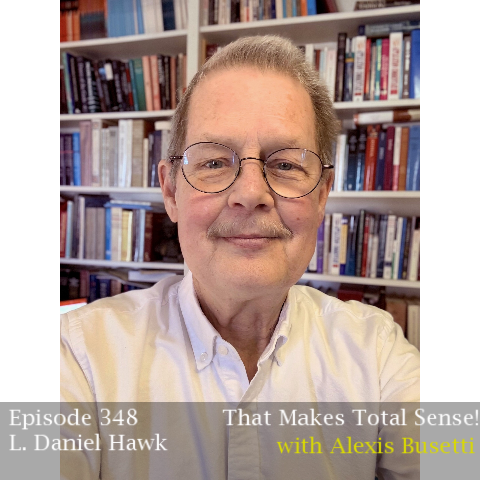
Longtime listeners know that this happens to me often where I get kind of jiving with a guest pre record and then I'm like oh my gosh, I wish we had fresh record minutes before we before we did. But we're here now and I'm thrilled to have author L. Daniel Hawk with me today. Daniel, you have written an incredible book that I just finished over the weekend.
It was great too because it was like a gray weekend in Austin. Those don't happen very often and so it was a perfect spot to be just sitting with my all day coffee, my beagle, my book.
This one's called Undoing Manifest Destiny, Settler America, Christian Colonists, and the Pursuit of Justice. Thanks for writing it, thanks for sharing it, and thanks for coming on to talk about it.
[00:01:37] Speaker B: Oh, thank you so much for your interest in the book and in this whole general topic.
That's really encouraging.
[00:01:46] Speaker A: Well, I mean you almost pulled my first question for you out of me right there, which is when you're talking about this journey general topic. I am super interested to hear how you first became interested in this general topic. I don't think it's in the title or subtitle, so I will say most of this book is regarding or you're I'll let you correct me. Much of this book includes history and I feel like we should not end at history. It includes current situations with our indigenous neighbors on in the U.S.
your your scope is limited to the U.S.
but manifest destiny, which we'll talk about in greater detail as the conversation goes on, severely impacted the Native American community and population in the US over the last hundreds of years.
So I didn't think that population was named in the book. So I wanted to ask you first what initially piqued your interest and then kind of what kept you going with a topic like this one?
[00:03:06] Speaker B: Yes, thank you. Well, I actually started as an academic enterprise so I decided I had some friends who were non white. I had done some work on the book of Joshua early in my career that was well received and I had some friends that were pushing me to say you need to do more with this than just keep it within the halls of the academy.
So I thought about that and I thought, I think that's right. So I started reading the book of Joshua and the American conquest narrative together, and the common script immediately grabbed hold of me. It just. It just was undeniable.
And so that got me into reading indigenous history and looking for.
For some kind of orientation to. To figure out what to do with all of this.
And long story short, I started speaking in churches and then in a few conferences in the area on this issue, because this is a topic in which there is a justice long delayed and a script that impacts both settlers and indigenous people.
And so something just grabbed a hold of me and I started speaking. And that got me.
I started going to Indian centers and powwows and talking to people and made some really good friends from indigenous communities. And as I walked with them and heard their stories and the stories of their people, I.
I just. It just grabbed a hold of me in. In a very deep way.
And so the immediate.
The immediate kind of pull to get me to do this was my.
My good friend Terry Wildman, who is the lead translator on the first nations version, started work on the Old Testament and Psalms of Proverbs, which has been published. And he asked me if I would serve as a Hebrew language consultant on the translation council. So I. I went up to intervarsity Press to do a gathering of the translation council. And everybody at the press was so enthusiastic about, you know, what they were doing and the way they were speaking into indigenous communities, publishing. And I thought I was actually at a juncture where I was going to write something else. And in that week, being with. With those individuals, I just.
It just grabbed me. This is. I've got to write this book.
And that's.
[00:06:09] Speaker A: That's what happened there. There's so much there.
Um, as it usually happens, this is taking me way in, out of order in my notes. Uh, but this is a great thing. Um, I want to. I want to come back to Joshua in just a moment. You're a Bible professor, so I want to come back to Joshua in just a moment. But first, I'm hoping that you can give our listeners a note on language. Um, that was one of the things in the book that I found to be incredibly helpful.
When you talk about how you are naming and addressing and the. The language you use is settlers and Indians, and you also use, as you just did, indigenous Native American.
But. But there's more to the nomenclature. More to the nomenclature there than.
Than Just like what might be a common vocab word for, for us. And so there's, there's story, there's narrative behind those terms. Excuse me. So I'm hoping that. Would you, Would you talk about. When you say specifically in the book and maybe in parts of this conversation, when you talk about settlers, what, what is the, the meaning behind that word as you're using it?
And also in the places in the book, there are many, many places where you specifically choose to use the word Indian as opposed to indigenous. And when you do that in the book, what are you meaning and what are you hoping that to accomplish?
[00:07:46] Speaker B: Oh, yeah. Thank you. That's a great question.
I think the base of it is the fact that for white Christian settlers who have basically written the American narrative, white Christian America, Settler America has shaped indigenous identities in order to fit within a narrative and a mythology that really speaks. Another thing. I didn't use this in the book, but, but we call ourselves an immigrant nation. We, we like to characterize ourselves in that way. And so indigenous people in that narrative, first of all, they're invisible even to say we are an immigrant nation, brackets out anywhere from 5 to 10% of our population, and says, well, then you're not really part of this nation.
I think it's really important as a decolonizing practice, first of all, to honor, Honor the various peoples by using the names that they use for themselves, letting them define.
When you say, yeah, I want to call you by your name, I'm basically saying, I value your culture. I value who you are.
And that's just such an important practice to turn away from this impulse on the part of, of white folks to characterize and dominate and tell their stories, which are not ours to tell. But we pretty much take dominion over the narrative as we have taken dominion over the nation. So I do use the term Indian, and I use that in places where I really want to highlight the settler perspective.
And so so much of the literature all the way through, up well into the 20th century, American Indians, Indians.
And it's not been that long since white America, white settler America has been willing to own and listen to and allowed, I should say allow. But, but, but invite indigenous peoples to, to help us to understand how they, how they name themselves. I mean, quick, quick tangent. In the Bible, naming is an expression of dominance. And I think that's that, that, that. So that's why Abram and. And Jacob get renamed by God.
But this naming thing is, I think, really an important piece. Your name, in a sense, carries your identity and the identity of your people.
[00:10:57] Speaker A: Yeah, thank you. Can you talk about what's behind your use of the word settler?
I think that will feel foreign to some folks, that term even.
[00:11:13] Speaker B: Yeah, I use that as, in a sense, a shorthand for settler. Colonial settler colonists.
European colonialism in general was propelled by going into unchristianized lands and exploiting labor, exploiting mineral wealth or natural resources, and enriching the colonial capitals and people by virtue of that. So that's the way it usually happened. But there are small number of cases, America being one, Canada, for example, being another, where the settlers who came were primarily after land.
That was.
And so our greed, our colonial greed, was not just for the labor and for what we could extract from the land. It was the land itself.
And so to be a settler is to be someone who says, this land belongs to me and my people for reasons that I explain in the book.
And in a sense, Christianity is enlisted to provide theological cover for some really, really grim and awful things.
[00:12:49] Speaker A: Thank you for that.
Gosh, I'm. I'm trying to figure out how. I want to ask you to explore Joshua.
So maybe I'll give just a tiny little preface here to say this.
I really want you to talk about Joshua because you started off by saying that was part of what piqued your interest in this, is reading these texts and these histories side by side.
However, in the book you express that there's not a lot of explicit references in literature, in American historical literature, to connect what was happening historically directly to the narrative in Joshua, even though it is pretty obvious to many folks who look at it.
What I don't want to shortcut, and I know that we will have time to come back to it, is just to, as a preface say, the first half of the book probably is gratefully full of receipts about this history.
I mentioned to you before we started recording, and some longer time listeners might recall that I was born and raised in Oklahoma.
In conversations like this, I usually say, read into that K through 12 public school in Oklahoma. Many of those years, Oklahoma State history was required.
Oklahoma was the end of the Trail of Tears for many tribal nations.
And we have a.
I don't know, I wouldn't say large, but we have a Native American population in Oklahoma that's probably bigger than a lot of other states because of that.
Tribal governments and things like that exist quite heartily in Oklahoma. And still I had a very, very basic, almost, I would say shamedly basic understanding of the history of the indigenous peoples in the US Even growing up in Oklahoma. That history included unthinkable violence, incredibly dramatic and traumatizing relocations treaties. I want to, almost want to use air quotes there that were not and continue to not be honored by the US government who put those in place and you know, theft, we could go on and on and on.
And so I don't want to skip over that, but I want to say for those of us who have a basic understanding, we can talk about Joshua in this part of the conversation without all of the receipts just yet.
Because, because I would like to, I would like to get to that comparison that, that, that you had there in Joshua. Because I think part of that when you just said the settler Christian colonial mindset, this is very present in, in what was happening, not just in our history, Daniel, but currently this mindset is alive and well and very influential.
[00:16:25] Speaker B: Yes, the script was written and filled out during our colonial period and western period of western expansion, but it's subliminal, it's subterranean.
It's a script that has become so normalized and white settler thinking, if I can continue to use that term, it's become so normalized as to be invisible. It's just kind of the way it is. So, so we've got that, we've got this idea that.
And you're right, one of the things that really surprised me was that even though, particularly in the founding period, you know, the so called founding fathers, they really embrace the imagery of the Exodus, you know, here we are, we've been delivered from tyranny, from the English tyrant, we made a passage through the water God's given us, set us in a new land.
And so there are Exodus metaphors all over the place.
There are virtually no references to Joshua in American public literature well into the 20th century.
So I, I had to ask myself at one point, what on earth is going on here? I mean, we're replicating the script, but.
And it would seem that you could just go to the Bible and say, well, see, the Bible tells us we
[00:18:00] Speaker A: should do this, but it's literally just a turn of the page.
[00:18:04] Speaker B: Yeah.
So what's going on? And what I came up to, the conclusion I reached was that what we were doing was so close to this orgy of violence that is claimed in the book of Joshua and which Christians have always had a problem with.
But it's almost as if we're to claim the Joshua kind of script, if we're to claim it outright, we really have to admit that we're running afoul to the basic human rights that we espouse as a nation and what we think makes us different and acceptable from all other. Other nations. So my sense is that again, as I said, that that script is there, but it. We. We just don't recognize it. Which is one of the big aims in the. One of the impulses, one of the reasons that I wrote the book.
We need to bring. We need to, in a sense, lift the COVID and see what's under the historical rug, acknowledge that and begin to.
The first step in healing is to acknowledge.
The first step in reconciliation healing, bringing people together, is to understand the harmful and damaging behavior attitudes that we white Christians have had.
And so I look at Joshua and I use a patristic metaphor for my approach to Joshua, and it's the metaphor of the mirror. So a lot of us think about the Bible. We think about it as a lamp unto our feet, lights the way, shows us how to live, kind of reveals Jesus. But there was also.
The idea of scripture as a mirror was also prominent in early Christianity. A mirror that. That shows us both how beautiful we are and how ugly we are. So I thought, if we're going to get Christians involved in dismantling what Christians built and endorse, we've got to do it via scripture and we've got to do it. And I want to suggest we do that by entering into a concerted conversation that arises out of reading Joshua and then saying, here's scripture that is showing back to us some things about ourselves that we probably don't want to recognize. So how can this book of Joshua and the way that is it is constructed, how can that be a way for guiding us into conversations that consign that old script to the dustbin of history and begin to join together in writing a new script in which all voices are honored and all peoples have dignity and beauty and worth and value.
[00:21:30] Speaker A: Thank you for that.
Yeah, that was.
I will say that's only one chapter, the book on Joshua.
And as you said, it's not explicit, but the script is there. The script was there way before any of us who are talking now were given birth to on the planet.
And I want to move to the opening epigraph of chapter one, because I feel like it captures what we're dealing with. When you're talking about the mirror, who are we? What is our history?
This was from. If you don't. If you don't mind, I'll just read it real quick. It's only a couple of lines, but this was recorded in a town meeting in Milford, Connecticut in 1640. 1640.
And the quote reads as follows.
Voted that the earth is the Lord's and the fullness thereof.
Voted that the earth is given to the saints.
Voted that we are the saints.
This was voted and stated by settlers in Connecticut in 1640.
This is the script. And I will say bluntly this, that the script also included in that time not just that the settlers were the saints, but that indigenous peoples were the savages.
Yes, that's one of the binaries. That's a driving binary in the events that were happening and continued to happen and even the mindsets that exist to today. Saints and savages. Yeah, go for it. I interrupted you.
[00:23:27] Speaker B: Not only savages, but in a Christian mind, they're under the domain of Satan.
And so one of the things you're alluding to is one of the key justifications, particularly for Protestant English colonists, the justification for taking land, and that is Genesis 1:28, which is God's creation mandate for all humanity to take dominion to replenish the earth. And as that was understood particularly by the Puritans, but by a lot of other people, the task of part of what English settlers, God was propelling English settlers to the New World in order to not only take dominion of people, but to. To reorder a chaotic wilderness. Wilderness is wild. So we're. We're ordered.
We, you know, we have bounded. We have fences around property and. And everybody knows whose is whose and what's, and what's. And everybody has property and can use that property to.
To make a living and fuel a market economy and all of this. So we're the order people. We have laws, we own. We understand that ownership is really important when it comes to land, real estate, we transform wilderness land into real estate. So on the other side, this is where the script, again, the script and the binary work together. I mean, if.
If you're crossing, if you're using the Exodus metaphor, and that's your idea for what God is calling you to do, what do you think about the people who are already there?
So.
So this whole. So this whole idea just gets wrapped up in this, as you said, a huge binary in which indigenous peoples are, at best, because they're nomadic, they don't own property, at least nomadic in the English sense.
There were lots of different expressions, but the idea was that they're nomadic and they're wasting a lot of land.
They could be used productively.
And so they're resisting God's mandate given to all human beings. They're not doing it, they're impeding it.
And we are Here, as the quotation that you referenced. We are here because God has sent us here to replenish this land, which means make it a look. Make it look a lot like England without the mess.
And that strain goes all the way through our interactions on up to today, where there's still this mindset that indigenous people, if there's something that is worth developing, that is for the good of particularly dominant culture, whites, then we just need to take it and develop it.
And regardless of whether it's sacred land or holy land or traditional land, they're wasting it. We just can't let. And you see this again and again and again in the literature. We cannot let this land lie waste.
[00:27:25] Speaker A: Whoo.
And you're right. The land lying waste versus development was modeled off of what was familiar to settlers at the time, which was what was happening in Europe, whether they were able to see it or not.
Settlers did not act on the knowledge and wisdom that the way that indigenous peoples engaged with the land was just different, arguably better, and.
And different, so that it didn't. So that it didn't look the same. But there wasn't time or opportunity for those conversations.
I'm kind of putting my own little. My own little twist in my imagination here, because the mandate that you're talked about wasn't just from settler's own theology or their imaginations.
Your book surveys history from the 15th century through to today in parts, but historically to the 20th century. But even in those earliest centuries where religious authority, for people who may not be familiar with things like the doctrine of discovery, but religious authority, authority passed down the mandate to Europeans who would come to, again, kind of air quotes, discover new lands.
The Mark Charles quote that lives in my head rent free is you can't discover lands already inhabited.
And so discover is, again, the word that we're using there, because it's the word that. That European settlers were using, but that's not true. True to what was actually happening.
So I'm wondering if you can talk a little bit about not just the theology, but the religious authority that was given and utilized to prop up the narrative, but also to, like, logistically make it possible for settlers to actually do what they did. I mean, there were finances involved and things like that, too.
[00:29:50] Speaker B: Yeah, money.
[00:29:51] Speaker A: Right, Right.
[00:29:53] Speaker B: Yeah.
So that's the other prong. So the one prong is the creation mandate. Christians have an obligation to extend Christendom by replenishing creation. But you're referring to how this all gets started, which is in the mid 15th century, at the beginning of European colonialism with the Portuguese and then the Spanish, who are asking the Pope to endorse conquests that they have already made or are getting ready to make.
And there are three papal bulls in the 15th century, mid 15th century. A bull is basically an announcement, a proclamation by the Pope.
And essentially the Popes issued three proclamations or bulls that essentially said that the Pope, by the Pope's authority as the Vicar of Christ and Vicar of Christ. That phrase was not even devised before this. So this was a title that the Pope arrogated to himself. Pope Nicholas V arrogated to himself, basically, which meant I am Christ's authorized representative on earth, and therefore I have full authority to manage what goes on here, particularly with the case of land. So, so he issues the authority and the Spanish and the Portuguese begin to reap all of the benefits of that. And the Pope also says, and here's how the Pope justifies it in the way this is an extension. You are extending Christendom, you are evangelizing. So you have that. I give you that authority not to appeal to your greed, but to lift you up as intrepid athletes for Christ, which is one of the phrases he used for Portuguese King Alfonso.
So colonialism at the beginning is wed to Christian theology.
And these, particularly in the case of English colonialism, these, these ideas get worked and baked into the whole mix. They're unquestioned and, and of course, once things get going, everybody else who wants to colonize is just not going to let the Spanish and Portuguese have it. So, so there is this flurry of European activity at the beginning, and they have to figure out how to validate everybody's colonial claims. And so there's a whole body of international law that develops, that is under the rubric of something called the doctrine of discovery. And the basic idea is this.
A Christian power, simply by virtue of being a Christian power, has the right, and actually the mandate here as well, to subjugate Christianize indigenous, newly discovered lands and may reduce the population to slavery and servitude.
So that kind of, that is the issue for like the first hundred years or so.
And then it just becomes self evident. Nobody questions it anymore. So by the time that the Puritans are making their, their migration to Boston in 1630, flotilla of 11 ships carrying about 700 Puritans, underwritten by a very wealthy land syndicate in, in London, who are expecting a big return for their investment. But these, nobody questions.
It just doesn't even enter anybody. It seemed to enter anybody's mind.
It's just now the way it's done, you go and your rationale is that you're going to convert the savages.
But that really is a convenient cover for the fact that you're really going over there to take land and to improve land and to enrich yourselves by land and to establish unequal social structures which give you dominance and basically shove indigenous people to the margins.
So yeah, it's just unquestioned. And then it finds its way in the 1830s into American law, which the martial court and again three, three decisions, declares that the United States owns its land by virtue of the doctrine of discovery. And you say, well, that's strange. How did that happen?
Well, their logic was the Marshall Court said, well, we are governed by laws that have their roots in English common law.
And English law says that whoever discovers a land owns it.
Therefore we own this land because our laws say that we own this land. Which is why, for example, when we talk about the Louisiana Purchase, we always talk about how the purchase was made from the French because the French owned it.
Nothing about the indigenous people there even asking their permission, inviting them into relationship. None of that. It's just the so called, right, the so called core of discovery. Lewis and Crooked, aptly named, they were going not just to get information, they were establishing America's dominion over that vast area that we call the Louisiana Purchase.
[00:36:42] Speaker A: I just want to highlight something that you've said because the phrase that keeps going over in my mind is that's how it is with Empire.
We just don't question it. You know, it's, it's all around us. We live in an empire. And there are things now on this topic and others, many others that we just don't question because this is just, this is how we live. We kind of think this is the way it's always been perhaps, and, and Empire's power, the hegemony, it just this, we just say that, okay, this is, you know, this is what it is. We don't, we don't question it.
I also keep thinking about that quote, you can't discover lands already inhabited. And so even those, you know, those laws that we're not questioning, or you know, they are, they're going to decisions in the Supreme Court, but they're coming down and saying, this is it. We, we have discovered them. Even though obviously they were not discovered, there were people already living there anyway, living there and doing well.
[00:37:51] Speaker B: Empty land. That was the other.
[00:37:54] Speaker A: Right?
[00:37:54] Speaker B: This is not, There wasn't anybody there that was owning it.
[00:37:58] Speaker A: Right?
[00:37:59] Speaker B: So that made it empty.
[00:38:01] Speaker A: That was owning It. Right.
Like I said, I don't want to, I don't want to skip over the first major parts of the book where, where the receipts are, but I am slowly kind of driving us to what ended up being my favorite chapter on mythic tropes. But, but to get there, I want to, I want you to elaborate on. We've kind of, you've kind of done like a.
Abroad, like a real, a real high level overview there. But when it came down to it, discovering again, kind of in quotes and, and, and owning this land had to be carried out practically, or I say had to. It was carried out practically by the settlers. So they were, they were financing to get here and then once here there were a lot of logistics and practical things that they made happen in order to steal this land.
[00:39:15] Speaker B: Yes.
[00:39:17] Speaker A: That I just want to pull out that. That was done in part because their was a narrative of dehumanization first.
[00:39:33] Speaker B: Yes.
[00:39:36] Speaker A: So as you said, when we're talking about Joshua, lots of Christians have a problem with the narrative in Joshua, don't understand the cruelty.
Things like this.
Settlers can't put themselves in that same position.
And so what is being conquered is land and savages who you said earlier are really under the dominion of Satan. Anyway, lots of narratives that basically bring it back to the same point, which is the people who they were violently terrorizing to the end of relocation, subjugation and death were not actually people.
And so that's really heavy. But it's so important to understand how, how this all was able to take place historically, but also to remind ourselves, like you mentioned earlier, kind of with the scriptural mirror, that these mindsets and narratives still exist in settler America today.
So I might ask you to.
So far I realize that we haven't brought up any of the kind of specific stories that you've used in the book and there were so many examples that really help us identify what's, what's happening with, with people. And it's not just kind of this broad history.
So if you, if you have one in mind, I'm wondering if you might tell a story or two that really exemplifies this dehumanization that was taking place during this time.
[00:41:27] Speaker B: Wow.
Well, I think I'll point to something that happened to a series of villages that were settled by Moravian converts or Lenape converts to Christianity under the ministry of Moravian missionaries.
And it just so happened that they had moved into Ohio to escape all the violence. They didn't want to be part of it that was arising in the revolution. And in the decades. And so they went to Ohio so that they could live a Christian life, that they would not be sucked up into the violence.
And they got sucked up into the violence because both the British and the American. The, the, the. The. Yeah, the Americans were, were contesting for Ohio and the West.
And so this group of about a hundred were forced, first of all, to relocate to Detroit by, By the British, where. Where they, they were starving and cold and not taken care of at all. So they, they asked if they could be released to go back and get corn that they had stored in their storehouses and harvest.
And while they were there, a. A contingent of Pennsylvania militia happened on the village, and they were really angry because the Shawnee had killed a settler family. So they were looking for blood and revenge. And they came to this village at Junaidan Hutton, and they disarmed. They took the hunting rifles away, and they found a few items that looked like European cookware. And of course, that implicated these people because they didn't use European cookware. So, bottom line, they decided that they needed to kill them all.
And they had moved the men into one of the big common house buildings, and they'd moved the women and children into another.
And they, they told them, we're, we're going to take you out, and you've been, You've been collaborating with the Shawnee.
And the, the leader said, well, please do us this.
Grant us this one request.
Do it tomorrow morning so that we can prepare our hearts for our entry into eternal life.
So they, they.
They stayed up all night singing and praying. And in the morning, they were taken out two by two in pairs into another building. And while they were praying there, they used heavy mallets, wooden mallets that they used to stun oxen before they slaughtered them. They used these mallets and bashed their heads in.
And 96 men, women, and children, the greatest number being children, probably I think around 40, 50, if I remember correctly.
But these were not human beings. I mean, the very fact that they took these, these mallets indicated that they looked at them as, as, as, as animals. And at the end, there was a lot of outrage. And the Virginia, excuse me, the Pennsylvania legislature insisted on an investigation, but it never really happened. And it just. There was outrage, and that was about it.
[00:45:26] Speaker A: This is one horrific incident.
But your book is a. Includes a small sampling of stories like that that defined what indigenous life looked like in the early centuries after the founding of the U.S.
this was, that was systematically.
Events like this were being carried out across what, what is now known as the U.S. i mean across the, across, across the country at that time.
One thing that I didn't know prior, there were so many things I didn't know prior to reading the book. Some were familiar. Many, many, many were not.
But people were probably familiar that scalping was one form of violence that was utilized against Indigenous communities in Settler America. But I did not know that there was a financial benefit to scalping indigenous individuals and turning in the evidence to the government. These are the kinds of things that it is important to let history also be a mirror to us and say these are the kinds of things that were happening.
I'm going to say fast forward even though that I hate that, but I want to say even after.
We can't say that.
I was going to say even after the violence like that, but that's not true. The violence has continued, especially for Indigenous women, until the present day. But I would say maybe after state sanctioned violence had come to a close somewhat, there continued to be.
There continued to be unjust practices in how indigenous populations were treated in the U.S. i'm thinking right now, again, something that I didn't know about drawing indigenous populations away from what little land many of their communities had left, drawing them into urban areas not for their benefit, but for the benefit of the government and the unjust practices surrounding that. I'm thinking in the 1950s, if I'm not mistaken, some of this was common.
Can you talk about that? Just continuing this thread of the treatment, dehumanization that has historically been true?
[00:48:45] Speaker B: Sure. Well, in, in the white mind, white Christian mind, Christian civilization and Christianity are fused. They're one and the same. So our civilization is a Christian civilization.
And beginning during the Washington administration, there is this sense that we need for their own good to find a way to assimilate indigenous peoples into this new nation.
And that involved. And, and, and this is another of the justifications. Well, yeah, we're taking their land, but we're giving them the benefits of our European civilization.
And so this is, you know, this is a thread that whens all the way through the nineteenth century and well into the twentieth century. And the, the whole impulse is to erase indigenous identity and enormous cultural and economic resources are devoted to, again from the white mind for their own good because they're like children. And we. One of the, one of the phrases that people use is their, their wards.
And so we have a responsibility. So there's just this cavalcade of government policies that are meant to erase Indigenous identity and remake them into good citizens of the United States which sometimes didn't even work because the citizens of the United States didn't want Indian people around them, but even so.
So boarding schools and allotments in which reservations are broken up into real estate and allotted to families.
And you probably know a lot about this in Oklahoma. And then all the rest becomes available to sail to settlers. There's that.
There's termination, where again, the government just says at one point, we're just going to. The best thing we can do for our Indian people is just to terminate their tribal identities. And so we're going to. We're going to treat them legally as if they're like, we're going to treat all other citizens, which created huge and enormous hardships. Relocation. We're going to take them off.
One of the problems is, is that they're just stuck in the squalor of their reservation. So we're going to take them into urban settings, set them up and take them out of their deleterious circumstances. And, of course, all these things were catastrophic failures. And just the government never bothering to ask indigenous people anything but just saying, we know better and we'll do this. And so, yeah, there's relocation and there's adoption, which was the practice of taking indigenous children out, of taking them from their families on a reservation with the idea that we're going to place them with a white family who will give them a much better life than they ever could have.
So this. Yeah, the thread is, we need to find a way to assimilate and erase indigenous people.
And one has. I have to wonder if there isn't something deeply embedded in there that says, and we need to do this so that we can get rid of this problem and this nagging question that of. Or issue of. Of their stories and what we've done. And we just.
We need to find a way to put that to rest and. And render them invisible and erase those stories, stories so that we can get on with it as a nation.
[00:52:57] Speaker A: Yeah.
Gosh, Daniel, there's. There's so, so much here. I want to just like, pause and say to listeners, there's so much here. This book is so dense. It is so good. It is extraordinarily educational.
I can't possibly. We can't possibly go all the places that I'm. That I'm hoping to go today.
And so I want to. I want to keep on this, this thread of that kind of that disappearing that you're talking about and move to the topic of mythic tropes, because you start off, and I'm going to let you, I'm going to let you, you explain. But you start off talking about a mascot in that chapter and we just say you live and work in Ohio. This, this actually was like, phenomenal for me because of my roots in Oklahoma. I'm, I'm accustomed to reading Native American themed works that have a lot to do with Oklahoma and, and not as many that have to do with the Midwest. So this was like, super educational for me in that way, even though it features a lot of stories from the Midwest. But the, but the history of course, is, is, but this, this disappearance, obviously it goes hand in hand with the naming. That has also been a thread in this conversation and a thread throughout the book, which is White Settler America. White Christian Settler America has taken it upon themselves to name indigenous populations how, how they want to name them, and this continues today. One of the examples you give is at the beginning of the chapter on tropes on with the mascot. So I would like for you to talk about that. But also like the overarching, like idea here, what's happening with mascot tropes, these binaries that are brought in by some Settler America.
[00:55:14] Speaker B: Wow. Wow.
So the, the mascots are, are one way that we, we render indigenous people invisible in the present.
We want to keep them in the past.
And you know, we've, we've constructed some, some mythic figures over the course of our time in this land. We've constructed some mythic figures that really attempt to work through our own deep anxiety with the fact that maybe we took this land illegitimately and in an unchristian and horrible atrocious fashion. So, you know, I.
Mythology. So we've got these pairs. We talk about binaries. We've got, we have two pairs of mythic figures that in a sense resolve the binaries so that, you know, we can create a myth and an ideology to go with it that really legitimates a myth of innocence, as it were.
So one is, the enduring myth is the Indians are going to die out eventually. I mean, that begins in the late 1700s and moves on. They're just progress and civilization are on the move and they're going to one day disappear under the tide of history if we don't do something for them fast.
So this myth of the dying race, the vanishing American, all of this is just one of these ways of saying, yeah, they're part of the past. But, but we don't see them here. But the others, the others are, for example, we have, we have figures in our literature. We have the noble Savage, who just kind of represents a nostalgic figure and represents the. The attributes that we inherited from the indigenous people. Freedom and liberty and all these good things. So there is a nobility that we.
That we drew from and that. That contributed to who we are now.
And on the other side, there is the bloodthirsty savage, the ignoble savage, who is the opposite, who. Who represents the. The satanic demonic power of the wilderness and its savagery. So we've got these two.
These two binaries that are really talking about something different, deeper, as we try to figure out how to deal with the real history and to suppress it, keep it in the past.
The other binary is an indigenous woman who. It's always a woman who at the beginning of a colonial enterprise, helps settlers to, you know, it helps them in their quest and implicitly acquiesces to their superiority, the indigenous helper. And then on the other side, you've got the white savage, who is a white settler who decides to live as an Indian and with the Indians. And he represents the opposite.
He represents what's going to happen to any white settler who is attracted by indigenous values and cultures. You know, they will end up again being savage people.
And so all of these kind of mythic tropes, I suggest, are just, again, they're subterranean, they're embedded, but they rise up when we begin to talk about things like mascots, which are parts, which are very much part of this symbolic universe. And it's why I think in my particular situation, living close to Cleveland, Ohio, the mascot, the Cleveland Indians, I mean, for years, even if you. Even if you suggested that, you know, that might be inappropriate, the response from people was so extreme as to say there's something deeper that this is challenging, and. And you don't even have to be aware of it, but it's just. Just these.
So. So, yeah, for the Indians, it was like the baseball team. We can go to a baseball, we can identify with Indians, we can identify as the Indians, and we have a ritual space in which we can kind of do that. And then when we're done, when the. The game is done, we can go home and resume our. Our lives. So the power of these mythic tropes, which, again, feed the fiction that indigenous people are no longer here, they're figures from the past, but they're no longer here. There's this incredible cultural energy to try to suppress the visibility of indigenous people because their continued presence just keeps raising difficult, difficult issues that we just. We just want to get behind and move on
[01:00:57] Speaker A: while you were talking, I was thinking even of cartoons that I used to watch as a kid.
I'm not that old. I'm middle aged, but I'm old enough to remember even, even mainstream stuff like Looney Tunes was what, you know, scenes from Looney Tunes popped into my head that included these tropes.
Pocahontas was a Disney princess when I was in high school, probably.
You know, these tropes exist, the mascots that you talk about, that still exists. One of the phrases that stood out to me both in the book and when you were talking right now, I'm wondering if you can elaborate on it just a little bit because the settler mindset is here.
I don't have words for it. You've helped give me some language for that. But one of the phrases that you use in relationship to that or even other kind of settler traditions is this idea of playing Indian.
You know, that's done obviously in the ballparks of fans with folks with Indian related mascots.
But that it was also something like as common as playing house or playing school or playing, you know, just pretend play in, you know, white settler homes included for some, playing Indian.
And so can you just, can you just talk about, talk about that concept of playing Indian?
[01:02:59] Speaker B: Well, yeah, I, yeah, the, the idea of playing Indian is that we somehow identify with the land and solidify our claim to the land by imitating or mimicking indigenous people.
And you know, I grew up in the, in the 60s with TV Westerns where those tropes were, were readily in place and where I learned that that violence was necessary to tame a wild West.
So, you know, our narratives and our stories are just absolutely saturated. I played cowboys and Indians when I was growing up. And one example you mentioned, the films, one, one example that has just struck me is, is if you go on to, if you look for the Disney film Song of the south, you're going to have a hard time finding it because it's just, it's just rife with racial stereotypes, demeaning stereotypes. So, so you're not going to find that anywhere.
And, and my sense is Disney is, is not really interested in, you know, having people, you know, watch that because it's just so offensive. On the other hand, Peter Pan, that cartoon, that cartoon movie you'll, you'll still find readily on YouTube. And there is this horribly demeaning scene that is, is sacrilegious and, and as I said, demeaning where Peter Pan gets kidnapped by, and goes to an Indian village and there's an Indian princess And all of that stuff and the caricatures are so outrageous. But we aren't really. We haven't been White America hasn't been sensitized to that nearly in the way that we have been, rightly so. To these egregious stereotypes that are appropriate for African Americans we don't even think about, Evidently. Yeah, Peter Pan's still good. What's. What's wrong with that?
Well, yeah, if you kind of bring a certain set of questions to it, there's. There's something really troubling about that.
[01:05:22] Speaker A: Absolutely.
As soon as you said thinking about the Westerns, violence was necessary. That's the lesson, you know, violence was necessary to tame the wilderness. Savage, all of that.
And it.
That strikes me again, what does this say about who we are? That this is.
That this is the continued narrative, is that violence is necessary.
I had another thought on top of that, and I lost it. But it's probably just as well because I realize we're getting.
We're getting close to getting close to time here.
I want to, maybe as we start to wrap up, I want to ask you to say it's hard, ask you to talk to folks who might identify as white settler Americans. But that's probably not many of us, to be honest.
We don't want to have that part of our identity. We don't want to face that part of our identity.
But you argue that it's important that we do, not only to face what has happened, but because the white Christian settler mindset is, as we've said in this conversation, is alive and well today, and it is affecting how we live and engage today.
And so maybe I'll. As you start to wrap up, I'll ask you that we've named that you're a professor, obviously, you're an author and you speak about this.
What's.
What's the elevator pitch to folks who might say, I'm not sure if that's me, but if it was.
But if it was, what. What might you say?
I'm asking you to address white settler Americans in a way that would. Might cause them to say, tell me more.
Peak our curiosity for this kind of.
Of work and why it still matters.
[01:08:15] Speaker B: Well, I.
I suppose that I would begin with this notion of what a violent.
What a violent nation we are.
Maybe begin to talk about that. I mean, and that's being played out in any number of ways.
We take. We make quick recourse to violence. We love our guns.
So where did that come from?
What's the root of that? Where did that start?
So that would be one. One piece and another piece. I would, I would say, is that.
What. What I am encouraging people just to consider is the, the prospect that Christian, Christian ancestors who were, who were Jesus people, Jesus followers, perpetrated some pretty awful stuff. And usually I get the back, you know, well, the Indians did it too. And so we can talk about that in the scale and scope and so on and so forth. But I don't. I'm not reluctant and I'm really speaking and I address my book to Christian readers. I'm not reluctant to use the language of sin to talk about what has been our response from the beginning to indigenous peoples and our impulse to take their land by violent and deceitful means.
And I just want to invite people to kind of grab hold of your basic Christian understanding, which says sin doesn't just go away until you expose it, acknowledge it, and determine to walk in a different direction.
Sin will continue to warp our practices, our perspectives.
Look around at the United States, how we're still, after hundreds of years, dealing with issues of race and violence and economic inequities and all kinds of things.
We need healing.
Our indigenous sisters and brothers need healing. The script that we're operating from is not healthy, but it can be. And this is where I, I just, you know, this is not a blame and shame type of, of operation. Blame and shame just. Just turns people inward and. And it does no good. But, but to recognize that as followers of Jesus Christ, we are called to a ministry of reconciliation, renewal at healing.
So I just invite my. My friends and sisters and brothers, dominant, however you want to characterize yourself, to begin to look into the history, begin to develop relationships if possible, but just entertain the possibility that the fruit of the nation that we're struggling with right now, which just seems to be coming apart at the seam as stuff that it's been.
Just been suppressed for so long, it's coming up into the service and people are saying outrageous and doing outrageous things.
This is the time to deal with this. And I believe that, that we walk with Christ when we say, you know, we're, you know, as, as, as followers of the Prince of Peace, we want to take the first steps.
We have the language, we have a theology.
We can do this.
But we as a church need to get our act together first.
And so let's get about the business of addressing our past and really telling the truth and seeking it out.
[01:12:43] Speaker A: Yeah, that's great.
Thank you so much, Daniel. I appreciate your time, your work, your interest in research, in this topic.
The book is fabulous, everybody. The book is fabulous.
There might be some history in there that folks know. If you're anything like me, there's a lot of history in here that I did not know, and I'm grateful for it. And, of course, the connections to today. So again, the book is Undoing Manifest Settler, Christian Colonists and the Pursuit of Justice by L. Daniel Hawk, who's been my guest today.
Thanks again, Daniel, for being with me.
[01:13:29] Speaker B: Well, thank you. This has been such an encouragement. Thank you.
[01:13:34] Speaker A: The links for all the resources mentioned in today's episode can be found in the show notes, music and podcast production by Seth Buscetti. Be sure to give us a review on itunes and subscribe at your favorite podcast listening app. You can also Visit
[email protected].
Sam.