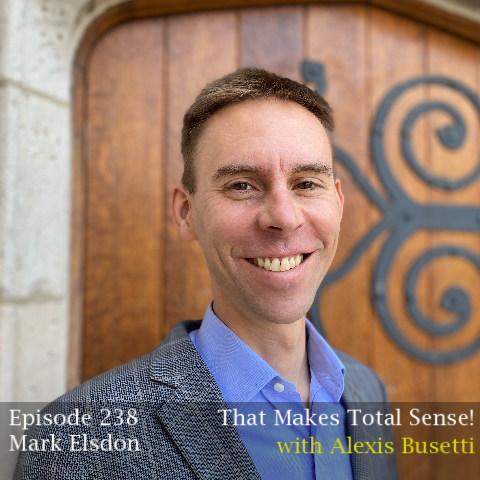
[00:00:07] Speaker A: Welcome to that makes total sense, a podcast dedicated to exploring God's generosity and justice. I'm Alexis Busetti, a Christian aiming to ask good questions and encouraging you to do the same.
Every one of us is wired by God to live out generosity and justice, but the how sometimes elusa that makes total sense is a way for us to get together, posture ourselves as learners, and challenge one another to practice generosity and justice in a tangible way every day.
Mark, I don't know if this is something that you have encountered, but when I have shared with a few folks as I was reading your book that we're going to talk about today, the topic of it, and it's almost like I have seen folks have a similar light as what I got. It's like one of those oh yeah moments when I name the topic. I had that a couple of years ago with a professor. I'll mention later when this topic was first introduced to me, and it's kind of one of those things that just, I feel like just flies under the radar. And then as soon as you say we're talking about churches and property and everyone's like, oh yeah, do you get that ever when you bring this up to folks like, I don't know, this is your cocktail party, you're waiting in line for coffee. Do you ever get that similar response?
[00:01:37] Speaker B: I do. I get it, yeah. From pretty much a lot of directions sometimes from church folk who think, oh yeah, this isn't just about our one church or the one church I've heard of, or my parents church or something like that. But this is about lots of churches. I've gotten it from friends that aren't church going and they think, oh yeah, I guess I vote at a church. So maybe I should think about what happens if that church is gone. And even one of the contributors, who's a professor of urban planning, talks about this a lot, about how when we first sat down to talk about this, he had this light bulb moment of, oh yeah, this is a lot of property that's going to change in the next couple of decades around the United States. We might want to think about that from an urban planning perspective. So yeah, that does happen.
[00:02:25] Speaker A: Yeah, it was actually his chapter that was kind of one of those where I was like, okay, I'm not the only one. I'm not the only one for whom this was brand new.
So the title of your book has a question mark gone for good, negotiating the coming wave of church property transition. And I am in about 1 minute going to give you the entire floor and I hope that you'll take it for the whole conversation. But I do just want to mention how this even came on to my radar. And I think it's because I'm in there. I grew up in Oklahoma, so very bible belt. There's a church on every corner type part of the country.
And not only is there a church on every corner, but a lot of the churches in these areas have been so long standing. I'm thinking of my upbringing in a smallish town, so not rural, but also not super urban. Like I live in Houston now, which is obviously very large city, but these spaces where maybe the pastor has been there for 30 years, maybe you're there because your parents were there, because their parents were there. My story is my parents met in their youth group, right? And I grew up and was baptized in that church. And it was just like the church was there forever.
I did think, as I was reading your book about my parents, the home church that I grew up in, that actually did have a move similar to what you talk about in the book, where two congregations combined. One of them was, they recognized their life cycle was ending.
They combined. And of course, this is a very simplified, this probably happened when I was in high school or something. So I'm looking back at this with a very simplified perspective. But it was kind of like, okay, this church got to keep the pastor. And then they all moved into this other church's building. And this is kind of how they negotiated it.
But fast forward to my years in seminary. And a couple of years ago, I had a professor who was just very, he was extremely perceptive and astute in some of these areas. And the idea that he introduced to the class was the idea of what he called hospice pastors for churches, that churches have a life cycle. Some of them will, there will be an end to some of these congregations, and that many times it's not to any fault of their own. Nor did he think they should necessarily be equipped, but pastors shouldn't necessarily be equipped to close their own churches, that these pastors needed pastors to come alongside of them and help them in the end of their life cycle. But he also brought up, what is the topic of your book, which is when those churches do close, what happens to their assets?
And this, of course, that's a very simplified way of saying, you and the contributors in this book talk about this from, I think, in a very holistic way.
It's not all about assets and money and property management, but I want to introduce that to say, I think it's something that it's definitely happening, but I think most of us, I feel like I am definitely unaware of how it's affecting not just me, but fabrics of communities.
It's affecting us kind of right under our noses, and I'm afraid that we don't realize it. So hopefully that'll be, like, the most I say for this conversation, because I want you to help us kind of walk through that. So first I will say this is how I was introduced to me.
What brought this project or this concept, this idea? What brought it on the radar for you and why this book and why now?
[00:06:44] Speaker B: Yeah. So I think a few different streams brought it on the radar for me. One is I've been a campus minister, executive director of a campus ministry at the University of Wisconsin in Madison for 20 years this year, actually. And there we redeveloped our parking lot into student housing. But it came in part out of a time when the campus ministry center was basically dormant, ministry wise, and the building was falling apart, the roof was leaking, it was really in rough shape. The denomination came very close to selling the entire property off, and that sparked a whole lot of question about what to do. This was before my wife and I were there as pastors. But then, as when we came in, this idea was resurrected that had been around for 80 years of building student housing on the property.
And so that was kind of my on the ground lived experience of this question around church property, and both an asset and a challenge. Right? So it's both.
And it can be, as one of the authors talks about in the book, an albatross or a great gift, and you're sort of in this interesting dynamic. So that is what led me to think about this on the ground. But then, actually, when I published my first book, we aren't broke, there's one chapter in that book about property. The rest of it's actually about investment assets. But the questions I got from people were so often about property, and I think it has something to do with that. Church folks, they live in those buildings as if it's their home. Right? And as you said at the beginning here, it was just a part of your life all the time. I think in many cases, that's the case. And even for those that don't really go to worship services, they still often kind of experience these buildings in their life. And so as soon as you start having questions about how are we going to maintain this building? And now we have these big expenses, we can't afford to fix it, and these buildings are aging or this building is mostly empty or we're closing, and we actually literally don't have anything to do with the building at all, then it becomes a very pressing, immediate question. And so honestly, it was kind of a response to people asking that question over and over again and then hearing it more and more and more. And that led me down the road of exploring how big is this issue, really, and starting to see, okay, there's going to be implications to the declining participation in christian churches in the United States beyond simply people's spiritual life, in their own personal spiritual life. But there's all this stuff around. There's all these structures and buildings and things that we created over really over sort of a century, you might say, that now has to be kind of unraveled or rethought or repurposed or something.
And it's a big issue now. Right. So if it's one or two churches in a city that close and then maybe a couple of others pop up, which is sort of the way it's been for a while, that's one thing. But now, as we've reached the point as of 2019 that more churches close every year than are started, we are in a period where we're going to start seeing five close or ten close and 20 close. I mean, obviously it depends on the size of the community, but I know of communities where I've heard of six out of eight churches are closed.
That's a high number. But even if it's 20% or 30%, it's starting to really have a ripple effect. So I think of kind of a city the size of my own in Madison. If it's 40 out of 100 churches that close, that's a lot of pockets of something changing all over the place.
And so that's what kind of drew me into this question, and it became a sort of pressing question. Well, it still is for me a pressing question because I think we have kind of one opportunity here. And by we, I mean a lot of we, the church people that care about the church, but also just municipalities, urban planners, anyone that cares about social fabric, have an opportunity to think about the reuse of these properties proactively or just sort of let it unfold randomly. And I'm not super confident that if it unfolds randomly, we're going to be really thrilled with the outcome 20 years from now.
[00:11:33] Speaker A: Yeah, I was kind of going back and thumbing through, and I went back to the forward that Willie James Jennings wrote. And one of the, I think it's definitely a theme throughout the contributions in this book. But he talks about us as believers offering witness. And I think when we think about the social fabric in these buildings or congregations moving, closing buildings closing, I think one of the questions that I start to ask is, how do we do this?
How do we witness well while these things are happening, because it's not a question of if it's happening. We know that church membership and church attendance is declining.
Many folks we've just seen anecdotally, but folks are starting to write about it now, how the pandemic just kind of like accelerated some of that that we had already seen.
And so here we sit at the beginning of 2024, and I think that you're right before it was exactly said, oh, this one closed, but then this one popped up, or this one was gone, and then maybe an immigrant church popped up in his place because the community around the building changed or things like that. And so I think those were things that we had grown accustomed to, maybe as churchgoers and even as community, just members of the community, you were kind of used to seeing those changes. But the changes that we're seeing now, I think, are bigger and the dynamic is bigger. The effect is bigger. And so part of what your book does is asking these questions, I think, of how do we do this? Well, how do we witness? Well, and one of places I'm hoping that you'll take us is asking when churches are doing this, are doing this, and really attempting to say what would it look like to faithfully change or close or whatever with these assets? They end up involving the community.
And there are stats in your book that talk about when folks are coming to these buildings, the very, very large percentages of folks who are not coming to worship.
[00:14:16] Speaker B: Right.
[00:14:16] Speaker A: They're coming to do lots of other things. And I also want to name this right now to say there are probably folks, though, within, I would say probably mostly evangelical spaces. Of course, my context is Bible Bell. I'm thinking maybe non denominational, these people who go to non denominational or something like that, who that actually might be unfamiliar. Some of those buildings sit empty all week and they open up for Sunday. They open up maybe for a Wednesday youth group or something like that, and that's it. Maybe they have a childcare or something.
But there are lots of other places and other kinds of congregations and buildings where you'd say, but this has been historically where AA meets or people come to vote, or this is where the scouts have their thing or whatever, or this is where the food pantry is.
But the numbers were striking to me sometimes what help me, 80 90% of folks who are coming.
[00:15:23] Speaker B: That's right. So partners from sacred places out of Philadelphia did a study. They've done a number of studies, and one of them is on the halo effect of congregations in a community. And one of the studies found, they studied, I think it was about 70 churches, and they found that only 9% of the visits that people made to those churches in the community were for worship.
91% were for something else, food pantry or voting or curl scouts or neighborhood association or aa or whatever it might be. Right. And that's pretty incredible actually, to think about that. There's a lot of stuff that goes on in churches that people don't really necessarily realize is going on, but it's critical, critical activity in a community, in addition to the spiritual life, of course, which is also important. But there's other things that happen and where are those things going to happen? And we're in a situation in our society where we already struggle a little bit with some of these spaces. Right. Libraries are really critical, but are sometimes struggling too.
In smaller rural communities, the post office gets closed or the school gets closed. So I mean, what's left, right? Like what's left? That's not a money making venture, that's not a business you have to pay to enter or not a home, a private resident. What's the third? Spaces. What are those spaces where things can happen, where community happens, where people live together and hang out together and serve each other, and where people who are lonely meet people and all of that. That's the stuff that is sort of slightly intangible, but really important. And I would actually argue what it in large part means to be the gathered community of Christ, frankly, is to live that out.
Worship is. I love worship, I'm a preacher.
But that's just one part of what it means to be a christian community.
A lot of it, when I read the Bible is people hanging out and eating together and doing things together and living life together. And that's what has happened in churches for a very long time. And as we have to wonder what's going to happen to them next. Some of them. That's a big question mark.
[00:17:42] Speaker A: Yeah. Can you walk us through some of the. I mean, it doesn't really matter where you go. I'm thinking of a lot of examples in my mind, but like pick a case study or pick an example of an organization maybe, who is kind of showing what this looks like to really take that to heart and how a church building is integral to the community when it's time to transition.
How have you seen that done?
[00:18:16] Speaker B: Well, yeah, there's a lot of great examples. I mean, there's a lot of examples of congregations doing affordable housing, for example, with their property, which is a really sort of clear way to engage in a need of a community.
I think also I should pause and say that you brought this up.
This isn't really just an issue about churches closing and needing to repurpose. That is a big issue, and that's going to be the estimates are perhaps 100,000 churches or buildings closing in the next decade. So a large number. But that's not really only the application of what we're exploring here. It's also, I think, I would argue, for any congregation to think about how it uses its space.
We have this wonderful asset of space, and sometimes the most thriving churches often have the most space. I mean, they might have a huge campus, frankly. Right. And is it being used in a way that's really blessing their community and really, again, sort of living out what it means to be a gathered christian community in their neighborhood? And so a lot of the times I feel like these questions are worth any church asking. And don't wait till you're about to close to ask them. Right. But let's ask them now. What do we have? What sort of resources do we have in our space is one of them, and how can we make good use of that?
Churches, they're doing coworking spaces and connecting with folks that would never attend a worship service.
My community at press house, we built student housing, and we have a sober living community.
We give away a million dollars of scholarships to residents in the last decade. We help students get food when they don't have enough to eat, which is actually an amazingly large number of college students.
After they pay to live and pay to go to school, they don't have enough to buy food.
But these are, by and large, students that would never attend a worship service, but they're really engaged with us. And interestingly, during the pandemic, nobody was attending worship, at least in our part of the country. Like in person, we had all of our residents living with us. So they were like, their shelter in place was in our building, and so we were really engaged with them. We had essentially 100% participation from our residents and the stuff that was going on in our building. And so we're able to go much deeper and wider with those connections. And then you ask about some other examples. There's so many interesting examples. There's a church in the Portland area that is actually experimenting with two different things.
This emerged out of their involvement in our rooted good, good Futures accelerator program, which helps churches think about this. One of them is they've actually led the effort to give a closed church property to a native american indigenous coalition of folks to build tiny homes for First nations women and children that are homeless. And so they have said, there is a closed church. There's this property here. We could sell it and monetize it, or we could actually take an active restoration here and return this land, essentially give this land to the folks who lived on this land a long, long time ago. And then they are able to then meet a really pressing need in their community around homelessness by putting tiny homes on this land. To me, that's just a beautiful way of being a steward of that resource. That same church is in their own building, creating a food entrepreneur support program. So they've actually taken their commercial kitchen and updated it, and they're bringing in food based entrepreneurs, and then they've taken a Sunday school wing, and that's going to be an arts based entrepreneurs program. And so they're just really getting engaged with the people in their community and who these people are people, again, who are not normally going to come to church, but who are suddenly now connected in this really vital way to this congregation. And they're coming and starting their little food business in the commercial kitchen. And it brings in a bit of revenue for the church, and it totally extends their mission out into the community in a way that they had never done before.
And so that's the same church doing both of those things.
And there's loads of examples like that. Every time I talk to somebody around this, somebody has a new idea. And it really is about thinking, oh, what could we do with this? And then you kind of end up with some beautiful ideas.
[00:23:05] Speaker A: Yeah, I think it's one of the things that struck me, and it might have been in one of the contributions surrounding zoning, I don't recall, but there were lots of examples. But just talking to the community and figuring out what they need. So one of the example that I'm thinking of right now is kind of like.
And I think this is where my head goes sometimes. It's kind of like, well, what could we do? And then we come up with some. I come up with some. We come up with some fantastic idea of what we could do. And there was one that was like, affordable senior housing. And they said, well, once they hired people to help them, they did a survey and realized there's actually an overabundance of affordable senior housing in their area. And so it was a great idea and it's wonderful, but it was plentiful already and not something that the community needed. And so kind of going back to square one, or you have examples where contributors talk about doing their own kind of surveys, meeting people for coffee, going to work tour, asking folks inside the community what they need. Can you talk about some of those things and how that, to me that's like one of those going back to Dr. Jennings, that's part of the witness that we want to cultivate, that we want to bear is how can we do this together? We have something, we all need something. How can we do this together?
[00:24:44] Speaker B: Yeah, totally. I mean, we're really good in the church about coming up with things that we think people need but they don't actually need or they don't actually want, right?
Yeah. I think one of the things that's interesting to me about the social enterprise sort of space, which is kind of a lot of the space that I work in here. And as a person with both an MDIB and an MBA, you have to have some sense of demand for what you're offering. Right. And a lot of times in the church we offer things that there's no demand for. And then we wonder why nobody's really interested in it. And again, this is not to say the church is just a business, but there is something to say for, like what is it that people actually are looking for, and can we connect with that? And also, what is it that people actually want to do or have gifts to do.
The way I think about it theologically is where's God already at work, as opposed to like, let's pull something out of thin air and just sort of offer. So, you know, one of the core principles of a lot of the work that I do with rooted good the organization that supports churches in this work is to think about how do we listen to the neighborhood and how do we listen to the people that we work with and want to work with and who we're engaged with and really listen for what it is that they're doing and they're interested in, and again, that they love or that they're afraid of or that they have gifts for or that they have need for or whatever it might be. I often encourage congregations that are thinking about this to have some conversations with just key people in the community, like the school principal of the school nearby or somebody in city government, the mayor or an alder person and just a citizen that lives nearby or a coach of a sports team or whatever it might be, and just ask them, what do you love about our community?
What do you feel like we're missing here? What do you feel like? If a church could do x, what would it be? If a church could do x, that would really change your experience or the peoples you work with experience here, what would that be? And who knows what you might come up with? It might be that they need five more soccer fields because there's just nowhere for kids to play soccer on the weekend. And how amazing would it be if they had that? And oh, while this church has three acres of land just sitting there doing nothing, how hard is it to paint a few soccer lines on the field and boom, there you are. You're connected and engaged, right? So you just never know what will emerge from those conversations. But starting there is critical, I think, to really doing this work. And then again, it leads into if there's an interest in social enterprise that involves sort of revenue and funding and money and so on, then there's some demand, some sense of demand, like actually people do want this, which is critical to making that work if you're going to sort of offer something. I have seen many instances where people, they grab hold of a model that they see and even something like affordable housing, oh, let's just do that. And it turns out that's really not the right location for it, or it's just not the right product for it, or their site is just not viable for it. And so it's a matter of listening again to what's possible, what could be done here, and connecting that with the passions of the congregation and its history, and trying to kind of connect all those things in a way that something new emerges that's really beautiful and powerful.
[00:28:23] Speaker A: Yeah, those were some of the things that struck me. You talk about in your intro and in your closing, making soup, making stone soup, but how even the things that you're talking about, even like with an MDIV and an MBA and saying, this isn't something that churches can go on solo, this isn't like a solo congregational mission or even a solo denominational mission, that if part of what we're really there to embody in these spaces, we need input from our neighbors and from, as you mentioned, these key community leaders. I'm also wondering, I feel like I'm kind of doing this backwards, but you have a couple of chapters in the book that were written by indigenous faith leaders.
I feel like I was chatting with a couple of folks at an event that I was at right before we started talking, and I'm like, I feel like those chapters, for me, it was kind of the wake up of, well, if you want to talk about property ownership, right.
Let's really go back and let's talk about it.
I probably almost should have started there in some respects, but we have all of these churches that own all of this property, and then we kind of think as we lined out that we know what should be done with it and all of this.
But what about the encouragement and the responsibility to look backwards at that property where it came from in the first place, these things that our indigenous friends are helping to make us aware of?
[00:30:18] Speaker B: Yeah, I mean, those are the challenging chapters. And I do tell people that I would actually not have or at least been very reticent to publish this book had I not had those chapters in there. It was really important for me to have that reflection in there. And I think it's because we do have this idea, and I'm in the same camp, this sort of idea, this western american idea that we own all this stuff. And now we're going to get a little deeper theologically here. Right? Because this happens with money, too, this idea that we own it, that somehow it's ours. And I struggle biblically with that concept because as I read the Bible, I get much more of a sense of us as stewards, as having use of these gifts for a time, but none of it's really truly owned by us. It's all gods. And we're kind of in this position of stewarding it. And I think we could argue that we've stewarded pretty poorly a lot of the land in the United States, and certainly the way native peoples were treated in the taking of that land is pretty awful. It's sinful, it's abhorrent, frankly. And so if we're going to then talk about how do we repurpose land that wasn't ours to begin with and maybe isn't really ours ever, even though we have some sort of deed that's legally filed with the state or the city or whatever, then what does that mean? I mean, it's a question that at least needs to be asked. And are there simple answers? Absolutely not. But it's a question that I think needs to be asked. And sometimes I will ask it with a congregation that says, well, we just don't know what to do with this built property, or we think we need to get. We sell it. This is the end of our road as a congregation. And I sometimes say, well, have you thought about just giving the land away and perhaps to native peoples that are still in the area to use in some way, and that sometimes this never occurred to people, but it can be a powerful, freeing thing to consider and at least to think about if we're going to somehow monetize it, sell it, build on it, and make it worth a lot more money than it was before.
Now we're then sort of making money off of, again, land that was taken at some point in the past. And reflecting on that and just being aware of that is really, I think, important.
It's not easy, though. It raises all sorts of questions, and there's some competing issues of justice around that with different populations that have struggled in the United States. And so there's a lot to think about there. But I guess what I would say is we should think about it, not just proceed blithely on selling things and monetizing things and assuming that it was ours since the beginning of time, which, of course, is not the case.
I think those chapters are quite a challenge, but they're worth a read.
[00:33:32] Speaker A: They are. No, they are quite the challenge and worth reading. I didn't flip back through, I'm going to say a cartoon. I don't know, you have a drawing at the beginning of each chapter, and I think I may be mistaken, but I feel like I remember in one of those chapters, there's someone kind of giving a land acknowledgment, and then there's this. What does this even mean?
That was kind of the vibe I picked up from that, and I think that is something we've kind of grown accustomed to hearing and maybe even saying some of those things or in email signatures or things like that.
But this author is saying, this is a nod, but we're not actually diving into what does this actually mean, in my words, I might say, and land acknowledgment isn't really an acknowledgment in a lot of cases.
Yeah. So thank you for that and thank you for that inclusion. I think that it's really easy for my imagination to move forward and just to kind of those things. Oh, affordable housing or as you or soccer field, that's an easy one, or whatever, without really thinking about the history attached to the land, how it became deeded to religious institutions in the first place, how that's been passed down generationally and those kinds of things.
Anyway. Yeah. Really important.
Can you talk a bit about who are some of the people in the communities when churches are beginning to ask these questions.
Who needs to be sitting around those tables?
I mentioned earlier with my pastor kind of just bringing an awareness to me that sometimes it's like they can't do this all on their own.
And not just with closing, but like you're saying, even if it's not closing, even if just asking the questions, how are we using this space?
I'm thinking about that kind of going. I pitched an idea to my husband a couple of years ago that he did not buy, which was, what if we switched the den in the dining room?
The den is much bigger. We could get a bigger table. We could do this. All we do in the den anyway, is read. What if we just. We just move the chairs? It's fine. He did not buy it. It's fine. Our den is still our den. Our dining room is still our dining room.
But it makes me think, because that's the way it's always been in our house, been our house almost a decade. That's the way it's always been. Why would we change? And he's not averse to change or anything, but it's just kind of like when you look at it every day, congregants, pastors, whatever, you just see it a certain way every day. And it can become difficult, I think, to have an imagination, either theologically or pragmatically, for what could be. So who are some of the folks who could be at those tables asking questions that might lead to a broader imagination for what could be? Whether you're staying there or whether you're closing or whatever the case is, just how are we using the space?
[00:37:01] Speaker B: Yeah, that's a great question.
I think of this a little bit in sort of terms of parallel track. So I think there's kind of an internal discernment that a congregation is going through. If there is a congregation or a remnant left. Right. And again, it's very super variable. This might be something that a very vibrant, growing congregation is doing, or it could be something that three people left are doing and trying to decide what the legacy of that property is going to be. In either case, there's sort of this internal discernment going on, prayerful reflection, and sort of this process of thinking about who we have been and who we want to be and where we're going. And then ideally, listening to the neighborhood and so on. And there's this sort of parallel process going on around what's possible here, too. And that's where there's conversations with city planning departments and zoning and real estate people and all the parts of what is possible here? And at some point, those parallel tracks will then merge and ideally merge into something that's possible to actually implement. Right. But both have to happen. And it's a little bit of like, they kind of have to kind of go back and forth, and there's sort of this iterative thing of like, okay, we're going to think on this sort of from our own perspective, and then we're going to go out and we're going to engage with people and see one of the churches that did our accelerator program in our pilot, they did this whole process, and then they started conversations with their city. And it turns out that their city was desperately looking for sites to build affordable housing. And it's a bit of a long story, but ultimately the city was basically being forced by the state, this is in California to find sites to build affordable housing because the city had shirked that responsibility for decades, which is not uncommon, and was now kind of over a barrel to have to figure out how to build some affordable housing. And there's nowhere to do it where they're located. And so they're like, well, church sites could be great. And at the very same time, this church with kind of a remnant of people was saying, well, what do we want the legacy to be here for this property? And that was this incredible moment where they started to converge. And after having heard this from the city and then having done their own discernment, and now they're moving forward with a big affordable housing project that they're hoping to see happen in that location. And so this parallel track thing, I think is really helpful. The other thing that I will say about that is that I love how church folks are so self reliant in many ways and like to take things on, at least where I'm at. They shovel snow on Sunday for people to come in. The members do this right? They cut the grass, they put the communion elements out, all of that, right. That's kind of a lot of what churches do. Obviously, some kind of professionalize that more than others, but that's part of sort of the nature of what it means to be a church, which is amazing and wonderful. But sometimes that mentality or habit gets a little bit in the way of this sort of work because this kind of work, social enterprise work or development or some of these more, I don't know, different ways of doing this stuff with property are going to require partnerships and engagement with different players.
That's really different. Like, you're not going to be signing leases for people living in an affordable housing building. Like, the members are not going to be doing that right. Or like, fixing the garbage disposal in 50 apartments in a building that you've put, that's not going to happen. You're going to be contracting with a property management company that is professionally and knows how to do that work and partnering with them, or partnering with a developer or partnering even with something as simple as, like the soccer field idea, partnering with the local soccer club to run that. You don't have to run it all yourself. You don't have to paint the lines yourself. Even so, there's a sense of, like, we can do a whole lot more if we recognize that these partnerships are really viable and valuable and effective. And there is a way in which the pressures of decline for the american church can lead to that. Because I think we are coming out of an era that was sort of, frankly, an abnormal era in the 1950s where the church was quite powerful in many ways and quite resourced and was able to build all these enormous denominational structures and all these layers and all these different things internally that required nobody's help, basically. Right.
And we're not there anymore in many places. And so we have to actually turn to partners. We have to reach out to other people that know how to do these other things. And that's kind of great. I think. I think we probably could have benefited from that all along, but we're not in a position to do it ourselves anymore. And so let's not try.
Let's embrace that. And it's a great way to really reengage with the wider community and not just be sort of siloed, doing our own thing self sufficiently, just taking care of it all on our own.
[00:42:30] Speaker A: Yeah, you brought up something that wasn't actually in my notes to ask you about, but I noticed it in a lot of the essays.
And I would say it kind of came as a bit of a surprise to me. But there were lots of authors who mentioned in some way, shape or form this, I don't know, kind of like almost trying to be concise, almost like misconception or something, but they would kind of butt up against this, like, oh, but what about separation of church and state kind of thing? Because you're talking about these partnerships and it's like, yes, you're going to need maybe a broker, or you're going to need the clubs, or you're going to need these things to be professionalized in some other ways as you move out, but there's also zoning. And lots of the essays also talked about does this align with the mission? Because the church is a not for profit, and so some of these things have to be taken into account because some of the folks who are listening are probably were thinking along those lines.
But how do we do this with the government or how do we do this as a partnership there? So I don't know. Could you talk about maybe some of the maybe misconceptions or something that some of the partners have come along and maybe found as hesitations from church folks? And then what does that actually look like in practice?
[00:44:11] Speaker B: Yeah, I mean, what it actually looks like is super variable. So kind of starting there and then going backwards with your question, but it's very variable. And I've seen almost any way you can envision this playing out. It can play out, and so structurally, legally, financially, in all those different ways. So there isn't a way that it works. But I guess the bottom line message that I would say and have seen is that we're more afraid of some of that than we need to be.
Yeah. There are issues depending on exactly what we're talking about with separation of church and state. What is possible, what is not possible, we've run into in our campus ministry, sometimes blocks with the university, for example, that the state university can't do certain partnerships with us because of that concern. Right. As a religious organization. But there's many others that they can do with us and many other relationships that can be built, and generally they're quite amenable to that if they can and if it is not discordant with their values and what they're trying to accomplish and the law. Right. And so I think a lot of it's figuring out what's possible, what's not possible. I know a lot of times people have questions about taxation and tax exempt status and all that.
There's a lot to learn about that. But again, none of it's a huge barrier if it's handled correctly. A lot of churches are starting auxiliary nonprofit organizations is one way that that's happening. Right. So they might own it, actually, or they might spin it off separately, but nonprofits can be incorporated with a much wider mission mandate than a worshipping church can. And that's a way for them to kind of move out and expand their mission in a way that's legally sound and that's kind of ethically sound, but that's still connected to the church in some way. But that isn't also the church way overstepping into things that it really shouldn't be in, in that way. And so that's one solution that often works. I always encourage people to again, partner and find help from legal help and cpas and so on to get some of that stuff worked out. But rarely have I seen it prevent things from happening other than in our own minds or in our own sense of like, well, that's a little bit too complicated, so let's not do it. Well, maybe, but actually probably it's doable. It's just a matter of kind of working through. And some of the chapters do invite municipalities and governments to be open to it. And that was one of the goals I have for the book, frankly, is this is not just a message to churches, but it's also a message on the other side.
Again, if you're going to have 40 out of 100 properties over the next 1015 years being available, closed, empty, whatnot, we need to think about what that's going to mean. Right. And can we set up some things, some incentives and some processes at a city level or at a municipal level that actually encourage new good things to emerge on those properties? Because otherwise we're going to pay the price, so to speak. We the whole community, the whole city, not just the church.
And sometimes I have found that government folks are more afraid than they need to be as well, actually, about this. They don't really want to touch churches because it's too much of a hot potato. But there really often isn't a reason for that. That's actually sort of valid, again, as long as both parties are doing it in good faith and actually have some sort of joint interests at heart where they can see something forward for the community.
[00:48:08] Speaker A: I've got one last place that I want to ask you to go, and then I'm going to ask you to kind of close this out however you want after that. But we kind of barely touched on it earlier and we've chatted a lot in this space that I'm more familiar with at this point, which is just urban settings we're talking about.
Affordable housing is like units and units of space or very large spaces where churches either have gathered or continue to gather, or 40 of 100 congregations that may be looking at this in the future. But what about more rural spaces? I think this is something, like I said, I grew up in a small town with rural areas around and I wasn't terribly familiar and didn't live in those, but I had family who did, friends who did. And it may be, as you said, there may be in Oklahoma, it's probably more than one. There may be just a handful of churches. But those churches wear a lot of hats in the communities. And in those communities, I think congregations are aging, they're shrinking. One of the things that one of your contributors mentioned is sometimes they don't have full time clergy. Maybe they are kind of being self sustained and self sufficient, as you mentioned, they're kind of doing everything.
But there comes a point, and there is coming more and more, as you talked about, where it's not sustainable anymore.
So what are you seeing in rural communities where the churches kind of, I don't know, they're kind of glue for a lot of these communities.
[00:50:04] Speaker B: Yeah.
It's both a big challenge and kind of an opportunity. Right. So it is, I think, worth just noting, being realistic that rural church settings are different with regard to some of this stuff. The possibilities for redeveloping property is very different. Right. Simply the monetary value of it is different.
Rural communities, like we talked about, are experiencing the closure of all kinds of things, post offices and schools and libraries and so on, in addition to churches. So churches are kind of caught up in a social change that's going on way beyond just them in those communities. And I think just being realistic about that, we can't replicate necessarily something that works in an urban setting, in a rural setting. But that said, you're absolutely right that in many ways, in rural communities, churches are even more central to the life of a community. And there might only be a couple of them. I mean, in parts of Wisconsin, there's basically a church and a bar on every corner of a small community. And there might be four corners. That's it. Right. But there's probably could be a church and a bar on all four of them.
Some version of that. Right.
[00:51:16] Speaker A: Speaking of repurposing, I think when I was in California, I was at a bar that used to be a church.
[00:51:21] Speaker B: Sure. You just merged the two. Right?
[00:51:23] Speaker A: And even the. Yeah, yeah, it was.
[00:51:25] Speaker B: Yeah. No, exactly. Why not? Maybe that's a good brewery church.
Know? I don't. Yeah. But there are some interesting things being explored in rural settings. Like for example, in the chapter that Jenny writes in the book about this, she's in Texas actually, that healthcare systems are a great potential partner in a rural setting. Right. So healthcare systems are looking to provide health care all over the place and in rural communities. And often they don't have the need the funding to build a full time clinic, perhaps, for example, because there's not that many people to serve, but they do want to come in, say, twice a week for a morning, twice a week to provide a nurse practitioner or something like that, to provide some wellness care. Well, a church is a great place to do that sort of a thing, right?
A church could actually take a part of its space and make it essentially like a permanent but part time health clinic. And then maybe a farmers market pops up on the same day when people are coming into town from around the area or coming into the church from around the area for health care. And then they meet up with their friends and neighbors, and there's a small farmers market, and then, I don't know, maybe on a Friday night, there's a food truck that shows up for somebody to.
It can actually kind of be both a new thing and an old thing, right? So it's a new versions of this, but it's really still tapping into the legacy and the tradition of churches being an anchor presence in a community. Now, what might be different is that it isn't all tied around, like a Sunday worship service, which is what people in the 1950s might have done at that church, and some of them probably still will, but it might be that that is not the case anymore, but instead, it's these other forms of engagement with the community that that church can fulfill, and it's still a central place for people to be having life together. Right.
And to me, that's really cool. I think there's a lot of potential there for that to happen. I'm really interested, actually, to see, over time, what will emerge from some of these experiments and projects in all of the settings, but in some ways, in particular in the rural setting, because I think they'll be, frankly, even more creative because they'll have to be. They won't be just putting up affordable housing. It'll be something different. Yeah.
[00:54:04] Speaker A: Well, in that chapter, if I'm not mistaken, that was kind of one of those oh, wow. Moments for me.
So there's a large catholic parish that's within walking distance of my house, and they have a farmers market there every other Thursday or every Thursday, something like this. And it's great. We love it, but we don't live in a food desert. And so for us, it's a fun outing the kids. We get to go and we get honey sticks, and we'll buy the veggies for that night. Or if we don't feel like cooking, there's always someone there selling tamales or something like this, because we're in Houston and it's wonderful and fun, but I didn't even think about. And you're talking about going back to what does the community need. It didn't even ever occur to me that a rural community might in some ways be a food desert, especially for those fresh foods, because the foods that might be being farmed are going outside of the community, right? And so that a farmers market, me with kind of my urban mindset and all this, like, oh, this is so fun. And it's like, yes, farmers markets are totally fun and this could really meet a need in the community for fresh fruits and veggies, for to have something there that would service the whole community in a way that was really meaningful and needed for them inside of that community. And then health care, another thing, just embarrassed to say, just don't even think about it because I haven't lived in a rural setting. But how dire that is. I think about if I have to set up, if I have to take my kid to the doctor, if I just put urgent care in on Google, right? Well, I can go to twelve within a couple of miles of my house, or I get on the app and set up a pediatrician appointment for any day I want. But to have that availability and for a church to be able to partner, as you're saying, with someone else who's become and also recognizes the need but has the resources to meet that need is huge. And so I was really grateful for those chapters as well. Mark, I'm going to ask you to kind of close this out. Something that I've done sometimes is, what's the question? I didn't ask?
What do you kind of wish that we would have touched on that you would want to leave people with that might, whatever it is that a whole. That you think that we didn't talk about this that might get people's minds moving in that direction.
[00:56:47] Speaker B: Yeah, I think you asked a lot of good questions. I don't think anything glaringly missing.
I guess what I would say sort of in closing is I think I'd like to leave with a message of hopefulness. And there's a great deal of lament and sadness in church circles in particular, not in some other circles. Some people are really celebrating churches closing, if we're honest, in parts of the country.
But there is a great deal of sadness, and that is true. And I think there is sadness and mourning to be had. Right. Especially if we are connected to a church that's closing or is going to close, which more and more we will be. That's just the way it's going to be.
But I think what I really want to emphasize in this moment is the opportunity before us and the hopefulness that's potentially there, right?
That there is a chance to continue to be the church. The church is not going away. God is not going away. God is not declining.
God is not abandoning us.
And honestly, even if 10% of America goes to worship on Sunday, God is still present with us, in my view. But what we do have is this opportunity to let the church expression be different and to sort of be free of that, a little bit of it being defined in one particular way.
And I guess I just want to hold on to that. And I want to listen for stories of that popping up all over the place, because I'm convinced they will in the coming years.
And that excites me.
[00:58:37] Speaker A: Yeah, thank you so much.
So again, the book is a question. I was hoping.
This book has raised a lot of questions for me. I hope it has for folks listening, too. But the book is gone for good. Negotiating the coming wave of church property transition edited by Mark Elsden forward by Willie James Jennings tons of wonderful contributing essays here.
I'm so grateful for your work in this space, Mark, and for sharing it with us through this book.
[00:59:10] Speaker B: Thank you. It's been a pleasure.
[00:59:13] Speaker A: The links for all the resources mentioned in today's episode can be found in the show notes, music and podcast production by Seth Busetti. Be sure to give us a review on iTunes and subscribe at your favorite podcast listening app. You can also visit
[email protected].