[00:00:07] Speaker A: Welcome to that makes total sense, a podcast dedicated to exploring God's generosity and justice. I'm Alexis Busetti, a Christian aiming to ask good questions and encouraging you to do the same.
Every one of us is wired by God to live out generosity and justice. But that the how, sometimes elusive, that makes total sense is a way for us to get together, posture ourselves as learners, and challenge one another to practice generosity and justice in a tangible way every day.
Okay, my guest for this episode is really. I mean, you're probably bored. I'm guessing it's 2024. It's an election year. You have nothing to do but just kind of twiddle your thumbs because you've been in this political space for a minute. So I'm sure this is, like, just a real easy year, right? You're coasting.
[00:01:07] Speaker B: Yeah, basically just waiting for your email for this conversation.
And then the rest of my calendar is clear?
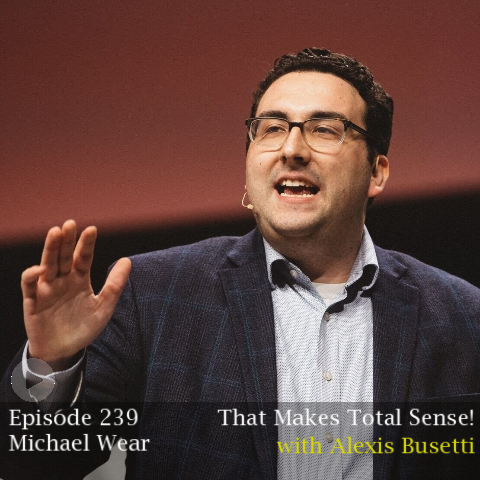
[00:01:16] Speaker A: Yeah, the rest of your calendar is clear. This is Michael Ware. The rest of his calendar is not clear, people. It's 2024. And for those of you who may or may not be familiar with Michael's work, Michael, I'm going to ask you in a minute, maybe not to do, like, a full out keynote, grand, huge introduction, but I do think it's important for people to know a little bit about your work, your resume, kind of where you're coming from. But today we're going to talk about your book, the spirit of our politics, spiritual formation, and the renovation of public life.
And just with the title and the subtitle, you have already done a doozy for some folks because we don't read politics and spiritual formation together as often as I think we probably both would argue that we should.
But you've done a really good job of weaving those together. So I want to do a small introduction to our conversation, and then I want to hand it over to you.
I've been following your work for a while. I think maybe the first time I heard you interviewed was on. Now I'm going to have to find this episode so I can post it with these show notes. It was probably on act podcast. I don't remember which one. I think you did one with Justin. Does that sound familiar? Like, maybe in 2019, 2020, potentially? Yeah, somewhere in that range, I feel like. And I was like, oh, my goodness, these guys know what they're talking about. This is not the norm political conversation that I am accustomed to in my faith settings. Yeah, I'll say that. In my faith settings, these were conversations that were deep and wide and really incredibly thoughtful. And so I just want to start off by saying thank you for that and thank you for your work. As I read this book, it was really obvious that it came out of your experiences, that you've seen some stuff and you've experienced some stuff in your years. And so I want to hand it to you now and just ask if you can share just a little bit, maybe the points that may be most relevant to this conversation, to this book, a little bit of your resume. What kind of work have you done? What kind of things have you seen, and what is your background in the seminary life? We would say, what's your social location? Michael, where are you coming at us from?
[00:03:53] Speaker B: Sure. So I'll try and be quick. The highlights I'm born, raised in Buffalo, New York. My wife's from Buffalo. Became a Christian when I was 15. After reading romans, I thought I should go to seminary, become a pastor. Just wanted to do, like, the most christian thing I could think of. And thankfully, there was a pastor in my life who know Michael, there are christians who aren't pastors. And I thought, that's a good observation. And so this vocational question of what does it mean to be faithful in and with public things? Has been central to my life from before I became an adult. That led me to Washington, DC, ended up bumping into a young United States senator named Barack Obama. And ten months later, I was working for him as an intern, first on his first presidential campaign and then working in the White House for three and a half years, running religious outreach for his reelection campaign, running religious affairs for his second inaugural. And then I spent the next ten years about as a consultant, helping christian organizations and leaders navigate public life and helping mainstream organizations partner with the faith community. That included significant work with the Anne campaign and Justin Gibbony, who's a dear friend and I love Anne.
Around 2021.
Well, so I had looked in 2016, 2017 towards starting an organization, and for a number of reasons, decided it wasn't time, it wasn't viable.
I revisited that in 2021 and thought enough had changed. And so we incorporated that organization in 2021. We publicly launched in 2022, and I now serve as founder, president, and CEO of the center for Christianity and Public Life, which is a national nonprofit, nonpartisan, with the mission to contend for the credibility of christian resources in public life for the public good. And so folks can learn more about that organization by visiting ccpubliclife.org. Happy to talk about it more, but this new book is, in many ways, you don't have to know or be interested in the organization to read the book. But the book is very much sort of the intellectual, theological explanation for the work that we're trying to embody with the center for Christianity and Public Life. I think just one thing I'd add, which is just going to be relevant, we're going to have to talk about at some point, which is my first meeting when I started at the White House was with Gary Haugen of International Justice Mission. And following my meeting with Gary, he sent to my offices a book called the Divine Conspiracy by Dallas Willard. And that book changed my life. And the spirit of our politics is very much an application of Dallas Willard's ideas and thoughts to politics and public life. And happy to talk, always happy to talk more about Dallas Willard as well. But I think those are the main sort of markers that will be helpful for this conversation.
[00:07:39] Speaker A: Yeah, thanks for that, Michael. I am excited to talk about Dallas Willard. I am going to do one tiny plug for don't know, I don't know mean goodness, I wish I did. But maybe, you know how you mentioned him bringing that book to you was just like life changing. And I would say for me, one of those moments was the locust mean that that book, it just tore me up one side and down. The reading, reading the Locust effect by Gary Hagen was one of those places where it was really formative, I guess, saying kind of, how do I think well, about things like this? How do I try and become an informed citizen, even if it's not something on a more leadership kind of role? But yeah. So that was one of those moments for me, too, was reading Gary's book. And of course, I love Dallas Fullard. We love Dallas. And I can't wait to talk about that in the context of this book.
One of the things that I appreciate about this book and the conversations that I think it will spark and what you're doing at center for Christianity and Public, I keep thinking about this, and as you're talking, I'm just like, michael, we're just so bad at thing. It's a good thing that we have folks to help guide us in ways, organizations and books and things that can help us. Because I know that's being really harsh on us as Christians, but I'm like, as christians, we're just not great. We're not super great at this. And part of what this book did for me, so I'll just name what it did for me. Part of what it did for me was it helped me name some things. And for me, as I'm processing. It's helpful to have a name.
So it's almost like this. It's almost like I was diagnosed, like, five years ago with an autoimmune disease. Well, I'd been having. People with autoimmunity know that sometimes it takes a long time to get diagnosed, several years, usually. And so I have all these symptoms, and I'm miserable, and I don't know what's going on. And finally, someone suggests the right test.
Then we see, oh, my goodness. Now all of a sudden, it has a name. In this case, it's a diagnosis, but it has a name. And then I go, okay, now that I can name it, I can kind of wrap my head around what I've been experiencing, and that's really helpful for me to process, in part because I don't feel crazy.
I don't feel like, oh, my goodness, what is this? It must just be me. It's like, no, you actually have a condition, and this is what it is. And so part of what your book did for me, and this was kind of an overarching way that I experienced your text, is that you gave names to things that I'm experiencing as a Christian, trying to live in a way that I think is helpful, faithful, whatever. And then the things that maybe I'm feeling, the things that I'm seeing around me, I'm kind of going, it feels chaotic in a lot of ways. And you named some of these things for me. So for context, that will be part of what I'm planning to ask you to delve into today was I'm seeing terms and I'm seeing definitions and I'm seeing these things, and I'm like, yes, that thing.
Help me with that. Right? Because maybe I see this on Facebook or maybe I see whatever. I'm like, no, but this is what Michael calls XYZ. And then I can kind of wrap my mind around it. So that's what I got.
What I want to ask you before we get into some of those specifics is with your experience that you just shared with us.
And I understand the connection to the organization. But even as you said, folks who don't have a connection to the organization, who are reading this, what is your hope for the average citizen reader when we pick up the spirit of our politics?
[00:12:07] Speaker B: Yeah, I think the hope is that people will be invited into interactive relationship with Jesus, that this will be an aid and an encouragement towards whole life discipleship.
And I think that for many, politics is this area of life which seems cordoned off from God.
This area of life in which the way of Jesus is unthinkable.
And that has tremendous implications and consequences for the health of our public life and our politics. And I talk about that quite a bit in the book, but the core concern are the implications and consequences of that for our formation, for the kind of people we are, the kind of people we're becoming.
Whole life discipleship is made incoherent if there are areas of our life in which we don't think Jesus is up to the task. And insofar that politics is one of those areas of life. And I think it's pretty evident that it is for many people.
Again, that's not just a political problem. It's actually a barrier towards putting your faith and trust in Jesus. And that is my principal.
So that's the aim of this book. Can we reposition politics not as above the gospel or outside and irrelevant to the gospel, which I think are two primary modes in which. In which it's been placed. But can we place politics as within and under our conception of the gospel, our conception of the kingdom of the heavens?
That is the chief aim for this book.
[00:14:21] Speaker A: Okay, so all my notes just went out the window, because I want to hang there for a second, because. No, I'm glad that you brought that up first.
And I like the framing that you just used. And I think you use a similar phrase in the book, which is sometimes we think Jesus isn't up to the.
So we separate it, we compartmentalize, recording off, and so we will get to spiritual formation.
First, I would like for you to tell us some observations, because I think, because it's compartmentalized, maybe it's not so readily available for us to admit how our politics are forming us.
[00:15:08] Speaker B: Yeah, sure.
[00:15:10] Speaker A: So in your observation, how are our politics forming us as christians now? We're not a monolith, obviously, there's lots of different ways, but what are maybe some of the common ways, some of the most impactful ways, some of the really significant ways that you see politics forming us as believers.
[00:15:30] Speaker B: Yeah. So there's quite a bit in the book, but maybe the easiest way to talk about it is this through line in the book of political sectarianism.
[00:15:43] Speaker A: Okay, I'm not throwing up my notes. That was my next thing. Okay, so, good, we're here.
[00:15:47] Speaker B: Yeah. So political sectarianism is this framework for thinking about polarization, advanced by 15 social scientists who all work on the issue of polarization from different perspectives and different disciplines, and they advanced this framework in 2020. And they said political sectarianism is a toxic cocktail made up of three primary ingredients, the tendency of aversion. So the tendency to dislike and distrust the political opposition, those who are politically different, othering, the tendency to other, those who are politically different, and then the tendency of what I call misplaced moralization, which is to raise political difference to the level of iniquity or sin or good versus evil. Now, it's very important.
These are not a whole bunch of pastors or, I don't know, like Enneagram special. This is not like a therapeutic sort of. These are social scientists who are studying the nuts and bolts of our politics, saying, these are the ingredients.
This is what the logic of our politics is running on.
And it's aversion, othering and a misplaced moralization.
The christian faith offers tremendous resources for undermining these three pillars, but it's also the fact that aversion, othering and a misplaced moralization are not just what our politics is promoting, but what we are promoting to our politics. We could talk much more about this, but I think there's a whole lot going on. I talk in the book a great deal about anger, and I think we have too much esteem for what we think anger can do. I actually was just on the hill talking to 100 plus congressional staffers, trying to make a case that they should reject anger in our politics.
[00:18:15] Speaker A: How'd that go?
[00:18:16] Speaker B: I thought I should just take the case right to the most difficult audience I could.
And I say that actually half mostly in jest, because, like, this is, it is a form of spiritual harm, and it's spiritual harm that is, again, not just something our politics is promoting, but these folks working in our politics feel like anger. And the performance of anger is what's being demanded of them by citizens. And so, yeah, I mean, this is the whole book, right? So we could talk, but I think that's enough fodder to sort of help people understand the kinds of things we're talking about. Aversion, othering, a misplaced moralization, an over reliance on anger and over esteem for anger and fear, and what those things can do and motivate in our politics.
[00:19:20] Speaker A: Yeah, okay. So you'd looked at my notes, which is totally fine, but I'm grateful that some of the things that stood out to me when I was reading are some of the things that you're pointing out. Now, I do want to talk more about anger, and I do want to talk more about fear. I would, however, like to go back to what you said about our faith having resources for undermining those three things, those three pillars of political sectarianism. So I'd like maybe talk about that a little bit more, but also the inverse, which you just kind of barely touched on in that. And I think this is one of those places where, as I mentioned earlier, naming those things, that's exactly what I'm seeing. I couldn't put my finger on it. I didn't know what this was called. I didn't know about the study. Right. But when I read it, I'm like, oh, yeah, duh. This is exactly what I'm seeing. And then I think what felt very disheartening is how much we're seeing that among christians as well. Even though our faith offers resources to undermine those, we really see this among christians in the political sphere. So two part question.
One thing I am curious is when you said that our faith has resources to undermine that, but that's not what we see. So tell me, what do we actually see? So that's part, like, what do we actually see happening? And then maybe the know, not that it's a fix, but you hear, what, what, how do we see that? And then what is Jesus actually.
[00:21:25] Speaker B: Yeah.
[00:21:26] Speaker A: How is Jesus up for the task?
[00:21:28] Speaker B: Great. Yeah. So I'll jump in.
So I think the first thing here is, and I know in this book, I try to be really clear about when I'm talking about evangelicals and when I'm talking about specific strains of the church and not using Christian as a euphemism for evangelicals.
[00:21:56] Speaker A: Yes, that's good.
[00:21:58] Speaker B: And I actually think we can come to appreciate what Christianity has to offer in our politics if we just step back a bit from the current conversation about evangelicals and Trump.
I am growing increasingly concerned, I don't know if I should, I am growing increasingly concerned that much of renewed political interest among evangelicals, particularly young evangelicals, is in reaction to and not for anything. It's actually interestingly like the model of approaching politics is reactionary in a way that is not all that dissimilar from the kind of politics that young evangelicals are reacting against.
[00:23:07] Speaker A: Right.
[00:23:10] Speaker B: And so I do want to say that. And I also want to say we need to be careful about even painting evangelicalism with too broad of a brush, certainly when it comes to general outlook and engagement. So you want to look at something like welcoming the stranger or immigration policy. Yeah. If you poll certain questions about border security or whatever. Now, some people who have more views that are more, to use a shorthand, sort of pro immigrant or whatever, may disagree with some of the policy preferences of evangelicals.
But even sometimes the most conservative evangelical communities, while they may have policy views, public policy views that some find objectionable, and that I sometimes find objectionable, sometimes it's in those very communities that you actually find the work being done to actually welcome immigrants.
We just need to be very careful about reacting to some modern flashpoints in a way that lead us to judge, to condemn in two categorical a manner.
One of the things that we see is what I call in the book political therapeutic deism.
And this is, of course, harkening on the term moral therapeutic deism.
And what's interesting about this is just like moral therapeutic theism. Political therapeutic theism sometimes, but not essentially, draws on christian language and sort of terms, but actually strips them of deep theological meaning. Political therapeutic deism is about a God who exists to provide supplemental support to one's politics.
And so the beliefs associated with political therapeutic deism, and again, this is a term that I developed and described in this book, but some of the ideas associated with political therapeutic deism are ideas. And let me know if any of these might sound familiar to you. There are beliefs like God is on my political party side.
There are beliefs like my actions in politics are justified in light of God's general approval of my politics. Or it is clear and obvious which political issues are most important to God.
Now, this gets tricky, right? Because these are views, again, just like moral therapeutic theism. These are views that you can find in churches. They're views that sometimes are like very core to how christian families are, how christian families are organized and the kinds of things.
And yet again, just like moral therapeutic deism.
One of the reasons I like this term political therapeutic deism is that it gives us a way, as you said, to name something without ceding the term christian to it.
So, for instance, we have a lot of people who insist on calling a group christian nationalists, when one of the hallmarks of what people are referring to as christian nationalism is an explicit rejection of loving your enemies.
Well, if embedded in a movement is an explicit, explicit, like, these folks will stand on a stage and say, look, I know Jesus has this love your enemies thing, but that doesn't work in the real world. And so if you try it, you're going to get steamrolled. So whatever you do in your personal life, I guess if you want to try that love your enemy stuff, I don't get it in your personal life, but you're free. But in politics, let me take care of you. Don't try that love your enemy stuff. I'm really hesitant to say that. That's christian nationalism.
So that's what I'll say on what we're seeing. There's a lot more to be said, and I don't mean to.
Yeah, there's a lot more to be said there, but that's what I'll say there.
What the book offers, and again, sort of a through line of the book.
Dallas Willard had a framework for how he thought formation happened in any case. So not just christian formation, but how he thought formation happened is through a model he called Vim, vision, intention memes.
And that is how I write this book, and it's how I argue.
I don't think he ever said this publicly, but I actually think it's how he wrote all of his books, particularly divine conspiracy, but it's how I think he wrote all of his books. And so, as you said, I start the book naming some things. It's hard to have vision for where you want to go, a vision of the world if you can't name things that are wrong with where you are, and if you can't put out some markers for where you're going. And so, vision, I think people will be surprised how theological this book is.
Intention. It's actually not enough to just have a vision, to just have a. Oh, wouldn't it that be nice if the world was this way? Wouldn't it be nice if I became this kind of a person?
You have to make a decision. You have to actually intend to take up to live into that vision and then finally means. So what are the means that you take up to carry out that intention?
And so there's a whole chapter in my book on spiritual disciplines, and one of the ways I position these disciplines is as antidotes to the aversion, othering and moralization that we have in our politics. So I could talk, obviously, a lot more about specific disciplines, but when we're talking about christian resources, we're talking about practices, we're talking about ideas, all of which are centered on the person of Jesus.
Jesus has to be the center. He has to be the starting point. I think we have a lot of sort of, again, reactive responses that are, we have this political problem now.
What scriptures can I pull out to combat this political problem?
And I think people rightly view that as a manipulation.
What we need to see is that what is happening right now is fundamentally opposed to the gospel of Jesus Christ. That is our starting point. That is our vision. And then we start from there into the whole of our lives, not just politics, but yes, including politics.
[00:31:31] Speaker A: So Jesus is up for the that. I love that phrasing that you have, and thank you for that. And I want to go back now to where we said we would go back, which is anger and fear. Yeah. Because as you were talking, you have a section on your book on gentler politics.
[00:31:54] Speaker B: Yeah.
[00:31:55] Speaker A: And this, like, Michael, people are going to read that and go, well, that's an oxymoron. Right? You can't. Gentle politics. Even with the is, it still reads like an oxymoron in some ways. But if Jesus is the center, if Jesus is up for the task, if we are disciples of Jesus, we see him not only being a gentle person and a gentle God, but calling us to gentleness, but again, because we coordinate off, we say, that's great in all of these other respects except for politics, because when it comes to politics, you got to be aggressive. Maybe that's a politically correct way to say that. You kind of got to be mean. There's attack ads. That is a thing, right? Like, this is not gentle, and this is not specific to one party, this is not specific to one ideology.
And you have a few that you list in that section. Anger, fear was vulgarity in that. Was that the same section? Yes, those three. I thought maybe we could do anger and fear, but I'm like, oh, vulgarity. I think it's worth it to go there. So can you talk about those? But in that context of what might it look like for us to attempt, at least to practice, and I think in connection with those disciplines, like, how do we come to be a more gentle person? This affects how we relate to one another in the political sphere as well.
[00:33:35] Speaker B: Yeah, well, so first we need to come to terms with what we actually think about who God is and what God's life is like.
Um, there is this idea that anger is required if you're going to get things done.
And I worry about how that translates to and the interplay between that idea and what people think about God.
And so first, we need to come to terms with what we think God's life is like. And I talk about that a significant deal in the book.
Second, I think it's really useful to get down to specific examples and force people to talk about specific instances in which they think anger is necessary to accomplish some end.
We do have an overconfidence in anger. There is the saying, right, if you're not angry, you're not paying attention.
[00:35:01] Speaker A: Right?
[00:35:02] Speaker B: As if anger is the most productive, effective response to what we could be of the injustice we see, in the world.
Now, I do want to be clear. And when we talk about anger in this context, we are primarily talking about the cultivation of anger, anger as an instantaneous, natural reaction to having your will crossed.
That's a normal human occurrence. And insofar as that is what we're talking about, there's nothing necessarily wrong with anger, although there's significant scriptural teaching and then from church fathers and others, that we would be better off if we were the kind of people who were not so quick to anger even in those natural occurrences. Tim Keller talks about this as self forgetfulness. But I talk a lot about Augustine's teaching on this issue. But what we're really talking about is the cultivation of anger. We're talking about anger as a strategy, and that's what is really concerning. And the basic argument I make in the book, and I hope people will read it, because this is a significant section.
I expect that this will be the most controversial section of the book. And I wrote it in a way that I hope people will sit with the argument and really think about it. But the basic argument is that people often think, and there is a long history of people thinking that they are using anger when anger is actually using them.
And I think our politics is rife with this.
That's what I'd say on anger. Fear operates in much the same way.
And I think that one of the ways our politics is inflicting spiritual harm on people is the cultivation of fear, which we know leads to a reaction we know leads to people being backed into a corner. And what do people do when they're backed into a corner? But we have a politics that uses fear and then castigates people for reacting to our messages of trying to inspire fear through responses that aren't the most healthy. And people need to be held accountable to how they respond to fear.
But I think one of the things I feel most strongly about is we have political actors who are cultivating fear that they know is not justified, but that they think is useful.
And they will be held accountable for that, not just for the lie and deception of it, but for what it does to people's souls when they know better.
Very few things.
I think that is a very cruel thing to do to people. Now, vulgarity is one of those things. Vulgarity is.
[00:38:58] Speaker A: Okay, before we get on vulgarity, can I interject on fear and anger, just a quick second? Because this was one of those places where I was like, oh, crap. I saw that I was not a helpful dialogue partner, and I recognized, oh, no, this is me. But I think what I recognized in part was how the fear and anger work in concert. Like, they're cultivated together often. And what you just said about people, I don't remember exactly what you said, but cultivating this fear that they know this is not reasonable. And so there was an issue.
It's been a couple of years ago now. I was talking to my dad, who also is a political scientist, journalist.
I joke that we've talked more on the phone since 2020, since we have ever since in my grown up years, because there's always so much to talk about. And he was the one who called me on it, basically, and said, this is exactly what they're trying to do, kind of the they, right, these political actors. But it was something like where what I was feeling was fear, but what I was acting out was anger, but I was acting out the anger as a reaction to my fear. And really in real life, it was one of those things that what was being broadcast was one of those things where it's like, okay, this is like a fraction of a fraction of a percentage of the actual situations, right. The actual possibilities. But it was broadcast to me in such a way that I took hold of it.
[00:40:38] Speaker B: Yes.
[00:40:39] Speaker A: And then the fear took hold of me. And then I got mad at first. Now, eventually I got mad about what was being broadcast. But that wasn't my initial reaction. Right. My initial reaction was that I got mad because my anger was a response to my fear, because I was like, were you kidding? This is happening and no one's doing anything about it. We got to do something about it, right? And my dad's looking at me, he's like, this is exactly what they want you to feel right now.
[00:41:04] Speaker B: Yeah.
[00:41:05] Speaker A: And I just thought, well, crap. Then I got mad about that, right.
But I realized how easily that happens and how those two things, at least for me, have worked in concert. Someone tells me something that actually, in this case, was not reasonable. It made me afraid, which was most likely what the goal was. We're going to try and make you afraid. And then once you're afraid and you think that something is threatened in your life, then you're going to get mad about it, and then that's going to be cultivated and you're going to move to action. And what action are you going to move to? You're going to move toward the action that this political actor wanted you to have that goes along with whatever their agenda is.
[00:41:47] Speaker B: Exactly. Right.
[00:41:48] Speaker A: Now I'm mad about that.
[00:41:53] Speaker B: Yes.
[00:41:55] Speaker A: So on to vulgarity. I just wondered that was like a little.
[00:41:59] Speaker B: I do think one thing I want to say is right.
The message here is not go out into the public and condemn people who are angry and fearful. No, we have compassion for people who are angry and fearful. This is about first and foremost, not solely, but first and foremost, this is about assessing our own hearts.
And there's a whole range of things to be said in the book. I talk about three biblical stories. I talk about how Jesus deals with Thomas, how Jesus deals with Peter, and how Jesus deals with the disciples on the boat in the middle of the storm. And I think our reading of those stories say much about how we view the fruit of the spirit, putting our faith and trust into Jesus.
And I think all of those stories, I speak to each of them individually, but just to speak sort of to sweep all of them. I think often those stories are read as, oh, Jesus really went in and was really trying to castigated his disciples for their failure. He really was disappointed in them.
And if that's your reading of those stories, then you might hear even this conversation now, and your response might be, gosh, I am angry. Jesus must be so upset with me. And that's just like a heartbreaking, no, that's not our God.
Jesus doesn't want you to get rid of anger in your life because it's part of this test and he's grading you.
No, Jesus wants you to thrive and flourish and find your security in the kingdom of God and in his provision.
And when you do that, anger becomes less necessary. Fear becomes less relevant to your outlook.
I just want to say that, and I do know, like, there's a tendency to, when we're talking about these things, people sometimes will have the reaction of, yeah, the other side is so angry. I'm so glad they're talking about the other side and how angry they are. And that is not the point.
Just a quick word on vulgarity, which is just to say, I think that there's been this recent narrative that our politics needs to use vulgarity more because that's the language of the people, and the stakes are high, and we need a language that sort of meets the moment. And right, like you put it, I'm trying not to be facetious, but that is really the argument, and it is really depressing in many ways.
But what I want to argue and what I would just encourage people to consider is that vulgar language in our politics may not be the antidote to dehumanization in our politics. It may be exactly what dehumanization needs to flourish it may be exactly what disregard for other human beings requires.
I don't see a vision in which vulgarity is weaponized in such a way that it leads to a greater regard for our fellow human beings. And I actually think if you sit down and look at the precise claims that are being made about the use of vulgarity in politics, the foolishness of it will be made clear. But often these sorts of calls and these sorts of people will look at a specific instance of it and be like, well, that policy is upsetting.
Why aren't you more concerned about the injustice than the vulgarity? And it's like, yes, if I had to choose, I would choose a vulgar politics where there was no injustice. I don't think that's the choice.
[00:46:57] Speaker A: Right. Yes.
[00:47:00] Speaker B: I actually think a just politics will be a less vulgar one.
And I actually think if we actually just consider that equation, I think we'll say that makes sense.
But there's so much sort of foolishness in our political discourse that for some reason we think that, oh, no, it doesn't. It won't work out that way in politics. Now, just my last point here would be like, think about your relationships. Are your relationships really flourishing?
Do you feel really respected when your friends are spouting cuss words at you and vulgarity at you?
Or what is the language, the kind of language that accompanies loving relationships of mutuality?
I think that sort of pattern of thought will lead us in a better place than. Well, if we're really going to acknowledge. No, we don't need vulgarity to acknowledge injustice.
That's the case in the book.
[00:48:13] Speaker A: Yeah, I know. We're starting to wrap up. I hate that I have so many bullet points left here.
I want to ask, use a couple of words throughout the book that are modifiers, I think, for politics. Prudential, yes. And penultimate.
[00:48:38] Speaker B: Yes.
[00:48:39] Speaker A: So maybe, as we start to wrap this up, can you expand a bit on your use of those descriptors for politics? Prudential and penultimate.
[00:48:51] Speaker B: Yeah, great.
I think Christianity has a great deal to offer when we think about public policy.
I don't mean to discredit the positive contribution Christianity has to offer to our politics and informing policy decisions and those kinds of things.
I do think in this moment, one of the greatest things Christianity has to contribute to our politics is not telling our politics what it is or what it must be, but reminding our politics what it is not.
When we step into politics, we are moving, at best, from ultimate values to the penultimate. We're moving from dogmatic principles and ideals to the prudential, um, an ultimate value or sort of fundamental principle, something that we could stand ten toes on, is that human beings are made in the image of God.
The application of that idea into the prudential realm of politics is exactly that, a translation. And we are imperfect translators, but what often happens is that we seek to leverage biblical authority for our prudential policy opinions.
C. S. Lewis referred to this as using God's name in vain. C. S. Lewis said that a principal temptation when you combine faith and politics is to proclaim God hath said where he hasn't spoken. And so, for instance, you'll hear these arguments, and sometimes again, if you step back, they're almost like comically.
I've once heard a speaker speak for like three minutes on Genesis three and the creation mandate and then go directly into.
And this is only like slightly a paraphrase. So as you see, this is why christians support the free market.
It's just like, I don't know that that's a direct one to one.
I'm all for the free market, but it is quite, quite a jump to be, well, God supports creativity and creation, and that's what the free market does. And to put the stamp of biblical authority, like, if you believe in Genesis three and the creation mandate, you're going to favor reaganomics.
That is just, well, here's a practical sort of recommendation. And this is going to sound like so subtle, maybe, that people will feel like it's.
But I think it would actually make a huge difference. I think typically we have operated in the mindset of I am a Christian and therefore I support policy a or Canada a.
I think it would make a world of difference if we moved to the language of because I'm a christian or motivated by my christian faith, I support policy a or candidate a.
Again, that may sound subtle, but what it does is it makes clear that you are in the position of translating the faith. You are not the embodiment of it in our politics. You are not sort of the sole arbiter of what a faithful christian politics looks like. No, you're seeking to be faithful in politics, and that's what we need to move to. That reflects the penultimacy and the prudentiality of politics as opposed to, again, I think some of these models that work very well for our political parties than our candidates. The easiest thing that you could do as a political candidate who's trying to appeal to christians is say, if you're a real christian, you'll vote for me.
That works very well, for the politicians, but we can resist and reject that approach. And we could actually provide incentives so that politicians start to view that approach as costly to them.
[00:54:16] Speaker A: And I like that challenge, actually, I want to end with, I want to ask you for a question.
So someone hears this conversation or they've just read your book or they've come across the site for center for Christianity and public Life.
Do you have a recommendation of something that could be a good starting place for a question that we could ask of ourselves?
So we're thinking about this. People think about this most during a big presidential election year like we're in right now. Although I do want to say just like insert commercial here for Michael's the truth that you tell that the local politics are excruciatingly important for each one of us.
Elections that probably many of us don't even pay attention to, don't even know when they're happening. But we all, we pay a grand amount of attention during these election years. And so we're starting to think about how we're processing politics. And so I was going to ask you for know, we all want to say, oh, what's the practical thing that we can do, Michael, if we only had one thing that we could do. And I think that that's valid. And you've got some really great suggestions in the book. But if we are starting to assess ourselves as we've talked about, what are some things that maybe we could, or maybe one or two things that we could ask ourselves that might help spur us in that self examination process? Have you found anything that's helpful for you or people in your community?
[00:56:14] Speaker B: That's such a great question.
I don't know if there's a single question, and I hope you don't find this to be evasive. But I think if we're asking a single question, then we're prone to err in the opposite direction. Yeah, that's good.
Or to be operating in a blind spot.
Politics cannot, you can say, well, politics.
I never get angry thinking about politics. Well, yeah, but you may be apathetic and totally sort of indifferent to it.
I'd want to do more thinking about that. If there's like a question or set of questions that can help people sort of assess if they're doing okay in this area, I think my general recommendation would be, I don't know.
I think a lot of people feel an uneasiness with how they relate to politics. And I actually think a lot of people have already identified this in their life, whether it's unease, or that politics affects them in a way that they know it doesn't quite sort of sit right. Or politics turns them into somebody that they don't want to be.
I think what people lack is a vision for what the possible alternative can be.
Okay. But that seems to be the world that we live in. And what I'm trying to do in this book is cast a vision and provide, like you said, some very practical resources.
So in the chapter on spiritual disciplines, that chapter concludes with a vignette of composite sort of character. What it might look like for a person who's actually trying to live this out, what a week in their life might look like.
[00:58:42] Speaker A: I loved her, but I felt very tired afterwards.
[00:58:49] Speaker B: She's having gatherings with friends. It's not all.
[00:58:54] Speaker A: No, I'm teasing. No, that was great. No, that was great. Laura. I think maybe. Is that who it was? Yeah.
[00:59:00] Speaker B: For a parent in their thirty s to get some silence and solitude, it's kind of a win.
I can say that as a parent in their 30s who doesn't always get that myself.
Yeah, I do think that there's.
But to your point, and this will be the sort of let what spiritual formation is about or what spiritual formation is not about, and what this book is not about is here's a checklist of new things you need to do to feel, to get your merit.
The burden in life is not following Jesus. The burden in life is not taking on his yoke.
The burdensome thing is trying to do it all yourself.
The burden is life outside of the kingdom of the heavens.
And what we're trying to do as christians is, um, we're seeking to live into that reality.
And we could do that with the whole of our lives, including our political engagement. We are taking on burdens that are not meant for us, and we're also not taking up the limited responsibility that we have.
So I've said the problem is not that we take politics seriously, but that we take it seriously in all of the wrong ways.
And I think that could be said about much of life.
We take seriously the things that we don't have responsibility over and that we can't control, and we don't take seriously the things that we can.
And this book is in part an invitation into rightly sizing our view of politics within the scope of our life in a way that is a blessing to our community and a blessing to our own lives. It will actually help us to flourish and grow in Christ likeness.
[01:01:34] Speaker A: Thanks, Michael.
I don't ordinarily like to kind of have the last word, necessarily. But I just want to reflect back to you something that as a reader, this book has helped me with, and that is to notice. So kind of as you were talking, I thought, yes, this book, for me, felt like an invitation to notice, to notice when I'm taking things seriously in a way that is not helpful or healthy or effective, to notice my anger, as I mentioned earlier, or just to notice when I am just kind of traveling down the lazy river. I'm just kind of going with the flow because this is where everyone else is going. And this is just kind of how the status quo just seems to work in this way.
And so just an invitation for me to notice and then maybe to ask myself some of these questions, to go to Jesus with some of these questions, because I love that, because he's up for the task and an invitation to listen. I think that's for me, as someone who's been in seminary for a while, that's one of the things that has been most impactful in my spiritual formation is how am I listening?
How am I listening? Well. And so I just want to reflect back to you as a reader. Those are some of the invitations that I have felt in this book and that I hope I don't forget as I'm moving forward, especially in this election season, but moving forward with all those things in my political life. So I just want to say thank you again, and I'm appreciative for your work in this space.
[01:03:25] Speaker B: Thank you so much. And if I could just make one note, which is just for those who do pick up the book and maybe are looking for a guide in walking through it, either as individuals or in the context of a small group or book club. The center for Christianity and Public Life has put together a discussion guide, a set of questions that cover all the chapters, and you could download that for
[email protected]. Book and we created that as a resource and a way to facilitate folks moving through this book. And we've been so encouraged.
We've had a number of people download that guide already, churches, small groups, book clubs. And so I would hope that that would be of service to folks.
[01:04:16] Speaker A: Wonderful. I will put the link for that in the show notes as well as everything else that we've mentioned today, including, of course, a link for the book and where people can grab it. The spirit of our politics, spiritual formation and the renovation of public life by Michael Ware. Thank you so much for joining me.
[01:04:34] Speaker B: Thank you. Thank you.
[01:04:36] Speaker A: The links for all the resources mentioned in today's episode can be found in the show notes, music and podcast production by Seth Bustetti. Be sure to give us a review on iTunes and subscribe at your favorite podcast listening app. You can also visit us at.