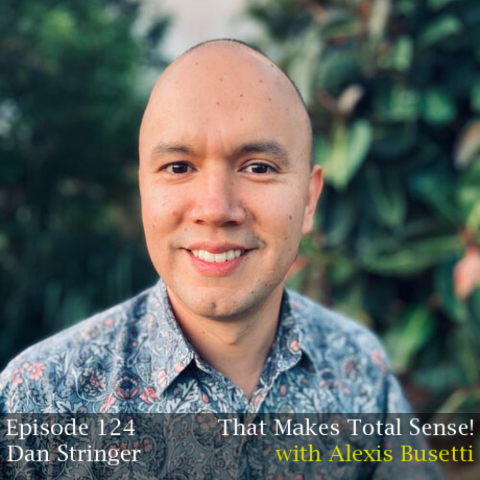
Speaker 1 00:00:07 Welcome to that. Makes total sense. A podcast dedicated to exploring God's generosity and justice. I'm Alexis. We setting the Christian aiming to ask good questions and encouraging you to do the same. Every one of us is wired by God to live out generosity and justice, but the how sometimes alludes us that makes total sense is a way for us to get together, posture ourselves as learners and challenge one another to practice generosity and justice in a tangible way every day. Hey everybody, I am sitting across an ocean from my guests today. I'm guessing Dan you're at home. Is that right? Are you in Hawaii? Right now?
Speaker 2 00:00:48 I am in Hawaii. I'm actually at the church office where it's a little quieter than our home. So not too far from where I live.
Speaker 1 00:00:56 I love it. Yes. My home only half of our crew is home today or else I would be, you know, just kind of crossing my fingers that we weren't having, you know, world war three in the background or something like that. So yeah, I totally get that. Um, but your office is beautiful. People can't see it right now, but great bookshelves behind you. And um, and I just love that and you are, let's just start there. You are at your church office and you currently are an ordained pastor. Tell us about, um, like your denomination and your church.
Speaker 2 00:01:28 Sure. So I'm actually in my wife's office because she's the lead pastor of our church. I'm one of the part-time pastors here, uh, wellspring covenant church, which is part of the ECC evangelical covenant church denomination. My full-time role is with InterVarsity Christian fellowship. I'm a team leader for the little narrow part of what InterVarsity does with grad students and faculty. Most of what Ivy does is with undergrad students, but we care about the whole university. And my focus is with grad students and faculty here in the islands. But I also have kind of a bi-vocational role at the church as a theological formation pastor, which I really enjoy as well. And it helps, you know, to kind of connect those church and para-church worlds, um, in my life, which is also, you know, a big part of my family too, since, um, Rebecca, my wife has a full-time pastor.
Speaker 1 00:02:28 Yeah. And you, you talk about that in the book that we're going to talk about. You don't specifically, um, I don't know that you name that she's the lead pastor, but you do name that she's a pastor and you talk about that being one of the things in evangelicalism that is, I mean, it's kind of a, it's kind of an issue, um, and in various places, depending upon where you live in the neighborhood, um, and we may touch on that. So, um, you're here to talk about your new book, struggling with evangelicalism, why I want to leave and what it takes to stay. And before we got on the only thing I could think of to tell you about this book that I just finished and it's wonderful by the way, is Dan, I think we grew up in the same house.
Speaker 2 00:03:17 Maybe like, I think a lot of us grew up there. Yeah. Different geographic places, but it's a similar type of environment, right? Yeah.
Speaker 1 00:03:26 I mean, we, we grew up in this same house and, and for people who don't have a copy of the book yet on the cover, why I went to leave has a match underneath it and what it takes to stay has a nail on top of it. And I think that that dichotomy sometimes describes at least I will say it names for me, it describes my emotions. There are days I wake up and I'm like, burn it down. Let's just be done. It's finished with it. And there are other days where I'm like, no, this is totally salvageable. This is our home. This is where we are. Um, what can we do to help and make it better? So, um, can you talk about, like in the book you take the first little piece and kind of describe your struggle and kind of where you were up until when you wrote this book and you also give us the spoiler alert that you're not finished with your struggle yet. So where did, where did this come from for you?
Speaker 2 00:04:27 You're right. That is, that is the spoiler alert is that I'm not done struggling. And I also don't tell my readers to stay or go, that's really your call with your own community because our experiences are so different. But I think what we share in common is that ambivalence that sense of having mixed feelings where sometimes there's bad, that outweighs good or good, that makes it worth it to still give it a chance. Um, if it was more of a slam dunk, you know, like stay all the way or leave all the way, then it would be a much easier decision. And, you know, that's not really who I'm writing to as much as folks who have that sense of consternation and struggle and grappling and ambivalence with what do we do with this? Because when we talk about this thing of evangelicalism, it's so many different things all at once, whether it's personal relationships or local church or upbringing, but also, you know, what's happening in public about our reputation and, you know, probably rightfully so the times when we've been called out for being part of really bad things.
Speaker 2 00:05:45 So all of that is kind of where this book came from. And of course it's very personal, it's very much nuance for my own experience. And that's, I don't really want to speak for anyone else, except that, you know, to the extent that we share, like you said, sharing that upbringing, sharing that sense of growing up and inhabiting this space that I think we can learn from each other, as well as talk about, you know, what is the struggle for you? What is it that keeps you, what is it that prompts you to want to leave? Because that's where it gets. Interesting.
Speaker 1 00:06:22 Yeah. And this is something like, this has been, you know, you mentioned this is evangelicalism is in the news all the time, and this is something for you though. That, I mean, I would say some of us probably started thinking about it, oh, I don't know, 2016 ish. And some of us probably started thinking about it a bit more, or maybe a real intensely in 2020, but this is not, when you started thinking about this, you had a file prior to that you had a pre-Trump file. And what did that, what did that look like for you as you started to kind of grapple with evangelicalism?
Speaker 2 00:07:02 Yeah, well, I think a lot of it began for me right after college. The 2004 election was one in which I was working as an intern at a radio station in Chicago, in the newsroom, helping out the reporters to gather sound bites, sound bites from the campaign, from the campaign trail, where at that point in the race there's, you know, like 12 or more Democrats trying to get the presidential nomination to run against George Bush, who was in his reelection campaign after being an officer for years. And, you know, as a young 23 year old listening to those clips, trying to, you know, find enough variety. So it wasn't the same one over and over each report at the bottom of the hour. Um, noticing just how much talk of God and scripture and religion came into the conversation from both sides of the aisle, as well as independence and all the different types of folks, um, that, that were running, you know, this was months before it, it eventually got, got narrowed down to John Kerry running that year, but, um, that's kinda where it started, you know, percolating for me wondering about this connection between faith and politics and how much strong disagreement there is.
Speaker 2 00:08:23 And then of course, four years later, it was 2008 election. By that time I was starting grad school and resonating with a lot of conversations around, um, what then candidate Obama was talking about. And I was in the field of social work, starting out my master's and understandably, a lot of folks in that field tend to be left of center. And we would have conversations about his policies compared to John McCain, who was the candidate then? And Sarah Pailin was the vice presidential candidate for McCain. And wondering, like on one hand I resonate with my classmates, but I'm also kind of too Christian for some of them. And when they talk about evangelicals, I know they're talking about something that doesn't totally describe me, even if I go to an evangelical church. And so like every four years, this thing kind of keeps coming up over and over again, you get to 2012, um, 2016 of course, and sort of that tension between how the word is used in public discourse and how it describes a particular type of faith that I'm actively part of in my world of church and ministry life. So that's kind of got, you know, where I got started with writing in blog posts about it and eventually shorter articles and eventually a book because it was just too much to process. So it had to become a book. I guess
Speaker 1 00:09:52 I love that you've been thinking about it for that long because it gives, it gives perspective. Right. Um, for so many of us and I'll speak for myself specifically, it just became the water I swam in. And so, um, you know, I was kind of aware, but I kind of like you had not really even heard the term, um, evangelicalism until I was in college, you know, even though that's where I grew up. Um, right. And I too, I was, yeah. I mean, my, so my best friend actually has her MSW and while she was doing social work, I was doing state casework at the time, um, in the Bible belt where I grew up and lived and were, um, I was married and we spent the first part of our first years of our marriage. And that space was odd for me because it was, you know, different geographically.
Speaker 1 00:10:46 But I went in and my best friend who was in the MSW program, the master of social work program, like, like you were, um, when I told her that I was gonna apply for a state caseworker job, she kind of prepped me because I was like, this is going to be great. Like we're literally taking care of the most vulnerable people in our community. Like I thought, and kind of naively in my, you know, early mid twenties said, this place is going to be swarming with Christians. And she was like, actually, it's, you might be surprised. It's kind of, you know what she said, um, because in that particular geographic region left of center does not equal evangelical, like at all. Um, you know, for the most part, um, evangelical in that Bible belt region where I'm from meant very, very right. And so the left of center that you're talking about, people who were doing the social work for the state, um, many of them did not identify as Christians, um, you know, were not church-going.
Speaker 1 00:11:48 Um, and so I remember I was, I was working there during that election actually. And so I'm resonating with some of the things that you're saying, but, um, but as you mentioned in the book, it's kind of, you're going, yeah, but we, we wanna, we re in tune with this, like, what do we do about poverty? What do we do about healthcare? What do we do about, you know, foster homes? What do we do about some of these things that are real, um, social issues that are affecting people around us? You know, what do we do? Where are the answers, um, for that? So, yeah, so I can relate to that. Um, part of what you talk about in the book. Well, let's, let's go here first. You, I would say now in almost we're almost in 20, 22, probably almost everyone who has at one point in their life worn that label of evangelical would say, yeah, we've thought about this now, because as you said, we're in the news all the time and you give us four aspects of this journey that you encourage people to, to take into consideration. But it kind of shocked me because at the end, in this renewal section, you said, you know, if you're tempted to skip to here, if you, if you skip to the renewal and haven't read the previous part, and I thought, Dan, that's so evangelical,
Speaker 2 00:13:07 That's what I want to like
Speaker 1 00:13:09 Do exactly. I mean, I can't tell you how many times that conversation has come up when I'm, when I'm having these other conversations about social justice and racial reconciliation, all of this stuff. And it's like, yeah, yeah, yeah, yeah, yeah, yeah. But what do I do? Right. And you say, read the first three parts. So we've got to we're, it's going to serve us best. If we go through this journey, looking at, you say awareness first, we have to, we have to know kind of who we are, where we've come from, appreciation, repentance, which is like the biggie for me. Um, and then renewal. So I don't know exactly where you want to start, but, um, but those are the four parts that you kind of want to take us through in your book.
Speaker 2 00:13:56 Yeah. I think awareness is a great place to start because that was what took the longest for me and the journey of not only writing this book, but just processing my relationship with evangelical spaces. Because as I grew more aware of the different ways that not only the word is used, the label is used or misused. Um, but just how broad and diverse evangelicalism is. Once you start expanding beyond American evangelicalism. And once you expand beyond white evangelicalism, um, or the way it's used politically, if you look at, you know, even the folks who might be considered part of the theological category of evangelicalism, it really varies so much by race, by geography, by nationality, um, by education. So sort of thinking of that piece first, I think one of the critical distinctions I make early on is that because there's so many different ways this word gets used.
Speaker 2 00:15:06 I tried to distinguish between the evangelical brand and the evangelical space and a brand is what you buy a space spaces where you live. And so it's a lot easier to change what you buy or what you wear than where you live, right? Like I can change clothing much easier than, you know, moving my whole family from one residence to another. And I think that with the brand, you know, there's so many of us who see that being sold and say, Nope, I'm not interested. I will not wear it. I will not buy it. That is not me. So I guess we're done with the word and the concept. Right? Well, the problem is that even though the word does describe a brand, it also describes more. And once you get into that space, that neighborhood, that habitat where so many of us live a particular type of Christianity, I think that's where the journey of awareness begins.
Speaker 2 00:16:04 Especially if you're in a place where the majority of Christians seem to be evangelical. You know, we often will just say Christian, when we really mean evangelical, like I went to a Christian college called Wheaton, well, it's also an evangelical college, or I listen to Christian music. Well, it's kind of really just evangelical music. There's other music made by Christians, there's other universities and colleges run by Christians. You think of Notre Dame or Catholic schools. Um, Christianity is so big and evangelicalism is one part of it. Um, that for those of us who grew up in it, it certainly is kind of the whole thing and seems really big. But once you see that Jesus can be, you know, Lord and savior of much more than our particular type of Christianity, then exciting things can happen and, and you can see, wow, I actually have options.
Speaker 2 00:17:00 And I'm actually part of something specific that even if I don't want to put it out there, you know, right away when I meet someone, hi, I'm Dan, I'm an evangelical, you know, I'm really cautious about how I use that when it comes to building relationships, there's also a time when I think it's important to own it. And to name that baggage. Not because it makes me look good. If it's more about being honest and it's more about saying, I am not the default neutral textbook Christian, I'm just this particular version. Um, amidst all the different other versions out there
Speaker 1 00:17:39 That distinction like naming that it is a brand, but it is also a space that was the, that was the game changer for me in this book. What, one of the things that you name is you, you mentioned, um, Catholics and Mormons and Muslims, and you say what they, what if they just decided, oh, well, I don't, I don't really like this. I'm just, I'm just not going to be called Catholic anymore. Like, that's not even a thing. Like, that's, you can't do that. You can't just say, well, I'm just not going to be called, you know? Right. And, and naming that, it's not just a label. It is a space, like you said, it takes, if you want to leave the space, then this is much more to think about. It's exactly. As you say, it's moving your residents. It's not that it's impossible, but this is like a, really, this is a, this is like a grave decision, right? Like this is something that should be, um, really thought about in a different way than just, yeah. I decided I don't like that t-shirt anymore. I'm not going to buy stuff from the gap, you know? Well, this is not exactly how this works. And I, and, and so I'm thankful, um, that you take the time to define that and say what you mean by that, because that helped me put this conversation in perspective from the beginning.
Speaker 2 00:19:03 Yes. Yes. There's a whole chapter in the book about what we mean when we say evangelical. And I talk about how there are so many different entities to which that word points and, you know, it really is the most precise, specific word for several different things. It'd be as if like the word Dalmatian not only meant this black and white spotted dog, but it also meant, you know, this type of dog food and also meant this other thing. Like, it would be really confusing to use that word. And yet, if it's the most specific one for that entity, it's hard to stop using it. So every four years we go through the cycle, all right, are we done with it? It's not good. I don't like using it. It's stressing me out. Let's just stop using the word and stop calling ourselves that, and then that lasts for like a really short time before we really kind of have to keep using the word.
Speaker 2 00:19:56 Not because we like how it makes us feel. You know, it's honestly very embarrassing sometimes, but because it's the word that we all generally agree points to a specific thing. And in that chapter, the four things that it points to are the theological category, the cultural movement, kind of the white political, religious brand. And then also this globally diverse movement and all four of those things have this same name, they're all called evangelical. And they certainly overlap. They're not totally different, but they're also not exactly the same. Some of them are really narrow. Some of them are really broad. Some of them are more about a brand. Some of them are more about a space. And so that, as you can probably tell from the way I'm talking about, it was really the bulk of the journey of getting there. And then once we get to appreciation and repentance, it's a little bit easier, I think, um, to do the work of figuring out what are the pros and cons, what are, you know, the things that cause me to resonate versus make me want to leave, because then we know what we're talking about.
Speaker 2 00:21:07 We know what we're, we're looking at. It's beyond just headlines and social media, but my own experience of, of people, of church, of God, of worship and scripture. So that's kind of where things go from there.
Speaker 1 00:21:23 Yeah. Um, on the appreciation part, I think this is where this is where you go next in the book. And I think this is where you mentioned it, um, with your social work background. And I used to do the same thing when I would visit families. Um, so I used to actually, I used to actually work in child protective services. And so when we would go out and I would visit with families who have experienced, you know, some real pain and trauma in their lives. And I was there usually because it was happening in a very dramatic way at the time. Um, that was one of the things that we did was we would go out and we would, we didn't usually have to identify completely what was wrong because that's why we were there. But one of the things we did do every time was help the family identify their strengths, right.
Speaker 1 00:22:07 And we would put those down because as caseworkers, we knew that that would be a starting place for us to help this family move forward and heal and reconcile and reunite in the cases where, um, they were separated. And so that rang a bell for me. When you talked about this, you know, that strength space thing, because I think right now where we sit, there are a lot of people who would look at evangelicalism and just say, this is a train wreck, like, appreciate what helped me, Dan, appreciate, you know, what, and then there are people who are probably, you know, hurt on the other side of it too, where they're like, I don't know what everyone's complaining about. Right. But in this, in this section, you talk about, we have to be, we have to be aware, but we've got to be able to appreciate, um, the good things, as well as be aware of, uh, and, and, and look at and repent for which is coming next, the things that are not so great.
Speaker 2 00:23:04 Yep. And what makes this section really tricky is that what might be a strength for one person might really be a weakness for someone else. So there is no defined canonized universally accepted list of what evangelicalism strengths are. What I'm saying in the book is that they exist in our own experience and in reality of how we've encountered God and Jesus in church or in Christian spaces, faith communities. And so for me, for example, the love of scripture, I think has been a tremendous gift and strength of evangelicals in my life. It's the evangelicals who have mentored me and been an examples for me, of really wrestling with the texts, seeing what's there, seeing how there's so many different voices across the 66 books of scripture. So many different questions that come up that are really, you know, prompted in a healthy way by scripture.
Speaker 2 00:24:12 And I have so much to be thankful for when it comes to the people and organizations and books and other influences in my life with regard to scripture that without evangelicalism, you know, I may not have experienced that because just about all of them, I mean, there's a few non-evangelical ones, but even those have been pointed to me by evangelical mentors. So most of the time when I'm reading like a Catholic or Eastern Orthodox book, it's often like if you trace it back, it's, it's from, you know, an evangelical seminary class or a pastor or somebody, um, because that's just the water I swim in. And then for other people who rightfully have a totally different take on it, they would say, Nope. Um, the way, the way scripture was handled is probably the worst thing about my experience with evangelicals. And because it was so controlling and judgemental and narrow minded and, you know, made scripture say all these terrible things that I just, you know, have a hard time even opening a Bible now, um, or hearing somebody quote a verse or mention a scripture reference, you know, and that is certainly legitimate because often our greatest strengths can become our greatest weaknesses as well.
Speaker 2 00:25:38 And scripture is just one example. You can use the same thing with prayer. You could say the same thing about how in the evangelical tradition, we have a real emphasis on say a direct relationship with God that doesn't limit itself to Sunday mornings or a church building or a clergy person. You know, I was raised with the idea that you can talk to God anytime and you can meet God while you're driving or listening to music or, you know, on a Saturday outdoors or something like that. And that's a real gift to me that, um, God is accessible and near and relatable and approachable. Um, and then the downside that comes with that though is God can become so personalized and individualized that we fail to see, you know, the collective dimensions of faith. And that's also one of evangelicalism major issues is that we don't have a very strong awareness of where we fit beyond just, okay, which church should I go to? That's my church, but how do these churches fit together? Where did they come from? What are the different faith streams that informed them? They didn't just come straight from the book of acts. So you can see right there that there's paradoxical relationships between the features of what would be an evangelical, evangelical strength or weakness.
Speaker 1 00:27:10 No, that's really important to name. And I liked the way that you did it here. And I liked the way you did it in the book, right? If someone, someone could raise their hand and name and strength than someone coming right behind them and say, and say, actually, no, that's a, that's a problem. Um, but I want to take the last one that you talked about about this communal kind of this individualized or communal, because that leads into what was like the flashing red light for me in the repentance section. Um, and that is that what I took away from that section the most is something that honestly, as an evangelical, I have probably been grappling with the most, which is our hyper individualism and our, as you know, in my traditions, in my experience and our lack of focus on communal anything really, um, you know, I was thrilled.
Speaker 1 00:28:11 It was in probably in my seminary classes and a couple of the other books I've read for the podcast, just being like having my eyes opened to the awareness of, oh, the church. Isn't just like, of course, like my congregation or my denomination or American evangelicalism or the global church, but it's even like the historical church, right? Like that, how we can learn from the voices. And we are a part of the voices who have come before us to, and this is part of our community. Um, but in the repentance section, you, what stood out to me was you talk about the issues. Really. I think that evangelicals have with this communal repentance and we kind of have a problem with it. Like we say, yes, like repent and name your sins. And this is how you're saved. This is the language that we use, right. Or if you're, if you're lying or you committed adultery, you yourself have to repent. That's an important thing for you to do as an individual. But once we start talking about us as a community repenting, man, there is resistance to that idea.
Speaker 2 00:29:24 Yeah. And I think, you know, not to blame evangelicalism completely for that. I think a lot of it just has to be, has to do with being in an American context. Um, one of the real factors for me in writing the book was my experience as a missionary kid for about nine or 10 years of my childhood living outside of the United States in Congo, Zaire, Nepal, and the Philippines, as well as just, you know, developing relationships where, you know, folks come from different sets of cultural assumptions about what is the basic identity that you're a part of. Is it your own individual choice, your own freedom, or is it about, you know, the reputation of your family, um, and, and bigger communities than that, you know, even your, your nation in some cases, um, or your, your people group. And so I think that really shaped my understanding as I, as I searched for my own sense of who are my people, who is my spiritual people group.
Speaker 2 00:30:32 Um, I'm also biracial as Asian and white. So there's that other aspect of like, who are my people ethnically? Uh, it can be multiple. And so when it comes to repentance, I think there certainly is a case where individualism affects our understanding of repentance. And it's not that individual repentance is not in scripture. It certainly is. And it's certainly important. It's just that we already know about it. So I don't really emphasize it because that's kind of the very beginning of the sinner's prayer or the forest spiritual laws, or many different methods that evangelicals used to describe the need for Jesus. Um, because it's so individualized, it can exclude the Camille dimensions. And that's why there's so much consternation when it comes to discussions of collective sins, collective wrongdoing, and it usually falls under the category of either idolatry or injustice. So many things just are in those two categories, which I think is very much the pattern we see in scripture, which also by the way, is full of communal confession, communal sin and communal repentance, which doesn't always go that great either.
Speaker 2 00:31:50 So if evangelicals have a hard time, um, not only confessing together, but actually changing the way we live together, then the good news is we're not alone. The people of God have always struggled with that, but if we can't even say that that's on our radar screen or that we, you know, don't think those issues matter because I personally have not done, you know, an unjust thing or a racist thing or a sexist thing that I'm off the hook, then we really don't grasp the way that our forebearers and our, our faith tradition has handed us such a rich legacy of understanding things beyond just the individual level to the communal level. Um, the things that we do well as a community, as well as the things that we need to repent of.
Speaker 1 00:32:43 Will you talk about Jesus' baptism in this section, the way that you describe him?
Speaker 2 00:32:51 Yes, I will try to, although the book says it better because I had more time on that, but basically this comes from one of my seminary professors at solar, Tommy given. So I have to give him credit for planting the seed of this because he would repeatedly say in a variety of new Testament classes that Jesus did not see the sins of his people as anything other than his own. And that really clashes with the idea of individual Jesus being, you know, pure holy sinless, which is true, but then why would he seek baptism? Why would he need to be baptized? And what was the important lesson there beyond just saying, all right, I'm just doing this as an example, so that you do it, or was there something deeper there? And I think in the book, I talk about how once we shift from an even, uh, an individual lens to a more communal lens when it comes to sin, we see that because Jesus is part of a people group, the Jewish nation.
Speaker 2 00:33:56 And because, you know, John, the Baptist is calling them to repent and be baptized. Then of course, as a member of the community, he desires to be part of that. And it's, and it's very appropriately being part of that repentance process because he belongs to this people group that is on a journey with God and needs to repent of things together. And so just the whole, the whole story of Jesus baptism, I think, is a great, um, model for us of how to think of ourselves as not only my own personal list of right and wrong, but what about the rights and wrongs of my people and how can I participate in solidarity and understand that your sins are also, um, mine in a sense of communal identity
Speaker 1 00:34:53 That, um, that section blew my mind. I have never, I will say, you know, like growing up in evangelicalism, right. I've never heard Jesus' baptism described in that way, um, as a part of that communal repentance process, but it was beautiful. Um, so thanks for indulging me. I've also heard wonderful things about Tommy givens. I've only heard wonderful things about Tommy given, so I hope I get the chance to take him, uh, before I leave fuller. But, um, thank you for going for taking us there. Um, lastly, we've got kind of where we started, which is this renewal section. And I have to admit, I, it was in 2020 when, you know, the world was kind of blowing up in a lot of ways. I first, I just happened to catch this, um, author that I follow on Instagram talking about American evangelicalism, um, kind of sin of triumphalism was, it was almost the way that he was putting it, right.
Speaker 1 00:36:01 Um, he's a black author. I've had him on the show. I would, I would link this. Obviously it's a story, so it's gone, but it was, it was Dante Stewart was talking about it. And, um, he was just really kind of free flowing. And it was the first time that I had really thought about, wow, is this kind of the way that we think about things, you know, is this, is this kind of our culture, is this, you know, how we operate and the more I listened to him, the more I thought, well, dang it, he's right. You know, like this is a lot of times where we find ourselves is we see something wrong and then it comes back to the, well, what do we do? Or we can fix this or let's hop on it, you know? Um, and so you talk about renewal, not in this triumphalist way. No, that's his word, but I'm not in this way, not in this like way that, that, um, emphasizes triumphalism, but, but you talk about it, um, in this way, after following these other three parts of, um, of this journey. So what do you think is important for us to know about this renewal process? Like if we choose to stay recognizing those who choose to leave, um, that kind of thing.
Speaker 2 00:37:11 Yes. And I love that you said if, if we choose to stay, I think you can look at these four postures as a discernment tool as well. They're kind of four things that can operate in different ways. One is it can be a pathway to being part of a solution, but another way to look at it is how do I make an informed decision about where to make my spiritual home, and maybe I need to relocate, which is totally an option. Um, I have some really good friends for whom their spiritual life is really thriving and coming back to life in a non-evangelical space, um, that is still following Jesus. So I don't tell everyone to be part of renewals, especially if, you know, you really feel like after doing some of that inventory of awareness appreciation and, and repentance, like that could be enough to give you a sense that yeah, there can be others who are called to be part of making this more habitable space, but I just don't sense that God is calling me to do that.
Speaker 2 00:38:22 And for me, I just need to have some distance in a different type of faith stream and that's totally fine. And so if those first three postures help you to discern that, then bless you. And I totally, um, think that's a valid pathway. That last part of renewal is really for, it's kind of like the tithing part of this, of the service, where it's like, if you're a guest here, you know, don't give your money. But if you are a member of this church, this is how we move forward together, um, as part of our discipleship. And so I think part of our discipleship, for those of us who are still here and have a certain degree of privilege, if you're in a leadership role, or maybe you've just been part of your church or faith community for awhile. So you have a sense of welcoming people and, um, you know, helping people to understand what it's about.
Speaker 2 00:39:18 Like whatever type of proximity you have to a sense of belonging in evangelicalism, even if you're still wrestling, even if you're still like me thinking that, well, I could still change my mind and leave tomorrow, which may be as possible. But if you're still here today, then the renewal process is how do we begin to clean up the mess so that even if it's not fixed overnight at which it won't be, because these things have taken years to make a mess of how can we at least leave it better today than it was yesterday or better next year than it was this year? Just a small incremental change can make a big difference. I like to say, even if, you know, evangelicalism was 10%, less racist or 10% less sexist, that would make a difference, um, right, 10% less greedy or arrogant, you know, we're not going to just flip a switch and all of a sudden, you know, get out of our, our patterns and upbringing, which are so formative to us, but I think we can be part of, you know, leaving it better than we found it, which is really how I define renewal.
Speaker 2 00:40:32 It's not so much about going back to the good old days. I don't say that there are good old days, you know, make evangelicalism great again or something like that. It never really was that great. In my opinion, however, there is work to be done in terms of the process of helping it come to life in a renewing sense of leaving it better than we found it much like the metaphor of an oil spill in the ocean, right. It devastates the environment, but what is our responsibility to try to help to be part of cleaning it up? Even if you know, it won't be like, it never happened. It'll still have happened, but hopefully we don't just leave it and do nothing when it's contaminating things.
Speaker 1 00:41:19 Yeah. I loved that analogy. And part of what I loved about it is that you also say we're cleaning this up, but it's not like for the glory of the cleaners, right? Like this is not about us. The people who have chosen to stay, who have said, okay, I'm going to try and leave this better than I found it. This is about the environment. This is about, this is about the space, right? This is about the people. This is not about us. Right. People live here. Exactly, exactly. People live here. And so how are we going to help, um, you know, clean this up and make it better? I just, I appreciate the freedom, um, that I found when I was reading, you're reading this book, it's just you name so many of the things and give language to so many of the things that, um, any emotions and, um, thoughts that I've had being in inside of evangelicalism. But there's also the freedom. Like you said, it's, it's a spoiler that you're still struggling a and B that you don't write this book to tell anyone whether they need to stay or go, um, we, you can't make that decision for anyone. I can't make that decision for anyone we have to, um, we have to discern that with help from the Lord. Um, where would you leave us as, um, as a pastor in this?
Speaker 2 00:42:46 I think as a pastor, I would just say, you're not alone. You are not the only one to struggle with these things. Your pastors are probably struggling with these things. If you're in a space where no one is allowed to say anything about the struggle or admit that it's going on, um, you know, there might be a better space for you or even, you know, something that you could be part of, um, to the, to the degree that you're interested in finding companions, who can be in that struggle with you. And as you start to learn the different options out there from other companions on the journey, you might discover some options for yourself, which not only include leaving, but also includes staying. So that's why the book is really just about helping you to struggle in a more realistic and redemptive way and how to struggle in a healthy way.
Speaker 2 00:43:49 And so it's more about the journey of struggling than, than the destination, because I think it's possible to struggle in a really healthy way and arrive at different conclusions, but it's also possible for everyone to try to just reach the same conclusion, but unfortunately do things in a way where, um, that the ends aren't justifying the means. Or did I say that right? The idea that, you know, we're just kind of so focused on where we land that we're overlooking the important work of doing that inventory, not only for ourselves, but just kind of tracing more of our own faith stream, the faith stream of our community, not even just where you go to church or your faith community now, but just the influences that you've had kind of figuring out where those came from. And so as a pastor, I just tell people, you know, you aren't alone in this journey, there are resources.
Speaker 2 00:44:54 Um, this might be kind of a new conversation for you to think about the different dimensions of something so complicated, but, um, there are people probably not too far away, especially now with, you know, online communities who are in a similar struggle as you. And so the more you can connect with others and have that discernment process be a communal one where you can be honest and realistic. Oh, and the other thing I'll say real quick is that you don't have to get your entire spiritual life from your church. Um, and as a pastor, you know, it sounds kind of weird to say that because pastors are usually the ones who are like, all right, we've got this church and it's gonna give you friends. It's gonna give you teaching. It's going to give you purpose and meaning and healing for the past and the future.
Speaker 2 00:45:47 And it's like, well, can a church really do all of that? Um, churches have strengths and weaknesses, right? So I think it's totally acceptable to recognize that, you know, what, whatever your church or community might not be as strong at, it's totally fine to listen to other sermons, read other books and find other communities beyond your local church, so that you have more of a, a healthy, balanced diet if you will, in your spiritual life. Because that is one of the things we've done wrong as evangelical pastors in churches is trying to say like, we've got this monopoly and don't go to the competitor because they're not as good. It's a zero sum game between us and them. And that's just not a healthy way of approaching our own understanding as, as members of the body of Christ,
Speaker 1 00:46:45 Man. That's good. Dan, thank you so much for that. Um, again, the title of this book that I just finished today, it's phenomenal. Um, I'll link it in the show. Notes is struggling with evangelicalism, why I want to leave and what it takes to stay. Um, Dan, do you hang out online? Are there places that we can, uh, connect with you there?
Speaker 2 00:47:14 Yes. Twitter is my online hanging out place. I am also on Facebook and Instagram, but the handle is the same rev Dan stringer. And if you aren't sure exactly where to start then I also have a Dan stringer.net, which has the links to kind of have everything in one place. If you want to learn about the book or the other things I've written or the other ministry connections, social media, it's all
[email protected].
Speaker 1 00:47:43 Awesome. Thank you so much. I'll link all of that in the show notes. So it will be just a click away for anybody who wants to connect with you in that way. Thanks so much, Dan, for coming on. I really appreciate your time and, um, and your influence. So this book,
Speaker 2 00:47:58 Thank you, Alexis, for having me, this has been a really engaging conversation and your perspective is really valuable. I look forward to, to hearing more of your show to
Speaker 1 00:48:09 The links for all the resources mentioned in today's episode can be found in the show notes, music and podcast production by Seth B city. Be sure to give us a review on iTunes and subscribe at your favorite podcast listening app, you can also visit us at that. Makes total sense.com