[00:00:10] Speaker A: Welcome to that Makes Total Sense, a podcast dedicated to exploring God's generosity and justice. I'm Alexis Busetti, a Christian, aiming to ask good questions and encouraging you to do the same.
Every one of us is wired by God to live out generosity and justice, but the how sometimes eludes us. That makes total sense is a way for us to get together, posture ourselves as learners, and challenge one another to practice generosity and justice in a tangible way every day.
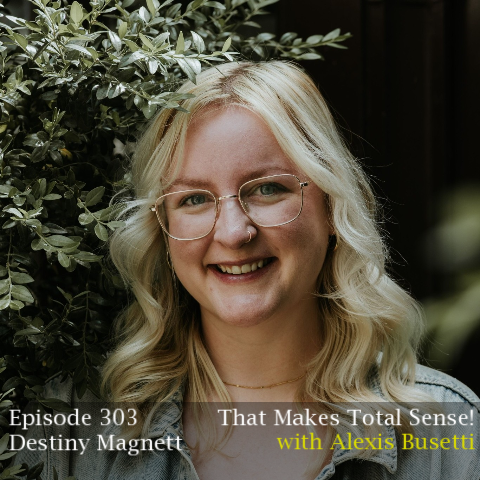
Okay, Destiny, I'm going to do exactly what I said I wasn't going to do pre record because we started and you said what to me? You're in Boston.
[00:00:53] Speaker B: Yeah, I'm in Boston. And it finally feels like springtime today.
[00:00:57] Speaker A: And it finally feels like spring springtime. And I'm so excited for you. And I'm like, it feels like summertime here. We're in late April.
I have been to Boston in the spring only one time. And so that's the only context I have. And it did not feel like spring for me. This, like I was this Oklahoma girl when I went, I was like, this feels like winter. I don't know.
I don't know. But it was like a cold, rainy day.
So I'm thrilled that you that it feels like a wonderful spring day. And I almost feel like I don't want to rush this conversation, but I also feel like you need to be outside, like, let's talk and then you need to split and get outside where it's. Where it's nice and pretty. But I do appreciate you taking the time since you're back in Boston to join me for just a little bit because you, in your role at churches for Middle east peace, which we'll chat about, have been traveling quite a bit, hosting leaders, specifically some Palestinian leaders I know recently in D.C. and things like that. And you were in Houston just a couple months ago ago, or we caught up. And so I know you're all over the place. Your work takes you all over the place. And so I'm, I'm glad that you're able to spend these few minutes with me today.
On that note, I'm hoping because I've chatted so some long term listeners of the podcast will remember that. I've chatted with Maely's cannon a couple of times, one of them specifically about what has been going on in Israel, Palestine. This, I'll link that in the show notes. But you guys work together at churches for Middle east peace. I'm wondering if you could give us a little bit about, like, what is your role in that organization, maybe remind some folks give us the elevator speech on what CMEP is. And then also maybe just some highlights from your CVS that we kind of know who we're talking to today because we're we're going to be talking about tough conversations, how to have them.
Also your context for that is largely what's happening in the Middle east, which is always tough to talk about. So I think it's good that we're understand kind of who we're hearing from and some of your experiences that brought you here.
[00:03:10] Speaker B: Absolutely. Thank you so much, Alexis. It's so good to be with you.
I had such a great time with you and your colleagues at Fuller in Houston a couple of months ago. I can't believe it was almost three months ago already, but was so energized from that conversation. And I'm so excited to be here to continue on some of those threads today.
So, as you mentioned, I work at Churches for Middle East Peace, or cmep, you'll hear me refer to it over the course of the episode. CMEP is a coalition of now 36 member denominations and communions that have come together to advocate for U.S. policies that promote holistic peace for all people in the Middle east, with a particular emphasis on Israel and Palestine.
Our denominations are super ecumenical. We have all kinds of Christian groups. I tell people a lot. We go from the US Conference of Catholic Bishops all the way to the Unitarian Universalists.
But in the middle of that spectrum, we've got peace churches like the Quakers and Mennonites. We have a lot of mainline Protestant groups. We have some evangelical coalitions.
And so that diversity is one of our greatest blessings and teaches me so, so much. I I'm originally, though you mentioned I'm in Boston these days. I'm a New England transplant, but I grew up in Kansas and have a real affinity for the Midwest.
I joke with churches when I visit them that I've been doing ecumenical work since before I knew the word ecumenical because my mom and her family were actually based in the LDS Church. She has a lot of Mormon family in Utah. And my dad is the son of a Missouri Synod Lutheran and a Catholic.
And so I have been thinking about these questions for a lot of my life from a personal stance and then at Churches for Middle East Peace. I have the great joy and privilege of working with these denominations and communions to think about what it means to be witnesses, what it means to be advocates for peace and justice, and how we can avoid getting stuck in our denominational silos and really work together to bring about the Kingdom of God or this vision of Christ's peace on earth. I think I was reminded of this a lot with the Easter tide emerging just a couple of weeks ago.
But I came. So Midwestern roots and I came to the Middle east in kind of a lot of dominoes came together. I went to school for my undergraduate work at Grinnell College in Iowa, did religious studies with Peace and Conflict Studies, and ended up in Jordan. And Jordan was the first place that I met Palestinian refugees, including a few Christian refugees, and some of the camps there. And I felt this deep call to work on the Middle east and as a graduate student at Harvard Divinity School, where I now hold a Master of Theological Studies. From there, I had the chance to go back to the Middle east, this time speaking, spending a longer stint in Palestine and Israel. I got to live in Bethlehem for, like, four months. I got to say that the birthplace of Jesus was my home, which, what a joy and a blessing. And that's also when I started working with churches for Middle east peace. So my introduction to this work was building connections with communities on the ground, and that included Palestinian Christians. I was also working with tons of incredible and courageous Israeli Jewish human rights advocates and groups like Betsellam or Rabbis for Human Rights PeaceNow, who are doing incredible work to advocate for peace and justice for all people in the land.
My current role with CMEP is to bring us full circle is programs and outreach manager, which means, in a nutshell, I get to work on church engagement. So I'm working with our congregations across the United States to think about, you know, how the heck do we, as Christians, faithfully and authent, have difficult conversations about Israel and Palestine in our communities, especially at a time that's particularly fraught. So I've been in this role since September 4, 2023. So almost my entire tenure working with churches and congregations to think about these questions has been in the post October 7th landscape and in the wake of the atrocities on that day and then the ongoing violence and bombardment of Gaza. So it's been quite a whirlwind. But I love what I do. I love getting to work with clergy. I love getting to work with lay leaders. And I spend a lot of time actually touring the US Sometimes on my own, sometimes with Palestinian Christian leaders, often with other US Coalition members, doing peace and justice work, to think deeply with Christian communities about what these times call us towards and how we can put our faith and our convictions, move them out of the pulpit and sanctuary, into actions and into change for the world.
[00:08:31] Speaker A: Destiny. I I'm feeling pretty overwhelmed by just some of the thoughts that are coming to my mind as you share.
I think I'll I'll start with maybe two things. One, more broadly a. I'm so grateful for the work of cmep. You know that I've. I've been a big fan of CMEP for years and I'm just so. I'm so grateful for the work that you all do.
In part, yes, your work is. I think the holistic lens that that CMAP has is just unmatched. I feel like in so many institutions, organizations, individuals trying to navigate this really, really tough space.
And the educational piece that you guys bring to this is so valuable.
I will say this from personal experience.
It's probably repeat information for you, but just to give listeners context in this conversation.
So I Part of the reason I just love the work of of cmip again is the is the holistic nature and the educational piece. I started traveling to Israel in 2003. That was my very first trip.
It feels really like I'm an old person saying that in 2025 that my first trip was over 20 years ago, but this was Intifada time. I was just reading, oh, maybe it was in the article that you sent me Talking about in 2002 being some of the most violent times that they had seen an IP and we traveled. And just on the heels of that, it's my very, very first trip. Back then, tourism was dead in Israel. And and as probably most people know, if they've been with their churches, they have seen tour groups advertise like tourism is a major, major industry in Israel. And it was just completely dry when we went in 2003.
Since then I've taken eight or nine or ten trips or something like that since. Since that. And the most recent trip I took was in 2022 with CMAP and that trip.
So again, that was maybe my 10th trip to the Holy Land. It was the first time I had set foot in occupied Palestinian territory.
We were not in Gaza. We were in the West Bank.
We met a lot of people in the West Bank. We did a lot of traveling in the West Bank. We were in Bethlehem, as you mentioned, and other places deeper inside.
And we had the opportunity to. I just, I continually get blown away the engagements that we had in this trip. But one of the things that we had the opportunity to stop by one of the UN agencies and we just sat and looked at maps and heard about checkpoints and all of these things and it was incredible. And my poor Husband had to listen to me when I would call home and say. And I would say to him, remember, like, you remember this highway that we go and blah, blah, blah. And I'm like, do you know what's under that highway? Do you know what's on the other side of this wall? Do you know, like, because being traveling and we didn't do only tourist things in Israel, but traveling as, as, as primarily tourists in Israel for, you know, multiple years, we just didn't see. We just didn't see. We really physically could not see the Palestinian population.
And it wasn't exactly out of sight, out of mind, but it's very, very different going and eating with people in their homes, listening to their stories, telling us about their family's history of being refugees.
These things were very, very personal.
And I felt embarrassed as someone who had had that much interaction in the Middle East. And I. I mean, we'd been to Jordan as well. We had crossed borders on, by foot, you know, like, all these kinds of things.
And at the same time, I just really didn't understand the plight of the Palestinians in general. I had no idea that generations of families were living displaced. I had no idea the political situation of people being stateless, not able to travel, they didn't have documents.
And this wasn't something that was happening in the 1970s, you know, shortly after statehood, and all this. This is stuff that was continually happening now in the 2020s. These are still things that people are dealing with. And so I'm saying all of that to say I'm so grateful for the work of cmep, but I'm also hoping that in the course of this conversation, we can talk about some of things, because even though we may not all have the ability to travel there, we may not have the ability to. To go and participate in some of the events that CMEP puts on where people have the opportunity to hear from Palestinians sharing their stories and from Israelis and, you know, Jewish clergy as well, and all this.
We can maybe bring familiarity a little bit, you know, closer in conversations like this. So that's a lot. I'm going to try. I'm really going to try Destiny to keep myself short on this. But as you know, this is just something that I feel so passionately about and. Yeah. And I'm so grateful for your work.
[00:14:16] Speaker B: Thank you. Yeah. There are a couple of threads that I would love to touch on from what you shared, and I'll start with the latter half with this ide of familiarity.
And as CEP this year, we had a Board meeting, as we do. We were going through the things that we really wanted our priorities to be this year, which we always do, you know, in consultation with our denominations, but also in consultation with churches and our partners on the ground in the Holy Land. And so one of the priority pieces we originally stated as humanizing Palestinian Christians. And it was so such a reframe for me. In one of our conversations with some of our Palestinian Christian partners, they said, what do you mean humanizing? We're already humans.
And they encouraged us. And we've since changed the language to combating the dehumanization of Palestinians. And there's a great quote. The last time I was in the land, I was visiting Dar Al Kalima, which is an arts and culture university in Bethlehem. It's run by a Lutheran pastor and theologian, Reverend Mitri Rehab.
And Reverend Mitry said to our group, you know, the church in the west, the people in the west, they only see Palestinians as either victims or terrorists. And we just want them to see us as people.
And I thought that was so powerful. And the way that the media is depicting these communities that we're thinking about these communities is it's not only this challenge of homogenizing the group and seeing some of the kind of anti Muslim, anti Arab tropes of terrorism, but also this idea that only seeing Palestinians as victims is also in its own way, contributing to this dehumanization.
And so at Churches for Middle East Peace, we do our work in three buckets. We always say educate, elevate, and advocate. And so this work is situated most in one elevating the voices from the Holy land of Palestinian Christians and showcasing these voices as, as people, like, who want to break bread and dance and be able to take their children to school without encountering checkpoints and military presences, to be able to worship freely and those kinds of everyday things that many of us here take for granted like, and they're not always the flashiest stories, but they're often the most important. And so highlighting that everydayness of the violence encountered under occupation, but also the joy and celebration that happens in Palestinian communities is super important and something we can do both through travel, but also through our online offerings and churches for Middle East Peace. We travel a lot. We, you know, do DC based advocacy, but we also have constant online webinars, resources. We do mini courses from time to time, and that all lives, you know, completely free, free on our YouTube channel, on our website, CMEP.org, and you can check all of that out there.
One of the Other pieces that you touched on in your first visit back, and it was 2003, you said, yeah, yeah, just in the week of the second Intifada.
[00:17:40] Speaker A: That's right.
[00:17:42] Speaker B: This idea of tourism and right now in the post October 7th landscape, this is something else that's really, really important right now. I was most recently in the land in November of last year, so November 2024.
And I have never seen the holy sites so empty. It was heartbreaking in a lot of ways. Oftentimes, some of the sites, like the Church of the Holy Sepulcher, to be able to go into the tomb, you have to wait for, you know, 30 minutes, if it's really crowded, an hour.
And when we got there with this, I was with a group of Christians who were going in solidarity and for pilgrimage, and we didn't have to wait at all. There were like three people in front of me or at the birthplace. At the Nativity Church in Bethlehem, you usually get 30 seconds down in the grotto to see where the manger was, where Jesus was born. And our group was able to stand together. We read scripture, we prayed together. It was us, and I think a Greek Orthodox nun were the only people in the Church of the Nativity. So these were so special. But also you see the impacts on the economy, people who rely on tourism, whether through hotels or taxi drivers or souvenir shop owners. And so that was something that was really, really difficult to see, is the impacts that the war has had not only directly on people's lives, as their friends or family or other loved ones have been killed or injured, but also that their livelihoods are just being complet wiped out. And that's been really, really difficult. And we're committed to continuing to travel.
We take groups a few times a year. Our executive director, Reverend Dr. May Elise Cannon, who was on an episode previously, she was also just in the land to celebrate Holy Week, and she wrote a really beautiful reflection that we can link its public on. Her experience at the Holy Fire ceremony, which is on Holy Saturday in Jerusalem, where there was was actually a bit of a scuffle between some Israeli police officers and some of the Christian worshipers. And she was caught in the middle of that and wrote a bit about her experience with that. But thinking about these questions and uplifting the stories from right now in the Holy Land are so important and remind us of how we can be in solidarity with our siblings, whether we have the ability to travel to actually. We always use the catchphrase, go and see and then come and tell. So if you can travel, go. There are so many opportunities to do that. And if that's something that's not feasible, then learn and think about ways to get your community involved in this work. Even if it's something as simple as hosting a reading group or watching a webinar together, or doing a film screening and conversation or a Bible study, just keeping the conversation alive and keeping these stories is at the forefront of our minds and consciousness is so important, especially as we continue to see lives lost in Gaza and increasing violence in the west bank and in Jerusalem.
[00:21:06] Speaker A: Yeah, thanks, Destiny.
I'm wondering as you do outreach here to churches and other Christian communities.
Gosh, there's, there's so, there's so much happening. The thing that kept going through my mind is because I, I wanted to say like, I want to kind of want to get to this other conversation, you know, in a minute. And then I'm like, yeah, like we've all seen the news. And then I'm like, whoa. Like I paused myself there and I'm like, a, the news is really heavy right now. Not just about the war in Israel, Gaza, but like everywhere. But also B, we all are aware that the news that we're taking in varies depending upon our silos, both self made and algorithm made. It varies on our social contexts, it varies on probably our geography to a degree varies on what apps do we have on our phone. You know, I mean, there's so much that varies. So I'm wondering, as you talk with Christian communities, churches, what are you encountering? You know, people are looking at the news, they know things are happening in general, even if they're not like super educated and stuff in the Middle east, which by the way would be really hard to do. I mean, to just be completely brought up to speed and know all of the history and all that stuff. Like gee whiz, I, like, I've joked with me, I'm like, she has a PhD in this, right? So like this is, this is hard. Not all of us have, have a Ph.D. in, in the conflict, you know, but so what are you encountering when you are coming in? Just like general laypeople who are, we're, you know, some folks are, you know, kind of the opposite. Some folks are looking at Fox, some folks are looking at cnn, some folks have the AP app on their phone and some folks have the Times or the Post.
Some people are reading headlines only or maybe every hundredth article that they see, you know about it.
And so how is that impacting how people are engaging? I guess I Guess part of the thing that we're. That I'm hearing in some of my contexts is that a lot of. Because I'm mostly talking probably to clergy who like or educators who are like, they want to talk about it, but either A, they feel like they don't know enough, B, they feel like the news is moving too fast, or C, they're concerned that they're going to alienate members of their congregations by what they would say. What. Regardless of what they say, they feel like kind of nothing that they can say is safe.
So what, what are you encountering on. On the ground?
[00:23:53] Speaker B: Definitely.
I'll split this into two to talk one, about clergy and what some pastors and leaders are thinking about as they're guiding their congregations through these times. And then I'll also share a little about what we've been seeing in, in communities lately among lay people.
So with clergy, one of something that one of that my pastor said to me like on October 12, 2023, it was like the Sunday after October 7th.
He said, what's going to come next is going to challenge us to strike a balance between the pastoral and the prophetic.
And I found this to be so wise and has held so true. And this is something that I've repeated and use all the time when I'm talking with pastors, whether it's individuals or groups who are like, how do I do this? They're like, I feel like I need to say something, but how do I do it in a way that's not gonna lose half of my congregation or isn't going to alienate this donor to my church? And questions like that, that and or. Or increasingly also jeopardize relationships with multi faith partners and siblings in those kinds of communities.
And so what I've seen be successful as people are answering this challenge to balance the pastoral and the prophetic is to start on the pastoral or relational side. It's like you, you know who I am. We can get coffee together and we can speak truthfully and honestly based on the rapport that we've been able to build or the friendship or the relationship that we have.
And starting from that kind of personable, relational approach, when I do events with communities, I love to do it over a meal because there's something about breaking bread together that just eases a little bit of the tension. If it's like lecture style or forum style, there's this pressure. There's like an authority figure or an expert and then all of these others. But when you're sharing a meal Together having a facilitated, guided conversation. Everyone feels like they can kind of enter on their own terms in their own way, bringing their full selves and whatever kinds of emotions might be tied up in this issue because there are so many or beyond that. And so I always include or I always encourage pastors to, instead of shying away from difficult conversations, which I think is a lot of our impulse, especially intense issues like this, to instead address the elephant in the room. Because I found a lot of communities where the pastors might say, I'm too nervous to talk about this. I have all of these stakes.
But would you churches for Middle East Peace as a third party be willing to come in and facilitate this conversation? More often than not, the people are hungry for it and it's something that's been kind of looming or an undercurrent that nobody's willing to broach. But as soon as we open up a conversation that's not necessarily in the format of here's what to think, here's exactly a prescription for what to do, but entering it in as what are some of the things weighing on your heart or your spirit or your mind, that tends to be a really productive kind of conversation. And something else that I like to do. And this is getting into the laypeople side of things when I facilitate events are grounding us in stories from the scripture, places that we can all find and seek common ground. And since we're relatively fresh out of Holy Week, I find the Good Friday into Resurrection narrative to be like such a beautiful and generative and powerful example of this is the death and destruction and sorrow not unlike that we see in the world in the Holy Land and far beyond it.
Aren't the end that there's something hopeful still to come? There's something beautiful symbolized by the resurrection and then doing the next step and asking and what is our role in putting this into play in real life? And so sometimes that also gives communities a common ground to enter with something they feel like they know or they have familiarity with.
And that can be scripture. If it's a multi faith group, maybe we use a story or a novel.
There are some great novels. The Lemon Tree by Sandy Tolan is one that comes to mind as a classic. I love to work through with community to enter in common space and common ground. But I think that's a really restorative and positive approach to the first steps in having these kinds of difficult conversations and making them feel not so unapproachable. And when people come from different places, as is going to happen in almost every single group you encounter. It's entering into that with a spirit of generosity and listening actively and holy and finding the places is that we can agree. And that really gets to the heart of the article that I sent you today, which is it's examining this idea of appreciative inquiry as a mechanism for positive peace building. And the part of this that I like the most, though it's a whole method, is moving from problem solving to possibility. And that's what I can see communities able to do in this space, is it's easy to be prescriptive and say, you know, the October 7th attacks were an atrocity and a tremendous problem. The occupation is a problem.
Expanding settler violence in the west bank is a problem. And we can look at all of those things and a laundry list more. But what does it mean to shift our view instead to an idea of possibility, which would look like imagining the kind of world that might exist just.
And then working backwards to see what we can do to get there from our contexts and our positionalities.
[00:30:17] Speaker A: Gosh, destiny. There's just so much in what you just said. But one of the things that struck me was that curiosity piece, you know, sitting down and asking people, yeah, what are they feeling? What are their concerns? Where are they coming from? You know, I think that.
I think it can be easy kind of going in, going into some of those situations with assumptions, I would say, especially when you're talking to church folk, it's like, look, I know what your doctrinal statement says, so I kind of know what you think, you know, but it's like, that's really not fair. This may not be, you know, this may not color, you know, really what's. What's going on in people's, you know, in people's hearts and minds as they think about. As they think about the conflict.
So coming into it with a curiosity of, like, what is what I think you said, what is weighing on their hearts? You know, what. What is it about this that keeps you up at night? You know, what is it about this that you wish you could change? You know, what is it about this that you wish you understood more?
Those questions, I think, could be really powerful conversation starters.
Also, the scriptural piece, I remember one of the things, and I'm saying this. It's coming. It's coming from someone who I'm. It's. This is an autobiographical statement. When I said your doctrinal statement colors your thing, because that was me. I mean, that was. That was me for so many Years. So this isn't, this isn't, this isn't putting this on someone else. This is like, yeah, I know, I know. I was, I was her. That's me.
But, you know, one of the things that really did color my viewpoint on this, on the conflict for years, was this theology that told me that this is always the way it was and this is always the way it's going to be.
And one of the things that changed that was exactly what you're talking about. It was a look at the scriptures. This one came from May, actually, but a look at the scriptures from May. And she said she was familiar with this theology. And she said, you know, look, people look back at Abraham, they look at Isaac and Ishmael, and they, they say. And they've learned a theology that says, this is the way it's always been and this is the way it's always going to be until Jesus comes. And then she turns it and says, actually, A, this isn't really theologically sound way to read this, which, you know, that's valid, but also the history doesn't actually support that theology. Like, these folks have been living in the land together, breaking bread as, you know, using your free, breaking bread together, living together, serving one another, being in communities together for centuries, not like a few years, but like for centuries. And so this idea that this is the way it's always been, this is the way it's always going to be until Jesus comes and, you know, God bless everyone, it's only going to get better with the return of Christ. It's like, well, actually, this history isn't. That's not representative, you know, of what we've actually seen happening. And I remember that being very powerful for me because it instilled hope. A, it gave me a different way to view this story that was, you know, so familiar to me, the scriptural story. But also B, it gave me hope to say it hasn't always been the way it is now. Which.
Which makes me think, gosh, then there's hope for it changing again. You know, there's hope for peace again. This isn't something that just has to be perpetually.
You know, it doesn't have to always look like this. You know, this isn't the evergreen story of Israel, Palestine, you know, it doesn't have to be because there, there was a time when it wasn't that way.
So anyway, so I'm really appreciative that you bring that, you bring that up.
Talking about that article.
We'll link the full book. It was an edited volume, but we'll link the full book for folks and I'll just kind of point out which. Which chapter it was that we're talking about. But what you just mentioned was one of the most powerful things for me was instead of looking at the problems, looking at the possibilities. But the other thing, one of the other. Anyway, I have lots of notes on this essay, but one of the things that was really also powerful for me was I think you could look at this. Of course, this has a lot of ways that it can be practiced, places and context that where it can be practiced. But this inquiry stage, again, this discovery stage, and also when we're having these conversations, we're working to build peace, we're looking toward possibilities. It's like not just the few people who were lucky enough to be in the room where it happened, but what does that look like to really engage everybody, as many people as you can. And so I'm curious what your experience is with that. Like, either, you know, talking peace building, country stuff, or, you know, just this. Like, I'm sitting literally in the pew next to someone who. We have very, very differing views on this, and it's hard to have conversations.
[00:35:38] Speaker B: Yeah, this person is actually quoted in the article, but is someone else I come back to over and over again. His name is John Paul Lederach, and he's a Mennonite scholar of peace studies. And in this speech he gave called the Moral Imagination, the Art and Soul of Peace Building, which what a title that is. But he gives these four components to the moral imagination, which are curiosity, creativity, relationship, and risk. And I see that coming up through this idea of appreciative inquiry, the curiosity of discovery. And I love the centrality of curiosity on the front end and then creativity as we're thinking about how we build a movement and expand it out beyond a few people or a few leaders. Or I even often think, think from the CMAP context of the occasional gap, or maybe not even occasional, the gap we see between what denominations are saying versus what people in the pews are believing or experiencing or bringing to the table.
That was a miss, a misstep. A learning I had early in my role here is I would like, for example, go into an elca, an Evangelical Lutheran Church in America context, be like, oh, well, the denomination put this statement out. And I learned very quickly that people in the pews don't necessarily care what the denomination said, or even if they do care, they may not necessarily be on the same page. And that isn't necessarily the entry point to come from.
And so from that learning, though, I think denominational statements are so powerful. Heads of communion speaking out like this is, is part of the joint or multi level approach to peacebuilding where we do top down and bottom up kind of simultaneously.
So I think that's super important. But when I'm talking to people in the pews, in addition to leaning into this idea of curiosity and working through relationship and stories, I like to think a lot about how is this community functioning, who is showing up to have a seat at the table and how can we encourage that to expand out even further and invite new people into conversation who have differing perspectives? Because I think that's where the most growth happens. Like I can have, you know, a great conversation with a group of 10 people who, you know, have been at their representatives offices calling for ceasefire every day for weeks and weeks or once a week for months and talk about activism and that kind of conversation. But if I have instead a conversation with 30 people who come from a broad spectrum, including some of those folks who are super active and including folks who maybe have, you know, seen a blurb on Fox News here and there, but haven't engaged deeply, I actually think those conversations, when done with this approach of curiosity and generosity together can be so much more impactful and draw so many more people into the conversation.
And so, I mean, movement building becomes the question. And I think one place that I've been really inspired looking at coalition building and movement building is with young people.
And across college campuses you can have a number of thoughts or approaches on, you know, the protests last spring, their impact, their legacy.
But I do think that it caused so many more people to start learning about what's happening in Israel and Palestine. It caused a lot of eyes to land on them. They got a lot of attention and that ended up being really generative because, because even if the conversation is one where people are disagreeing, I would rather have a conversation where we disagree than no conversation at all. Because that means that we're talking about it and that there's something to continue in conversation. And I, yeah, I'm very pro having conversations with people who we may disagree on some things with and looking for common ground within that.
And it can be really, really powerful and important. And I've also been thinking a lot about thinking about coalitions and visibility.
The Oscar winning film documentary no Other Land and in the acceptance speech, the film was, for those who maybe haven't seen it, follows the story of Mustafar Yatta, which are these villages, the South Hebron Hills in the west bank that have been threatened by annexation, confiscation, a lot of home destructions. And so the film was created by Yuval and Basil. Yuval is an Israeli activist and filmmaker. Basil is a local from the village. And in their Oscar acceptance speech, Yuval, the Israeli activists said, my people can't be safe until his people are free.
And so this troubled the black and white or right and wrong binary approach that we see so often in this, this issue, where you have to be either pro Israel or pro Palestine. You can't support both people or advocate for both. That troubled, that binary. And I'm interested in these conversations and in movement building, in getting rid of this binary thinking as much as possible to create something more unified, more holistic, and think about the values driving us rather than the either or. And my tagline for this when I've been preaching and doing events with churches is that empathy is not a finite resource.
And when we use that as a framing approach and ground it in Scripture, I'm thinking here of Romans, chapter 12, which is mourn with those who mourn, rejoice with those who rejoice.
When we ground ourselves in our faith and in these values, and then use that as a lens to examine this issue, we end up with a lot, lot more possibility, and then we think about the creative actions that can be born from that.
[00:42:12] Speaker A: Yeah, I, again, that's just one of the things that I love about CMEP is, Gosh, I love how you say that. Troubled, the binary. I mean, thankfully, for years now, CMEP has been helping form my perspective on this. And so my binary has been troubled for a while.
For a while. And that doesn't mean I know anything. It doesn't. You know, CMAP's done a lot of work. Doesn't mean I've absorbed everything that, that you guys have put out. But, but that, that, that binary being troubled is, it's, it's imperative. I mean, it, it just has to happen. I mean, and again, that goes back to the, you know, the trip that I took with Sumepro. I was like, wow, okay, now I can kind of see everybody, you know, because it included these conversations with Jewish rabbis and with imams and, you know, dinner in Palestinian homes and dinner in Jewish homes. And.
Yeah, and nuance feels like a weird word here, but it's complex. I mean, it's a very, very complex situation. I, I, History is so hard for me, but this is one of those places where I'm like, even, even getting a, just a slightly better grasp of the history for each of us helps, I think, with that empathy piece, because the problems that are happening in Israel and Palestine did not begin in October of, you know, 2023, and they didn't begin in 2002 with the second intravada. And they didn't, you know, these, these, these go back longer than that. Not all the way to Abraham, as we mentioned, but they, they go back further than that. And so, so that piece is, is really important, I think, to, to, to find ways to, to stir that empathy for communities, for families, all of these groups of people who are experiencing hardship, violence, oppression, fear. That was another huge one for me is the fear from. Experienced, you know, from people. I sat in, you know, in, in 2022, in the. The home of a Jewish family and listened to a pregnant mother tell me how afraid she was. You know, this is in the Old City of Jerusalem, how afraid she was. You know, and this was pre October 7th. And so there had been quite a while without major acts of violence like that. And I had done significant travel in the, in the area, at least for, you know, just kind of for a layperson like me. I'd done quite a bit of travel and I just thought, But I don't know, I was a little. I felt a little bit like fear really, you know, at that point. But this was easy for a foreigner to say who holds a U.S. passport, you know, and. And then sure enough, you know, not even a year later, they're experiencing, you know, this, this worst terrorist attack that they've had. And, and you go, yeah, this, this fear is grounded, you know, and then at the same time, we see what's happening in Gaza, in the west bank, and we say, yes, yes, the fear is grounded. And it's, it's very, it's very real.
One of the scriptural things for me, years and years ago, I was having something happening in my own life. And the Psalm of David, with him saying that God is going to deliver him from all of his fears.
It hit me like a ton of bricks. I was like, he's not saying, God deliver me from violence. God deliver me from oppression. God deliver me from. From acts. You know, he's not asking for God to deliver him from the actions. He's stating he wants deliverance from the fear, because fear is so powerful, it is so real. And it just hit me like a ton of bricks. And so. But I think that's a place where maybe we can gain some empathy. We all know what it's like to feel afraid.
Many of us have not had to to fear like that. You know, we're not fear, we're not in fear of the lives, of our, of our own selves or of our family members.
But empathy for that fear even, I think would get us a long ways toward that compassion that we want.
[00:46:50] Speaker B: Yeah, absolutely. And alongside that, and you totally gestured to this, too, and not comparing like, who deserves to be afraid because it's not like a, that's not the way it works. And I hear a lot of times kind of these comparisons of circumstances which I think enforces the idea of these binaries or these or statements or these but statements. And I always think about moving from like but to and so and saying this Jewish Israeli mother is afraid because of threats of terrorism. And instead of saying but Palestinians in the west bank are experiencing fear of night race, it's, it's changing that to an and. And it's like, how do we hold these side by side and recognize that both of these families are experiencing fear while also at the same time holding that there are power dynamics happening here and there are power imbalances happening in the midst of all of that. But I turn over and over again also to these ideas. A lot of my prayers are, especially lately, have been for those in fear to feel comfort and for those living without fear to have courage.
Because I think that this moment, for those of us, especially here in the US I am working with US Communities, CMAP works on US Policy.
Those of us who have the privilege to live either without fear or with a relatively small amount of fear compared to folks in our communities who are facing various threats right now, what kind of courage can we offer? What is our witness? To speak out for those who have been silenced or speak out for those who fear repercussions if they were to do it themselves?
And I think that's one of the things that this moment really has been calling me towards, both from a spiritual perspective and a political reality, and that I'm encouraging churches and individuals to also embrace.
[00:49:11] Speaker A: Okay, so I have a real nitty gritty question on that. And it is great. We do all the editing and producing in house. So if you're like, alexis, we're not going to talk about that. I'll be like, okay, then we'll edit it out and it's totally fine.
Sony. Anyway, so you let me know. But I thought about this when you were talking about the protests that were happening on college campuses, especially last year. I was just listening today to an NPR News podcast talking about one of the men who's being held in detention right now, who was Palestinian and how he had experienced freedom of movement is what he said, Freedom of movement and freedom of speech, being in the US and so for those of us who are called to courage right now, I'm curious, maybe, how have you seen folks who were doing, acting courageously navigate this current system? Well, I mean, I will just name it so that there's no elephant in the room kind of thing, but this current administration is not taking kindly to some folks who are speaking publicly, especially about the war in Israel, Gaza, and people who are not citizens we've seen have been, I mean, they've been detained, deported for voicing concerns. And.
Yeah, and there are some folks who think that the Trump administration is, is kind of maybe just getting warmed up and that maybe there will be folks who have said, you know, or thought, well, I'm a citizen, this doesn't affect me or, you know, whatever, that there may be concerns for, for those of us who would say, I'm, I'm fine, I hold you as password. I'll say what I want to say.
There are those who say maybe, maybe not, you know, that this, this trajectory looks like that speech may not be protected or maybe a target. I guess so. Yeah. I mean, this feels, honestly, I will say this feels different. You know, talking about the subject now in the spring of 2025 feels very, very different than talking about it in the spring of 2024 or speaking about it even in the fall of 2024.
So, yeah, again, you can say, alexis, we're not going there. And then I'll just, my husband will cut this whole thing out and we'll do something else and then we'll close.
But, yeah, I'm just curious how, how maybe you guys, as an organization or maybe what you've seen or. Yeah, how. What, how do we navigate this right now?
[00:51:59] Speaker B: Yeah, I'll start by saying I think every individual in every organization has to do their own risk assessment here and pray about it, talk to your spiritual leaders about it, talk to your family, the loved ones and the, the people in your support system about it and make a decision that you feel called to in this moment. And speaking publicly is not the only way to contribute. And so everyone can find different ways and avenues and places to use their gifts and talents right now. And that's not, not public witness for everyone. And that's okay because there's so many other things that are calling us right now. Maybe you're someone who can give to organizations doing work like CMAP or organizations who are doing community kind of mutual aid, network support. Maybe that's something that you can feel called to. Maybe your church is doing things like know your rights trainings or behind the scenes actions that are helping to support people right now. So that's the first thing I'll say, is that I will speak from my own perspective in my own call. I'll say a little bit about how CMAP is navigating this, but with this disclaimer that every person and every organization and community has to go through their own process of discernment for what the moment's calling them towards.
For myself, I come back over and over and over again to this essay from Rabbi Abraham Joshua Heschel. The essay is from the book Prophets. It's called what? What Manner of Man is the Prophet? And there's a line in this where he says that few are guilty, but all are responsible.
I think this line is so powerful in calling out the idea that even if we're not the ones actively engaged in processes of oppression and violence, that if we're not doing something, whether it's public witness, whether it's something else to counter it, then we're complicit and each of us are deeply responsible. And Rabbi Heschel is, of course, writing in the aftermath, in this case of the Holocaust, and looking at how many people may not have been actively engaged in the regime and the Shoah. I mean, we just had a Yom Hashoah, the Holocaust Remembrance Day, and that even those who are not actively engaged in this process of violence were not necessarily free from responsibility.
And so thinking now in this very different context, but where we do see these tendencies of suppression of dissenting voices, where we're seeing people's rights be threatened, I think about the idea of responsibility. And for myself, taking responsibility means being unafraid to name these qualities as I see them, make deep connections to history and make deep connections to the things that my faith calls me to. And Reverend Dr. Muntah Itzhak, a Palestinian theologian, has been talking for a couple of years now about the idea of costly solidarity. This is in his new book, which was inspired by his Christmas 2023 sermon, Christ in the Rubble, which is based entirely on this idea that Jesus, if he walked the earth in human form today, would be among the most victimized, marginalized and oppressed. And he would be under the rubble in Gaza. He would be with families mourning, and he would be with those who are facing detention here in the United States. And I believe in a God of justice and A God of mercy, and in that, enacted through Christ, who would stand alongside the marginalized, victimized and oppressed. And this is one avenue and platform that I am able to do that by offering public witness, by writing and speaking and calling people to this kind of work, grounded, of course, and always in the principles of nonviolence, as we see exercised in the Gospels. Always a good note. But. But organizationally, Churches for Middle East Peace is thinking a lot about how we can continue to engage across ideas of difference, where we can find common ground.
I think a good example of this is in spaces relating to the sustainability of the church in the Holy Land and some of the threats that are facing Christian communities.
That there are more conservative members of Congress, members of the administration who that will resonate with. And if we can use that as a building block for these larger conversations about structural injustice, then that's something that we're, you know, willing to do to continue moving things in positive directions. And one of our priorities is, of course, the sustainability of the church and the Holy Land. And I always add that of course, we want sustainability for all people in the Holy Land beyond that as well, and just as much for their Muslim and Jewish neighbors, for this vision of what might a peaceful, shared old city of Jerusalem and land look like more broadly. And so this is going back to those four that I talked about. We got a lot into the curiosity and relationship. And this is where I think we start to. To see the creativity and the risk as people weigh where they're called to act, how they're called to act, to what degree they are working within networks and communities and public versus private.
And this also leaves a lot of space for creative forms of resistance and ideas for what that might look like.
[00:57:58] Speaker A: Okay, Destiny, as we start to close our time together, I want to offer one last question. And this goes back to your prayer. Thank you for sharing that, by the way. That was just really beautiful and powerful. And I'm imagining. So let's see if you can. See if you can follow my word picture here. But I'm imagining someone kind of placed in the middle, so maybe this person probably isn't experiencing fear. I'm just going to say this is like there's. There's dots all over the map, which is kind of crazy to me for this podcast, but mostly a us based audience.
And so I'm imagining someone who has. Is placed kind of in the middle where they're not really experiencing fear, but maybe they recognize that there are people either near to them or near to their hearts. Who are experiencing fear.
And so I'm wondering what questions might this person be able to ask herself in two ways? One, how could I help provide comfort to someone near to me or near to my heart who is experiencing fear?
And since, you know, I happen to be in a place where I'm not, how also might I exercise courage for someone like me? It might be how might I gain courage to exercise it? But how might I exercise courage in my context? So this, this person I'm imagining is in the middle and she's saying, I see people who are experiencing fear and I want to be, I want to be able to, to provide them with some sort of something that would comfort them in this time. And I would love to be a part of change.
How can I gain courage? How can I exercise the courage I already have to be a part of that process as well? What are some questions that she could ask herself?
She was standing there, oh, this is a good one.
[01:00:10] Speaker B: Foreign thinking.
I was.
I spent last week in Washington D.C. as part of a multi faith leadership retreat. And one part of this was scriptural reasoning. And in this multi faith scriptural reasoning, we spent time in the Gospel of Luke and specifically from Jesus's Sermon on the Plain, which is of course the Sermon on the Mount, and, and other parts of the Gospels.
But thinking deeply about, I have it this line from this is Luke 6, verse 35 that reads, love your enemies, do good and lend expecting nothing in return.
And I like grounding this idea here.
One from how do we show love to everyone? And not a love that's, you know, a pat on the shoulder, but something that's deeper than that, whether it's inviting someone for tea or having coffee or listening to them express their fears as an expression of comfort and of solidarity. And I always ask someone feeling fear, you know, what are you looking for others to do for you? Or how can I act in a way that's comforting and that depends on the relationship and what it looks like. But I think really entering in this spirit of service and service to God, of course, but also service to those in our communities and those who are close at hand.
And so one is asking the people in fear just, you know, how can I serve you?
How can I love you better? And I think that's one question that we can ask across the board and that many of us, at least I'll speak for myself, I'll speak personally, like I think that's a question I need to ask more often in my context, especially to those who are so close at hand to me, when I'm thinking about structures and systems and nations.
And then second, on the idea of change, it's what are you willing to give for nothing in return?
And I think this is different. And sometimes maybe it's something negative in return. And that's where we start to weigh the ideas of risks.
But that's what it means to be courageous to me is how far am I willing to go if no one even notices or if the wrong quote, unquote, wrong people notice?
And what am I willing to put on the line in that regard? And then to go back to this idea of the pastoral and the prophetic from earlier, I think striking the balance between the two on an individual level is an ongoing challenge for each of us as we look to hold our communities close, to keep the people we love safe life, to comfort those in our spheres who are living in states of fear and also using our gifts and talents to speak prophetically or offer prophetic witness in whatever format that might be, whether it's speaking and writing or whether it's hosting a dinner party like, I think that in this moment, where people are more divided than ever, having a meeting meal together can be an act of prophetic witness and of resistance. So it all is starting with the communities, and we can't do anything alone. And when we remember that we're not alone, that's when change can start to be made. And so if this theoretical person or anyone listening is in this space of feeling hopelessness or loneliness or like their sorrows and fears are removed from those of the people around them, I hope that this episode can be a reminder that this work is not happening alone, that we do this with the strength of the Lord behind us and only through the coalition of the communities which are so dear.
[01:04:35] Speaker A: Amen.
[01:04:36] Speaker B: Amen.
[01:04:36] Speaker A: Destiny this has been just a beautiful, enriched time for me again. My guest today is Destiny Magnet. She's the Programs nowreach manager at Churches for Middle East Peace.
I almost ran out of room in the resources section so you didn't have to write everything down. We'll get links for all of those things that we mentioned today in the show notes. And again, I just want to thank you so much, Destiny, for coming on and just bless you and all of your work.
[01:05:04] Speaker B: Thank you so much, Alexis. It was a blessing and a joy to be with you.
[01:05:08] Speaker A: You.
The links for all the resources mentioned in today's episode can be found in the show notes, music and podcast production by Seth Busetti. Be sure to give us a review on itunes and subscribe at your favorite podcast listening app. You can also Visit
[email protected] Sam.