Episode Transcript
[00:00:07] Speaker A: Welcome to that Makes Total Sense, a podcast dedicated to exploring God's generosity and justice. I'm Alexis Buscetti, a Christian, aiming to ask good questions and encouraging you to do the same.
Every one of us is wired by God to live out generosity and justice, but the how sometimes eludes us. That makes Total Sense is a way for us to get together, posture ourselves as Lear, and challenge one another to practice generosity and justice in a tangible way every day.
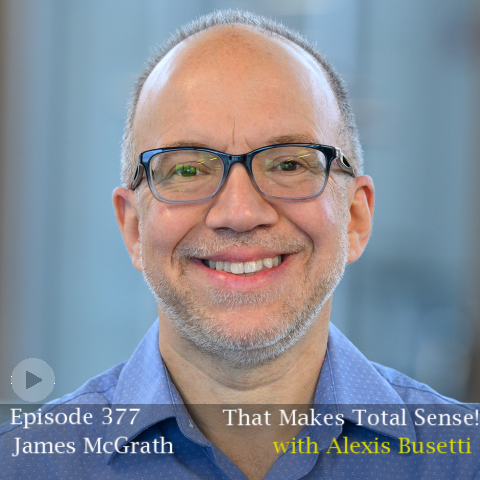
Oh my gosh. I'm so, so grateful to our guest today, James McGrath, for being on the podcast I started in our pre record, James, by letting you know that I've already recommended this book.
Full disclosure, I recommended this book 20 pages in and then I crossed my fingers. No, it was great.
The whole thing was great. It's called Beyond Deconstruction. Building a More Expansive Faith by my guest, James McGrath, who is, as we were just chatting pre record, a professor of New Testament language and literature, but a professor of New Testament at a secular institution, correct?
[00:01:29] Speaker B: Yes, that's correct.
[00:01:30] Speaker A: That's great.
I kind of want to jump in and use this as our diving board because again, as we were chatting pre report, I am not a biblical scholar.
Some folks who listen to the podcast or know me know that I haven't. I have an M. Div. From a seminary, currently in a PhD program. I know that. I know that. I know that. I'm not a biblical scholar. I appreciate biblical scholars. Scholars. I have friends who are biblical scholars. That is not me.
But what I want to ask is how, if you could tell us how your work as a biblical scholar shaped.
I would. You can flip it if you want. I would say a shaped the book because it did. It was very clear that it did. And also be shaped your journey.
Because this book really includes a lot of your own deconstruction, reconstruction, you know, journey in your faith. So I'm curious how your work as a biblical scholar helped helped form and shape those processes for you.
[00:02:43] Speaker B: Yeah. Thank you, Alexis, for the. The opportunity to talk about the book. I'm so glad that once you got past those 20 pages, it continued to live up to your initial impression.
I. I will say that, you know, as I'm somebody who finds theology in the, you know, systematic and sometimes not so systematic senses of the word, really important and engaging and you could have gone that route, but I'm very conscious that I didn't and that when people start talking about the details.
Yeah, it's. Yeah, we each have our areas of expertise and. But I love the conversations across those and certainly my journey has been one that has made me aware of the fact that even though there's often a gulf between systematic theology and biblical studies, if you're doing theology within a Christian or Jewish context or any context that has scripture as an important part of it, then those conversations need to happen.
But as, as is true of many people who have come, you either have grown up in or have come to a personal faith through some form of conservative evangelicalism.
Often our faith ends up being in the Bible to a very large extent.
And obviously there are things in the Bible that suggest that that might be problematic and we might get to that. But to the extent that that either is what one is brought up with or what one is told should be the case, or something that just one picks up along the way, then if you go to study the Bible because it is so central to your faith, one of the things that will happen is that you'll discover that the Bible is a lot more complicated, a lot messier, and simply just does not go along with and does not stay nicely within the box that, you know, a doctrine such as, you know, biblical inerrancy tries to place it within.
And that experience is what a lot of people have come to start describing as deconstruction.
And so this is a book that I actually had a.
Had an idea for for quite some time as, as people who, you know, as a result of doing this, you have been doing this deconstruction thing since long before the term was applied to.
Seemed to me that anyone who's gone through that has come out the other side with, you know, not just with their faith, you know, surviving, you know, because I wouldn't say, you know, my faith has survived in tatters or that I wouldn't say it's come through intact because it was transformed by the process. But I feel much more comfortable and, you know, invigorated and, you know, made alive by the theological engagement and the engagement with scripture that I have now as part of my faith than my experience prior to that, where a great deal of time and effort, right, that might have been spent exploring new possibilities was spent instead trying to get the Bible to toe the line of my doctrine about the Bible.
And I think sometimes all it takes is putting it that way to realize that, okay, so if. If you're. The Scripture's supposed to be your ultimate authority, and you're really having to, you know, sort of basically push the Bible around in order to get it to. To go along with this doctrine that you're imposing on it, then seems like maybe the Bible is not, in fact, your ultimate authority. Right. And it was that thought process that made me realize that, in fact, not only was my doctrine of Scripture a higher authority than Scripture itself, but as a result of that, the things I was finding in the Bible were not allowed to transform my faith in the way that they otherwise might because they couldn't challenge the doctrines that I was imposing on it. And once you've done that, of course, then the Bible can be made to conform to every other doctrine that goes along as part of the package.
And so that's why I, you know, I always appreciate when somebody asks me about the journey that went into the book because it helps me explain not just why, you know, as a New Testament scholar, I wrote this book that is, you know, about the life of the church and the life of faith and things that biblical scholars don't always write about, but also helps. Helps me really unpack why it is that, you know, I, I feel like my Christianity is more robust and more authentic as a result of, of having dare to take that journey.
[00:07:50] Speaker A: Yeah, thank you.
I've got this, you know, great list of notes, and I feel like I'm just going to end up scrapping many of them based on our conversation, which is great, but I, I want to, I want to move to a place that I felt initially a little hesitant to move to. But I think that your first answer kind of gives. Gives a good segue there. And that is, I would love for you to talk about fundamentalism.
And specifically, the phrase I have in my notes is that fundamentalism is fragile.
And I'm asking you to talk about that at this moment, because what's going through my mind at this moment is that you, you talk quite a bit about fundamentalism in the book.
But I have a feeling that that label sometimes causes those of us who have either been in fundamentalist spaces or maybe currently live in fundamentalist spaces don't really want to claim the label because of kind of what we, what we think it means or the connotations that go along with it.
But I think it's important to. So maybe I'll ask you to kind of help us define, define that phrase, that term a little bit and then talk about its fragility. Because as you were describing, for example, our relationship, many of us who might be listening or who would read your book, our relationship to the Bible as you described that description, falls into that fundamentalist camp of these, you know, having these doctrines and kind of the, you know, the gymnastics that sometimes it takes to kind of keep those things in check. And so I'll end with this and then. And then ask you to speak. Speak to it. But I would say just a note for listeners as I was reading and a note to you as I was reading, I didn't ever feel like there was some sort of us and them or some sort of bashing of fundamentalism or fundamentalists.
But what I really felt more was maybe as a student looking at this, saying, oh, I think this person is trying to help me understand kind of what fundamentalism is. You know, we say this, but can we separate the label for a minute and really just talk about the open the hood kind of talk about what's going on inside of it and what is fragile about that. And I think for many of us, I'll speak for myself. What ended up being unhelpful at best for me and harmful at its worst moments for me and my faith.
So can you talk about that a bit?
[00:10:56] Speaker B: Sure, yeah. And fundamentalism is not a label that I think I ever sort of consciously wore.
And yet with hindsight, I'm sure that I was at least adjacent to that space, if not firmly in it.
And part of that, you know, goes.
Goes back to some key aspects of my journey.
I grew up in the Roman Catholic Church, had an experience of coming to a personal faith in my teens, and that was through a Pentecostal church. Right. And so some of these terms that we use, like fundamentalism, evangelicalism, often people aren't aware just how recent they are in some instances, but also how much they've changed in terms of their connotations.
And so, you know, sort of in the. In the 1980s, going to a Pentecostal church.
One thing I will tell you is that Pentecostals did not typically think of themselves as belonging to the same thing as Baptists, let's say. I say this as someone who's not only married to a Baptist, but now is a member of, moderator of and Sunday, an adult Sunday school teacher in a Baptist church.
But, you know, the differences about, you know, things to do with the Holy Spirit and things like that were. Were felt to be much more important than the things that we shared in common. And yet, because Baptists often did the Bible study thing so well, Pentecostal young people would, you know, with. With some fear and trepidation still go to, like, Baptist run camps and things. And so it was all, you know, just really fascinating thing.
And at some point, you know, and the process surely. The process surely had started then but, you know, I think a lot of that was not things that people in youth groups were aware of, but the process of trying to forge that into a broader coalition of people who felt that, you know, conversion, personal faith were important and create a sense of collective evangelical identity. Right. And so one of the things that's happened is that terms like evangelical and fundamentalism, on the one hand, can be really useful ways of pointing in a particular direction to a broad phenomenon, but on the other hand, you can look very, very different.
And so Pentecostals might use the Bible in a lot of the same ways that, say, Baptist would or Presbyterians would. And yet, because the experience is so central, if somebody comes along and makes a persuasive case that, you know, about some, that you should think differently about a particular doctrine or something like that, it might not be as big a deal. Right. And so within evangelicalism, within anything that might be labeled fundamentalism, I think one has to.
You. Has to realize that, you know, those terms are at times unhelpful or at least are.
Are lumping people together that, you know, may not all fit equally well.
So in my, in my own case, you know, I sort of fell into fundamentalism, I guess you could say, to a certain extent. But even then it was, you know, or maybe I should stick with the term evangelicalism for the moment. But it. I went to study in the UK so being very vibrant and enthusiastic about this newfound faith, I wanted, not just wanted to tell people, I was immediately telling people, but volunteered for, you know, children's camp work in the Republic of Ireland because that's where my ancestors are from and still have relatives there and encountered people from other denominations and they cared about stuff. I mean, there. I remember somebody asking me, I'm pretty sure it was, you know, are you a Calvinist or an Arminian? And I was like a what or a what you. Because did not come up in, you know, the sort of the Pentecostal circles that I'd been in. And yeah, this was still, you know, only a couple of years into, you know, through my faith journey.
And that persuaded me that, you know, there's.
There's more to this thing that I need to learn and that differences of denomination and differences of culture were both important and so looked for and found an opportunity to study in the uk and one thing I will say is that, yeah, there is, you know, something that is very much, you know, evangelicalism in the uk and it. It does do the policing of the boundaries in the same way that I think all evangelicalism and all fundamentalisms do, but it is not nearly as dogmatic or as sectarian as American evangelicalism. And fundamentalism tend to be one thing that there, there isn't in British, British evangelicalism to the same extent, right. So I went, I started out in Evangelical Bible College in the uk but a lot of the big names in British evangelical scholarship, right? I, Howard Marshall, you know, FF Bruce, you comes to mind, I think.
Or is he American? Let me think. Okay, yeah. And then of course, my doctoral supervisor was Jimmy Dunn, who was one of those boundary cases where people are like, we're not sure he belongs in this group, right? Because he was suggesting. But think about somebody like N.T. wright, Tom Wright, you know, is, is somebody who, Anglican clergy, New Testament scholar without question, and sometimes gets labeled because he's a Christian who is advocating for certain viewpoints as an apologist. And that's another one of those terms that, you know, really has changed, Right. You go back and look at, you know, you look at the early apologists, you know, people like Justin Martyr and Tertullian, and the way they are engaging in a way that's not just resistant to the systems of faith in their time is not what most people that we label as apologists today are doing, right? There's this, you know, actual robust engagement with, with other viewpoints in a way that is open to borrowing what they consider to be good from them as well as pushing back against them.
And so all this to say that, you know, these, these terms are sometimes unhelpful.
But, you know, whether in the broad sense or the narrow sense, you know, I did sort find my way into this and it was, it took longer than perhaps it did for some who may have grown up in a different denomination and grown up in evangelicalism, period, for me to encounter biblical inerrancy as something that was being advocated. But what, but once it did, it certainly seemed like the sort of thing that I was supposed to be in line with. But precisely because I did my study in the context of the UK and because it was this profound experience that had sort of set me on this journey, I do think that I was able to come through the experience of discovering the Bible was not everything I assumed it was, with at least somewhat less trauma in the process.
But that's. That, I think, gets us to that question of, you know, what do I mean by fundamentalism is fragile, Right.
Even if there were aspects of, you know, my belief system that were more open than might have been the case if I had grown up being told this is what you must believe. You must, you know, stick to these beliefs at all costs.
If I'd had that earlier, might have related to that differently. But the experience that I had. Right. Was something that I certainly shielded from any kind of critical inquiry.
And so one of the things I think is true across the board with things that might be labeled as fundamentalism, and I'm going to resist the temptation to actually talk about the whole history of the term fundamentalism and where that comes from, which actually is an interesting story and didn't have all the connotations that it does today either.
But all of these ways of approaching the life of faith, whether they're focused on experience, whether they're focused on doctrine, which doctrines are focused on what is said and precisely. How about the Bible? Which texts are the most important and given the most prominence?
There's always this shielding of those things that are felt to be crucial to the worldview as affirmations of truth, of doctrine, and there's an attempt to shield those from scrutiny. Right. And that's what I mean by talking about fundamentalism as, as fragile. Right. And when, when we use a word like faith, right. I mean, it means trust, it means confidence, right. It, it means reliance.
And one of the things that I've become increasingly convinced of is that something that is calls itself faith and yet is spending all of its time fighting defensive battles and preventing, questioning and preventing close analysis probably shouldn't be called faith. Right. I mean, because there's, there's terror there. Right. And I think one thing that will provide like an across the board test of whether you have that sort of fragile faith or faith substitute is just how terrified you are of anyone challenging whatever it is that you've made central to that.
And so finding a way for faith to take on that confidence. Right.
The issue is ultimately, I think idolatry, Right. When you put your faith in the work of human hands, and that includes, you know, the Bible, which, you know, sometimes the author even names themselves, right. I mean, this as work of human hands goes it, it's, it's not denying the fact, it's affirming it explicitly time and time again.
But when we turn the Bible or a belief system or anything else into an idol, idols can't live up to the, the promise of a transcendent God. And what, what is our souls are actually searching for.
And because the idol is always going to fall short, right. It could, it, it could topple over and break. I mean, it's. Yeah. And the same thing can happen with a With a worldview, we have to defend it, we have to keep it. It partitioned off from other things, protect it from anything that might cause the illusion of certainty and of power to come crashing down.
And so it's that fear, I think, that indicates that one is dealing with that, that kind of fragility.
And it might be better, you know, maybe I should have come up with another term like, you know, fragile faith substitutes rather than. You talk about fundamentalism as fragile, because I certainly know never, never willingly embrace that label, even though with hindsight I can see how it's not an inappropriate descriptor. But it's. I think that fragility, you know, is. Is something that's an indication, an indicator that something is amiss in what our faith is supposed to be.
And that can be the case even outside of things that are normally labeled fundamentalism.
[00:23:16] Speaker A: So thank. Thank you for that one. I want to kind of pull some of these threads together here if I. If I can, as we move along. But when I.
A couple years before I started the podcast, and I think it might still be in some of the language somewhere, but it was this, this kind of realization for me, and I didn't know what it meant at the time necessarily. It was just kind of like a. Kind of like a hunch where I.
I had grown up in faith systems and culture that. And I'll say, like, don't get it twisted. My personality really liked it, which was having the correct answers is the most important thing that, like, really spoke to me. I'm an enneagram one.
I joke at my house that I have type A tendencies. My kids completely argue that not a tendency. Mom, this is. This is. This is real.
But that right answers part feels, like, really good to me. And so it was so easy for me to embrace that.
Knowing the Bible is part of that. I mean, I was in a Southern Baptist community where I did. We called them Bible drills back in the day. I know some people have referred to them as sword drills. We didn't call them sword drills. We called them Bible drills. But, you know, like, left hand on top, right hand on bottom, you flip open, you know, can you find the Beatitudes in a certain amount of seconds? I mean, you know, these kinds of things. But my.
I started to shift and I don't. I couldn't name it right now, but this is probably where I would say was like a. I had been probably already deconstructing at a point there where I just asked this question really of myself, which was, what if, like, what if this whole, like, walking with Jesus thing, faith thing, isn't actually about having all of the right answers?
What if it's about asking better questions?
And that felt like revelatory to me, but also felt a little blasphemous, you know, because what might those questions lead you to? And what does better questions even mean? And should we be questioning certain things and, you know, this kind of thing? And so your book really spoke to me especially I was thinking of the.
You have a quote from Sagan about having our God stay little.
And that's really what I took away from this book as a whole. If someone were to ask me, like, you know, what's the book about? And it's like, I mean, allowing your imagination, you know, to, to kind of discover how big and wide and wonderful and deep and loving and, you know, unimaginatively like, like we using our imagination to say our imagination really can't even grasp, you know, God divine reality as you, you know, sometimes use the term.
But in my experience, like that Sagan quote fundamentalism or things like that, I think you use, you may talk about certainty.
Previous guest Becca McNeil sometimes refers to evangelicals as certainty worshipers, which I think is just a great descriptor, but it's like, but that doesn't feel very safe, like this expansive kind of view. And so, and so there were.
And so I think Idol, I guess to come back to that, where you landed.
Idol is a fit descriptor in, in many ways. And I might want to go back to the Bible just a little bit, since I am talking to a Bible scholar to say you used an example. And I'll let, I'll let you, I'll let you say more. I've heard other folks talk about this, this kind of same example of like evangelicals or folks in this, in this sphere like to talk a lot about, for example, biblical marriage.
And there is, you know, this we, we have. But I'm, but I'm, I'll let you speak to it. I'll say you got to do a lot of gymnastics if you're really talking about biblical marriage to get to what most evangelicals who say biblical marriage actually mean when they say biblical marriage, because when they say biblical marriage, in short, it is not what's actually modeled or shown to us in the Bible.
So, so anyway, so just as an example, I would ask maybe if you'd kind of talk through that because I think it's helpful to say, like, when we're deconstructing, reconstructing, we do have to go through these processes where we're like, I've had this. For me, I would say I've had this correct answer for a really long time. And this is just one example of what this is. And that is the faith answer. And on our house, we might say, that's the Sunday School answer. It's Jesus, it's God. You know, that's the Sunday School answer. But that's. The expanse of it is very.
It's different.
They're not necessarily fully incongruent. But there's some differences.
[00:28:48] Speaker B: Would
[00:28:48] Speaker A: you say, James?
[00:28:50] Speaker B: Yeah. So, first of all, I can relate to the, you know, the desire for right answers.
And I think one reason why the. The journey gets to be traumatic for.
For some of us who get into the study of whether it's theology or biblical studies or anything related to it is that, I mean, the quest, you know, the desire to do research, the study, all this can initially make us feel like we're getting closer and closer to the right answers. Right? And if you're the sort of person who likes to think creatively, it's like, yeah, well, everyone else got it wrong. But I'm gonna get. I'm gonna get this figured out right, finally.
And eventually you get to the point where. Where, you know, thing after thing will come up, you know, and it's not everything, Right. There's some stuff where. Okay, yeah, that does seem pretty clear.
That's not how any of us sitting in our church pews understood it. But it's, you know, in light of the cultural background here, you know, we can understand it. But then there are things where, you know, every commentator discusses a list of options, tries to come up with something new, and feel like none of them is any more persuasive than the others because we just don't know right there. There are things.
Yeah. And this is not even like mystery in the profound theological sense that God is mysterious because God is transcendent and we are finite creatures.
This is mystery in the sense of we can't figure out what this word means.
It's a much more everyday sort of mystery or puzzle.
But unless we find other evidence, somebody else using the word that can help us figure things out, then we just don't have what we need in order to solve it.
And that's one reason why there's still room for people to keep digging and working. Linguistics and studying, you know, studying texts that sit in libraries but have never actually been translated. There's still plenty of work to be done.
But when it comes to things like biblical marriage. Right. Or any number of other things that one might think of that are promoted as this is what the Bible says.
I think there are two key factors that both show, you know, just how, how dangerous that sort of language can become, right. And how harmful and detrimental and how it can close people off from actually discovering what the Bible says.
So one thing that often goes hand in hand with these confident, clear, succinct statements about, you know, what the Bible teaches is, for want of a better term, biblical illiteracy.
Right.
It was much easier for me to say the Bible says such and such when I didn't know the Bible as well as I do now. Right.
And it's.
If you don't spend time wrestling with the, the complexities, then there's another thing that comes into the, into the picture is the, the phrase we sometimes use of interpreting scripture in light of scripture, right. So you start with the thing that you think is what the Bible is supposed to say, and then anything that seem. Say something else can't possibly mean that because we already know what the Bible says. Right.
And then there's a third factor which is the fact that we inevitably approach the text, you know, and especially, you know, when we're reading it in English translation. But this, this problem doesn't go away if you read it in, you know, you learn the biblical languages, right. We still bring cultural assumptions, you know, social norms, your customs to the text as modern readers.
And what marriage means today is two people, right? In, in our context anyway, two people entering into a relationship by mutual agreement, you with witnesses and so on. So, and one of the hardest things to notice when reading the Bible is what's not there, right? And, you know, find that time and time again and so noticing that.
So so much of the, you know, legal framework, you know, by the time you get to the New Testament, you know, there's, there are legal processes for marriage and you know, there's paperwork and things like that. Your papyrus work. Is that the. I don't know what the term would be since, you know, paper is in its modern sense is not a thing yet. But, you know, there's documentation and there's witnesses, but a lot of that is just social custom, right? That's there alongside the Bible. It's not something that the Bible actually offers.
And then, you know, to give one example from things I was covering because we were up to the biblical laws in my, in one of the courses I'm teaching this semester and talking through the fact that pronouns in Hebrew are gendered and so, you know, when it says, you know, you shall not commit adultery, it is speaking to the men and is making certain assumptions about what that means. Right. And what it would mean for a man to commit adultery in that context of patriarchal marriage and the possibility of polygamy and concubine age and things like adultery doesn't mean the same thing for men and for women in that context. Right. Whereas today, you know, if I ask my students, you know, what is adultery? And it's, it's, it's egalitarian. Right.
And if you're coming with that as your experience, then you, you may not even notice that the Bible is, well, for. Maybe it's appropriate word to phrase, to use, since it's literally doing that, but also metaphorically, the Bible is speaking a different language.
[00:34:36] Speaker A: I mean, I have a lot of questions.
[00:34:38] Speaker B: Ask away.
[00:34:39] Speaker A: I have a lot of questions, but I'm sitting. But then I, I switched gears for a moment into where I'm imagining myself in your classroom and say, what does that mean for men?
[00:34:48] Speaker B: Yeah.
[00:34:48] Speaker A: What does it mean for men in the New Testament versus women in the New Testament?
[00:34:53] Speaker B: Yeah. This
[00:34:54] Speaker A: is a total side note, but I'm, but I'm curious.
[00:34:56] Speaker B: Yeah, yeah. And I was thinking much more of, you know, because they were working through the, the Ten Commandments, but it's not clear that it had changed all that dramatically.
But in, in the Roman cont.
Polygamy was much less common. Right.
I mean, you have, you think about Herod Antipas, you know, you have serial monogamy rather than polygamy. Right. A lot of the time, which is also today is not that different in certain respect.
But he's not offered there as a model to be emulated. Right.
But in the context of the Hebrew Bible, you have several instances of, you know, one husband, multiple wives, concubines and, you know, handmaids or slave, enslaved people and all these things.
And a man can have these multiple sexual relationships and it's not considered infidelity, whereas if one of his wives or any woman were to do something similar, it would not be viewed in the same way.
And I think that's the sort of, the short answer.
[00:36:07] Speaker A: Right. That was my curiosity is like, is there something that would be considered adultery for a man at that point? You know, I mean, it seems like the, the gates are pretty wide.
[00:36:15] Speaker B: Yeah. If you sleep with somebody else's wife.
[00:36:19] Speaker A: That's right.
[00:36:20] Speaker B: Yeah. So
[00:36:20] Speaker A: that's right.
[00:36:21] Speaker B: Yeah. Yeah.
[00:36:23] Speaker A: I mean, yes. So.
So again, when we speak and I include myself in this, but I would say when we have spoken or when we speak, when fundamentalism speaks of biblical marriage.
We aren't really talking about biblical marriage. We're, we're doing, we're doing some gymnastics to, to get there, really.
I also had just a thought on when you, when you. The first thing you said, which I feel like gosh, could be its own podcast, was you said something, I heard you say something. Like, it's kind of easier for me to say what was biblical or what the Bible said when I didn't know the Bible as well.
And, and I remember. Laugh. That brought back this moment that I, I hope stays with me for a long time. But it was like when I was very first introduced to textual criticism in like a, I think it was a Hebrew related class. It wasn't a pure Hebrew class, but I had, we had to do a lot of translations in it. And the professor was basically just like, we're not going to get into fully, but I want you to be, you know, introduced to it in this context.
And, and I just remember it laughing out loud because I had been a part of so many, you know, cultures and systems and people I love and me, and me kind of being a part of that bumper sticker, the Bible says it and I believe it. And that settles it. And I just remember in that moment laughing again. I've confessed on this, on this podcast, this episode, I'm not a biblical scholar, but I just remember laughing and going, we don't even know what the Bible says. Right?
Like, how can we be so certain to put on a bumper sticker, the Bible says it, I believe it. And that settles it. When scholars for generations and generations and generations, and as you said, like, still trying to figure some of those things out, it's not necessarily, as you put it, the mystery of the word world. It's like we don't even know what this one word means in some of these places. And so how, how in the world could any of us, myself included, kind of just have this like, mindset of like. Yeah, that, that's, There you go. That's. That's the, that's the Bible. Like, what? It just feels so wild to me.
[00:38:56] Speaker B: Yeah. Well, one thing, even if we're interested in the Bible and trying to read through it and become acquainted with all of it, that doesn't mean we look at the footnotes, right? And those are the places that will clue you in, on the one hand, that there are differences between manuscripts.
[00:39:14] Speaker A: And
[00:39:14] Speaker B: on the other hand, particularly like the Book of Job, there's place after place where the footnote will say, the meaning of this Hebrew phrase is uncertain.
[00:39:23] Speaker A: Right.
[00:39:23] Speaker B: But the English is clear. Right. And I don't begrudge them that. Right. I mean, what are you supposed to do? You know, put something in that doesn't make any sense, just to give a. Give a sense of how it feels reading the Hebrew? I mean, but on the other hand, if you don't look at the notes, you don't get. Become acquainted at that depth, then you can have the wrong impression about what this text is and even how it functions.
Just coming back briefly to, you know, that whole thing about biblical marriage. You know, I think one of the things that, you know, has been helpful serving my journey and, you know, I sometimes talk about this with students, you know, help them wrestle with this, is that, yeah, part of. Part of the problem is the assumption that we're. We're supposed to be. And we're able to be biblical. Right,
[00:40:09] Speaker A: Right.
[00:40:10] Speaker B: As though there were some way that we could inhabit, you know, all, you know, do the things that we'd have to do in order to do that, which would be to inhabit all of the assumptions of these ancient people. Of course, you know, biblical texts are sometimes a conversation with one another, and so we still probably have to pick a side between, you know, some of them on some things.
But the.
The approach to marriage that we have now is clearly influenced by, among other things, some of the language that's used about marriage as a metaphor for Christ in the church in the New Testament. Right. And that idea of, you know, and the. The mutuality and things like that are not, you know, exactly what's described there, but it's certainly. It's inspired by There. It's influenced by that. And so there's a sense in which, you know, whether it's that. Whether it's, you know, the abolition of slavery, whether it's, you know, any number of other things, there are places where the.
The way we do things now is not biblical, but reflects the impact of core teachings of the Bible.
And I think that's more than okay.
But again, if you're looking for certainty and just find it too uncomfortable to grapple with the fact that, okay, we're gonna have to make a moral judgment here, and we could be wrong, take responsibility for it.
It's so much more comforting to believe that you have a book of answers and you've figured out what the answer is and you are no longer responsible for making a judgment call. You're able to turn to the definitive source which gives you the definitive answer in some manuscripts, if you don't look at the footnotes.
[00:41:59] Speaker A: So now I want to take what doesn't. I hope it doesn't feel like a sharp left turn, but I'm not really that scared of a sharp left turn at this point. So I kind of want to move. I kind of want to move from the biblical side to the theology side a little bit, as if they're binaries. They're not. We both know that, but they're completely interrelated. But I want to just name maybe the part of the book that, at least as I've continued to mull over, it had the greatest impact for me.
And that is because it's some. It's. I would say this. It's an exercise that I have hesitantly done, but have been a little afraid.
And then your book gave me some words and maybe a little bit of permission or encouragement to do it a little bit more fully. And I imagine that it will be something that I continue to do as my faith, you know, as, as I continue on my faith journey. And that is you, you, you talk in the book about when you were starting to kind of go through these ideas. You were blogging quite a bit and that there you had an atheist reader who basically gave you a challenge and kind of said, if you had a time machine.
And as I understand, I want to ask you to kind of explain it a little bit better, but if you had a time machine and you could travel anywhere, is there something, is there. Is, is there something that you could witness that would basically put you in a position where you're, you're, you didn't believe anymore. And I even kind of use that in a weird kind of. Because I'm like, I don't know how much, how much is belief, how much is, you know, but, but you know that word. I don't. I hesitate to say, to use, to use that word, but, like, would there be something that would make a dramatic difference for you? I think in the negative was kind of the point of the challenge. And so you took us through a couple of those exercises for you that felt really meaningful for me. And so I'm wondering if it's not too much of a spoiler and if you're up for it, if you would share a little bit about that.
Because I feel like that to me. Cut to the quick. Like that to me, kind of gets to the heart of, at least for me, like, what am I afraid of? Am I, you know, what is it that might make me kind of lean More towards the. Yeah, it's about the answers, the correct answers, and maybe not as much about those questions.
[00:44:52] Speaker B: Yeah. So just by way of background. Right. For, for listeners who may not know me or other than the introduction, as a New Testament scholar, one of my side areas that really took off and became its own area of focus is work on the intersection of religion and science fiction.
And so I am a big sci fi nerd. And so this thing was getting at like was. Was hitting the sweet spot. I mean, it was speaking my language. You know, this person is offering me a tardis.
But I'm also engaged in grappling with what we can know about Jesus as a historical figure.
And one of the things I found myself really wrestling with at key point and, you know, some studying the New Testament is what can historical tools tell us about the past? And can you apply historical tools to something like the Resurrection. Right. Because history deals with probabilities and you know, God raising Jesus from the dead, I mean, describing that as probable, I mean, that just doesn't seem like, like meaningful, appropriate language. Right.
And so many would say that historical study just can't give you those kinds of answers. Yeah, but a time machine, maybe it could. Right. And so this was just a really helpful thought experiment, you know, in so many ways for thinking about the things that were important to me and doing it using, you know, an imagined tool that I had imagined you had watched watch shows about and things.
And the challenge came from an atheist who said, you know, pose the question as what would it take to make you lose your faith?
And first choice was go to Jerusalem. You might have to hop around a bit to get the right year because there's some uncertainty in dating. But once you track down the right year, identify the right tomb outside the walls of Jerusalem, get there presumably once everybody's also observing the Sabbath. I mean, how does Sabbath observance even work when you've got a time machine?
Let's not go there, but then wait and see what happens.
And as I thought about it, what I realized is that, you know, on the one hand, you know, there, there might be things I could see that would confirm my faith, but if I go and witness, you know, the, the crucifixion, the aftermath, and see that the Romans actually tossed Jesus body to the dogs. Right. As one scholar had imagined it would have been a more typical fate, or don't, don't close the, you know, the, the tomb off sufficiently and you know, dogs can get in and you know, scavengers get in and devour the body or anything else like that, would that mean that God could not have vindicated Jesus beyond death? Right? I mean, the idea that, you know, if you burn the body of a martyr, therefore, you know, you and scatter the ashes, you know, or feed them to animals, then they become part of another island. So it gets too complicated for resurrection to work. I mean, that's. That should not be how we view resurrection, right?
And so, I mean, that did take the.
That question outside of the realm of, of history and of proof for me, right?
And one of the things that this person was challenging me about was, you know, to get out whether my beliefs were unfalsifiable. And I realized that was one where it really was not a historical matter, right? And so it was something, you know, that, you know, either you. You affirm or you don't affirm, you hope or don't hope.
But I wasn't done with the thought experiment. I was like, okay, you know, so that, you know, it did seem like maybe nothing would be definitive, you know, I mean, because it still left me with, you know, it was still challenging to me in the sense that it's like, okay, but I still can't prove what happened, right? And so I'm like, I'm not sure this is helping me. But then what I realized is that if I were to go, like, just to spend more time, as long as I've got the time machine, you observe the life of Jesus. And the way I've often told the story, because that's the thought that popped into my head at one point is, you know, I mean, if I saw Jesus kicking a puppy,
[00:49:10] Speaker A: right,
[00:49:10] Speaker B: that's gonna, that's gonna, that's gonna challenge my, my belief system in a whole other way, right? Because it's just sort of about the character of Jesus, right? And I realized that the kind of person that Jesus was and is that that was in. In some ways more central, right?
If I can't, you know, if I can't answer the question of, you know, or can't prove what happened to sort of the. The life of Jesus beyond death was somehow less make or break, you know, it's because, like, nobody can. But if Jesus is not who I think Jesus was, then that's, that's, you know, that's something else. And, but what this. This made me realize is that, you know, this challenge from an atheist, you know, the person assumed, you know, okay, if you lose your Christian beliefs, then you become an atheist. And often Christians think that way too. And I said, you know, this might.
There are things I could see if I had a time machine that might lead me to no longer apply the label Christian to myself.
But my faith and my, My sense that there is God and there's meaning and that of transcendence was something deeper and that it was not.
You know, there are other ways. There are other, other ways of affirming that that don't involve Jesus. I mean, I guess, is the way to put it. Right. And so I realized that, you know, changing your beliefs is not necessarily the same thing as losing your faith.
And that, I think, was the most helpful thing that this thought experiment made me realize. Right.
And if you couple that with, you know, coming, becoming persuaded that, you know, that there is an ultimate, that there is, you know, source, you know, that some reality simply exists, you know, and so you become persuaded of that, the search for truth and as much understanding and getting as much stuff right in relation to that ultimate reality is something that one can do without, without any real fear. Right?
Yeah. You, you talked earlier. You use the term safe. You know, that some of the exploration doesn't feel safe. And immediately what sprang to mind was that, you know, that that quote from the Narnia series, right, where somebody asks, is Aslan safe? It's like, you know, of course not. Right? But he's good, right?
And I realized that the thing that could cause me to lose my faith, like, at that core, deepest level, would be, you know, if you can go. If I could go billions, trillions, quadrillions of years into the future.
And when I get to that point, me and my time machine is all this. There, like there's nothing. There's no God, there's no universe, there's nothing that might undercut my faith that there's. There's a meaningfulness and a goodness sort of at the, at the heart of, of reality.
But ultimately, you know, it also made me a lot more comfortable realizing that it's okay to have faith.
As somebody who was spending a lot of time looking for proof, looking for evidence, looking to see what I can prove, reading apologists saying, you know, the resurrection proven beyond doubt and things like that, realizing that, you know, as a human being, despite the illusions I had for myself when I early in my studies, I am not going to solve every mystery and, you know, crack every puzzle and resolve every conundrum, and that's okay. And that, you know, on the more everyday level, when I view other human beings as of inherent worth, that's not something I can prove in a science lab. Right. It's it's, it's a statement of belief, it's a conviction.
And not only is that, okay, life is impoverished if we only live with what we can demonstrate through, you know, rigorous laboratory testing. Right.
That has its place. Right. And I think we should, you know, if something is demonstrated in the lab, we should make it part of how we view the world. But that's not the only kind of thing that is important to human life and to existence more generally. And so yeah, this thought experiment, I mean the person thought it was going to basically cause my worldview to come crashing down. And it actually helped me figure out what was foundational, what were things that I'm perfectly happy having them there. But in theory they could be replaced and the structure would still be there and the foundation would still be there.
Also led me to write a short story about time travel to 1st century Jerusalem vicinity, which if you haven't read it, I'll tell you where you can find it.
[00:54:10] Speaker A: Yeah, actually why don't you. If you do that, I'll put it in the show notes so that people who want to grab that I'm looking at the time and I want to go one more place before we, before we end. And I want to give you free reign to end it how you want. But
[00:54:30] Speaker B: so I'll give you the story. The story is called Certainty and it was published in my book Religion Science Fiction, but I think I got permission to have it republished, reprinted somewhere else. And so I think if you Google James McGrath certainty, you can find it online. But I can also send you the link to that.
[00:54:49] Speaker A: Okay, perfect, I'll put it in there. I'm making those notes now.
Let's see. Short story. Okay, I want.
You've got a.
A shortish chapter on experience and, and as you were talking, this is coming to my mind and, and I will say just, just a little bit that just who knows at. At the risk that this might be interesting to. To you or to someone else.
As I mentioned, I'm actually starting third year PhD today. So I spent all summer in just. In methods like just swimming is very generous in drowning in methods, work, philosophy and praxis and you know, all of the things and, and it was very different. My husband has a PhD in the hard sciences.
So lab work, lots of the data looks. Is there but it looks different. And this was kind of my paradigm. Plus all of those great shows that I like to watch of people in the labs with gloves and little pipettes or whatever you call them. Anyway, my type of research will not Be like that. It'll be very different.
But it's exploring people's experiences.
And something about that speaks to me because really, with this methodology, as a researcher, I'm not going to be as concerned necessarily about the facts of what happened like a journalist might be, but really more how did the person experience what happened?
That's what I'm interested in as a researcher, and not in the sense that the facts don't matter, but also in the sense at the same time that the experience is also true.
And.
And when I was reading this chapter, of course, because I think many of us, when we're in this thing, everything gets filtered through what we're learning and, you know, all of that. But I'm reading your chapter on experience, and I'm like this.
This is one of those. You could say it's a tricky place. But it isn't really in the sense that when we have an experience, religious or otherwise, it is true.
Right. Like, there is truth to it. It is true to us.
And you use some examples there, which I have thought of before as well, you know, kind of especially in days where, you know, like, evangelism was central to my faith practice. And you say, how do I speak to someone who has also had an experience?
Just like I've had an experience.
But I.
Without discounting, you know, so anyway, so I'm wondering if you could kind of talk about, in this deconstruction reconstruction, just a little bit about how faith experiences impact that journey. I mean, it's. That's a really big question. But maybe if you want to give just some personal examples or if you want to just share, like kind of your. Maybe your paradigm for that now.
[00:58:23] Speaker B: Yeah. So the background to this and the reason why that was the. The thing that got the least scrutiny for the longest. For the longest amount of time on my faith journey is that my coming to. My coming to a personal faith was me after, you know, wrestling with a lot of. A lot of difficulties and challenges as. I mean, and some of them were more typical teenage things, but, you know, not all of them.
Just feeling at the end of my rope and really searching very much in a. Something of a sort of a seeker phase and having been invited to a concert at a friend's church and having already found that there were people who could sing about their faith in a way that, you know, I could not as somebody who was very into music. And yet that was not something I could do because I.
There was something to their experience, something that they had that I did not.
And at this concert, again, people, you know, just singing and singing things like, you know, I say, yes, Lord, right? This, just talking to God in surrender just, it moved me to tears. And the following morning I just called out to God and said, I don't know what your way of living is, but my way is not working. So whatever your, whatever your way is, I want to try it.
And had this sense of, of peace come over me. And it was, you know, I knew essentially instantaneously that, you know, my life was going to be different from that moment on.
I distinctly remember it was working at a local music store. And the following day, the, the owner was sort of jokingly saying, you know, nothing matters but money. You know, just doing a funny thing, you know, kind of, you know, or something he thought was funny. And, you know, I was like, what about God? And we sort of, you know, as the conversation unfolded, somebody said, you know, when did you get religious? And I said, yesterday, this was Monday morning, right? And it was like, you know, and it was always
[01:00:30] Speaker A: literally though,
[01:00:30] Speaker B: you know, but literally, right. And it was, it was, it was so strange. But I immediately knew that this is, you know, I feel different and I need to talk about this.
And when I'd talk with people in my school, you know, they would sometimes say, you know, well, you know, I'm sure, you know, there's something psychological there. And I would be like, no, no, it's not, it wasn't psychological, it was spiritual.
And with hindsight, I realized that, you know, if it's a human experience, then it's psychological. Right? I mean, it may also be spiritual, but we don't actually have sort of a means of, of completely bypassing the brain. I mean, presumably if we did have a way of having experiences that completely bypass the brain, then there'd be the question of, well, then how do we remember them? Because, you know, the memory seems to be in the brain, right?
And obviously there's whole thing of, you know, what is an appropriate Christian anthropology that takes into account what we know about biology and psychology. And I'll leave that to the theologians. Right? That gets well beyond biblical studies.
Yeah, it's important to know the limits of our, of our fields, especially when we reach the end of our expertise and are hoping the person hosting the podcast won't ask us awkward follow up questions. No, but seriously, I do find those questions and I've never felt comfortable just stopping there. It's just that I know I need to go and, you know, find other people who, who actually focus on those things and Figure out where the work I'm doing maybe from the Bible end dovetails into those things. And you know. Yeah, but anyway, so, so what I try to do now is to, you know, on the one hand, you know, make room for experience.
Recognize that.
Yeah. Even, even if things, activities like prayer have become much more puzzling and mysterious and less clear cut, I know that my, my inner life, you know, and my moral discernment and other things suffer if I do not do that.
And how much of that is because I'm, I'm voicing things, you know, in a way that is conversational and how much is because there's something happening that, so no, someone else could not experience if they, you know, unless they had the same sort of faith again, I do, I have no way of knowing that. Right. I can't experience someone else's experience directly.
And there's no way that I can sort of get outside of the, the limits of my, my human psyche and view things from like a God's eye perspective.
And so in recognizing that, you know, there's importance to, and limitations of my own experience, I think maybe the most helpful thing I've discovered in pursuing that is recognizing that, you know, as much as, you know, when you do PhD research to talk about something that we can both relate to, we are, are doing our, we're trying to make our own individual contribution.
And yet it's full of footnotes and it, you have a mentor and you have, you know, and it's, you're joining a conversation.
And so none of us can do this thing alone.
And so always being open to hearing about other people's experiences I think is important.
And where that became difficult was when people who I disagreed with doctrinally and thought that they were terrible heretics were saying that they had a religious experience. And I was like, no, you can't have, because that's our thing.
And so things like that are maybe the experiential equivalent of discovering a contradiction you can't resolve for the person for whom biblical inerrancy is the more foundational thing.
But sooner or later, you know, the fragile faith, the fragile fake faith, the fragile supplement for faith substitute for faith has something that it can't, it can't courageously investigate or pursue and figuring out what's wrong there so that we can have a faith that doesn't need to be afraid. Right. That can pursue the, the truth and not feel afraid.
I think is, is when we get to the kind of faith that actually doesn't, doesn't need to be constantly on the defensive and, and we can live it, and we can experience joy in it. Right. Rather than fear.
And when we do that, I think people see the difference and, and it offers something that many, many with that sort of fragile worldview, need, but also the world in general needs. Right.
And I think we can spend a lot of our time, if we've come through that route, just trying to help others along on their journeys. And that's important.
But, you know, you mentioned evangelism earlier, and while, you know, I don't know that I ever use the term nowadays because of how, you know, all the connotations, you know, I'm never going around with, you know, giving out tracks with four things God wants you
[01:05:54] Speaker A: to
[01:05:55] Speaker B: know or something like that. But I, we, we have something that's worth sharing, right? And not sharing in a way like, you know, I'm right, you're wrong. I'm going to tell you all about. But this is my experience, right? And for most Christians, that's the only thing that you can actually share with someone. Right. If you have limited biblical literacy and you get in a debate about the Bible, you might lose. Right? And then you feel like you, you've been a, you've been a failure or your faith is inadequate. You know, making sure you have that kind of personal experience of faith gives you something that you can then talk about with others, Right? Because as you said, that's, that's your own. That's, that's your, your truth.
What was happening in the brain, what was happening in the mind, what's happening in the soul? Those are your other questions. But you had the experience, and you, and all of you can talk about that.
And by doing so, you're bringing something to others that to at least some extent, they don't have.
[01:06:53] Speaker A: Yeah, okay.
I realize I'm eking out trying to get one more. Trying to get one more question, if you have it.
When I talked with professors, a lot of times, I like to ask this final question, and I'll give you a moment to think about it because I'm going to go through a little bullet point here from the book.
But the question is, what's the question I didn't ask?
So, like, if we were in a classroom and you're like, I love this topic. I'm really enjoying this conversation. The class is awesome, and, ooh, I really wish we would have gotten to this one thing and we didn't, and the bell's about to ring or however, you know, whatever time is about to be Up.
What's the one question I didn't ask? Now? I'm going to give you a moment to think about it, if you don't already have something in your head, because I might just go through a quick. I told you I had a list of questions and we didn't get to half of them. So I'm just going to kind of. They weren't formulated into questions, but for listeners who may be ready to push by on this book, I'm going to say these are things we didn't get to, but really.
Anyway. But I noted them here.
So while you're thinking, I'm just going to throw these out here.
That reconstruction is as DIY picture was super helpful in our homes. I have parentheses faith, we seek an illusion of safety, which we've talked about a little bit.
Let's see.
[01:08:25] Speaker B: You've done some DIY work, haven't you?
[01:08:27] Speaker A: I've done a little DIY work, yeah.
[01:08:29] Speaker B: I can usually tell. Right.
People who find that particularly meaningful. It's like, I see what's underneath the floor.
[01:08:36] Speaker A: Oh, gosh. Not as much as that. Yeah, yeah. Not, not. Not that kind of diy. I've done. I've done some of the. The DIY faith work. And then the other stuff is way too scary for me, to be honest.
Let's see. Collapse is due to structural issues. I think that's why it scares me. Static faith equals a dead faith.
Let's see, what. I can't even read my notes on that one, so we'll skip it. Oh, gosh. Paul going against the Bible kind of as, you know, as he was. As he was writing the Bible, which, hello.
Specifically in inclusion of uncircumcised Gentiles, just as an example, Jesus placing emphasis on doing and not doctrine.
The way that you use the term ultimate reality or divine reality, which you touched on a little bit, was really helpful for me.
Embracing uncertainty as a positive expression of faith.
Fundamentalism being threatened by a progress in knowledge.
Let's see, we talked about Sagan's quote.
There was something in there about when we're reading a story, how we kind of equate who are the villains and who.
Who are the heroes and how that is not always helpful.
And then, yeah, just a little. Just another little side note about how fundamentalism hasn't ever been actually the normative or dominant form of Christianity. So, anyway, so those are my bullets. Please don't even. I mean, if one of those rings with you, great. But I'm really curious about what you might say.
We didn't quite get here, but I would love to say just a final word on it.
[01:10:20] Speaker B: Yeah, I mean, you managed to get to so much and you did that sort of speed round at the end, which I loved that you just got those. It's like, yo, good. I'm glad you mentioned that. I'm glad you mentioned that. That's good.
If there was one other thing that maybe, you know, might be helpful is leaving room for imagination as. As a. As actually a positive tool in the journey of faith.
That thought experiment. Right. It was me imagining.
And I'm actually gonna be talking at an event that's coming up in October.
It's called Theology Beer Camp. Not sure if you are familiar with it.
And for those who are wondering, I mean, yes, there is beer, but I think that Trip Fuller, who came up with this thing, put that in the title mainly because there are people who would show up at a thing called Theology Camp and then start giving everybody a hard time who will not show up at a thing called Theology Beer Camp. And so you just self select out and then it's a place for people who are open to exploration and things like that. But it's actually going to be a session about depictions of Jesus in particular, but also other biblical stories in film and television.
And I remember when I started watching the Chosen, like I watched the first episode because this was a thing that people were talking about.
And then I was like, okay, I can't do it is because I'm gonna have to blog about it. Like, I'm gonna have to write stuff about it because, you know, there's so much here I. I have thoughts about.
And there are moments when it. I think it does. Some things are really interesting and potentially helpful. And there are places where I feel like, you know, that I really don't think that gets at what this story is about or this character was like or what's going on here.
And there's some things where it's just there because the biblical texts don't give us enough most of the time to make a television episode, much less a movie.
And even if TV and film were not a thing, our minds fill in the gaps because that's what we do. We. We love stories. We process things as stories. And a lot of us in the Bible is story and in story form. But it's always the case that stories assume things, right? Whether it's about geography, about people groups, about relationships, about customs, things like that.
And so that's where learning about culture and cultural background actually sometimes helps fill Things in, in well informed ways, right? Without that kind of well informed, you know, sort of drawing on what we know about history, we will still imagine. But our imaginations can take things in, in directions that the biblical authors could never have imagined, right, because it reflects our culture and our assumptions.
But sometimes we just imagine things a particular way and we don't realize we've filled in.
And then we don't realize that there are other possible ways of understanding the story, right. Some of which might have important things to say to us.
And so becoming aware of imagination, becoming aware that not all of our imagining is good and does good things, but that imagining is necessary and unavoidable. And so working to use our imaginations. Well, I remember I still haven't been able to track it down and maybe this is a good opportunity to ask a theologian because I had thought it was in a book by John Macquarie. And then I've looked through the book, I've searched it and I haven't found it there. But I remember at some point, you know, when I was really determined to, to solve doctrinal questions about Christology, you know, doing the systematic theology type thing, was talking about the, you know, things related to the hypostatic union and you know, the, you know, whether the, the, the humanity of Jesus was, was it a, a hypostatic until the hypostatus, hypostasis of the Logos was talking about all these technical things. And this person who was talking about the history of Christian doctrine said, yeah, this is, this is beautiful, amazing language. How can any human being claim to know these things?
Right?
[01:14:41] Speaker A: Yeah,
[01:14:42] Speaker B: like about what's the.
And so, so much of our theology is imagining and that's not necessarily bad, right? We want answers to questions. We need to know how to think about this thing, right?
We need some sort of mental image, right? Because, you know, God is beyond what we can, can ever describe.
But we can't just stay silent, right?
We have to think, we have to speak, we.
And so we use our words, you know, symbolically, we use our thoughts imaginatively. And recognizing that, you know, imagination closes doors, that it would be helpful if they remained open for our faith. But that imagination also makes this positive contribution and an essential contribution to the life of faith.
All, all human worldview involves imagination. It involves things beyond what anyone can prove.
And so, you know, imagine, you know, freely, courageously and ethically in service of your faith rather than fearing things as, you know, oh, well, that's just imaginative. The imagination as, you know, people like JRR Tolkien and CS Lewis have hopefully demonstrated to some extent has a, has a positive role to play in the life of fate.
[01:15:59] Speaker A: I love that. Thank you so much. I remember when I started using the term for myself, my theological imagination and it felt, it felt uncomfortable at first and now I love it. I love it. So thank you for giving us that reminder and the permission I think for some to, to utilize that God given gift that we have of our imagination.
James, this has been so great.
I will say the name of the book again and put the notes. I just, I just looked up that theology beer camp as you were chatting. That looks like a great lineup by the way. This is going to air after that event, unfortunately, but I would say my guess is it looks like it's an annual thing. So
[01:16:45] Speaker B: yeah,
[01:16:45] Speaker A: sign up for next year, I guess so. That looks great.
The name of this book is called Beyond Building a More Expansive Faith by New Testament scholar James McGrath. James, this has been a real pleasure to have you with me and the book was incredible. So thanks for writing it and thanks for coming on.
[01:17:04] Speaker B: Oh no, it's been my pleasure. I've really enjoyed our conversation and I genuinely hope it won't be our last one.
[01:17:09] Speaker A: Thank you.
The links for all the resources mentioned in today's episode can be found in the show Notes, music and podcast production by Seth Buscetti. Be sure to give us a review on itunes and subscribe at your favorite podcast listening app. You can also Visit us at thatmakestotalsense.
Com sam.