Speaker 0 00:04 Hi and welcome to. That makes total sense. The podcast where we talk about faith, finance and everyday life in a way that makes total sense. I'm your host Alexis BU city. On this podcast you'll hear the personal stories of friends I'll be interviewing who are doing familiar things in new and innovative ways. We'll answer questions specifically about money and our relationship with it and we'll explore faith and Bible teaching together. In all of these. It's not about changing our convictions as much as it is about messing with our methods. We'll have a lot of moments here together where we pause and say that makes total sense.
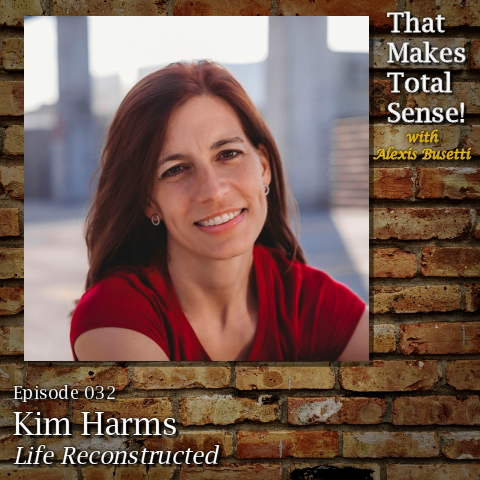
Speaker 0 00:44 Hi, I'm Alexis <inaudible> and welcome to that makes total sense. Today I am privileged to bring you a wonderful conversation I had with Kim harms. Kim is a wife and a mom and a freelance writer and a cancer survivor. She has a website and blog called life reconstructed and is putting the finishing touches on a book that will be released next spring by the same title. Kim. Today on this shows shares her story of being diagnosed with breast cancer and then being faced with the difficult decisions that followed that diagnosis, including the one to have a bilateral mastectomy and reconstructive surgeries. Kim is one of those people I'm so thankful for who has decided to share her story publicly. And this helps all of us people who are going through a similar situation, those of us who are trying to support someone in a similar situation. And I just feel like with her sharing her emotions and thoughts and struggles, um, it gives words to some of us who are trying to cope with this.
Speaker 0 01:58 So whether or not you have someone in your life who has gone through this, we do sets sister, my sweet sister in law, Rachel has been going through treatments for breast cancer. And so we're looking to support her and love her. But even if you don't have someone in your life that this is directly affecting, just listen to Kim story. She talks about her faith. She talks about looking at her whole self, not just her body and, and who she is to the Lord. And I really think this conversation will bless you. So here it is. My time with Kim harms. Hello everybody. Welcome to that makes total sense. I am Alexis <inaudible> and I am so excited to introduce you to Kim harms. Hi Kim. Aye. So Kim, uh, and I connected very, very recently and I will tell you it was one of those crazy Google search things for me. I was looking online at one of my favorite magazines, Christianity today, and saw that Kim is a contributor for Christianity today. And that led me down one of those, everyone's been on those, right? Those wild goose internet chases and, and saw, Oh my goodness. Her story. Like I just really connected with Kim's story. I'll let her tell you about it, but primarily because I'm walking with my sister in law right now who's going through a similar stories. So Kim, thank you for being on the podcast today.
Speaker 1 03:28 Oh, you're welcome. I'm really glad that you invited me.
Speaker 0 03:31 So would you just give us some context, give us, you know, like, are you married, do you have kids? Where do you live? Um, what do you do kind of, what's your everyday life look like?
Speaker 1 03:41 Right, sure. Yeah. I am married to my husband, Corey. We've been married for 21 years. We live in, um, Huxley, Iowa, which is about 20 miles North of Des Moines. Um, so Midwest girl lived in Iowa my whole life. Uh, and Corey and I have three kids. Our oldest Carter is 18, and he'll be graduating in may. And then we have Owen who is, he'll be 17 in a couple of well weeks and he's a junior and then maybe Lewis is 12 and in sixth grade. So we've got three boys. Um, so I've got a crazy wild house of boys. And then we've also got a crazy dog, which I was never going to have, but I do have one and he's growing on me. So
Speaker 0 04:25 I love it. I love it. I, we have, uh, four kids, two girls and two boys. And I'm like with all of my friends who are boy moms, whether they have only boys or whether they have like more than one boy, we tell our other friends who have one boy and maybe some girls we say, listen, there's a difference between one boy in the house and more than one boy in the house. Like, you know, like you're, yes, you're a boy mom with one boy. That's true. That's great. But one boy and more than one boy there is just like night and day difference. Right? I mean three boys, I can't even imagine.
Speaker 1 04:59 Yeah, it's, it's a while. It's a lot of fun though. I really love boys. I'm like, I'm sure if I had girls I would love them just as much. But part pardon me, thinks what would I do with girls? I'm so used to boys. I just know, I know boys.
Speaker 0 05:11 No, that's the truth. That's the truth. So Kim, can you tell us just like a little bit about, um, about some of the writing that you do and we'll get to the book maybe in just in a minute. We're not maybe, but we'll for sure get to the book in just a minute. And then about the organization and then that will kind of lead us into, um, into the book and the story that you're writing and how God has really impacted that part of your life.
Speaker 1 05:37 Sure. So I am, I'm a freelance writer and I've been writing for years. I graduated with an English degree and a journalism minor before I had kids. I was a newspaper reporter and then I stayed home with them for a lot of years. And then when my youngest, I don't remember how old he was, um, probably preschool ish, I started doing some freelancing, um, and just kind of built into that. And, um, I've been freelancing from home for, you know, very part time for, for most of my kids' lives. And, um, yeah, so that's kind of my, I guess, professional what we would say. But, um, as far as where I'm at, do you want my story of cancer and just kinda how that came into my life? Yeah, let's do it. Let's talk about the cancer. Um, I'm like, I do want to at some point mention the 500 dresses.
Speaker 1 06:35 Oh yeah. You want to talk about that too? And so, cause I guess, cause I want it to be out there because I know that it's, I mean obviously something that's close to your heart and I think that it's, it's super cool. So maybe if we just talk about that and then we'll go into that. Yeah. So, um, I have a connection to Haiti. When I was in college in the mid to late nineties, I went, when did I go? Um, 97, I think it was my first trip to Haiti, kind of. I was, I had actually been planning to go to Asia that summer with, uh, with an organization that I was involved with in college. Um, that was canceled because of political turmoil and stuff over there. So, um, a friend of mine said, well, I'm going to Haiti. What do you want to go with me?
Speaker 1 07:15 And I'm like, okay. So I went and just stayed kind of connected with that over the years. And then, um, it was actually probably around 2010 or so. Um, I just, I don't know what caused it exactly, but my best friend and I were just, we were both like, we, we have, um, we have so much and what can we, what can we give, what should we be doing? We, we, we should be, um, contributing to the cause of Christ more than we are. And, um, that ended up with her taking a trip to Africa and, and making some connections there. And I ended up going back to Haiti. And it's funny because my, my mom is a seamstress and growing up she taught me how to sew, so I knew how to sew. But to tell you the truth, I don't even like to sew, but I know how to say it.
Speaker 1 08:04 But, so it kept coming to my head. We could, so some dresses, let social dresses. I talked to my mom and we were just, it was going to be a onetime thing. Um, but it ended up being, um, kind of a continual thing where we were, we would sew dresses and we'd, um, except dresses from people. It's sold them and sun dresses basically for kids in Haiti. And we'd send them through a ministry that's been there since early eighties, um, called mission to Haiti. And then that kind of morphed and I was invited to go down and teach sewing classes. So I've been down there three times to teach sewing. My mom has been with me two of those times. Um, and through that we also got a connection also through this mission to Haiti organization to a bridal, um, rental business. So when Haitians rent their bridal gowns, um, and then they like the bridesmaids dresses.
Speaker 1 08:57 So we started taking donations of, um, wedding gowns and bridesmaid's dresses and we shipped those down. So that's primarily what we do now. We don't send as many sun dresses. We're not making dresses as much anymore that we do send those some. But we have kind of morphed into trying to support the, the bridal gown business. And then in connection, um, there's also a, this, uh, when we went down to teach was a vocational sewing school down there that was, uh, started by a pastor who, um, is in bodega Haiti, which is part of Port-au-Prince or Capitol. And it started out with just like a tarp roofie, you know, they're outside or teaching on treadmill sewing machines, you know, um, they had a generator, so we had a few, a couple of machines that were, you know, modern. Um, but they're in the process of building the building a building right now for the school.
Speaker 1 09:48 So they're actually using the building, but it's not, there's like not a roof on it. It's got tarps and it's just been a slow, uh, process. Um, but where you're hoping to go down mom and I again, um, sometime probably in the next year or two and, and do some more teaching. But that's, that's kind of that. And we've, we call it 500 dresses, cause our goal was to send 500 dresses and, um, between the sundresses and the formal gowns, I think we're probably around 2000 or something like that. Now. Um, so yeah, that's when a really cool thing to do with my mom too, because that's a passion of hers. Um, and I kind of am, I kind of go along and help her, but that's, that's super cool. And, and correct me if I'm wrong, but the, so the rental, the bridal rental that really does help support, like those are local businesses.
Speaker 1 10:37 Yes, it does. That's a little business. Yes. Local business. So it's a, it's a Haitian woman who runs that business and it, um, it provides her, um, like financial support. So it's the, the mission to Haiti, the organization that that's kind of all under, um, is the people who started it live in Miami and are based out of Miami, but they, they travel monthly, um, to Haiti, but they've been there so long. They have, um, most of the people who run the organization in Puerto Prince are Haitian. So it's, it's some American started and kind of overseen and, um, but they have a lot of Haitian, fulltime employees down there. I won't say a lot. It's a pretty small organization, but so, um, so it's really cool to see that it's benefiting, benefiting them. And then this, um, her name is Madam Bennison who runs the, the, uh, rental business. Um, yeah, it, it provides for her and then there at the sewing school, they're also going to be starting, I believe, to do a rental and, um, a bridal business too. So really cool. I love it. I love it. Thank you so much. And actually one of our, one of my good girlfriends, um, here in the States, in college, she rented her bridal gown, like she rented it
Speaker 0 11:54 in Dallas. And so that was, yeah, so that was super fun too. Um, but she, that was a like a, like a frugality thing for her and she, you know, just said, Hey, I'm only gonna wear it once and what are the odds that my daughter is actually going to be the same size or like my style or want to wear it or whatever. So she picked out what she wanted and got it. That, you know, for the day of, at a heck of a discount. Right. And she got to wear the gown that she wanted to wear. So that was, so that was super cool. So I see that practicality in that, but so thank you for sharing that. I know that's not exactly, you know the crux, that's not why I asked you to come on today. But part of the reason I wanted you to share that is because I feel like one of the things that God is speaking to me more and more and more is, and it's like this is kind of a duh thing, but it's like he has built us all to be multifaceted, you know, so it's like we might have this one thing that is our focus or maybe it's our focus for a season or something like that.
Speaker 0 12:47 But if we will allow God to grow us, you know, then we can minister. And I feel like we can minister in so many different areas that maybe we didn't even realize it. You know, where you find someone who you say, Oh well they're known for X, Y, Z. They're known for this one. You know, this one particular thing. And then you look and you go, yeah, but they're also like a heck of a teacher or they really love scuba diving and there's weird time, you know, or whatever it is. And it's like just kind of a God reminding me of like how he built us to be multifaceted and, and rounded and um, and that we can really minister, you know, in a lot of different areas. Even though we might, you know, he might give us a focus or might give us something in a season or for a lifetime that's kind of like, that's your gig.
Speaker 0 13:32 But, um, you know, that we can do all these other things. And so to me that was kind of an, an example of like, yeah, I want you to come on, we're going to talk about it. We're going to talk about cancer today. We're going to talk about Kim's story. We're going to talk about how she got through it with Jesus. And I love what, when I emailed and she said, I don't know how people do this without Jesus. And so we're going to talk about that. But I also just think it's cool because you're a writer and you, um, and you know, and you do these, this charity work and you do the all of this other stuff too. And, and, um, all of that is about part of who God made you to be. So, so let's dig in. So, um, we're going to talk about cancers today.
Speaker 0 14:10 We're going to talk about breast cancer. And so while we definitely won't, you know, get graphic or anything like that, I just do want to let you guys know that we're going to be talking about, you know, this sensitive topic of, of cancer. And so I just want you to be aware when we get into the conversation that that's kind of where we're going to head. So Kim, why don't you just, I mean, you just take the floor, just tell us your story and I'll maybe interject with some with some questions. Okay. Um, yeah, so I was diagnosed with breast cancer when I was 40. Um, I actually turned 40 on December 20th of 2015 and was diagnosed on January 20th of 2016. So a month after I turned 40, um,
Speaker 1 14:52 and I actually found the cancer myself. Um, I will admit that I was not a regular monthly checker of my breasts, but it happened to be, um, at my bra line, um, where my underwire would hit and it kinda hurt. And I was like, Oh, there's, there's something there. And I thought, I really didn't think a whole lot of it. I thought, Oh, it's probably not a big deal. I almost talked myself out of going to the doctor. I'm like, okay, it's, I'm sure it's not a big deal. Um, but I went to my doctor and she's like, you know what? It looks, it feels, it looks like a SIS to me. I'm not very worried, but let's go get it checked out. You know, you're 40 anyway, now you should be starting your mammograms. And, um, when it's, you know, we should have it checked out.
Speaker 1 15:34 So I went, uh, then have a mammogram. And, um, then immediately from there they sent me to an ultrasound and still not totally worried, but thinking, okay, so ultrasound and then the nurse are doing the looking at my images is like, we need to bring the radiologist in here. So then I started getting nervous and he was, um, he was really quiet when he's looking at it and then he's just like, well, um, we need to have a biopsy. So several days later I had a biopsy and I will never forget what he said to me because I, yeah, he said, um, well, I've got good news and bad news. The good news or the bad news is you're going to be sore for a couple of days after the biopsy, but the good news is in a couple of days you'll know whether or not you have cancer. And I thought, how was that good news?
Speaker 1 16:28 Like what? That's not the way you should put that. But, um, but yeah, so I, uh, it was supposed to find out two days later, um, the results, but my family doctor, who I adore, the results came across her desk. Um, at the end of the day, um, the day before I was supposed to find out. And so she called me at home and, and told me and my husband was there. And, um, I just kind of collapsed into him. And, um, yeah, it's just, that's something you want to hear. But it ended up being a blessing that I heard a day early. And I know that was a God thing because nobody, everybody knew I had the biopsy. Nobody was expecting results for another 24 hours. And so Corey and I had this time to just like settle into that and figure out, okay, how do we tell our kids, how do we tell our parents?
Speaker 1 17:18 Like some of those things that we had a little time and I, that was really, um, that was really a good thing. And, um, we were able to, I told just a couple, um, people, uh, before I told, we told our kids so they can be praying and stuff, but, um, the next, the next day we told the kids. And, um, at that point, I didn't know, you know, I just knew I had cancer. You hear that word. It's so scary. It's just a scary word. And, um, didn't know how far it had progressed or, or anything. Um, so that was a kind of, that was a really scary time not knowing where it was at. But then after I started, uh, you know, I saw my surgeon and, and um, started seeing doctors and found out, um, that I was stage one, which was fantastic. Um, and knowing that I had a plan it got, it was like, okay, we can do this.
Speaker 1 18:12 God has me. Um, he'd have me no matter what stage it was, but it was a relief, you know, that it was, it was a stage one diagnosis and I was able to, um, I did not have to have chemotherapy. Um, and I'll tell you a weird thing like I, it's a struggle for me. I speak to people about the struggles I went through with breast cancer, with body image and just a lot of struggles I had. And I'll have guilt that I didn't go through chemo. I mean it's the weirdest, you know, you just like, Oh, but you went through chemo and so what can I say to you? Because I did not go through that hard thing, but I'm learning that God has us each in the place. He has us for a reason. Um, and I probably wouldn't have written this book that I'm writing if I had gone through chemo cause my story would be a lot different I think.
Speaker 1 19:00 Um, but all that to say to come back to you, I, um, I had a bilateral mastectomy so I had both of my breasts removed. One of those was recommended to have one breast removed. The other one, um, you basically can choose, you know, do you want to have them both removed or do you know there wasn't cancer and the other breast, but I just decided at age 40, um, let's just do that and then I'm not, you know, it's just one less thing to worry about for the rest of my, my life. And I know people who have chosen to just do a single, a unilateral mastectomy. Um, but yeah, that was my choice. And then I had breast reconstruction and then I am on, um, hormone therapy. So for 10 years total, I've got six more years on hormone therapy, um, which I haven't had too many side effects from.
Speaker 1 19:52 I take a pill every morning. I've had hot flashes and things like that from it. Um, but hasn't been too bad. So that was, that was kind of my journey. Those are the things that I went through. And then, um, just this end of the summer, uh, it was in the news, I don't know if you saw anything on this or not, but um, there was a certain type of implant that was recalled because it's linked to causing cancer. And I had that implant, so I had my implants removed a couple months ago in exchange for a different set. So it's just been this crazy, um, crazy kind of journey for me. But funny thing, if you look at the silver lining, um, this is my second set of implants. I, I actually liked them better. They changed the shape of my boobs a little bit and I was like, Oh, I actually like the shave butter. So, if anything good has come of having to go through that again, I like maybe better.
Speaker 0 20:49 No, I'm like, I'm, I'm sitting here going, we're laughing about boob shape at this point and you know, and you're, and you're just sitting here telling me you got diagnosed with breast cancer at age 40. Um, so I mean, the first thing I'm just like, while I'm forming my thoughts, it's just like, wow, thank you for sharing that with us. I mean, it's a lot and I know that you're, you know, probably you've, you've spoken to a lot of groups in your writing about it and you're kind of, you know, quote used to sharing it at this point, but, um, but it's, it's still a really tender place, you know, and I think I, I just want to say like, I hear that, you know, like every time you share it, it doesn't make it any less your story and it doesn't make it any less sensitive or I could see you going back.
Speaker 0 21:34 I mean, I felt like I could see you almost going back and reliving, you know, the diagnosis moment and things like that. And so, um, I just, I don't know, I just want you to hear like I can, I can hear that in your voice and I see that and I recognize it. Um, and, and I want to touch on the chemo for a moment. Um, because, uh, the, the, the phrase that came into my mind, and it's, and it's not like I don't want to put this on you at all, but I'm kind of thinking it, putting myself in in this spot. I'm kind of thinking, I think my feeling it would maybe be guilt. Like you said, I didn't have to go through that, but I was kind of thinking what I feel like kind of, kind of like not as much a cancer patient or something, you know, kind of like, Oh, these, these guys are the real deal cancer patients because they had to go through chemo or they did this and I'm, you know, I think, you know, like they, they throw that word around like this imposter syndrome, right.
Speaker 0 22:31 And I'm like, you know, it's kind of like that. That was the thought I had of like, Oh my God, is there, is there even such thing? Like what a weird phenomenon, what a weird thought that just like popped into my head of like an imposter syndrome when it comes to cancer, you know? But it's like you didn't kind of go through that quintessential almost like Rite of passage, right. For a lot of cancer patients, which is chemotherapy but got just because God didn't have that as part of your story doesn't make your story less than, does it make your story less impactful? Does it make the cancer itself, you know, um, any less scary, you know, or anything like that. But I just kind of even think, Oh, that's like a frustrating thing for me. I'm just kind of talking to think right now.
Speaker 0 23:14 But like this kind of frustrating thing that the enemy can even take something like that and try and twist it, you know, and say, well, this wasn't whatever and you're like, I'm just like, shut up. You know? Like this was one of the things that is not a good thing, but, but God, God's business is redemption. And he turns things that are not good into things that are for your good. And he turns things that are not fun and things that are for his glory. And, um, and that's what he did, you know, that's he did and what he's doing with you. And so I just, I just kind of, that that kind of triggered in my mind of like, man, that's kind of a wild thought. You know, that I'm this, so many people that you speak with did have, did have chemo. So can we talk about that with the book for a minute? When you say you think maybe if you had chemo that maybe you wouldn't be, you wouldn't be writing the book that you're writing. And so wha what, what do you mean by that? What would you think would be the difference in your story? Um,
Speaker 1 24:17 I think, uh, the story is the book I say at the beginning of the book, it's not a cancer book. Um, and I say that cause I think if, if I had run the whole gamut of that, I think there would be more about, um, just the hardship of going through chemotherapy and the side effects that you have for Matt. Um, and how that affects your family and being sick in those, those kinds of things. Um, but since that is not part of my story that the book focuses, um, really on, when you, what happens when you lose your breasts? Like it's, it's about cancer. My cancer story is in there, but you know, I, I speak about, um, body image. I have a chapter on the difference between a boob job and breast reconstruction because people will say, well, you at least you get a boob job.
Speaker 1 25:15 Well, no, not really. I can't, I can't feel my boobs. I don't have nipples. Like, it's not the same thing. Um, and I talk about physical intimacy with a changed body and, um, how it affects relationships and, um, and things like that and how to choose like whether or not how to choose, but kind of, I interviewed many women who chose different things. Some people who choose to stay flat or what type of reconstruction to choose. So I could really focus on, I guess the breast part of it and not so much on, um, getting through cancer, but getting through, um, the piece of your body that's missing or changed. So that's kind of way where I think, I don't know what God would have had for me had I gone through chemotherapy and other pieces of that. But I do know that the, if I had written a book and had a different story, it would, it would be a different book.
Speaker 0 26:16 That's right. So, so let's talk about, let's talk about breasts then. I mean, you know, like, let's, you know, because I think that it's like this, um, we know, um, I would say we know as believers that God has made us like body, soul, and spirit, right? Like we have these things like all of these, again, this multi-facet, but it's like these are parts of who we are. And, um, and so for example, um, I, my grandfather lost his legs below the need for, um, due to diabetes and type two diabetes. And, um, his disease was not under control and he ended up losing, um, both of his legs below the knee or, um, I have a, a cousin, he, my grandfather's passed away now and my cousin has passed away now, but they, um, he had cancer and lost, um, one of his legs, uh, below the knee or, you know, we, I have, um, you know, my sister-in-law, I'm not, I am not going to share her story, but she is a breast cancer survivor. And so she was faced with this, you know, decision about mastectomy and what does that look like and all of this. And so I think that those of us who have never gone through that personally or maybe who have never known anyone who has gone through that personally, and I'm not even saying is knowing someone that it's the same thing, but like we,
Speaker 0 27:46 I don't know, like this is not something you think about like losing a part of your body. What impact does that have on you when you lose an actual part of your body? And I would say I think that culturally we view breasts very, very differently than we do limbs, right? Because we say, well, you can function without your breast or you can, you know, you can do this or you do that, but if you lose your legs then you have to, you have to have a prosthesis or you have to do this or we have to do those. But like there are some things that are different, but there are some things that are very similar I would guess. Right? You can say this, like the, we, I'm losing a body part due to a disease that is a, that requires some sort of mental reshaping or emotional reshaping. So I guess my first question is, can you talk to us about your decision to have a bilateral mastectomy and then just flow from that of like what, what that process was for you to lose both of your breasts and then to make the decision to do the reconstruction and, and kind of take us through that path for you.
Speaker 1 28:48 Okay. Yeah. So I, I decided pretty quickly, well, it's weird because you get the diagnosis and you have to make decisions pretty quickly. Um, so, you know, you don't have a ton of time to think through things. But I, I did decide, um, pretty early on that I wanted to have both of my breasts, um, taken, um, just for peace of mind and you have cancer and you think, okay, just get it out of me. What is that? What is the thing I can do to make this, to get this over with and not worry about it anymore? And that's kind of weird thinking because you just cancer's kind of, once you've had it. I don't, I don't dwell on it, but it's always there, you know, in the back of your mind. But, um, aye, I saw it, um, kind of some advice from women that had been through it before.
Speaker 1 29:40 Um, when I was making that decision and not one person told me, Oh, just do, just have one remove just, and so I didn't even think about that really. Um, I had a cousin who went through this years ago and she's like, have them do both. And I have a, um, another woman who I spoke to who had a one removed and she said, I think you should, I think you should on both removed. If I were to go back, I would do that. Um, you know, since the process has been over, I know people that have chosen the other way and had I spoken to them and I was like, what? I've made a different decision. I don't know, but you can't go back. But, so that was, uh, I made that decision pretty quickly thinking, get the cancer out of my body. And at that time you're not thinking about, Oh, how is this going to affect the rest of my life?
Speaker 1 30:28 Because like you said, and you think of your boobs, Oh, I don't need him anymore. You know, I'm a nurse. My kids, I've, I've never smoked. I mean, I just don't need them. So I didn't, I didn't even think how it would affect me. Um, like affects me emotionally and psychologically after I went through the surgeries. Because you're not thinking about that right away. You're just thinking, okay, how do we take care of this? And, and you're right about like, like the losing of a limb. And I, um, I was looking for a quote, I can't find it, but, um, as I was writing the book, there's, there's the U S national library of medicine actually talks about losing limbs and just the effect that has on you psychologically. Um, and it also mentions losing things like, like a breast and the fact that it's not like an arm or a hand that you use, but it's still, um, it's still can affect, um, how you think about yourself and how you feel about yourself. And as I was reading things like that in my research, it actually made me feel better. Like, Oh, okay, this, this is normal. I need to work through this. But, um,
Speaker 0 31:34 right. I mean I was thinking just as you were talking, sorry to interrupt. I was just thinking like, even like people who, um, you know, I've known some people who like have gone through the, some sort of weight loss surgery, right? And you think like they're not losing a part of their body. There's, you know, some functionality with, you know, some of their, their, you know, gastrointestinal tract and stuff like that, but just even the effect that that is going to have on their body. Like usually the people that I've spoken with have had to have like some sort of preemptive like discussion with counselors or maybe they go to groups or things like that, right. To prepare them emotionally for the changes in their body because it's an optional surgery for, you know, many people that have it. It is an elective surgery, but I just kind of think wow, like that.
Speaker 0 32:29 Like it just kind of hit me like that change in their body is going to have such an emotional impact that it's really recommended that they start with some sort at least talk therapy or something like that. Right. To kind of prepare them and to kind of continue going through that. But I think like when you're saying like you're forced to kind of make decisions really quickly, you're just thinking, get the cancer out of me. And, you know, kind of hearing you say that, it's like, wow, but you know, but that's, that's impactful. I don't know, I'm kind of like, maybe we should do a better job right above. Um, you know, having some of these like, uh, anticipating some of those needs, right. For women who are going to be going through that kind of surgery because, yeah. I think you're not necessarily thinking most many people may not necessarily be thinking longterm rest of my life kind of thing. They're thinking exactly like you, like, let's get this out, let's get this taken care of, but then you wake up and the cancer is gone, but so are your breasts or what do you do? Right,
Speaker 1 33:27 right. Yeah. Right. Yeah. I, it's, it's a crazy, weird experience. Um, and hard, very hard experience. But I, but yeah, I think even as you're talking about, um, like people losing limbs and things, um, as I've talked to women, I have a, you know, my best friend has had, um, multiple C-sections and just, you know, you think our culture wants, our culture tells us beauty. Is it right? Like you have, you need to have the perfect body and the perfect boobs and, um, and all of this. And you see it, your mom bartered everywhere with it. And we look at magazines and we see these pictures and they're Photoshop and not even real, but still we're drawn to that. And so I think even in a, in a smaller way, like some, somebody who maybe has a huge scar from a C-section or, or something like that can, you can relate to that.
Speaker 1 34:17 Cause you, you feel you're, it's, you're different and you don't maybe feel as as pretty or as whole, um, as you did. And it causes you to just have to really work through what, okay, what, what makes me me and is it okay that I'm sad about this? Is it okay that I'm struggling with this? And, um, I really had to fight through some of that. And, you know, um, and you can interrupt me if you have any questions, other questions. But I'm thinking about, uh, like I said, the culture telling me that beauty is it, I, I kind of, I looked at that and, and I thought, okay, that's what it says. There is something to beauty, but culture lies all the time. You know, these businesses that are trying to, um, advertise, they don't care about my emotional wellbeing. They want me to feel dissatisfied so I buy their products.
Speaker 1 35:09 So you have to look at that and be like, okay, they consider the source. Right? Right. Yeah. Right. So, so then I'm like, okay, so I can't trust culture. But you, you look at the natural world though. I, I would, I look at nature and I'm like, there is beauty out there. I mean, that is real, that the mountains, there's a reason that, you know, thousands and thousands of people go to Rocky mountain national park every year. There's a reason that all the beaches are full of resorts because are drawn to natural beauty and, um, natural beauty that that beauty that God created is not trying to convince me of anything. It's just beautiful. And it's there. And as I thought about that, I'm a God created me too. And when, when he created humans, he didn't just say it was good. He said it was very good.
Speaker 1 35:54 So, um, so culture aside, if I look at creation, what God created, I started thinking, okay, it's, I think it's okay to be sad about this because God created this beauty. He created beauty in the human form. And, um, you can even look at scripture and the scripture, you know, there's a focus on the internal cause that is really the key important thing. But you know, there's a, there's a proverb that says, let her breasts satisfy you always. And I read that and like, I don't have, I don't have that anymore. So, Oh my goodness, that makes me, you know, a little bit sad. And, um, there's, you know, a song of Solomon, all the imagery, weird imagery. But, um, of the beauty of the human form. And, um, I really got to thinking through, okay, um, I am sad about this and I think, I think maybe it's okay because I think that, um, there is some value to the human form.
Speaker 1 36:53 So I would say to anybody who is struggling with the loss of, of a piece of themselves that, um, it's OK to be sad, you know, it is okay to be sad. And I actually read a book, uh, as I was kind of going through this and it's called Wednesdays were pretty normal. It's by a guy named Michael Kelly and it's his walk through leukemia with his little boy. And he, um, this quote actually was really one of the key things that gave me permission to, to grieve my breasts. Um, and it, he says, we often think about the grieving process exclusively in terms of people. You lose someone close to you and you lament that loss in personal and profound ways. But the same process happens, I believe, to other areas of life too. And in the end, grieving is about loss and finding your way through life with that out, that thing that is not there anymore.
Speaker 1 37:44 And I was like, Oh, that exactly as where I'm at. Um, so that is kind of where, uh, I came with the body image, um, getting to the point where, okay, I can be sad about this, but what do I do now? Like, right, so, so that was going to be my question. It's like, okay, so what's the answer is like, is it okay? Is it okay to be said about that? Yeah, of course. I think that that's a good answer, but even the process of wrestling through that, right? Because it's kind of like you said, like there's, there, there is some talk scripturally about the body and outside and it's very good and all of that. But then there's so much talk about the internal and God looks at the heart and all of that. And so I could see where it's kind of like is, yeah, like is this even, is this even, okay, what does this even say about me? That I'm wrestling
Speaker 0 38:36 with the loss of, of this. So now it's okay to be sad and it's okay to, to grieve the loss of part of yourself. And so through that grieving process, that is the next question is what do you, what do you do now? Because this really could be anyone, like you said, I relate to the woman with C-sections because, uh, you know, I've been there, done that twice. Um, you know, one was not my choice and then one, you know, and ended up being, but it's like, but now the body looks different. Or, um, even just, I'm just saying, even for people who have been completely blessed to be so healthy and not had an illness seriously impact their life or an accident, seriously impact their life. I mean, we can even talk about aging in this context, right. To say like this person, you know, like I, I'm, I'm, we're on the way to church the other morning and I'm talking to my husband and he keeps looking like at this part above my forehead.
Speaker 0 39:33 And I'm like, what are you looking at? And he's like, it's just that one. If I could, I just gonna I'm just gonna pull that one gray. I'm like, don't you touch it? But being distracted, you know. But it's like we were, you know, we're married almost 17 years ago. I didn't have any gray hair. 17 you know, so it's like even just these small things of aging, I think maybe it's even natural in this to say we're, we're grieving kind of what we use to look like. Or if we put on weight like, you know, we may, there may be part of us that say whatever it is. We were not looking in the mirror at the same person as we were five years ago or 10 years ago or 20 years ago. And it will continue to be that way. So, not to lessen someone who said their body impacted by illness or injury or accident, but even just to say, I think this is a universal message for all of us, right? That our bodies are going to change. And so what do you say when you say yes, it's, it's okay. God has given me permission. I've wrestled with this idea. It's okay to be sad and to grieve this, but now what do you do? Because you can't live in a state of sadness. You can have that. Like you said, it can be in the back of your mind and those things, but, but you're not going to live in a state of sadness. And so what do you do moving forward?
Speaker 1 40:48 Um, well, looking at scripture, so I talked about there are places in scripture that talk about a physical, natural beauty, but as you've said, the internal beauty is, is key, is more important. So I think the important thing was, okay, allow myself the opportunity to grieve because it is real and it is sad. But let's, let's put this in perspective and look at how God created me as a whole person. And he cares. He cares so much more about my heart. You know, he does not my outside. Sure. He created it to be a beautiful and good, but it is my, the internal that he's concerned with. And um, I, I everybody knows the Proverbs 31 woman, you know, you read that chapter about how I'm just amazing. She is. And um, there's one little verse in there that talks about physical beauty and the, that verse says that it is fleeting.
Speaker 1 41:48 So I take from that, okay, physical beauty does exist. It is a real thing. But look at this whole chapter about this beautiful woman and all the beautiful things about her except for that little piece that says beauty is fleeting, are about the internal, you know, she's, she's an amazing mother and wife and a business woman and she, she's just wise and she knows how to take care of her household. And um, so that, that helped me to put that in perspective. Like, yes, it's okay. Beauty is exists that does exist. It is fleeting. Um, the internal is, is more important. Um, and you know, I even think about people in my life, um, and you can probably think of someone in your life too. But when I think about from beauty, um, what comes to my mind is my aunt Marilyn who is, um, she's a wonderful woman.
Speaker 1 42:38 She's an average looking woman like me. If you saw her on the street, you would think that she's an average looking woman. Um, but I look at her and I see that I see beauty, um, because I can, I see beyond her hair and her face and her eyes. And I see this woman who her parents were killed when she was a teenager and she has left to raise her siblings. Um, her husband, my uncle, um, died. Uh, he had, uh, liver transplant that he never recovered from. Um, and then her son had the same liver disease and he had had a transplant as well. And he's doing great like 16, 18 years later. I'm not sure. But anyway, I tell her story to say, okay, I look at her and I see that she is beautiful because her inside shines to the outside. And I think we can look at historical figures and do that too.
Speaker 1 43:29 Like think about Abraham Lincoln, he's the ugly guy. Look at a picture. But you don't think about that. You think, Oh my goodness, he was, um, helped with the abolishing slavery. So, uh, I think perspective is just so key. Um, and uh, there are, you know, you could talk about a ton of places in scripture that talk about the value of the internal, so, so yes, um, it is okay to grieve. Um, but it's also key to just have, um, have a, a good perspective on how that should work. Um, and, and what your, your focus should be. Um, but I S if you don't allow yourself degree, if you say, um, okay, I can't, this is, I need to just get over this. Um, the internal is the only thing that matters. I think what will happen and what happened to me as I struggled through it at least is that, um, you're still sad. You've still got that sadness, but you lay or guilt on top of that because you don't think you have a right to grieve it because it's not worth
Speaker 0 44:32 grieving. And that becomes just this horrible battle. So you need to really get yourself to a point where you can grieve that and that it's okay. You know, it's, this is different than the loss of, um, a person who you love. You know that, that grief is different and, and immediate and, um, it's just, it's a different level. But that doesn't mean that you can't also grieve the piece of you that's different or changed or missing. So for sure, for sure. And thank you for pointing that out in Proverbs 31 because I think, um, the women who are listening would say, like, we, we all almost have that chapter memorized, right? And I think for some of us, I'm going to raise my hand here. It's not necessarily because we like love and rising scripture and are so great with this. It's like this woman is out of her mind.
Speaker 0 45:22 It's like, you know, like we think sometimes I cannot live up to this woman, whoever she is, but I had never put that together. That the only verse in that particular chapter that talks about beauty talks about how it's fleeting. And so it's, it's not to say that beauty is unimportant, it's just to say that there is a context for it. Right. And I think that that's what I hear you saying. And um, and that, that's really, that's really an important part of it. I also love what you said about the natural beauty that God created this natural beauty. It's not really trying to convince you of anything. It's just beautiful, you know? And um, and I think in the same way, like even your changing body and your changing story is beautiful. You know, it's a beautiful thing. You know, it's like part of the reason that we love natural beauty is I think it's both of those things.
Speaker 0 46:14 It's the stability and it's the change. You know, like our family loves to go to Taos, New Mexico, and it's like we love to go there and we, and we haven't been in the summer, but we always talk about going in the summer because it's like, can you imagine all of these things that we see that are covered in snow and they're so fun to ski and all of this, this, this beauty, this majesty of the mountains. When the seasons change, this snow is gone. But it's totally beautiful still. There's, you know, you can see the green of the trees, you can see, you know, the grass, you can mountain bike and do different things. And so I think, you know, part of what I'm seeing in your story is like, you are who God created you to be. And then there, you know, there was a change in this one's not seasonal, you know, this one's, you know, permanent to a degree, but that you can be that kind of mountain that God made and then experienced these different times in these different seasons.
Speaker 0 47:08 And that even in the change, um, that can be beautiful as well. So when you talked to women in particular about body image, even women who, you know, still have their breasts, maybe they haven't experienced something like cancer or another, uh, injury or illness that would change their bodies. But I think that body image is something, I mean, I would almost go out and say 100% of women struggle with this, but I'm saying it's like probably in the high nineties. Right? Like this is a universal problem. And so when you speak to women about body image, what do you encourage them with? What is the truth that can be combined with that beauty? What is the truth about God and the truth about them that doesn't change no matter what their bodies look like?
Speaker 1 48:03 Well, yeah, the truth about God is that he, um, like I said, he created the external and internal and me, they work together. And that that internal is, um, is, is so important. Um, but what I think a lot of women struggle with, and probably men too, but is that we have these voices in our heads that keep telling us things that are not true about us. And so the important thing is to fight those. Cause I think that, and even before I struggled with this body image and really had to think about what I was thinking in the voices, wasn't what they were telling me. I know that I lived my life, like having voices tell me things that were probably not true in my head and just kind of, you know, you just kind of live. And, um, but then when I was, I was forced to really think through what my mind was telling me.
Speaker 1 48:58 Um, I had to fight those voices and his first career, second Corinthians, um, I don't know. It's around verse. I know. It's right. Second Corinthians ten five says that we demolish arguments and every pretension that sets itself up against the knowledge of God. And we take captive every thought, making it obedient to Christ. Uh, so reading those words, um, and, and struggling with thoughts in your head, which I know all women do. Um, it says take captive every thought. Uh, and that word captive is active. So I would say you can't just live your life and try to ignore the voices in your head. You have to take that voice that says, I'm not whole anymore. I'm ugly and say I am whole, I am different. God has made me different and he's making me new. I am not ugly. I am beautiful in a new way. Um, and you have to actively work to bring yourself to it, to a good place in regard to body image. It's not a, okay one time thing. Um, I hear what you're saying. I'm going to just be okay now. It's a, it's a daily battle. It's still a battle for me that I fight. I would say that I'm in a good place now, but um, but it is one of those thoughts come, you'd have to fight them or they will convince you of things that, that aren't true,
Speaker 0 50:22 don't you? That's so good. And it's, it's active. It's for, it's for sure. Active. I'm actually reading Jennie Allen's book right now that I think is so good. I'm going to put it in the notes, but, um, it's called get out of your head and it's talking about stopping toxic thought patterns. Right. And she, you know, of course it talks about that verse. Um, but it's a very, very, it's a very active process. I remember years ago, I read, um, Joyce Meyer, kind of one of her big books was battlefield of the mind. And I remember that the, this was, Oh gee, was, this was probably a or more years ago when I read this and <inaudible> the quote that was revolutionary to me at the time, and I still think about it, is she said, just because you have a thought doesn't mean you have to think it. <inaudible> and I thought, what is this woman out of her mind?
Speaker 0 51:12 Because I mean, I'm like, I, I'm kinda like, you are. I'm like, I had recognized there were voices, they were probably telling me things that weren't true, but I just kind of thought that's just how you lived, you know? And, and for her to come in and say, just because you have a thought doesn't mean you'd have to think it. It was a huge light bulb moment for me. Right? It was a, it was a huge one. And I think, but it's like, but that doesn't mean you just ignore it. That's, that's not how you accomplish, not thinking it is ignoring it. You have to do exactly what you said. You have to do what scripture said. You have to be active and you have to take the thought captive. You have to actually do something to change it. And what I would say, I have noticed over the years in my life, even as I had struggled with body image, which was a serious problem for me, um, in, in high school, mostly in college and my, in my young adult years, um, and as I had friends who surrounded me, who were, we were kind of working this battle together.
Speaker 0 52:08 Um, we would check up on each other. We would say, how's, how's the body image thing going for you lately? How are you feeling regarding this? And we would, um, it wasn't, you know, necessarily quote, holding each other accountable. It was just like, we were really trying to fight this together. I felt like they were my foxhole friends, right? Like, we, we've, we're in this war together, we're going to fight this. And more and more and more, even as my body has, has changed over the years, I feel like the, it's like the whack-a-mole thing, you know, it's like the more you punch it down, the more you take it captive and make it obey Christ, then the less it tends to pop up or with, with less frequency, with less Gusto, you know, it's like I'm not whacking nearly as many moles as I was, you know, now at age 38, I'm not whacking nearly as many as I was at age 18 or even at age 28, you know, and it's not even just about age, it's about, it's about changing, you know, and all of this stuff. And I'm noticing, you know, certain seasons and cycles and I'm just saying, um, I think I've whacked it so much. <inaudible> it's, it's tired now.
Speaker 0 53:20 Those voices are getting more tired in my life. Right. And I mean, I know that, that we have a different story, but you're in a good place now. Have you noticed that that's part of it?
Speaker 1 53:30 Yes. Yeah, it definitely, I think it's like, like anything, like do you think about physical activity? If you're going to start running, it's really hard and exhausting at first, but the more you do it, the more it becomes, um, it's, the more the easier it becomes and the healthier you feel. And so, um, I think the same thing can help happen for us internally. Other people don't see it going on, but it's, um, I think a similar concept. Um, if you work at something and you, it improves. I mean, it's just kinda how <inaudible>
Speaker 0 54:05 so I don't want to put you on the spot necessarily, so if you don't have any, that's totally okay. Um, but do you have any scriptures that you have leaned on during this time too? Combat those voices? Or do you, even if they're not exact scriptures, do you have any just like truths from the word or ideas from the word? You mentioned a couple, but I'm thinking something that people can put in their arsenal. Like you've mentioned, you know, like I, you know, the, the, the voice comes and says you're, you're not whole and you say, I am, I am home, you know, like, or I, I am beautiful. I'm beautiful in a different way. Or do you have any of those? Because the easiest way, the most effective way to combat those lies is with the truth. Right. So do you have any that you've leaned on in your, in your personal walk through this?
Speaker 1 54:57 Yeah. Well, second Corinthians four 16 talks about outwardly wasting away, but inwardly being renewed day by day. Um, so that is an excellent scripture. Um, because we are, I mean from the moment we're born, we're heading toward death and outwardly we are, um, wasting away, but we can be renewed day by day internally. So that, that is an excellent scripture, I think to help to help focus on that. Um, another thing, and it's not that scripture passage, but a whole book. I love the book of Esther. Um, I love just reading it for the story. I'm like, this is the coolest story ever. Um, I read that once or twice a year and I was reading that as, um, I was kinda going through some of this stuff and something struck me and, and I may be taking a little Liberty with it, but, um, I think about this sometimes.
Speaker 1 55:50 So at the beginning of that book, there's queen Vashti and you know, she's beautiful because she's queen. And if she wasn't beautiful, she wouldn't have been the queen. Um, so she has that outward beauty, but then the King summons her and she, um, refuses to submit to him. And so this is where I may take a little bit of Liberty, but I think it's probably accurate in saying that her internal beauty was not, you know, she was not so great on the internal and it, it got her banished from the kingdom. And then you have got Esther who comes along as she is obviously beautiful too. And she through 12 months of beauty treatments and the King chooses her over so many others. And it was her beauty, her physical beauty that got her to the place of being queen. So it had this value to it.
Speaker 1 56:35 Yet when she was queen, Mmm. She had the opportunity to say the whole Jewish nation from massacre and it was her internal piece of her that did that. And I think I, I just love that story cause I think, okay, you can see the value of the external, but man, it was the internal part of her that was a scary thing she had to do. Um, and God used her in such a huge way. Um, the, I think as women, as we think through, um, just our body image and the struggling, what does God want to do with us and, and can God do anything with me when I have, when I'm struggling so bad with how I look and how I feel about myself. Um, but to think, okay, there is some, there is some value to that beauty or to the external. But man, God, God wants to use that internal piece of you far more. Um, so I think about that as I struggle through things. What, what does God want to do with me? Right? What, what does he want to do? Um, and even if it's a scary thing, um, I want to try to do that thing. So that's a book that's just been, it's been meaningful to me through this whole process.
Speaker 0 57:47 I love the story of Esther. I love, love the story of Esther in our, in our family. We really, we really just love that when that's, that's one of those that we could read over and over and over again because it's, yeah, it's so good. And it is, it, it kind of shows you both. And, and I think too, like, um, you know, just kind of getting in our minds, I think of even this external beauty, you know, we're not going to sit here on this podcast in a few minutes. We have left and define what beauty is for sure. Okay. But it's even just the realization that, you know, number one, what we think is beautiful isn't necessarily beautiful to everyone else. Um, you know, it is that our idea of what beauty is changes, you know, over over time and, um, and that, that is beautiful, um, that it can be so different.
Speaker 0 58:41 You know. Um, I think when, when I was younger I struggled more with kind of the cultural idea of beauty and kind of the magazine beauty, if you will, and you know, kind of this airbrush thing that you had talked about earlier. Um, but I think as I age, that's something that's becoming more beautiful to me is to say, you know, I mean, even even gee whiz, we cooked dinner and you say, Oh my goodness, that's so good. And we say it like, it's like it's this fact statement. He'd go, well, maybe not because she doesn't like mushrooms. And that thing is chock-full and mushrooms, you know? Is there anything wrong with not liking? No, there's nothing wrong with not liking mushrooms, but for people who do, it's really awesome, you know? And, and it's like I had, you know, I think about, part of, part of my story was I have like a little my, in my profile view, there's like a hump on my nose.
Speaker 0 59:30 And I had always, that has always been one of those things. Like if I was, Oh, if I was going to do anything or I was going to get a nose job when I was old enough to do it or you know, whatever it was. And then I ended up the man that I'm married, like, no joke, he's like, this was one of the things that attracted me to you as your profile. And I'm like, my profile, I'm like, I would try and like not look at people to the side, you know, because of that. And he's like, no, I just think it's beautiful. Like this Aztec princess, you know, kind of. I'm like, first of all, you crazy, you know? But it's just to say like something that was really bothersome to me, like is genuinely beautiful to him. And I think that that's also kind of key for us to keep in perspective, you know, as women or with people in general who struggle with body image.
Speaker 0 00:16 It's also, there's also kind of that check for me now in my spirit to say who says I even know what beautiful is in this context. You know, like you know the story of a breast cancer survivor choosing, you know, choosing to have both of her breast removed and choosing to have reconstruction and then choosing to have surgery again, G as you know, it's like that is beautiful, you know, like that is beautiful. And, and, and you can look at all of these other things and say, who is to say that whenever I look at my own, my own stuff, my own scar or my own nose or my own whatever and that I am the ultimate authority on whether or not that's beautiful. Like it's not like a guilt or like a come down on ourselves thing. But it is kind of a realization to say this is only my perspective.
Speaker 0 01:07 And not only do the people around me have different perspectives, but God surely has the ultimate perspective on what is beautiful and what is beautiful to him. I think sometimes is that struggle that you were talking about the wrestling with him. You know, Jacob wrestled with God and he didn't get in trouble for it. You know, because I think that to some degree that is beautiful. Even Esther, she had the dinner party and she did not throw down the first time. It was a struggle in her where she kind of backed out and, and one of the most courageous women that we see in scripture had this moment where she thought, I don't know if I can do this. You know? But then the beauty came through in that she took up God, you know, took up courage in God and move forward even when it was terrifying for her.
Speaker 0 01:57 You know? And that was beautiful. And so I don't know, I mean, I just think, like I said, we're not going to sit here and define in 10 minutes what beauty is. But I just think that that also is something that has helped me over the years is like recognizing that there's a whole lot of different forms of beauty and um, and what I look at and concentrate on what I think, Oh, this beautiful actually for me can sometimes be distracting because it's like, it takes my viewpoint away from, I don't know, kind of the greater conversation about what, what is beautiful. Does that make sense? Yes. Yes, definitely. So what in the last few minutes that we have, I just, I just love that you've shared your story. I just love that you're being so open and vulnerable because I think that that um, so many people can see themselves in your story, whether or not they've battled cancer or whether or not, um, you know, they've had, um, some major thing like that to deal with.
Speaker 0 02:53 I think so many people can see themselves in your story. That's why I'm talking a little more than I thought I would because I can see myself in your story. But, um, what would be just your encouragement to people out there going, even if they just say to themselves, they wake up in the morning and they look at themselves in the mirror and they just go, I'm not even sure. I'm not even sure that what I'm seeing is beautiful or maybe I'm not even sure that what I'm going through on the inside is beautiful or they're struggling with that idea of, you know, I don't even want to say like, Ken, God, love this, you know, or can someone else love and enjoy me the way I am? And, and, you know, maybe those cycles, those, those kind of, those mental cycles, those thought patterns. What would you say to those people if you could just sit down and have coffee with them? And what would you say to encourage them?
Speaker 1 03:46 Um, well, I would encourage them, you know, as I've spoken to before, to, to, to try to fight those voices when they come into your head. Um, but another thing I would encourage them to do is to find someone who they love, trust. Um, someone who they know will speak truth into their life and have that person, um, go alongside them a ness, well, there'd be a husband, a best friend, a mentor, um, because we will, those voices in your head, nobody else hears them. And if you don't share that with somebody, that fight feels like it's all your own. Um, and the spirit will help you. Like I don't share everything that I'm struggling with every, with everyone. And I mean Jesus, he helps me. Um, but there's something about having someone who loves you. Mmm. Who will encourage you. I'm sorry, I was hoping to get through this whole thing without getting emotional.
Speaker 1 04:44 But, um, I will just say that my husband, so Korea has, I mean, he'll tell me I'm more beautiful today than I was when we got married 20 years ago. And you know, I can, I can think, okay, he is lying. You know, that's not true. You have to say that because he's married to me, but it's not, I can't marry a liar. So a man who, um, speaks truth into my life and loves me, and if he's going to tell me I'm beautiful, well then I'm going to believe that I am beautiful. So I, I would say to someone who is struggling with find that person, it doesn't have to be her husband. It can be your, you know, your roommate from college or your earning, someone who loves you and cares about you because, um, they will speak truth to you when your head, um, won't. Um, so I think it's key to find someone who will walk this path with you.
Speaker 0 05:38 Amen. I completely, I completely agree. And I am thankful that you didn't make it through this whole time without getting emotional. Um, I am because I'm, because it's, it's, it's real life, you know, I mean, this is what we're going through and, and I think it's actually really good. I mean, this is, this is fresh still. You know, and I think that even in 20 years, um, it's okay to still, you know, to still get emotional about it, but it's not, I, what I can feel in your emotion is not just the cancer and not just the, the physical struggle. And I definitely don't want to put words in your mouth, but what I, what I've, what I feel like I'm perceiving through the emotion is like you recalling God's closeness to you and you know, and kind of where he's brought you and that, that part of your story has been what's impacted me today, um, because the cancer could have been anything else.
Speaker 1 06:47 Hmm. But
Speaker 0 06:48 for God too, for you to, for you to wrestle with those thoughts and for you to find God even in a more, you know, in a more deeper way than you knew him before is, um, is profoundly beautiful. And I really, really appreciate you sharing that with us. Um, tell us last thing, what is the name of the book? And I know you may not have an exact date, but when do you anticipate that will come out?
Speaker 1 07:19 Okay. Well, the name and it's tentative, but it will likely stay very similar to this. Um, because I'm in between first draft and final draft. I'm waiting on publisher and editor right now. Um, but it's called life reconstructed. Um, subtitle, a girlfriend's guide to mastectomies and breast reconstruction. Um, and it is, it will be coming out in spring 2021 so about a year from right now as one that the bill will be coming out. My final draft is due in may. And then this is my, I've done writing for a long time. This is my first experience with a book, so I'm just learning as I go. But, um, it should be, the book should be available early next spring, so,
Speaker 0 08:03 Oh, I am, I'm so excited for you and I'm so excited to read it. I love, um, I love to read memoirs and biographies and people's stories and, and all of that because, uh, because of what I just mentioned, I think that everyone, um, the story is so powerful because we can all see a little bit of ourselves in that and we can learn from other people's experiences just like reading Esther, right? Like she has a really powerful story that God has put in there that we can learn from her. And so thank you for making your story available to all of us. And I'll put all of these links in the show notes and anything else that, um, that you and I might come up with in the meantime before this episode comes out that we think people need to see. And then where can people find you if they want to follow along with you and from this part of your process forward?
Speaker 1 08:57 Uh, well, I am, I have a website. It's uh, Kim harms.net is where you'll find me. It's, um, life reconstructed. I, um, have resources on that website for women going through this. I actually, my mom, and this is another ministry she has, um, she and a couple of friends, both all had daughters diagnosed with cancer the same year. And at that point they, um, started making mastectomy pillows, which um, if you're not familiar with breast cancer, um, it hurts to have your arms down on your sides after surgery, no matter what kind of surgery you have. So they make these heart-shaped pillows that go in your armpits and uh, we send those out to for free to people who, um, are in need. So, um, you can find a request form on my website there. Um, and then you can, I also keep up with, um, what's going on with the book and you can sign up for a newsletter on the website as well, but if you go to Kym harms.net, you'll be able to find the information that I put out there. So.
Speaker 0 09:57 Awesome. Thank you so much, Kim. I really appreciate it. Again, and we'll look forward to the book and to hearing more from your story, because I know that you would say this before I weighed. God is not finished writing it yet.
Speaker 1 10:10 That's right. Thank you so much for having me.
Speaker 0 10:16 So thank you again so much for listening. Don't forget to subscribe so you won't miss an episode. Share the link with your friends. You can visit
[email protected] and until next time, this is Alexis Piseti remembering to do well for ourselves so we can do good for others.
Speaker 2 10:36 <inaudible>.