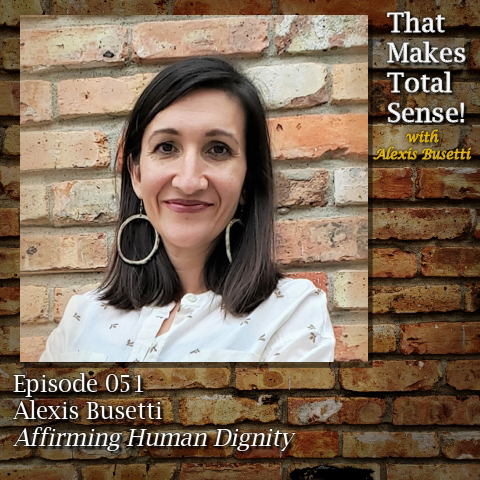
Speaker 0 00:00:00 <inaudible> hi and welcome to that makes total sense. The podcast where we talk about faith, finance and everyday life in a way that makes total sense. I'm your host, Alexis obesity on this podcast, you'll hear the personal stories of friends I'll be interviewing who were doing familiar things in new and innovative ways. We'll answer questions specifically about money and our relationship with it. And we'll explore faith and Bible teaching together in all of these. It's not about changing our convictions as much as it is about messing with our methods. We'll have a lot of moments here together where we pause and say, that makes total sense.
Speaker 0 00:00:44 Hi, I'm Alexis <inaudible> and this is, that makes total sense today. I want to talk about dignity. There's this phrasing that I feel like is popping up everywhere in my life right now. And, and I understand it's probably kind of like when you're looking to buy a Honda and it's like, all of a sudden, all you can see are Honda's right. Um, but this phrasing that has been popping up to me everywhere is affirming human dignity. So I've been seeing it in books, I'm reading, it's in conversations. I'm having for the podcast and offline as well. And I've begun to kind of ask myself, what does it mean to affirm someone's dignity? And so that's what I want to talk about today and just kind of get some of these thoughts out and maybe start a conversation wherever you are about this idea of affirming someone's human dignity.
Speaker 0 00:01:44 So what does that even mean? What does it mean to walk along the side to someone for the sake of their dignity, even to fight for someone's dignity? I realized this is a theme that we see in scripture, and it's how God interacts with us actually over and over and over again, he made us in his image, dignity intact, and he affirms his creation in us and through us through relationships specifically through our relationship with him. And I'm not talking about necessarily this like saving relationship that we might have through Jesus. I mean, his relationship with us as creation. He affirms our dignity by affirming that he made us in his image. And I'm going to tell you about two of the times, I can see that he does this for us as people. These are the two of the categories. God affirms our dignity when we deserve it.
Speaker 0 00:02:49 And he affirms our dignity. And when we don't, and I think that pretty much covers it. No, when I say that I'm like half joking, because we always affirm deserve our dignity to be affirmed, but sometimes we don't act like it. Sometimes we know better, but we don't do better. And I would say, we should do this too. We should be affirming one another's dignity, even when people are acting out of character, but oftentimes we don't. We stopped short and we put limits on what we feel is necessary in our interactions with other humans, Christians, I think we're called, I think we're called to this in a more kind of way. Um, we know the truth of everyone's existence and of the amigo day or the image of God they hold. And we should affirm the dignity of all people, but sometimes we can be among the worst offenders and I'm not exactly sure of all the dynamics of why that might be, but often I think it starts with behavior. We have a problem with someone else's behavior. And so somehow that gets filtered through and we end up with a lack of concern for him or her as a person because of how they're behaving. So we'll put his dignity on the back burner and treat him with disdain or we're apathetic, or maybe we even have some sort of ambivalence because of our own confusion or in congruence in a certain space. But I want to encourage all of us to look toward dignity first and behavior second, because we're not defined by what we do.
Speaker 0 00:04:42 And I'm going to say, I may have just lost some people because there was a time in which that phrase would have lost me. The phrase of we're not defined by what we do. So let me explain this a little bit before a little bit further, because I'm not going to say behavior doesn't matter, but, but follow me, follow me here for a minute. When I worked in the child welfare system, I was a caseworker. So I was in the negative nitty gritty with people every single day. And I engaged with parents on a daily basis who had made horrible mistakes. And some of them had even put their children's own lives in danger. Now the spectrum of bad choices in that space varied quite a bit, but one of the ideas that we, as an agency, as workers, that we kept close to us when we were building relationships and, and aiming to serve these parents well and serve the families well, is this idea that if the tables were turned, we knew we fully recognize that none of us would want to be defined by our worst mistakes.
Speaker 0 00:05:59 None of us would want to be treated in such a way that every interaction we had was defined by the worst thing we had ever done. Now hear me for a second. That doesn't mean that the actions of these parents and caregivers weren't harmful because they absolutely were. But if we viewed them as monsters refusing to affirm their dignity as humans, that would have put up barriers to working with them in love and helping them correct their actions so that their families could be brought back together. We recognize that for many of us, the worst mistakes we'd ever made, and the worst things we'd ever done would never be public knowledge. But for these parents, the worst thing they'd ever done was, and we needed to be able to treat them with human dignity so that they could heal so that they could get better so that their families could get better and move forward, but sometimes a clear right or wrong like it was in, in those cases or a mistake or a set of mistakes.
Speaker 0 00:07:18 Isn't the issue. Sometimes our barrier to treating some with someone with dignity is a super hardcore disagreement. It's like a conviction issue where we see someone else's point of view as completely wrong. And not only are they wrong, they are like living inside of their wrongness every single day. I'm just going to say like Facebook, anybody, no, I'm not on Facebook, but maybe their opinions or their perspectives in one matter or another, make it impossible for me to view that person as redeemable. Like maybe have you ever said this in your mind? Okay. I have, Oh my goodness. She's just a lost cause at this point, I can't even see what, where this is going, what's happening, right? But this is not biblical. This isn't biblical. We need to view people with the same perspective as Jesus views us with the same perspective as God views Jesus, namely, this means recognizing that people have inherent value that was with them from the moment they came into existence, no matter what they have ever done or ever will do.
Speaker 0 00:08:35 And that God loves each of us based on his love, not based on our habits, not based on our viewpoints, not based on our actions, whether they're good or bad. So I'm going to share a couple of examples from the Bible that have helped me process and are helping me process this idea of dignity. But first I want to share a personal experience from my family. So when I was, I guess, a preteen, I was in eighth grade, middle school, getting ready for school. We got a phone call at our house saying that my aunt had been taken into the emergency room that morning. And the doctors there had declared her dead specifically. They told us that she was brain dead and they were keeping her body alive because she was an organ donor. So as you can imagine, this was a shock to our family.
Speaker 0 00:09:34 So we rushed to the hospital to meet our family. We're all grieving. But when we got there, it turns out the news was a little bit different than what we had heard on the phone. So my extended family and my grandparents specifically had asked that more tests be run. And the doctors discovered that she was not actually brain dead as they originally thought, but she had suffered a brain injury and she was unresponsive in an Acoma. At that point, none of the doctors really knew what her future would hold and none of them could give us a precise longterm prognosis. And in the midst of that crisis, we saw two extremes, my grandparents. So her parents and my extended family, we just gathered around my aunt and we loved on her. Oh my goodness. We loved on her in really tangible ways. And, and we loved her through her rehabilitation, which was not ever full.
Speaker 0 00:10:42 And until she died over 20 years after that incident. So that was kind of the one thing that we saw. It was beautiful. And shockingly, the other thing we saw was that, um, her husband of almost 20 years at that point left her, um, he divorced her when she was in, um, a longterm care facility. And obviously he really had some wounding as well. But what we saw from those of us who stayed, was a willingness to fight for her dignity, even though she would never be the same woman she was when she had gone to bed the night before, that is not to say it wasn't hard to fight for her in this new way, because it was, you could ask anyone in my extended family, it was one of the hardest things any of us ever chose to do, but we chose to love her and stay by her side and walk with her.
Speaker 0 00:11:54 And we did our best to treat her with the God given dignity. She deserved just because she was just because she was a human, just because she was loved by us, just because she was loved by God and made in the image of God, the actions that we knew from her previously and the ones that we loved from her work gone, her personality shifted like it does. Sometimes when people have brain injuries, um, her memories vanished. Most of them, her life was never, ever, ever the same before her injury. She was an artist. She was a Baker, a poet, a business owner, relationally her life. When she was a mother, a wife, a daughter, and a sister. It never looked the way that it did before her injury. Not one part of her life was ever restored to what it was before, but we didn't love her any less because of it.
Speaker 0 00:12:55 And we wanted to see her dignity intact, regardless of that fact. And in some ways through the, like I said, more than two decades, that we were with her after her injury and some ways her injury brought our attention as her family, to the fact that we were willing to fight for her dignity in a way that we didn't have to, before we, we wanted to affirm her dignity, but we didn't really have to do it before this changed things. And her circumstances opened my eyes to the struggle that it is to maintain human, human dignity for all of the people around me, no matter what.
Speaker 1 00:13:38 Okay.
Speaker 0 00:13:38 Loved her and had a relationship with her. So it feels different sometimes. But what if we saw our enemies the same way? What if we saw them as worthy of dignity? No matter what, what if we saw the people with whom we have the most difference as incredibly worthy of dignity? And what if just maybe we joined with people in affirming their dignity instead of trying to destroy it with our rightness, our opinions, our various causes.
Speaker 0 00:14:15 Let's go on to the biblical examples because I want to share two stories from jesus' ministry, where I believe he shows us how to walk with people and affirm their God given dignity. First, one of my very favorite women in the gospels, the Samaritan woman at the well, her story is in John chapter four. And if you haven't read it, or if it's been a while, I encourage you go back and read this it's it's amazing. So Jesus is going through Samaria Samaria, and he meets a woman at Jacob's well, and she's drawing water and they have a conversation. And the whole time she's like super confused about why he is even talking to her, cause nothing about her status or this situation seems to add up to why a Jewish man is talking to her a Samaritan woman, because a she's a woman be she's a Samaritan.
Speaker 0 00:15:11 And see she had a past kind of in quotes, right? She felt despised by her community because they knew about her marital history. That was her past. And she was used to people passing her by looking the other way or even worse. But Jesus, this Jewish man in the wrong place at the wrong time, according to her thoughts, he was engaging her. So they have this interaction about water and living water, which is priceless in and of itself. And then he asks her to go get her husband. And she says, she's not married. And Jesus tells her, he's aware of her marital situation, her present marital situation and her past Meredith situation. He tells her she's had five husbands previously in the man she's currently living with isn't her husband. Now, historically we should recognize there could have been a lot of different reasons for this.
Speaker 0 00:16:12 And almost none of those reasons add up to the sermons. I've heard that basically say this was all her fault because after all women even married women in first century, Palestine didn't have any rights basically or any say over their marriage. Um, so we don't really know why her marriage has ended, but my guess is it wasn't her fault. But moving forward, I can't get over. What happens next in the story, the woman recognizes Jesus to be a prophet and they have another discussion about worship and where it's appropriate to worship God. And I feel like this woman is super gutsy and, and, and having this talk and then it happens. She realizes who she is, who Jesus is. I mean, and she runs back into her village and tells everyone about her encounter with him. But this is how she introduces Jesus. Come see a man who told me everything I've ever done. Wait a minute. We have to pause right there because this is a woman who is despised. She's had five husbands. She's currently involved with someone she's not married to. And all of these situations make her feel shame and loneliness. And they cause her community to shun her. Yet. She is absolutely astatic with a man who repeated all of that past, back to her. And I just can't even imagine how he must have done this.
Speaker 2 00:17:47 Yes. In
Speaker 0 00:17:50 What way did he repeat her past, back to her that made her feel known and not shamed. I can tell you he didn't do it the way we do it on Facebook. Well, you load it down. Filthy known it. No, it couldn't have been that way. Not even close. I mean the love, the compassion, the affirmation of her dignity as a person, as a child of God, he saw her and she felt seen by him. She wasn't seen or defined by her mistakes in that moment by her sin, by her situation, by her lack. But by her essence, her human ness, her dignity, her belovedness, there's another woman, just a few chapters later in John. And this is in John chapter eight. And this woman is caught in the very act of adultery is how some translations put it. Now here, some of the religious leaders of the day literally bring this woman to him while he's teaching near the temple. And of course, the question we've been asking for years is where's the dude. I mean caught in the very act. It seems pretty hard to catch her in the act alone, but that's another subject for another day. Anyway, the pious leaders tell Jesus she's been caught in the act of adultery. And then they proceeded to tell him as if he doesn't know that the law says she must be stoned.
Speaker 0 00:19:29 It seems to me here, like they're looking at her through the lens of one of the worst thing she's ever done, right? Possibly the worst thing she's ever done in her life, a mistake, a sin. And they conclude based on their interpretation of the Torah that she deserves to die because of it. Now I say based on their interpretation of the Torah, because we happen to have the one who wrote the Torah right there on the scene front and center, and he interprets it differently. In that moment, she got caught and now everyone knows about it and she can't possibly live because what kind of example would that be for everyone else? Right. But Jesus does not believe she deserves to die for her sins. In fact, as Jesus was and is prone to do, he turns the tables around the example he sets in that moment is that when someone's worst is set before you treat them with your best, treat them how you would want to be treated, gain that person's attention long enough to stare into her eyes and remind her of who she was created to be, and then send her off to be that person.
Speaker 0 00:20:44 That's what Jesus did and what I want to do
Speaker 0 00:20:50 Prompting for thinking about this human dignity and the affirmation of it. The prompting for me, thinking about it lately is our current climate in America. In case you haven't noticed right now, every single thing is political. And it feels like every single person has an opinion about it. The conversations can get heated and more often than I think any of us wants to see dignity gets thrown out the window, but it doesn't have to be that way. And I believe Christians can lead the charge on this. The rest of the story of the woman caught in adultery was the charge. Really almost the command from jesus' own mouth. He said to her accusers, the ones who thought they were better than her, the ones who were bringing her to the authority for her mistakes to be counted. Jesus said to them, stoner, do what you want with her because of her situation.
Speaker 0 00:21:52 The only request I have is that you find among yourselves, the person who hasn't ever been involved in a scandalous sinful situation to throw the first rock at her, huh? That's my loose paraphrase. Go ahead and strip her of her dignity. Like she's been stripped of her clothing, but by doing so, watch out because your dignity will disappear when you enact her punishment, you see part of what I'm learning is that we're wrapped into each other. When we go guns, ablazing at someone else because of their opinions, their mistakes, their messed up mindset. Without first, considering our own, we're not only dismantling their dignity. We're denying our own dignity as well. We're actually participating in what we're accusing them of. We're labeling ourselves by an opinion, or an, a mindset or an action or a mistake instead of recognizing our whole complicated humanity. Cause that's what we're doing to someone else.
Speaker 0 00:22:58 But Jesus loves our whole personhood. David King, David was labeled a man after God's own heart, not just right after he defeated Goliath or when he was strumming his harp as a shepherd. But after he acted like a lunatic, when he was on the run, he also got a married woman pregnant and had her husband killed in a war. He was too apathetic to fight in the first place, but God affirmed. David's dignity as a whole person. God provided Jonah with shade for his hot head. After he went the entirely opposite direction on his missionary journey and was subsequently shipwrecked and swallowed by a fish
Speaker 2 00:23:44 Jesus, the church on a confession
Speaker 0 00:23:46 Of a would be trader in Peter and he stopped a murderous Paul in his tracks and didn't hold his worst sins against him. When he sent him out to preach the gospel to the world, he knew at the time we are more than our worst mistakes. We are more than our injuries and our wounds. We are image bearers and each one of us is worthy of dignity and worthy of having our dignity affirmed by the image bearers that surround us. So thank you again so much for listening. Don't forget to subscribe. So you won't miss an episode, share the link with your friends. You can visit
[email protected]. And until next time, this is Alexis Piseti remembering to do well for ourselves so we can do good for others. Bye
Speaker 3 00:24:43 <inaudible>.