Speaker 0 00:00:00 <inaudible>
Speaker 1 00:00:04 Hi and welcome to that makes total sense. The podcast where we talk about faith, finance and everyday life in a way that makes total sense. I'm your host, Alexis obesity on this podcast, you'll hear the personal stories of friends I'll be interviewing who were doing familiar things in new and innovative ways. We'll answer questions specifically about money in our relationship with it. And we'll explore faith and Bible teaching together in all of these. It's not about changing our convictions as much as it is about messing with our methods. We'll have a lot of moments here together where we pause and say, that makes total sense.
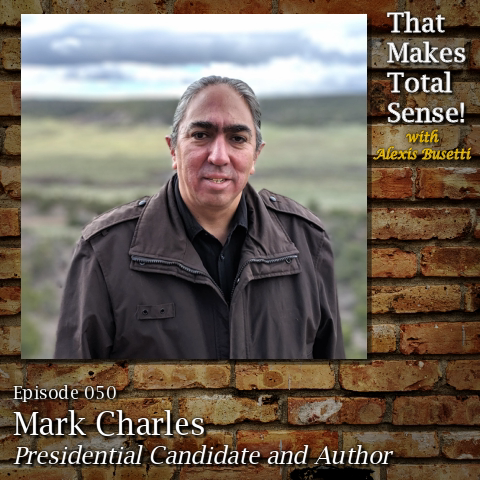
Speaker 1 00:00:44 Hi, I'm Alexis <inaudible>. And this is, that makes total sense. Today's conversation that I'm ringing you was a first for me. I have never until a few weeks ago, when I sat down to record this conversation, I have never interviewed formally or informally. Anyone who is running for the office of president of the United States. But I had the opportunity to do that a few weeks ago. When I talked with Mark, Charles Mark is a dual citizen of the United States and the Navajo nation. He is a believer of Dutch and Navajo heritage. And he, in my view is a conversation starter. It was a, at the beginning of the quarantine, I was sitting in my front yard, looking at my phone. I had heard his name on another podcast in another conversation. And I looked him up and watched his announcement video, where he announced his candidacy.
Speaker 1 00:01:42 And it's it's about eight, eight to 10 minutes long. But I looked over at my husband and said, I don't know who this guy is. I don't know what's going to happen in November, but I am really loving the conversation that he's bringing to the table. Mark is also an author. He is a speaker and he has written a book that was just released with coauthor soon. Sean Ron called unsettling truths, the ongoing dehumanizing legacy of the doctrine of discovery. And that was put out by Ivy press. I unfortunately have not finished that book yet, but my husband Seth has read it. And this is just an ongoing educational process for us and ongoing conversation. And the reason I'm bringing this to you, the reason I was so thrilled to have Mark on the show is because I'm hoping that it will be an ongoing conversation in your house and in your neighborhood and among your friends and family and church and peers.
Speaker 1 00:02:40 And I'm hoping it will be an ongoing educational process for you as well. Mark brings up a lot of points from the perspective of a member of the Navajo nation. Um, he has a perspective that I think we all need to hear. So with no further ado, here is my conversation with Mark Charles. Hi, I'm Alexis <inaudible>. And this is, that makes total sense. Today is it's an honor for me today. I have never had the opportunity to interview someone who is running for the office of president of the United States. But here I am today sitting across my computer spray screen from Mark Charles. Hi Mark.
Speaker 2 00:03:29 Hey, how are you?
Speaker 1 00:03:30 Great. Thank you so much for being on today.
Speaker 2 00:03:35 You're very welcome. If you wouldn't mind, I'd like to introduce myself traditionally, so yeah. Okay. Mark Shelby Anisha <inaudible> chain <inaudible> and our Navajo culture. When we introduce ourselves, we always give our four clans or it makes a lineal as the people with our identities confirmed mother's mother. So my mother's mother's American I'm Dutch heritage. And that's why I say syndicate, Nat and Aslan loosely translated. That means I'm from the wooden shoe people. My second clan, my father's mother is toy gleaning, which is the waters that flow together. My third clan, my mother's father is also send the kid dinner and then my fourth clan, my father's father's total cheat me. And that's a bitter water plan. It's one of the original cleanse of our Navajo people. I also just want to acknowledge the time speaking to you today from the land of the Piscataway. I live in the area now known as Washington, D C with my family, and it's the Piscataway nation, who they were, the ones who lived here. They hunted here, they farmed here. They fished here. Their society was here long before Columbus got lost at sea. And I like to acknowledge the indigenous nations of the land wherever I am around the country. And so it's an honor for me to say that I'm living and, uh, here on the Piscataway lands, and I want to thank the discovery people for their stewardship of these lands.
Speaker 1 00:04:59 Hmm. Thank you so much, Mark. I was hoping that you would introduce yourself in the traditional way that I've heard you do so many times I'm on video. And so I appreciate that so much. Um, Mark is a speaker. He's a consultant, he's a writer, he's an advocate. He is a coauthor of the book that I literally just had dropped on my doorstep about an hour ago. Um, with soon Shawn raw called unsettling truths, the ongoing dehumanizing legacy of the doctrine of discovery. And it's not that often that I record a podcast without having read the book in its entirety. If I'm speaking with an author, but because of the timing this week, we, um, we had to do it this way, but I have read the introduction and spent over an hour today, listening to, um, or, and this week I spent some time listening to Ted talks.
Speaker 1 00:05:58 I watched a YouTube video of, of you Mark at Calvin university, which was incredible. And I will link all of those things in the notes because unfortunately today we will not have time to get into all of the unsettling truths that Mark presents on a regular basis. But I say, unfortunately, but it's also, it's fortunate at the same time at the end of that Calvin university talk. I remember you sit you answering the question and saying, it's usually months after someone hears you talk that things start to sink in enough where people are available to have a conversation. So talk about what you talk about and why that is that it takes that kind of time for people to really start to sink in and have that conversation.
Speaker 2 00:06:49 Yeah, well, one of the things that I work very hard is to engage a dialogue that's honest, and that acknowledges the history, but it also allows, um, not only those who have been marginalized are pressed to express what they're feeling, but that is not easy, but inviting to people who may be challenged by the conversation. A lot of that goes back to when I first moved to the reservation. So I was the pastor of a church in Denver for two years called the Christian Indian center. And I was living there with my wife and our son. And the first question the church gave me was, um, what does it mean to be native to me, Christian, they wanted to understand contextualize worship. And so we began a process of building relationships with indigenous Christians all over the world. I got involved with a group called the world Christian gathering on indigenous peoples.
Speaker 2 00:07:44 Um, you know, so my, my father's side of my family, my, my novice side of the family, both of my grandparents are Christian, which is unusual for their generation. And they were became Christians in the boarding school. Now the goals of the boarding schools were to kill the Indian, to save the man. They were forced to simulation. Um, and so my grandparents became Christian, but that means they had to give up the language and the culture and the ceremony I'm understanding what's sacred and all of those things. And so my father didn't learn those things as a child, so he didn't learn them to teach them to me. And so the message of the missionary was you have to get to know this guy, Jesus, but he likes it best when you speak English, he likes it best when you have to get rid of your pagan holidays and embrace the Easter bunny and Christmas and Santa Claus and those types of things.
Speaker 2 00:08:35 And so the way I use it and other people have framed, it is most indigenous peoples have the experience of being colonized by the Costco where people came in and they said, here's this message, but you have to become European and white and English speaking and Western in order to really understand it and to embrace it. And that's by and large, the face that my grandparents had and when they pass down to us, you know, and so to be at this church where the congregation was asking, what does it mean to be native and be Christian? What does it mean to embrace our language and who we are and understanding of the sacred. And so having these relationships, this, um, group I was involved with called the world Christian gathering on indigenous peoples. So it's really eyeopening. I got to be mentored by, I got to build relationship with hear stories of people and tribes and nations all around the world who are decolonizing their faith.
Speaker 2 00:09:32 And after two years of being engaged in that and deciding with my wife and I, that this is something we really wanted to invest in. We realized if we were going to do that, we really had to be back on the reservation because I grew up in a border town because I attended it was a private school, but it was actually transitioning from being a boarding school to, to a day school. So they were actually boarding school students at the school while I was there. Um, and just vastly different experiences even as students. And so, because I had grown up in that Verde assimilated environment, I wanted the experience of living on the reservation and living as traditionally as possible. And so there was a family in our church that had a Hogan where, um, one of the, the wife, I was related to the husband, we were a clan, the same clan, but his wife had, was also a boarding school survivor and had grown up in a remote part of the reservation in a traditional Hogan.
Speaker 2 00:10:27 And she still had that Hogan and her, she said that we could live there, Rachel and my son and myself. And so we moved to this Hogan from Denver, Colorado. Uh, I think it was 2003 this year that we moved and we were six miles often nearest paved road on a dirt road, no running water, no electricity. That whole house was the size of a medium sized bedroom, about 20 to 25 feet in diameter and had a dirt floor log walls, no running water, no electricity had an outhouse about 50 to 75 yards away that we lived on a sheep camp and our neighbors and people on the sheep camp or wove rugs and herded sheep for a living. And it was just a completely different world. And we moved there knowing that we were going to have to be off the grid, knowing that we'd have to get used to cooking by a campfire and hauling our water and all the things that happened when he live in that rule sort of space.
Speaker 2 00:11:25 So we, we prepared for that. We psyched herself up for that. We told ourselves, love it or hate it. We're going to be there for at least a year. We just, we really wanted to experience it, not just for a small time, but at least for a year. And we ended up living there for three years. But once we got there, the first thing we realized was the easiest part of the adjustment was being off the grid that was fairly easy cooking by camp stove, um, using an open fire, using an outhouse hauling water that was easy. The hard part of living there was how intensely marginalized we felt. I mean, it literally felt like when we moved there, we dropped off the face of the earth. I quickly learned and observed that by and large, the only groups of non natives who came to Indian reservations or those who came to take your picture are those who came to give you charity.
Speaker 2 00:12:26 Oftentimes they were the same group of people and frequently they never came back. They weren't interested in knowing you as a person. They were there to drop off their charity and take some of their poverty pornography and then beyond with their lives. And as we were there experiencing this intense marginalization, and we're seeing the historical trauma of our community, and we're understanding more of the history of what happened and how we even gotten to the situation in the first place. I found myself becoming very agitated, even angry about it. And I was, I was aware of what was going on, but I was trying to process through what I was feeling and what was happening. And so I was reaching out to some of my friends, um, from off the reservation to just try and process through what was happening to me on the phone, because again, they weren't coming to the reservation.
Speaker 2 00:13:19 Um, and so every time we'd have a conversation about this, I could feel the motion drives up in me and she and I have to hang up the phone or I would start screaming at my friends. So I learned how to engage it by disconnecting. I would talk about the, my feelings and the emotions and the experience. Like I had read it in the newspaper, disconnected from it, which let me stay in the dialogue longer. But then the longer I was in the conversation, the defense of my friends would go up. It wasn't my family that did that too. It wasn't, my community did those things to your people. And soon they would hang up the phone because they were so agitated and ashamed and wrestling with the motions. And so I'm like we weren't discussing the real issues. And one day I was writing a letter to my friend is probably the 10th time.
Speaker 2 00:14:12 I was trying to get them to understand how it felt. And in my letter, I said to them around, don't have the exact wording, but I said, essentially, living, being native American and living on an Indian reservation in the middle of this country, it feels like our native communities are this old grandmother who has a very large and very beautiful house. And years ago, some people came into our house and they locked us upstairs in the bedroom today. Our house is full of people. They're sitting on our furniture, they're eating our food. They're having a party inside our house. Now they've since come upstairs and they've unlocked the door to our bedroom, but it's much later and we're tired. We're old, we're weak are sick. So we can't, or we don't come out. But the thing that hurts us the most, but what causes us the most pain is that virtually nobody from this party ever comes upstairs, seeks out of the grandmother in the bedroom system.
Speaker 2 00:15:04 Next on the bed, takes her hand and simply says, thank you. Thank you for letting us be in your house. I wrote that. I mean, that's it, that's when I'm feeling. I shared that with some people I was living around and the response I got was, you know, I've lived here a long time, even all my life. I've struggled to know how to articulate what I'm feeling and you're hitting the nail on the head. I started sharing that with my friends and people off the reservation. And instead of getting defensive, they would come back and they would say, how do we say, thank you. How does my family, my church, my city, my community, my nation expressing gratitude to the host people of turtle Island. See, now we're having a very different conversation. Now, instead of talking about victim versus oppressor, now we're discussing what I think is the heart of the matter, which is this reversal of roles, which is we have 300 plus million people who immigrated here. Most of them from Europe, some even generations ago, they've never asked for nor have they ever been given permission to be here. They can't point to a treaty that gives them a right to be here and they run around and like they own the place. And we have native peoples. Who've been pushed to the margins off to reservations off to the side. And we're being treated like unwanted guests at someone else's house.
Speaker 2 00:16:37 And so we have to reverse those roles. I need the majority of Americans understand that their guests in someone else's house. And I want our native people to understand that we're the hosts people of the land, that metaphor, that story of the grandmother and the house is one of the most effective tools. I was able to develop, to engage a dialogue, not just on the reservation, but I've used it globally to engage conversation between indigenous peoples and their colonizers. And it was the first step. So if our book is called unsettling truth, and the goal of the book is let's lay out the history, not so we can passive aggressively shame people, not so we can stick it to those who stuck it to us. But so we can do what Georgia Rasmus. Who's an indigenous leader from the DNA. People in Canada can do what he calls common memory.
Speaker 2 00:17:46 He said, we're common memories lacking where people do not share in the same path. There can be no real community. If you want to build a community center, you have to start by creating common memory. So to create this calm memory, we have to learn how to talk about our history, not by watering it down and making a toothless and not by using it to agitate and to, and to poke and to prod and to shame. But to have an honest dialogue where the people who have been oppressed or offended or aggrieved can come and feel like I'm being honest about what I'm feeling and the people who are there can listen and engage and participate knowing, yes, this is hard, but we're moving towards something healthy. And that's my work. That's what I'm trying to do with the book. That's what I'm trying to, that was, I was trying to do the metaphor of how can I be honest and yet still move the conversation forward
Speaker 1 00:18:46 That quote about the common memory. It hit me like between the eyes. Um, when I, when I first heard you use that, because I've been having these conversations lately, specifically regarding racial injustice and the church and the church's complicity in racism and white supremacy and having conversations with, um, with other scholars in this space about how we have a shared history that we need to recognize is family history, but we don't recognize his family history. And what you say is so key, because even though we have a shared history, we have not experienced history the same way, and we haven't remembered history the same way. And so there's, there's kind of this two fold of, of, you know, even have yes, experiencing a common memory so that we can build community because we know that that's part of what builds community had been. If we think about our family, I mean, what do we do at family reunions?
Speaker 1 00:19:52 We sit around and we talk about the old times, right? We talk about the things that we've done together, you know, in our, in our churches and our schools, we talk about that. So we know that that, that makes sense to us to have a common memory to move forward. But what I love about what you're doing and what you're bringing forward to move the conversation in that direction is you're helping us recognize that even though we have a shared history, we don't have a common memory of that history, right. We have experienced history differently as people groups, and we have taught history differently as people, as people groups. Um, and so moving that conversation forward, thank you for sharing that about, uh, about your, your personal history in Denver and moving to the reservation and, and why that was so important to you. Now, you said that you lived there for three, and we're able to develop some of these things as you worked through and processed your emotions of feeling marginalized. Then what happened after those three years? Next time
Speaker 2 00:20:57 We lived in the Hogan for three years, we lived in that remote section for three years. We lived on the reservation for a total of 11 years. Wow. So we moved from that, that remote section into a more, uh, a smaller village area called, um, four to five, which is not too far from window rock, which is the capital of the Navajo nation. And we lived in a house there. We were still on a dirt road. We were still, um, I, you know, we're still kind of on the edges of the town, but we were not as far off the grid, we had electricity, we had running water. We even had cell phone service and internet. And we actually, we had cell phone service at the Hogan to, uh, my, my username on most social media is wireless. So gone. Right? And we started using that when I lived in that Hogan, where I found that I could, I could hang my cell phone from the ceiling of our Hogan.
Speaker 2 00:21:49 I could charge my laptop in the car and then tether it to my cell phone and get the only artificial light you can see from our Hogan was a cell phone tower about five miles away. So I could actually, this was in 2003, 2004. I can get on the internet at one X speed, which is today, it's slow back then. It was fairly good. But I actually saw, I had a wireless network in my wireless Hogan. And so it was kind of an oxymoron. And so I started using the username wireless. So gotten back then to just understand who we were and where we were living at that point. But so when we moved into Fort defiance, we were not off the grid as much, but we were still in a fairly remote section. Um, you know, we're still off on a dirt road. We had neighbors, we were in a smaller village or town.
Speaker 2 00:22:38 Um, and our, our, we live in that house for eight years and, you know, there's our kids, our son had already been born, but our daughters were born while we lived either in the Hogan or in Fort defiance. And there was an immersion school in that community, a Navajo language emergent school that our social and attended while we were there. And so it was, it was a really good space for us to be for those years to give my children the opportunity to experience something I never did, which was, they were able to learn the language and even some of the oral history through their schooling. And so, you know, for years, my son speaks better Navajo than I do, because he actually learned it as a child. Not, you know, I've been learning it as an adult, but he's learned as a child. And so even, even today, or even, even when we, you know, when he knew it really well, he would always get me. Cause my, my intonation was always wrong. And he was always much better at pronouncing the words because of the intonation in the, in the various words is so important. So anyway, so yeah, so it was very good to be in that community for eight additional years until we moved to Washington, D C about five and a half years ago, five years ago.
Speaker 1 00:23:54 And what have you been doing in Washington? What prompted that move?
Speaker 2 00:24:00 Well? So as we were living on the reservation and I'm learning more about the doctrine of discovery, I'm a native author while we were there during the years, we were there, he published a book titled, um, pagans in the promised land, which is really one of the premier books on the doctrine of discovery. And I was involved in several projects around the doctrine of discovery and I was becoming very aware of it and engaging with it and studying it and writing about it myself and I was gaining this vision of, yeah, we ha this is the history. We don't know, this is the on settling truth. This is the truth that we don't know how to talk about and either it's victim or presser. And we just ended up yelling at each other and we don't know how to invite ourselves. This is the common memory we have to learn how to create.
Speaker 2 00:24:49 And so I began looking for ways of how do we articulate it? How do we communicate that I wrote an article while we were living there. It was probably back in 2014, even earlier than that, maybe 2013, 2014. I wrote an article about the doctrine of discovery. Um, it was called the duck discovery, a bear, uh, an empty apology, an empty chair and a buried apology or something like that. It was it's on my blog. And it was one of the first articles that I put together. A lot of the pieces of the doctrine, as well as, um, the history behind it. And I articulated in the vision of having a space where we could create common memory. And that was, if anything, I've ever written went viral. And that was probably the closest where it didn't go viral nationally, but it got re posted republished a lot, got a lot of traffic for a long time. It's still one of the most popular articles on my blog today. And I started getting a lot of invitations to speak and to write and to comment on it. And it started me thinking about what would it look like?
Speaker 2 00:26:04 The doctrine of discovery of varied apology and an empty chair. That was the name of the article. Um, and so it started getting me thinking of what would it look like to really wrestle with this nationally and how can we engage this? And I began, I began talking about, we have to find a way to create this common memory at a national level. And in 2014, 2015, I think it was as soon as when Pope Francis became Pope of the Catholic church and president Obama was going into his last year and a half to two years of his second term in office, as president, I already knew from an experience I had back in 2012 of reading an apology that was buried to native peoples in, um, a department of defense appropriations bill. And that was buried by president Obama, that he was not willing to engage this history alone.
Speaker 2 00:27:01 He had, as far as presidents go, he was one of the best presidents. As far as engaging native audiences. He would bring native leaders to the white house every year to talk about native issues. He then campaigned on some native reservations. He was one of the best presidents we've had up to that point about engaging native issues, but he even buried this apology and never mentioned it and kind of puts it to the side. And so I knew he didn't have the courage to address these things alone, but I thought Pope Francis impressed me when he first became Pope and he was very prophetic. He didn't have much problem speaking truth to power. You know, he lived very simply, he moved out of the mansion wherever the Pope lived before. And he moved into this very simple apartment. You know, he, he was planning his first trip to the U S and he's driving around the U S and a Fiat, you know, kind of thumbing his nose at big oil.
Speaker 2 00:27:59 And I thought there's was a lot of energy like this guy, most pokes cause native peoples have been trying to engage the Catholic church with the doctrine of discovery for a long time and have gotten nowhere. And I thought this Pope might be willing to engage it. And so I actually decided to move with my family from Washington DC, to our, from the Navajo nation to Washington DC, with the hope that maybe we could actually get Pope Francis and president Obama together to engage the doctrine of discovery. Wow. Like that was my hope I knew. I knew no Pope was ever had ever in the past been willing to engage it alone. And I knew president Obama didn't have the courage to engage as alone, but I thought maybe the willingness of president Obama to move in that direction and maybe the willingness of Pope Francis to address systemic problems and be more truthful about the history who knows maybe something could happen.
Speaker 2 00:29:09 And during 2015, 2016, which is when we moved here to DC. And so we moved here and it was funny because it was just a few months afterwards that Pope Francis made his first official visit to the U S and um, in his visit, you know, he, he traveled around the country and he spoke to a joint session of Congress. And there was a lot of expectation that even among native communities about, would he be willing to engage the doctrine of discovery? You know, when he was in Bolivia a few months before coming here, he actually spoke about to the indigenous peoples in Bolivia, and he used language of apology to talk to them. And so there was hope that maybe he will be willing to engage it. And so I, you know, I'm, I'm not any personal prominence. And so I was not like at the, at the Capitol, I was not in any of these meetings with him, but I was actually out, they had a huge jumbotron outside of the Capitol building the morning that he was speaking to a joint session of Congress. And I was out there watching his speech and I was kind of nervous. I didn't know what he was going to say. And in his speech, he acknowledged, um, the Anjous history against native peoples. And he acknowledged his, his, um, appreciation and his respect for native communities.
Speaker 2 00:30:35 He even known some of the violence that happened against native peoples, but in closing that section of his speech, what he said to our Congress is he said, but it's difficult to judge the past by the criteria of the present, meaning we're not going to hold you accountable, right. America, you get a pass on this. And I heard those words in my heart fell. Literally just, I could hear it sump again. I already knew president Obama didn't have the courage to engage it personally. I was hoping Pope Francis wouldn't walk away from it either. And the two of them together might be able to do it. And when I heard Pope Francis to sell out to the white us Congress, I'm like, yeah, this isn't going to happen.
Speaker 2 00:31:31 And I would actually say, I went into a period of lament, probably two or three. I mean, I've seen five or six months of just limit. What do I do? How do we engage this? If the president doesn't have the courage to do it, the Pope doesn't have the courage to do it. How do we actually wrestle with this? And I spent six months just kind of sitting in that, not trying to solve it, not trying to figure it out, just sitting in it and allowing my heart to be grieved by it. And it's in a lament that I own. I find, I hear God speak most clearly. He doesn't come quickly. He often lets you sit there for awhile and just understand the brokenness that you're in the midst of, but God, God comes and provides. Vision provides hope, provides leadership, often spurs thinking and ideas that you never would have even thought of at the beginning of the process, he kind of allows your fear frame of reference or your, your mindset to shift.
Speaker 2 00:32:47 And so I came out of that period with a very renewed sense of what might be possible. And that's when I began advocating, I already been advocating for, for some sort of commission, some for the truth commission, some sort of truth and, and, and, uh, not reconciliation, but I, I was somebody that to deal with this creates this common memory. And I came out of that period much more with a sense of, okay, if we can't expect the established leaders to do it, maybe we need to look for other ways to do it. And that's when I actually got the idea for the first time that one of the best ways to engage this history and to bring this story to the American public was to use a presidential campaign. Um, it was in, uh, it was in a, uh, in a, um, conference. I was speaking at, in Jan in January of 2016, I think it was late in 2000 in December of 2015.
Speaker 2 00:33:57 And that was the first time I ever presented to an audience that I think the best way to create this common memory. If we can't get our leaders who are already at the pinnacle of their careers to engage, it is to have someone stepping onto that stage to begin to engage it. And I presented to that conference, the idea that as a seminar at a conference, I presented to the audience that one, maybe the best way to engage it would be to run for president and to make this creating this common memory, a part of your platform and a teaching of the history. So that was, again, that was the first time I ever had the idea that maybe this could be a way to cause you know, one of the things, if you go back to, I always go back frequently to president Obama's last state of the union in 2016.
Speaker 2 00:34:53 And on, in that speech, he was, um, kind of not lamenting, but he was acknowledging the deep divisiveness that had enveloped our nation during the eight years he was in office. And while he was there, he was talking about the need for our country to have a new politics. And he quoted the constitution. He said, we, the people, our constitution begins with these three simple words, words we've come to recognize mean all the people. Now I heard him say that and he got a lot of applause for that line. But as I'm sitting there listening to him talk, I'm realizing, we've never decided that mr. President, the founding fathers did not believe we, the people meant all the people, Abraham Lincoln did not believe we are. The people met all the people as good as the civil rights movement was. It did not get us to we, the people means all the people.
Speaker 2 00:35:56 We've never decided this as a nation. And that's the conversation we need to have. We need to decide, do we want to be a place where we, the people actually means all the people. And so this has been that that now has become the center theme of my campaign right now, Ryan working to build a nation where we, the people actually means all the people. And I'm the way I phrase it is I'm calling the question. I'm, I'm calling the question for our country, which is we need to make a decision. This isn't what we want. If we want to be a place where we, the people mean to all the people, then we have to deal with our foundation. We have to deal with the things we're standing on. We have to deal with our declaration of independence. Our constitution we have to deal with are the fact that we've never bought a slavery. We have to deal with the fact that our constitution refers to natives as savages are, are, are definitely independent. She first natives as savages, we have to deal with the things we're built on. If we want to really be a place where we, the people mean to all the people
Speaker 1 00:37:07 That's, that's so good. And that would be a perfect place to end. If you have time, I have two more questions, but it's not no pressure.
Speaker 2 00:37:20 Um, yeah, that's fine.
Speaker 1 00:37:21 Are you sure? Because we can totally get it. I'll have my husband cut this out. I wanted to touch on the lament portion and I want to draw attention to the fact that you brought that in and that that was a part of your process and then flip it. And my question is, if you, um, on the other side of lament, when you're in this process and you're educating people and you're advocating and you're engaging, and you're inviting people into this conversation with you, those are kind of the lows, even in God, comes and meets you and feeds you in the lows. What are some of the highs? What are some of the things, the positives, the, the affirmations, what, what do you get that feeds that part of your calling that keeps you going? So that's that?
Speaker 2 00:38:20 So one of the things that gives me hope in the midst of this is, and I'll, I'll talk about it in reference to the, uh, the campaign I'm running now, you know, where we started this campaign, knowing that we were, we're not going to get much coverage from the media, knowing that because we weren't, we, I was running an independent and not as a Democrat or Republican, we would be dismissed by a lot of people. Um, but one of the things that gives me a lot of hope is the massive diversity of people that are coming to support this campaign and people of all walks of life, all just the diversity that's been coming together has really been encouraging for me. I, I was, I was, I told people that there's a sermon in here somewhere where I have been able to attract and draw a much more diverse team in leading this campaign than I ever was able to attract doing things within the church, which is telling right.
Speaker 2 00:39:53 And, and so, yeah, there's something about this. And even in writing the book, you know, it helped me understand a lot of the framing we have for, for the campaign we're trying to do right now. But that gives me a lot of hope. When I see, you know, one of the things I say to people in the way, the way we're trying to do the campaign is we're not everything about politics runs through the white landowning male, everything about politics. Um, I tell people I've never been in a more white supremacist space in my life than running for president where everything about this entire system, from the media to the money, to the political parties, to where you campaign to the primary setup, to everything about this is meant to benefit the white landowning male and to make it easier for the white landing mail to be victorious.
Speaker 2 00:40:52 And so all along, we've been very adamant that our campaign, and so, so much of what you have to do to be successful is you have to figure out how to get the white landowning male behind you. Like that's what politics is about is how do you capture the support, the money and the vote of the white landowning male. Um, everything is centered around the white landowning male. And so our campaign was designed from the beginning to de-center whiteness. We're not trying to oppress white people. We're not trying to, um, stick it to white. We are trying to dissenter them. Now, when you're used to being in the center and being told you're superior and being told you're the, you're the, you're the best of everything being treated just as human is going to feel oppressive, even though it's not. And so we are trying, we have a strategy to get to the white house, not by gaining the vote of the white landowning male, but how do we get there in spite of the vote of the white landowning male?
Speaker 2 00:42:08 Not that they can't vote for me, but acknowledging because of the things I'm advocating for, because of the policy that I want to put in place, they most likely won't. And so either I have to water down my policies, so they will be more open to them, or I have to stick with my policies and my platform and my plans and recognize, yeah, if we get there, it's going to be in spite of their vote. Not because of it in spite of their support, not because of in spite of their money, not because of it. And so it's been really fascinating. And one of the things I, I, I, our base and the people I appealed to most often are, you know, if you read the constitution, you have women specifically being excluded. You have natives being who you have, African people being excluded. And so I appeal to people who, at some point in their life, they had a very real awakening where they understood beyond a shadow of a doubt that we, the people did not include them, right?
Speaker 2 00:43:09 Whether it's women, whether it's BiPAP people, whether it's LGBTQ to us, plus people who have an understanding that at some point we, the people at some level, very deep level, we have the people doesn't include them. Those are the people that our campaign attracts right. First and foremost. And so it, it does it, it gathers people to our campaign from a very diverse group. And then to see that begin to come together has been really, really beautiful. Um, and yeah, like I said, there's a sermon in there somewhere. I haven't preached it yet, but there's definitely a sermon in there. And that, that's the kind of thing that gives me hope. That's the kind of thing that, that really gives me hope. And then the other thing, and I actually alluded this to this in the book, um, at the introduction to the book where I talk about watching the sunrise and I say, beautiful.
Speaker 2 00:44:13 Yeah. When I lived on the reservation, I took up the practice of our culture early on of watching the sunrise while I prayed every morning. And I did this probably four or five, six mornings a week. And when you go and watch the sunrise, you know, on Easter morning or the morning you have an early flight, it's always beautiful. But what I learned after being there, not just for a year, but for over a decade, when you watch the sunrise day after day, and then week after week, and then month after month. And eventually year after year, you see the seasons change, you see the birds migrating, you see the flowers rising up and blooming and dying, and you see the snow and the rain and the, all these, see all of these things in motion. And the longer you observed that over and over and over again, the more convinced you become that you're not in control and everything about Western culture is about maintaining control and being in control.
Speaker 2 00:45:16 And so there's a part of that, where for 11 years, I was re being reminded every morning that I watched the sunrise. I'm not in control. And I learned how to be comfortable not being in control. And so now with, uh, with this campaign, there are so many things outside of my control things I can't, I can't make the press cover me. I can't make people donate to me. And if I do start to try to compel that I, you know, this is where you get into trouble. And so just acknowledging, yeah, I'm not in control of this. I can't control the pandemic. I can't control, you know, race relations in our nation. I can't control these things that are having huge impacts on the campaign. And, and to be able to be at peace in the midst of this crazy process, recognizing, yeah, I'm not in control of this. Um, that's been a very humbling, but healthy reminder throughout this process, because again, everything about this process is meant to, it's about taking control. So that's been another really good reminder in the past during the process of when I'm going through right now.
Speaker 1 00:46:36 That's so good. Lastly, currently I'm reading Stephen Garber's visions of vocation, and the subtitle is common grace for the common good. And the question he asks over and over and it evolves over and over time is what are we doing with what we know and my question for you, and just leave us with whatever you have in this space is those of us who are being introduced to your work. Those of us who are waking up right now to injustices that are, have been in front of our faces for decades, um, those of us who will pick up your book or read, um, read something from someone else, we, those of us who don't have the gumption, or even the desire to run for political and to take our calling in that direction as you have it, and we'll continue to do so, whether you get eight years or four years, or whether your run is over in November, I anticipate you'll continue doing what you're doing. And so my question for you is for those of us who, who won't live in that public space, what is your advice to us? Because now we know, and as we gain more knowledge, how can we do better now that we know better?
Speaker 2 00:48:04 There was a passage in the old Testament that describes Moses prayer life. And, you know, Moses was the leader of Israel. He was called by God at the burning Bush. He led people out of Israel. He did the template. He's one of the greatest leaders of Israel. And there was a passage in there where it talks about when, when Moses would go into the tent of meetings, I think it was called. And he would talk to God as one, talked to a friend. I love that passage. I love just that phrasing. Oftentimes when I feel like my prayer life is getting roped and I'm just repeating requests in petitions over and over, over again, I remind myself of that passage. And what does it mean? What does it look like? Kind of worldview you have to have, where you can talk to God is if you talk to a friend and, you know, I spent my commitment on the reservation was I watched the sunrise almost every morning in prayer.
Speaker 2 00:49:08 It's not as easy to are for sunrise. You're living in D C. I've looked for other ways to connect with creation with God. I'm been watching the sunrise every morning, but those 11 years, that spiritual discipline for 11 years of watching that sunrise day after day after day, transformed my prayer life and spending that regular time in that setting in what I would call one of the most powerless places in our country, yet dealing with these massive systemic issues like white supremacy and the doctrine of discovery, and this very oppressive in history of enslavement and genocide and learning in that space. How to talk with God almost as one talks with a friend, you know, when you, there's another passage in the Bible that says, um, about God, your ways are higher than my thoughts and your thoughts are different than my thoughts.
Speaker 2 00:50:12 And there are ways where if I am a human limited by time and space, limited by finances and, and strengthened access and everything else. And I'm having conversation with the creator of the universe, those are two completely different things. And two completely different ways of looking at the world, approaching the world, understanding your role in the world. And one of the most important lessons I would say I learned living on the reservation is I've actually preached on this several times. There's several videos on me online of me talking on this topic. There's a, uh, a speech I gave at is called the urban youth workers conference. Um, it was in LA about 43 years ago. I think the biblical dynamics of power and authority, what's the difference between power and authority of power is the ability to act. You have muscle, you have money, you have power. And that gives you the ability to act and authority is the right of jurisdiction, the permission to act.
Speaker 2 00:51:23 And when you look closely at the scriptures, especially in the gospel of Mark, you see it, the Claris, we all think of Jesus as powerful guy, right? He did miracles. He was the son of God. He Rose from the dead. But if you read through his interactions in the gospel, specifically in Mark, most of what he did, he did through authority, not through power and the lesson he was trying to get his disciples understand is how do you act out of authority instead of out of power? And so for me, the 11 years living on the reservation was me getting, I don't want to say a crash course, but giving an experiential course in the difference between power and authority, what does it mean to act out of authority instead of out of power? If the world is run by power, if the world is consumed by power, if Chris dumb in the heretical church is consumed by power and yet everything Jesus did out of his ministry was done through authority, not necessarily power. I, God had me in a space for 11 years where, because we had no money, we had no resources. We had, we were in one of the powerless, most powerless places in America. And yet God was giving me this desire to see changes at massive levels. I found when I looked at the solutions through a paradigm of authority, instead of a paradigm of power, I could see, I could see possible solutions.
Speaker 2 00:53:12 And so that framework, that understanding between the difference between power and authority and rather than being concerned of, do I have enough power to accomplish this? Instead I would ask, do I have the permission to accomplish this? So even my campaign, you know, when you begin a campaign, you announce make your announcements in the runoff to Island New Hampshire, right? I was the first caucus, state, New Hampshire, the first primary state. I was the fourth, the sixth wide state in the country. New Hampshire is the fourth. Iowa has a highest rate of, of private land in the country. New Hampshire has the highest rate of home ownership. I want to run for president. The first place you go. When you spend a year, there is you go to seek the permission, the money and the support of white landowning men.
Speaker 2 00:54:08 That's how our system is set up, but I'm convinced if you want to govern these lands encompassed by turtle Island, the most appropriate and respectful way to begin that campaign is not talking to the white landowning people who colonized it, but to talk to the indigenous hosts of the land, I spent the first seven months of my campaign, criss crossing the country, campaigning to native peoples, sharing my vision, talking with them, small groups, small meetings, no press, very little money, but bringing my, my vision first and foremost to the indigenous peoples of these lands, to the hosts of these lands, rather than to the white land owning men of these lands, that sort of thing is very grounding that Caradigm. And so, and so these are the things I try to remember now, when I live in, if I, if I came from one of the most powerless places in the world, which is an Indian reservation, and I came now to one of the most powerful places, which is Washington, D C, which is all about power, I'm finding I'm.
Speaker 2 00:55:30 I need to make sure I keep my mindset rooted in a paradigm of authority instead of a paradigm of power. And I'm running for president, which everything about the system is about power. What does it mean rather than the focus on how much money I raised to focus on how much integrity do I have? What does it mean to, to, to speak? Not only to my supporters, but even to my opponents, as fellow humans, how I have integrity and understanding the hiss, all these different things. And so I don't know if that exactly answers your question, but that that's the paradigm that shifted for me in the 11 years I was on the reservation and it's a paradigm I continue to go back and draw from, as I now live in an environment, and I'm engaged in a process that is absolutely consumed with power. And I'm recognizing, yeah, I don't want to engage this in the same way. I want to engage us from the lessons I've learned back among my people, watching the sunrise and having very little resources. So
Speaker 1 00:56:46 Thank you. I think it, it more than answered my question. So thank you. You just, you just preached a sermon to me and I appreciate it. And I took notes. Um, uh, Mark, thank you again. Um, tell us how we can get in touch with you, how we can learn more about your campaign and, um, I'll link all of this in the, in the show notes. Everyone has access to it.
Speaker 2 00:57:14 Yeah, so the, our campaign website is Mar Charles 20 twenty.com. Um, and we, uh, have, uh, I announced my candidacy about a year ago in may of 2019. We actually have a nine minute announcement video on our campaign website to do this day. It's one of our most effective campaign tools that we've developed. Um, you know, we, if people go there and watch that video, and if we look at the divisiveness that our nation is experiencing, if we look at the, the challenges we're facing right now, most of what's happening in the campaign is people are responding to these crises. They're responding to the pandemic, they're responding to, um, the murder of George Floyd. They're responding to this uprising of this, this, um, not pricing, but this crisis of, of racial relation breakdown. And if you go back and watch the announcement, you'll see that we were actually talking about these issues a year ago.
Speaker 2 00:58:15 We're not responding to them. We're, we're now trying to lead in the midst of them. You know, so right now we're having a huge debate in the nation about what do we do about policing? How do we reform our criminal justice system? How do we do we even need to just train cops to have different so-called or do we have to defund the police? And I'm the only candidate who's advocating that we have to, first of all, is slavery and our 13th amendment redefined and codify slavery under the jurisdiction of the criminal justice system. And this is a justice system that's causing so much violence and oppression against people of color, just deciding on what so-called to use. Isn't going to fix the problem. We have to remove the institutionalized white supremacy and the constitutional protection for slavery that exists within these systems. And so, again, our campaign is bringing the dialogue down to a much deeper level and the people who are finding us and listening to us and joining our campaign right now, like how has it been a year?
Speaker 2 00:59:19 And I've never heard of you. Well, the need is not covering us, but we've been out there and we're engaging these conversations. And so showing people that video helps them understand we're not responding. We're not reacting. We're not a deer caught in the headlights right now. We are trying to lead because we've been anticipating these crises to come up again. And we were talking about them a year ago. So yeah, go to our website. You can find us on social media. We're on Twitter, we're on Instagram, we're on Facebook. Um, we have a YouTube channel that has, we do live streams almost every day through our YouTube channel. We're going to get on tech talk in the next week or later this week, actually, we're going to start our tech talk account. So Mark Charles 2020 is our campaign account. And wireless Hogan is my personal account on almost every social media. So people are welcome to connect with us there. Um, and yeah. Thank you very much.
Speaker 1 01:00:12 Thank you, Mark. I will, I will log all of those things. As a side note, I did watch the nine minute video a few months ago, uh, sitting in my front yard during the pandemic. And I immediately texted my dad who is, uh, his education is in political science and he works in media. And I basically said it was kind of this I've never heard of Mark Charles. And I said, I don't know who this man is, but I love his narrative. Who is he as my dad, tell me everything you know about Mark Charles. So yes, I watched the nine minute video. It is moving. It is the narrative. It is the conversation that I want us to continue having. So thank you. Thank you. Thank you so much, Mark. I appreciate it.
Speaker 2 01:00:52 You're very welcome. Thanks for having me on the show. I hope you have a great rest of the weekend,
Speaker 1 01:00:58 So thank you again so much for listening. Don't forget to subscribe. So you want missed an episode, share the link with your friends. You can visit
[email protected]. And until next time, this is Alexis Piseti remembering to do well for ourselves so we can do good for others by <inaudible>.