Episode Transcript
Speaker 1 00:00:06 Welcome to That Makes Total Sense, a podcast dedicated to exploring God's generosity and justice. I'm Alexis Bassetti, a Christian aiming to ask good questions and encouraging you to do the same. Every one of us is wired by God to live out generosity and justice. But the how sometimes eludes us that makes total sense is a way for us to get together, posture ourselves as learners, and challenge one another, to practice generosity and justice in a tangible way every day.
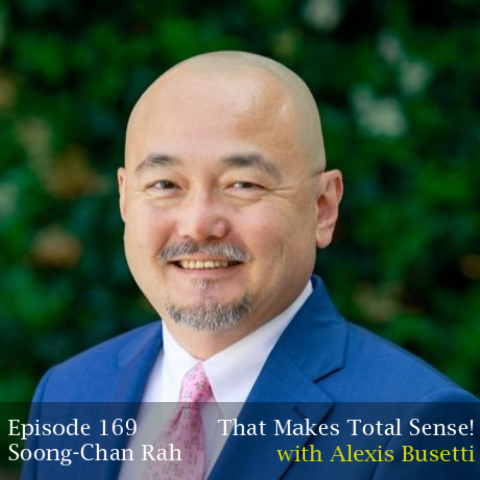
Speaker 1 00:00:41 Well, as some of you know, every once in a while I get the privilege to interview a former professor of mine, and that day has come for me again, today. I am sitting across from Dr. Sing John Raw, who probably most people listening to this would know you sing John and your work and, and where you've been and heard you speak and all of that kind of stuff. Um, and so we could be talking about, I mean, so many things right now we could be talking about Yeah. Half a dozen books that you've written or <laugh> if you know, dozens and dozens of lectures. Um, but we're gonna focus, I, you know, this hardly ever happens, but we're gonna focus on a book that's like older, uh, that you, that you co-wrote. Yep. It's called Return to Justice, Six Movements that Have Reignited Our Contemporary Evangelical Conscience. So thanks for coming on.
Speaker 2 00:01:32 Sure. Glad to be on.
Speaker 1 00:01:34 I'm, I'm really excited about this work. And as I was looking and kind of reminding myself of your official bio Uhhuh <affirmative>, I think it's cool because you talk a lot and you teach a lot, and you are in this space of advocacy and social justice. Yeah. But where you are at Fuller is the professor, you hold this chair Yeah. Of evangelism, Uhhuh <affirmative>. And so I feel like you are, like, I'm staring at someone whose professional life kind of is these two things that have made Yeah. Evangelicalism with a capital E.
Speaker 2 00:02:11 Yeah, yeah. Yeah. So it's, it's funny cuz for 15 years prior to coming to, um, Fuller, I was at North Park where it was the, uh, similar position, professor of evangelism. And, um, my perspective has always been evangelism is not as simple as the four spiritual laws knocking on doors and, you know, secret sensitive services. Those are not awful examples. They're just not a complete example of what evangelism is. And so for me, um, as a, as a professor, as an academic, but also having been a, a pastor and a, and a campus minister and those who, someone who has worked in ministry for many years, um, 17 years in on the ground ministry, uh, for me, the work of evangelism was never that simplistic. It was never that reductionist. And so when we wrote this book, my, my co-author Gary Van De Paul and I, we were actually, uh, pastors of the same church.
Speaker 2 00:03:02 I was the senior pastor, Gary was my associate pastor. Um, and both of us are, as academics historians, uh, really wanted to reflect, um, how some of the larger academic issues and intellectual questions that we might have might actually have bearing on the day to day life of the church. And so that's been an important part of my formation as an academic, my experience as a pastor. And I hope that kind of shows in this book, in that that was one of the sweet spots for both Gary and I were both academically inclined, but also very much, uh, minister, minister, uh, ministry, uh, geared. And so evangelism and justice, the, the ecclesial expressions of that was an, is a very important theme in this book.
Speaker 1 00:03:45 Yeah, it is. And, and I, I, I, I told you before we started recording, I'm like, I have never, I have never asked and author this <laugh> on air. And so here goes first time for everything, but you explain all this. And I'm like, Yes. Like I'm, I'm not a publisher, but I'm like, Yes, write that book please. Right? This is, yes, this is the one. And then you write it and it doesn't sell
Speaker 2 00:04:06 <laugh>. Well, thank you for letting the cat out of the bag there. <laugh>. But, I mean, but you're right. <laugh>,
Speaker 1 00:04:12 This is so interesting. So I'm like, all of these things that you just said, and I'm like, But why? Like, why, why was this one, like, you know, not as successful as all of your other books have been incredibly successful. Like, why was this one, like comparatively Yeah. You know, kind of, kind of a dud compared to the Well
Speaker 2 00:04:31 <laugh>, thank you. Uh, well, it's true. Um, but I wouldn't quite call it the other books, Roaring Successes. I, you know, they <laugh> they paid for a couple of nice dinners, maybe
Speaker 1 00:04:41 <laugh> and award winning.
Speaker 2 00:04:43 Yeah. Award winning. You don't for sure. You don't get into, uh, Christian publishing to, for the Big bucks unless you're a Rick Warren. You know,
Speaker 1 00:04:51 <laugh>. That's right, that's right.
Speaker 2 00:04:52 Uh, you know, most Christian books, if you know, I think about 5%, that's the number make, uh, so sell over 10,000 and the other 95% are less than 10,000. The number's pretty atrocious, in other words. Yeah. Uh, so, but this one, you're right, relatively speaking to my other texts was even worse than the, the other texts. Um, and it was interesting cuz uh, my co-author and I, we had a lot of high hopes on this. Uh, as I say, we're both academics, we're both, uh, were pastors for many years. Uh, and so we really thought this is a really good text to tell the history, particularly of Evangelicalism. And we tell the story of Evangelicalism, but through the historical pastoral lens of how churches do justice or how the evangelical churches then, uh, works of justice. And, uh, if you look at the copyright date and when the book was released, it was released in 2016 <laugh>. Um, and so Gary and I
Speaker 1 00:05:47 Arrived not a great year for Evangel Evangelicals in America. <laugh> not
Speaker 2 00:05:49 A great year for any kind of conversations on social justice. That's right. Sadly, even kind of six, seven years later, we're still having trouble gaining some of that traction. Now, this book, uh, was written on the heels of a couple of really good other academic books that were more academically driven, model minority and Brentley Gas Away's book, Schwartz's book and Gas away's books, both were on university presses. They didn't get the wide readership, but there were attempts to try to engage this untold narrative around evangelicals who engage social justice ministries. Uh, and they do it again, more from an academic historian perspective. Gary and I did it from more pastoral historian perspective. Um, and we were excited. We had Mark Knows endorsement, we had Jim Wallace's endorsement, we had all these folks who were really excited about the book as well. Uh, it was on Brazos, which is a great press for books like this, uh, intellectually Minded.
Speaker 2 00:06:42 But for, uh, broad consumption, we thought, you know, hey, this book is gonna put us on the map in terms of church history and theology and application to pastoral ministry. Uh, but as we know in that moment, uh, the year 2015 and 2016, uh, particularly 2016 was the election. So leading up to the November election of Donald Trump in 2016, uh, there was a lot of contentious kind of argument around, uh, evangelicalism and evangelical identity and evangelical identity in those years. And still to this day, was pretty much co-opted by the religious right. And people began to associate, uh, evangelicalism with the religious right. So at that time, when you write a book on evangelicalism and social justice and progressive movements, nobody wants to read that book as everybody's talking about the religious right. In fact, around that time, a number of books were published about evangelicalism and political conservatism, religious right.
Speaker 2 00:07:38 Those books did sell. <laugh> in our book did not gain the traction. And again, you gotta think back, it wasn't that long ago in 2016 that we were talking about how, uh, and we know in 2016 that 81% of white evangelicals voted for Trump. Uh, this is not an audience that wanted to hear about a group of Christians who were actively involved in, uh, justice ministries. And certainly in our book, we try to tell the broad story of evangelicalism, including black evangelicals and Latino theologians, and that wouldn't have jived with the current, um, at that moment, the cultural occurrence, which was, we don't want to talk about this. We wanna talk about, uh, white centric, white supremacy. We wanna talk about, uh, close the borders, you know, build the wall, We wanna talk about keep the Arabs out. And, you know, it was all sorts of crazy rhetoric. And so this book just did not fit in that rhetoric. Uh, so it actually went out of print and I, I, I, I personally bought like 500 copies and, and made it available to, on Facebook for be Able to Buy. I've, I've wrote out of those copies and I'm, I'm hoping the publisher didn't destroy those other copies of the books. Uh, but it's a hard one to get. Uh, but I, I think it's actually one of the best books I've written cuz it's a good combination of history, academics and pastoral ministries.
Speaker 1 00:08:55 No, I thought it was fantastic. I did find it on Amazon, by the way. Okay. It was not prime shipping. So I, I almost doubled the pri my purchase price by, by having it shipped to me. But it was brand new copy, so, you know, somebody's got it somewhere. Yeah. But it's, but it's funny because I, at the, at the time, um, had been working on a project, it was actually in 2017 ish. Yeah. And, uh, I had, I kind of threw a series of events and a series of, of people telling me, You should, you should talk to this guy, you should talk to that guy. I ended up chatting with a, a retired pastor from a large, uh, mainline denominational church here in Houston. And we were just chatting about this project I had. And, and he said, um, you know, I told him that the subtitle and it just had the, the phrase social justice in the subtitle. Yeah, Yeah. And he said, You can't do that. Yeah. <laugh>, he said, if you put those words in the subtitle Right, no, Evangelicals will read it.
Speaker 2 00:09:50 Unfortunately. Unfortunately. True. Yeah. Yeah. And the recent industry has proven that. Yes. Where you get the label of Social justice warrior. Yes. You get all the labels, uh, c r t, um, Marxist Leftist Liberal. Um, and we were actually, our intention was trying to disprove that to say, these folks who were doing great ministry on the ground were very profoundly theologically conservative. They were evangelical theologically. Now they had some progressive social views. So black evangelicals were deeply, deeply immersed in scripture. Uh, they had a very high view of scripture, very high view of soteriology. You know, you give them a test on the evangelical check marks theologically, they would've passed a flying colors, but they were seen as Marxist progressive liberals because they talked about race issues. And you'll see that pattern over and over again. And sadly here we are 40, 50 years later, anybody who says, Hey, let's care for the poor.
Speaker 2 00:10:48 Oh, you're a Marxist. Uh, let's talk about race. Oh, you're a C R T Marxist. You know, all these labels start coming out. And that's the unfortunate reality. Certain terms are like the third rail of a, of a railroad trade, and you don't, you can't touch 'em. And that's the unfortunate, uh, sad, but, and, and really intellectually vacuous argument to kind of lump all this together without really thinking through. Uh, and in our book, that's what we're trying to do. We're trying to say these social justice movements have a biblical theological, uh, motivation to them. And that's what unfortunately has gotten lost over the last several, last decade or so, I would say.
Speaker 1 00:11:25 Well, I, I would love for, because, because everything you're saying is a hundred percent right when you say, like, it's just, it's a pattern. Like that's the thing that came to my mind is this, it's this rhyming history. Right. That's over and over and over again. But what was so eye opening for me, and I'm hoping that you'll kind of school us a little bit and give us maybe, you know, the, the Cliffs Notes version here, but you spend, um, you and Gary spend the first part of the book, the introduction, laying out this history. I mean, it's, it's in, it's in pages, not in volumes as it as it could be. Yes. But, but these, uh, pages to kind of let us know how we got here. Yes. And that was fascinating to me. Be and because I mean, just like a tiny little bit of my story, I have always, now I have wonderful language from Robert Chow Romero as a Hispanic woman, as a mixed Hispanic woman of saying, I've been on the social justice borderlands.
Speaker 1 00:12:20 Yes. Now, I just didn't know there were other people there with me. Right. I didn't know that was a thing. But kind of my, my whole life, you know, when I've had this bent toward social justice as a Christian, I've always felt marginalized and kind of pushed to the outskirts. And I'm only in my forties, but this is something that didn't begin in the eighties. Right. Like this has always Yep, that's right. You know, this has been for a very long time. And so kind of the phrase that stood out for me that's helped me, um, with this context and this history a bit is the great reversal. Yeah. So, so can you help us understand a little bit of the history? Like, how did we get here? Why does this keep on rhyming? It, it hasn't always been this way. Yeah. But what happened?
Speaker 2 00:12:59 Yeah. So if you look at the long history of and, um, of evangelical Christianity, and we do distinguish between what we call capital E Evangelicalism and lower Casey Evangelicalism, I'll flesh that out later. But the idea is that lowercase evangelicalism you see throughout history, you see it in the early church, you see it in St. Patrick, you see it in the Reformation, you see it in Wesley and, and Edwards. And, um, the African Pentecostal movement, uh, evangelicalism with a lowercase e is a larger ecclesial theological movement. And when you trace that history, and these are folks who would identify as like Bible believing, christologically centered activist faith type of Christians. If you look at that throughout church's history, you'll see repeatedly that evangelism or the expression of communicating the gospel through individual means, uh, was always side by side, hand in hand with acts of justice, mercy, justice and compassion.
Speaker 2 00:14:01 You see it over and over again. It begins with a book of acts, actually in chapter two, where you see in Acts chapter two, the work of the church preaching the gospel like Peter does. But in the very next paragraph you're seeing, they shared everything in common and gave to the poor. Those are back to back. And both are factors in the growth of the church and the growth of the early church. Uh, Rodney Stark writes about how the church grows from the small set of Judaism, uh, in, uh, in Palestine. And then it grows into the largest, uh, of most powerful religion in the Roman Empire in 300 years. And he points out that it wasn't just the personal evangelism piece of it, but it really was acts of mercy, justice, and compassion where the Christians care for the poor Christians gave mercy and justice, uh, to those who were sick and provided healthcare to those who didn't have it.
Speaker 2 00:14:52 Uh, so you see throughout the church's history that evangelism, the, the, what we define as evangelism now, which we would define a little too narrowly as personal individual, that's the four spiritual laws. You knock on doors, you do, uh, evangelistic crusades, individuals come to faith in a, in a personal relationship with Jesus. That individual expression of evangelism was never the full picture of evangelism. It always was. On the flip side, was social justice or works of justice, mercy and compassion, they always went hand in hand. For 1900 years of church history. You look at church history for 1900 years, you saw that, you saw that in the US in the 19th century because every revival movement that you saw in the church, the great awakening, the second grade awakening, it always co coincided with social change. Um, when you had the second grade awakening, you had that leading into, uh, an, the anti-slavery movement.
Speaker 2 00:15:49 You had that leading into, uh, uh, women's, uh, right to vote. Uh, women's right to vote occurred in the basement of churches. Uh, so all of these major social justice movements in the 19th century had their roots in evangelical Christianity, the right to vote, uh, the end of slavery, uh, child label laws, reforms, all these major changes, positive progressive movements were actually rooted in, uh, in the church and in in Christian communities. But the great reversal, and this is language that was used, um, by, um, uh, David Moberg, uh, in the 20th century as a church historian, uh, and Moberg points out that after 1900 years where you had this combination working together, uh, left foot, right foot flip side of the same coin, justice in evangelism, uh, it was in the, uh, early part of the 20th century that you begin to see the separation, the divorce, the reversal of that, uh, uh, working together.
Speaker 2 00:16:49 And there's a lot of different factors. One of them is what we call the, the modernist fundamentalist controversy, where the modernists were seen as liberal and progressive, and the fundamentalists were seen as conservative and, uh, evangelical. And so because of that split, um, you began to see evangelical fundamentalist see the world as a wrecked vessel. This would be the language, for example, of DL Moody. And so your job is not to deal with a wrecked vessel, but it's to save individuals out of that wrecked vessel. So the focus becomes individual evangelism and salvation. Don't worry about social change because, and a lot of that is tied in with dispensational theology, eschatology where, where the world's gonna be destroyed anyway, so why worry about it? Why end slavery? Because the world's gonna get destroyed. Destroyed. Why end racism? Because, hey, it doesn't even exist anyway. So why deal with these social systemic issues?
Speaker 2 00:17:46 Why deal with these structural problems when our main goal is to save individual souls? Again, that was not the narrative for 1900 years of church history, but it became a primary way in the 20th century of experiencing so that the gospel now, the, the Christian message now is no longer the good news of the both Anne, the changing of the individual and the changing of the world. But it has been reduced to, well, the gospel is really an individual sinner coming to faith in Jesus Christ through a personal revelation. Well, that's part of the gospel, but it's not complete. And so what happened in the 20th century is, um, is actually the, the exception, not the rule. So the rule is justice and evangelism have worked together. The blip on the radar that says actually we're doing it wrong, is the last hundred years where we have separated the two out and said, the personal evangelism is what the conservatives do, and social justice is what the liberals do. And that's been the narrative of the last hundred years, unfortunately. But it, it is reversing and it is changing 1900 years of church history.
Speaker 1 00:18:55 What happened,
Speaker 2 00:18:57 <laugh>, that's what I found
Speaker 1 00:18:59 What happened that led a, cuz it wasn't everybody, Right,
Speaker 2 00:19:05 Right.
Speaker 1 00:19:06 Who had been this in this lower case. Right. Evangelicalism. So what happened that that split kind of began and that, you know, cuz it sounds like as chronological to me, right? This maybe, maybe coinciding with maybe, uh, dispensationalism and kind of those types of views. But I don't know that it was all theological. Was it social as well? Like what was happening?
Speaker 2 00:19:30 Yeah, so there were a lot of factors in the early part of the 20th century, and I would point to two major social sociological factors. The first is, uh, something like the scopes trial in the early 20th century. Yeah. Where, um, the, the, the battle over whether you're gonna teach evolution in the high schools, uh, or in the, in the secondary schools. Um, as, as many of us know, um, even though, um, the trial was warned by the conservative fundamentalist in the court of public opinion, in the newspaper reports, the Christians, the evangelical fundamentalists looked stupid. Oh
Speaker 1 00:20:08 Yeah. They got totally locked in
Speaker 2 00:20:09 Looking really like country bumpkins who had no idea about the way the world really worked. And so because of that, what you ended up with is evangelical fundamentalists around that time, beginning to withdraw from the world. And you see a lot more language and ideas around what you would call church against culture or Christ against culture. We see the world as hostile. Um, and that also ties in with the dispensational, uh, pre-millennial ology. So one is looking at the world and say, Hey, the world is hostile to us. We're not gonna save the world. We're not going to take the gospel into world. We're just gonna save ourselves. And I, I talk about how around this time you see, uh, the architecture of American Christianity begin to look like, uh, Noah's arc. They look like ships upside down ships. And the reason is, that's the self-perception.
Speaker 2 00:20:59 We're a church that runs away from the world, that hides from the world. We hide out in Noah's arc. We begin to build cultural appropriations of the world out there. So secular music will have Christian music, secular art will have Christian art. Uh, secular literature, secular schools will have Christian literature in Christian schools. And so there develops in the 20th century, especially in the early 20th century, this Christ against culture, uh, ideology or I or philosophy. And when you have that kind of theology of Christ against culture, you begin to not only run away, you don't care about what happens in the world. You hide in Noah's Ark and let the world be just, uh, destroyed. The amplification of that or the, uh, the ultimate affirmation of that move actually comes and the, the, the, the finishing off of that move occurs, uh, post World War II with, uh, white flight, Uh, you begin to see urban centers change from, uh, centers of white Anglo sax and Protestantism to much more diverse, uh, you get African Americans in the great migration moving from the southern, uh, states to the northern cities like Detroit and Chicago and New York and Baltimore and Philadelphia.
Speaker 2 00:22:12 Uh, you get to begin to get the influx of Latino immigration and Asian immigration. And so the cities go from centers of whiteness to much more multicultural and multiethnic. And that's when the whites begin to leave the city and start to move into the suburbs. And now you begin the narrative of the city as an evil broken, uh, crime written place because all the minorities live there. And then the new Jerusalems are the suburban communities. And that's why you'll notice in the seventies onward, all the megachurches pretty much are in the suburban communities with few exceptions, but mostly they're found in the suburban communities. The churches that we talk about in the eighties and nineties are in, you know, an hour outside of la an hour outside of Chicago. Uh, that's the typical megachurch because that's all part of white flight. And so you have these kind of two earth shaking events within US history one, this kind of split between modernists and fundamentalists where the fundamentalists are viewed in a negative way and the fundamentalists run away and hide.
Speaker 2 00:23:15 And then the second, the changing demographics of American society, particularly in our cities, and again, very similar scenario, the whites runaway and hide. And so you have this kind of antagonism to the world. And so what do you do when you're in the suburbs? You don't need to change the suburbs. You just change individual lives, Save souls and don't worry about society and let society be, you know, overrun by evil people like in these urban centers. And that's where some of that language comes out about the city as evil. And Chicago is where all the violence is, or LA is where all the violence is. And all the good people have gone to, you know, uh, um, <laugh>, uh, Orange County and go to Saddleback and all the good people have gone to, uh, you know, uh, Barrington. And they go to, they go to Willow Creek. And so that narrative develops where the emphasis is, well, we just need to save souls because we don't care about the world out there. And that those two kind of major moments have shaped the way we do Christianity now, you know, even a hundred years later.
Speaker 1 00:24:16 So one of the most fascinating things because, cause I was, I was familiar with like some of the stories and some of the organizations in the book, but the, of course the places that gathered my attention were places that you went, you know, deeper or told more of the story that I hadn't heard, or some that I hadn't heard at all. And it was this, oh crap, I didn't write it down, but this h u p like homogenous Yes.
Speaker 2 00:24:36 Homogenous, you know, principle
Speaker 1 00:24:38 Unipri. Yes, yes, yes. Talk about that, because I just thought that was, that was crazy to me exactly what you just talked about instead of like trying to bring people together and unite. I'm like so interested in like multicultural churches and all this stuff and, and churches were doing exactly what you just said and hanging onto that and using that for church growth.
Speaker 2 00:24:57 Yeah. You know what's interesting is if you trace the history of big e evangelicalism, capitally evangelicalism, which Gary and I assert emerges in 1970s, and that's when you start seeing evangelical institutions become more prominent. The seminaries are clearly evangelical seminaries, The Trinity, the Gordon Conways, and the Fullers. Uh, the colleges are clearly evangelical. The Wheatons and the Gordon Colleges and the, uh, you know, Zoo Pacifics, they're, they're pretty clearly evangelical, uh, but certainly in a varsity campus crusade, uh, world vision. Um, um, there are all these emerging evangelical institution, obviously the Nae, uh, you know, these institutions begin to, uh, Willow Creek associations become the places where evangelicals interact with one with one another. And they're these relational spaces. And one of the things that happened is that when you look at the growth of Big Evangelicalism post 1970, um, there are very sim uh, there are kind of markers that show and parallel the growth of evangelicalism.
Speaker 2 00:26:01 And one of those is the church growth and megachurch movement. You have, you see these kind of growing side by side as Evangelicalism grows. So also along the same trajectory grows the megachurch movement in this, uh, uh, uh, church growth movement. Um, so this is interesting cuz you know, both of us are affiliated with Fuller. It actually started a fuller seminary where a mission, uh, professor by the name of Donald McGovern was actually trying to do good academic research. He goes to India, he was a missionary in India before he retires and comes back to the US and he notices that, uh, people come to faith in kind of communities, which actually is in the Bible as well, Right? How the jailer goes back and the whole household comes to faith. That's not out of the ordinary, but he applies that, uh, in kind of this missionary context that we need to, uh, the gospel needs to be more holistic and it needs to deal more with communities and not just individuals.
Speaker 2 00:26:57 But when it comes to the US it takes on a very unique American expression. And that's picked up by Peter Wagner and a couple of other, uh, like, well actually Rick Warren and John Maxwell, uh, they all come out of Fuller's, uh, program, and they apply it in a different way. They apply it not only as a church growth principle, but apply what we call the H U P, the Homogenous Unit Principle. And this is, uh, mostly Wagner's work, but it comes from a sociological, not a biblical philosophy. The sociological philosophy is called homophily, which basically means birds of a feather flock together. And it's very true. Uh, if you want a tighter cohesion and unity in a community, the best way is to bring people together who are like one another. Um, I mean, <laugh> really negative example is kind of the Republican party right now.
Speaker 2 00:27:47 Who are they bringing together? They're bringing whites, uh, white Republican evangelicals. They're bringing that group and that group is tightly bonded together because they hold similar values, similar race, similar culture, similar narratives, all of that. And so that's the idea of the homogenous principle, that if you have like-minded people, you will kinda have tighter bonds. And if you're an organization, you'll probably grow faster. Now, there's some truth to that sociological truth, but the problem was it was coming into application at maybe the worst time where it should have been applied. It was coming into application, Dante's principle at the time when, uh, desegregation was beginning to occur in US society, right? So you have the civil rights movement that's tearing down the Jim Crow laws, and you're getting schools integrated. You're getting the military integrated, you're getting governments integrated, You're getting neighborhoods more integrated. And the only place that didn't work well, two places.
Speaker 2 00:28:45 One, the country clubs never integrated <laugh>, right? But, and the churches never integrated, uh, until recently, it's getting better. But there was a time where the homo principle was used as justification. Why? Because we're all about evangelism. We're supposed to grow the church. What's good is evangelism if we don't grow the church. And where if we're going to grow the church, then we need to follow. And it's true the homogenous, you know, principle, because it is true, You grow faster if you attract only one type of people, right? In fact, it's harder to grow when you are diverse. It's just natural human social reality. It's hard to grow when everybody's different. It takes longer time to get to know each other. The the trust takes longer to develop. Whereas if you're all Korean, that group will grow fast because you already have a common language and common culture.
Speaker 2 00:29:33 If you're all white suburbanites in Orange County, you will grow faster because you have a common language and common culture. And so the homogenous of principle does work, but it is a sociological success story in that it will grow the church numerically. But it is a theological ecclesial failure because it actually produces hyper segregation. And I don't know if I put it in the, in this book, but, uh, Michael Emerson did the survey of, um, the level of segregation at the height of the megachurch homogenous unit principal movement. And he found that the level of segregation in the US Church, um, was, it was something like 91% segregation, 91, 90 2% segregation. There was only one other time in US history that that level of segregation was possible. And that was, uh, in the deep South during Jim Crow laws. It was the only other rival in terms of the level of segregation.
Speaker 2 00:30:32 And the church was able to accomplish that. So what you're seeing is, as Jim Crow is falling apart or being torn apart by the federal government, by, uh, by the Civil rights movement, all of that, the church is actually reinstating Jim Crow. But doing it under these theological auspices, pretending, Oh, we wanna grow the church, we're all about evangelism. And the best way to do evangelism is just by evangelizing the people that are like us. Um, and that was the pattern for 30, 40 years. And that was in many ways the root of evangelical Christianity. I'll give you a quick example of this. Um, if you look at a copy of Before, uh, Rick Warren wrote A Purpose Driven Life. He wrote a book called The Purpose Driven Church. And that was drawing from the homogenization of principle because he would say, This is the person we want at the church.
Speaker 2 00:31:23 It's actually a picture of a white man in his forties with a golf club and a cell phone, khaki pants and a polo shirt. And he said, This is the person we want to come to our church. Now think about if you are not that, if you're a woman, if you're an African American, if you're a Latino, um, an Asian, you don't fit. That's not who they want. And so they built the church for the 40 year old white male with the khaki pants and the polo shirt and the loafers and everybody else, we, you know, you can come, but we're not, we didn't make this church for you because birds of a feather flock together. So of course the church will grow, but it had huge unintended negative consequences, which was hyper segregation that we're still finding, to this day, we still haven't figured out how to get over because that hyper segregation led to 81% of white evangelicals voting for Trump. That's the product of the homogenous of principle and the hyper segregation that we saw in the church starting from the seventies, right. Up until the last 10 years.
Speaker 1 00:32:24 I feel like there's a, there's like a, a bridge that I'm kind of wanting to see in my mind, but I don't, I don't know, I don't have words for it right now, but, but this, this homogenous kinda like goal, everything that you're just describing Yeah. Like feels just incredibly related to our problem as evangelicals with individualism. Yeah. And this one, this kind of, not just this one-on-one, um, evangelism that we, you know, kind of tend toward, but also just this, this full-fledged like we, like we say, community with the ones side of our mouths, but like, really it's like a group of individuals Yes. Is probably really what more it's like. So I don't know, Can can you speak to that? Can you help give me some words for kind of what I'm, what I'm trying to Sure. What I'm imagining
Speaker 2 00:33:12 There <laugh>, that's where, um, it's a very American phenomenon and I would actually add, it's a very white American phenomenon, right? That's why we try to give two examples that I think are the important examples outside of White American evangelicalism, which is the black evangelical movement as well as Latino theologians. Yep. Both movements try to break out of this hyper individualism, but that's a very common phenomenon, mainly because that's in a, a, a western American US value individualism. Now, I'm not saying that that's all bad, cuz um, individuation is an important part of one's identity to understand that you can have a personal relationship with Jesus. You're not bound by the histories of your family, of your people. That's an important part of Christian faith. But again, you can't reverse all the other stuff either. You can't wipe out all the other stuff. And so, um, individualism leads us into oftentimes community worship, church life that caters to the individual.
Speaker 2 00:34:10 Um, I joked about when, you know, 20 years ago when I was a worship leader, how, you know, I would look through the collection of songs we had and like 60% of the songs began with a letter I Yes. Uh, because of the individualistic folks. Now think about the intention of corporate worship, to worship together, not just individuals in a room singing, but a corporate worship. And so how come half our songs start with a letter? I, it shows this hyper individualistic tendency that we have as the church to gravitate towards this, you know, individualistic view. Uh, and you could argue, uh, and I, and I know there are exceptions, but many small groups operate this way. Mm-hmm. <affirmative>, uh, many churches operate this way. Individuals come to the church saying, Oh, I better have my my needs met, met today, and if I don't, then there's always a church I can go to and find another church that will meet my needs.
Speaker 2 00:35:02 And so that has led to, um, the church in many ways, um, complying with the consumer. If the consumer, the person who fills the seats and pays the tithes, if the consumer wants an individualistic Christianity, then that's what we're gonna give them. Because otherwise we don't have a church or we have too few people to have a church. And so that's why I think it's important that oftentimes when we fall into some of these traps around Christianity, and we develop these very, um, culturally captive ways of expressions of worship and church life, that God introduces other places where you see a different type of Christianity, a different type of church life. Uh, my first book I talk about how the Korean immigrant church modeled a different type of community. It wasn't just about the individual. It was about how a community cared for the recent immigrant and the alien and immigrant that just came to the us.
Speaker 2 00:35:58 Uh, you see this very much in the black church. You see this in Latino communities with Spanish speaking congregations. Uh, and you see this in many other churches as well. Um, but what you're trying to develop is a counter narrative to the dominant story that church is about the individual. And God in his infinite wisdom has always given these counter examples. And so when the evangelicals met in Lasan to talk about evangelism, that's when Latino theologians were there to say, Hey, we are not the, the white Americans in North America. We are coming from Latin America. We're coming from other parts of the world that sh that clearly says you've got to include justice and not just individualism. And so some of the best ways we can combat the idolatry of individualism is actually being in community and relationship with those who are not coming from that space. So people of color, immigrant communities, global Christianity, they have a different view because they have a different context and their Christianity is much more communal, whereas ours in the US tends to be much more individualistic.
Speaker 1 00:37:07 Yeah. I mean, I'm thinking right now of, you know, you were, you were talking about the Latino theologians, um Yeah. Which was which, and you even mentioned like, even, even so many Spanish speaking students or Latino students, like in in their careers had like never heard of these guys. Padillas Yeah. You know, some of these guys, which I'm like, Yeah, I was in that boat until I, you know, until I hit Fuller. Um, you know, same didn't realize that all of this, you know, kind of familial history I'd had. But, but I'm thinking about kind of going back to the first, uh, chapter of the book where you talk about Perkins for sure. Yes. Which is like huge, huge example. Um, but the but the story that like threw me for a complete loop, I have to be honest, was the story of World Vision.
Speaker 2 00:37:49 Yeah.
Speaker 1 00:37:50 Because I'm like, Good night. This is like something that's, you know, with we know child sponsorship, right? And we know of the kind of more abroad justice work that they're, that they're doing as, as an organization. But to watch, in my mind, I'm like watching this train go by of, of how they started and kind of how they got here. And that is almost, I mean, that's like, that's the messiness of American Evangelicalism. Yes. Like right there kinda wrapped up in the World Vision story. So can you give us a few highlights of <laugh> of that, for those of us who don't, who you know, don't completely know the history of that. We, we all know the organization, I feel like.
Speaker 2 00:38:34 Right, Right, Sure.
Speaker 1 00:38:34 But we just don't realize kind of the trajectory that they'd taken as far as leadership and, and, and Yes. And all of that that you're talking about in history of the organization.
Speaker 2 00:38:43 Yes. So, uh, full disclosure, I was certain on the Board of World Vision for nine years, and I have a, uh, and, and, and Gary actually did his dissertation on World Vision. So that's why this chapter was so important. And that's why it's so robust, because there's really good, uh, both my my kind of personal experience as well as Gary's in depth research, uh, into the organization. Um, but I will say one of the things is that World Vision, you could argue, started off as a typical evangelical institution, uh, in, you know, good ways in that there was a lot of generosity, there was a lot of, you know, care for the care for other people. Those are good things. But there was some dysfunction there too, right? I mean, you had this kind of Tarn individual, Bob Pierce who was kind of going go out and conquer the world.
Speaker 2 00:39:27 He was probably exploiting, you know, the kind of the whole, uh, the feel compassion for those that are, that are less, you know, than us. Um, and individual as an individual. He was not the best human being, all that kinds of stuff. But even in all that fallenness and brokenness, I think God did an amazing thing in World Vision. So what started off, one could argue as, Hey, this feels very paternalistic, just kinda white people writing checks to help poor Koreans and poor Chinese people out. Um, and, you know, orphans in particular, um, but that's not where World Vision ends up. And that's where some of the, the hopefulness of that narrative and trajectory occurs where an organization that was committed to the gospel and still Christian Witness is one of the key elements of the World Vision identity. Um, and yet, uh, wanting to do the best that it can to serve and care for the poor.
Speaker 2 00:40:16 And so World Vision moves for away from this kind of hyper individualism child sponsorships, say one child at a time, uh, and really begins to move towards, actually we're gonna work in community development and villages, and then it becomes advocacy, and then it becomes, uh, you know, uh, disaster relief. It becomes, uh, care for, um, especially things like, uh, uh, uh, um, women and girls in need, uh, you know, uh, urban programs that are a little bit different than the rural kind of, uh, you know, get water and dig well, this type of thing. It's doing the whole spectrum of it. Because World Vision was one of the major things that it did was it actually listened to the poor and, uh, World Vision was the first NGO Christian or non-Christian to, uh, federalize its model. And others have not all follow through, but some have.
Speaker 2 00:41:04 What I mean by federalizing is that even though World Vision started in the US and to this day at least, I think half the funding still comes from the us it went to an international model, a global model. And what it did was it actually, and I was served on the international board for three years on the international model. The governing body of World Vision is no longer US based, It is now internationally based. So I would sit around a table where we would have four representatives from North America, but two representatives from Europe, one from the Middle East, three from Africa, three from uh, Asia, uh, uh, and then another two from Ano. You know, they separated out Asia, another from, uh, from Australia, New Zealand. And you look around this table and you have a, a Kenyan, uh, and a Ugandan saying, Hey, this is what we really need, not what America is telling us we need.
Speaker 2 00:41:54 We have a bivian who's saying, this is what's going on in our community now, we might have to change our strategy. And I, that was a, that was a real picture of the Kingdom of God on this massive large scale of an organization that started on very US centric. It was all about US dollars going overseas and writing the checks and putting up your little foster child on your, on your refrigerator door. I still think that's great, but at the end of the day, what you see of World Vision is a genuine global church coming together to serve the poor and the neediest, especially the children. Um, and so, uh, that's a success story. Uh, now it's come under fire for some of these things, but I think what World Vision has done well, it has kept that narrative. We're a Christian organization. We believe in Christian witness, but we also want to do well in our work for the poor, and we also wanna serve the poor.
Speaker 2 00:42:43 Well, and I would say that World Vision as an NGO is still one of, regardless of Christian or non-Christian, still one of the most successful, one of the most cutting edge. And as you may know, the current ceo, uh, president, CEO of World Vision US is a Latino, uh, Edgar Sandoval. Uh, and Edgar came on when I was still on the board. Uh, and that was such an exciting moment to have a, uh, and he's a, he's actually an immigrant generation. Uh, he was born out, uh, he was born in the US but then lived outside of the US for several years and then came back. Uh, so he is bilingual, uh, bicultural, uh, you know, uh, wonderful story. And he's, he's now leading World Vision us. And one of the most amazing things is he tells the story that got lost, and we try to recapture it a little bit.
Speaker 2 00:43:26 David Schwartz were a book on this later on, that the real growth of role vision was not Bob Pierce. You know, Bob Pierce would come and tell the stories and get sponsored children and send money, but the real work were the local Korean churches that were, were actually running these orphanages. I was actually serving the poor. And then the local Korean churches, uh, and some of 'em will go on to become very big churches later on, but it was really the work on the ground of these churches that brought the transformation, uh, and brought the work of World Vision to that whole new level. So World Vision has that history, what started off with maybe kind of mixed intentions of like, Yeah, I care for the war, but it would be great if I could, you know, uh, be a big celebrity in the process at, at after many, many decades. That's not where World Vision is. It's a really Christian, Christ, Christ-centered Christian organization that does a, uh, a cutting edge job of serving the poor the best that it can.
Speaker 1 00:44:21 Yeah, I think the, the phrase that stood out to me, I think it was Gary's phrase, kind of as, as, uh, you're wrapping up that chapter Yeah. Was that World Vision discovered that justice is complicated.
Speaker 2 00:44:33 <laugh> Yes. <laugh>.
Speaker 1 00:44:35 And, you know, and I think, you know, and when I think about the history of, uh, Evangelicalism and, and capital ev evangelicalism as we've chatted, I'm like, I feel a little bit of, of grief, and maybe I'm reading this the wrong way, but had the great reversal not happen, it's not that justice wouldn't be uncomplicated. Yes. But I wonder if the road hadn't been, if we hadn't detoured Yeah. So much, you know, would we be able to traverse this a little bit easier? You know, I kind of, I kind of wonder that, you know, um, Yeah.
Speaker 2 00:45:08 You know, it's, it's interesting that, um, the, our personal evangelism and discipleship will very often reflect, um, the way we, our church life is. Uh, and I don't think that's should is necessarily good, but it's true. And so if there's a good that I can come out of it is that out of trial, out of mistakes, out of failure, sometimes God does his best work, right? Um, I've, I look back on my personal life and I look at the places of failure, the places of struggle, the places where I thought like, okay, this is it. That's the end of the story for me. Uh, and yet God still offers redemption hope, possibility, even in the midst of my lament. And, um, I do believe that for myself, but I also believe that for the church and that there's obviously a lot of hand ringing and, you know, woe is me.
Speaker 2 00:46:03 What's gonna happen to the church? The church is dying, especially post covid as you, as you're probably aware. Uh, and as I've been traveling and talking to pastors, um, 10 years ago, there's a church that was, you know, many, many churches followed this pattern. 10 years ago, church had a attendance of 5,000 pre Covid. There were 2000, and then during Covid there were 500, and they thought they were gonna go back up to 2000, but they're staying at 500, a thousand. So what's going on? And they're going back to, Well, what were we doing when we were 2000 and trying to get back to that? And there woe is me, or, and, you know, many of these megachurches, uh, one of the largest megachurches had to do 50% staff cut, uh, post covid because, you know, they, I think out of 300, they cut 150 staff, because you can't, you can't maintain a church when you're declining in attendance like that.
Speaker 2 00:46:49 So, um, there is a lot of handing, there is a lot of, woe is me, but sometimes out of the midst of that brokenness and the woe is me, is when really God begins to restore. And I really hope we learned the right lessons here. Uh, covid sped up, what was going to happen anyway, right? So we were gonna go from 5,000 to 500. That was not a question. Um, it took 15 years and it probably would've taken 25 if Covid had not intervened, but it was still headed in that direction. Just look at all the numbers in the trajectory. So the question is, we can look at this and go back to our exceptionalism, triumphalism, Hey, weren't we a great church, you know, in 2016, you know, make Christianity great again. Make the Evangelical Church great again. Let's go back to our 2016 numbers.
Speaker 2 00:47:37 Or we could say no, we were headed in the wrong direction anyway. Our churches were dying. Um, our next generation was leaving in droves. Uh, we were, uh, we were still clinging to the homogenous of principle. Uh, we were still clinging to white supremacy and white centrality. Uh, those were all broken narratives that needed fixing. And, uh, we didn't. And so the hopefulness for me is that in the midst of all the mess, and that's what we see in the book, I think too, where sometimes God in brokenness brings out some of the, the best of what human capacity can do. Um, and that's just, I think throughout church history, we see that, and that's why for Gary and I, both of us with our background in church history, is yeah, that's what God does out of brokenness. You can choose to double down on exceptionalism or you can opt for lament and cry out to God.
Speaker 2 00:48:31 Uh, I don't do it in this book, but I, I talk about that's what Bon Offerer does, right? Where a German church sees itself as exceptional and wants to make Germany great again. And the German church great again. So they buy into the whole narrative of exceptionalism in Triumphalism that was Esped by Hitler or Nazi Germany. Uh, Bon Huffer sees a different example of the black church in the United States that has gone through even worse tragedy in suffering and still emerges out of that, not with triumphalism and exceptionalism, but with humility, with a sense of justice, with a sense of God's calling to be the exhibitors of justice. And that's what Bono fur learns and takes that theology and ecclesiology back to Germany with them. Um, so there is that real value of learning from outside your community, those who are doing something in the midst of maybe the same struggle.
Speaker 2 00:49:24 And out of that comes this a a different narrative. And that's the stories that we're trying to tell here, how the black evangelicals actually tell a different story. How John Perkins tells a different story, how Renee Padilla tells a different story, um, how, you know, World Vision tells a different story. Uh, these are all important parts of maybe God's doing something different, not just in the megachurches, not just in the, uh, big, uh, big movement of, you know, revivals, of, of conferences that have the big names and the big splash or the best selling books. But sometimes behind the scenes God is doing something pretty amazing.
Speaker 1 00:50:02 That's so good. That's so good. St. John. I, I think about <laugh>, the phrase that kept coming in my mind was, Yeah, I think maybe it's the real us Ah, you know, like we, we, we've, we've had some, uh, we've gone through some, some parenting classes help us. We have, you know, Yes. <laugh>. But, but it's like sometimes, you know, one of, one of the pieces of advice was when you have a kiddo who maybe is kind of acting out or Yes. Kind of behaving in a way that you, you know, something else is going on, You know, call them, call them out in a good way and say, Yes, yes, I know this isn't the real you. Right? Yes. Yes. And, and it makes me think about, you know, gosh, could we, you know, this isn't the real us maybe <laugh> Yes. You know, the history tells a different story.
Speaker 1 00:50:46 The history has 1900 years Yeah. Of a different story of, of who, who the real us is as, um, as a church. Yeah. Uh, we, we have those, those two sides of the coin. It doesn't always have to be separated. It doesn't always have to look like that. We, we can Yes. I think look at the nuance, right? <laugh>, like, I think they can traverse the, the complicated things. And, and that's one of the things that was so encouraging to me about this, is we look at yes, John Perkins and World Vision and Yes. Jim Wallace and, and Padilla and Yes. And all of these guys and the, and the black church. Yes. It's like, goodness, there are people there, there have been threads Yes. That have just continued with this both and inside of, of the movement and not let one go for the sake of the other.
Speaker 2 00:51:40 Yes. And that's the hope. The hope is that the, the message of the gospel is very, very, um, persistent. And I think even the human evangelical with a capital e attempt to reduce the gospel to a marketable, um, um, digestible, uh, simplistic version. Right. Um, I believe that the gospel is bigger and, um, that that human attempt will fail. Great. And return to justice are the snapshots of how God still demonstrates the gospel. Not just proclaims it, but demonstrates the gospel. And that, you know, um, that to me is where my, I find my hope, uh, that, um, God is always doing something beyond what human beings trying to limit him to do. Uh, and so return to justice is both, uh, by the way, that was the title. It was, um, an idea returning to justice, but we also kind of thought it would be funny to think of this as a command.
Speaker 2 00:52:47 Let's return to justice. Yes. Let's return to the, the full gospel of Jesus Christ. Yes. Um, and we're returning to it because it never went away. It was, it's, it's, we've seen the flashes. Um, George Elton Lad and New Testament theology talks about this, the, the intrusions of the kingdom of God. And those are the things we look at and say, Yes, the kingdom of God is here. It's near, and it is at hand, and it is coming. And we see all those at once because that intrusion is not something we do. It is something that God demonstrates for us, and we can return to that justice.
Speaker 1 00:53:22 Amen. Okay. So here's the deal. <laugh>, I feel like that could be it. I feel like we could, we could put this, the stamp on it and be none, but Yes. Uh, one thing that I love to do with guests in general, but especially with professors, because I've been in classes enough times Yes. Where I've seen the look on the face of the instructor. Right. And they're kind of going, I wish, I wish they would just ask this one thing. Right. <laugh>, if if they would, if they would go here, we could, we could take it home. So, so I'm gonna ask you that today, and I will say Dr. Raw as I'm asking you that Yes. What question did I not ask <laugh>? What place, what place did I not let you go today that you really wanted to go with this book?
Speaker 2 00:54:00 Well, you know, not to you, Yeah. Not to, uh, appease the host too much, but I gotta say, um, I, I, uh, I really appreciated, um, your kind of questions and, and also giving me a lot of room to say a lot of stuff that wasn't necessarily part of the original question, which I have a tendency to do. I do that in class too, but too, by the way, when someone asks me a question, I just start, and then I just go on a tangent. So thank you for allowing me that latitude and room to kind of go into different spaces and explore different ideas. Um, I, I would say not so much, uh, a new idea, but, um, I, um, I really wanna recover hope and, um, the hope and the larger narrative of the Kingdom of God, and that to me is why I still am in this thing. You know, <laugh>, you know, I, I, I've got about 15 years left in my career. I can't believe I'm saying that, but I've got about 15 years left. And I'll be honest, I could kind of mail it in for the next 15 years. I don't have to write any more books. I'm tenured. I'm full, full faculty. Uh, I've got all my material, I've got, you know, I could probably mail it. I, I I'm not going to <laugh>. Good. That's not just for you, that's for my dean to hear. I'm not mailing it in
Speaker 1 00:55:12 <laugh>. Well, isn't it straight to Dr. Youngs <laugh>?
Speaker 2 00:55:14 Yeah. And my, and my new president. I'm not mailing this in. Yeah. Uh, for me, it's, it's the hope that God is still at work in his church and that I get to still participate in that despite my shortcomings and my failures. And so if, um, even though there might be places like, Oh, this is a bad story or a difficult story, um, at the end of the day, I would hope that we would still come up with a hopefulness. That even in our brokenness, even in our failures, even with capital E Evangelicalism, with everything that is wrong with it, and we can count, you know, long list of why it's a problem, uh, at the end of the day, God still loves his church and God still wants the church to do better and be better. And I, I still believe that. And so I'm not gonna mail it in, hopefully not for the next 15 years. <laugh>. Well, when I hit 70, I'll start mailing it in now then. <laugh>. That's what
Speaker 1 00:56:04 You'll have permission. You'll have permission at 70. Who knows, You may get that second win.
Speaker 2 00:56:09 That's true. People, you
Speaker 1 00:56:10 Know, you may just keep, you may just keep going. You may maybe 10 books between 70 and 80. Who knows?
Speaker 2 00:56:14 That's true.
Speaker 1 00:56:15 <laugh>, thank you. Thank you, Thank you so much. Um, I'm gonna say the name of this book and you know what I'm gonna, I'm gonna link where I bought it. Yes. And I'm just gonna say, say people can still get a hold of it, even though your 500 copies are gone. Yep. I would encourage people to do so. We're in 2022. This is a different place kind of than 26. Yep. I think so. Yeah. But it's, but it's phenomen. It's still a phenomenal work. This is Return to Justice by Chandra and Gary VanderPol. Six movements that reignited our contemporary evangelical conscience. Thanks so much for coming on. Thank you for having me on. The links for all the resources mentioned in today's episode can be found in the show notes, music and podcast production by Seth Boetti. Be sure to give us a review on iTunes and subscribe at your favorite podcast listening app. You can also visit us at. That makes total sense.com.