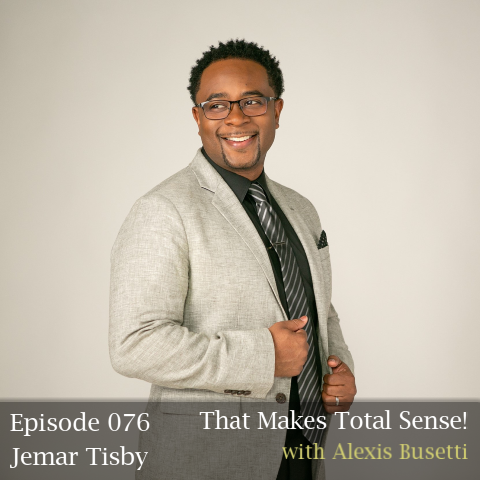
Speaker 0 00:00:07 Welcome to that makes total sense. A podcast dedicated to exploring God's generosity and justice. I'm Alexis resetting the Christian, aiming to ask good questions and encouraging you to do the same. Every one of us is wired by God to live out generosity and justice, but the house sometimes alludes us. That makes total sense is a way for us to get together, posture ourselves as learners and challenge one another to practice generosity and justice in a tangible way every day. So today is a really, really special day for me. And I forgot to tell our guests when we were doing kind of the housekeeping before we record, but this is actually the first time I'm on the podcast that we have had a guest return for a second episode to talk about something completely different. So, Hey, Jomar welcome back.
Speaker 1 00:00:59 I am so honored that that's a huge privilege. Thank you for having me back.
Speaker 0 00:01:03 Oh my goodness. It's fabulous. Now at the, at the very beginning of the podcast, I did a few like two part episodes where we sat down and recorded at the same time and released it kind of as a, as a short, um, series. But, um, we didn't end up liking that. And, and so anyway, it was recruited at the same time, but you are for sure. The first guests that I've had the privilege of asking back and the honor of you saying yes a second time. So thank you so much. I'm so thrilled.
Speaker 1 00:01:32 Absolutely. Absolutely. Thank you for having me back and for such an important time as this.
Speaker 0 00:01:39 So can we say the time right now? I think it's important. Um, because January 6th, 2021, many of us, I dare to say most Americans felt that day as a, as another before and after moment in our history. And so as, as Providence would have it, as it would work out Gemara and I were actually scheduled to talk before January 6th. And in which case it no doubt would have been a great discussion. Um, Jamar's great. And the material he's bringing is great. And so it would have been a fabulous discussion. Um, we got rescheduled to today, which is January 12th, 2021. So we're less than a week after the insurrection, the attempted coup we're using lots of different words for it, but I want, I'm not calling it a protest personally, um, or a riot, because I don't think that that language is strong enough for what we saw at the Capitol. So Jomar, this is the time. So what do you, I mean, can you start us off because I'm, I'm kind of at, um, I'm kind of at a loss for words right now.
Speaker 1 00:02:50 I, one of the things I was thinking about just recently, you know, each day brings a sort of new stage in the process of processing what happened and I'm in agreement with you. This is an insurrection and attempted coup we need to use that language. One of the things I think on an emotional level is that we need to give ourselves permission to grieve and to feel a sense of loss. And one of the most, one of the cruelest things about this administration has been that we've been robbed of the chance to celebrate. So it happened right after the election, of course, first of all, it took days and days and days to finally call the winner. And then when they did immediately, the president, his allies said it's a fraud. And so even as people who understand this as the regime, that it is, and we're celebrating that we would have a different president, it was tainted by all these conspiracy theories of election fraud.
Speaker 1 00:03:50 And then the, the, the mature fruit of that, of those lies was this insurrection on January 6th. So that even on a chronological level, we were so eager for 2020 to be over, to turn a new page in 2021, less than a week into the new year, we get an attack on the Capitol, such as we haven't seen pretty much in our history, uh, what foreign governments salivate over, but haven't been able to do what even the Confederates were, were, were not able to achieve. And, and this happened in, in a matter of a couple of hours on a Wednesday afternoon. Um, so we didn't even get the chance to celebrate sort of a brand new year, a fresh start and opportunity to sort of breathe again. So I think we need even just on an emotional level to acknowledge the fatigue and, um, the sense that it's almost like, it's almost like you're, you're running a marathon and you think the finish line is just a few yards ahead, and then they move it back and you got to keep going. And you're like, where am I going to get the strength to take another step? Um, and, and probably we don't have that strength and we need to stop and sit and rest and breathe because, um, nobody's going to give us that opportunity. We got to take it. So that's my first thought.
Speaker 0 00:05:14 No, I can. I completely agree. And, um, and as you were speaking, I have, I have thought not only have we been robbed of the opportunity to celebrate, which I think is a hundred percent valid and I'm actually glad you brought it up for me personally, because I'm thinking what is there to celebrate. Right. But, but it's true. You're right. We have been, we have, that has been taken from us. Um, but also since Wednesday, I feel like this administration has absolutely robbed our country, have the opportunity to lament and to repent corporately. Now we, we can do those things just like we just like, we can celebrate on our own, but, but to led in that way, right. This was something that AF as of today, on January 12th, we have heard nothing from the sitting president about the attacks on our capital. Um, we've heard nothing.
Speaker 0 00:06:13 And as someone who I was, um, a preteen, I guess when the, uh, domestic terrorist attack happened in Oklahoma city and, um, 169, I believe lives were lost that day. And I remember the, the morning and th the corporate mourning and lament that was put, you know, that from our leadership came down right. And, and, um, in demanding justice. Right. And, and all of those things. And it gave us an opportunity as a community to really, um, feel seen and heard and grieve, um, on a corporate level. And so I feel like we also have not had that opportunity corporately from the administration because he hasn't acknowledged what happened.
Speaker 1 00:07:02 Right. Right. And, and, and let it
Speaker 0 00:07:05 Right. Absolutely. And let it absolutely. So, I mean, I don't, I don't anticipate, I don't anticipate that. I'm just thinking I'm, I'm, I'm a little, I'm a few days old, and I would think of, I'm thinking back to what other presidents have done and, and, you know, in spaces when something of this magnitude have happened, obviously I'm not expecting that from the sitting president, um, right now. But, um, but yes, I'm thankful and I'm actually, um, looking forward to celebrating with the new, with the new administration who has already spoken out, um, about the attacks on Wednesday,
Speaker 1 00:07:40 On another level, um, sort of a, uh, a historical level. This is, this is an incredible moment in history. I mean, should our nation and our world last, this long, you know, 20, 30, 40 years from now, historians will absolutely be writing volumes on not just the day, January 6th, but all of the buildup that led to it. And, and as a student of history, I just, I cannot overstate how, how monumental and event this was. And, uh, we were mentioning before we press record just the importance of, um, rightly remembering this moment right now is when the narratives are being crafted, the stories are being shaped. And even right now, they're already being misshaped and distorted. We see, um, you know, sort of minimizing, we see a kind of fear-mongering in the sense of what we can't, um, speak about this in too harsher terms.
Speaker 1 00:08:50 Otherwise, you know, it's going to make people mad, kind of a thing. And that's so, so dangerous. The other aspect, historically, besides, you know, very being very intentional about accurately and rightly, uh, remembering this moment, the other aspect is, uh, w what do we do with the insurrectionists? How do we hold them accountable? And that is critical because after the civil war, so many Confederate soldiers and leaders were, um, given amnesty that were let off the hook, they were able to remain property owners, uh, to retain offices, all of these things, and this relatively lenient way of dealing with treason, you know, traders to the United States, opened the door for decades of white supremacist extremism. And if we are lenient, if we are, um, passive with the consequences for, for folks who literally broke into the Capitol building right now, it will again, leave the door wide open for more kinds of, of these insurrectionist attacks. So we need to deal with it very strictly right now.
Speaker 0 00:10:07 Jomar, I am beyond thankful that you brought that up, because now I've been kind of going back and forth. I think many of us have, um, between, like, we have to laugh to keep from crying situation. Right. And so one on, on the day that it happened, I was actually watching, um, CNN live, watching them begin the debate with Arizona, um, when this happened. And then before I knew it, um, my dad had called and then, and then before I knew it, one of my girlfriends, um, cause we were having our own little celebration after the election together by text message. So she texted just a few minutes after that. And we were texting, you know, just kind of had to string, you know, all through the night and I'm just gonna throw it out there. What I said, maybe I shouldn't, but I texted her.
Speaker 0 00:10:54 I said, do you think anyone else notices how like ultra white, these protesters are like these tech, right? Like, yeah. I don't know. I'm just going to kind of throw it out there. Like, does anyone notice how ultra white this crowd is as I'm watching them scale the walls of the Capitol, like dumbfounded. Right. And would you, um, I feel like I'm gonna say this right now. I'm staring at Jamar's book, which I promise we're going to talk about it's brand new, how to fight racism, get your hands on a copy. Cause I get, I'm gonna tell you everything I think about it. Um, it's amazing. I think it's going to be the Hamburg for our generation, but as we're talking about that, um, about this context of this, um, you know, the, what would happen to the insurrectionists, comparing it to what's happening after the civil war with treason, but would you take a moment because I feel like, and maybe I'm wrong and I hope I'm wrong, but I feel like there crowds of people who, when some people are saying this was white supremacist, terrorism, and other people are going, what, I don't really get how that fits together.
Speaker 0 00:12:04 I don't, I hope that's not true. And maybe you have not seen the same thing, but I feel like there is a disconnect potentially still, um, in some people's minds between what happened Wednesday at the Capitol being absolutely spurred on by white supremacy. Um, and then, and then some people thinking, I don't know what, what maybe it's no, it wasn't that it was, uh, all about the election. It was about fraud. It was about, you know, fill in the blank, whatever it is. And so can you talk to people as a historian? Can you talk to people about this connection between what happened on Wednesday and white supremacy ideology?
Speaker 1 00:12:45 Yes. Great point. So I'll, I'll start more with the present and then move backwards. So it, it, it should not be lost on us. What also happened that first week of January, which is, uh, Reverend Raphael Warnock winning, uh, the Georgia Senate runoff and becoming the first black us Senator for, to represent the state of Georgia, along with Jon Ossoff, the first Jewish, uh, us Senator for the state of Georgia. And, uh, those two, the, the, the, those election wins and this insurrection are related. They are connected. And so what we're seeing, if somebody wants to say it was all about the election, I'll be like, okay. Yeah, it was, it was a reaction and a backlash to the mobilizing of political power among racial and ethnic minorities. And it was the feeling among these white supremacist extremists who staged an insurrection of losing quote unquote, their America, their country, their power, their position.
Speaker 1 00:13:56 And so those two are related. And then you go back historically and you can see this all the more. So the KU Klux Klan had three major iterations. I talk about this in the first book, the color of compromise, um, each wave of the Klan one was right after the civil war. The second was, uh, began in 1915 during Jim Crow. The third one was during the civil rights movement of the fifties and sixties. Each of those waves coincided with what the advancement of in particular black political power. And so in reaction to an, a pushback of that, and that's exactly what we're seeing now. And it actually weaves into my second book, how to fight racism because I began the book. The very first sentence was, was, you know, something that, that makes my palms sweat to write. And it said something is different this time.
Speaker 1 00:14:48 And then I spend the next few paragraphs talking about the racial justice uprisings in 2020 and how that really pushed the envelope, created some, uh, long overdue and necessary changes. But, but I write that as a student of history, knowing full well that it's two steps forward, one step back kind of a thing. But I think that also actually plays into that statement. Something is different this time, and I've been calling, uh, the present day, you know, our, our, our modern day civil rights movement. And I think it's important to realize that that, that we can evaluate a movement, not just by the protests that we stage or the progress that we make, but also by the opposition we face. And so, as I look at this crowd of thousands of white insurrectionists, to me, that's a sign that they feel threatened. They feel like civil rights is, is advancing, and they're trying to push back on it. And, uh, in an odd kind of a way it's, it's sort of a confirmation that there is progress, uh, because there are so many people who are opposed to that progress,
Speaker 0 00:15:59 Right? And, um, man, I feel like, I feel like you are one of those people who would be qualified in the volumes that will come in the future. But I feel like someone, um, with your understanding and areas of expertise could also write a volume on the Christian symbolism that we saw at the Capitol building on Wednesday. And it, it makes me think of the last time you and I were talking one of the first things, cause I, you had tweeted that morning and I was like, this is too good. I have to ask him, but it was the civil rights movement of our day. And you said, basically make no mistake how you are responding to the civil rights movement of our day is how you would have responded in the sixties. So, so let's not try to go back right, and pretend or say we would have done XYZ because how we're responding now is how we would've done it then.
Speaker 0 00:16:58 And when we, as Christians look back at some of the signs with scriptures on them, in the, in the sixties that were fighting against, um, you know, uh, desegregation of schools and churches and things like that were appalled, right? The white church looks back and says, no, there's no way, how could they have been so backwards? How could they have been so vain? How could they have been so, you know, proud or whatever it is hateful. And then we cannot ignore that there were signs Jesus, 2020 Jesus saves Jesus all over that crowd. I have seen videos that make me sick to my stomach of, of, of people praying and singing in the name of Jesus before they started being violent at the Capitol. I don't know. Do you have any, I don't necessarily want to put you on the spot, but do you have any words for that?
Speaker 1 00:18:02 I've thought a lot about that. To me, that was as a Christian, that was the most disturbing element of the insurrection. Obviously it was a threat to our nation and to democracy itself, but to do so much of this in the name of Jesus is absolutely chilling. And like you said, it makes me sick to my stomach. So a couple of things, one, the subtitle of how to fight racism is courageous Christianity and the journey toward racial justice. And, and, and, and I say in the introduction, why I sort of explicitly name Christians, and one of the reasons is because historically, and as we're seeing right now in the present day, Christians have been such a part of the problem of racism.
Speaker 0 00:18:50 Can you say that again, please? It's not a slip of the tongue. This is actually black and white. This is here. Yes.
Speaker 1 00:18:57 Christians have been such a big part of the problem of creating a racist society that, that they simply must be part of the solution. Um, to try to go around that is, is, is going to be a fool's errand. We got to go right through it and, and include, uh, people who call on the name of Christ. And what we're seeing in the insurrection is how it looks right now for Christians to be in support of white supremacy and racism and all of these kinds of things. So, uh, there's a reason why, why that's in a subtitle and why that's in the book. And also I think of let's go back to, I believe it was either late September, early October, 2020, the presidents of the six Southern Baptist convention seminaries put out a statement, condemning critical race theory, calling it wholly incompatible with the gospel. Now, mind you, this is what boggles my mind. All they had to do was say, we affirm the Baptist faith and message. Thank you. Have a nice day.
Speaker 1 00:20:13 Instead, they went on this really unrelated rant about critical race theory and did something as academic leaders. They're presidents of seminaries makes absolutely no sense, which is to say a particular system of thought has zero resonance overlap or compatibility with Christianity. I mean, what they should be teaching what I'm sure they, um, uh, advocate as far as teaching is to critically discern and figure out, you know, what, what fits with our, uh, Christian theology? What doesn't, what can we learn from people who may not be Christian, but nonetheless have some wisdom, but they didn't do that. There, there were no qualifications. There was no definition of critical race theory. So who knows what they're thinking it is. And then two, there was not even any PR allowance, which actually went against a resolution as we see resolution number nine that they had passed, uh, either in, uh, summer 2020 or 2019. So anyway, I think about that and, and, and it caused a huge backlash, like people, black pastors and, and black Christians publicly, uh, disavowing the SBC and, and separating from the denomination because of this statement. So it, it made huge ripples in the SBC.
Speaker 0 00:21:37 Yeah. Can I, um, I want to say something on that too, because, um, I'm not necessarily trying to, trying to clarify, but I feel like some of the, the black pastors that I saw came back, not necessarily in defense of critical race theory. Right. But it was basically saying, if you think this is the problem, you cannot see the problem. Am I, I mean, did I read that? I felt like I may have been reading the room correctly when I say, because, because I'm like, it's clear from last week, that critical race theory, isn't actually the threat to the gospel that Christian White supremacy and Christian nationalism is. And so I feel like when we can see, and I mainly, I will, I will link to this statement, but I'll link to, I know you responded to it. Um, Charlie dates was one of the guys who came back and said, Nope, we're done. Um, and even, uh, Justin given, he, I think did a, did a podcast where he basically said, uh, something similar. And so I just kind of wanted to throw that out there. I don't think these pastors were coming out saying, yes, we defend everything. Critical race theory was saying, it felt to me more like, um, you actually don't know what the problem is. That's right. That's your presidents. You don't know what the problem is. Yeah,
Speaker 1 00:22:47 Yeah. That's my whole point is in this statement, what if instant, instead of condemning and critical race theory, they had condemned white supremacy and Christian nationalism that would have been first of all, accurate as actual threat to us, Christianity, at least as far as white churches go. And then two, how different would, could their posture have been after January 6th? Cause they have zero credibility right now, uh, to, to speak to these issues. But what if they had, uh, several months ago publicly in a statement from the seminary, presidents, condemned, the correct issues. And then when this insurrection happens, they can actually say, well, we were on top of this, but no,
Speaker 0 00:23:32 Well, but I, but I think, I mean, I, and I know you talk about this in the book extensively, but I think it goes so much deeper than that because, um, now I, I grew up SPC like hard. Like I joking both of my grandparents on my dad's side have passed away now, but I used to describe them jokingly as if you want to, if you want to just a quick snippet there, the widest, most Southern Baptist people you'll ever meet. And that was, that was my dad's parents. Um, so I'm not, I'm not unfamiliar with the SBC is, is partially what I'm saying. Um, but what I think so, so I was doing it doing a term paper last quarter, and there was a statement in 2017 from the SPC, not from the seminary presidents, but from, but from the SPC where they night, I think it was something like 99.9 denounced, white supremacy, the alt-right racism in all forms called it demonic, prayed for, you know, the salvation of people, all of the things, 99.9% with a standing ovation.
Speaker 0 00:24:30 Right. And my point in saying that is if, if your rhetoric doesn't line up with a, your beliefs and B your actions, then I don't care what you say. I don't care what you have passed. I don't care if you stood up and clapped about it. If it doesn't line up with your beliefs and your actions and it, and your response does not show me that you have an actual understanding of the problem, then I don't care what comes out of your mouth. I mean, you, I have young kids and I can teach them to pair it, anything. I want them to pair it and they can say it back to me, but that doesn't mean they have an intellectual or even an emotional understanding of what just came out of their mouth. Right. And sometimes I feel sorry, Jomar I told you I was not going to try to not rant,
Speaker 1 00:25:20 Let it out. But that's
Speaker 0 00:25:21 The way I feel. That's what I feel like we're, we're seeing. And so, yes, I agree if, if there had been a statement that would have come out, then it would have postured the denomination for something after the sixth. But at the same time, I still even have doubts if that would have been the case.
Speaker 1 00:25:39 Yeah. I mean, there's a reason they didn't say that. Right. Um, cause they don't, they don't see it as a threat. They may not even see it. Um, this is one of the most insidious things about Christian nationalism in the U S is when I pointed out on social media and in other places that, that this is Christian nationalism on display. People didn't recognize it because they are so steeped in it. It just looks like regular old Christianity to them. And, and you know, the way this thing works out is, you know, there'll be the Christian flag in one corner of the pulpit and the American flag in the other. It'll be churches that make a huge deal about the 4th of July and America and independence. It'll be, um, folks who essentially in practice equate the Republican party with Christianity. It's the folks who, uh, you know, can quote the constitution better.
Speaker 1 00:26:38 They can better than they can quote the Bible. Right? Uh, this is what people grew up in and are steeped in. And it's these kinds of folks who have bought into that, who are scaling the walls of the Capitol building, but it's so near and close and within the walls of, um, regular old, white American Christianity that so many people don't recognize it because it's, it's too familiar to them. It doesn't seem strange at all. Uh, so that's part of the reason why, you know, it doesn't get brought up in these statements unless other folks like black folks, Latinos and Latinas bring it up, you know, um, people from outside of that bubble who can see it say, Hey, this is an issue. So all of that goes, goes into it. Um, it is frightening on so many levels and what is perhaps even most chilling is that what we saw and when this episode comes out, God forbid, we may see even more. It might be a beginning, not an end.
Speaker 0 00:27:34 Right. I want to talk about the book specifically. Um, yes. When this episode comes out, um, right now it's, it's scheduled to air near the beginning of February, which is black history month. Um, my son had a birthday in January and thankfully target already had their black history month apparel out. And so I bought him a sweatshirt that reads, I am black history and I was thrilled. It has, it has a drawing of the African continent. He is actually from Africa. And so it was just like this and he wears it every day. Like he can't stop he's seven and he wears it every single day. Um, my other son has a problem with the grammar because he doesn't understand the nuance of I am black history. Right. Um, anyway, we're trying to explain it to him. Um, that the point of that is to say that when you're saying we, we may see more, I feel like I am no professional student of history like you, but the more I have read the past year, two years specifically, um, about our nation's history about the, the church's history in America, I am can't remember who I heard use this phrase first.
Speaker 0 00:28:48 I continue to be shocked, but not surprised by what's happening. And you have an entire chapter in your book dedicated to history, uh, besides the fact that you did open the book that way, right. Which is like, this is something very big for a historian to say something is different this time. Um, so can you talk about the history? Because part of me, you know, when we, when we go back in our own minds and say, what is should a Coda? Part of me says, maybe this wouldn't have been had the church had a greater understanding of our history. Um, and maybe in the future, we can attain a greater understanding of our history so that we won't continue to write those new verses and rhyme
Speaker 1 00:29:42 With it.
Speaker 2 00:29:43 So this was
Speaker 1 00:29:45 Like for me, probably the most fun chapter to write chapter four, how to study the history of race, because I got to geek out about history. Um, but it, the, the book in general, every chapter is structured similarly. So there's going to be some sort of opening story or illustration to, to kind of demonstrate what, what the chapter's about. And then there's two sections, essential understandings and, uh, racial justice practices. So the essential understandings portion, I think is probably part of the hidden gem of this book, um, because it really unfolds, uh, kind of my philosophy or approach to race and racial justice in general. Um, and then the racial justice practices are what flow from those understandings in that chapter on history. One of the essential understandings is that Latin phrase at Fontus, uh, back to the sources. This is why I love history.
Speaker 1 00:30:39 History has the receipts. And so in an era when people are arguing over fake news and facts, right, you can go historically to the sources. You can quote the speeches, you can cite the writings. You can look at the historical events as primary sources like this is not being filtered through someone else. This is not being translated by a mass media news outlet or anything. If you want to see for yourself, then you can go to Alexander Stephens, cornerstone speech, which said the cornerstone of the Confederacy is the quote unquote truth that black people are inferior. And, uh, relegated to slavery and, and white man is, is superior, right? Like that's not your Mar saying that that's the historical actors themselves. So that's one of the reasons why I think history is so important is that we can go back and we can look at the actual words and actions of people.
Speaker 1 00:31:44 The other reason I think history is so important is because we, we talk a lot about what we believe in words, we were talking about this before, but history shows what we believe through our actions, right? So we can say all this stuff about following Jesus about loving neighbor, but, but history shows us the actual actions of people and how they either line up or contradict their stated beliefs. Um, so again, history has receipts as far as how to study history. Um, goodness, I really think too many teachers do a disservice to history because so many people think it's boring. And to me it is absolutely engrossing and even academic histories, which is one of the racial justice practices I encourage. So an academic history is one published typically by a university press university of Kentucky, university of Illinois, press, whatever it might be. The reason I say go to these kinds of historical books is because they've been vetted and critiqued and peer reviewed.
Speaker 1 00:32:50 So that research is subject to other experts in the field within the same discipline, using the standards and practices of that discipline to critique it hopefully and refine it and make it better as opposed to, if you go to the few brick and mortar bookstores that are left or whatever, or even look at the rankings right of different, um, categories in history. So much of that quote unquote history is actually propaganda. It's Americanism, it's this, you know, history of presidents and war. And it's sort of this glorified and glamorized tale of American greatness that is an often are written by, you know, uh, pundits and politicians and journalists, but not actual historians. So one of the racial justice practices is to go there. Um, I could keep going, but I want to pause there, but it's so vital, vital in order to understand our present day context, to understand the historical context as well.
Speaker 0 00:33:52 Yeah. I mean, I agree. And, um, I think that that was something that we saw on Wednesday, right. To see, um, not just the symbols, but some of the things that showed up, um, at the Capitol on Wednesday, I'm going to say a warning right now. I'm going to name one of them. So you might want to mute it for a second. But, um, we saw a news show up at the Capitol on Wednesday and, um, that was in conjunction with death threats. Um, and it was in correspondence with history. It was both, I think, I think there was a, there was a present day context for that and a historical context for that. Um, and if we are not students of history or trying to be students of history, then we will miss half of the story. Oftentimes, um, when things like this happen, and it's not just about missing half of the story, right.
Speaker 0 00:34:57 I keep, I keep thinking, um, to your arc and I keep thinking, this is, um, this is a huge part of the awareness piece is, is making ourselves aware. We cannot close our eyes to the history and then act surprised when it comes back around. Right. Um, now I, I told Jomar before we started recording, I have no clout to say this, but when I finished reading this book, first of all, the first thing I kept thinking in my head was, um, the refrain of Jesus of, of, if you have ears to hear, let those who have ears to hear, let them hear. And, um, I thought it was a phenomenal book and very powerful. Um, but also, um, and the reason that phrase kept coming to my mind is an understanding just from relationships that I have, that, um, not everyone will have ears to hear what you've written.
Speaker 0 00:35:55 Jomar. I just, I just think that's unfortunately is the case. But the other thing I told him, and I actually told my husband, as soon as I was done, I walked into the kitchen. I was like, I'm finished with this. And I am going to tell you that I have no authority to say this, but this could be the handbook for our generation, if we let it on how to fight racism. Part of that is because, and I would like for you to go into this, if you would, as much as you, as much as you want to. But part of that is because the Ark, um, keeps going around and around in my head. And when I'm thinking about what am I doing, or I feel immobilized by things that are happening around me, or I'm thinking, am I doing enough? What am I saying?
Speaker 0 00:36:42 I think about the arc. And I think what part of this does this fall into right now? Because as an example, I would say, if I am reading a news article that is, um, strengthening my awareness piece of the arc, right? I'm making myself more aware. Um, if I'm checking on my friends who I know are affected during this time, then that is, um, that's pushing forward in love in that relationship piece. Right. And, and having conversations like this for me, um, it is a personal commitment to say, I am choosing not to back down from this conversation. I'm choosing to record this rants and all, and air it as a part of my personal commitment. Um, because that's what I can do. I personally have a microphone. So, um, I'm sorry that just like, kind of got personal for me all of a sudden, but can you, can you talk about that arc that you talk about throughout the book and what that means for, for us as we move forward to fight racism?
Speaker 1 00:37:47 Well, first of all, thank you for reading and thank you for that. Um, very, uh, powerful, just reflection on the book. And I, I do hope it's empowering for people that when we feel a sense of helplessness and, and feel overwhelmed by all of this racism, white supremacy, these problems, uh, that you could, you know, pick up how to fight racism and find something, anything that you can do to exercise agency and to, and to feel like even if I can't do everything, I can do something. And so that would be one of my hopes for the book. And I'm glad you brought up the arc of racial justice. It's a, it's a model, it's a frame framework I've been working on. It's an acronym that stands for awareness, relationships, commitment. And, uh, I deliberately simple cause, cause that's what I need. And so hopefully it's, it's helpful to other people, but I think you need all three elements to have a robust, holistic approach to racial justice.
Speaker 1 00:38:46 And so the awareness piece is just what you would think. It's, it's the knowledge, it's the data, it's the facts, it's the studying the history it's, it's watching the documentary, it's reading the book, all those things that, that we need to do to understand how, how racism and white supremacy function past and present the relationship piece is a little bit harder to explain because we've so often gotten it wrong. Thinking that the only thing we need to do to fight racism is to just have friends across racial and ethnic lines. And so this is where people say, Oh, some of my best friends are black or, you know, I just, I just had a meal the other day with somebody who's different. Like, that's great keep doing that, but that's not, it I'll get to that in a second. But I do think that this racial justice work is fundamentally relational, meaning it has to do with real people.
Speaker 1 00:39:38 And it can be so easy even for us who, who, who, those of us who are committed to racial justice to so distance ourselves from other people, um, that we begin to make them two dimensional, uh, begin to dehumanize them. And certainly obviously that's true on the part of racists, right? So, so, but we're going to constantly need this interaction with actual people to humanize each other and to grant one another, the dignity that, that, that we are all inherently imbued with as being made in the image of God. But again, that's not enough. So, you know, once everybody's had the vaccine and it's safe to go outside again, have that cup of coffee, have that heart to heart conversation, but recognize that's not going to do anything about mass incarceration, uh, the pulpit swap or the, the choir exchange. That's not going to change voter suppression, right? Like we have to work on an institutional or policy, a systemic level to combat racism. And so I structured the book around the arc of racial justice. There's three chapters on each of those, um, elements with the hope that we can constantly be interrogating our racial justice practices to make sure that we are doing something in all three of those areas.
Speaker 0 00:40:59 Yeah, no, it was, it was totally helpful for me. And, um, and I think sometimes even for me, the commitment portion, but, you know, I think that the, the commitment piece is sometimes difficult because, um, you know, other than what we can do in our little circle, it, the systemic portion feels, um, overwhelming. Yeah. And, and I think that, you know, personally, something that I, um, started doing actually right after the election, I live in Texas. So you know who my senators are. So anyway, um, but I just, you know, I'm not necessarily blowing up their inboxes, but, um, I've made a few phone calls and I've said, you know, written a few emails. And when I got a response back, that was very obvious that they had not read my email. I sent it again. Um, you know, and said, if, if you, if your staffers had read this and they would know that this, this wasn't the form letter you needed to send back to me, this was a different, you know, it was a different one, but, you know, just really personally trying to remind my senators that, um, they represent me and their job is to be a public servant and they represent, um, they represent me as, um, as a constituent.
Speaker 0 00:42:23 And so I know that you give a lot of really good places to start, right, for how to combat some of these, uh, from some of this racism from a, from a systemic place. But I think that even, even if we feel overwhelmed, I guess it's my encouragement. Just as someone who, you know, I'm not an author, I'm not a speaker. I'm not, you know, I don't have all of these, I'm not a pastor. Um, but I'm a citizen. And, um, and so that's my encouragement to there's the other citizens listening is that there are things we can do. We can sign petitions, we can forward those petitions to our friends, you know, to sign. Um, we can make our voices heard to the people who are making decisions. And even if they go against what we say, we can continue, um, to make our voices known.
Speaker 0 00:43:15 Um, because eventually, right, that's, that's, I mean, change, hopefully will come. But I I'm encouraged by looking back at the previous civil rights, um, movement in the sixties of going something that, uh, cause I think if you have no context and you look back and you think people sat in a diner Hmm. That doesn't seem very consequential. People decided not to ride the bus. Wow. You know, if you have no context, um, those things seem inconsequential. This is a daily habit that they just chose. I'm going to have this daily habit in a different way now and our country was changed. And so, I don't know, personally, I'm kind of looking for some of these things, what can be some of these habits, right. That may seem inconsequential to me right now, but I can see from history that they could have really, really great consequences.
Speaker 1 00:44:11 That's right. That's right. Yeah. So the commitment aspect, I think, especially for Christians is one that we need to deeply discuss and think about, uh, it is committed to obviously changing our own posture and disposition toward racial justice so that it is a daily habit and not something occasional or reactive to whatever the current headline is. But it's also the kind of commitment that changes circumstances, not just for one person or a small group of individuals, but, but nationally and even internationally. And so how can you do that? Well, number one, never underestimate the power of writing a check. So, so much of the racial injustice that we see is, is very much tied to economics. Um, you can look at the racial wealth gap for sure. But one of the things that we do at the organization I lead the witness is we are trying to build a distinctly black led and, and black Christian organization, um, that actually has the resources we need to do the work. And so, uh, as has often been said of a budget is a moral document. And as we look at our giving and our spending, how are we being intentional about using our financial resources to, to work for racial justice? So that's one element there.
Speaker 0 00:45:40 Can I, can I butt in there for just a second because some of the people listening will know that I used to do, um, personal finance coaching, um, a few years ago. And we wrote just a little, a little workbook, um, to help some of my clients and some, you know, some church groups that we led and things like that. But one of the things that I emphasized over and over and over when people were making their budgets is the truth of exactly what you said. It's a moral document. I phrased it a little differently and said, your budget needs to reflect your values. If it doesn't, it's just numbers. And so from the personal finance side, if it's, if it's just numbers, then it won't ever actually ever actually work for you because you're not tied to that in any way. And so if your budget reflects your values, that's the only way that you'll ever be successful and actually moving forward with your financial goals.
Speaker 0 00:46:32 Right. And so when you say that it is, I couldn't agree with you more because, and even as we look at that as a check and balance for ourselves, for our household, what are we committed to? You know, are we, yes, we have things we all have to pay like rent and groceries and things like that. But when it comes to, and I'm not even just talking about extra money, right. But what are we sacrificing in our homes? Who are we supporting? What causes are we supporting? What are we doing? I would just personally take a moment and just encourage people. If you're, if you are listening and you have a charitable, um, uh, you know, donations on your budget, my husband and I literally did this this week and just take an inventory and go back and look at some of these organizations, do their values still line up with yours.
Speaker 0 00:47:22 Are they still promoting what you want to see promoted in the world? You know, take an inventory of those things because, um, because he's, Jamar's exactly right. I would add to that, the words of Jesus that struck me when I first started to get my finances together a couple of decades ago, which is in Matthew six, when Jesus said, where your treasure is, there will your heart be also. And I had always flipped that. And I just thought, Oh, well, if I really love something, then I'll invest in it. But that is actually not what Jesus is saying. He's saying what you are financially invested in your heart is going to move toward that thing. Your heart is going to follow your treasure, not the other way around. And so maybe you're going, I don't know, I've never heard of the witness. Let me go look it up, but you think, yeah, I could do that. And you start monthly every month. Something goes there and then you start going, well, I'm going to check them out. I'm going to look and see what they wrote this month. I'm going to do this. I'm going to start sharing this with my friends, because I believe in what they're doing and your heart will follow your money to that place. So, sorry, soapbox, a moment I'm done. Go on with your next thing.
Speaker 1 00:48:29 A great point. What a great point. Yes. And, um, if you, if you are interested, you can visit the witness Inc com the witness Inc com. Uh, but, but beyond even just our, our personal finances, right? What does it look like for the institutions, with which we are affiliated to invest in, um, racial justice? And so how can you use your influence your position within a college or university, a seminary, a workplace, a nonprofit, whatever it might be to make sure that their spending is reflective of their commitments, or at least their stated commitments to racial justice. So those are some of the ways that we can work on an institutional level. And then, you know, I think a great error that many churches have made is in the effort to avoid conflict. They have not talked explicitly about politics, which is I think a great mistake because number one, it's an error in discipleship, whatever the church is silent on, the culture is going to shape us more than the congregation, right.
Speaker 1 00:49:36 And then number two, politics has everything to do with how we interact as neighbors. Right? And so in that sense, it's, it's very biblical and it is absolutely possible to talk about politics without being overly partisan, you know, and just saying, well, it must be this party. It must be that party, but to say, you know what politics can and can't do what they're good for, what they're not equipped to do and how Christians ought to be filtering this. So historically, you know, if you want to know what that looks like, look at the black church tradition. Um, it, it, it, it, it, it is impossible to say that the gospel is good news for an oppressed people and not speak to their oppression, which often works itself out politically. And in terms of, uh, laws legality. So that's always been sort of part of the conversation in many black churches. And if you want to know what that looks like, uh, you can read some of the books on it. You can actually attend a black church, uh, which is really easy to do right now in a pandemic, because you can just log on online. Um, so there's lots of ways to, to, to figure out what that looks like into work on a broader level for racial justice, which is what I would love to see, uh, come as a result of people reading this book.
Speaker 0 00:50:56 Yeah. And I will, I will actually link to your article in the post. I read your Washington post article this morning, um, on Warnock's when and the black church, um, uh, the history of that. And so that's, that's also, I will point people there because that's also kind of a, kind of a short little snippet where you do, um, you know, a good summary and then kind of what, what did that look like with this, um, with this runoff as well? And so I, I agree with you wholeheartedly that this is a hundred percent an area of discipleship where many churches have failed. Um, the white church in America has, has failed largely, um, on this, uh, in, in this area because of, we're not being courageous like you, like you say, in the book, this is, um, failing to talk about politics in church is, is not a courageous move, is it is a, I think it's motivated by fear.
Speaker 0 00:51:55 Um, but that's my opinion from my experiences, as I think it's motivated by fear. Um, so Jomar, I, um, before we started recording, I told you I had all these pages of notes that I thought, or this, this, this entire page of notes, I thought in some ways, I just want to scrap it. And in some ways I want to say that this, this conversation is more important today, even, even than it was, um, last week when the book came out, but through all of this conversation that I'm incredibly thankful for, what, what did we not hit? What would you leave us with right now? This is probably going to air at the beginning of February. Um, but right now we're a week after the insurrection. So this season, what would you leave us with in this season?
Speaker 1 00:52:49 I think you did touch on it just a moment ago and it's about courage. So the flip side of that, why are we in this conundrum right now with racism and white supremacy? And so much of it is due to fear, um, the fear in churches about talking about politics and how this member might react, or will they withdraw their donation, the fear of colleges and seminaries and universities from alumni and what the backlash might be. If they start speaking boldly about race, et cetera, et cetera, the fear of what family members and friends might think, am I going to lose face with them, or is it going to strain or even break the relationship to which I say, um, you know, the, the, the contrast to a complicit Christianity is a courageous Christianity, and that's so much of what we need in this moment, the courage, first of all, to tell the truth, my goodness, this is just the basic bottom line, bare minimum.
Speaker 1 00:53:53 Let's tell the truth. Let's tell the truth about the racist history of this country, uh, whether that has to do with 16, 19, or your own local congregation, uh, let's tell the truth about what's happening politically. Right now, there was no election fraud. Uh, this was not a stolen election in any sense that has been proven time and time again, but let's tell the truth about it. Um, and the courage I think, to take risks. And how do you get that courage? Think, read the Bible, cause it's all over the place. But I think also, um, I bookend the beginning and the end of the book with, um, some short stories, uh, from the life of Fannie Lou Hamer. And she is such an example to me, of courageous Christianity. She was born in 1917. She was the, uh, 20th of 20 kids in her sharecropping family.
Speaker 1 00:54:50 She had everything against her earthly speaking. She was poor, she was black and she was a woman. It wasn't until her forties that she got involved publicly with the civil rights movement and particularly with voting rights. So, um, this is in sunflower County, Mississippi. She goes to register to vote. She is promptly fired from her job and kicked off the plantation where she was working as a sharecropper. So this is a poor person who has lost their only source of income. And we want to talk about risk, and we want to talk about fear, this woman, and so many others like her, put everything on the line, just for the basic right to vote. So what are we actually risking? Somebody's, you know, calling us a name or labeling us, uh, or, or maybe even we are risking our jobs, but I would just encourage and exhort people that that's what solidarity looks like.
Speaker 1 00:55:44 Black people throughout us history have risked that much and more, and even lost their lives for the sake of working for racial justice. We need to be willing, not just as a nod to history, but as a Testament to our faith, to be willing, to risk everything because to take up the cause of justice is to take up the cause of Jesus. And so I would encourage everyone to be bold and courageous, go back and read Joshua chapter one, verses one through nine, be bold and courageous, and know that with that exhortation from God is also a promise from God, which is that I will be with you. And I have found that to be true on my own journey of racial justice, that the more we pursue it, uh, the, the persecution that we face for righteousness sake, Jesus is right there with us. So it's absolutely worth the cost.
Speaker 0 00:56:43 Thank you. Tomorrow. I have to admit I was getting a little emotional. I had the opportunity to do it a short study for one of my classes last year on a Fannie Lou Hamer. And, um, I think you may even have this quote in the book. I don't remember exactly how she said it, but she's, she was going to fight for justice. And if she fails, then she would just fall four feet, five feet, four inches closer, right. And it a five foot, three woman I can totally relate. And I wa I pray that courage, um, on myself and I pray that courage, um, on our listeners. So thank you for leaving us with, um, with Fannie Lou. That's incredible. Um, we've been talking about the book, please tell us how our listeners can get this book into their hands. It's so vital.
Speaker 1 00:57:30 It is available now, wherever books are sold in hardcover ebook and audio book format, the easiest thing to do is just to go to how to fight racism.com, how to fight racism.com. And that will give you tons of resources as well as links to different places where you can buy the book. I also recently started a newsletter where you can see some of my rantings and have formed thoughts, uh, at, uh, jemartisby dot <inaudible> dot com <inaudible> dot com.
Speaker 0 00:58:02 Awesome. Well, I've, I've been hopefully keeping track, and I've got a list of links that I will put in the notes for this episode. So if you guys didn't, didn't catch that, just look for the notes on your app, and you can click and get a direct link to any of the places that Jamar just said. But again, the book is how to fight racism, courageous Christianity, and the journey toward racial justice. Um, I am in awe of this book, and I'm so thankful Gemara that you would gift this to our generation. Um, I just pray that it would point people toward Jesus and an emboldened us with the courage that it takes to fight racism. Thanks for being with us.
Speaker 1 00:58:43 Amen. Let it be. So
Speaker 0 00:58:46 The links for all the resources mentioned in today's episode can be found in the show notes, music, and podcast production by Seth B city. Be sure to give us a review on iTunes and subscribe at your favorite podcast listening app, you can also visit
[email protected].