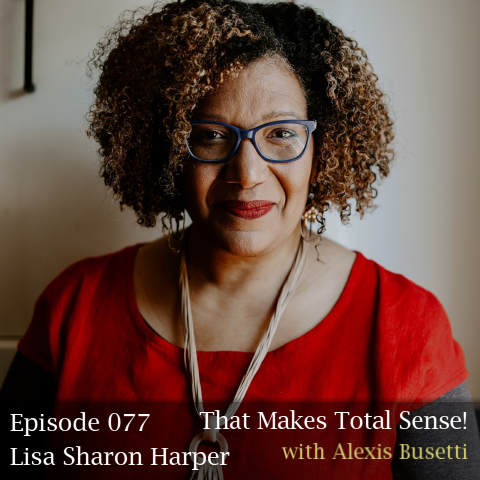
Speaker 0 00:00:07 Welcome to that makes total sense. A podcast dedicated to exploring God's generosity and justice. I'm Alexis besetting the Christian, aiming to ask good questions and encouraging you to do the same. Every one of us is wired by God to live out generosity and justice, but the how sometimes alludes us that makes total sense is a way for us to get together, posture ourselves as learners and challenge one another to practice generosity and justice in a tangible way every day. Hi everybody. I am so excited to be sitting across from Lisa Sharon Harper. Today. I have finished her book recently. It is a little bit older, but I just called it a timeless, a timeless word. When we were talking right before we started recording, it is called the very good gospel, how everything wrong can be made. Right. And Lisa is a speaker. She's a writer. She is an activist and she is the founder of freedom road.
Speaker 0 00:01:14 And we have heard some amazing things about that. In fact, Karen Meredith has been on the podcast with us, and that was one of the things that she just adored. And she loved talking about her time with you on freedom road and what that meant for her. So, um, you can find Lisa been following her on social media for awhile, and she is having the relevant conversations right now about, um, where the church has been, where we have made some wrong turns and where we can move ahead in the future. So thank you so much for coming on the show. Lisa, I appreciate that Alexis. I'm glad to be with you. And I really like the first question that I wanted to ask and I feel like let's just, let's just dive in with the time that we have here, because it wasn't until I went back after I had read your whole book and I was rewriting the title in my notes and I was like the very good gospel, just like she says from Genesis one, this is the very good, this is <inaudible>.
Speaker 0 00:02:13 This is, this is how God intended it. The very good gospel to be top of the class. Okay. But I, but I got it. Um, at the, at the very end, you know, it all kind of came together, but I want to say that in this book, Lisa really does cover the gospel from the beginning of Genesis from Genesis one, one. And I feel like that is especially relevant to where we are today because maybe Lisa, you have heard the same thing in 2020, even at the beginning of 2020 or 21 at 2021. It is, you know, there's racial injustice. There is a pandemic, there's all of these things happening in the world. And the number one phrase I hear from Christians is we'll just preach the
Speaker 1 00:03:00 Gospel. Hmm, wow. Yes. I have heard that too. All we need is the gospel. Just the gospel. Go back to the, and let me just tell you that was literally, that was the mantra at the turn of the 20th century of the fundamentalists then. So that's the whole reason for the fundamentalist movement. We just have to get back to the fundamentals because the world was getting too complex for their little brains to hold. And I don't mean forgive me. I don't mean to, uh, to, to minimize people, but this is a very small idea. Quite honestly, that the world is that, that simple, that you can fund, you can minimize God's story down to five points. I mean, that's quite honestly, it is, it is counter to the very mechanism through which God gave us the gospel. It was the mechanism of story, not points, not legal construct.
Speaker 1 00:03:59 It is story. And as such, it is complex. It is to be, it should be because it's, it comes from the human experience and humans. We are not simple. We are complex, right? And we are fundamentally relational. We're about relationship, relationship with God relationship with others, relationship with the rest of creation, relationship with self relationship, with the systems that govern us, all of those relationships, as you read in the very good gospel, we're all created in a very first chapter of the whole Bible. So if that's the context within which our story rolls, how could we think that we could like narrow it down to? Well, we just got to tell the gospel, well, you can't understand the gospel. If you don't understand the story, you got to understand the story, to understand the gospel. What is the actual good news?
Speaker 0 00:04:55 Well, and, and you, and you pull that out in the first chapter in, and I'm hoping, can you give us, uh, give us a starting point for this thick. I love that term for this thick understanding of the gospel, because, because I feel like even in that phrase, um, that's kind of loaded right now. What's implied for me, especially after reading your book, that the terminology I would apply to it is a thin preaching of the gospel is not going to solve this. Oh, absolutely thick understanding of the gospel. Now we have a chance, right. So what do you mean when, when you start describing this thick understanding
Speaker 1 00:05:38 Of the gospel? Well, when I, first of all, the language of the thick gospel and the thin gospel for me came from my reading of Miroslav bull. You got it from other theologians, but MIRSA bull talks about it in his book, public faith, public faith. And in that book, he talks about the reality that most of the heinous like, um, genocides or pogroms or, um, major, uh, injustice oppression that we see in the 20th century, 19th century, even going as far back to the 16th century, with the, with the beginning of slavery, it was all justified through been readings of the scripture, through thin faith. Then faith gives us the ability to manipulate the scripture to me, what we wanted to mean or to nullify the parts that we, you know, are problematic for us. So if, you know, focusing on injustice or, or working for women's empowerment is, is, um, um, you know, it gets in the way of your agenda.
Speaker 1 00:06:52 Well then narrowed down to five points. So you can cut out the rest of the entire story and just focus people in on these five points that are now extracted from the story. So now you can make it mean whatever you want it to mean because it it's not grounded in any meaning that proceeds your points. Um, and that's how we did it. That's how we got to thin faith that then influenced our politics, influences our faith influences our, I mean, our lives. It has influenced who could marry, who it has influenced who could go to school, where it has influenced, um, where certain people could live and where they could not live. And it all started with a thin read of the scripture. Even the question of slavery itself, the question of America itself started with a thin read of the scripture. You go back to, uh, to Jonathan Edwards and Jonathan Edwards when he, when he wrote the city or no, Jonathan Winthrop forgive me, but Jonathan Edwards too, but we can go there later.
Speaker 1 00:07:59 Jonathan Winthrop, when he wrote the city on a Hill and gave that amazing sermon. And the very, you know, in the beginning of, of this, not even the first colony, but the first people who were kind of around, um, up in the new England there, he said, we have to abide by the scripture in order for us to, to, um, to be a light on a shining Hill in order for us to be protected by God in this really horrible place, right. Or this is very dangerous place, but, you know, the peak massacre was his idea. It was his idea. So the theme man who had this vision of the city on a Hill and, and from which president Obama then called us a city on a Hill, he was the man that city on the Hill was the kind of the seed bed for manifest destiny that gave us the theological justification for the P clot massacre for the removal of native American people, um, all across the continent, moving them West, the killing off of the Buffalo.
Speaker 1 00:09:06 Um, and more than that, the enslavement, or as much as that, the enslavement of people, of African descent and the dehumanization by law of people of African descent saying that they are only worth 60% of a human being to bits of a human being. Where did they get that from? Well, they got that from their bad read of Genesis one, which they got from Pope Nicholas, the fifth, who declared in 1452 to 1454, that these white European explorers could claim the land and enslaved the people if they were not civilized. So that doctrine, which we now call the doctrine of discovery was carried forward and is embedded in our constitution, in our laws. Um, and, and the, the basis of it is actually spin gospel thin read of scripture reads of scripture that are disconnected from the actual context of the writers and disconnected from the, from the, the context of the stories that the writers are writing. And, um, and that's what you can do. You can manipulate the scripture to me to anything you want when you disconnect it from its origins. Yeah.
Speaker 0 00:10:23 And wow, thank you for that. Because, and so much of that history is new to everyone who just started because even though it's our history as Americans and it's our history as Christians, um, that's something that I have been wrestling with, right. Is, is, uh, something I know that freedom road you guys focus on, but is this narrative right? What narrative is being told? And, um, and, and that is one of the, that is one of the conversations that, that I'm looking to right now with this, um, with the church, where are we, where are we going? What is the narrative that we're, that we're believing? What is the narrative that we're, that we're going toward?
Speaker 1 00:11:14 Yeah. I, I firmly believe that narrative shapes, worldview absolutely stories that we are told about who we are and how we got here, shape our understanding of ourselves and where we're going and where we need to go. But when, when we're told lies for generations about who we were and how we got where we are, for example, when we're told, and the lie is perpetuated, especially within the church, and especially, I'd say within the conservative evangelical church, which has married itself to laissez-faire free market capitalism. Right? So, and that's a whole another, I'm sorry, I'm kind of going off here, but I'm thinking back to talk about story. I'm thinking back to a conference that I went to, um, and I spoke at, I think it was in 2012, and yes, it was at Cedar Hill university. And my coauthor of left-right in Christ spoke along with me, he was the person on the right.
Speaker 1 00:12:19 And I was the person that the book proposed was on the left. I don't see myself on the left. I see myself as centered around Shalom around the values and ethics of the kingdom of God. But if I fall out on a, on a spectrum, there's a manmade spectrum. I might fall to the left of center. Right. So here I am representing left. So he gets up and he speaks first, my coat, my coauthor, David and S. And what he said was David NS. What he said was that there are three ways to gain wealth, um, or no, he's a two, there are two ways to gain wealth. One is through productivity and the other is through pillaging. And he said, America gained its well through productivity. Yeah. I see your face.
Speaker 2 00:13:06 I'm sorry. My mouth just dropped. I mean,
Speaker 1 00:13:16 First thing that comes to my mind when he said that was, Oh yeah, pillaging. Absolutely. My family was pillaged from West Africa, from Nigeria, from Mali, from Senegal. And now I know that because we've done the DNA, there are stories. There, there were people who experienced to worst themselves. Their bodies were pillaged were extracted from their context for money, for gain and take it on a ship. And God, by the grace of God, by the power of God, they survived the middle passage, which consumed about a hundred million. They say, uh, people of African descent, but they survived. They were among the 10 million who survived. And somehow they made it. They were brought to Maryland and Virginia and South Carolina, actually Virginia, and then moved into South Carolina. And somehow our family was then sold into every single state in the South. And we had family who was enslaved in Barbados. And then within one generation, within 20 years of them landing in 70, around 1750, according to DNA evidence, they were, they had been by 1770. They had been sold into every Caribbean Island.
Speaker 1 00:14:41 So you talk about separation of families. Hello, you talk about family values. You talk about the honoring of life. You talk about all of these things and yet you will not recognize that in your history, not even that far back, we don't need to go bed at that far back. We can go back to the 1980s and we can talk about forced sterilizations of people, of women, of African descent by Southern white doctors who were likely deacons in their churches. Right, right. We don't have to go that far back, but you, when you know the stories, when you've lived the stories, then there's no way, there's no way that you can then look at this black thin understanding of the gospel that proclaims Jesus came for my sin to pay the penalty for my sin and get me to heaven and think that really the majority of the world, which is people of color, the majority of the world would look at that and go. And so tell me how that's good news for me. Who's sitting here and change who just lost my daughter because you sold her away, who just lost the ability to have progeny because you tied my tubes without my permission, who, who has, who's going to die early because you dumped your toxins into my backyard, literally because it was economical for you. So tell me where the good news is in the fact that Jesus died for my sin.
Speaker 1 00:16:26 No, no. So what happened for me was I went on a pilgrimage back in 2003 and I was confronted with that question.
Speaker 3 00:16:36 I was confronted with the question of how would my own third great-grandmother respond to this gospel that I at that time was proclaiming was the gospel. And I understood it the way that campus crusade for Christ understands it. You know, um, she, God loves you and has a wonderful plan for your life. Tell me how she's going to hear that she has 17 children likely because she's a breeder. She's what they called a breeder. Her job on the plantation was to breed money for her master. And that meant that her children were sold away.
Speaker 1 00:17:14 How
Speaker 3 00:17:14 Is she going to respond to God, loves you and has a wonderful plan for your life. How's she going to respond to? But, but Jesus died for your sin. No, but you are sinful and therefore separated from God.
Speaker 1 00:17:26 I'll tell you what people of African descent are. The most
Speaker 3 00:17:32 Devout people in the United States of America. We have been through, through data through, through polls, through self-reporting of different, um, religious groups, people of African descent are the most devout people in the, and there's no way that, that you could, you could not be devout. Having seen God rescue us. We have seen God rescue us from the hands of people who enslaved us from the hands of people who strung us up from the hands of people who locked us into communities, um, and, and threw away the key we are devout because we know God we've seen God. My third grade grandmother, I don't know if she knew how to read. In fact, the census tells me actually that she didn't know how to read. And yet I know that she was a devout woman because that faith was passed down in our family.
Speaker 4 00:18:29 I
Speaker 3 00:18:29 Know that the, the second grade awakening was catalyzed by black faith. So when we asked the question, when I asked the question at the end of my pilgrimage in 2003, would my understanding of the gospel, which goes on to say that Jesus died for my sins. And so therefore all I need to do is pray this prayer at the back of the gold booklet. And I get to go to heaven. Would that make Leah Ballard? My third grade grandmother jumping shout for joy. And I realized I had to come to the conclusion when I was honest with myself, the answer is,
Speaker 4 00:19:07 Hell no,
Speaker 3 00:19:10 She lived in the 1980s. She might look at me and say, are you smoking crack? Do you not see me? Do you not see, do you not see? And the thing is I didn't. And I didn't think that God did.
Speaker 4 00:19:25 And I was honest with myself. And so I, I had a scale.
Speaker 3 00:19:32 It was off the eyes moment there. And that's what propelled me into 13 years of wrestling at Genesis, which is where I understand the concept of Shalom to be grounded in scripture. And it's in that space, in that Genesis one context, which is this grand Epic Hebrew poem with a seven day structure. And at the end of this poem, there's this proclamation of very goodness where God looks around at the end of that, that seventh of the sixth day and says, this is told may owed. This is talk may owed.
Speaker 4 00:20:09 Um, that means
Speaker 3 00:20:11 Very good, but it doesn't just mean very good. It means, I mean, the to-be is goodness, but the way that the Hebrews would have understood goodness, is that it exists between things. It doesn't just exist inside the thing, which is a very Greek understanding of goodness or perfection. The Greeks project was to find the perfectly levels floor or build the perfectly level floor or, or find the perfect flower or, or be the perfect person. Perfection was located inside the thing for the Greeks, but we don't have a Greek faith. We have a Hebrew faith and for the Hebrews goodness existed between things. It was relational. So when God looked around at the end of the seventh day and said, this has told me, Oh, this is very good. And that word very means radically good. It means, um, fervently good. It means even could, you could even make the argument.
Speaker 3 00:21:03 It means violently good. That good. That it's the relationships between things that God is saying was, was radically good. Um, is the relationship between us and God, humanity and God, the relationship between men and women and all genders, hello somebody. And it's the relationship between us and the rest of creation and the, and all of creation including us because we are creation. We are not creator. There's only two, two categories and we're not the greater. So all of us, the created ones and the way that things work, the systems that govern us, those are all relationships that are created in that first chapter of the whole Bible. And it's at the end, the God says this, the relatedness between all these things, this is what I declare to be perfect, to be very good. And that included humanity, all of humanity, men and women, no matter where you were born in the world, no matter what your station was, all of humanity being created to exercise dominion in the world, being created to exercise agency in the world, to Stuart the world, to make choices that impact the world.
Speaker 3 00:22:22 But the very, um, heart of, of sin, the heart of the break between us is actually the domination of some over others, the limitation of the capacity of some, or many to exercise that to minion and the exclusive claiming of the right of dominion. And I think that's the principle sin of people, of European descent and the United States and an all colonized areas or formerly colonized areas. Um, and that's how they broke the world. That's how they broke the world. And the primary first thing that they did in establishing, um, colonized, uh, uh, outposts from their own nations was to create racial
Speaker 4 00:23:08 Hierarchy. And I always
Speaker 3 00:23:10 Went along with gender hierarchy, the two go together, they run, they run together. Um, and, and it's that subjugation that didn't, it didn't just put black folk in chains to ingest. Um, it didn't just kill off native Americans or indigenous people around the world. It killed off the image of God.
Speaker 4 00:23:30 Okay.
Speaker 3 00:23:33 It was a declaration of war against God and the name of God.
Speaker 4 00:23:45 So how did we get here? How did we get to January 6th? We got to January 6th because the church has never repented for its war against God in the name of God, in the name of God, as you said, and we saw that
Speaker 0 00:24:09 So clearly on January 6th,
Speaker 4 00:24:12 Yes. They were actually saying that this was done in the God's name. They were actually quoting scripture sign.
Speaker 0 00:24:20 Jesus saves praying on the floor of Congress
Speaker 4 00:24:26 After having killed five people in Jesus name in Jesus name in Brown colonized, indigenous Jesus's name.
Speaker 0 00:24:43 But it's, as you say, this is not, this is not a new
Speaker 4 00:24:49 Story, right? This is
Speaker 0 00:24:51 The same story. And other verse, right. There was a, there was a, there was a song we used to sing when I was a kids. That same song, second verse, a little bit louder and a little bit worse. Right. And, and that's, um, and that's this, and I want to, I want to ask you for a minute,
Speaker 4 00:25:10 Because
Speaker 0 00:25:12 <inaudible> evangelicalism in the U S white conservative evangelicalism in the U S is married to white nationalism. We absolutely married to white supremacy. It is married to Christian national. It's all this, it's all this amalgamation. So it's this, it's this ball of veal. That's just all together. Um, and, and when we saw that on the Capitol, on the sixth in side, the house of the government on the sixth and you and you, and when we saw the Christians doing this, right,
Speaker 4 00:25:49 Say they are Christians, right. Say they are.
Speaker 0 00:25:53 And, and, and this has been the, I would say the same people, but this is I'm. I mean, I'm sorry to say it, but who were the people who were doing this in Nazi Germany? Right. You talk about going to DACA. I mean, we've, we've also been to some of the concentration camps in, in Eastern Europe. And you say th this was also done in the name of Jesus by image, bearers, destroying other image bearers. This, this was also done in, in, in, in this, in his name, one of the questions, um, that you ask in your book and this book, the very good gospel. Um, and I love the reflections. Um, just a confession right here. I feel like I'm going to say it out loud in the gender chapter. Yeah. You want to talk about gender sub subjugation of women? Um, I'm 39 years old and I told my husband this morning, I had to skip that reflection because I recognized I'm just not ready for it. Ooh. Um, I, I started to tear up and where I was, I couldn't do it. And I put a little dog here on that page and I thought to myself, I'll come back to it when I think I'm ready for it. I agree with everything you said in the chapter.
Speaker 3 00:27:08 Yeah. When you say you're not ready for it, what does that mean to you?
Speaker 0 00:27:14 Um, I'm not ready as a woman who was raised and has been basically in this space, in the same space that we're talking about in this conservative evangelical American church. Um, for me, my experience has been, I, even though I believed everything that you wrote in the chapter, and I thought it was all true. And I thought it was very good. This is not the narrative that has been told to me. Can I say that this is not the narrative that's been told to me? And when you recognize that the narrative that's been told to you is not true.
Speaker 3 00:27:54 Yes, it does. Let me just say it takes a minute for all of us, because when you have been soaking in a false narrative, not only a false narrative of the world and how the world should work, but a false narrative of the scripture itself and what, what God says in the scripture. And you've been living that for 39 years of your life, right? 39 years of your life. And you have shaped your life. According to that, that like you have you, I imagine you have limited your own capacity based on what you were told. You have made decisions in your life to go one way and not the other based on what you were told, what would be the Holy way for a woman versus the unholy way, right. For a woman biblically. Well, it's really hard. Then it's a, it's an emotional, you have to make an emotional shift in as much as you have to make a mental shift.
Speaker 3 00:28:51 Um, and that does take time. And for me, it took time. It wasn't what God, God takes us in through paradigm shifts. That's what I call it. A paradigm shift. A paradigm shift is almost like a spiral. It starts kind of in the beginning. The beginning is like, there's a catalytic event, a moment that kind of starts you on the journey. Um, whether you hear something that someone said or read something that triggers a, that doesn't work with the world, as I know it, which is what happened when you read the chapter on, um, Shalom and gender that doesn't work with the world, as I know it. And, and then that if you're going to do a paradigm shift that then propels you to ask questions, right? And you go back to the text, you ask questions of the texts. You ask questions of your life.
Speaker 3 00:29:39 You ask questions of other writers, other, other theologians, and, and each time you get input you. Okay. Okay. All right. Okay. This is, it's making a little bit more sense now. And then you think you got it and then something else comes along and causes another question. And that's how we, we get from the middle of a spiral all the way out to the outer edges are, and we realize we've moved. We moved to distance, but it was not a straight line. Oh, that's a good picture. We've, we've been, we've been kind of circling something and going a little further out each time. And that's, that's what God does. That's how God grows leaders. That's how we grow. So, yeah, I'm okay with you not being able to pray that at this point, but I do want you to come back to it at the point, when you see that you're ready.
Speaker 0 00:30:27 I, I plan on it, which is why I S I said to myself, and I really did put a, put a Mark in the book of dog you're on it. And I thought I will come back to this because it's something I've been wrestling with. Right. I'm, I'm already slightly out, but I've just not all the way quite there. And your prayer is very provocative in that space for me, even though it wouldn't have been for, for many women. I think I'm so sorry about that. That was just kind of a little aside, but, um, but one in one of your, your reflection chapters, and I think it was on, um, nation, and this is where maybe we can, um, maybe we can spend the rest of our time here. Cause I'd love for you to kind of answer this question in terms of, um, what we saw on January 6th.
Speaker 0 00:31:11 And I say that because it's a pinnacle, not because it's the only data point, goodness knows. It's not the only data point. Right. Um, but, um, but it's almost said it's the high point. It's the low point, right? It's, it's, it's definitely a low data point, but one of the questions you raised was you said, what would it look like if current day empires, right? Including the United States made their primary purpose, the blossoming of the image of God within their borders and beyond. And I raised that question, not to Joe Biden or Camila Harris, or, you know, I raised that question to the conservative evangelical, who has at whatever level connected themselves deeply to the ideology of Christian nationalism. And we say, okay, you know, almost like, okay, if this is where you're going to live, then what would it look like for you to put your primary political purpose to be for the flourishing of the people around you in this nation and beyond what would that look like? Because that's Shalom. That's the very good gospel, that's our call as believers. And then of course we can contrast that with what we're actually seeing right now, but maybe you can spend that time. And then, and then we'll, we'll kind of land it there. Well, I think
Speaker 3 00:32:40 That there's something about something that I found in my research, um, for the very good gospel when I was thinking about how does, how does, how do we see sin develop in the scripture? Um, we often think of sin as being something that's individual, right? It's one person sins against another, but we actually do see an evolution of sin in the, in the scripture. And it doesn't take long to get there. It literally takes 14 chapters all in Genesis, we're in the first book and we already see, like, we get to empire, we get to colonization and by chapter 14. And, um, and that is actually, it's the, what part of the introduction of Abraham into the story is actually in the context of college, he was colonized. Um, he is a colonized person in Babylon. And so like the tower of Babel, that's Babylon, most scholars believe that, that you're talking about Babylon there.
Speaker 3 00:33:40 And, um, what you see is you see that we have gone from, uh, naked and unashamed and clinging to each other and an all people being able to exercise dominion because the image of God is, is, is seen and recognized and cultivated and protected within all in chapter one. And then men and women are, um, each and Aisha Ameesha. They are together and, and, and clinging to each other. And then in chapter three, when it all falls down, which is why we call it the fall, um, that's where he began to see the breaks, right? Um, the man and woman point to each other and blame each other, and then the earth doesn't produce anything. So we got to beat the earth to get anything out of it. Hello. Um, and then death enters the world and God rips open one of God's own creation in order to cover over our shame.
Speaker 3 00:34:39 And so the impact of our sin now is felt by creation. Um, and then in chapter, chapter four, you have Cain and Abel and L'Amic with his two wives. So the breakup of families. And then by the time you get to the tower of Babel, the tower of Babel is the first key verse confusion of languages and leads to the first ethnic enmity. And then it only takes two chapters from there to get the look, we actually see the first mention of the word war, and it comes in the same breath, think sentencing breath as the first mention of the word King. And the context is one King trying to exact his will over several smaller Kings and that my friends that is colonization. So that happens. We go from, uh, from, um, taking our own piece by our own way, when the, when the man and woman grabbed at peace, uh, by eating of the fruit of which God said do not eat.
Speaker 3 00:35:47 Um, and then we get war, you know, just 11 chapters later. So when I asked the question of what Shalom between nations looks like, it goes right back. It's in the same lineage and the same sin lineage as the, as the war between us, as individuals, as the war, between genders, as the war between us and the rest of creation, that all comes from us, trying to grab at our own peace in our own way. Not, not believing God that God is the author of peace, not us, that we do not have to. We don't have to live as if we live in a zero sum world that as I seek the peace of my neighbor, I too will be able to have peace because if my neighbor is not at peace, then I also will have no peace. And we have seen this to be true in the United States of America.
Speaker 3 00:36:46 We have an, we have an economic theory in our nation that basically says, get yours. That's our economic theory, get yours. Laissez-faire free market capitalism. I talked about that earlier, that really came onto the scene in a major way through Ronald Reagan, who I know has been christened as a Saint by most white evangelicals. He was not a Saint. He was barely even a Christian. And when he came into his office and he said, um, he made a major partnership with, um, uh, uh, with, with, uh, the prime minister of England at the time, uh, Margaret Thatcher, both of whom actually had the same understanding that there are some people who were created to rule. And there are others who were not, who were created to be ruled and money. The exchange of money is what tells us, who is who, whoever gets the most money.
Speaker 3 00:37:45 They're the ones who God has ordained to rule and whoever doesn't, they're the ones who God has ordained to, to, uh, to serve, to, to, to be ruled this, this system. This has been with us since enslavement. We deemed people of African descent to be not human in order to enslave them. And then through our understanding of election, we then looked at them because they were poor after enslavement and said, you are not of the elect because you are poor because you, um, you obviously do not have a good work ethic. Um, excuse me, do not have a good work ethic. We were the workers. What were you doing? Managing money that came from our free labor, right?
Speaker 4 00:38:36 So when you
Speaker 3 00:38:36 Get to, when you get to nations and what it looks like for nations, then to bless each other, it must look like nations, seeing our next door neighbors, and even seeing the, the flourishing of those who would call themselves our enemies as being intricately wrapped up into our own peace, simply because that's just the way God made it, that we are all tied together. As Dr. King said, and an inextricable tapestry of human being
Speaker 4 00:39:10 That we can not be taken
Speaker 3 00:39:12 Apart from each other. We do not live in silos. We live connected as things go down on my block, your block will feel
Speaker 4 00:39:20 It. And
Speaker 3 00:39:23 I mean, in a very practical sense, we, we understand that in America
Speaker 4 00:39:28 Because
Speaker 3 00:39:29 We have done that. We've created an economy where some people get educated and prepared to lead because they are ordained to lead in our own system. We believe that people who are of European descent were ordained to lead. And so therefore we have constructed our education system in a way that funnels money into white neighborhoods and not
Speaker 4 00:39:53 Black ones. And
Speaker 3 00:39:56 That that system was created. It was constructed by segregationists in the mid 20th century and never has been dismantled, never, never,
Speaker 4 00:40:06 Barely questioned.
Speaker 3 00:40:09 I see it in the way that we do our policing, that we do. Public safety, public safety is about more than police. Public safety is about lights in your community. Public safety is about parks and free access to green space. Public safety is about safe foods being in a person's neighborhood so that their children can be nourished so they can go to school so they can learn. So that there's less poverty. There can be public safety is about access to transportation so that you can get to a job. But in mid century, 20th century segregation is in the North and South blocked off black people from transportation that would get them to jobs. And so you have a shorter, a smaller job rate also
Speaker 4 00:40:56 To day,
Speaker 3 00:40:58 If people have a black sounding name and you know exactly what I mean, if their name sounds like it might come from the African-American community, they are far less likely to get a call back on a resume, even, uh, even a resume that is equitable. Exactly the same resume as somebody who might be called Amy
Speaker 4 00:41:19 Or Christopher, Christopher,
Speaker 3 00:41:24 Or, um, uh, Williams, Christopher Barker, Christopher, or Amy, you know, Amy Cooper. Hello. There are, there are inequities that we see in our nation and they are evidence of our beliefs about each other, and the same exists on an international level. That as we think about our international neighbors, when we think about the continent full of hundreds of nations in Africa, do we even think of them as partners on an economic journey? Do we think of them as having anything to offer to us in America? No, we don't. We think of them as being the recipients of our charity, but the reality is, is that the very first library in the entire world was on that continent in Mali. The very first university in the entire world was on that continent. The very first cathedrals in the entire world were in Africa, deep in the heart of Africa and Congo. They had cathedrals before slavery.
Speaker 3 00:42:39 So our eyes, our view of our neighbors, our international neighbors has also been tainted, been skewed, been twisted, been distorted, been corrupted by the seed of white supremacy and white patriarchy and white nationalism. And it's not until we repent of that, that America can find peace that United States of America can find peace, because we will always, until we understand that we will always see ourselves in a zero sum game. We will always think that our goal and role is to lead everybody else. And therefore to we, what we need to do in order to lead our race, we have to subjugate everybody else. We need to prevent them from growing. We see their growth, their flourishing as threat. And I just want to say one last thing, as I, as I close there, that economic strategy, that economic theory, that international policymaking is based on the premise that there is no God,
Speaker 5 00:44:01 Okay.
Speaker 3 00:44:01 Because if you believe that there is a God and you believe this is what the scripture says about God, then there's no way that you can believe that resources are finite. That peace is a zero sum game. And some people have to live without it in order for me to it. No, if you believe in God, if you believe in yeah. Way, if you believe in Jehovah, if you believe in Brown colonized indigenous Jesus, then you must understand that it is God who is the author of Shalom. And God calls us to a certain ethic, a way of being in the world together, a certain politics, a certain way of answering the question of how the Polis will live together, which is all politics is I don't mean partisanship. I mean, a way to respond to the question of how then shall we live together.
Speaker 3 00:45:19 The kingdom of God, the kingdom of God requires the reign of God requires us to protect, defend, cultivate the image of God in every corner of the world. Because as the ancients understood the image of the King, each image is a marker of where God rules. So when we, with our policies, our international policies cause the downfall of nations and therefore the downfall of people, of individuals, of, of images of God. Then we are also causing the downfall of the kingdom of God, the limitation of it, the destruction of it. And that my friends is why I said earlier, we have been at war with God, but the good news, the very good news is that this is doesn't have to be, we can repent. We can recognize the truth about God and who we are in relationship to God that we are only simply creation that God has God. And we are not. We can recognize that we have been at war with God, for supremacy. We can lay down our arms with God and our arms against our fellow human brothers and sisters. We can rejoin the circle of humanity. And we can ask the question with all on a level playing field. How now shall we live together? And then we can listen and we can follow.
Speaker 0 00:47:20 Thank you. I just, I don't have any words. I've been over here dancing in my seat and I'm muting. So I could say amen, as much as I wanted and not interrupt your audio. Um, Lisa, I am, I am incredibly, incredibly thankful, um, to have you on today. Can you do me just one small favor right now and just tell my, uh, everyone who's listening to this, where if they're not already following you on social media, or they're not already connected to the work that you're doing, where can they find you? And, um, and I'll also put a link to this book and where they can find it in the show notes.
Speaker 3 00:48:00 Thank you so much. So you can pick up the very good gospel anywhere. Good books are sold. Um, you can follow me on social media, on Twitter at Lisa, as Harper, also on Instagram at Lisa, as Harper on
[email protected]. So that's my page. Um, just like the page and you'll start getting that in your feed. Um, and also on the website. So we have two websites. Um, freedom road is a consulting group and also an Institute now. So if you want to grow in your capacity to read a very thick gospel, to understand a thick gospel, then, you know, sign up for some of our webinars or growth communities or coaching cohorts that we have through the freedom road Institute for leadership injustice. And then you can also check me out on, just find out more about me and what I'm up to on my website, Lisa Sharon, harper.com.
Speaker 0 00:48:54 Thank you so much. And, um, I will put links to all of that in the notes. And so everybody it'll just be a click away. Um, Lisa has been doing some incredible, just having conversations. I feel like you're, you must be having them back to back at this point, but, um, but my point is, please tune in, please listen to what Lisa is saying, but also take that next step wherever God is nudging you. Um, don't just listen. Um, let's take the next step repent, right? That that's the next step that I heard you say right now. And so, um, Lisa, one of the things I feel about her ministry that is so powerful is she does not leave us without a call to action. And so she will give us a call to action. We can pray and ask God where we need to move, um, with what we have learned from her. So thank you so much. Um, I really appreciate you coming on. Thank you Alexis. God bless you. Thanks. The links for all the resources mentioned in today's episode can be found in the show notes, music and podcast production by Seth B city. Be sure to give us a review on iTunes and subscribe at your favorite podcast listening app, you can also visit us at that. Makes total sense.com.