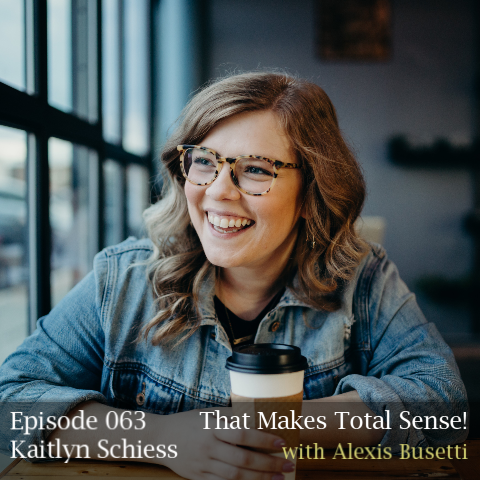
Speaker 0 00:00:07 Welcome to that makes total sense. A podcast dedicated to exploring God's generosity and justice. I'm Alexis resetting the Christian, aiming to ask good questions and encouraging you to do the same. Every one of us is wired by God to live out generosity and justice, but the house sometimes alludes us. That makes total sense is a way for us to get together, posture ourselves as learners and challenge one another to practice generosity and justice in a tangible way every day. Hey everybody. I am so excited in this season, in this political season to be sitting across from who I'm sitting across from today. And that is student author speaker. I mean, I feel like we could go on and on, but this is Kaitlin chef's. Hey Kaitlin. Hi. How are you? Oh, I'm so great. Thank you so much for joining me today. I just feel like, I mean, you said you were doing like multiple podcast interviews today. Has it just been swamped for you since the book came out?
Speaker 1 00:01:11 Yeah, basically I kind of thought that the work of promoting a book was pre pre-release and then I was going to be done and I would have my regular semester and all that kind of stuff. And then I realized that when it comes to, especially this topic, people want to keep talking about it. And I don't, I don't anticipate it letting up until at least the election is over.
Speaker 0 00:01:30 No, I know I'm I'm so with you on that, and I'm like, I've had, I actually, it's been really cool. I've had the opportunity to talk with some authors who have been releasing books in this season. Some of them, most of them, not about politics, but some of them about politics and, and you know, way more than I do about how the publishing world works. But it's like, all of these are coming out this amazing time, right before this super controversial election. And it's like, Oh, well, you didn't just like, decide to start writing something up when you got locked down in March. Like you've been working on this project for, I mean years, right?
Speaker 1 00:02:04 Yeah. Yeah. And I think back when I was first starting, even then the timeline kind of made sense for it to come out for the election, you know, because mine is about politics, but I mean, when I was starting, I couldn't have even imagined anything like what's happening now.
Speaker 0 00:02:19 Exactly. So I'm with you, people are not going to stop talking about it where we want to, we're not going to stop. It's funny. The other morning I got a textile, like six 15 or something like that. And I got out of the shower and I saw it and I'm like, I wonder if he's texting me this early in the morning, it was my neighbor, like two doors down. And it was just like a real quick, like one sentence with emojis referencing something political that had happened the day before, because you know, these are the conversations we're having when people are walking their kids down the street and, you know, riding their bikes to the park. And it's like, this is, this is what's on our minds all the time. So the, of the book that you have just released, and then I'm going to let you introduce yourself because you said semester, so that's probably already got some people going. Um, so the name of the book is the liturgy of politics. And this is my favorite. The subtitle is spiritual formation for the sake of our neighbor. So Caitlin, tell us a little bit about like your life right now, kind of surrounding, uh, the writing and release of this book.
Speaker 1 00:03:27 Yeah. So like you said, I'm, I'm in a semester, I am a student at Dallas theological seminary, and I really wrote this book coming out of the 2016 election. I graduated from college at Liberty university, which was a strange place to be at, during the election and started seminary, you know, during the fall semester of 2016, which was a strange time to start seminary and kind of just kept finding myself in political conversations. And that was kind of what my background was in. I went to school initially as a political science student and undergrad and came to seminary and thought, okay, I'm not, you know, I'm done with that. Now I'm going to talk about these other things and just kept finding that, that, that background was useful. And that I just felt God really calling me and pushing me towards leaning into those conversations, especially in a context where I felt like I could see.
Speaker 1 00:04:19 So clearly during the 2016 election, this is important. This is a discipleship issue. It's not just about politics. It is about how we are discipling our people and what is shaping and forming them. And yet finding that a lot of people weren't interested in having that conversation. And so, um, you know, I was working at a local church that I still am. I've been there the whole time I've been in seminary. And so I've just, I feel like I'm very rooted in this place, in this unique kind of seminary time, but also very much in Dallas where I live and at the local church in Dallas that I work at and just kept finding myself in those conversations. And it, it got to the point finally, where I had a class called spiritual formation in contemporary culture. And we had all these units on gender and sexuality and technology.
Speaker 1 00:05:04 And we were supposed to have a unit at the end on politics and we didn't get to it because like a lot of classes, you know, you spend a lot of time, everything takes longer than you think, and we didn't get to it. And so I wrote my final paper that was supposed to be like an overview of the class. I wrote the whole paper on how each of the different conversations we'd had would have been better if we'd talked about politics, because I thought it's really important. And so that class ended with the professor saying, um, do you want to do an independent study? Like, is this really good sense, really important to you and started just kind of thinking about it, working on it and have been really blessed by a seminary community of so many professors and students who have said like, how can I help you make this work?
Speaker 1 00:05:46 How can I help you have space to research and write? I had another professor on campus who I had gotten an email from a publisher that was like, do you want to write this book? And I went to her and I was like, how could I do this? I'm in school and I have a job. And, and she said, you know, I'll, I'll let you do this as your internship. And instead of working for me, you'll just write the book, which is a gift, such a gift. So I feel like no matter what I do in the future, I, I think I will look back on this book and think that was the product of a community more. I mean, I hope I hope all of our work, we could say that of, but I just feel like this book even more than anything else I've ever done, I can say, there's no way I could have done that. If I didn't have like a really church community seminary, community, family, friends, like supporting me to do it because, um, I couldn't have done it in school otherwise.
Speaker 0 00:06:33 Oh my goodness. I love that you started there because I just finished the book today. So like I had been, I, you know, because we talked before, like I'm in school. And so I'm in my second quarter of seminary. And, and so it is, it's kind of like a lot, right? Like there's a lot of school. And, um, of course now with COVID where like, um, trying to educate our kids as best we can and we have four of them. And so I've been reading this like, um, your book, like, uh, you know, like a half a chapter here after chapter there, you know, since I got it. And then today I read like the last four chapters or something like that this morning, I was like, okay. I was like, kids just let's set a timer. You got to give me a minute
Speaker 1 00:07:14 To do this. But I
Speaker 0 00:07:16 Thought it was great because at the end of it, I came away with thinking, wow, this book is about community. So it was, it was a product of community. Thank you for sharing that. But this book is about community. Like I'm reading it as an individual, but this book is not about me. And this book is not about you. Um, this book is about our community. Um, and so the forward I'm going to kind of start there, um, the foreword by Michael, where, Oh my goodness. It's so Michael, where for, if you don't know, is I'm a political strategist, he's co-founder of the and campaign. Um, and I'll just put a little plug in here. You can hear the episode with his, with his co-founder Justin Guinea, I'll make the, I'll put the, uh, so fun. I'll put the link in there for that. So you can get a little bit more of an idea of where they're coming from, but Michael Ware wrote the forward to this.
Speaker 0 00:08:11 And what stuck out about what he wrote is he was, he called the book of gift with which I agree it is, it's a total gift to the church, but he said, it's it's as if you, you hired someone to go on, I'm probably gonna mess this up a bit, but it's as if, as if you hired someone to go and think about this subject, to research it and to think about it. Right. And I just thought from your description of writing it, it's like you must have been surrounded by people to help you think about it. Maybe better. I don't want to put words in your mouth, but also just given the space to think about it. And I feel like the gift that, that brings to us, to me and to the Christian community, specifically to the evangelical community, is that we can take your thoughts and, and kind of, and use them right. As, um, as, as a bit of a platform, you know, for us to help us think better about this, um, about this whole subject. Do you think that's fair?
Speaker 1 00:09:14 Yeah. I could not have asked for a better foreword to the book. He did. He did such a good job and, and our conversation about it beforehand, um, because he was very gracious and said, you know, what, what are forwards you? Like, what are you, what do you want this to do to introduce to people? And, um, too many people skip them. And I hope they don't with this one because, because he did a really good job. And, and what I told him beforehand was I love when a forward takes the assumptions that someone might have, if they pick up a book and their first thought is like, Oh, I know what this is. Or, you know, I know this name, or maybe they'll turn it on the back and see endorsements and become like, Oh, okay, I categorize you. And, you know, according to him versus you're in this group.
Speaker 1 00:09:52 And I would really hope that the foreword would just kind of help people like ease their shoulders a little bit. Like if you've come into this with either the topic of politics makes you tense up, which is totally understandable. Or if you're coming in and maybe you're thinking, you know, Oh, this young evangelicals going to tell us what we've done wrong for 50 years, or you're thinking, Oh, this conservative is like going to, you know, whatever. So whatever perspective you're coming from for him to just say, receive this for what it is. Not yet, there are criticisms in the book of things, but not to receive it as if what it primarily is as a criticism, but as, as a gift. And as, um, coming from someone who loves the church specifically loves the evangelical church because it's my people, because, because that's where I grew up, because I feel kind of responsible and beholden and like, I, I belong to those people.
Speaker 1 00:10:45 And so, yeah, I really hope that people can take it that way, especially with, you know, there are some topics that are not like this, that with politics, people come in with a lot, with a lot of preconceived notions. And I would not enter into this this time where I was thinking and reading and was, was, you know, blessed enough to have a community to do it in. Um, I would not have entered into this conversation around a worship and politics and a lot of people's opinions about it if I didn't want it to just be, to just be a gift. And, and I, there, I'm sure there are things that I'm wrong about. I'm sure that as I learn and grow, you know, I'll change my mind about certain things, but I just feel like in this moment, this was, this was the most earnest gift that I could give that, that I hope is helpful.
Speaker 0 00:11:28 Yeah, no, it totally was. I really felt that way. I want to talk about that subtitle for a minute, because maybe it's just me, it's totally possible that it is, but I feel like the term spiritual formation, especially in the evangelical circles that I have run in is either, I would say maybe on the, on hopeful end of the spectrum, it is a new phrase. Um, but on the pessimistic end of the spectrum, it is, um, it is unknown, right? I did not grow up hearing anything about spiritual formation. Um, it really hasn't been until recently the last several years, but especially since I entered into seminary, when this term has become not just comfortable, um, but really it's like a joyful place. Like when I hear that terminology, it just kind of makes me smile because I love it so much. So I know that I don't remember if I was reading it or if it was in another place where it's like, you can take semesters and semesters on spiritual formation. Like, this is not this isn't like, Oh, got it. You know, so, so without, we don't have that kind of time, but can you just like brief us for those of us that that may be a new or an unfamiliar term on spiritual formation and then what does that have to do with politics?
Speaker 1 00:13:00 Yeah, yeah. Um, probably the same. I've probably had the same experience as you where I got to seminary. And then it was like the word all the time. I mean, I think at this point I've taken four or five classes that have that term in the title. Um, and at my seminary, we require your first two years for you to be in a spiritual formation group where you're working through a curriculum with a group of people that is hopefully created to be a pretty diverse group of people. Um, but yeah, I think part of the reason, a lot of evangelicals, um, initially haven't heard this term, I do think it's kind of getting a Renaissance right now where it's exciting and more people are hearing about it. But, um, part of it is that, you know, we were sort of, at least the churches that I grew up in, we were sort of suspicious of anything that felt kind of high church kind of like when I was growing up, I would've said that all of that was just Catholic, but I think if I had walked into an Anglican church, I would have been like a Catholic, you know, like I just, and that, and I, what I meant by that was something really negative, you know?
Speaker 1 00:13:54 Um, and so I think part of it's that suspicion around anything that feels like ritual or that feels, uh, legalistic, maybe. So if you think about special disciplines that might feel kind of scary. Um, and I do think the other reason is that we have thought of our faith very intellectually. Um, there's a weird thing where evangelicals are both sort of anti intellectual in a sense that we tend to be suspicious of like liberal universities are suspicious of, you know, if you read too many books that are dangerous, then you'll, but at the same time, at least in the youth groups that I grew up in, a lot of the language was the world outside is very emotional and, you know, your truth is your truth. And we know the truth, we know the absolute truth. And if we know the right things, we will act the right way.
Speaker 1 00:14:36 Um, and we have seen that that's not true. You know, we could go through so many examples of whether it's leaders who have fallen or communities that have gone astray, or, you know, what, not even just people in our own lives where we know, like they knew all the answers and, and it didn't, it didn't mean that they were the kind of people that could live a faithful life in the world. And so for me, spiritual formation, not only encapsulates what it tends to mean, and kind of like our context in a seminary, which is usually something like, you know, a intentional community focused, um, formative experience, whether that's going through curriculum or whether that's, um, personal, like spiritual disciplines, or I'm going to kind of observe some certain practice for a period of time. But the general emphasis is more than knowledge, but formation.
Speaker 1 00:15:21 So how am I through the habits that I have or the thing that I'm practicing being formed? Not just my mind, but my heart, my affections, um, towards, towards God and towards his kingdom. And so it's, it's so important. I think for us to grasp one that this is not individual, a lot of evangelicals. If we have some corollary to spiritual formation, it's like quiet time. You know, I have my daily, you know, 15 minutes maybe if I'm really Holy 30 minutes or whatever time with my Bible and it's me and Jesus time. And it's the women, just all the language we use to describe it. It's very individual and it's very focused on how I am formed internally. And so am I experiencing inner contentedness? Am I, um, I mean, to be totally honest, when I was in high school, you know, part of the allure of the daily quiet time was like, I will feel good.
Speaker 1 00:16:13 I will feel at peace. I will feel connected to God. And you know, if it's a really good one, then it'll be a good day. And if it's not, then, you know, whatever, um, and spiritual formation in its, in its best truest form is not only not just thinking, but it's also communal. So it's, it's outward focused. And so that's what the subtitle spiritual formation for the sake of our neighbor, that the whole life of the church is intended to be outward focused. That's from the very beginning of rule and reign, steward creation. First conversation with Abraham is you will be a light to the nations all the way through to the, to the church and the picture and revelation of the entire creation redeemed, like we are intended to be outward focused. And so how do things like spiritual disciplines, the worship of the church, especially the worship of the church that is embodied and repeated because we as humans learn things that way, how can those things form us outward in the world?
Speaker 1 00:17:08 And then to answer the second part of that, if that's, if that's shaping our outward orientation to the world, the world around us is inevitably political. And so the way that we are in a Pew and a ballot box and in a community center and in our neighborhood at our school, at the grocery store, all of those things, our faith should be faithful reflections of that kind of internal work that's being done in spiritual formation. And so to split up, how am I being formed to kind of have a personal relationship with someone and how am I being formed to vote? It's just not how I think humans help, especially believers. The people of God are intended to live in the world. All that should be one holistic thing. And so that's, that's really the heart of the book is to say, are we being in ways that not only kind of make us internally feel good are shaping our inner piety, but also how we, how we live in the world, including how we vote and how we, and how we do all sorts of other things that are political that are not just voting, serving in our communities, advocating for things, you know, all those kinds of things.
Speaker 0 00:18:05 Yeah. I'm I, for 1:00 AM really excited about what I feel like is a budding conversation to this, right. I feel like the church communally, we are, um, really, really starting to, um, to, to, to, to trend that direction. Now it could be my husband jokes that I have an echo chamber on Twitter that my echo chamber is trending that way. But I want to believe, um, that the church at large is, is trending that way. Um, I wanted to bring up this, um, I kinda, I, like I said, I took like four pages of notes or something on this book. It was so incredible. Um, but the one I just ended up starring and putting at the top of my page was our conversation about political engagement must begin in the church because conversation about all conversation about Christian life begins in the church. Um, which I think is in part what you just said, but I don't want to skip over and maybe you can go into this.
Speaker 0 00:19:11 I don't want to skip over really one of the, one of the things that for me is helping me think about this, hopefully in a better way. Um, is this idea that where our idea of church is not really, I'm just going to say, it's not really biblical, right? Like we worry doing, if you're want to say it that way, kind of in quotes the way we're doing church right now, isn't really the biblical way that we're intending to do church. And it comes back to what you just said. It comes back to, like I said, what I feel like is over and over and over again in this book, which is we see church in a very individualistic way. Yeah. I get in my car and I go somewhere or now I sign on somewhere and these moments it's, it's that way for us.
Speaker 0 00:19:56 Right. And that's why I sign on somewhere and I kind of go to church. I kind of do church. I, whatever it is. And then almost in the same way as that quiet time, Caitlin, I feel like it makes me feel good. I do things. I greet my people. I sing a song that's, that's also probably individualistic and it's lyrics. And then I go home and I do my thing in the way that I think about it and the way that I want to do it, maybe I'm overdoing it, maybe not. But, um, the, the I language there, but this statement that I just read doesn't make sense if the church isn't communal, can you talk about that a little bit? How you expressed it in the book or whatever you, whatever else you want to add about this nature of church right now for believers. Yeah, I I'm,
Speaker 1 00:20:48 Again, going back to just the fact that I was in such a great community when I was writing this, one of the things I'm so thankful for is I was, I was working with this professor trying to figure out how do I write this book? She was like, here do an internship. And another thing she said was planned some classes, the next couple of semesters that will really, you know, fit the nature of the book. And so one of the early classes I took as I was writing the book was ecclesiology. So thinking about the church and I am so thankful to that professor and to that class, because we learned all sorts of, you know, specific things. And I wrote papers about specific questions about church government and leadership and gender and all these kinds of things. But honestly, the thing that I think I most left that class with was I think of church as something that I individually kind of come to, and it's a bunch of people with similar interests, but we're fundamentally still in our own little families, our own individual worlds.
Speaker 1 00:21:43 And it's more like, you know, the public library, we all like books. So we show up at the library, you know, or we all like, you know, this kind of food. So we show up at the same restaurant and we all, we just sort of have a similar interest. And our personal relationship with God is the similar interest. And so we all show up together instead of thinking of it, the way I think really early Christians would have naturally thought about it, which is that the base, the foundation, the center of your entire faith, which is your entire life, is the church. Not just because that's where you find community. That's so important to think about building relationships. You know, I'm in young adult ministry and we're talking all the time about how people can get good sermons and good coffee and good worship music anywhere. But what they can't get is community and that's important, but, but something even more foundational than that, that God created a people for himself,
Speaker 2 00:22:35 Like made a new thing,
Speaker 1 00:22:37 Not just drew some people together and told them to hang out with each other, but made a, a real, like a spiritual material, real thing. And it was a miracle and we are like, we are part of that. And we were part of it, even then, you know, we hadn't been born yet. And yet he had created this to people that was bound together across time and space. We are more connected. And again, this is something early Christians definitely thought, especially through things like celebrating, like all saints day or the way that they thought about people who had come before them. Like we are connected to the people in the first century, we are connected to people currently, you know, being persecuted across the world that celebrate and, you know, observe their faith in very different ways than we do. And one of the interesting things I learned in researching for the book was the fact that when nation States were first created this thing that like really didn't access before your community was much smaller and, and kind of understanding government authority and empire and all those things was very different.
Speaker 1 00:23:31 But the creation of the nation state part of what needed to happen was telling people that their primary identity and community where the people geographically near to them, even if, for example, in the United States, for some reason, like I naturally think this way, an American person who lives in a totally different part of the country whose life is totally different, whose geographical features are totally different. Some like it really is this strange thing that someone created in me to think that that person shares this really important similarity to me, that for a lot of time throughout the history of the world, wasn't true. If I lived in a very different part of what you know, would now be considered one country, I wouldn't have felt that identity. And so that really disrupted the way that Christians tended to identify their community, because now it's who lives in your country and that's not how most people thought.
Speaker 1 00:24:18 And so now I'm just going, I'm going to stop because I'm going off and all these other things. But I just don't think we have a sense of the reality of the church as a real thing that God made that then like when we are baptized into that faith community, whatever, however you think about baptism at what age or whatever you do it, this is something in which you are now a part of something that, that you were, you didn't have obligations to them before you didn't belong to them and they didn't belong to you. And now they belong to you and you belong to them and suddenly your money, your family, your job, all of those things, you have obligations to people you didn't have before. And I don't think we have that strong of a sense of you're my primary community. I belong to you. You belong to me.
Speaker 0 00:24:59 Yeah. I, I, my mind is going in two different places right now. And so bring clarity Katelyn. Um, but I'm like, so, so the first thing that I'm thinking of is when you're talking about building community, I'm like, yes. And I feel like all of our listeners feel like, yes, that for sure. Yes. Um, the two different places my mind is going, and maybe you can help draw them in or, or go back to back here is, okay. So we have a part of what we say, even kind of melding those two ideas that you just talked about with it, with the, um, with the nation state is the thing that I hear most often, especially when someone becomes a new believer is you have to find a local body, right? You need a local body of believers that you can worship with that. You can break bread with all of this stuff.
Speaker 0 00:25:44 Okay. But we have to pause there because when we're talking about spiritual formation for the sake of our neighbor, right, right. Our local bodies in America are very segregated by neighborhood, by racial identity, by socioeconomic status. And so when we go to this, I think at one point you, you kind of referred to the church, almost like a social club, like you said earlier, like a library or, you know, something like this. So when we go to our local body, which in some ways reflects that of a social club, because of the things that you've already mentioned, when we go there, it's very easy. I feel like I'm going to say this for me, it's easy for me to trick myself and say, okay, what did she say? We're having conversations about political engagement because at church, because all of our Christian yeah, of course, yeah.
Speaker 0 00:26:34 All of our Christian life stuff, it should begin at church. It's great because really I'm worshiping with someone who really believes a lot of the same things to my left, to my right, the pastor, the children's minister, um, you know, all, all of us. We're, we're, it's cool. We're all kind of in the same boat here together. We do feel the same way. And when I am examining my convictions and I'm supposed to do that in community, when I look to my right and my left, that's pretty easy. Right. Because they feel the same way I do. Or they, they believe the same way I do. But I think the argument is often it's that way, because they look the same way as you, and not just physically. Right. But they look the same way as you, they have the same lifestyle as, as you do or as I do.
Speaker 0 00:27:20 And so that's the one place I was going is kind of, how do we differentiate? How do we get ourselves out of that? And then the other one may seem far on the opposite end, but maybe you can help me is I just keep having these ideas of the, of the quote gospels in my head, right. The prosperity gospel, which we're all familiar with, but the security gospel and the social gospel. So, so can you weave us from where I, from where my mind was going, can you weave us and kind of make some sense about all of that? I will try. So
Speaker 1 00:27:58 I think, I think there's somewhere in the book, um, you know, how like with publishing works, it feels so far away though. You know, it could be, I could be wrong about this, but I think there's somewhere in the book where I talk about how, even in my own church, we can read passages in the new Testament that talk about division in the church and be like, look at us,
Speaker 0 00:28:17 Like, we're fine. Right. Right. Right.
Speaker 1 00:28:19 So Paul writing all these letters and then there's all of this division and it's often over wealth and power and status differences and ethnic differences when it comes to Jews and Gentiles and cultural differences and all these kinds of things. And we look around and we're like, we're doing so good. Right. We're great. You know? Um, and yet those exact differences that he is describing are the differences that have become so solidified in our culture. That that's why your church feels so similar.
Speaker 0 00:28:48 Right. Right.
Speaker 1 00:28:50 You know, and, and again, it makes sense. You plant a church in a neighborhood, it's going to reflect the character of the neighborhood. And in most of our cities and even areas outside of cities and our country, unfortunately after decades of legal segregation and then decades of other kinds of less legal, but still really formative and powerful forms of segregation, both by race and by class and all sorts of other things, we are, neighborhoods are pretty homogeneous. And so our churches are too. And so I, for one I, one thing I would say is our churches are not supposed to just reflect existing injustices in the world. They are supposed to confront those injustices in really powerful ways. One of the examples that I love in scripture is, um, the picture that's given, I believe, Oh, I'm blanking now on what's on what city it's in.
Speaker 1 00:29:35 But the city that it says in acts where they were first folk, where they were first called Christians, that particular city where they have any maybe yes, that's what it is. Antioch. Thank you. Um, this city where they were first called Christians, it's kind of just like a random note. It does not really give a lot of explanation. And yet that particular city was one that like a lot of cities in the ancient world were pretty segregated by status and class, but that particular city had literal walls dividing up the different areas of the city. So that if you were this ethnic group or status or whatever, you could be fully separated from each other. And so it doesn't explicitly say this. So, you know, this is not the inspired word of God, but, but I think part of what's happening there when it says, this is the first place they were called, Christians is we can't categorize you because you're made up of people from all of these different groups when we're very used to kind of, you know, I, I think I also say in the book, there's there, they had existing language for a group that kind of came together because they all had a similar interests.
Speaker 1 00:30:33 They had existing language for a religious community or for a kind of group that, you know, we would consider like in political terms, like a lobbyist group or a special interest group, they had language for that. And yet they chose, ekklesia a word that had a public connotation, you know, a group that is for the sake of, of the larger community, a very public word for a reason, because one, I couldn't really be categorized by a special interest. How could you, if you've got rich and poor and slave and free and, you know, ethnic differences in gender differences that were really significant at the time, you know, which is hard for us to imagine, but, but really that, like, they, they had to have this more public word to describe this strange group of people. And I think that should be instructive for us in saying a lot of us let ourselves off the hook because our neighborhood is really white.
Speaker 1 00:31:23 And so we go, okay, well, that's, you know what it is instead of saying, you know, for me, one of the things I've been talking about a lot with the, with the women in my group at my church is we live in a city Dallas that has had a really strong history of segregation. And could we, before we even start to do anything, you know, we've been having all these conversations around race with protests all over the country, but we're going to see big enough where they've been really prominent here. And could we, before we even start figuring out how we respond, could we know the history of our very local area? Well, enough to even kind of have any say in the conversation, we don't want to come in totally ignorant and realizing that the particular makeup of our church reflects really deep injustices instead of kind of letting that be okay, how could we, how could we engage in that?
Speaker 1 00:32:13 Whether that's partnerships with churches, especially when it comes to resources. We really want to have partnerships where someone comes and preaches in your pulpit, or you kind of are friends on social media, but like, what would it look like to really resource a church that that relationship could be greater? Um, what could it look like for us to support policies and support community service efforts that actually tried to fix some of those injustices when it came to communities that there's serious inequality, um, communities where there's great poverty, like what would it look like for us to materially engage in those injustices and inequalities? Um, and the reason that it's hard to get specific is because it's so depends on the community that you're in, um, which is why I said the thing about learning the history of, of Dallas for me, where I'm at and trying to engage helpfully in those areas.
Speaker 1 00:32:58 Um, and then to kind of weave in the other part about the gospels part of what happens is we, our communities are shaped not only by our theology. If you show up to a church, they'll be like, here's our doctrinal statement. Here's all the things we believe you don't have to be a theologian or a seminary student or whatever to know that that does not tell you everything about the church, right? Like, yeah, you'll see that. And you're like, okay, that's great. I agree with all of that, you're gonna need to spend some time and you'll learn all sorts of things about what they value by sitting in a service by looking at a budget by talking to people in the church. And so we are shaped by that theology that we have all agreed to, but a lot of our communities are also shaped by an overriding desire for physical security, by patriotism, that we actually have an idolatrous kind of relationship with, by an underlying assumption or set of prejudices or biases about our racial group, specifically white people and white supremacy.
Speaker 1 00:33:54 Um, and we have really been shaped by the prosperity that we have, not even just our orientation to that prosperity, but just the fact of the extreme wealth that many of us live in which we don't think of as extreme, but compared to most of the world is quite extreme that is shaping us. And so to look at our own churches and say, we're doing really well. We don't have a lot of conflict is one to ignore that a lot of our homogeneity comes from systemic injustices, but also is to ignore that maybe some of that homogeneity comes not from us all agreeing to the same theological distinctives. We don't have unity necessarily made up of the things we want our unity to meet up of. Some of our unity is made up of all agreeing to, to really false gospels about the world and dealing with that is even harder than having the political conversations that we're so scared of.
Speaker 0 00:34:41 Yeah. I feel like, thank you. That was really great, but I feel like a lot of that. So I kind of want to talk about this season a little bit in, in the time that we have left because, um, one of the things, so I'm just, I'm just going to put a plug in here and say, um, get the book, get the book if you're listening to this early on. Um, I think we're going to have a giveaway. Um, I'm talking to the publisher about that. And so I think that that's going to happen. So, but, but if you don't win, just get the book. Um, and I specifically am saying that because I we're, we're not going to really have time to fully go there about the, the last chapter where you talk about eschatology, where this just, this, like, um, you talk about revelation as the word that we're seen as regulatory.
Speaker 0 00:35:24 Um, and so I feel like one of the things that you did for me in that, and I feel like you're doing that for the readers of this book, especially from our shared tradition is revealing, um, a lot of this stuff that most of us, it's just not on the surface. It's not the normal things that we think about. Right. Um, but having said that, I feel like in this season, those gospels that you're talking about, the prosperity gospel, the, the security gospel, this, um, you know, this gospel of patriotism and misnamed, some of them I'm sure, but it they're, they're coming out right now. So I kind of want to say specifically, um, when my husband and I have, we've been having these conversations over and over. It's like you said, everybody wants to talk about this right now, many people, I won't say everybody, but many people want to talk about this right now.
Speaker 0 00:36:14 And, and in our family, we are one of the things my husband is, is white. Um, and one of the things that he looked into kind of when, when a lot of this, uh, specifically the racial injustice started coming to the forefront is he felt very in line with kind of the church as a whole, right? The, the unified church as a whole, what he learned just from a few like research statistics is that he was very in line with the white church as a whole politically. And what struck him was when he was looking at racial makeup, just a voting, um, one on issues, but specifically party voting. He's like, wait a minute, like you got all the white Christians over here who are voting this way, but Christians who are nonwhite tend to actually vote, not in the same way that white Christians tend to.
Speaker 0 00:37:14 And if you want to just kind of look at this patriotic Judeo-Christian idea that we have in our minds, um, Jewish people tend to not vote in the same way that white Christians do. And so that was a very revealing thing to him during this whole conversation is, Oh, wait a minute. I thought that we were all aligned, um, in this space. Um, but we're not. And so can you, I mean, you don't have to talk about the race part, but maybe in line with the homogenity of it, like the homogeneous nature of our, of our local bodies. Maybe, can you talk a little bit about that is especially in the season as much as you want to.
Speaker 1 00:37:58 Yeah. I mean, one thing that's been helpful for me is to again, think of, to realize that the churches that I grew up in the tradition I grew up in, I mean, I was a military kid, so I went to all these different churches, but they were really like very similar, you know, they all were, they were all really low church, kind of evangelical Baptist kind of church, this and the tradition that I grew up in. And I think this is reflective of, of some broadly evangelical churches. We tend to think of ourselves as the center of the universe and especially the center of the Christian universe. And so it's hard for us to realize that things that very natural to us have not been the same for Christians all throughout history. So things that we just assume to be true, maybe some of our really foundational, theological beliefs have always been true.
Speaker 1 00:38:47 Um, but a lot of the things that really shape our communities are things that would be so foreign to a Christian in a different context. And to pull ourselves out of that mindset of this is the Christian faith is this one expression that I have lived my whole life in is so important. I think not only to gain empathy for differences that do exist in our neighborhoods and our churches and all those kinds of things, but to hopefully seek greater diversity in our churches and in our, you know, the welcoming that we have to other people, um, not just being rooted in wanting to, to be diverse because, you know, we feel like we're being pressured to, but because we think it's reflective of the real, you know, people of God and what they look like and how they're described, even in revelation, that there's, that, that the peoples of the world of all the nations that have become one people, um, with God.
Speaker 1 00:39:32 And so one of the things I remember telling the women at my church, where I saw all these like shock spaces was, uh, we were reading, we've been going through some stuff in the gospels and we were referencing when Jesus says the thing about, you know, from today on Samarian to the ends of the earth. And I said something about like, we, that's the only part of his there that involves us. Yes. Any of the other part of that? Yes. When he is telling the disciples, you know, this kind of concentric circles of going out, you know, farther and farther, like their ends of the earth wasn't even us yet like biographically or time-wise like their end of the earth. Like they had a conception of where the authentic and who isn't, where the work actually ends, you know? And so we are, so, I mean, not, we are connected, like we said, the beginning, like more connected to them in a certain sense than even our neighbors who are not believers.
Speaker 1 00:40:23 We are deeply connected to Christians throughout history, but do we have a sense of like, again, we are not the center of, of the Christian universe and we are indebted to a long line of Christians from very different backgrounds that have looked very different from us. Um, I was telling someone earlier today that one of the things that was so comforting to me during the 2016 election, when, you know, again, like you said, revealing like divisions that we didn't, you know, that we kind of had kept quiet or, um, places that our affections had been cultivated that maybe we didn't realize, you know, we've have leaders that have said some things about politics for a really long time. And then in this election, some other things that seemed very different and trying to figure out what is going on and everything feels sort of destabilized.
Speaker 1 00:41:07 One of the most stabilizing things was that, that, that particular fall, when the election was happening was my first semester of seminary. And I was my first semester of Greek struggling through it. And it was weird weirdly comforting to, to make these passages in scripture strange again, and to try and approach them the way that any Christian from our, like, we're, we're blessed to have all these translations, but, but in a weird way to remember that, like it has worked for me to translate the words and the culture and the context of the faith that I now am being distorted in all these ways. And it was a helpful reminder that they don't own it. Like the people that are distributing it, it is not theirs. It is older, it is more ancient. It comes from a totally different place in the world with a totally different culture.
Speaker 1 00:41:49 And that was weirdly stabilizing and foundation setting to realize we have deep divisions. And yet some of those divisions are of our own making of our own sins and injustices. And they are not reflective of the true nature of our faith. And yet those divisions have also existed in all sorts of really catastrophic ways through all of history. And the Holy spirit has sustained the church through things. I mean, thinking back again to really early Christians, like the fall of the Roman empire is the most catastrophic thing you can imagine. You know, we have no grasp of what that would have meant for someone, especially someone who like let's try and find someone closest to us in terms of power and status, like someone in some kind of position in the Roman empire, like that would have been so, you know, happened over many years, but like catastrophic. And so for us to, to not know our history well, to not know our connection to people that have, you know, have been bearers of the faith, passing on this inheritance to us for generations is a real loss to us because it makes us feel like we popped up out of nowhere, a pastor and a Bible popped up in the middle of America and here we are. And that's just not, that's not what it is. I don't know if that even answered your question, but that's, what's been comforting to me.
Speaker 0 00:42:59 No, it's great. I don't know if you've heard, um, dr. Willie Jennings talk about kind of that same concept, but I was listening to him a while back and he was talking about, um, his explanation right. Of, of the story with Peter and Cornelius and the sheet and, and the way he told it, and he just laughed in this podcast and he said, we think we're Peter, right? Like, like we relate to Peter. He's like, no, no, no, you're in the sheet. Right. You're, you're one of the like, abominable, like nasty things in the sheet that Peter cannot even fathom having in sort of contact with you think you're Peter, you're in the sheet, man. And it's like, it's exactly what you said. It's just a reminder that we are. Um, and then it's like this with all of us, you know, um, even, you know, Don Miller talks about, you know, we're not the hero of this story.
Speaker 0 00:43:53 Right. Um, and so it's like, but, but that's, he has to remind us because that's human nature. We think we are the hero of the story. And so it's not like, Oh, you know, white evangelical America is so bad. And I know that's not what you're saying, but it's just like, we have to be reminded like everyone else, this isn't our story. We're not the center of this. Um, and it's about our neighbor. Right. And, and I know that that's what you're getting at, um, in this book and with all of the work that you're doing right now is it's, it's about our neighbor. And, um, and I think, for me to think better about that means, think more about my neighbor, right. Is to think more about my neighbor. So really, um, I just kinda, I just kinda wish we had all day and we could just, we could just, we could just flip off the record and chat as much as we wanted, but what, um, what would you leave us with, whether we've touched on it or not? What, what would you want to emphasize as we bring our time to a close about this whole subject that you've been thinking about and researching so much?
Speaker 1 00:44:59 Yeah, I think, I think the thing that I just keep telling people during this election is your spiritual formation, your spiritual life and your political life share the same purpose, which is the life of the world and the good of your neighbor. And so instead of thinking of separation between those worlds, and especially instead of thinking, you know, maybe my individual relationships, I care most about my neighbor. I put them before me, I serve the vulnerable, but then when I get in the ballot, you know, when I get to my ballot, when I get in the voting booth, suddenly it's about my comfort, my security, my needs. Um, I don't think Christians have that option. I think every part of our life is oriented towards the life of the world and the good of our neighbor. And it's, it's a strange, um, cultural and historical progression that has led us to a place where that's not the way we commonly think about it.
Speaker 1 00:45:50 Um, we should rather commonly think about it that way. Um, even when it means we're voting against our own self interest, that's, that's how Christians have, have often fought in our best, most faithful representations of the church. Christians have thought about their lives as sacrifice for the sake of another, both in, you know, individual acts of service and service in the church. Um, and I think we get that better, but to see that, that also means that in the strange mix of blessing and maybe a little curse of being in a democracy and all of the responsibility that falls on us as individuals, that also then means that we have this incredible responsibility to extend that whole purpose for our whole life of being for the life of the world and the good of our neighbor to the way that we vote.
Speaker 0 00:46:35 Thank you so much, Katelyn. So if people don't grab a copy during the hopeful giveaway, where can they get a copy of the book and then where can we follow you? And, um, and some of these thoughts on social media and other places,
Speaker 1 00:46:50 Yeah. I'm on Instagram and Twitter at Caitlin chess. And then if you go to Kaitlin chess.com, there's a bunch of links to places that you can buy the book. You can get it on Amazon, but I would personally prefer if you have a local bookstore or something like that, that's better. Um,
[email protected], there is, um, a bunch of, there's a couple of resources, a discussion guide for the book and then my favorite, uh, set of prayers and practices for the election season. So even if getting the book is not in the cards for you right now, those are just free resources that I think will be helpful for us to have some kind of language and some questions to ask ourselves during this season to make sure that we're, we're centered on the right thing.
Speaker 0 00:47:26 Awesome. Thank you so much, Katelyn, and just a small little, I just want to encourage all of us to continue to think this way after the election is over, because we're recording this right now and we are less than four weeks away, even as we record. So it'll be less than that by the time everyone hears this. And so, um, I just want to say that this is, this is a worthy topic for us as believers as we move forward. Um, spiritual formation is worthy. Spiritual formation for the sake of our neighbor is worthy and thinking about politics as believers is worthy of our consideration. So just a little plug, um, to not let this conversation, at least between you and the Lord in your local community, don't let that end when the election is over. Um, I would say, keep this close to the forefront of your mind. I think we'll all be better for it. Amen. Thank you so much, Caitlin. I appreciate your time so much today. Thank you. The links for all the resources mentioned in today's episode can be found in the show notes, music and podcasts production by Seth city. Be sure to give us a review on iTunes and subscribe at your favorite podcast listening app, you can also visit
[email protected].