Speaker 0 00:00:07 Welcome to that makes total sense. A podcast dedicated to exploring God's generosity and justice. I'm Alexis resetting the Christian, aiming to ask good questions and encouraging you to do the same. Every one of us is wired by God to live out generosity and justice, but the house sometimes alludes us. That makes total sense is a way for us to get together, posture ourselves as learners and challenge one another to practice generosity and justice in a tangible way every day. Okay. So I'm like 90 something episodes into this podcast. And I usually tell my guests, I like to pray before we get started, because I still feel like a touch of nerves, but I'm just going to be real honest for everyone out there. I'm interviewing my professor today. So the nerves I feel are just a little bit higher. Matt, the nerves I feel are a little bit higher.
Speaker 1 00:01:05 Well, don't feel nervous. I have to say I feel nervous because I'm on a podcast that this is, that makes total sense. So my, my goal here as your professor and as your guest is that at some point during this discussion, Alexis, you will say that makes total sense.
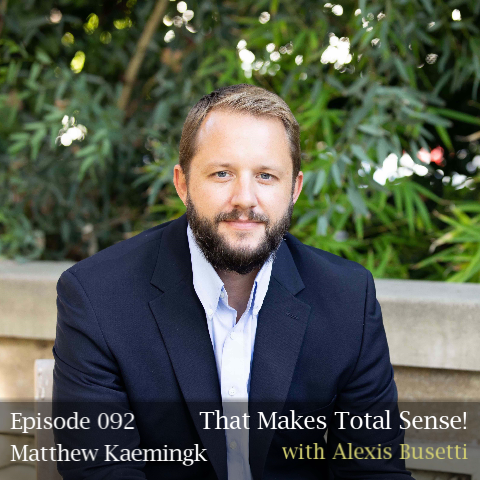
Speaker 0 00:01:23 I mean, we can make it happen and there will be those moments. That's how I felt all the time in class. It was just like all of these light bulbs going off. So before we get into it, I am interviewing today. Dr. Matthew, Kaminak my, uh, professor at fuller who I've taken before. I will take again before my career at fuller is over. I'm. Sure. So Matt, can you, so first of all, welcome to the podcast. And can you tell us a little bit about your role at fuller and then just continue in that and tell us the context for what you study, what kind of theology are you studying and teaching, um, and then that'll kind of lead us into the topic for today.
Speaker 1 00:02:04 Absolutely. So, um, I'm a professor of Christian ethics and public theology. And so public theology is, uh, basically a term for a field of thinking, uh, publicly about theological truth. So what difference does our faith make in how we engage politics, economics, business, the arts culture, race, all of those sorts of things. Um, how do we live our faith in the public square? So I'm not particularly interested in sort of internal church issues and discussions. I'm more interested in what does this space look like, uh, Monday, um, in the rest of our lives. And so I teach courses on faith and politics, which is the class that you took Alexis. Um, yeah, but I also teach classes on faith in the workplace and the marketplace, um, classes on faith and culture and social ethics and things like that. And, you know, I mean, for me, it began, you know, when I was in college, I studied political science and international relations. And I was asking just a lot of questions about how my faith related to all of these different political debates. And that's really what, what got me started.
Speaker 0 00:03:26 Yeah. And the, the, um, the politics class that I just took from you, I'm like, I just wish everyone could audit that class. It was incredible. The texts that we read the lectures, um, and that's where this invitation came from actually. Um, so you have a brand new book on work and worship. And so I'll actually put the link. You talked to Dr. Lamberton about that book. And so I'll put the link to the book and the podcast, um, conversation there, if people want to know more about that, but you also wrote a book on Muslim immigration, right? Remind me the title of that one.
Speaker 1 00:04:06 Yes. That one is called Christian hospitality and Muslim immigration, um, in an age of fear. And that, that came out a few years ago, sort of during the heat of the Trump presidency, um, amidst his, his ban on Muslim immigration. And it was really an attempt to help Christians think about this, this issue of Muslim immigration, uh, Christianly.
Speaker 0 00:04:35 Yes Christianlly. And I'll just be, I mean, I'll be Frank, you probably more than the listeners understand a little bit about the reading load, um, that students might have in a given quarter. And so typically I read all of the books that I have when I have authors on the podcast. Also, typically they are not academic books and they are less than 200 pages. So it's easy for me to slide those in on the weekend, you know, and I was like, thinking I was trying to brainstorm, how can I ask Matt to come on and actually save the 350 page academic book for later? So I'm not saying I'll never read it, but I am admitting full force that I have not read it at this point, but I did find a brilliant article that you wrote on the same topic, um, a few years ago for, uh, the center for public justice journal. Is that right? I think it's, um, the public justice review. Yes. And this article, which I'll also link for everybody is called refugees and the politics of Holy week, which I loved. And even though we're past totally, we get this point we're in, may you really start that article off by saying, if we believe that the, of Holy week literally changed everything, then we really have to think about this, right?
Speaker 1 00:06:04 Yeah, that's absolutely right. Um, and, uh, that's what, we're, what I'm really trying to get at, um, in that article is that Holy week, um, but the final week of Christ's life, you know, before his, his death and resurrection, um, is not simply a story or an event that impacts our hearts. So it certainly does. Um, it is, it is a public story that changes our lives in public life. Um, it's a story of God's hospitality to us. Um, but it's a story that, um, leads us into lives of hospitality, of, of costs like hospitality and hospitality. I take it as, um, to be the act of making space for another and costly hospitality is making space for someone else, uh, that you might be fearful of, uh, that, um, that maybe you don't want to make space for. And that's the key thing that's, that's happening in Holy week, of course, right?
Speaker 1 00:07:13 Is that Jesus is making space, uh, not simply for loyal friends, he's making space for, uh, people who ran away from him and even for enemies, um, at great cost to himself. And so, uh, you know, in that article and your, um, your listeners can go look it up. But, um, in that article, I sort of talk about all the different ways in which Jesus makes space for others in that final week of his life. Um, and frankly, the presence of meals and tables, um, both before and after. And that, um, you know, really after that week, um, on the road to a mass, he breaks bread, uh, with his disciples and his disciples recognize him as he makes a meal for them. And, uh, at the side of the beach there, um, he makes breakfast for his disciples once again, that, that his death and resurrection is really about, um, reconnecting those who are, uh, divided. And so that brings us to this topic of refugees and Muslims. We can talk about that a little bit.
Speaker 0 00:08:24 Yeah. So take us back. I mean, I jumped ahead to the article because I want people to know that's what we're going to chat about today mainly, and I'll link it in the notes here, but, um, take us back to the Netherlands because that's really what grasped my attention, um, was when you told us about the work and the study that you had done in the Netherlands about Muslim immigration in Europe. So, I mean, tell us anything you want to tell us about that and just kind of set the stage for us.
Speaker 1 00:08:51 Sure, sure. So, um, this issue of Muslim immigration and refugees, um, is sort of a new one for Americans. We've really only been having this debate about Muslim immigration, really since Trump ran for office because, um, Trump made it a big issue and it was a big bone of contention. Um, it was not as big of a discussion during the Bush presidency or the Obama presidency. So it's a new debate for many American Christians. Um, but in Europe, um, the debate over Muslim immigration has been going on since the 1990s, um, um, for, uh, for many decades, Muslims from North Africa and from the middle East have been immigrating into Europe. And so, um, Germany, France, the Netherlands England have all been debating. What does it mean to make space for Muslims in our society? And, um, over the past few decades, there's been two rising voices.
Speaker 1 00:09:59 Um, in Europe, one is a more sort of a high walls voice, a restrictive voice, which really says that, um, Muslims either need to assimilate and become like us, or they need to leave. Um, so they need to get rid of their religion, uh, and they need to become, you know, secular Europeans, um, and really assimilate to the French way of life or the German way of life. Um, so that's, that's one voice sort of, uh, uh, high walls, high restriction, um, sort of right-wing voice. And then on the left, you have sort of a, um, a soft multiculturalism we might say, which is, is, uh, let's be very generous to these new Muslim immigrants. Let's give them, you know, lots of welfare and education and let's give them social workers and get them jobs and things like that. And if we, the Europeans are very tolerant towards them and very generous towards them, eventually they will see that the Muslim religion is, is backwards and terrible, and they were, they will sort of grow out of it. They will experience a European enlightenment and they will become like us.
Speaker 0 00:11:22 I mean, this is what I'm saying, when you said soft multiculturalism, I kind of thought, where's he going with that? But it's basically like if I'm hearing kind of in a blunt way, assimilation is the goal on either end yes. In that
Speaker 1 00:11:33 Yes. Yeah. On both sides. Yeah. On both sides on the right and the left, um, Islam is the problem and Europe is the solution. So, um, the, you know, we will let Muslims in, but we need a plan for how to make them like, and so this debate has been going on in Europe for a long time. So that brings us to me. I, um, back in 2010, um, I read this book about, um, the debate that was happening in the Netherlands, uh, about Muslim immigration. Now, when you think about the Netherlands, most Americans don't think about this tiny European country, but they normally think about the legalization of marijuana and prostitution. Right. They think of the Netherlands as a very progressive country. Um,
Speaker 0 00:12:28 Mean I know a little bit,
Speaker 1 00:12:31 You know, I mean they think of it like, um, like a country where everyone is kind of like Nancy Pelosi and Al Gore, you know, just like progressive European, um, whatever. So the Netherlands has this international reputation of being very progressive, very tolerant, very open-minded. Um, however, um, around 2004, there were a number of controversies over Muslim immigration and the number of attacks and this country, um, shifted hard to the right on the question of Islam. And, um, this really bubbled up around this murder of, uh, Vincent van Gogh, the famous painter, um, his, his great grand nephew was murdered by a Muslim extremist in Amsterdam. And there was this huge national fight over this. And what happened essentially was many Dutch voters who, um, or were quite progressive and open-minded at least that's what they thought of themselves. Um, shifted hard to the right and a number of right wing, nationalists and populous group, um, in the Netherlands.
Speaker 1 00:13:54 And we see this throughout Europe starting about 20 years ago, right? Wing nationalist parties and France in, um, in Germany and Austria, Switzerland, and the Tay. And so, um, anyways, I became very interested in this and as a Christian ethicist, I wanted to know how are Christians in Europe responding not only to Muslim immigrants and refugees, but how are they responding to right wing nationalism and right-wing populism. So once again, this is like 2010. So this is six years before Donald Trump. And that's, that's what drove me to go to the Netherlands to study these things. I had no idea that, you know, Trump politics was coming through the United States when this happened.
Speaker 0 00:14:46 I mean, that's, that's crazy. Cause I'm just like, it's like, you kind of get to watch this, like almost this like secular prophetic vision, you know, of what, what would happen here. And I don't, I mean, this is probably an ignorant question, but I mean, you're used to my ignorant questions by this point, because we spent a quarter together. But when you said about 20 years ago, I thought, did I understand that this was in Europe, but did the events surrounding nine 11 in the United States? Did any of that or any of the effects of that or the environment like did any of that transfer, was any of that connected to what they, the shifts they started to see in Europe?
Speaker 1 00:15:27 Yes, absolutely. So nine 11 was a big, had a big impact on European politics as well. So from yeah, 2000 to 2005, there were a number of Muslim, uh, terrorist attacks in the United States and in America and in Europe. And, um, and there were a number of controversies around things like political cartoons and movies and headscarves, just a number of things that really sort of bubbled to the surface in Europe. And, um, so after, after one of these controversies where, um, this, this man was murdered by a Muslim extremist, uh, there was a backlash against Muslims throughout the country and, um, Dutch mosques were burned. Um, they were defaced, there was graffiti on them. Um, Muslim schools were, were burned and, um, Muslims were just experiencing just a high rate of hate crimes in the Netherlands. And, and this was shocking to everyone, right? Because they thought of the Netherlands is this very tolerant, progressive place.
Speaker 1 00:16:43 And, uh, while this was happening, you know, of course my research question was how are Christians responding to this? When, when the pitchforks and torches come out from Muslims, are, are Christians, how are Christians going to respond or are they going to enjoy joining the mob or are they going to fight against it? And, um, so I was particularly interested in the Christians who decided to stand up for Muslim rights and dignity. And I interviewed a number of Christian pastors and leaders throughout the country who did this. And one particular, one was quite interesting to me is this is a Pentecostal pastor who, um, who ended up defending Muslim rights though. He, he told me very clearly he did not agree with Islamic theology. He, he really honestly didn't terribly like Muslims. Um, but he felt a particular compulsion to be a part of this.
Speaker 1 00:17:43 And so, um, during these nights, when Muslim mosques were being burned, he called up a number of his, um, fellow Pentecostals. And they went and knocked on the door of their local mosque and said, hello. Um, we are here to guard your mosque for you. And we are going to walk around every night, um, your mosque, uh, until these attacks stop. And he in fact, um, called a variety of other Pentecostal pastors throughout the Netherlands. And they organized, um, essentially marches, nighttime marches around the mosque to protect them from attacks. And I sat down in his, his little living room years later and interviewed him about this. And I wanted to know, right. Why, why is this? And, um, he said, fundamentally, I'm defending Muslim rights and dignity because of what Jesus did for me. Um, Jesus died for me when I was far off from him.
Speaker 1 00:18:52 Um, and it's not because I was particularly likable that Jesus died for me. Um, and so I, I, Jesus commands me to love my neighbors and even my enemies too. And he said, one other thing to me that was really interesting. Um, he said that, uh, for years he had been a volunteer in a local Jewish cemetery now, um, during world war II, many Jews were taken from the Netherlands and, um, died at the hands of the Nazis, uh, in concentration camps. And there there's a great deal of guilt in the Netherlands about this, that the Dutch did not do a better job of protecting the Jewish minority, uh, and hiding them. Some of them did, but not enough. And so there's a lot of guilt that the Dutch didn't stand up, um, for Jews. And this particular pastor said, you know, I care for these Jewish cemeteries and I'm reminded of the ways in which we did not stand up for the Jews. And he said to me, I don't want to be, um, caring for a Muslim cemetery that, you know, I didn't stand up to them. And so that's another reason why I do this. And, and I think that story, you know, listening to him back in 2011, um, kind of prepared me to, to write a book that would come out during the Trump presidency when, um, a growing group of Americans saw, um, Muslims as a sort of imminent threat to America and to Christianity and, and took a posture of antagonism towards Muslims.
Speaker 2 00:20:44 Yeah. I mean, that, that I've
Speaker 0 00:20:48 Heard before, and I'm still getting teary and I'm still getting chills. Um, because this is, um, this is like, this is the third way. Right. Um, you've already alluded to it in, in your article. You talk about the, um, you know, the high, the high walls versus the wider doors. Um, and, and I do like your verbiage. I mean, you say it's simplistic and tired in the article. Um, you know, just these, these two things that we've, you know, we've said it just in this conversation, you know, just to, to kind of categorize them in some ways, like they both kind of have the same end goal, right. They both, they're, they're kind of coming at it from two different, um, points of view, but really they're kind of more similar than they are not in some ways in how they're viewing and how this, this view is.
Speaker 0 00:21:45 Um, interpreting, you know, the threat that, that felt threat, I should say, um, of Muslim immigration refugees, but in your article and with this pastor, and I'm sure what the book that I'll read at some point, but, um, you talk about kind of this third way. That is how do we respond if we really do believe that that how do we respond to Jesus in this way? Right. Because I would say he, the pastor was definitely caring for his Muslim neighbors, but he went and knocked on their door. Right. He was responding to Jesus in a way. He wasn't responding to their ask. He saw a need, but he was responding to the call. He felt from Jesus. Um, so how does that look?
Speaker 1 00:22:34 Yeah. So, I mean, we're talking about Muslim immigration and refugees right here, but ultimately what we're talking about is as Christians, how do we make space for deep difference, um, in our lives, you know, and, and, and here, the example is Muslim Democrats. They're, they're different from us in terms of their culture, their religion, their race, uh, just the way of life. Um, it's different, and that can make us uncomfortable and fearful. And yet as Christians, we're called to make space for them. And, uh, the politics of the world gives us two, two primary options on how we deal with difference. And I use the language of either high walls or open doors. And the high walls is we have to keep that difference out. It is a threat to us. Uh, we have to stop it. We have to create limits. Um, it's an issue of security.
Speaker 1 00:23:34 So let's build walls. Let's keep the difference out now. Um, there's some wisdom in that and that difference can be indeed dangerous and we should dangerous seriously. Um, this is a dangerous world. Um, and so security matters and a difference can indeed be challenging, however, um, high walls doesn't really, but the politics of high walls doesn't really give us any way to live with the deep difference that we have. So you and I, we live in Houston, Texas. We, we live in the most diverse city in America, w we, we win. So, um, the politics of high walls can't really help you. And I live here in Houston because differences already here, there's, there is no wall to be built. There's, there's difference up and down my street, religious difference, racial difference, economic difference, it's everywhere. And so the politics of high walls doesn't help me because it's already here.
Speaker 1 00:24:43 Now, on the other side, we might call this the left-wing side. You have the politics of open doors, which is let's, let's let this difference in, and let's just embrace it and it'll be awesome. And, um, we're all gonna sing kumbaya and, and it's going to be great. Um, and the problem here is not the openness, of course, being open is, is a good thing. Um, and being welcoming and making space. Um, all of those are, are very Christian and there are many reasons why Christians should be, you know, um, um, sort of open to this, this left-wing posture of openness. Um, however, there's a problem here as well in that what happens in terms of left-wing multiculturalism is, um, you, first of all, don't really take the challenges of diversity. Seriously, first of all, so you can kind of romanticize diversity as this awesome thing.
Speaker 1 00:25:49 That's going to bring nothing, but goodness, and, and, and just, you wait, it's going to be tremendous. Um, the second is you can often downplay the differences and say, well, we're all essentially the same, you know, Muslims and Christians and Jews. And we all basically worship the same God. Um, difference really isn't much of a challenge. Um, and the problem there is you're not really taking these distinct faiths and cultures. Seriously. There are real differences and real disagreements, and you, and you can't just simply say, let's just be open because you actually do have to make some hard decisions. So there it is. You've got high walls as one option for Christians and open doors as the other option. Um, and both of these things fall short and, you know, to just continue our, our house metaphor, the, I argue that Jesus, um, Jesus Christ offers us a third way beyond high walls and open doors.
Speaker 1 00:26:59 And that's what I call the politics of the table. And that's what I argue is, is frankly, um, what a house is for, um, the whole purpose of a house is what happens around the table. Being able to sit at a table, um, with deep difference, right there at the table, costly, uncomfortable, deep difference, and have relationship one another. And Jesus can help me do that. Um, the politics of high walls can't help me sit at that table. Neither can sort of a soft multiculturalism, uh, on the left, the politics of open doors and high walls. Can't help me, um, sit down with deep difference and stay there and stay in that relationship. And I just argue that democracy, um, in order for democracy to exist, we need tables. We need conversation. We need places where we can really talk about our deep differences. And, um, and yeah, I just find the politics of the right and the left wanting, um, when it comes to these discussions of deep difference. And, and I just want to encourage Christians not to follow, um, those more secular ideologies and to say that actually Christ and Christ cross really does offer us a way to, um, to live in a globalized world with deep difference. I talk for a lot there. So Alexis, I mean, how does that hit you? What are you?
Speaker 0 00:28:41 No, I mean, it really, it really hits me and I'll tell you the, the thing that was kind of swimming in my head the whole time, I don't think is in your article, but we'll, we're just going to wing it. Cause we can, we can just talk about this, but the, the thing that, that kept swimming in my head the whole time when you're talking about relationship and, and table fellowship, being at the table with one another, especially in the context of Holy week is man. And it actually, might've been maybe your last lecture on, um, on the sacraments that were, this kind of really got me thinking it's, hasn't left. So appreciate that. But, um, man, if Judas wasn't at that table with Jesus and I'm like, and then he, like, he knew that there was going to be betrayal. He knew there was going to be death. He knew those things that opening his table to Judas was going to bring, I mean, Peter was no Saint after that, you know, and we everybody's split. Right. I mean, I just keep thinking about, um, the risk that Jesus welcomed and preparing a table for people who, you know, um, one who had very deep difference, um, with him and it actually was dangerous, but you know, just, just the, the risk of that, of that politic, you know,
Speaker 1 00:30:08 We domesticate, we domesticate that table. We domesticate communion, right? We make it this sort of soft, sentimental, um, spiritual thing that we do. But we don't recognize that you have sitting at that table, a zealot revolutionary and a tax collector for the empire, a tax collector for the empire and a zealot revolutionary. And they're both sitting at that table together. And the only person who could bring those two people who are so politically divided together is Jesus. And Jesus is willing to sit there and he's willing to dip right. That bread right next to his betrayer and, um,
Speaker 0 00:30:54 With his betrayer. Right. I mean, I love that scripture, right? Like, like the one who's going to dip with me right. At the same time our hands are going in at the same time, this is him. Right. It's nutty, it's nutty. I mean, yeah. So I think it, I think it hits me as nutty. That's how it hits me, um, to me as like, as like beautifully nutty, right? This, this, this politic Jesus.
Speaker 1 00:31:21 I mean, if you read secular political theory today, when it comes to the future of democracy in the West, there is a lot of pessimism out there about whether or not democracy can really survive. Can we actually live together? Can we respect the results of an election? Um, can we allow ourselves to be ruled by a tribe that is not our own, um, there is a lot of pessimism out there about how democracy is going to continue and how we can live with deep difference and this issue of, um, where are we going to find these resources for patients for forgiveness?
Speaker 0 00:32:05 Oh, say that again, Matt. Cause it came, it just cut out.
Speaker 1 00:32:09 Can you hear me now? I
Speaker 0 00:32:11 Can't. I'm sure it was. I'm sure it was like really good. So can you repeat it, sorry.
Speaker 1 00:32:14 So that, I mean, these democratic theorists are asking where are we going to find the resources for patients for, you know, forgiveness for generosity, for mercy. Um, you know, uh, a government program cannot create democratic virtues, um, that that democracies depend on. And so, um, this is a real crisis in Western democracy. And in my argument here is that Jesus Christ, um, is the core of, uh, of, uh, Christians posture and democratic diverse society. And, uh, we as Christians need to return to a Christ centered politic, uh, as opposed to sort of these ideologies of the right and the left.
Speaker 0 00:33:07 Right. Cause when you were talking about the ideologies of the right and the left specifically on the left, um, I like that term, that soft multiculturalism, but you know, in, in that, Oh, we're all just kind of the same or let's sing kumbaya. I'm like, but that's like in essence, that's like fundamentally disrespectful though. Right? Um, of, of one another's faith of our beliefs, right. When I equate, um, your difference and, and want to pull it to my sameness or, or otherwise, like that's just, that's just fundamentally disrespectful and it's, and it's, and it's fundamentally, it's not dignifying. Right. Um, but, but the same is true on the right when we try and say, no, I actually get to a degree that you have difference, which is why I don't want you here. Right. That's also disrespectful and not dignifying to, um, to the people who we see as not being the same as us.
Speaker 0 00:34:09 And so, I mean, I think that that's yeah, what you're, what you're talking about is kind of the question, right? Answer the question for us, Matt. Like how do we, as Christians live in a respectful and dignifying way and understanding the deep difference and not anticipating the change? I think that was kind of my point with, with the Judas conversation and the communion table conversation, right, is that we don't have the ability to look into the future like Jesus did, but he did look into the future and knowing the future and knowing that there was going to be danger in betrayal. He still dignified every person who sat with him. Right. And he still taught his disciples to respect one another and their deep difference. And so I think that's kind of where I'm going with that, with that risk, you know, that riskiness is, you know, what does that, what are some of the ways that that looks like for us to, to treat one another with dignity and respect and not anticipate a change in one another's difference? Is that question makes sense?
Speaker 1 00:35:20 Yeah. Yeah. I think so these two terms of, uh, convicted civility and principled pluralism, or we might just use Paul's language of grace and truth, um, like convicted civility that are a person of deep and profound conviction. Um, uh, and yet you, and out of that conviction, you are a person of civility and generosity towards people with other convictions or to use the term principled pluralism, you have deep principles, um, principles that you do not want to compromise at all deep principles. Um, and yet you make plural space for others who, um, have different principles so that you are a person of deep commitment to truth. Uh, and, but that truth demands a grace. Um, and it's not your truth, it's Christ's truth. It's not your grace, it's Christ Christ. And so bringing it back to Holy week, um, we are people who, um, as Christians, we recognize that we participated in the crucifixion of Jesus.
Speaker 1 00:36:38 We are not sort of these righteous Holy ones who are outside the story of Holy week. Um, but we actually played a role in, in betraying Jesus in nailing Jesus and taking his clothes, um, in, um, denying Jesus. So, um, Christians participate, ought to participate in public life as people who are profoundly humbled by their own recognition of their own sin, their own brokenness, their own rebellion that, um, they are Christians, not by their own, you know, moral night. Um, they are Christians by the grace of God. And so if, if they've taken Holy week, seriously, um, Christians will not enter into these discussions of deep difference with a sense of Christ like sovereignty, because they recognize there's a difference between Christ and Christians
Speaker 0 00:37:45 Go a little bit further with that. Um, the theologian who talks about how we were an, the ones who were uncovered.
Speaker 1 00:37:54 Yeah. So, um, in the, in my little book on Muslim immigration, we talk about what does it mean to wrestle with the cross? Um, there is, uh, one of my favorite sermons from this old, uh, Dutch preacher who was part of the, not a resistance against the Nazis. He preached this sermon about Christ nakedness on the cross and this sermon about, um, the fact that, um, you know, in the garden of Eden when we sin, uh, the first thing that God does for us is he gives us clothes. Um, and the last thing that we do to God on the cross, as we take his clothes from him, and, and he talks about how, um, as, as Jesus is hanging there on the cross and he's naked, he is surrounded by people who are mocking him and cheering him as a failure because they imagined that they have, they have unclothed him and exposed him as a failure. We have exposed the King of the Jews as nothing but a fraud, right? We have taken away all of his pretense of power and we've exposed him as a failure.
Speaker 1 00:39:19 And what skill there in his sermon does is he says, what happens on the cross is not us exposing God, but actually God is exposing us. When we take his clothes from him, Jesus exposes us and our, um, our fearfulness, our rage, our violence, our, our inherent rebellion. Um, we are exposed by Christ's nakedness. Um, but his, his sermon turns on this note of grace and comfort. He says, um, God, doesn't because that's a jarring image, right? Um, he says, God does not leave us naked and shivering. Um, but instead there on the cross, he clothes us with himself. Um, and so Christians are not people who, uh, dress themselves up in, in, in, in rationality and morality and all of these special things, but they are ones who have been dressed, um, in clothing that they could not make for themselves. And it's only by the grace of Christ that they can walk through this world.
Speaker 1 00:40:39 And so, um, if we show any humility in politics, if we show any grace in politics or any truth in politics, it is only Christ in us and clothe us. Um, that is, that is the only thing we have to hold on to because we know that, um, we were stripped bare. Um, and, uh, and so the rehearsal every year of good Friday services, my wife's a worship director. And so for her, she would say, it's so important for us to remember good Friday year after year to remember, um, how we were exposed and how Christ clothed us. Um, and so good Friday is not just a story about my personal salvation, but it's a story that should impact my political life, my political posture, my posture towards those who are different from me. Um, and so when we talk about the politics of Holy week, that's what we need, that, that it should, Holy week should shape every aspect of our life, including our political, uh, interactions with our neighbors.
Speaker 0 00:41:56 Thank you for that. Um, as we start to wrap up,
Speaker 1 00:42:02 That makes total sense.
Speaker 0 00:42:03 That makes total sense, man. That makes total sense. I was thinking it actually, when you were talking about convicted civility and principled pluralism, so we'll back it up. I'll have my husband, like, I'll, we'll clip it in there, but I was taking, I was like, I was back in class. I was like frantically taking notes. I'm like, I hope he says that again. I'm going to write that. That was it for me. That was my, that makes total sense. Moment is this convicted civility and principled pluralism. So there you go. Um, I was going to ask, so I feel like this probably happens, uh, probably, maybe I I'm going to put this on you. I'm like, does this happen more often than you than you hope it does? Where, where the lecture is wrapping up and you think now, why didn't they ask this? So I'm going to say, what's the question you wish I would have asked you as well. And that gives you a chance to say whatever I missed in this conversation,
Speaker 1 00:42:58 Alexis, you did a lovely job. You covered everything. But, you know, I think normally at this point, uh, someone asked me, okay, so what do I do? I've got a Muslim neighbor, right? What do I do? What do, what do we do next? What do you have to say to westbound about practically? What does this look like? Because professor you're at 30,000 feet talking about the cross and talking about all this theology stuff now, what do I do,
Speaker 0 00:43:23 Right? Yeah, exactly. Like we go, yeah, I'm going to the Y I'm going to swim team this afternoon and I'm running into my neighbor when I'm pulling in the groceries. I mean, we're, we're not in Europe where we're having these like kind of some of the drastic conversations, like the pastor that you interviewed. Right? Yeah. So that's a great question. I'm glad someone asked that. What do we do?
Speaker 1 00:43:47 So, uh, we, you know, I argue in my book that we're called to practice hospitality and I put a high, a high emphasis on the practice, which means, you know, most Christians, when they have a Muslim neighbor, they're really nervous, um, to talk with them, to invite them over, um, just to, just to interact with them. It's, it's nerve wracking because some of 'em are afraid of Muslims, but some of them are just afraid that they're going to say something wrong or, um, you know, embarrass themselves or embarrass their neighbor, um, or do something insensitive. Um, so they're afraid to make a mistake. And so they, they simply ignore their Muslim neighbor or maybe it's their Muslim coworker, um, or whatever else. And so my, my response to that is practice hospitality. And by practice, I mean, you're going to be bad at it. You're going to make some mistakes and that's okay, you're, you are right.
Speaker 1 00:44:52 You will make a mistake. You will say something wrong. You will most likely do something like you will offer your Muslim neighbor some bacon or some wine, or, you know, you'll, you'll, you'll offer to make them lunch during Ramadan when they're fasting, you know, so you will make a mistake and that's okay. That's just getting to know your Muslim neighbors and actually interacting with them. And that's the, that's the hard, slow work of democracy. And it's the hard, slow work of Christian discipleship, which is, um, going out and making disciples of all nations. And so I just really do encourage, um, first of all, Christians to step out and ask questions. And now I, I grew up in Seattle, which is a very secular city. Um, being a Christian, there is very strange act. And I have to say that, um, in my experience, it is much easier to talk with Muslims about my Christian faith than it is to talk with white atheists, um, and white secular people.
Speaker 1 00:46:02 Um, Muslims are often very excited and open to talk about things of God and to talk about family and morals and honoring God. And you can have really interesting and thoughtful conversations, uh, with your Muslim neighbors about these kinds of things. My, my dear Muslim friends, Shadi, Hamid, he recently read the book of Galatians in the Bible and, uh, he wanted to talk to me about the relationship between the law and the gospel. And we had a really wonderful conversation. And frankly, it was a, it was a great experience for me to just be reminded of God's grace. And so, yeah, I just encourage that, that practicing of hospitality.
Speaker 0 00:46:46 Yeah. That's really good. I feel like this is slightly off topic, but I think as, um, like kind of as an older student, you know, I think that that's something though that adults, I think we just struggle with in general is kind of practicing things that we're not good at yet. Um, because we're kind of in the habit right. Of just, you know, like we do things because we're good at them. Right. And at this point I'm not trying to ride a bike anymore. Right. And I'm probably not going to touch rollerblades. So I'm not worried about that. Right. But like being back in school has reminded me, like, exactly what you said, like I'm here because I don't know this yet, so I'm going to mess up and I'm going to make mistakes. And I'm going to say stupid things and write stupid thing.
Speaker 0 00:47:31 Hopefully write fewer stupid things than I say, but, you know, it's just, it's been a good practice. It's been a good reminder of me for the, for the practice of practicing. Right. Um, and I think as adults, that's, that's really good that you say that. Um, because I think sometimes you're just not used to it, you know, my kids fall down and get up all the time. Right. Because they're just kind of in this continual learning process. But if we look at this as a learning process, as a part of our greater discipleship, um, then I think that context helps. Um,
Speaker 1 00:48:05 Yeah. And frankly, you know, I mean, as America becomes more and more secular, um, being a Christian is going to be more and more strange. And, um, we, in the future, we'll be able to have more conversations with our Muslim neighbors about what it means to be strange people of faith in a secular society. And we will increasingly, uh, have stories to share about, you know, wrestling with what does it mean to raise faithful families in a consumeristic secular culture. And that's a question that Muslims and Christians are wrestling with, you know, the Muslim family across the street from me, they're, they're wrestling with, how do I raise my teenage daughter, um, in a culture that wants to sexually sexualize her, you know? Um, and that's something, you know, Muslim parents and Christian parents both wrestle with. And so, you know, I think, you know, as, yeah, yeah,
Speaker 0 00:49:15 No, I liked it. I liked it. Um, so I normally end this with like, I'm going to put all the links here for everything that we've talked about, but I normally end with tell us where we can find you. Um, I mean, I follow you on Twitter. Is that where you are online?
Speaker 1 00:49:31 Yeah. Yeah. You can follow me on Twitter, Matthew caming. It is a, it is a long Dutch name that makes no sense. So there you go. So you can find that letter or
[email protected]. I have a little bit website as well, but, um, yeah. Gosh, Alexis has been great to be with you and, uh, con uh, we're all just so proud of you here at fuller seminary, just so proud to have you and, um, and really just very glad for all these conversations that you're cultivating. And I think just the curious, generous and humble way you're, you're getting after this. So go let's.
Speaker 0 00:50:13 Thanks, Matt. I appreciate it.
Speaker 1 00:50:16 Absolutely. Thanks for having me.
Speaker 0 00:50:17 Yeah. The links for all the resources mentioned in today's episode can be found in the show notes, music and podcast production by city.
Speaker 4 00:50:28 Be sure to give us a review on iTunes and subscribe at your favorite podcast listening app, you can also visit us at that makes total sense. <inaudible>.