Episode Transcript
Speaker 1 00:00:06 Welcome to that makes total sense. A podcast dedicated to exploring God's generosity and justice. I'm Alexis ETT, a Christian aiming to ask good questions and encouraging you to do the same. Every one of us is wired by God to live out generosity and justice, but the how sometimes eludes us that makes total sense is a way for us to get together, posture ourselves as learners and challenge one another to practice generosity and justice in a tangible way every day. Okay.
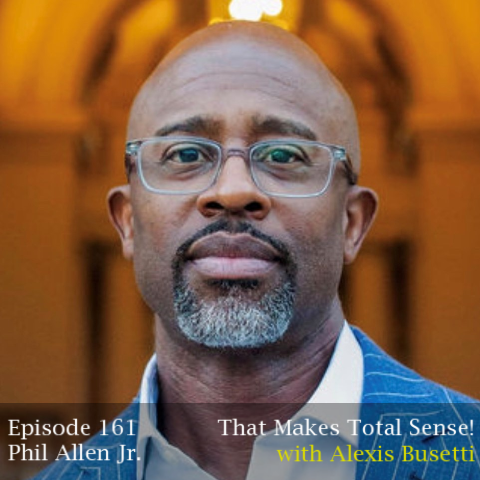
Speaker 2 00:00:42 So I'm super pumped because I get to see my friend Phil's face again, and I just finished his second book last night and sent a group text Phil. That was just like read Phil's book. That's it like? That's the text. <laugh> that's the message. Read the book. It's called the prophetic lens, the camera and black moral agency from MLK to Darnell Frazier. Phil, are you pumped about this? About to make its way into the world?
Speaker 3 00:01:12 Am I, oh my goodness. I'm so excited. Um, I feel really good about it. You know, it it's three years into making and I didn't realize that I, I was just thinking about when I started writing it, but the original idea and original paper goes back to 2019. Wow. And it, I repurposed it a couple of times for some AR a journal articles. And after the Derek Chauvin trial, I was like, okay, I gotta write this. I gotta flesh this out some more. And um, I feel really good about it. I'm sure there's gonna be some critique. Every everything has critique. Um, but overall I'm excited. I'm pumped up ready to engage people with this, with this book.
Speaker 2 00:01:57 Yeah. This, it was in, it was incredible. Like I said, I, I finished it last night. I felt like so yesterday was labor day and I felt like I just kept saying to my husband, okay. I I've just got, if I can do, if I can do one more chapter, I'm do one more chapter. And I, one more chapter in my way until about eight 30 <laugh> last night. And I was like, man, this, this was so good. But, but here's, here's what I'll tell you. Um, so this is, this is not a critique. I wanna, I wanna tell you this as, um, as a friend, but as a reader, I read the, the subtitle, okay. From MLK to Darnell Frazier, and I was ready to jump right into cameras with MLK and civil rights movement and all that stuff. And you did not let me do that.
Speaker 2 00:02:44 And at first I was super frustrated. I was like, Phil, we gotta, I wanna be like with the camera right now, but it was so beautiful. You, the, the first half of the book really is foundational for this conversation. And I, I know that you did that intentionally, but as a reader, even though I was familiar with much of what was said in the first half of the book, the way that you lay out the history, the way that you talk about the, the narrative and black narrative in the us specifically, um, it was it, we needed that. We needed that cake part, you know, uh, the other, this, this frosting of what I, what I really wanted to tell me about the camera. Tell me about this. Tell me about that. That's an amazing second half, but we needed this foundation again for you to take us through the history of the NA the narrative history in America, before we got to the media, George Floyd, you know, all of those kinds of things. So, um, I just wanna note that as an observation and then ask you, what was your thinking behind that and the way that you kind of laid this out?
Speaker 3 00:03:59 Great question. And, and I was as frustrated writing it as you were reading it <laugh>
Speaker 2 00:04:05 <laugh>
Speaker 3 00:04:06 Cause
Speaker 2 00:04:06 The frustration didn't last long
Speaker 3 00:04:08 <laugh> I, I was ready by chapter two or three to get into <laugh>. Yeah. Initially, and then, um, wrestling with, I knew I needed to have a foundation for what, what am I, what do you mean by prophetic?
Speaker 2 00:04:23 Yeah.
Speaker 3 00:04:24 Like that's the first thing. Um, yeah, we can talk about the camera and, and all that stuff. But what do you mean by prophetic? What do you mean by, um, this, this moral agency for black people? Why is that so important? Why is the camera so important? So talking with my editor and he pushed me to he's like, Phil, we gotta, we gotta lay some more foundation here. And so I, I just started to try to unpack, you know, take a little journey. Let me talk about the black experience. Let me talk about the part that's not seen the unseen violence or the part of the black experience that, um, that, that people outside of the black community just may not be aware of. Like this is the daily. See, we see, we see the, the shooting, the death, the violence, but there's something before that.
Speaker 3 00:05:21 There's a, there's a lot before that, there, there are things that you, that, that are daily in our lives that just, I can talk about it all day, but people don't necessarily believe me. Then I had to talk about, well, where's the violence coming from historically. Then we get into, um, the prophetic, the use of the word prophetic. And then we start to tell the narrative how the narrative has been, has been told. So all that was necessary to set up and hopefully people will see that it places now the camera has more value by the time you get to it. Right. Mm-hmm <affirmative> so that was the thinking behind that.
Speaker 2 00:06:02 Yeah. So I want you to, I want you to connect these two things for me, because as, as you were just talking about the, the unseen violence, right? What happens before the shooting or the, the over-policing, the violence, all of that. What happens before, um, you and I have spent some time together. And so this may have hit me in a, in a different way, because, because we personally know each other and meaning like I've stood beside you. I know what you look like. <laugh> right. But you talk about going for a job in Pasadena and having to make a decision on a chilly day, whether or not you're gonna put your skull cap on this is not far fetched. I think in the way that you threaded this together, when you talk about the, what happens before the unseen stuff, the daily stuff, and how we got there, tie your decision to put on a skull cap or not as a tall, big black man to birth of a nation.
Speaker 3 00:07:07 Yeah. So part of it is, is, is that that narrative that was created by films like birth of a nation and birth of a nation is kind of the film that everyone goes back to that created this narrative, that, uh, to, to fear black men. Um, if you watch the film and it's, it's, it's hard to watch, but if you watch the film, you, you, you see every aspect of it, the subtleties to the most blatant, it created this narrative. Well, that narrative has, has lasted, right? Um, so that's part of it. Then the other part is my own personal experience. So I still think about literally 20, 20 plus years ago, walking to the bus stop in a neighborhood that I lived in at my mom, with my mom at the time for almost two years, I was a personal trainer. So I wear sports gear, athletic gear.
Speaker 3 00:08:07 It was 30 some degrees outside. So I have a knit hat on. I have a hoodie on, I have my backpack cause I'm, I'm a personal trainer. So I'm going to the gym. I'm gonna be there all day and all night training clients off and on. I'm walking to the bus, stop, minding my business. I'm not looking around at anything. I'm not looking suspicious. It's too cold. I wanna get to the bus, stop, get on the bus and get to work. I live in the neighborhood. So I'm comfortable. Well, apparently there was somebody, a white man who it was a holiday. So he was off that day and he saw me. He called the police.
Speaker 3 00:08:46 That's, that's a violence. That's that's the, the violence I'm talking about. Mm-hmm <affirmative>, mm-hmm, <affirmative> the, the, the, the, the, the fact that he sees me and assumes criminality, right? He doesn't see my humanity, see violence starts there. It starts when we know, when we don't see the humanity in, in, in another person, it's not what we see on camera. Oftentimes that's the terminal end, but there's a progression of violence that starts when you don't see my humanity. So it happened to be a holiday. And I realized, oh, I missed the, the, the bus. So I turned to, to walk back to my house and I saw the cops sitting further down the street. I didn't think anything of it. And he shoots down the street towards me. I still didn't think anything of it. I thought he got a call. Someone's doing something up the street.
Speaker 3 00:09:42 And I don't live in a bad neighborhood. I, at that time, it was a middle class up middle class, really nice neighborhood. And, um, then he turns on my street and I was like, wow, it's in, it's in my neighborhood. <laugh>, I'm still, I'm not thinking he's coming from me. And then he turns toward the curb as where I was walking. I thought he was driving up on the curb. So now my heart's racing because he, he was flying down the street towards me and he gets out of the car. He rushes towards me and asks me quick questions where you live. Like he's trying to catch me. And I gave him my address. And I said, what's going on? And he told me someone called they saw, uh, someone that fit a description with a knit hat, a hoodie, and they didn't recognize walking the neighborhood.
Speaker 3 00:10:32 And I said to myself, all of that for that, cuz someone just, and I said, so you're telling me if I called y'all because I saw a white guy walking through our neighborhood that I don't recognize, will you come and do the same thing? He hands me my ID back and say, you have a nice day, sir. Wow. And it, my day, I mean, I was pissed for days, but to this day, before I go running, now I will wear a knit hat. Cause I'm not gonna go out there and, and get sick sweating in, in the, in the cold, in the wintertime when it's cool at night or in the morning here. But I don't put a hoodie on to this day. I, I don't, I don't like wearing hoodies if I wear a hoodie, it's probably cuz I'm just like, you know what, I'm gonna wear this hoodie today.
Speaker 3 00:11:19 But typically I don't, I don't really like wearing a hoodie because that sticks in the back of my mind. That's, that's just one of three times in my neighborhoods in different different states that I was pulled over, um, by law enforcement. Um, and then you got the note, the idea of black guy with a knit hat in the stereotype that going back to birth of a nation, the stereotypes that come with how we may, you know, carry ourselves. And I think about those things sometimes I don't care. And sometimes I don't have the energy to deal with what may come of it. So I, I, I, I challenge myself sometimes. Um, well, and I challenge myself, but I wrestle <laugh> sometimes. Do you wanna wear this today? Um, yeah. Yeah, but again, I'm going, I'm not gonna get sick running and sweating and not have anything on my head. So I will wear a knit hat. That's just what it is. People just have to deal with their own, um, biases. But the fact that they have to think about it because of my experience and because of those narratives that are out there.
Speaker 2 00:12:24 Thanks for sharing that, Phil. Um, I, I, I hate leading with it, but you led with it in the book and I think it's important. I think it's important that we lead with that because as you mentioned, when we, when we started this off, there are just some things that people don't think about unless they have to think about it because it's their everyday experience. A lot of people don't think about it or they don't wanna think about it or they have never thought about it. Or they think that it's a myth or it's overplayed, you know, some of this, but part of the reason I asked you to connect those things is because our, our history matters. And one of the things that you do, I think brilliantly in this book is you don't let our history remain our history. Um, you pull it through. Yeah. So we go from, we go from birth of a nation to January 6th and we can see all of this is connected. Yeah. Um, it's, it's, it's all connected. I do wanna say, I, I have not watched birth of a nation. I know of birth of a nation. What I did not know, there were a couple of things that, that I, that I kind of starred in the book that I was like, what? This was one of them that birth of a nation was based on a novel written by a Baptist pastor.
Speaker 3 00:13:59 <laugh> yeah.
Speaker 2 00:14:01 Yep. Isn't that great?
Speaker 3 00:14:02 Yep.
Speaker 2 00:14:04 I'm like, are you, are you kidding me here? And I thought, I thought why this was, it was just in a paragraph, you know, I'm like, this is like this, this needs to be like in subtitle print. I don't know what to, I mean like what, and, and, and that narrative continues and that is not our, our history only anymore. Yeah. Right. We could anyway, list a hundred resources for complicity and
Speaker 3 00:14:29 Well, let, let me speak to that real quick. Cause I just had an exchange with a pastor, an evangelical pastor. And when I, and we, I posted something, uh, I said, my, my post this week let this last week was, there are far too many. Non-profit P P R O P H E T churches. Then there are non-profit P R O F I T churches. And then he said, I knew he, I knew I would get something from him. Cause he always does. I, I told him, I knew I would hear from you because you're always you're surveillance. You're always watching over my, my site that purposely said surveillance. That's part of my research, dealing with the plantation model that there's a, a constant surveillance. And, and, and we, we went back and forth for a little bit and I was very direct with the last few times I told him, actually, I said, don't even message me anymore because this is getting annoying.
Speaker 3 00:15:29 But I said your evangelical sensibilities show. And he responded, you know, I'm proud of my evangelical sensibilities and I, and I haven't responded to that part and I might not, but I wanted him to understand the roots of those evangelical sensibilities. Yeah. Mm-hmm <affirmative> mm-hmm <affirmative> and the ties to white supremacy. Yes. He will probably deny it without doing the research. That's the sad part because he wants to hold to whatever positive imagery perception that he has of his roots. Because to do the, the work is to come to a place of lament and grieving what you actually find the ties to white supremacy. But I just, I just thought it was interesting that we, we talk about connecting the past today. Mm-hmm <affirmative> mm-hmm <affirmative> and just having this exchange a couple of days ago and, um, him not even realizing, like that's not a good thing, in my opinion, your ties to, you know, um, evangelicalism.
Speaker 2 00:16:34 Yeah. But it isn't, but it is important because we, we do have a choice to delve into that history, to do the research, to read sources like yours that are well researched and, and to look on our own, it was funny. It was something really trivial in your, uh, in one of these chapters, I'll tell you what it was. This is funny because, uh, we like MJ in our house here. And I was like, they're not playing Michael Jackson on MTV. Like what, you know, because I grew up watching Michael Jackson on like Nick load. They used to have a show called Nick rocks. Right. And we would, and, and VH one and all I probably, my parents may not have, let me watch MTV, but anyway, but I grew up watching Michael Jackson. It was, it was dumbfounding to me that there was a time when they wouldn't play his music videos.
Speaker 2 00:17:22 Right. And so I read it out loud and, and I said, I know it's. I said, I know, I know Phil's got a footnote here. And so I went <laugh>, you know, and, and looked it up and saw it, which is just a silly trivial example. But it's like, but the stuff is out there. Right. The stuff is out there. It's, it's, it's not a secret, but it is my, my husband's favorite quote from Mark Charles, when, when Mark Charles talking about American history in general, and someone says, I didn't know that. And Mark's answer you is sometimes, well, you weren't supposed to find out
Speaker 3 00:17:59 <laugh>. Yeah. Ex. Exactly. And, and, and that, that movement has heightened today.
Speaker 2 00:18:05 Yeah. Yes.
Speaker 3 00:18:08 It's, it's it's heightened today. Yes. It's never stopped.
Speaker 2 00:18:11 Yes.
Speaker 3 00:18:11 Heightened amplified today. Um, you're not supposed to find out. And I tell this story all the time. I don't know if I shared this the last time I was on here, but there was a young lady that I taught a class in Missouri, and she was angry after one of my sessions during the break. And I, I thought she was mad at me. So I wanted to engage that let's let's process this together. Cause if you're mad at me, you're mad at the facts. And she said, I'm angry. I said why? And she said, because my parents and my grandparents did not teach me this stuff. They didn't tell me this stuff. You weren't supposed to know. That's right. To borrow from Mark Charles. She wasn't supposed to know. And this is a young lady that was going to Chicago to do inner urban ministries, inner city ministry, young white girl in her fiance. They're probably married. Now. They were on their way, months after graduation, they were getting ready to graduate. And that's where they were gonna go serve. How what's the likelihood that she could compound trauma, make things worse for certain kids without knowing their context, their history, and how we even got here. She wasn't supposed to know
Speaker 2 00:19:29 That's right. I wanna, I wanna, I wish that I had like a real, you know, great outline in everything for this interview, but I just don't. Okay. So I'm gonna jump over. Yeah. Because one of the other things that I, that I was like star. So, so the, the birth, the nation written by, based on novel written by a Baptist pastor, that was one, the second one was, and I'm, I'm actually really embarrassed by this one, but you bring out, so this is on the, you, weren't supposed to find out and I'm saying this. So this goes to the democratization of the camera and all this stuff. This goes to Darnell Frazier. This goes to all this. I apparently in all of the coverage over George Floyd's murder had never seen the original statement that the police gave of what happened. Yep. Phil, Phil. I was dumbfounded. Yeah. I was mad. And, and here and that, that you weren't supposed to find out nobody.
Speaker 3 00:20:33 Yep.
Speaker 2 00:20:34 Was supposed to find out after that original official statement came out.
Speaker 3 00:20:44 Here's the power of the camera. It's not just that it records an event happening, but even more so it disrupts or creates narrative. Every one of us lives within a narrative. We have a narrative. We believe narratives. We are formed and conditioned by narratives. If you are a Christian and you're reading the Bible, you're reading a biblical narrative. It is a soap opera with a good ending. <laugh> right. And so when that statement comes out, it's basically saying there's no, there, there mm-hmm <affirmative>. Yeah. They're not aware, apparently that there's other footage. They went by their by. And, and so imagine if they, if Don Frazier wasn't there and they went by the body cam footage, the editing, the, the, the, uh, gymnastics that would be done to present to the world, their version of what happened, even the surveillance cameras on the, the, the, the buildings across the street.
Speaker 3 00:22:03 And what have you does not capture it all. And so people gotta realize the presence of mine to pull the camera out. Cause it's not like you're watching something entertaining. You're watching something traumatic. You pull the camera out. And then the, the resilience to stay, to stay. Rosa parks had the presence of mind to, I'm not getting up, but the resilience to stay in spite of the threat of what would happen. And so that statement comes out hoping to create a narrative, the camera, the video, and then is published, which further demo the, the democratization of power. Now she has a, every one of us has a platform to not just, we don't just record the camera. We now have a platform to publish it is content. Now we can challenge that narrative. We can disrupt it. Now you gotta, you have to do a double take. You, you have to say that that was a punk fake. Cause this defense right here, my basketball hat on right now. Right? Like, like that's what she did. That's what the camera does. And it's sad that, that the statement was even made that quickly. And that, uh, it's, it is egregious.
Speaker 2 00:23:51 I think what killed me, the, the part of it that was so obscene was the, the quote was something like, um, he began to exhibit medical distress. And so he was taken to the hospital where he was pronounced dead. Why did he begin to exhibit medical distress? Exactly. No mention of the knee.
Speaker 3 00:24:20 Exactly.
Speaker 2 00:24:24 Like there, I, I just had, uh, former fuller guy on the show. Scott Sunquest was on a week or two ago. And, and he talks about, of course he's a historian and he talks about history. Yes. You have to memorize facts, but we need to realize that it's narrative. Right. And so, yes, he was exhibiting medical distress. That was the, that was a fact, right. He was taken to the hospital. That was a fact he was pronounced dead. That was a fact. You've missed something in the narrative, though, if that is all you're reporting, if those are all the facts that you're reporting, you have missed something in the narrative. And that is going to continue to affect the people who say it and the people who hear it and the people who believe it, or don't believe it from this point forward.
Speaker 3 00:25:23 Yeah. And so you made me think about go the first chapter unseen violence. And this is part of why it's unseen is because we haven't controlled the narrative for the most part historically. And so facts come out. Like I love it when people will will say to me, but Lincoln freed the slaves. That's a fact, he made a decision as, uh, commander in chief, but let's go to the, the details. Let's get context. Let's look at the whole narrative. Let's get some things that he said himself. And see if you still celebrate, not yet still celebrate the decision, but see if you still celebrate him the same, because that, those, those facts are a part of, like you said, a part of a narrative, but you know, that's part of, you know, for me, that's part of what it meant, meant to be black. I wish there was a camera to capture my grandfather's murder and my great-grandfather's murder 20 years apart. Right. There are plenty of things in those, in those events that we weren't supposed to know what happened.
Speaker 2 00:26:49 Let's talk about that for a minute, because one of the things that you mentioned that I think is really noteworthy as a part of your story is that you had a home life that were your, your family was able to supplement your learning of black history at home. Uh, you didn't just get what you would get at school. Right. Um, but, but I wanna say, I, I don't know. I just, I just, I kind of want you to elaborate on that a bit, because a I'm thinking of black friends of mine who have told me they didn't have similar experiences. And so they're learning a lot of things as adults that they didn't, that they didn't grow up knowing, um, I have a, a, a father who studied political science and is, is kind of a little left of center. And so I, I did grow up learning a lot of the, kind of the untold history stories and specifically government <laugh> issues and things like that.
Speaker 2 00:28:07 But I didn't, it wasn't, you know, I mean, it was better I'm learning than what a lot of my peers had, but still, you know, incomplete. Right. Because he was just, you know, just one person trying to do that. Um, but I, I would like for you to just kind of elaborate on what, what was that like for you? What is it like to, to kind of realize that if someone isn't getting supplementary history at home or from another source that what we're providing is incomplete? Um, I don't know. Just talk about that for a minute.
Speaker 3 00:28:48 Yeah. See, uh, part of it is the era I grew up in. I grew up in, I mean, I was born early part of seventies into the eighties. Uh, my grandparents are big influence on me. Um, but also the black church. So in the AME church, we had black history plays, black history programs, I should say. And so that built into our were theological faith was our history. So, you know, I, I remember doing a speech or something on Frederick Douglass or, uh, uh, Richard Allen, right? So that was one source black church. And I had an uncle he away seven years ago, he played, um, college and pro football. And he was one of my first looking back, one of my first mentors. And he got me a book, a couple of books, they were college level books. And I think I was in middle school.
Speaker 3 00:29:59 I'm like, dude, <laugh>, I'm not reading this. And I remember skimming through some of it though. I could understand. I mean, I was pretty, I could understand some things, but I didn't have the interest as much. I would get it from, um, hip hop. I remember particularly remember there was a song run DMC. It was BA basically a black history song and just running through names and events and inventions and stuff like that. And, um, I remember some of the things that they, you know, talked about. So it was important for my family to make sure we understood who we were at educators in my family. Now, the, the people who were born a little after me, maybe 5, 10, 15 years after that was an era, even though we dealt with the crack epidemic, that was an era where you had a lot of, um, upward mobility, especially going into the nineties.
Speaker 3 00:30:58 So I think my generation kind of dropped the ball when it comes to this generation before us was trying to equip us generation after us, millennials on fire want cause you know, social change. I think though my generation, we kind of dropped the ball because we prosperity was in front of us. You started to see hip hop. You started to see actors, you started to see athletes get paid crazy money, um, more and more going, going to, going to college. So I think we dropped the ball there. So it doesn't surprise me cause I've run into a lot of people in the black community. Um, unfortunately that do not know the history. And so, but a cousin of mine, um, Dr. Rodney Smith at, um, MKC. Yeah, yeah. Actually he's at William jewel college now. Uh, but he said, it doesn't matter what time in the morning you get up, you wake up six o'clock in the morning or 10 o'clock in the morning, as long as you wake up. So those who are just now getting their information, they're up, they're awake and that's okay. Just continue to learn. Right. So that's how I, that's how I look at it. You know, I had the, the resources I had the people, um, pushing me, teaching me. Um, but everyone didn't have that. So, but now we don't really have the excuses because we have so much information in front of us. The question is whether or not you want to know,
Speaker 2 00:32:34 Right. You know, something that you, you allude to in the book. I think you may say it explicitly one, one or two times, but this, this kind of thing that we're talking about, it's, it's not, it's important that we, that we all know it, right. It's not just important for the black community to know this. And one of the examples that I give that makes me mad, like that woman was mad <laugh> at that session in Missouri is, um, the Tulsa race massacre because I grew up in Oklahoma. So, so Reed here, 12 years of Oklahoma state history, right. Or whatever it was. And I was in my thirties before I had even heard of it, even knew, even knew anything about it. And, and I'm like, how, how in the, how in the world is that even possible? How do I know the Oklahoma state bird? But I don't know that something, this egregious happened in our state, in the century that I was going to school in Oklahoma. How do I not know that I went to my, my graduate degree at the university of Oklahoma, the professor who founded our department was the first black property owner in that city.
Speaker 3 00:34:21 Hmm.
Speaker 2 00:34:22 As a professor in the fifties, maybe
Speaker 3 00:34:27 In Norman.
Speaker 2 00:34:28 Yes, Oklahoma. Yeah. Yeah. The, the first black property owner, this is not something now, if you know where to hunt for it, you can find it <laugh> right. But this was something I learned from, from, you know, my advisor when I was, when I was in grad school. Right. But this is, this stuff is, this stuff is crazy. And this is stuff that we all need to know and be aware of because it's, it's black history. It's our history. We need to know this collectively.
Speaker 3 00:35:05 Absolutely. And you know, if we were to broaden it out, we can look at same thing for native history.
Speaker 2 00:35:13 Yes, yes.
Speaker 3 00:35:14 Um, yes. The immigrant experience in history, um, we, we can go on and on. Yeah. But I think, I think we have to be honest about why, why don't we know number one is gonna challenge this notion of American exceptionalism. And most, we don't wanna do that, but what does it, what does it mean to be American? And if we're honest, the measuring stick to be American is white. So then we're gonna have to re-look we have to take another look at what it means to be white and the, the, the influence, the implications of white supremacy, white sovereignty. We have to look at all of that, honestly. And those who have traditionally and historically been in power, their conscience can't handle that.
Speaker 3 00:36:19 You ever noticed that as there's no problem talking about the Holocaust, we should, we should never forget the Holocaust. And I tell people, it's one thing to know, reading the book. It's another thing to walk in the actual gas chambers and, and Auschwitz that's. I got goosebumps now, remembering walking through the gas chambers and Auschwitz, seeing the actual hair that was shaped, that was taken off of the Jews. It's still there. Not all of it. Like two tons are still behind a glass they're gray, baby shoes, suitcases glasses. It makes it real, but America doesn't have a problem talking about the Holocaust. That's not on America's conscience. We were on the, the, the right side of history. Then, um, nine 11, we don't have a problem saying never forget.
Speaker 3 00:37:14 Um, that includes white bodies as victims in that building. And there's an external enemy. And it's coming at all of us, regardless of race. That, that was that's the narrative, right? There's an external in enemy, infiltrating trying to infiltrate this country. And it doesn't matter what race, gender, age, whatever they're coming for. All of us. So now it includes white bodies. It would force us force people to have to not center whiteness, not center or include white bodies to have to, uh, our conscience has to now wrestle with this history. We have to now be willing to look at America differently. Um, and, and those are in power. Don't want that the, the dominant group does not want that. So just as much as there are people who are writing, um, uh, producing films, what have you trying to tell the truth? There are, there are forces trying to silence that that's the reality.
Speaker 2 00:38:30 I'm not gonna go off on the tangent, but cuz I'm gonna bring us back to the camera. But I am gonna say, I'm just gonna throw it out there. Like, like there are actual laws being written right now to try and keep this kind of stuff out of schools. Right? Absolutely. And by this kind of stuff, I mean like history, historical narratives that are actually true. Um, but anyway, but we will not go there. Um, people in power dominant group in power, we talked about dry Frazier having the wherewithal to, to pull out her phone and actually, and actually capture these moments. I like how you call her and others like her with standards, but I wanna, but I wanna go for a second back to the power that you were just talking about because you give some stats about people who are in charge of producing media behind the counter, uh, behind the camera, people execs all of this.
Speaker 2 00:39:38 I'm gonna, I'm gonna say spoiler alert for this part of the, for this part of the book, they're all white <laugh> okay. 97% bill. Okay. <laugh> the people with the power behind the camera. And, and, and as you point out for a long time in front of the camera, mm-hmm <affirmative> are white. Now. I think you said we've finally reached like representation in front of the camera when it comes to African American actors, um, in front of the camera, but that's representation and that's right now and that's still is not usually leading roles or all black cast or anything like that. It's still a lot of tokenism, um, in front of the camera, but maybe talk just a little bit about, because it, I, I wanna say this because you've, you've got a great section and we can talk about historical narrative, but also like art imitating life and life imitating art. And so even though a lot of what's being produced is fictional, it's still culturally very formative. Right. And so to talk about the power, the way that you talk about the power is not just valid, it's really an, an important conversa part of this holistic conversation to talk about the, the power of the production. Um, part of it.
Speaker 3 00:41:03 Yeah. Um, so the representation in front of the camera is minimal still. So I, I, you know, we kind of broke even <laugh>, but we're not now it's time to make some progress. Um, and I got a lot of friends in the industry that express their frustrations with the opportunities that are not there for many of them as, as it would be for their white counterparts. Um, the, the, the, just like the camera is important in terms of disrupting or creating a, a new narrative. Um, it requires that representation and representation says a couple of things. Um, one that you're seen, right, you're no longer invisible. You know, there was a time when white folks played parts for black people, like in birth of a nation. Um, which means if they're playing those parts and they're writing that narrative, um, you don't have a voice in your own story.
Speaker 3 00:42:04 Mm-hmm <affirmative>. And the other part is if you're seeing your value, so representation speaks to value. Not only are, are you valued, but your story is valuable. I mean, if you, if I tell you how many times I have spoken with, um, people in the industry who battle in the writing room with white writers or actors who will say to white writers, I wouldn't say this, or because they, a white writer is writing a black narrative from a white perspective, which is usually not proximal to blackness. It's usually from over there and they're basing it off of stereotypes. So there's not only just value in, in those bodies and that, that group, that, that group of people, but it's value in your stories. And there's, then there's an authenticity that you bring for being able to, to not only be in front of the camera performing, but behind the camera, directing and producing that casting, this, this new vision, again, going back to disrupting narratives, casting this new vision.
Speaker 3 00:43:22 So for me to see when I grew up to see a Luga Jr, that just that's just like, wow, a Diane Carol. Wow. Now beauty has brown skin in it's represented. It's not just blonde blue eyes, thin white skin. Now there's another shade of beauty here. Right. And so that's why it's important in, in how the camera, when you talk about, you know, Ava and, and spike and other filmmakers, John Singleton. Yeah. John Singleton, um, you think about these filmmakers, they're making a statement about value, authenticity, truthfulness, you know, Michelle Fu Fuko talks about, um, the connection between truth telling and self care that to tell the truth is to care for yourself. So this is, think about, about that for, for a moment, when we think about the camera Darnell, Fraser, MLK, they are telling the truth, according to Fuco is self care in the midst of trauma.
Speaker 3 00:44:51 Think about the tension there, the in between this there. And so that's why it's important to have representation in front of, and behind of, because that end of itself is self-care it's self-care for me, it, because it combats the image that I saw growing up of black men in the news portrayed mostly as they had no problem putting up the criminal, the mugshots of, of black faces. But I, I, I didn't see them many other places. So what does that do to me as a kid? And I'm internalizing that. So when someone comes and disrupts that narrative with their camera, with their writing, and they present this different image, this positive image, just more, a fuller image, that's caring for me as a kid. So I think Fuko is right in, in terms of truth, telling is self-care, it's caring for, for, for one's self, you know, how can you lead others? He says, if you don't care for yourself, but how can you be an activist without caring for yourself or, or, or your people. So I think that's why it's so important. The, the work of the camera, whether it's a, a Darnell Fraser or an Ava DuVernay is so important for communicating value, authenticity, um, affirmation care, caring for black bodies is important. Work.
Speaker 2 00:46:44 It is important work. I wanna talk about Ava for a second. Um,
Speaker 2 00:46:50 Because something that just came to my mind, even as I wanna talk about when they see us, which you, which you talk about in the book, which was it, it is one of those series that will stay with me forever and ever, and ever. Um, I don't want to watch it a second time, but in some ways I feel like I don't have to, because the images are they're seared in my, in my mind. Um, I think she may correct me if she hears this. I don't think my mom could finish it. Um, <affirmative> and it was just too, it was too hard. Um, but part of what hit me when you were talking, cuz cuz you mentioned Trump a few times in the book and he has a little cameo in, um, in, when they see us. So for the people who don't know I'll link it, but this is about, um, the exonerated five who were at the time known as a central park five, um, young teens, uh, who were wrongly accused and convicted of, uh, an attempted rape, uh, that happened in central park, in New York, in the eighties, I think in the early eighties.
Speaker 2 00:48:09 And um, Donald Trump makes his cameo because he had, if I'm remembering correctly, this is kind of on the fly here. Uh, he put like a one like a full page ad in the times or something like that of like, or I don't know if it was in the times full page ad basically saying death penalty for these kids. And anyway, it was outrageous, horrible, horrible stuff. But what came to my mind when you're talking is as mu, as in, as influential as that art was, and this is not fiction, I mentioned it being fiction before power behind the camera. This was not fiction. This was a, a, a, a story, a real story. But sometimes the retraction does not make the same. Most of the time, the retraction does not make the same kind of news as the original story. Right. So, so a, a newspaper journalist right.
Speaker 2 00:49:01 Puts something in there and then they realize, oh crap, that fact wasn't right. Or whatever. And they go and they journalistically do the correct thing and morally do the right thing. But that retraction or that edit, you know, back in the day when Phil, you and I used to use, you read real newspapers, right. Where it was, it was printed like on the third page, you know, or something like that. It was a real short paragraph. It's not like they redid the entire headline yeah. To show this retraction, right. This correction of facts, this truth that could care for people. Well, doesn't get as much air time. Yeah. As the original story. And I think that that's, I think that's a, that's kind of a profound thing about humanity. Right. But even thinking about Ava's work specifically with when they see us super influential, I mean, she's on Oprah for crying out loud, you know, all of the things, right.
Speaker 2 00:49:58 But a, is it as influential as the original narrative B obviously lives were completely destroyed by, by this and then C you have another really influential character, namely the former president of the United States still with the same narrative, not specifically saying these boys are guilty, but with the same narrative, these boys are dangerous. Right. Boys who look like them are dangerous. People who don't look like us are dangerous. You kind of talk about the them, us, you know, um, exchange in the book a bit. And so I'm just kind of, I don't even know if there's a question in there I'm just kind of like looking for a partner in this conversation and kind of process this of, of, of how even when the power is beginning to shift or be shared or things like that. How, I don't know. I mean, there's not just catch up to do. Right. But there's, there's dynamic, even as that new art is being is being shared.
Speaker 3 00:51:07 Yeah. That's, that's a lot, um, <laugh>, you know, when, when I think back to, you know, Donald Trump, first of all, understanding what he did back then gives more context of who he is today.
Speaker 2 00:51:21 Right, right, right, right. Yeah.
Speaker 3 00:51:22 Um, and the fact that he's still trying to save face, and I've always seen him as an embodiment of white supremacy, like a physical embodiment of it. And that's why it's so easy for, for many people who either subscribe to white supremacy, um, consciously or unconsciously, uh, are drawn to it. Like they, they, they are formed by it and that allegiance and that loyalty to Trump or defending him or being silent in the face of that. Um, because he's a microcosm that when you think about what he did, he, he made a statement. It was without being informed. Uh, I can a, I could say motivated by RA racism or what have you. Um, then years later refuses to simply say I was wrong. I was flat out wrong because he has to say face there's a, a preservation there. And that's one of the dangers in my opinion of white supremacy or whiteness it's tendency to preserve itself by all means, by any means.
Speaker 3 00:52:44 Um, rather than because that, that's what the whole thing about banning books and, and, and not, not getting the history out. The, the full of picture out is the preservation of whiteness at the end of the day. And, and most people may, may not agree with that or make that connection, but you gotta go back to the, what founded this nation and what was the motivation behind it? Does God ordained Christian White supremacy, Christian White male supremacy. That's literally the foundation that that's how this country was founded on. And it's this hierarchy that places, that person at the top, you can't just ignore that and not see that play out even today. And so I, when I see Donald Trump doing, doing what he does and says what he says and not even having the humility to I was wrong, I I'm so sorry. Where is that in the, in the, the American narrative,
Speaker 2 00:53:43 Thank you.
Speaker 3 00:53:44 Where where's that in? Instead of well, slavery ended 150 years ago, so racism is not existing today. What is that? So we, we, we'll never move forward with justice and, and a beloved community because we won't even many people won't even acknowledge that the past was as bad as it was, or that there's still a legacy of that pass. So, and I'm talking about Mitch McConnell, a Senator said this on national TV, well, slavery ended 150 years ago. So what about Jim Crow segregation? Well, that's not racism. What about mass incarceration? Oh, that's not racism racial profile. That's not racism disparities in hiring practices, the way the, the, the, the, the wealth gap. None of those are implications of racism, black kids being suspended at three to three and a half, four times. Uh, more times in white kids. That's not possibly racism. I mean, we can go in every, every aspect of society and you will see the disparities along racial lives, particularly between white and black, but not to exclude the Asian experience, the native experience and, and the, uh, Latino experience, but the, the poll or opposites between white and black are the most prominent.
Speaker 3 00:55:11 I mean, it's the most, you know, the, the greatest, uh, differences. And so I'm kind of rambling right now, but, but when I go back to Donald Trump and, and, and how he behaved back then, and now to me is an embodiment of whiteness.
Speaker 2 00:55:27 It goes to, to my favorite Mark Charles quote, which he, the, the first time I heard him say he was talking about, um, women making 70 cents on the dollar to men. But he, but his answer to that is it was the same answer to what, what you're saying right now, which is the constitution is working. The constitution was written. He says, and it's true for, and by white land owning men. And so when we see these kinds of things that you have just described, the school experience, the racial, uh, wealth gap, the hiring, the incarceration, Jim Crow, when we see all of this, the answer is the constitution is working. Yes. This is how our country was designed to work.
Speaker 3 00:56:18 Yes.
Speaker 2 00:56:19 Four and by white land owning men. And so when we see these discrepancies, it's by design. Yep. It was on purpose. It was on purpose. We have a bunch of makeshift things where we've sought to fill some holes here and there, but it's working to preserve whiteness. As you say, this is, this is, this is how we shouldn't be shocked by this. This is how it's designed. And so it's operating exactly how it was designed to operate.
Speaker 3 00:56:55 And we have to have, we have to have that as central to the conversation and not just among people of color mm-hmm <affirmative>, um, allies, um, women, not just among those groups. It, it has to be that white folks cannot be afraid to reflect deeply and critically about whiteness and the, the implications of white supremacy, how it benefits white community. You can't be afraid to have that conversation so more and more people have to be willing to have that conversation. And O otherwise we're gonna be having the same talks 20, 30 years from now, just a younger version, younger versions of us. <laugh>
Speaker 2 00:57:39 I wanna give you a chance to end with someplace different, but before that, I wanna, and that'll be wherever you wanna end by the way. But, um, before that, I, I wanna, I want you to talk about that for a second. Cause if, if I'm remembering correctly, where you, where you talk about asking white people to reflect on that deeply is the place where you give, it was a personal, you know, somewhat trivial example of your, of your jump shot. Right. And so I feel like we're kind of coming, coming back to where we started of, like, it's gonna be critique, no one likes to be critiqued. Right. But we, we need that in order to better ourselves. Right. So, um, I would say if you were having this conversation with a white friend, but I'm sure you've had this conversation with many white friends. So what are some of the things that you, that you, that you say when you share your heart about, about this and, and asking white people to reflect on these questions and these, these truths about our history deeply.
Speaker 3 00:58:40 Great, great question. Um, and what I'm learning more and more, rather than trying to, in, in terms of the people who are most resistant, the people who are just not there, and they're, they're really are, is challenging to have these conversations. What I'd learned to do is just, is ask them questions and make, and now you have to wrestle with the question, and sometimes it's more disarming and sometimes it's not, but, you know, especially Christians, you know, <laugh> is, is, was slavery bad. Was that racism? Yes. Okay. Okay. Was Jim Crow? Segregation was that racism. Okay. Okay. And I'll just ask like basic stuff to where you have to, you have to answer truthfully and honestly, and then when you start to see the gymnastic, the linguistic gymnastics happen, then I gotta pull 'em back in. And I'm just asking questions. And I'm forcing you to have to wrestle with these realities rather than me telling you and imposing upon you. I'm asking you the questions factual que did this happen? Is this the, is this the wealth gap are kids black kids and brown kids suspended at a much higher rate, go look at, go look it up. You don't believe me, go look it up. Right? Um, hiring practices is this happening? And, and, and then at the same, at the end of the day, if someone is still refuting that, then for me, the conversation is gonna be short. That is someone that I will not give energy to.
Speaker 3 01:00:29 I I'm, I'm treating him like Jesus treated the Pharisees. Sometimes when they tried to trap him, neither will I ask, answer your question. In other words, I'm not engaging you. And I, I had to realize I'm not for everyone. This subject. Matter's not gonna be for everyone. Um, everyone's not gonna be on board. There's always, there're always gonna be elements or aspects of society, factions of society that are gonna be resistant to even to truth. So, and I'm not talking about controversial stuff. I'm talking about basic fundamental truth facts, because there's something they're trying to hold. There's something they have a greater allegiance to. I'm not trying to fight with that allegiance. I'm not trying to take your fingers from around from ripping that that's not my job. So I've had to come to a place where I'm gonna ask some questions and those questions will let me know where you are. And if, if you're not willing to, cause I'm not going, just by opinion, I'm going by facts, data, experience, testimony, observations. And then I know that that conversation's gonna be pretty short cause I gotta look out. I also also have to look out for my own well wellbeing and I can't, I don't have the energy to keep engaging like that.
Speaker 2 01:01:47 Well, because it's almost the, it's the reciprocal of what we talked about earlier with Fuco right. If, if, if, if that, if telling the truth is self-care, then having someone spout, those lies back at you is gonna be detrimental to your self care, right? Yes. So you gotta protect yourself in those moments.
Speaker 3 01:02:06 Yep. So, you know, for me, my health is number one, mental, physical blood pressure, my heart, my Cho, all that stuff is number one stress level. I will write, I will teach, speak lecture. I will dialogue when I sense that it is adversely affecting me. I will pull back. I will disengage. I will not let this thing kill me. I won't. So that person who does not want to hear me, I will move on to the next. Maybe someone else can reach them, cuz that has happened too. And I gotta be okay with that.
Speaker 2 01:02:50 Right. Or maybe there are some people who will just be unreachable. Yeah. And don't wear yourself out on it. Yeah. Um, alright Phil, I, I showed you my cards at the beginning, this conversation. I said, I wish I had a great outline. Did have some notes this time. Um, but since I didn't have this spectacular outline, what did I not get to that you wish we would've? I mean, I will, I would just, I would just say already, there's probably about six things that I wish we could have, but we just can't. So that's why I'll put the link to buy the book in the <laugh> in the notes because it's, it's just so rich and good. There's just so much obviously that we can't get to in this time. But, but what for you is kind of, is kind of still hanging out there right now.
Speaker 3 01:03:42 You know, I think wanting to make sure people understand what I mean by the prophetic lens, the prophetic aspect and using Walter Bruin's framework in prophetic imagination talks about, um, I'm paraphrasing, nurturing, nourishing, um, essentially a new consciousness, but also in doing that it's criticizing and energizing. And I think the camera does that inherently the camera, especially when we have this catalog of content. Now it inherently criticizes say policing it inherently criticizes, uh, white supremacy, it inherently criticizes. Um, tho those who in, within the workplace may perpetuate microaggressions. It is, is inherently critical just in capturing the CU the, the event. But it's also intended to energize toward, uh, toward a new community. Like something new has to come from this. We can't just, and that's what going back to Emmett Till's, uh, mom. And she wanted them to, to see her son something good, something different has to happen from this.
Speaker 3 01:05:09 Otherwise this is all in vain. So a new humanity, a new community, a new consciousness. And you started to see hints of that in 2020, and much of that has died down, but that's why it has to continue, not just capturing, um, content on the camera and publishing it, but the conversations, the, the lament, the grief, um, the activism and not just from black folks or people of color, um, but white folks too, that's preserving the nation. If you're not willing to do that, you're not trying to preserve the nation. You're trying to preserve something within that. And so this energize, this CRI being critical of the dominant consciousness, but energizing a new consciousness and a new community. That's the purpose of the camera. And I, and, and you could see that clearly in the civil rights movement, you could see hints of that, um, with what happened with Donella Frazier and Arber footage and more footage continues to come out, more events are happening, but that's what you see. That's what needs to happen.
Speaker 2 01:06:34 It's incredible. Phil. I just, I can't thank you enough. I'm thrilled that you came back a second time to talk about this. Um, I'm more thrilled that you wrote a second book. This is, oh, go ahead.
Speaker 3 01:06:48 No, I was gonna say I'm excited. You had me back. Thank you so much. Thank you. So I, I always love our engagements from DC when we, when we met to now just always lively, enlightening. Um, I love it. Thank
Speaker 2 01:07:00 You. Oh, Phil. Me too. And even early coffee in Pasadena, right? <laugh> yeah, we can, we can do that. Um, the new book is the prophetic lens, the camera and black moral agency from MLK to dry Frazier. This is available September 13th. Is that correct?
Speaker 3 01:07:19 This is order now. Yep. You can order now people are getting their books now. Um, let's make it a, let's make it a, a bestseller if we
Speaker 2 01:07:26 Can. This is, this is exciting. It's it's it's so, so good I will put the link for all of that and everything that we talked about today in the notes. Thank you so much, Phil.
Speaker 3 01:07:35 Thank you.
Speaker 1 01:07:37 The links for all the resources mentioned in today's episode can be found in the show notes, music and podcast production by Seth BTI. Be sure to give us a review on iTunes and subscribe at your favorite podcast listening app, you can also visit us sense.