Episode Transcript
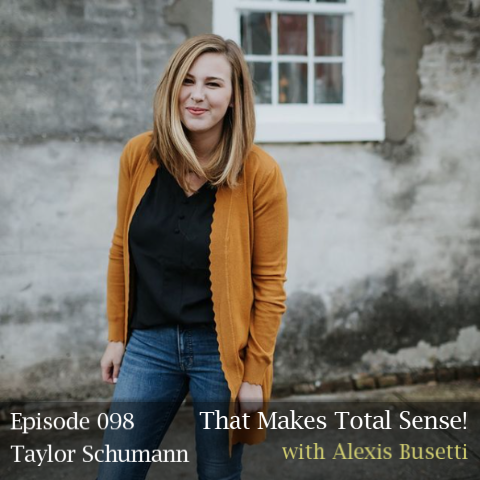
Speaker 0 00:00:07 Welcome to that makes total sense. A podcast dedicated to exploring God's generosity and justice. I'm Alexis resetting the Christian, aiming to ask good questions and encouraging you to do the same. Every one of us is wired by God to live out generosity and justice, but the how sometimes alludes us that makes total sense is a way for us to get together posture ourselves as learners and challenge one another to practice generosity and justice in a tangible way every day. All right, this morning, I am sharing a virtual cup of coffee with Taylor Schumann all the way in South Carolina. And we were talking about her book that is forthcoming. It comes out on help me tailor July 20th. Is that right? July 20th. It is, um, out by IBB prep, IB press, and it is called when thoughts and prayers aren't enough as shooting survivors journey into the realities of gun violence. How are you Taylor, and
Speaker 1 00:01:09 To, well, thank you so much for having me. Oh,
Speaker 0 00:01:12 I am so thrilled to have you on. I told you before we started recording that I've been following along on Twitter and the truth is I don't even know how I found your account on Twitter. I think Twitter can be that way, right? Like, I guess a lot of social media can be that way where you don't really know like kind of where these come from. And I wasn't even on Twitter until the pandemic kit. And then I realized a, I needed to see what Beth Moore was doing on Twitter
Speaker 1 00:01:38 Because, because
Speaker 0 00:01:40 She's the best, but she's the best on Twitter. Um, and I wanted to be able to keep up with kind of fast news, right? That was my excuse. Right. Things kind of changed fast and I wanted to see what was happening in my world. But anyway, I found your account. You're super fun to follow. So I'm going to link that in the notes because you guys are going to get a kick out of Taylor's account and Henry, um, he needs his own account on Twitter, but then I realized a little bit, it started coming together, as you would share kind of parts of your story, or, you know, do some social media advocacy work on Twitter. I was like, wow, like this, this is incredible. And I really, I was just kind of crossing my fingers. I'd get a chance to read your book and talk with you for the podcast. So thanks so much for coming on.
Speaker 1 00:02:28 Oh, of course. Yeah. That's, that's awesome. I'm so glad that you found me.
Speaker 0 00:02:32 Oh, me too. It's it's been great. Um, before we get into your story, because, um, so most of, most of you don't have this advanced copy in your hand just yet, but I'm going to, I'm going to tell you you'll really want to grab it when it comes out. Um, I just want to let you know, kind of how the book is broken up. It's broken up into a couple of parts. The first part of the book, Taylor shares her story. Um, and what, and what happened to her and how she, um, was impacted by gun violence. And then the second half, she really goes into this work of advocacy that she's grown into. Um, I hope that's fair that you've grown into over the last several years, but before I ask you to share your story, I kind of wanted to start with the dedication. Um, and in this copy that I have, you, you say that you really want people who have been impacted by gun violence to know that they're seen. Um, gosh, that's just so rich and so valuable. Can you talk about why, why start there? Cause I feel like that may center us kind of for reading your book and hearing your story and also for these conversations that follow.
Speaker 1 00:03:46 Yeah. I think that that word has always felt really poignant to me. Um, in my experience because there were just so many moments, um, you know, after my shooting where I felt alone, pretty isolated by that experience, even when I had, you know, a lot of really loving and supportive people around me, um, I just, I felt alone because no one else could have known what I went through. No one else was there. Um, and then as time goes by that feeling kind of grows because, you know, when you experience a trauma, you know, it's still in, you like other people can move on in their own ways, even if they were really affected by it, they can move on in their own ways. But I, you know, I couldn't like for me, that was it. And so the word scene, you know, I think someone said that to me once, you know, you're seeing, I see you and that just, it touched me so deeply that, you know, someone was seeing not just like looking at me, not just like looking for whatever they needed to see, but they could see me and what I was going through.
Speaker 1 00:04:59 And so I think that when I think about my fellow survivors who often maybe feel forgotten in the aftermath of a shooting, you know, after the news kind of moves on, um, I, I want people to know. I see, I see them and I see, you know, what they're dealing with, what they're going through. Um,
Speaker 0 00:05:20 Thank you so much. And, and really, you know, when I read your book, I was, um, and we talked about this a little before we started recording, but there are so many of us who, even, even if we just talk about collective trauma over, over the year of 2020, right. Who, um, yeah, when in, in the new cycle changes and then we go, wait, we're moving on from the trauma that I just experienced to a different trauma or two different group in it. And it feels rushed sometimes or something like that. But, but I think, you know, part of that, part of that for me, like what I heard as a reader, um, you know, was just like that, that God sees us, you know, like individually we are all seen in whatever it is that we're going through. And, you know, and as you were saying, when we feel like we just can't, we just can't move on or we feel isolated or lonely, you know, that God sees us. And I think it's important to that, that you communicate that you are someone who is seeing them, you know, that we may feel isolated, but that there are others, um, you know, who we have something in common with and who, and who see us and we can care for one another, you know, we can comfort. It always feels like a tongue twister. I like comfort each other with the comfort, with which we were comforted. Right. Yes. Yeah. Yeah.
Speaker 1 00:06:44 And, you know, it's so true because you know, how great of a comfort is it to know that God sees us and, you know, sees everything we go through. And at the same time, like we need other human beings to see us as well. And that's why God has placed us here, right? Like for community, for support. And, you know, he gives us, you know, the ability to, to be near to the brokenhearted as he is near to us when we are brokenhearted. And, and so I think that to kind of take that on as a responsibility of someone who is a Feis, a Christ follower is really important.
Speaker 0 00:07:20 Yeah. I agree. I agree. Um, so let's get into, um, gosh, it just, it feels so hard to even ask you, even though I've, I've read, you know, a hundred pages of your story, it feels, it feels hard to ask you to share it again. Um, so I just want to thank you first of all, for doing that, for being willing to share. Um, it's just, um, I think it's, it's, it's a kindness that feels undeserved on the other end. Um, and so I just, I'm really thankful for your willingness to share your story. And since you are, I'm just going to go for it. And I'm just going to ask you, I'm just going to ask you to share, but I will just say, you know, share, share whatever, whatever you want, parts that are in the book, parts that aren't as long or short as you want it as many details as you want. I just really want you to feel, you know, some freedom in this space to just share, share it in, in this moment. How, how, and, and how much you want to share.
Speaker 1 00:08:15 Yeah. So, um, in 2013 I was working, um, at a community college and, uh, one day at work, um, you know, I was hanging out at my desk, which was kind of in the lobby area of, of the entrance of the school. And I was just hanging out with my boss and another guy that was working there with us and, uh, you know, everything was normal. And my, um, my bridal shower was the next day. So, you know, I was chatting with all my friends were coming into town and it was just, you know, it was a great day. And, you know, all of a sudden I looked up, I was facing away from the door and I looked up and my boss kind of stood up and her face had just white and she started screaming and I turned around and there was a young man there standing about, you know, a couple of feet away from me with a shotgun pointed at my head.
Speaker 1 00:09:06 And it was one of those moments where I've since learned a lot about this. Um, you know, your brain is trying to rationalize what's happening in front of you because it just doesn't make any sense. And, you know, I remember thinking like, oh, you can't bring guns to school. I'm going to have to tell this guy that he has to go put his gun back in his car, you know, cause that was much easier to understand than, oh, this person is here to hurt us. And so I, I was able to duck underneath my desk and my boss took off and tried to run out from, from where the desk was and he followed her. And I knew that was kind of my chance to try to get away. And, and I couldn't go very far, but I was able to get into a supply closet.
Speaker 1 00:09:55 Um, that was, that was behind my desk. And as I slammed the door, um, he had seen me and so he fired a shot into the door and it went through my hand, my left hand and it was a fireproof door. So it was pretty thick in the bullet, kind of exploded into the door. And so pieces of shrapnel and wood had, had kind of flown out. And so I couldn't see at a one of my eyes because of some of that shrapnel and I, you know, I had never believed what you see in movies and TV. You know how sometimes people are, are shot and, you know, they say, oh, it was so shocking. I didn't feel it. I didn't know. But it was kind of like that. I didn't realize what had happened until I looked down and saw blood and I looked around and realized I'm not the only person here.
Speaker 1 00:10:48 This must be mine. And I looked down at my hand and sure enough, that was, that was me. And I could hear gunshots coming from the school, but I, I couldn't see anything. I didn't know it was happening. I couldn't lock the door. My key was back at my desk. I didn't have my phone. And I was just praying that someone had called the police and I, I didn't know what to do. I kind of sat down on the floor and put my back up against the door, hoping to, to block it if he tried to come back and come inside. And I, I realized in that moment, you know, oh, this has happened to me. I'm, uh, I'm someone who's experienced a shooting I've been shot. This will never have not happened to me. You know, just like that. And I was just terrified.
Speaker 1 00:11:39 I thought I was losing a lot of blood and I, I really thought I was going to die before anyone could get there to help me. And I was, it was so like physically painful thinking about that almost more painful than the bullet wound itself was just waiting to die. And I was thinking about, you know, I was engaged at the time, my fiance, my family, and not getting to do all these things that I'd imagine and not getting to see my loved ones again. And finally, I just prayed to the Lord, like, okay, if this is my time to go, if you, if I'm going to die here, if you're going to take me, just please take me quickly, please just take me now. It's just too painful to sit here and wait, please don't make me wait. And just so clearly I, you know, heard the voice of God, speak to me like, no, this is not your time.
Speaker 1 00:12:38 There's more for you than, than this day. There's more for you to do. And it kind of sent a jolt through me, like, okay, well, if I'm going to be in here, I need to figure out what to do. And I, at that moment kind of raised my hand above my head because I had no idea what to do for a bullet wound, but I knew I needed to try to stop the bleeding if I could. And so I raised my hand above my head and, um, that was the, the moment that he, the shooter had come back and fired another shot through the door. And it came through, um, about where my arm had been up against the door. So I moved away from the door and I thought about trying to like push a copy machine in front of it, but I didn't want to make too much noise.
Speaker 1 00:13:20 And I couldn't really push the coffee machine very far. So I didn't do that, but I kind of just stood there and, and waited and, um, uh, you know, a minute or so later I heard some, someone yelling it's okay, it's safe. Is anyone here is anyone hurt? And I have been thinking through all the things I knew about shootings and because when you grow up like hearing about shootings and, um, you know, I, I went to Virginia tech for college. And so I knew a lot about the shooting that took place there. And I kind of had these nuggets of information in my mind, you know, like, no who's at the door, don't open the door because shooters pretend they're hurt or, you know, all these kind of little things. And so I didn't want to open the door at first and where the bull had come through, there was a pretty big hole in the door.
Speaker 1 00:14:10 So I was able to kind of peek peek through. And I saw this man sitting there with another student and, um, I, I knew it was safe. And so I kind of opened the door and stuck my, my wounded hand out so they could see, you know, I was hurt and I wasn't dangerous. I needed help. And he came over and helped to carry me out. And the police had gotten there and the ambulance soon after, and they took me to the hospital and somehow the news had started getting around. And my husband, um, my fiance at the time was able to get to the hospital pretty fast. And he found me in the emergency room. And when they, when they brought me in, it was a pretty small community hospital. And I looked around the room and there were dozens of doctors and nurses there.
Speaker 1 00:15:02 And I were thinking like, how many people are coming? Like, this is crazy. Like, and I said to the nurse, oh my goodness, how many people are here? Like how many people are here? And she said, it's just you. And it was so overwhelming to me that all those people were there to take care of me. And one other student had been wounded, but they airlifted her to a different hospital that I would go to later. And yeah. And so people kind of started coming to the hospital and by the time they transported me, I think I had a dozen family members and friends they're just ready to support me. And, um, I had one surgery that day. Um, I've had four in total. I had about a year of occupational therapy to get some of my thesis of my hand back, a lot of counseling, a lot of, um, treatment as far as that, that stuff goes.
Speaker 1 00:15:59 And, um, yeah, I I've regained about 20% use of my hand, which is more than we thought I would. And, um, I'm very thankful for every bit of that 20% though. It doesn't sound like a whole lot. And yeah. So since then, I, I've kind of been living in this life as a shooting survivor, as someone who, who survived and figuring out what, what that means, what that looks like, what, what God has called me to do and how to support other people who, who have been through shootings or just other really terrible events that they didn't plan for or ask for or want. And you know, how, how do we walk that, walk in that together and support one another. Um, and then, you know, kind of found myself in this, um, activism role, just really, um, trying to bring awareness to this problem and, and ask questions about what we can do to, to reduce it.
Speaker 0 00:17:05 Thanks, Taylor. Yeah. Um, I think that kind of the phrase that it just keeps replaying in my mind that you just said was this, this would never, it wouldn't now I'm going to mess it up. Um, this, this is, this will never not have happened to me. Right? Like this is, this is it now, you know, you, you can't go back and just, as you talked about, like, um, and we'll get into this more, I think it was, we have the conversation, but, um, like it's pretty clear, like in your upbringing, you weren't like, yes, I'm going to be a gun reform activist when I grow up. Like, those are my hopes and dreams, you know, but it's very beautiful at the same time to see, you know, to see the Lord bringing beauty from ashes. And from, from you saying, there are other people too who wa this will never have not happened to them, whatever it is.
Speaker 0 00:18:07 And it wasn't of their choosing either you were at work planning, bridal shower, you know, um, this wasn't something that you chose this wasn't and, and that, and, and that's not to negate the trauma that sometimes our own choices bring on us because those are difficult to heal from as well. Um, but there is kind of a category of trauma, right? That you're, that, that, that fits your circumstance where it's the trauma that we didn't have anything to do with this. This took us by surprise. And this wasn't a choice that we made and now the choice is to recover. And then what does that look like? You know, moving forward. And, and, and I do want to say though, that I think with God's grace, it is a choice. You know, I remember growing up, I was in high school and someone very close to me, um, had something happened.
Speaker 0 00:19:07 Um, and it, and it kind of led to this trauma and it, and, and afterwards she said she was bothered because people would say, well, you didn't really have a choice. You had to, you know, like in her recovery. And she said, oh, no, plenty of people choose not to. Right. Or plenty of people, maybe don't make the intentional choice to move forward in, in such a way that, that promotes health and well-being and recovery, and in your case advocacy as well. And so, um, and so that's, again, not to, not, to, not to kind of, you know, discount someone who, who is not there yet. Um, but that is to say this moving forward in this way. Um, I just of want to recognize that it is a choice, you know, to make toward healing. You know, sometimes I'm reminded I don't, I don't, I don't have it and exit Jesus on it, but I often think of the man who'd been sitting for 38 years.
Speaker 0 00:20:05 Right. And Jesus says, do you want to be, well, you know, like he says, well, I've been, I've been sitting here by this pool and he's like, the question I didn't ask you, have you been sitting by the glass? You do you want to be well, you know, um, but Jesus is right there to pick up his hand. Um, yes. In that moment. Right. And so, um, and so I don't, I don't have a, I don't have like a, like a conclusion for that or an ending for that. I just kind of want to recognize that I think that it's, um, there's a, there's something that I just kind of want to name that it's like, yeah, but you're choosing yeah. It's road to recovery
Speaker 1 00:20:42 Airlines. I saw a post the other day. I heard this phrase, so I'm not sure the original, um, creator of this phrase, but Jen Hatmaker, reshared it on a post recently that, you know, what happened to you? Your trauma's not your fault, but your healing is your responsibility. And I think that kind of sums it up quite well. You know, whether you've experienced abuse or gun violence, or, um, a natural disaster, like wherever your trauma comes from, like you did not choose that it was not your, um, your bad toy, your quote, unquote, bad choices. You know, you didn't bring that upon yourself, but it is your responsibility. And hopefully you have support from people around you or helping you, but eventually, like that is on you to decide like, okay, do I want to walk forward in my life? And what does that look like?
Speaker 1 00:21:38 And what choices do I have to make? What do I have to do to get there? And, um, you know, I think that I, uh, I had seasons of time where I really railed against that because that's not fair, you know, like I don't want to come on. I don't want to go to counseling. I don't want to have to do the hard work. I don't want to have to like, put myself through pain to find, you know, to get to a place of healing. And, you know, whether that's like the physical pain, cause there's a lot of that or the emotional pain. Like, I don't want anything to do with this, but I have to, no one else is doing this for me. And I think it hit me once when I was in occupational therapy one day and there had been a, uh, young woman in my community who had been injured in a drive by shooting.
Speaker 1 00:22:28 And she had come in for therapy one day that I was in there. And so we kind of chatted a little bit and she was, she was really young and she had come in by herself and I asked my OT, the next time I was in there. Oh, you know, has she been back? You know, I haven't seen her and you know, they can't tell you much. Of course. Um, but she had said, you know, she she's, hasn't come back and that's always stuck with me because, um, I had people around me to like, help me make the choice and encourage me to make the choice. And that's like a privilege that many people do not have. And I think that's just another way, like we were saying before, where like we're in community for a reason. And, um, you know, it is our responsibility is our choice, but like, hopefully we have people around us to help make that choice less of a burden to carry it with us. And, and largely, that's kind of the hope I have for, for this book and sharing my story is that, you know, even if it's just reading my words on a page, but that, that might be a comfort to someone who, who has to make that choice and doesn't want to, because you know what, it's not fair and it shouldn't be that way, but it is way. And so what can we do to, to support each other?
Speaker 0 00:23:50 Yeah. I mean, you're, you're absolutely right. I mean, the community makes all the difference and, um, and I think kind of, for other reasons in my own life, I'm like realizing more and more, even my husband and I were having a discussion this weekend, like what is church? You know? And I, and of course I'm like, I just finished my first year of seminary, you know? And so I'm like, I'm like still fully in the space of, oh, wow. I didn't realize how dumb I am when it comes to this kind of stuff. Like, you know, like you don't know what you don't know. Right. And so I'm like, okay, I'm firmly in the place where I realized, I don't know anything now. So thank you. You know, but so I'm trying to be succinct, you know? And I say, I think if I had to sum it up in a word, like, what's it supposed to be?
Speaker 0 00:24:28 Even when you, you know, kind of quote, go to church, I'm like, dude, it's community. Yeah. That's it, man. That is all of the things that we do when we go there. And I said, I think some people would argue with me and say, no, it's worship. You know, if I had to say one word or whatever, I'm like, dude, but it's worship in community. We're singing hymns to encourage one another in the Lord, in addition to praising him, right. This is, this is community. And we need to be there for one another. Um, because when you're having a season that you're feeling like I can't do this, hopefully someone near to you is having a season where they feel like they can and then it will flip-flop yes. Well to lift them up in, in their season when they're feeling like they just can't, um, when they just can't.
Speaker 0 00:25:15 And one of the things I do appreciate about your book and I loved it so much when I was reading is you, I don't feel like you sugarcoated much of those seasons. Um, you were, you, it, it felt like a very honest telling, um, of you going through those seasons and part of that, and, and I kind of want to kind of move this direction as we, as we move forward in our conversation. But part of that was you kind of realizing, in addition to your own healing, like your physical healing and your emotional healing and those, and those things that took time realizing that your perspective was starting to shift when it came to this kind of, what's been a, I don't want to say it's a hot button issue now. It's, it's been a hot button issue for as long as I can remember of gun control, gun violence, um, reforming all of that gun laws, that kind of thing.
Speaker 0 00:26:14 Um, I realized when I was reading I'm about a decade older than you ish. Um, I was a senior in high school when Columbine happened. Okay. Yeah. And so, um, so I, I graduated high school in 99, so I was going out that spring, um, as that happened. So I only had one drill, you know, when, when I, when I'm realizing, oh my goodness, these kids who are, who are growing up now or who grew up, you know, when you did just a few short years behind me that this has been a part of your school life, um, have been these drills, you know, I grew up in Southern Oklahoma, so I was a tornado drill. That's what we did. And I thought really being in the hallway with our hands over our necks is going to save us from a Mr. Okay. Yeah. You know, that's, that's a whole other story, but, um, but you know, just, just kind of your, when your perspective, you know, having grown up in this and some of the culture that you were also, um, that you also were raised in, and then kind of realizing how this had impacted your life and wow.
Speaker 0 00:27:16 If it had impacted your life, it had impacted all of these other people's lives. So can you start to talk about that perspective shift and, and how that happened kind of at least in parallel or conjunction with, um, your healing process? Yeah. Um,
Speaker 1 00:27:33 If there was like a specific moment for me, because I think that, um, if you don't know me, like if you didn't know me as I was going through this, it's easy to think, oh, I was like very pro gun and then I got shot and then I was anti-gun, but there was actually like a period of time between being shot and kind of figuring out how I felt about guns and, um, where I was like wrestling with a lot of these ideas. And there was a moment where, um, soon after I had been shot a local, um, police department was doing trainings for some high school teachers, um, or school teachers for like active shooters and, um, you know, how to take care of gunshot wounds and all, you know, all those kinds of things. And I remember seeing people, they were upset about it, you know, oh, how, why are we teaching teachers to do this?
Speaker 1 00:28:34 This is terrible. This is terrible. And I was reading it and I was like, this sounds great. Like, people need to know because I was still really hurting and really, um, just really aching. And I was feeling like other people didn't get it. You know, this can happen to anyone. And like, we should be prepared and we should be teaching people how to deal with it. I couldn't see from where I was sitting, why those things are traumatic in, and of themselves, for the people who are dealing with them. I couldn't see that. And I couldn't see the real root of, of the issue then, um, which was like, why are we having to think about this at all? What led us here? Why is this even a thing? Like this is a symptom of a larger problem. Um, but all I could see was like, well, we better prepare teachers and students to get shot at school.
Speaker 1 00:29:32 And it was out of a place of like, I really did care. It was at a place of caring because I had felt so unprepared. I had felt so scared and alone. And so I was thinking, I don't want the people to feel that way. Um, and not people shouldn't have to be in a position to make this choice. And so once I started really learning about what these active shooter drills have become, because when I was in school, they were still very mild. It was still very okay. If a bad guy comes into the school, we're going to go here and we're going to stay quiet. We're going to drop the lights. Now in a lot of places, these drills have become, okay. People are going to come into the school and pretend to be a shooter, and they're going to fire blinks in the hallway.
Speaker 1 00:30:20 And in one school, you know, they even shot teachers with, um, you know, paintball guns or airsoft guns. Um, you know, or we're not even going to tell the school that it's a drill, we're just going to let the teachers and students think it's real. And, you know, there are kids that are afraid to go to school, kids that are, um, like using the bathroom in a classroom, like peeing their pants, because they're too afraid to go to the bathroom during class because they don't want to be left alone if something bad happens. And that's what, and, and I mean, the teachers as well, like we've put all this weight on the teacher's shoulders of like, you need to know how to protect your students from a gun. And they're thinking, I just want to teach them math. Like what, what has gone so horribly wrong that we're putting the way of this on teachers and elementary school kids.
Speaker 1 00:31:15 And, you know, and, and that kind of led me into, into kind of taking a hard look at that. And, and, um, you know, there were a lot of ways that, that I, I felt that evolution as well. You know, I think the Lord really renewed my faith and, and taught me so much about, um, about suffering and, and, um, feeling marginalized, um, you know, for, I, I was able to relate more to some of these communities that I wasn't a part of, or couldn't be a part of and, and see, um, God's heart for, for justice and, and the hurting. And, um, and he was just really able to kind of reveal and bring clarity to me. And once that happened, what I had believed about guns for so long, it just didn't fit anymore. It couldn't fit, um, with what I knew and believed about God and had, and experienced of God, this idea of cleaning so tightly to this, right. Um, as an American, just no longer felt congruent with what my responsibility was as a follower of Christ. And, and that's really what, what led me and it wasn't the getting shot part. It was how God used that in my life. Um, more so. And, um, yeah. So
Speaker 0 00:32:52 Where did you, where did you start? Um, because the, the book, um, in a way I feel like, um, in a way I feel like it reads like a thesis, um, you know, it reads, um, it's, it's not like, you know, my husband's doctoral dissertation, which I will never pick up, um, every time it's easier than that. Um, but I say that because I say, this is obviously not, you know, you, you, you, you talk about in the book, how I'm picturing this scene of you, like on your bedroom floor with all of these index cards and books and things, and you're saying, you know, what do I share, right. And how do I share it? How do I piece these things together? But it's very clear that even though the book is well-researched, so thank you for that. Even though the, even though the book is well researched, it's very clear that you didn't begin doing the research and, and gathering information when you got the contract. So where did the, where did the kind of, I don't know, kind of fishing that stuff out on your own, where did that start for me? Like, what was, I don't know, what was the first thing you looked at or, or kind of, what did that journey of finding out more information, if that's even what it looked like? I mean, where did, where did that start from you after you had that moment about the school training?
Speaker 1 00:34:16 Yeah, I, you know, I could kind of feel all this, like welling up in me and bubbling up and, you know, when I would see conversations taking place, I would just feel this like, oh, I've got to say something. I have to, you know, talk about this with people. Um, but I, I felt very, um, deeply that I wanted to do that from a place of being informed. Um, having understanding about a lot of the things that I didn't know, I just kinda knew what I had experienced and what I was, um, feeling and witnessing, but I wanted to really know what I was talking about before I kind of launched myself into that new place, especially because of, of my background. And it was such a stark switch that I just, I really just wanted to feel that feel grounded in some information. And, and so I just kind of started reading whatever I could find.
Speaker 1 00:35:17 Um, I started following some advocacy groups and they would share studies and statistics, and I immersed myself in that information. And I would, I found so many great articles. Um, and, and I joined a couple of survivor groups of mass shootings and listen to stories and, and things just kind of started to take hold and, and come together. And I was able to develop a clearer picture of what gun violence really looks like in America and the causes and the types of people who commit mass violence and, and, um, establish a framework for how these things happen and what allows them to happen, kind of what we keep letting happen, um, and how all that stuff works together, because it can feel very overwhelming. There's a lot of structural things and it's different in each state. And, you know, we have things at the federal level and at the state level, and there's just, there's so much.
Speaker 1 00:36:28 And so I just wanted to have some sort of foundation. So yeah, I just kind of started reading anything I could bind, um, read some books. Um, and, and yeah, and then once I felt like, okay, I think I have a little bit under my belt. I think I can start having some conversations. Then I started kind of diving into these conversations and some of them went terrible, terrible. Um, I've had some really bad ones. It was not like I learned everything. And then I was able to have really great conversations and change everyone's minds. It was so not like that, but it was, it was practice. And it, and I, it made me feel, I felt passionate and it made me feel good to have conversations about things I was passionate about, even if it went really poorly. Um, even if my feelings were hurt or I felt like I, I couldn't remember anything. I had learned all those things and it just felt important to me. It felt right. And, um, it felt like I was doing something that, that God was leading me into. And I just prayed then. And I pray now all the time that he will just equip me with what I need to know and the way, um, and, and portray the information in a way that is honoring to him and that's effective.
Speaker 0 00:37:55 Yeah. So one, one of the things that just kinda kept turning around in my head as you were, as you were talking, and even when you were, when you were talking about the training for the schools, is that I think so much, and I, of course not everything is just like a two-sided argument. Right. But I feel like in the last year and a half, probably a lot of the kind of rhetoric I hear on at least two sides of things, almost no matter what the issue is, is it's either this it's a systemic problem or it's a sin problem, you know, like it's this American individualism, it's a sin problem. The problem isn't the gun laws, it's the guy who went in to shoot, you know, um, it, the problem, isn't the, the system in America, it's the guy who chooses at that moment to exercise his racism, you know?
Speaker 0 00:38:42 Um, it's, it's all of these things, right. And I think with a lot of things, it's like, well, the answer is both, right. I mean, we wouldn't have, you know, these systemic issues. We didn't have sinful people and these people wouldn't be able to get away with it if we didn't have systems that promoted it to some degree, you know, and, and, and encouraged it. Um, Mark Charles says, uh, has a quote it's, it's, it's kind of edgy, but when he talks about the constitution and our country being founded by white landowning men, you know, and he says something like, well, why are you surprised that women earn 70 cents on the dollar to men that the constitution is working right. That that's the way it was, it was set up. So why are we shocked by this? We shouldn't be shocked by this. Right. And we're like, why are our kids having to do mass shooter drills?
Speaker 0 00:39:26 Well, because that's the way the system is set up, it's set up so that anybody can carry a gun anywhere, you know? And, and you kind of have these systemic issues along with these. Yes. These are individually people who are, who are choosing to sin, but you kind of have both. And I think that a lot of times with the gun debate as a law, I think a lot of things we hear it's the focus is on the individualism. The focus is on the individual evil or the individual sin. But some of the things that your book helped me gain a perspective on was what are the systemic issues with this problem, right? Like you said, in that moment that you, that you spoke about earlier, why are our kids having to do this in the first place, right? Yes. It's traumatizing, but what in the world brought us here? Um, so I want to ask you, like, I have a few notes on things that stood out to me, but as I was reading, I became really curious, like, was there one or two things, like when you were doing your research, what surprised you, or what stood out to you or what was the thing that you kind of thought this is a shocker, or if everybody could see this, you know, it might be a game changer. What, was there something like that for you when you were doing the research?
Speaker 1 00:40:46 Yeah, I think there were a few things. Um, you know, I really dove into the history of the NRA, um, national rifle organization. And, um, yeah, I, I knew a bit about it and how it was formed. And, um, but it's so fascinating to look back at the history of realized, like the NRA was started as a gun safety organization, essentially, um, teaching, um, it was, you know, after men had come back from, from the war and had been really, uh, the, you know, soldiers, they were fighting from other countries were so much better with, with guns than American soldiers were. And so the NRA, you know, was doing, um, classes, marksman classes and, and teaching Americans how to better American men, uh, how to better use their weapon and, uh, how to do it safely. And the NRA was behind a lot of gun safety measures, lobbying for gun safety laws.
Speaker 1 00:41:52 They really respected guns and how they should use. And that's not to say, like, I don't mean to paint like a glowing portrait of that RA because there's a lot of really bad stuff in its history as well. Um, eh, you know, it's clearly a very racist organization and those kinds of things, but to see kind of the evolution of what it was and what it has become, because I think there are a lot of people in the NRA, um, now, because they always have been and their dad was, and their grandfather was, and it, um, it's a tradition, it's a family thing. And what I say to people now is this organization is not the same as your grandfather's organization. It's not doing the same things. It's not about gun safety. It's not about learning about guns, it's it, that's not what it's about anymore.
Speaker 1 00:42:42 Um, and seeing kind of the types of legislation that the NRA used to be behind, what they do now, how they use their money was really eyeopening. The main other thing was, uh, learning more about the history of some of these organizations that run, um, school safety, like lockdown programs. Uh, there's, there's some questionable history there. Um, especially with one of the organizations, two of the founders were like former policemen who were, uh, either forced to resigned or resigned after a questionable police shooting things. Um, so yeah, you know, that was, that was really interesting. I didn't know any of that. And, uh, and then probably the last one that sticks out in my mind is really learning, uh, about, you know, we have, there's a few communities in America, you know, people always reference, we talk about how bad gun violence is, you know, um, Chicago, Philadelphia, you know, how bad the gun laws are there, or how bad the gun violence is there.
Speaker 1 00:43:50 And really learning about basically like how white people, uh, you know, essentially used things like red lining and zoning to put low income people in these communities where they thought there was a lot of violence and they didn't want to live near the violence. And they thought, well, we can just call these people together and they can live together and just be violent towards one another. Uh, and then we, we act so confused by why these communities see so much violence. And then, uh, you know, so we use those communities as arguments for gun laws, don't work. Um, and, and so learning about that, it, it just so clicked with me. Wow. Like we created this problem and then use this problem as a reason not to fix the problem and, you know, just learning stuff like that. It, it, uh, it made me more passionate about talking about, about those things and cause, you know, that's not really stuff you're just going to come, come across, like the kind of information it takes a while and not everyone has the time to do that. And so if I can kind of find some of that information and condense it down into smaller chunks that can prompt people to, to learn a little bit more than, you know, I'm glad I, I can do that for people. But yeah, those, those things were really, um, really shocking. So, well,
Speaker 0 00:45:19 You definitely did that for me. I mean, I tweeted at you yesterday because I was like, okay, she got my, you know, she got my attention. And so I, I know that we're like, we're gonna, we're gonna land this plane here in a minute. And I was like, okay, I've got two left. I'm going to leave one as a teaser and maybe see if I can get you to talk about one. So the teaser I want to leave people with is Taylor has a whole chapter on myths and it's amazing. So I love, I think there's like 14 myths that you go through and debunk when it comes to gun violence, reform laws, um, control, you know, all of those kinds of things. And that was, that was, that was a great, a great chapter read for me. Um, that's not, that's not where I tweeted you though.
Speaker 0 00:46:03 I tweeted you about the police reform, um, because I would say, and, and we all come at information from our own lens. Right. And so I, um, kind of understood when, when the call to police reform started becoming more strong in the wake of a lot of the shootings and, and, and violence. Um, in 2020, I was looking at this, um, partially through the lens of someone who used to do some social work. So back back in my pre kid life, um, you know, that's, that's what I did. I did case work for the state. And I was thinking, you know, there, there were, of course all of the names and the people in the violence. Um, in 2020 that we heard about in the ones that we did in are all devastating. I think the one that clicked with me the most was, um, Ray shard Brooks, and he was outside of the Wendy's.
Speaker 0 00:46:57 Right. And, and, and I was like, this is what, this is what an, you know, me, I'm trying to solve all the world's problems, but I'm like, this is what this guy needed. This guy needed someone to walk him home. That's it, that's all he needed. He needed a social worker to come to walk him home, to knock on the door. I think it was his sister's home was the closest to knock on the door and say, hi, can I just get you to like, give me your word or sign this little sheet of paper saying, you promise, promise. You'll let him sleep this off here. And you won't give him the keys until the morning. That's it. Right. That's all he needed. Um, you know, kind of in this perfect utopian, you know, police world. So when the cause for reform came, I kind of looked at it more from the perspective of a casework right.
Speaker 0 00:47:42 Of social work saying it really, you know, a lot of what police get called for obviously we've, we've heard those arguments, right? They don't need force for sure. They don't need a police, an officer of the law. They often need maybe medical attention, mental health professionals, a social worker, someone who can just come out, assess the situation, get the person what they actually need since they're not committing a crime and then just get them home, you know? And that was where it came from me. When I read your section was when it really hit me. Oh, why are we having these problems in the first place? You know, kind of like your, your moment with the kids in school, right? Well, the, the police reform and the gun reform, they're all intertwined. It's this systemic stuff that is easy for us to see in some areas, but not as easy in other areas. And that's where it hit me. So even though I've gone on and given a blurb about that from my perspective, can, can you talk about that for just a minute?
Speaker 1 00:48:38 Yeah. I, um, I think that it's, it, it started clicking for me when, um, I guess particularly after, um, George Floyd was, was killed people, you know, really started sounding the defund, the police, the abolish, the police drums. And I try to kind of explain those in detail a little bit in the book because they are different things. And I think that the words can, you know, there are so many more people who are much more wise about this than I am, but I think that sometimes the words can confuse people and, um, trim people off a little to exploring these, these topics. Um, and so people were saying, you know, we don't need the police, um, all these things. And so I, I, I think I sent out a tweet one day and I just said, Hey, like before all the calls for defunding the police, like we have to understand how guns and gun culture affect policing and police killings, because they're very intertwined.
Speaker 1 00:49:42 And I think that, you know, largely my experience is that people who are very pro-police and who are unwilling to examine the role of police and the type of violence we've seen are very pro gun. And once you start really examining it, you can see, oh, the amount of guns we have in America really play a role in how the police are trained and how they, um, use that training in the field with, with citizens. You know, if, if every person you might encounter as a police officer is a potential gun owner, which is likely based on how many guns we have in America, then there's, there's an automatic need to be on guard to be defensive, to, uh, assume you're going to have to use your weapon. Um, and so of course, like we see more police violence because that's the world we live in.
Speaker 1 00:50:38 Like anyone can have a gun, any, you know, many types of guns, a lot of ammo, like, um, that's kind of the society we have. So until we deal with the gun violence issue, um, it's going to be really hard to deal with, um, the concept of defunding the police or abolishing the police wherever you kind of fall. Um, in those, those camps. Um, I support the idea of, of defunding the police, diverting funds into other, um, places like you were talking, mental health support and, um, you know, medical, you know, medical needs, um, housing needs, you know, all, all these kinds of things that all collectively raise crime rates and, and ultimately lead to more police violence. Um, I support that idea, but if we're going to have, um, if we're going to do that, we also have to deal with the amount of guns, the gun violence we're seeing who can have guns.
Speaker 1 00:51:40 These, these issues really, um, are intertwined in a way that I don't think is widely understood in a way that we can't untangle. So I think we're going to have to kind of look at both at the same time. So my call was really, Hey, if you're pro defunding the police, you need to get on board with, with gun safety and gun reform. And if you are, um, you know, calling for gun safety, you should also look at how that's affecting, um, our police force and then what that looks like in the community as well.
Speaker 0 00:52:11 Absolutely. Yeah. And that's, that's where it hit me is kind of your, you know, that call to action at the end of that section, you know, it was me going, I don't really have to be convinced about the police reform. You know, I'm kind of on board with that, but man, if I'm not also paying attention to how our gun laws are affecting the police, then I'm, I'm only seeing a part of the picture and that's not helpful.
Speaker 1 00:52:32 Right. And, and I think, cause a lot of what, what you'll see in these conversations is people talking about what police looked like in other countries, you know, there's, there's a handful of countries and right. Try outline these in the book where the police don't even carry guns. Very few police do. And they're used in like incredibly emergent C type of situations. Well, there's a reason that can work in other countries. And there's a reason that can't work here right now anyway, um, guns aren't widely as, as available in other countries that have those policies, there are very few guns there. So of course that, that looks different for what police can do, uh, without guns. And, and here we just, that that's a lovely thought. I would love to one day, see, uh, you know, police force a peacekeeping force in America that doesn't carry guns where guns aren't used as much, but we, we assume that we can just kind of plop that type of policing into America and it will work the same as it does in other countries. They don't have the gun problem we do. So we have to examine both of these,
Speaker 0 00:53:38 Right? Yeah. The systems are different. Like we were talking about earlier, the systems are different. Um, Taylor, as we start to wrap up, um, I just feel like I could, I could listen to you talk about this for a long time. Um, but what is like, what's what you would leave us with or what is, what is the, if there was a question burning you're like, oh, I hope she asks me this. Like what what's left burning in you, um, that you'd want to leave. Um, the listeners of this episode with,
Speaker 1 00:54:07 Uh, I think, um, doing so much work on this book during the COVID pandemic, um, really was very formative for how I have continued to kind of think through this, especially as I'm doing more interviews and talking about it and, um, really just, what's always on my mind and my heart and burdening me is thinking through our ideas of individualism versus community versus the collective good. We've seen this in so many ways with COVID, you know, um, masks, staying home, doing things that are frustrating for us personally, that we don't want to do and might feel that we, um, have a right, not to do them, but are ultimately good for others and, and saying, okay, I can sacrifice a little of my personal comfort if that means keeping someone else safe. Or if that means that my immunocompromised friend is safer, I can do those things.
Speaker 1 00:55:14 And, and so that's, that's been heavily on my mind as we're having these conversations around gun reform too, is, is saying, yes, I know that some people really enjoy owning guns and they really enjoy the hobby. It's connected to family. It's connected to tradition. Um, they liked doing target practice. They like, you know, whatever it is for them. Um, maybe they just like collecting guns or, um, accessories, you know, those types of things. Um, and it can be hard to think, but I, I should get to do this. I should get to keep this because I like it and I enjoy it. Um, but how can we, how can we think through, yeah, you could, you can do those things. It's your right to do those things, but would you sacrifice a little bit of that? If it meant keeping someone else safe and if not, why?
Speaker 1 00:56:13 I think that's a tough question. And I think we need to be more willing to ask it of one another. Like, why aren't we more willing to sacrifice our personal for the sake of others, especially if we are followers of Jesus who continually asks us to lay down our lives for a friend to, um, consider the needs of others greater than our own. Um, you know, in first Corinthians, Paul says, I think it's first Corinthians. Paul talks about you know, just because, um, we have a right to do something doesn't mean it brings true freedom, you know, who's yeah. We can exercise this right to own a gun and as many guns as we want in a lot of areas of the country, but does that exercise in that right. Bring true freedom to us and to those around us. Um, you know, I don't pretend to have all the answers about this and, and I certainly couldn't give them to everyone, but I think that if we can, can get into a posture of listening and caring for those around us, then having the exact answers won't matter so much.
Speaker 1 00:57:28 If we can filter our beliefs about guns and other things through a lens of who does this benefit just me, or does this benefit everyone? Um, is this good for everyone or is it just good for me? I think if we can have that framework and look at things through that, I think it will be easier to, to change our minds on some things. I think it'll be easier to, to ask more questions. Um, and yeah, I think that's the kind of thing that's just like burning in my, in my soul lately is, um, once we can do that, it seems so much more simple to me anyway. Um, and they were just making it too complicated.
Speaker 0 00:58:19 That's good. Thank you so much. Um, again, this is Taylor Schumann on her new book. Be out July 20th from Ivy press when thoughts and prayers aren't enough as shooting survivors journey into the realities of gun violence. Thanks so much for coming on. Thank you so much for having me the links for all the resources mentioned in today's episode can be found in the show notes, music and podcast production by Seth B SETI. Be sure to give us a review on iTunes and subscribe at your favorite podcast listening app, you can also visit us at that. Makes total sense.com.