Episode Transcript
[00:00:07] Speaker A: Welcome to that Makes Total Sense, a podcast dedicated to exploring God's generosity and justice. I'm Alexis Busetti, a Christian aiming to ask good questions and encouraging you to do the same.
Every one of us is wired by God to live out generosity and justice. But that the how sometimes Elusa that Makes Total Sense is a way for us to get together, posture ourselves as learners, and challenge one another to practice generosity and justice in a tangible way every day.
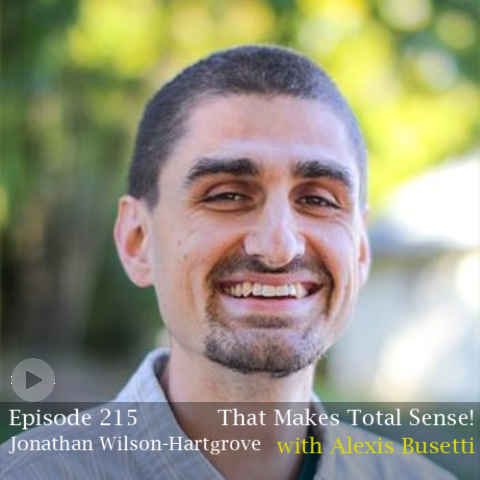
Everyone, I'm here with Jonathan Wilson Hartgrove, and he's been so gracious to join me to talk about a book that he wrote years ago, but it continues to have not just value in its original contents, but it speaks to us in our current context. In 2023, Jonathan, you named a lot of things in this book, revolution of Values, that a lot of us maybe saw bits and pieces of. Maybe we couldn't quite see the full picture. Maybe we had blinders on and could not see with real clarity some of the things that were going on in our faith community and in our country.
But you've named a lot of these things in this book and really encouraged us to see them for what they are, and then I think, given us some real tools for how can we move forward once we've seen it, we can't unsee it. So how can we move forward in some of our communities?
Say the full title of this book, revolution of Values reclaiming Public Faith for the Common Good. So welcome, Jonathan.
[00:02:01] Speaker B: Thank you. It's great to be with you.
[00:02:04] Speaker A: So I want to say one of your titles right now because I think it will help frame us in our conversation today, and you are the help me correct me if I get this wrong. You're the Assistant Director for Partnerships and Fellowships at the center for Public Theology and Public Policy at Yale Divinity School. Did I get that right?
[00:02:26] Speaker B: That's a mouthful. Almost. I'm an assistant director. Okay.
[00:02:30] Speaker A: There we go.
[00:02:30] Speaker B: There are others. There we go. Yes, I'm one of them.
[00:02:34] Speaker A: Nice. But what I wanted to focus on is the well, I mean, all of it, really. It's so great. But partnerships, of course, but public theology and public policy. Yeah, of course. As a part of a divinity school, and I don't know, maybe we should just I don't even know where to start, except maybe I'll just stick with the plan. At our house, we say, stick with the plan. Pajamas, stick with the plan and go back to what you and I said, because I rarely do this, but when you introed this book, I have stars, and it's lit up, and I think I even wrote some. Let me see what my annotation was. It was something probably pretty profound, as it usually is. There are a lot of wows in your book. Oh, I put great opener. And then I put to myself, think about this statement, right? So I'm going to read this statement so that we can think about it.
[00:03:34] Speaker B: All right? Let's think about it together as we continue.
[00:03:37] Speaker A: Since the late 1970s in America, political operatives have invested money and energy in framing the cultural concerns of conservative white Christians as the moral issues in our public life.
And I want to repeat the last part of that sentence because that's what got me the cultural concerns of conservative white Christians as the and it's in italics in the book as the moral issues in our public life. Hello.
[00:04:12] Speaker B: When I was a kid, I loved magic. I learned how to do all these magic tricks, and then I would go around the places my parents drugged me, along with other adults, and try them out on them. But one of the things I remember about magic is that for a lot of tricks, the key to it is the distraction, right? You pull off what looks like magic by sort of tricking the person's eyes and their mind into paying attention to something else. And in some ways, this is the story that I'm telling here in this book, that there were people who had a vested interest in keeping a block of white voters together. And prior to the civil rights movement, they had mostly used explicitly racist appeals to do that, particularly in the south. I mean, a lot of people don't remember, but 100 years ago in the south, there was a political party that said it was the party of white supremacy. I've seen a little political button from the county I live in here in North Carolina that know the party of white supremacy. This is like how people advertise themselves. So that had been mainstream and that had been the understanding for a long time. The civil rights movement and the way that it shifted public opinion in the country made that socially unacceptable. But there were people in both local and national politics who had a real interest in keeping that voting bloc together.
And so they had to find a way to appeal to people without appealing to their race.
And the short version of the story is that those people decided that they would use religion and what we call the culture wars now is a way of describing the issues that they decided to get people to argue about, right? Because it was a way of sort of tapping into the cultural anxieties and concerns of this white voting bloc.
But what happens, like in the Magic Trick, is that that becomes the distraction that keeps people from paying attention to everything else that I think on any reasonable assessment would be considered a moral concern. And so this book, Revolution of Values, is really about paying attention to the people and the movements that have lifted all of these other moral concerns in our public life. Things that touch on, really the poorest and most vulnerable among us. And rooting that in the scriptures. Because I think if you pay any attention to the Bible, god is concerned that human beings, first of all, are tempted by idolatry. That is, we're tempted to worship something other than the true God, and often that's ourselves. Let's just be honest in its various forms. But secondly, the biggest sin that the Bible addresses is the way that that temptation of idolatry works itself out in human relations, which is that we learn to ignore the poor and the vulnerable. And it's a central concern not just of our scriptures, but frankly, of most religious and moral traditions in the world. And this movement has very successfully distracted a lot of white Christians from even noticing that those things are in our.
[00:08:02] Speaker A: A lot. Thanks for that, Jonathan. There's been a lot of talk to I want to just kind of name something, maybe as an example or kind of a case study. I don't necessarily want to pick on this issue.
You bring it up in the book, but in a different way. But there's been a lot of talk about how potentially abortion was one of those issues that brought this religious right, the Moral Majority, together in a similar time frame to what you're talking about. And the way that you just explained that right now. For me, one of the things that I felt like I heard was like, oh, okay, I can see how that makes sense to me because you could categorize the unborn as like the most vulnerable, the most marginalized, the most voiceless group of people. And so in a way, it's kind of like, well, if you have this group of people who are for the unborn, for example, they're defending this life who has not even been born yet, then they're doing the work, right? And so, I mean, I am also for the unborn. I'm not saying that I'm not, but it's like you could say we're really doing the work. And I've seen some critique recently say, if this is your platform issue, in some ways it's an easy issue because this group of people can't actually advocate for themselves and so they can't actually talk back to their advocates, right, like other groups of people can.
Minority racial and ethnic groups working poor, unhoused population, women.
We can speak up and say, this is what I would like, this is what I don't like. This is how you can help. This actually isn't helpful at all. But I think maybe there's something like I said, I don't need to harp on that kind of pro life issue as a thing, but to me it kind of is like almost a way if I were there to say, yeah, but we are doing this.
We are speaking out for the marginalized and the voiceless and this kind of thing, but there's a whole lot of other, as you use the phrase, like cultural concerns that get kind of lumped into this that actually can be oppositional to these other marginalized people and the most vulnerable people who really do need help. Namely, for example, the way that the Moral Majority has been tied to really bad economic policies and things like that.
This isn't helpful.
How do we kind of view this? What's a good way to think about this or reconcile some of these things that maybe many folks who grew up in white conservative Christianity are saying these are the things that I was taught matter, and now I'm hearing these other things matter and I can't reconcile them. Or better yet, these are the things that I was taught matter. Now I'm hearing about this voting rights, for example, and the people who have always taught me XYZ are now saying, don't listen to that, that's not important, or whatever. How do we learn how to think about these things better?
[00:11:32] Speaker B: Yeah, I think history is really important because it helps us understand sort of how we it's a story about how we got to where we are. And a lot of people who are wrestling with this whole sort of conglomeration of things within church life have found my friend who's a historian, Kristen Dumay, did this book Jesus and John Wayne and it just tells the story of some of these conversations, particularly related to gender and gender roles in the church.
And to hear the story of how it happened and really with just a kind of a lens to the facts and, you know, all the things that were happening as particular things were emphasized and and conversations developed, I think it's very liberating for a lot of people. So, you know, you said you you didn't want to harp on the whole pro life thing, but the fact of the matter is that it's an important piece of the history. Because when I was talking earlier about how there were people who had an interest in holding a voting bloc together well, political interests get organized through parties and political operatives. And so in this story, there's a particular political operative, a guy named Paul Wyrich, who wasn't thinking about this alone, but ended up sort of establishing a lot of the networks that made this happen on the political side of things. And he wrestled for a while in the 1970s with the question of what issue could hold white voters together, particularly in the south.
And it was actually in recognizing the what I'm drawing on here is the work of a historian named Randall Ballmer. If anybody wants to go and read more about this. But what Wyrick really recognized was that white churches in the south had become a vehicle for white people who had all kinds of fears that had been stirred up by racism around the desegregation of schools. Their churches became a vehicle for them to resist what they had not been able to resist in court. Other kinds of protests, as many people know, when the brown decision was first made and the court said that schools should be desegregated with all deliberate speed, there was resistance to that. There were political movements. There were people who know we're going to shut down the schools rather than integrate them. But that didn't last too long because like you learned during COVID when all the kids are at home for a long time, people get tired of it.
So those kinds of resistance didn't work so well. Well, what a lot of white folks did in the south is they went to their churches and they started segregation academies. Well, by the mid 70s, what's happening is the IRS is beginning to crack down on these segregation academies, saying you can't use your nonprofit status, which is the federal government, allowing you to amass your resources and use them without taxation. You can't do that in violation of federal law. So if you're going to have an all white school at your church, then you're not going to be a tax exempt organization anymore. That's essentially what the IRS is saying. And this got churches all riled up. Well, Wyrich recognized the real energy, and any political operative knows that when people get fired up, you can organize them. But he knew that a segregation academy was not going to be an issue that could play in public life. Again, this is post civil rights. This is when it's no longer sort of legitimate to be exclusively racist. So his decision to organize those folks around a so called pro life movement is very much about finding, as you were suggesting, an issue that can appear to be a concern for the vulnerable, a concern for the other, a kind of cause that doesn't look self centered, but looks like it's concerned about others.
That's simply the history. That's what he was doing. That's what he said. That's how it came to be. Now, I'm not saying that everyone who's ever been pro life was primarily driven by racism. That's not true at all. I've known lots of people who have genuine commitment to that. But historically, that's how the movement got organized. And I think it's incredibly important for people who've only heard that side of the story to know that's where it came from and that the people who organized that were very intentional about silencing. The religious voices that were concerned about the poor, concerned about women's rights, concerned about environmental rights, because those had been some of the most influential voices in the previous decade. Right? I mean, think about the civil rights movement, the women's rights movement, movements that won real legislative victories on capitol hill and were often represented by, you know, clergy and people. Remember folks like dr. King, Abraham, joshua heschel, people who were out front leading those things were very explicitly religious leaders.
[00:17:16] Speaker A: Yeah, thanks for going through that.
Just a little kind of shout out to kristen. I don't know kristen. I haven't spoken with her, but I have read her book Jesus and John Wayne, and I read it pretty quickly after it came out. And you know, with any book like there's, there's going to be a little bit of hoopla, right? There's going to be a little bit of uproar about it. But Kristen is a historian, as you mentioned, and my kind of one liner on Jesus and, you know, because my husband read it first and then he was like, you have know, there's a few, but we're both pretty. Avid readers, and so we'll kind of, you know, you might like this one. Or what he was. You you have to read this, which is that's not the common place in our house. And so I read it. I didn't know if I was ready, I wasn't, truthfully, but I read it and my one line statement back to him was all she did was pull back the curtain.
We saw everything that was happening involved in that culture. You see everything that's happening kind of from the seats out front, I felt like she didn't do anything. I didn't get a lot of Kristen opinion in that book. Really.
It was history, right? It was history. These were what it was. Of course. It was well documented, well footnoted book, and I thought it was great. I thought it was really hard to read for someone who grew up in white evangelicalism in the you know, no less. I grew up in Oklahoma, in southern Oklahoma, which is we used to affectionately call it the buckle of the Bible belt. But that culture is a know in and of itself. And so I was really appreciative of.
[00:19:15] Speaker B: Great history. And there's other folks who've done great history around this. On the race piece in particular, I think reading Anthea Butler's White evangelicalism is really important. I mentioned Randall Ballmer. I mean, there's really good history that's been done to tell this story.
Revolution of values. I'm not a historian, I'm primarily a Christian writing for the church. And in this book, what I tried to do was say, if you've grappled with all that history, what do you do? Right?
[00:19:48] Speaker A: Yeah.
[00:19:49] Speaker B: This is primarily a pastoral book. What do you do after you've realized that you've been shaped by this story?
And I think there's good news. There is all that history and all that history is true and there's a whole nother story, right. There are other things that people were doing at the same time. And I try to introduce people to some of that and to say that that can be a resource for us to draw on as we try to find faithful ways to live in the.
[00:20:20] Speaker A: I really and I really appreciate that.
Again, my husband also read Enthia Butler's work, White Evangelicalism and loved it. I'll throw out it's at this point. Lots of folks have read it, but if they haven't picked up color of know on the race jamar jamar's book is great. That's Jamar tisby a phenomenal job know, giving a survey of this history and how the church has been complicit.
One of the I'll just say real.
[00:20:53] Speaker B: Quickly, since you mentioned I don't think his new book is out yet, but his follow up book to that book is he's a historian and he's actually doing this other side that I was mentioning. So while the so called white church was excluding black voices, what was happening among black Christianity? And so he's telling that story now, which I think is really important.
[00:21:17] Speaker A: Oh, I cannot wait.
I can't wait. I didn't realize he had that project in the works, but I'm excited about it already.
On that note, I think one of the things you do quite well in this book is you kind of say you don't need to reinvent the wheel in a pastoral way. You don't need to reinvent the wheel. I think I have shared on the podcast before that which one of these things just isn't the same. I kind of felt that way often in my church upbringing because I think at this point I would hope I want to go back to my younger self and say, oh, she had good theological instincts. I don't know if that's true. I had a gut feeling that some of these things that I was being taught I didn't love, some things that stand out to me, for example, were capital punishment. I grew up in the Bible Belt. Now I live in Texas.
And this is something that the church I just kind of had this inkling right, that this would be a subject that we would be in alignment on.
And I found that to not be true. And so I kind of felt like a fish out of water in some ways. And then I kind of discovered, oh, there are people who are doing this work. And not only are there people who are doing this work now, as you just mentioned, there are people who have been doing this kind of work. And so we don't have to reinvent the wheel. We just find people who are doing this kind of work and join in with them.
And one of the folks, you name her in your voting chapter, but the main gist isn't about her, but it's about a woman who did some similar work. But I'm thinking of like Fannie Lou Hamer, right, and some of these other black women, black Christian women who gave their lives to this work of earning even though it was a right that had technically already been given of earning this right to vote for black people in the United States for disenfranchised as minorities.
And I kind of would like to go there for a minute because if I admit my own context right now and say I live in Texas and this state has been one of the worst offenders for voting rights in the country, and continue to our state politicians continue to do that. They continue to try and disenfranchise voters who don't look like honestly, those folks that you named in the beginning who would have these same cultural concerns of white conservative Christians.
So I know some people might say, oh, that's a political issue, I don't really want to think about that, but talk about how that is not just some faraway political issue. Why is that a moral issue that we should care about?
[00:24:45] Speaker B: Yes. So the story I tell in the book is a woman named Rosanelle Eaton.
[00:24:49] Speaker A: That's right.
[00:24:50] Speaker B: So her story is familiar in the way that history is usually framed, but it's also, I think, surprising to many people. So she's a woman who came to voting age in the Jim Crow South and so lived under legalized practices that were designed to exclude black people. And most people remember those things like poll taxes and these voter registration tests. So as a young woman, she told the story of riding into town and standing and reciting the preamble to the Constitution, which is what was required by this Jim Crow law in order to register. So she beat the system. Right. Something that was designed to exclude most black voters. She was able to beat it as a young person and went on in her life to obviously be part of the civil rights movement and advocate for expansion of voting rights, certainly. But very directly, she told me she registered 4000 people to vote in her life. If you've ever registered somebody to vote, you kind of understand the process.
This is serious one on one work with 4000 people. So she was very committed to this. And at the end of her life, in her 80s, she was living in North Carolina when the North Carolina legislature passed an omnibus bill, which means it had all kinds of different pieces to it, but all designed to make it more difficult to vote. And they did this immediately after the Shelby decision at the Supreme Court, which was the decision the court made that allowed states to forego the provisions of the Voting Rights Act in Section Five. That said, if states or voting districts had a history of voter suppression, they had to preclear their changes with the Justice Department. So the court said it's been long enough that we shouldn't have this anymore. Even though these districts had continued to do things that were discriminatory, they took it away. And so, of course, the immediate action of many of these places, like Texas, which you mentioned, and here in North Carolina, was that they passed discriminatory voting restrictions.
And it literally meant that Miss Eaton because part of it was a voter ID requirement. And she was born before the current conventions we have around birth certificates, so her legal name did not align with the documents that exist from that era.
So she couldn't get an ID that would match the voter role was the basic point. So after all this long history, she was going to be excluded again from voting by this new law. But here's the thing that surprises people with someone with a long voting history like that. You can say, well, that's racist and it is.
But when she came to protest it, she joined hands with a white woman who was also going to be excluded by the new law and said, I remember a time when the two of us couldn't fight together. We got to walk in there together and tell them, this is wrong. Right. So what's I think often missed is that these sort of voter suppression tactics that do sometimes very explicitly target African Americans, they actually end up excluding a lot of people.
I mean, in Texas, there the attempt to roll back the accessibility provisions for voting, the 24 hours voting that happened in some of your cities. What that means is that low wage workers who don't get to set their own schedules, whether they're black, white, brown or whatever, are being excluded from the opportunity to vote. And the reason people are doing this is because they understand that it's not only black folks who don't want them to represent them. It's most poor in the way of people because they would like representatives who would actually focus on policies that would help people like them. And that's not the agenda of the people who are representing them. So I think it's important to see the connection to the long history of racism, but to also recognize that challenging racism is not just about saying we have to stop injustice against black people. It's that that kind of injustice that undermines democracy is actually hurting most people. And a lot of folks have an interest in standing up against.
[00:29:35] Speaker A: And as you know, as Christians, the example that we follow in Jesus is someone who wanted to hear all voices, right, who reached out to the marginalized, who didn't take the sides of the people in power, the ruling class and that kind of thing.
When we're excluding this, not only, I think, are we not being true to our Christian values, but I think for folks who on the one hand say they want to be true to the founding or to democracy, this undermines democracy as well.
To have so many voices excluded from this basic tenet of democracy, which is just voting.
[00:30:27] Speaker B: Yeah, that's right. And when I recognize that my faith is being used and manipulated in order to undermine democracy and that the undermining of democracy is actually hurting people, that Jesus tells me to be concerned.
Mean, Jesus is pretty clear on this.
You can say whatever you want, know Christian values, moral values, whatever. But if you just talk about Jesus, jesus is pretty clear.
Inasmuch as you did it under the least of these, you did it unto me. Jesus spent his time with the sick and the lame and the poor and the marginalized and Jesus'concerns are pretty.
So when we see this happening, I think the question that the church anybody who's part of the church has to ask is what role do we have to play in challenging it, in telling the truth and in offering a real alternative to it?
For other people who are Christians, certainly, but also for our neighbors who are not.
Whether your neighbors are Muslim or Buddhist or just people who, for whatever reason don't have a religious tradition, I can guarantee you that they would like some Christian neighbors who are more concerned about loving than their neighbors than they are about sort of foisting some kind of agenda on everyone.
[00:31:58] Speaker A: Yeah, you're right.
I'm hitting kind of some of the spots in the book that hit me, and I don't have a direct question. It is really open ended. And I just want to say talk to us about militarism and the connections that you have seen with this American white evangelical Christian culture, some of the spaces that you've been in, some of the people that you've been surrounded with who maybe have a different perspective of Americanism or what that looks like.
I'm thinking about the person whose story you shadowed in that chapter. But I'm also thinking about what you heard when you were in the Middle East in the beginning of this century, when the United States was on the attack in some of those regions.
Yeah. So I know, like, all the topics in this book, it's a pretty sensitive one, but I appreciate your pastoral heart and maybe just kind of talking, maybe illuminating some of the places that those of us who are kind of just used to this being a part of culture maybe haven't seen it in a particular way before.
[00:33:41] Speaker B: Yeah, well, I'll go back to the history first and just say that the reason that this sort of culture war movement ended up aligned with militarism had a lot to do with money. Right? So the way that so much of corporate interests that were backing this movement were benefiting from the war economy meant that whatever Christianity has to say to limit war, and there's quite a bit, even if you're not a pacifist, you have to acknowledge the whole just war tradition is about saying when you can't fight, it's definitely about limiting war.
So all of that was counter to the financial interest of this movement.
And this is very bipartisan in the United States. It's also important to say, I think about 53 or fifty four cents of every discretionary dollar right now goes to the military budget. And the military budget is a budget that has continued to grow year after year for decades. Now.
Let's just talk about Republican politics for a second. In the United States, right. Republicans say that they're the party of small government and that they are concerned about debt and the way that debt is. Going to impact the country long term the vulnerabilities of debt, this sort of you know, they're always concerned about cutting back on spending and want to have sort of if you have new spending they want to have countermeasures and revenue neutral budgets and this sort of thing. So all of that language is just sort of blown away by the actions that every member of the party in Congress has taken for years on military spending because the party line has been that no matter the cost we can afford to.
Frankly the Congress often gives the Defense Department more than it asked for in terms of the raises every year. So why is that? Right. What's driving that?
I think fundamentally it's financial interest. And to point out the contradiction on the Republican side is not to say that Democrats are uninvolved because most Democrats also vote for expanding the military budget. It's just been part of the political consensus.
In the midst of that, though, I think it's important to recognize that Christians have very good reason, if nothing else, because we pledge our primary allegiance to a universal Lord and it entails membership in a global community, right? So it's very hard to be a Christian and to say that you're primarily committed to the defense of your nation when as a matter of fact you're confessing and participating in communion. You're sort of actively proclaiming every week that your sisters and brothers are in countries all over the know. One Lord, one faith, one baptism means that at know by faith I should be as connected and committed to my sister or brother in Iraq or Afghanistan as I am to the one sitting beside me in the pew. That's the spiritual reality that we're practicing when we practice communion. So that's a real challenge and Christians have wrestled with that through history and it's not always a hard thing to figure out. But if we give into the nationalism that goes along with most of American militarism I think we really forfeit that whole tradition.
I've been on a journey of trying to recognize how my own faith got sort of distorted. To believe that faithfulness to God meant essentially going along with whatever the US. Military said was in its interests, to really trying to be a faithful Christian in America. Which means negotiating the fact that I am a citizen of this place. And I do recognize that this entity within a world political order has interests and negotiates them. But nevertheless, our primary call is to serve the Lord and to try to pursue the good of the whole world from the place where we are. And so I think that often means saying that even our own government is as we try to in Iraq, is sometimes practicing unjust wars.
Most Christians did not want to hear that at the time and told us as much. But it's interesting to be 20 years later and look back and now the historical consensus is it was in fact, an unjust war and that it was motivated by lies, but nobody wanted to hear that then.
[00:39:24] Speaker A: Yeah, you're right. And I think it's really important that we learn from that part of history as well what we were wrong about specifically, kind of the micro thing and also the macro. Right. What are we looking at? Big picture? What does this mean that we support these kinds of endeavors in this way?
[00:39:47] Speaker B: Yeah, and since we're talking about in terms of politics, I'll just say real quickly, when I look back over those 20 years, there was one member of the US. House who voted against the resolution to go to war in Iraq. She's still a member of Congress. Her name is Barbara Lee from California. And I have a great deal of respect for a politician who was there then, saw what was happening, said, no, is still there. And I'm very pleased to say that in her role as a leader among the progressive caucus of the House, she is one of the primary sponsors of a resolution that some members of the House took up in support of the Poor People's Campaign, which I'm part of and which I wrote about in this book. It's called the Third Reconstruction Resolution, and they have outlined what kinds of commitments Congress could make now in order to pursue an agenda that would lift everybody from the bottom in our society. And it's not one bill. It would be a whole lot of bills. So it outlines an agenda, but it really is an opportunity for members of Congress to say, these are the people that I'm here fighting for, and a number of them have signed it. And you can ask your member of Congress if they have signed on to it, but if they haven't, then that also makes clear what they're not willing to do.
[00:41:18] Speaker A: Yeah. Jonathan, maybe could you take a few minutes and talk a little bit about you just mentioned some ways that you recognized kind of like a malformation, if I heard you correctly. A little bit of a malformation in some of your perspectives when it came to faith and public life, and then a way that you've embraced more holistically these moral concerns that affect all of us, that affect so many people, the vulnerable, the marginalized, as we keep talking about. So I don't know, how were you able to open yourself up to some of these other values?
And how have you seen folks who have been faithful in doing this kind of work for a long time? Have you seen folks who have kind of made some shifts like you have?
What has that looked like in practical ways, kind of in real life?
What has that looked like for you or some of the folks that you've seen around you that you really admire kind of how they're living this out?
[00:42:42] Speaker B: Well, I tell the story in revolution of values about how as a young person, I was sort of in formation programs that were developed to raise young leaders up in the religious right. So like any formation programs, I mean, those things have sort of incentive programs built into them.
Sometimes that's just affirmation. Sometimes it ends up being somebody's financial stability.
Whatever the case, what I've noticed is that people who are willing to face the contradictions and sort of get off of that path have to count the cost and have had to say, I'm willing to risk something for the truth.
But I think that's an important part of the gospel story, right?
That really until you find what you're willing to risk in order to lean into this gospel story and see if it can give you life.
In some ways, until that point, you don't learn what the way of the cross is, right?
Jesus invites us to take up the cross and follow, you know, in the church where I worship, we sing this song that says, must Jesus bear his cross alone and all the world go free. No, there's a cross for everyone and there's a cross for me.
Now, that's a hard thing sometimes because it means giving up. But I think the logic of the cross is that when you are willing to risk something and learn what you have to give up, what you have to lay down, what has to die in your own life and context, then you have the experience of getting to live resurrection life, right? What is the life on the other side of laying down what you think you can't do without? And I think that's the journey that a lot of people are on and it's a beautiful, liberating thing to see, to see people leaving what they thought was absolutely necessary and sort of discovering a whole new life. And what I do in the book and what I often encourage people to do is to recognize where that kind of life, that new life that's different than the one you've known is already happening, is already being practiced among other people and joining people there. I mean, it doesn't always mean that you're just going to go and sort of relocate yourself, join a new church, join a new movement, new tradition, whatever.
You might just go and learn, go and see something else is possible and figure out for yourself what it means to translate that into your own context. But at any case, I think it's important to recognize that God is at work in lots of ways, in lots of places, and that the resurrection life that we all want to live is possible, right?
So we can learn from it, be inspired by it. Sometimes we join it, sometimes we figure out new ways to live it forward. But at any rate, I think it's an important process that a lot of people are going through and it always means risking letting go of something that often you think you have to have.
[00:46:24] Speaker A: Wow. That's really great, Jonathan.
Thank you so much for that. I know you talk at churches quite a bit, and you mentioned that this is a pastoral book, and I've contextualized I've told you my social location is Houston, one of the largest cities in the country.
But right now, I'm thinking about folks who don't live in giant cities, where to learn, even as you said, may not mean leaving your space and going somewhere else, but even just learning is really as simple as googling something and maybe joining a public meeting next week. Right. That's really easy.
But maybe we can wrap this up by thinking. I'm also aware most Americans don't live in big, giant cities, where I've grown accustomed to just having lots of options when it comes to everything.
So is there any way that you would cater that wonderful message that you just gave right now specifically to folks who maybe live in smaller towns, in rural areas, in places where just the culture looks a little bit different than it does in some of the urban centers?
[00:47:49] Speaker B: Yeah.
Well, one of the gifts of writing this book is I got to know other people who've worked on telling this story in different ways. And there's a journalist at Columbia's Journalism School in New York, a woman named Anne Nelson.
And Anne has a great book that she wrote on the sort of organizational network that has created the culture wars and pushes them and continues to sort of modify them in different ways.
It's called the shadow network. And one of the things that Anne helped me to see is that this network, over decades now has really focused on creating what she calls a wraparound culture in rural America, such that things that might just sound absolutely crazy if you heard them one time begin to sound normal when they're repeated on the radio station by the pastor at the local church, by the leader of the local Republican Party, by the folks who run the NRA group or whatever. All these organizations have kind of coordinated messaging to focus on communities so that they can sort of repeat their narrative and build a culture.
Things happened during the pandemic. For example.
People were taking Ivermectin, which is a horse medication for the COVID which was a new thing, and people were trying to figure out. So it's perfectly reasonable that folks had confusion about it. But there was a lot of consensus in some communities that you would do something that just sounded wild to people who weren't part of it. And a lot of that was because of this wraparound culture. Right. It got repeated in ways that it just seemed normal to people. And I think, as I've learned from her and as I've seen how that works itself out, it has really persuaded me that our churches need to be committed to building some culture in these places. Not just building up membership or attendance at local worship, but are there spaces where people can be and share information and talk about the world and what it means to love your neighbors and love the world in ways that are life giving in these places? I think that's incredibly important to build and there are folks who are doing that.
It doesn't have to be partisan politics, right? It can be community groups. It can be folks who are trying to address access to food in places like this and running community gardens and food banks, but also talking about food justice issues and issues of income inequality. And what are the policies that impact these things to begin to just focus on the people in your place and what the real needs are of people in your place and what kinds of issues impact those folks and what policies are shaping the lives of people there, I think, can have a huge impact in these places where so often these culture war issues get stirred up every four years on the election cycle. And everybody thinks that. That's all that elections are about. And then they go on about their lives and end up really being driven apart from folks, sometimes even in their own families, by these attempts to constantly have some hot button issue that they can be mobilized around. So I think investing in building those kinds of networks and organizations in rural communities is an important calling of our time.
[00:52:10] Speaker A: Thanks so much for that, Jonathan.
Yeah, I feel like that might be a good place to wrap us up because I think while that's a good advice for folks who live in those kinds of communities, just listening to what you said, I think that's just good advice. In general, I think that would do all of us good to have some of those spaces where we can share those things openly and honestly in a way that's forming us in healthy and helpful ways. So I'm really appreciative again, this is a slightly older book. Did this come out in 2019, is that right?
[00:52:51] Speaker B: Right at the end?
[00:52:52] Speaker A: Right at the end.
[00:52:53] Speaker B: Just that the world was shutting down, this book came out, that's right.
[00:52:56] Speaker A: But I would say again, that post shutdown. I found the things in this book to be just impactful and life giving and helpful as I continue to think about these issues that you were already naming. So thank you so much for that. Again it is revolution of Values reclaiming Public Faith for the Common Good by Jonathan Wilson Hartgrove. And I'll have the link to this book and also the other resources that Jonathan and I both mentioned in this episode. I'll put those in the show notes. Thank you so much again, Jonathan, for being with me.
[00:53:33] Speaker B: Thank you, Alexis. Bless you.
[00:53:36] Speaker A: The links for all the resources mentioned in today's episode can be found in the show notes. Music and Podcast production by Seth Busetti Be sure to give us a review on itunes and subscribe at your favorite podcast listening app. You can also visit us at that makes totalcent.com.