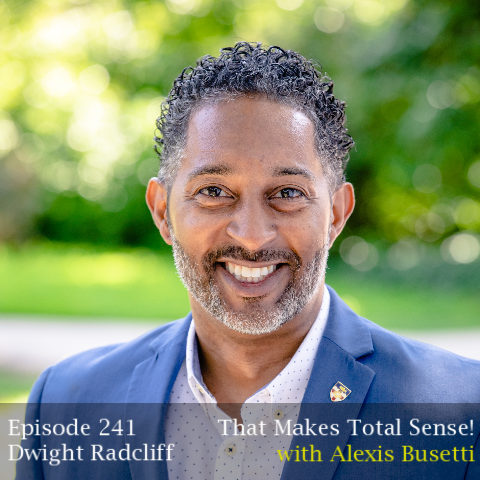
[00:00:07] Speaker A: Welcome to that makes Total Sense, a podcast dedicated to exploring God's generosity and justice. I'm Alexis Busetti, a christian aiming to ask good questions and encouraging you to do the same.
Every one of us is wired by God to live out generosity and justice. But. But the how sometimes eludes us that makes total sense is a way for us to get together, posture ourselves as learners, and challenge one another to practice generosity and justice in a tangible way every day.
So I revealed to my guests just now that this may be the first conversation that I have ever had where I have literally no notes. We have nothing, Dr. Radcliffe.
[00:00:49] Speaker B: We're shooting in the dark.
[00:00:51] Speaker A: We have nothing. We have no book. We have no journal article.
We don't even have a track. We don't have a song, music video.
[00:01:02] Speaker B: I can give you some, but we need to get some licensing fees.
[00:01:06] Speaker A: We have nothing today. So I'm sitting across from Dr. Dwight Radcliffe, who was my professor, is my professor at Fuller. And I brought him on, asked him to come on. He was so gracious, in part because one of the most fun things I did all spring, Dr. Radcliffe, was just tell people the name of the class that I just took from you, which was the theology of hip hop culture. And then I feel like I just want to let you lecture for an hour, but I'm going to butt in like I did in class and ask all kinds of weird questions and stuff.
[00:01:45] Speaker B: Like, should, as you should. As you should.
[00:01:48] Speaker A: So can you first tell people who don't know you like I do and the students at Fuller do? Tell us a little bit about who you are and how you got to the point where you are kind of the hip hop guy at Fuller.
[00:02:00] Speaker B: Wow.
So my name is Dwight Radcliffe. I feel like this is an AA meeting.
My name is Dwight Radcliffe. Thank you.
Yeah, I think some of the important stuff to know about me, especially for the context of this conversation, is I am a product of South Los Angeles, born and raised South LA. Well, technically not born, but raised in south LA.
I was raised in a single parent home. I'm a late life academic.
I didn't come to the academy until later in life. And I came to the academy because I just wanted to be. Initially, I just wanted to be a better pastor. So I'm a church planter and pastor. I am a girl dad to my core. It is what it is. I've got a now 20. Oh, my God. My baby turned 20 last week.
[00:03:01] Speaker A: That's crazy.
[00:03:02] Speaker B: Yeah. I have a 20 and a 22 year old. My wife and I have been married, going on 24 years.
Yeah. So that's kind of me. I pastor, I'm a professor.
My dissertation, which kind of leads into kind of how I got to teach this class and what this class means for me and for others, really. In my dissertation, my PhD dissertation, I was building a mythological model. So many people that study hip hop culture do it from the lens of, is there a God in hip hop culture or youth culture, like building a hip hop church to reach the kids.
Those dog on kids are out there with all the boomity.
So that's kind of what people tend to do with regard to hip hop studies.
But for me, I'm 47. I'll be 48 next month.
As a middle aged somewhat, I guess, older, middle aged individual who grew up with hip hop, I was born in 74, hip hop, 72, 73. So I literally grew up with hip hop. And I was more conscious of the way that it has shaped my worldview. And I knew I wasn't alone. And so in my dissertation, I looked at adult preachers who were similar to myself, had grown up with hip hop, and could see how it was informing, and for some of them, couldn't see how it was informing their worldview, their hermeneutic, and their approach to preaching and teaching. So that was my research, my PhD research. I got to study under the great Dr. Ralph Watkins, who still is a wonderful hip hop scholar. I was inspired by people like Dan White Hodge, who did his dissertation at Fuller. He's at North park seminary.
Imani Perry's work really shook me. Kelly Douglas is the black Christ, I think I read it in concert with that and James cones, the spirituals in the blues. These were works that just really ignited something in me, because as a Pentecostal, I grew up kind of Baptist and wavered over into the Pentecostal area.
I was against all secular music, like traditional holiness, pentecostal, whatever. And my time at Fuller helped me to reawaken something that was in me and part of me. And I recognized I didn't have to relinquish all parts of my identity just to serve Christ. So that's how I got here.
[00:05:42] Speaker A: I want to go back for a second, because I'm sure that I've heard most of that, but not kind of in the way that you just described it right now. But I want to go back to your dissertation work and talking about the pastors, like your generation of pastors, and kind of that question of how had hip hop shaped them?
How had it shaped their hermeneutic? But specifically, maybe, can you talk a little bit about kind of the.
I don't know, maybe this is probably the wrong word, but kind of the prototype maybe, or the stereotypical pastor who couldn't see how hip hop had shaped his hermeneutic, because that caught my attention.
[00:06:32] Speaker B: One of the interviews specifically that I did for my research, as I was interviewing the person.
Person basically told me straight out, hip hop doesn't affect me. Doesn't. Whatever.
It's a thing. It's out there. I know what it is. I listen to some of it, but it's not a part of my.
I'm paraphrasing, right? It's not a part of my DNA. It's not a part of my fabric. And so I accepted what they said as a good researcher.
And about 30 minutes into the interview, person starts telling me about when they go to the gym and when they play football and how they put on hip hop to get them in the mindset, but doesn't affect them at all. Right?
And so we dug into that a little bit. And so there are some who. If you're asking me as a. As a. As a scholar, what is my analysis of that? I think that it really is because that person is embedded in a theological system that doesn't allow for a positive presence of hip hop culture. And so theologically, they've put it into a box where it's that thing over there, and it doesn't impact me. And it doesn't affect me. When, in actuality, if you grew up, at the time frame that I grew up, hip hop is a part of your worldview. It was especially for black culture, specifically for black men. It was one of the few places that you saw stories that were similar to your own in mainstream culture. So to say that it did not impact you at all, I'm sure there's some people that it may not have, but in a very large way, this was the Woodstock. This was the entrance of the Beatles. This was the quote, unquote, entrance of rock and roll.
There's so many things that I could talk about in mainstream society. Mainstream culture, industrial revolution, the Renaissance. There's so many things that have happened in mainstream culture. And majority culture has had a way of honoring and recognizing those cultural influences on their own life. But for some reason, with black culture, we don't always give our own cultural products and cultural contributions the same respect, the same space.
And that segues into. We mentioned maybe talking about reception. When I started telling some of my black pastor colleagues what I was doing for my dissertation. I had some of them gave me a lot of negative pushback, and it wasn't the holiness thing.
It was for them. They didn't see hip hop culture or even the impact of hip hop culture on preaching and preacher formation.
They didn't see it as worthy of academic study.
And that bothered me.
There's this thing that happens within my culture, my cultural context, where we don't give credence to our own ingenuity, our own creativity, our own cultural production.
And you saw this in the class. We treat the Mona Lisa with a certain amount of reverence. But this thing that we call hip hop culture, that was birthed in low income black and Afro caribbean communities in New York and has turned into a worldwide phenomenon that you can drop me off in Kenya, in South Korea, in Japan, and in India, and you will find hip hop communities, and you will find hip hop. So to feel from my own community that that kind of work isn't what real academics should be doing was hurtful, surprising as well.
[00:11:02] Speaker A: Yeah.
When it comes to, I don't know, maybe there's a matter of distance there.
There is certainly a matter of content there. But you don't see that with jazz. Right?
It's not like anyone I know multiple people who have master's degrees in a jazz instrument, right?
Maybe have a graduate degree in jazz guitar. Right? No one blinks an eye at that. So there's certainly a distance component, I think, that exists there because jazz is older. Right.
But there's also, I think we can't ignore that there's a content issue there, too, right. That people, especially pastors, would be surprised that this would be something not just that you would study in the academy, but something that you would study in a seminary.
[00:12:08] Speaker B: Absolutely.
[00:12:09] Speaker A: Because it doesn't seem like there's that much holy inside of HIPAA.
[00:12:17] Speaker B: Now.
[00:12:17] Speaker A: I know better now. Spoiler alert. I know better now.
[00:12:21] Speaker B: If not, I'm going to talk to your professor.
[00:12:23] Speaker A: I know, right? He didn't do a very good job, if I don't know better at this point.
[00:12:26] Speaker B: But, yeah, I think that's legitimate. I think we look at hip hop culture, especially for those that have more of an ethic, an outside perspective of it, and all we know is video clips here and there and media buz.
If that's all we know, then yeah, absolutely. You could say that it's horrible, it's debase, it's misogynist, it's homophobic, it's vulgar, it's explicitly sexual, it's overtly violent.
It idolizes a particular type of negative or criminal lifestyle. You could say all of that stuff. You could. But here's where you and I could do a mic drop. I could say all of that about the United States of America, please.
Literally, I could say all of that. Everything that I just said, the rape, the murder, the homophobia, the misogyny, the violence, we could say that about the United States. But yet, and still people get degrees in US history, in eras of us. I'm colonial, so we could say the same thing about so many other products.
I think you can't dismiss the racialized aspect that this is predominantly black and black and brown people doing this and engaging in this and creating this. So there's an automatic dismissal of its worth and value because of the people producing it, then, yes, there are some very negative elements of it. And like I said, we could say everything that we said about hip hop, about the United States of America, but then let's bring this to the seminary. I could say everything that I just said about the church, everything. And probably about the church in the last 25 years, more specifically.
But we don't give up on that.
And so I think there's a lot of layers as to why it's dismissed. But I think hopefully what we've learned to do in our course is to listen deeply, because amidst those curse words are cursed worlds. Amidst those. That's language.
Oh, God, I'm going to black hip hop hell.
[00:15:07] Speaker A: I'm going with you because I can't get it in my brain either.
[00:15:10] Speaker B: It was Michael Eric Dyson.
[00:15:11] Speaker A: There you go.
[00:15:12] Speaker B: When he was talking to Congress, he said, we're more concerned about the cursed words than we are about the cursed worlds that these individuals inhabit. And so I think that we are called to do deep listening. I think that the reason why this is theologically necessary is partially because of the very racialized and colonized history of the church and of seminary, of theological education. And so courses like ours force people to do deep listening, force people to immerse themselves in things that they had previously written off. And if that's not Jesus, I'm not sure what is.
[00:15:50] Speaker A: But when you talked about the edict perspective, the outsider's perspective, I can't help. I'm like doing mental wrestling right now. Because when you talk about the church, when you talk about the academy or theological education, when you talk about the United States, the kind of people that we're talking about that say hip hop doesn't affect me, or that would just look at the content warnings and not anything else, don't have an edict perspective, of any of those other places.
They haven't created that boundary for themselves. Right. Because they can't. So it's like this weird. I don't know. There's this tension that I'm feeling between maybe the pastor, who would be surprised that you would study hip hop on that level, at the same time saying he's not affected by it because he kind of knows, maybe he should have an outsider's perspective of hip hop.
[00:16:55] Speaker B: Right?
[00:16:57] Speaker A: But like you said, there's no secular music here. We're not doing that, whatever. So there's a tension that I'm kind of feeling inside that person or inside people who fit inside that community where they're surprised by this, because maybe they feel like they should have an outsider's perspective. Something that can come down in judgment on that and not own the emic is that the other one not own the insider's perspective on that. But we can't do that with larger circles on that. Right. It's much harder to do that as an American. It's much harder to do that inside the church. Right. For those of us in the academy, it's harder for us to do that inside of the academy. But with hip hop, it's a little bit easier because someone else has created a boundary and said, don't go there.
[00:17:55] Speaker B: Yeah. So I think this is when work like the late James cone, spirituals in the blues are really helpful. That when you trace the roots of hip hop culture back, it traces its roots back to the blues. It traces its roots back to the same. Cone calls it the same fountain that gives us the spirituals, gives us the blues. They are both flowing from the fountain of the black experience. And so one of them is more concerned about God, and one of them is more concerned about my actual lived reality.
But the beauty of Cone's work in that space is that Cohn says neither one of them, though, is complete without the other, that you need both of these voices together to give you the whole picture. And so I think the church has conveniently isolated this aspect of hip hop from the experience and has told us that it's debased, it's sinful. So you don't need that as part of the narrative to be a good Christian. And I think that's where we have to push back just a little bit. I think that if you've read the Bible and you haven't been offended, then you haven't actually read the.
You know, whether it's Jesus's words of that fox or those vipers, whether it's him calling a woman a dog.
There's offense. This is the same God that mauls children for laughing at the bald headed prophet or opens up the earth and swallows people. We're not even going to go into genocides.
There's offense. This is the same Bible that talks about when it comes to our enemies, God, I wish that you would take the baby's skulls and dash them against a wall.
I don't know how you've read scripture. Jeremiah is told by God, by the most high, the most holy of holies, right.
To take your dirty underwear and put them in a rock and leave them there and come back in, like three, four months and come get those dirty underwear. Dirty draws. Come get them dirty underwear and take it out the rock. That's. That's. Hold that up. That's Israel. Those are my people.
So, I mean, like, how do you read the Bible and not be offended? How are we not offended when Herod slaughters babies?
How are we not offended when Moses's mother, in order to save her child, and I'm trying not to preach, but when she takes her child, in order to save her child, puts her child literally in the cemetery that the Nile river was, where so many babies, specifically baby hebrew baby boys, had lost their life.
And she, in order to what trauma, what mental gymnastics does she have to do to take her baby boy, who's hunted after and hide him in the very place where they go to kill baby boys?
So I don't know, how do you deal with David being ridiculed by his own father, being ostracized and disbelieved and thrown to the side by his own father, and then David not dealing with avenging the rape of his own daughter.
You can't read scripture without being offended. And so for me, I think it's important for us to say that I don't think you have to be a hip hop head. I don't think you have to be completely inside of hip hop culture. But there is something about hip hop culture that if Cohn is correct, and I believe that he is, that is telling a part of the narrative that the church has tried to sanitize and tried to say, that's not part of our narrative. And in reality, it is part of many people's narrative. And so to dismiss that is to dismiss part of people's culture and their formation and their upbringing and their identity. And I think it's just part of that colonized, sanitized Christianity that we tend to preach that everybody's going to look the same and talk the same and be the same.
[00:22:33] Speaker A: Yeah, that's good. I just finished in my own devotional time. Ezekiel, you want to talk about being offended?
No one has written, like, 140 days with Ezekiel. Nobody's doing that. This is not the feel good book. This is not. No, none of that is there. I wiped my brow this morning when I was finished with that because offense. Right.
[00:23:00] Speaker B: Yes.
[00:23:01] Speaker A: It's nasty. And I'm reading it in the message, too, so it's like.
It's nasty.
So. You're right.
But we have a paradigm for that. So, unfortunately, I don't think we have to think about the mental gymnastics of Jacobed when we read Moses'story, because we've been reading it since. Felt board for many of.
Please. Yes, felt board. But really, the baby in the basket on the felt board, so we don't have to think about that. But Brenda's got a not.
[00:23:52] Speaker B: Yeah.
[00:23:52] Speaker A: That's not sanitized for us already, for people who are not hip hop heads. So I speak for myself in that. People who are not inside the this.
When I hear Brenda's got a baby, for better or worse, it strikes me. And I have to think about that sometimes even more than I have to think about Moses mom, just because that story is so familiar to me. Right.
[00:24:20] Speaker B: Yeah.
[00:24:20] Speaker A: But I think one of the things that I learned in your class, and this will serve me well moving forward, is that when I learn to listen to Tupac, well, I actually learn how to go back and listen to Jacob Ed's story better. Right. And my neighbor's story. And your neighbor's story. And the person on the picket line. Right. And the person at the border. Because if I didn't learn anything else in your class, and I did, I learned how to listen better.
[00:25:05] Speaker B: Yeah.
The epiphany moment is that if I can listen to this, perhaps I can actually hear the Bible better.
I had a conversation with a student today, and I was talking about where I am theologically, culturally, and that in a lot of spaces, I feel as though I kind of exist in this liminal space.
I'm too far this for them and too far that for them. And I actually believe the Bible.
So I kind of exist in this space, but I exist here not because I've culturally decided that I want to exist here. And I don't take the theological stances that I take because they are culturally appropriate. Reading the Bible deeply and listening and hearing scripture deeply forces us to listen and to hear and to respond to God and humanity much deeper and that's the goal, that I sit and listen to Tupac, and this is part of my testimony. So, as a former youth pastor, I'm confessing now on your podcast. I'm confessing all of my sins as a former youth pastor who burned my CDs and told my youth, burn your CDs? That's the devil.
I remember specifically, this was an epiphany moment for me. I remember specifically that Tupac has a song, I wonder if heaven got to get him, and I won't recite the lyrics even though I can, because you'd have to edit out your entire podcast. Your entire podcast would sound like somebody dialing on their phone.
But I remember that song specifically because that song, for me as a holiness Pentecostal preacher, was offensive. How dare you say I wonder if heaven has a ghetto? And I remember taking a hardline stance against that song. And I remember coming to Fuller and remember Dr. Ralph Watkins talking about Tupac specifically. And he introduced me. I believe the woman's name was C Dolores Tucker. And C Dolores Tucker was a congresswoman who kind of let charge with the whole explicit lyrics and trying to get hip hop banned and all this stuff.
And she really went hard against Tupac. And after Tupac died, I don't know if she talked about it or whatever, but it came out that she had never actually sat and listened to an entire Tupac album.
So she was the number one voice against this thing and had never actually listened to a song.
So I went back and listened to I wonder if heaven got a ghetto. I was raised a little young, doing bad stuff, talk much stuff, because I never had stuff.
I can remember being bad in class, and my mama will whip my. And he goes on to talk, and I'm going to listen to the lyrics of this song. This is not a song that's saying, I hope when I get to heaven that there are low rent projects. The song is not saying that I hope when I get to heaven, there's redlining and redistricting. That's not what the song is saying. The song is saying that this is how I was born, and this is where I was raised, and with a father in prison, and with a mother strung out for days on drugs, and with a little sister in my house.
If I go out and snatch a purse, because there's no federally funded after school programs, there are no programs that I'm eligible for, and my mother doesn't have the capacity to get us what we need. And my father is not present, and no one in my community, the churches have all moved to the suburbs.
Is there enough compassion in God in heaven to understand the difference between me, who's doing what I have to do to survive and to make sure that my sister can have food to eat tonight, and the guy who's just out enjoying killing people and robbing people? That's what the song is questioning. I wonder if there is compassion in heaven for somebody who, outside of his or her own control, has been dealt a set of circumstances, and they don't have boots or bootstraps to pull themselves up. They've got three options, and all of them are bad.
Is there enough compassion in God?
Alexis, when I listened to the lyrics of that song, I literally experienced another salvation.
I have a rule in my home that on Sundays, we don't listen to any secular music until after church.
It's just our little offering to God. And I don't carry the big division. You've been in my class. You know, I don't carry the big division between sacred and secular, but I just feel like on the Lord's day, we want to honor God with songs that specifically are about worship and specifically about honoring God.
For about two months straight, and my kids looked at me crazy. My wife looked at me crazy. For about two months straight, I listened to that song, the explicit version, every Sunday before I would preach, because that song reminded me of how badly I had missed it.
It reminded me of how badly the church is missing it. And it reminded me that there's somebody that needs to hear the true and honest gospel of Jesus Christ, that God is so concerned about us that God moves into talking about that message translation. John 114. The message translation. That God so loved the world that God moved into the neighborhood.
And if my preaching. And I'm trying not to break down in preach whatever the hell I'm about to say about the gospel, if my preaching that Sunday morning doesn't have any good news for Tupac, then it's not good news for anybody.
And that, my sister, is why this class is something that I am passionate about. It's not just, hey, let's listen to Meg, thee stallion, and Jay Z.
It is. Can I take you on a journey to dismiss judgment until after you've done the deep listening, to dismiss your prejudice until after you've allowed the broken worlds that many of these artists either personally endured or representationally dictate or describe?
Can you enter into their world first and then speak?
And if we can do that, then I can enter into the worlds that scripture is describing. And I believe that if I do my job well enough in this class, I can help myself and others become better Christians. And that's what the class is about.
[00:33:18] Speaker A: I just wish you would preach. Just keep on preaching. But that's the cursed words in the cursed worlds.
Exactly that you mentioned earlier. Exactly. Tell about the example.
[00:33:34] Speaker B: Oh God, I think I know the.
[00:33:37] Speaker A: Woman outside of the church.
[00:33:39] Speaker B: Yeah.
So I was still at the time part of a Pentecostal denomination. So I had people in my church looking at me like, you're a heretic, you're losing it, you're going too deep.
And so here's the analogy that I used for them. I did an entire sermon series on hip hop called the cry of a generation over the sound of an organ.
And it was basically juxtaposing what this generation was crying for and what we wanted to hear. So the analogy that I give is this, we need to be as Christians, we need to be listening to and impacted by hip hop culture.
Because hip hop is describing a reality, an unsanitized, unfiltered reality that the majority of american society doesn't want to talk about, deal with, or speak to.
So because it often is the voice of a marginalized population or marginalized populations, we need to be listening because these are the very people that Jesus died for. These are the very people that God has told us that we are to be speaking to and speaking for and demonstrating the kingdom of God in front of. So we need to be listening because of that. And so most of us, though as Christians, as good old christian folk, the reason why we object to hip hop culture, as you alluded to earlier, is because of the profanity. It's because of the misogyny, it's because of the gang violence or whatever.
And we are dismissing the profanity, the cursed words.
And because we're dismissing that, we're also dismissing the cursed worlds that these artists, or sometimes are inhabiting. And so the analogy that I said, I said, look, if there was a woman outside who was being sexually assaulted and she was beating her attacker off of her and screaming all kinds of obscenities, if we're sitting in church and we hear this, would we run outside to her aide and then lean over to her and say, miss, ma'am, we're going to help you, but before we do, can you stop with all the profanity? If you can stop cursing first, then we'll help you?
And no one in their right mind would do that. No one.
But with hip hop culture, we're asking the culture to, would you please stop all the profanity, and then we'll speak to the way that your community has been redlined. Would you stop all the profanity? And then we'll talk about the excessive policing and the militarization of policing in your community, if you would just stop all the language. And then we'll help with the fact that the local communities, the private businesses in your community, are looking at your third great results and determining how many prisons they're going to build in your community. If you would just stop. And James Cohn talks to this, too. He says, it's almost like the oppressor saying, I'm going to take my foot off your neck. I'm going to stop choking you out. I'm going to stop choking the life out of you. Right? And this is pre Floyd, pre Gardner. This is, I think, back in the dog on 80s when Cohn wrote this, we'll take our foot off your neck, the oppressor saying, I'll take my foot off your neck. But first, I need you to stop being so angry about it.
And that's where we, as the church, need to hear the stupidity of our hypocrisy, that we should be just as moved by the cursed worlds as we are by the cursed words, and we should be moved to action in ways that demonstrate that there's good news for that person or those persons as well.
And if we were going to preach, we'd go to Luke, but we're not going to preach.
[00:38:11] Speaker A: Go. And if we were going to preach. But I'll let you preach anytime.
In fact, as I am prepping messages, you said this a lot during class, too, but I had to write it down again, which is, if I preach a message and it's not good news for Tupac, then is it really good news?
I need to have that in my head every time.
Every time I prepare a message anyway. Every time. But I want to go here with this big question, and then we do whatever we want after that.
Probably one of them. I don't know why this question has stuck out to me so much. Probably because of my long stint in the Pentecostal tradition as well.
But this question of whether or not hip hop is prophetic, I mean, come on.
[00:39:11] Speaker B: All right.
[00:39:12] Speaker A: Bringing out the big guns on. Yes, bringing out the big guns, because it's such an important question.
[00:39:23] Speaker B: It is.
I agree. I mean, I teach the class, but. I agree.
[00:39:31] Speaker A: But let me just say here, though.
But I would say that question is so good and so rich, if we actually wrap our minds theologically around what is prophetic, right. This is not just somebody who's acting like they have a God breathed crystal ball and is going to tell you something about the apocalypse or the future or something like this. Right? The prophetic is, well, it's Jeremiah. It's Ezekiel as we talked about, but it is telling the actual.
It is, it is saying what is.
And a lot of biblical prophets, I can see in my head where I was listening to this lecture where you bring up the artist rendition of Elijah, I think right in the lecture on this topic of whether or not hip hop is prophetic, because a lot of these guys got in trouble just for saying what was right, not even talking about what God was going to do. They had to start off by saying what was absolutely. And they started off usually by saying what their people were doing.
[00:40:58] Speaker B: Yeah.
[00:41:00] Speaker A: That was not.
[00:41:04] Speaker B: Yeah, yeah. You're going to get me in complete trouble here. And I love it.
[00:41:08] Speaker A: I kind of want to. So go.
[00:41:11] Speaker B: Yeah. So Jeremiah is probably one of the baddest MCs that ever walked the earth.
So Jeremiah, everybody is saying, we've got this enemy coming down on us. And the house prophets, as I call them, the prophets on the king's payroll were saying, no, God is with us. God is with us. And Jeremiah comes in and said, nah, God's not with us. As a matter of fact, it's so obvious that God's not with us, we should pack our bags and just give in. Should, matter of fact, the Lord is saying we should give in. And it pisses people off so badly that Jeremiah's life is endangered. Repeatedly lowered into a cistern of mud, left to die, beaten.
Elijah's reputation is such that nobody wants to see it's, we've got this american view of prophecy that is, promise me a Bentley and a Maybok and tell me my court case is going to be all right.
And that's such, that's not biblical. And so I think one of the beautiful things that I was able to do in my dissertation project was I was able to put Brugemin, Heschel and Marvin McMichol in conversation together. And for the audience members that may not know Abraham Heschel, I believe he's a jewish Old Testament scholar on the prophets, Walter Brugeman. Come on. I mean, if you're a seminarian, you know the name Walter Brugeman, but. Right. He's written the prophetic imagination, the practice of the prophetic imagination. And then Marvin McMichell, who, if you're not inside of black prophetic circles and you might not know him, but he wrote a book on prophetic preachings. And the title of the book is, where have all the prophets gone? Basically calling the black church back to the prophetic tradition, where have the prophets gone? So I did this piece where I put the three of them in conversation to actually come up with a definition of what it means for something to be prophetic. Heschel and Brugemann would agree that first, there must be a Brugeman's kind of terminology, right? There's got to be this divine imagination that wars against the royal imagination. And the royal imagination is the government, the country, the culture. There's a view of the way things are that people are saying. Then there's a view that God is saying, it could be a different way. This is what I really want to see happen. This is what I really want.
So Brugemin and Heschel would agree that there's this imagination, there's this royal imagination, or this divine imagination from God, that things are this way, but there's another reality, and the other reality is actually more real, and it's more what God wants.
So that's where they would talk.
Heschel digs into more the personality and the psychology of the prophet themselves, but they would agree that prophecy is this thing, that it is an image, an alternative vision of reality.
It's usually poetic or musical, and it usually rails against current conditions.
And when you put all of those things in conversation, then with Marvin McMichol and talking about prophetic preaching, then the answer has to come back that, yes, hip hop is prophetic. Now, I'm not going to baptize and sanctify all of hip hop any more than I'm going to baptize and sanctify all of the church. There are some horrible preachers out there.
Let's just call it what it is. There are some horrible preachers out there. There are some messages out there, and some churches out there that are doing horrible things in the name of Jesus. Horrible things.
But there are some genuine followers of Jesus Christ also in the church.
Same thing with hip hop culture. There are some people who understand this mission, this agenda, this role that hip hop plays in its community and to the world, and then there are some that are just in it for themselves and whatever it is, what it is. But can hip hop be prophetic? Absolutely.
Can hip hop remind us that things should not be this way?
Absolutely. Talib Kweli has a song just to get by, and he talks about all the stuff that people do just to get by.
Not to come up, just to exist.
Like, yeah, that's real.
We go to grandma's flash and the song, the message, broken glass everywhere, people pissing on. I mean, there's a reality that's being described in many of those songs that we don't want to deal with. And things don't have to be like this.
They don't have to be. So I think the better question is not, is hip hop prophetic? And I used to hate when my professors would take my question and not directly answer it and rephrase the question. I used to hate that.
But the better question is, can hip hop be prophetic? And that answer is, yes, 1000%.
If God can use a donkey jackass to spare the life of the prophet, if God can use a woman with a very questionable reputation who would not even go to the well in the cool of the morning because she didn't want to deal with the other women, that she would wait until the heat of the day to go draw water because it was just easier for her sanity. If God can use her to save an entire city, if God can use a brown skinned Hebrew boy in a roman world, then, yeah, God can speak through hip hop culture, too.
Absolutely.
[00:47:36] Speaker A: So good. I'm glad I asked that question and glad you rephrased it, because I needed to be reminded of the imagination piece.
[00:47:45] Speaker B: Yeah, of that. That's Brugeman. That's Brugeman's language, that whole imagination, prophetic imagination, divine imagination. I think it is. But it's that there is something else that God is calling God's people to. Something else. And there are just songs that if you listen to them, there are songs that cry out for something else.
Gil Scott Heron the revolution will not be televised public enemies whether it's 911 is a joke or fight the power, there's something that's being said there.
I'm just running through even our playlist from the class hard knock life by Jay Z.
Oh, my God. I can't even get into chance and stuff like that. But there's just so many songs that are talking about. There's something else. There's more than just what we have. There's something else that God wants to do and God is trying to do, but it often is riddled with profanity. But I go back to something that we talked about earlier. I think the reason we're offended so easily by hip hop is because we haven't really read our bibles. We're not offended by the bible.
I mean, you tell a prophet, I want you to lay on your side and make a cake of your own excrement.
Yeah. I want you to crap. Literally eat crap. And the prophet has to beg with God. Can I at least use cow crap?
I don't want to use my own. Come on, God. Really?
We're not offended by that. We're not offended by God telling a prophet, I want you to go marry, whether you call her a prostitute or the daughter of a prostitute, however you want to word it. And then I want you to stigmatize and traumatize your children.
Call your daughter, I'm not loved.
Call your son. I don't have any people.
These are not stories. This is not felt board.
That daughter had to grow up her entire life having everyone she knew calling her, you're not loved. You're not worthy. I'm a father of two black girls who live in a world where black beauty is not always valued. Their own images of self worth have been challenged in their adolescence. So to name a child I'm not loved.
There's a fence in that. And then go take your wife that left you to go into prostitution, take your hard earned money, buy her back.
You what, Hagar? Go back to the slave house where you are beaten physically, emotionally, and verbally. Go back.
We're not offended.
And so again, I think that we're offended by hip hop, and we refuse to see the prophetic value, nature, and worth of hip hop because we're not offended by the Bible.
We're not offended.
We read it as though everything in it is okay. Can I rabbit trail?
[00:51:34] Speaker A: Yeah.
[00:51:36] Speaker B: Hermeneutics 101. I'm praying that somebody hears this and takes this to heart.
I take authority of scripture very seriously.
But you cannot read the Bible as a complete condoning of everything in the Bible.
There are things in scripture that are given to us to warn us or to tell us how jacked up and stupid we are. So when David rapes Bathsheba, that's not a story to be elevated as, oh, look at the king sowing his royal oats. No, when that prophet, that judge runs off to war and promises, God, I'll kill the very first thing that comes out of my house, and it's his daughter.
These are not stories that need to be sanitized for the sake of making good Sunday school lessons. These are stories that we need to hear that in spite of God's desire to speak through and move through humanity, we are so broken and we are so jacked up that even when God moves in us and through us, he does it in and through broken vessels.
So we must read Scripture, and we must hear the offense and the brokenness and the complicatedness of scripture, and then we might actually be able to serve God correctly.
But as long as we're serving the God of our sanitized bibles, the God of our bleached, our whitewashed, our americanized, our politicized Jesus, as long as that's the God that we serve, we're not actually impacting the kingdom.
All right, I'm off my soapbox.
I'm off my soapbox.
[00:53:35] Speaker A: I don't have anything to answer that because my mind's going in 100 places, and I don't have anything to answer that because that's so good.
So here's what I'm going to do as we wrap up, because now, Lordy, I'm speechless.
[00:53:58] Speaker B: Stop.
[00:53:58] Speaker A: And you know, that doesn't happen that often. Okay.
What I do sometimes, if I have professors or even just regular old guests, is I will say, answer the question that I didn't ask. But I'm not going to do that with you because I was in your class.
[00:54:19] Speaker B: All right?
[00:54:19] Speaker A: I was in your class for ten weeks.
What I'm going to do for you instead is say, answer the question of the person who hasn't taken your class.
[00:54:35] Speaker B: Yeah.
[00:54:35] Speaker A: Somebody who just set in on this conversation. They're eavesdropping on us.
I wish we were having actual coffee, but I think we're both just drinking boring old water. But anyway, just water.
They're eavesdropping on our virtual coffee conversation, and their mind is going in 100 different places because this is the first time they've heard anything like this, and they have a question burning in their mind. Yeah, ask and answer that question.
[00:55:12] Speaker B: Their question is, why in the world would I even take that class?
Why would I take a theology and hip hop culture class? And the answer is something that I struggle to communicate throughout the class.
You take theology and hip hop culture with Dr. Ragla because it's not about hip hop, really.
The bigger picture is this is about teaching you the tools of how to study, sit in, and become a listener and a student of culture at large, so that you can better discern how the Holy Spirit might be moving in that place and how you then might be able to partner with the Holy Spirit to impact the kingdom.
Hip hop culture is our context. It is the locus of where we do that. But the ultimate goal of the class is not. I'm not trying to produce hip hop heads. I'm not trying to get people to listen to more hip hop. I'm trying to get people to then recognize, post this class, recognize other pockets of people that we have not engaged with, that we have refused to engage with, or that we have written off, and then take this set of tools and these set of practices and use those same tools and practices to sit, to listen, and to engage for the sake of the good news in the kingdom.
That's why you take the class. It will change you. It will stretch you.
I've had people that knew all about hip hop and people that knew nothing about hip hop, and all of them have been extremely glad, tremendously glad that they took the class. So that's why you take the class. You take the class to better engage with humanity, to better engage with culture, and to better engage with your own body.
[00:57:29] Speaker A: That's legit. That's the real truth.
I am going to ask you one more favor before we end, but sure, before we do that, I'm going to put the link to your fuller bio page or whatever it is.
[00:57:45] Speaker B: On the.
[00:57:46] Speaker A: Show notes for this. But do you want people like, can they connect with you on social, too? Is that a thing that you do? Or you're like, sure, no, not really sure. Because we can edit this part out. If it's like, nah, not really. Then I just put the other one.
[00:58:03] Speaker B: The beauty of social media, you don't have to respond to think I almost named somebody. I think certain NBA players and others need to figure out. You don't have to respond.
I don't have to talk to mean. I've said some stuff over the years. People come up, the beauty of Facebook, that block button, I block you.
I unfollow you. I don't have to deal with you if I don't want.
Yeah, please follow me. I mean, please follow whatever. Engage. If people get crazy, I think we live in this day, man, where people just feel like they got to defend everything. Got to say certain things are beneath your response. Certain things you shouldn't have to respond to.
[00:58:57] Speaker A: That's right. Where are you? Where you're not responding to people. Are you on Facebook? That's the one I heard.
[00:59:03] Speaker B: Oh, I'm on Facebook and Instagram.
I'm on Twitter.
Twitter, to me, takes more time.
[00:59:12] Speaker A: Twitter is hard, man.
[00:59:14] Speaker B: It takes more time.
[00:59:15] Speaker A: Twitter is hard. You wouldn't think 140 characters would take more time, but it kind of does. Twitter is hard. Now you want to talk about rabbit holes? That's where I get down, though. I have to watch myself. A five minute break turns into something stupid on Twitter.
[00:59:29] Speaker B: What's your handle at Pastor rat? P a s t o r r.
[00:59:34] Speaker A: A d on both.
[00:59:37] Speaker B: Yeah.
[00:59:37] Speaker A: Okay.
[00:59:38] Speaker B: It's pretty consistent. I think all of them have either the name or the nickname of at Pastor rad.
[00:59:45] Speaker A: Okay, cool. Yeah. I'm not on Facebook. I think I may have followed you on Instagram 100 years ago, like, back before I thought I would even take your class, because I heard that. Because I'm also going to post the interview that you did with Dr. Laberton.
[01:00:02] Speaker B: Oh, yeah.
[01:00:04] Speaker A: That was really good. That was actually where I was introduced to your work. And I don't even know if I was a student yet, but I thought, when I get there, eventually, I'm going to take this guy's class. Yeah. So I'm going to post that conversing.
[01:00:20] Speaker B: Yeah, that was a good conversation.
[01:00:22] Speaker A: That was really good.
[01:00:23] Speaker B: That was a good conversation at a very difficult time.
Literally, right before I think we filmed that, I had taken, I think, like, two or three days. I just called my dean and just said, I hope I can say this on the podcast. I'm calling him black.
I can't. I don't have the capacity as an african american man. I just don't have the capacity to do anything right now. I am overwhelmed, and I'm traumatized and overwhelmed, and my administrators were extremely gracious with me.
[01:01:06] Speaker A: Yeah, that was a really great conversation. I do remember that.
Gosh, that part of it now, whenever you were talking about that. Gee whiz. Gosh. That was a good one. Yeah. So I'll post that as well.
[01:01:24] Speaker B: Now.
[01:01:25] Speaker A: Social.
[01:01:26] Speaker B: Now.
You blackmailed me. Tisby's been on twice.
[01:01:30] Speaker A: Tisby's been on twice. Yep.
[01:01:31] Speaker B: So I was supposed to have breakfast with Jamar last week. Come on. But my schedule. I was traveling back and forth, and so we missed each other.
If Tisby's been on twice, then you got to reschedule me. I got to come back, and we got to do a part two or something.
[01:01:48] Speaker A: Oh, there's enough for part. For ten parts.
There's ten weeks of class. There's literally enough for ten parts to this interview. So, yeah, I'm going to take you at your word on that one and say that when I send this out again, then you will schedule again and we will do part two.
[01:02:06] Speaker B: I will. You can always call my wife.
[01:02:09] Speaker A: That's right.
[01:02:12] Speaker B: She likes you.
[01:02:13] Speaker A: Oh, I know. I like her. The feelings mutual. Yeah, I know. We got something. We're Leos, right? That's it. That's it. We got it. But in the meantime, because you let this slide, at the beginning, as if you didn't make it evident throughout the conversation by your preaching. You were a pastor before you were a professor.
[01:02:35] Speaker B: Absolutely.
[01:02:35] Speaker A: And you don't get to be a pastor on this podcast without praying us out.
[01:02:40] Speaker B: Oh my God. My pleasure.
It's going to be selfish, but I will.
[01:02:45] Speaker A: That's all right.
[01:02:46] Speaker B: Yeah, let me pray.
God, I thank you for Alexis, for this platform.
God, my selfish prayer is that someone that has listened to this episode or bits and parts of this episode would be challenged to go back and read their Bible afresh. Yes, that they would be challenged to go back and to hear scripture, not through lenses of patriarchy and lenses of acceptable types of violence, but that they would read through scripture, God, and they would see your love and your passion and compassion navigating its way, weaving its way through human brokenness.
God, it's not my desire that anyone would be this or that. It is my desire that you would make us, God, to be students and serious readers and listeners of your word and doers of your word.
Help us, in the midst of everything else that we do, to read your word, to listen to your word, to be transformed by your word, and then, God, to do your word.
And that's my selfish prayer. I pray that for myself, for our families, for our churches, for our communities. In Jesus name, amen.
[01:04:38] Speaker A: Amen.
The links for all the resources mentioned in today's episode can be found in the show notes, music and podcast production by Seth Busetti. Be sure to give us a review on iTunes and subscribe at your favorite podcast listening app. You can also visit
[email protected].