Speaker 0 00:00:07 Welcome to that makes total sense. A podcast dedicated to exploring God's generosity and justice. I'm Alexis resetting the Christian, aiming to ask good questions and encouraging you to do the same. Every one of us is wired by God to live out generosity and justice, but the how sometimes alludes us that makes total sense is a way for us to get together posture ourselves as learners and challenge one another to practice generosity and justice in a tangible way every day.
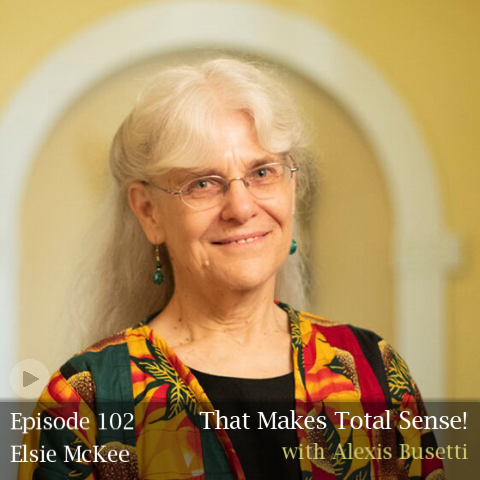
Speaker 1 00:00:39 So this is a unique interview, um, about a unique project you will hear in just a moment, the kind of backwards introduction that my guest and I have Dr. Elsie McKee. She is the co-author of the book cradling abundance that we're going to talk about today, but I just wanted to mention that I am interviewing Elsie because my Mon Monique, who is the author of the book, and this is her story, um, lives in DRC. And so the technology, uh, would be kind of challenging because this is a country that does not have always operational, um, electricity and internet. And so I just wanted to mention that we are acknowledging that this is Monique's story. We are acknowledging that Monique is the author with Elsie of this book. But as far as the interview, I had the honor and privilege of speaking with Elsie McKee today, as you will hear in this interview,
Speaker 2 00:01:49 My name it's my baptismal name, it's two money. It was my grant
Speaker 1 00:01:54 To, to,
Speaker 2 00:01:56 It was my grandmother's name. When people came to Congo, uh, people there knew Congolese neighbors gave them the name that they thought was fitting. And this one, uh, means torch, or it can also mean the, uh, burning SAP of a tree. The idea is that it is a, uh, uh, a burning and the light giving thing. So, uh, when I was baptized, that was the name I got. So it isn't technically my middle name. Uh, it's my baptismal name. My technical name is LCN. McKeith my legal name, but in a happy reversal. Uh, my, uh, Christian name is join you.
Speaker 1 00:02:37 Awesome. So you've just heard it straight from my guest today. Elsie and McKee Elsie chimney. Mickey is here with me today. I'm so thrilled. We've been chatting about Congo because she has written and co-written, we'll talk about that. This project is a, is a really cool project. Um, but she's, co-written a book with my mom, Monique from DRC, from Dr. Congo called cradling abundance, one African Christians story of empowering women and fighting systemic poverty. So we did that a little bit backwards LC, but welcome. Thanks for coming.
Speaker 2 00:03:17 It is my pleasure to be here. I'm so glad to be able to come and to share my story because it is amazing. And I'm grateful to you for letting me have this stage to give her a voice.
Speaker 1 00:03:31 Thank you so much now, before we get into this project, um, because this is, I don't even know how to classify. How would we classify this book? A memoir, a biography, a
Speaker 2 00:03:44 I think we would classify it probably as a memoir or an autobiography, uh, but edited by another person. Uh, so that it originally, we were talking with the press about what kind of language to use. We ended up saying with LCG when you be key, because I did more than translate. Uh, I was responsible for deciding which, uh, half or two thirds got cut out, uh, no fresher glowing books. So I had put it together into a form, uh, that, uh, would have coherent narrative, uh, value because we taped it in all kinds of different, uh, settings. And my most common interjection was when cold cold, because I wanted to know, where am I supposed to put this piece in relationship to the stories that we've just been hearing or the ones that you're going to tell later. So ended up with hundreds of pages. Well, what were then that of French and some truly transcribed texts, and then tried to figure out, well, how do we put it into, uh, an order that will be a readable? So that's where the width came from, because the way that it's presented as well as the translation is my work, but the story and all of the, um, the language is hers.
Speaker 1 00:05:15 Yes. So before we get into my mom Monique's story, would you tell us how you came about, why does this make sense for you to be the one who is involved in this story? Because people may, you know, we'll, we'll put some links in the show notes and people will Google your name. And they'll say, this is a white woman. Who's at theology professor or a history professor at a, at a seminary. And then here's a woman running a nonprofit and doing church work in DRC. How do these two women connect and what is, what is their story there? So tell us how you got involved, not just in the book, but, um, but a little bit of your background and why this makes sense for you.
Speaker 2 00:06:00 Thank you very much. I'm happy to do so. I actually I'm of Monique and I were born in the same province in Congo, but she was born on one side and I was born on the other side and we went to school in different languages. So we didn't cross paths as children, but I was born where her father was born. Uh, and our teachers, you could say were the same people, uh, the Presbyterian missionaries at the time, uh, who brought the gospel to this area of Congo, uh, her paternal great grandparents, uh, great grandmother. Oh, it was probably one of the very first convert in the Casa. She was born, uh, around 1902 at Waymo, uh, a mission organization station that had only been founded, uh, 11 years earlier. My grandfather and grandmother came to Congo in 1911. Uh, and they were, uh, at Levo for part of the time before they were transferred, uh, to work in, uh, areas more to the south end east.
Speaker 2 00:07:10 Uh, and then that means they ended up doing most of their ministry in the part of Congo where Monique was born and grew up the Eastern Congo. And they founded the station where her secondary school was Bianca and where my father was born. Uh, so we have a kind of an intertwined, uh, set of family histories without ever having known it, uh, before, uh, we met in 2008, uh, because our, most of my work in Congo until then had been focused on theological education. And I'm still very much involved in the theological school where my parents taught and where I taught on one sabbatical, uh, in 1995. But I have also now been able to connect with the women's work, uh, that, uh, Monique is doing. Uh, she is now located or has been since she went to university, uh, in Kinshasa, which is a considerable distance from where both of us were born and grew up.
Speaker 2 00:08:17 Uh, so my acquaintance with Kinshasa was somewhat more limited. I did go to secondary school there in a boarding school for a couple of years, uh, but I didn't get to know it the way I know the cosign. So the thing is we have parallel stories of, um, Presbyterian families in which our fathers and grandfathers and mothers and grandmothers, uh, were the fundamental, uh, shapers of our religious and our, uh, earthly identities, uh, because they, her and my parents in particular, but we're the ones who both taught us and modeled for us what a Christian life would look like. And I grew up with a clear consciousness that any persons work that serves God and neighbor is a Christian vocation, because all the people around me, uh, were involved in what might be called church work. But in fact, very few of them were ministers.
Speaker 2 00:09:26 My father happens to be a minister and a teacher of ministers, but my mother's main job was teaching in secondary school or teaching women at the theological school. Regrettably part of the tradition is that men get to go to school and women don't. So by and large, the women who came as the seminary students, wives, I had very little education and really needed their own school, uh, to be able to become better qualified, to do the kinds of things that would be expected of them as ministers, wives, anyhow, to say, both of my parents were involved in education and her father was involved in all kinds of creative activities. He was a nurse, he was a veterinarian, he was a community activist. Uh, he was a, uh, a remarkably strong, generous, um, and daring kind of person, uh, not sticking to the traditional ideas about what women should do.
Speaker 2 00:10:37 His children all would be sent to school girls and boys alike. And actually Monique was his favorite because she was the best at doing the kinds of things that he saw as important. Some of the other children were also well-educated, but I don't think any of them have the, uh, the drive that her father had and that she has. Um, and in a good sense, not that she is either he or she, uh, tell people what to do and told people do. Uh, but they had so much concentrated combination of intelligence and energy, um, along with a considerable amount of charm. And I don't mean that in persuading people to do things, but just inviting people, encouraging them, the warm personality. I never knew, uh, touchable Louise, her father, uh, but all the signs say that she's very much like him and she is a delightful personality. So although we did not meet until we were, uh, both adults in ministry, uh, we share a common church, uh, and family history of dedication to the work of God among the people in Congo. And that is a very deep bond between us. We also probably share a sense of humor, which doesn't, which doesn't hurt. I love to say something that makes her chuckle.
Speaker 1 00:12:13 So how did you and my mom Monique meet in 2008,
Speaker 2 00:12:21 The Presbyterian church USA has a program called a peacemaking program that has the purpose of inviting a number of, uh, visitors from partner churches around the world to come for. Usually it's about a month in October, give or take a bit, maybe five weeks and visit American churches to share the kinds of things that they are doing in well, it's called peacemaking, but basically peacemaking. We would call the flourishing of the Christian life because it has to do with things that deal with violence as well, but even more has to do with how do we, uh, see that the least of these actually gain enough, uh, space and attention, uh, that they can flourish, that they can recognize that they are made in the image of God, that they can have, uh, the, uh, possibility of a life that is healthy and satisfying and capable of generating life for other people.
Speaker 2 00:13:36 So in that sense, uh, the purpose of the peacemaking program is more that the partner churches, uh, should come to understand each other's ministries a bit better. And Monique is very good at this. She's done it three or four times. Uh, the first time was in 2001, she arrived just after nine 11. She said it was really a very interesting, and she didn't speak much English. Then English is her fourth language, which she taught herself in order to be able to speak to Americans in particular. And, um, it was a rather hair-raising first peacemaking trip, but she did it very, very well. Uh, and she was invited back multiple times. So 2008 was one of them. And at that point, while I was teaching it at Princeton seminary, I heard about her visit. I don't know how I had missed some of the others. Um, although probably 2001 was not going to be a time when most of us were deeply engaged in, uh, mission activities right at that moment.
Speaker 2 00:14:41 But anyway, uh, so when she came in 2008, I asked if she could come and visit, uh, for instance, we could make that one of her stops on her tour, uh, and arranged for her to speak to, uh, some friends. Uh, we gathered in, uh, the chaplain at the seminary. Uh, the Reverend Janice Ammon, uh, helped us organize a, a little gathering for anybody who wanted to come in here about it. I think it was a Thursday evening, uh, which means that there were not very many people there because people were busy with classes, but we had a very nice visit. Uh, and so I got involved in some of the ministries she was doing, as I said earlier, my primary engagement with Congo has been with theological education in the cosign. Uh, so this was the first time I had had a, um, close contact, uh, with a church representative from Kinshasa, uh, in a different part of the ministry, working with women and children.
Speaker 2 00:15:39 And I thought, this is wonderful. So I got involved in helping support the ministry she was doing then as director of the department of, uh, women and families for the Presbyterian church of Kinshasa. And we kept in contact. And then I, uh, was able to, um, send some assistance for her projects, but along the way, uh, things were not going quite so well because she is, she's not an uppity woman, but she got called that, uh, by leaders of her church. Uh, the terrible thing is she showed them up. Uh, they were not as well educated, uh, and they were not as, um, capable of making collegial, uh, leadership, the model for the church. Um, they wanted to be in charge, which is a very common factor with all kinds of human beings, that these are not unusual, but the point was that they had gotten tired of the fact that she was better at things than they were, uh, and when, uh, they thought wrongly, but they thought that she had criticized them to American partners.
Speaker 2 00:17:04 Uh, they said out, you go, in fact, that's not what happened, but that was the way they interpreted it. So when I went to visit in 2010, uh, this was all coming apart. You could say she had just been fired. You could say from her position and my sister, Beth and I, and my husband John were there. And we were sitting on the porch of her house, just talking about the situation. She was still hoping that things could be brought back together for the sake of the church, for the sake of the ministries. Um, I was hoping it too, but I thought we cannot leave to try to do all of the ministry she's been doing with no one to help her. Um, so if it turns out that can be repaired and she can continue with the church ministry, wonderful. If not, we're going to try to do something.
Speaker 2 00:18:09 So at that point, it was no longer just a good friendship. My, uh, engaged in supporting the work she was already doing. It became a kind of a major preoccupation, uh, for me to see that she end, uh, the little group of women who followed her, uh, could maintain their ministry or actually could actually put it together more because she was carrying it on, uh, in her own house, uh, with very limited resources. And so, uh, that is the way that we got, uh, and engaged together in this ministry. And this has been one of my major preoccupations ever since.
Speaker 1 00:18:55 Thank you for, thank you for sharing, how you guys got connected. Um, and when you were talking about mama and Monique, I was imagining the, the, you know, the pictures that your mind creates when you're reading a story like this. And I mentioned to you earlier that my, uh, before we started recording that my youngest son is from Kinshasa. And, um, there, before we brought him home, my husband and I had done some, a decent amount of reading on, um, the history of the DRC, uh, politically, um, you know, trying to acquaint ourselves culturally, um, with what, um, his home country, uh, is, um, you know, some of the norms, how they operate. And as you were talking about her, and as I was, I was thinking back to reading the book, I was thinking she, her work. And I feel like she just is kind of representative in my mind as being this beautiful bridge, right?
Speaker 1 00:20:00 Because Congo has this very, very difficult history, and we won't take time to go into it there, but I'm thankful that you do in the book you give, you give kind of some cliffs notes for the history of DRC and the book. And it's, it's a, it's a history of violent colonization, um, for centuries, really. Um, and, and also you've got the, um, the, the peoples, the multiple peoples who are there, um, still with their own traditions. Um, you know, that weren't flattened completely by the colonization. And then also Christianity, um, in the mix on top of that, and, and everything is swarming. And when, when you, you, you hit on it earlier when you said that her father wanted all of his children to be educated, you know, and when you talked about your parents work, and I think that there's some of this story, especially when it comes to men and women in the church, that feels a little bit foreign because it is, and, you know, an African culture, but at the same time, it feels very familiar.
Speaker 1 00:21:13 Um, I grew up in the SBC and so a lot of this actually kind of felt familiar to me, but I think what I see from her and correct me if I'm wrong, I feel like what I see from her story is that she doesn't excellent job of maintaining this, um, this cultural, uh, beauty she's, she's loyal to her culture and brings the beauty and the correction when needed, um, from the biblical side as well. And she somehow is able to weave these things together as she is discipling women and ministering in churches. Um, and she, her boldness allows her to, just to just keep, to keep going and pushing through, um, some of those places. So I'm wondering if you can talk a little bit when you were saying the women, you know, who were kind of following her during this time, but she has done some incredible work with women as far as, um, poverty, um, sexual education, um, vocational, uh, empowerment. Can, can you talk about some of those ways where she and her faith is emboldening her to, um, to minister, to women in this context of purse?
Speaker 2 00:22:38 Yes, I will be happy to, and I'll start with one of her favorite Bible verses she says is, uh, God created them male and female, because one of her goals is to encourage women to see that they are equally created in God's image. It doesn't mean that everybody's exactly the same, but it means that equally the image of God. And when she was telling a funny story, once when she was speaking, or at least I thought it was funny, she said, well, you know, when God created Adam and Eve, God created Adam first. And then God created the masterpiece, the woman, because he practiced on Adam, uh, that's not everybody's interpretation. Uh, but it does produce chuckle. I loved
Speaker 1 00:23:25 When I read that, I think she said, I think the way it came out in the book is, and then I said with a twinkle in my eye
Speaker 2 00:23:33 And I, I did, I chuckled when I read it too. Yes, yes, it was, it was really fun. So that's her one of her favorite Bible verses the other of the two primary ones is John 10, 10, which is the founding text for the nonprofit. Uh, Jesus said, I came to give them life and give it abundantly. Uh, the, their organization is called woman cradle of abundance, uh, and, uh, fun desolate, uh, as of the acronym is FIBA in French. Uh, but when she looks at that for her, that is what her calling is. And if you stop and think about it, um, when women are second class citizens, now, if it weren't a statement of faith, it would be an act of hubris to claim that women could be the cradle of abundance for others, but that is how she approaches it. So with those kinds of texts, shaping what she does, she looks for the, the people who are the least, uh, tended to, uh, I say it that way because she's concerned about poverty and it doesn't mean just girls.
Speaker 2 00:24:52 Uh, it means the starving child that she sees down the street, she goes and takes food to his family, and then discovers that there are a great many more. So she gets her church to organize a group to work on nutrition, especially nutrition for children. And they end up having to say, okay, it's only for the most malnourished, those who don't get any food at home. If you get to eat once a day at home, we can't include you because there's so many people who don't get to eat at all. Um, so her attention to everyone who is disadvantaged in any way is I think probably one of the most, uh, striking characteristics now because women and girls tend to be more disadvantaged in the culture in Congo. She gives them most of her attention. So the question of sexuality, obviously a big one, because women are primarily identified with their sexuality in many ways.
Speaker 2 00:26:05 Um, a woman's primary worth is as a mother, uh, the number of children she bears, uh, are evidence of the wealth that she provides to her family. Just a quick parenthesis here, the woman who was our nurse, when I was growing up, someone, we could, you could say the person who looked after us while my mother was at school was a barren woman. Uh, she had failed to bury your children. Her husband threw her out. Her family of origin would not take her back. She had failed in her duties. So we became her children and she became a part of our family. My youngest sister's baptismal name, uh, is, uh, uh, Jatana from barbecue Tanger, who was, you know, part of our family. But that being the case, the situation of women as identified with, uh, reproduction, uh, is a very important factor. And most women accept that without question w when he is not interested in trying to prevent them from understanding that as a major part of their life and work, but she refuses to let them be reduced to a baby machine.
Speaker 2 00:27:27 And traditionally, many of the things that husbands could demand of their wives, uh, had no limits, shall we say, even today, for example, when, um, aids is a problem, uh, a, a man can demand sex from his wife whenever he pleases. It doesn't matter whether he's infected or not. And if she says, okay, go and get tested, he may throw a fit. So the ways that traditional sexual relations have been defined, um, disadvantage the women, uh, and without trying to change the dynamics of marriage, in a sense of making it a perfectly egalitarian thing, uh, she wants to make it something that recognizes both made in the image of God, both as children of God, each with, uh, per his own, uh, needs and gifts to provide. So when she looks around her, there is a great field of work to be done. Uh, because one of the things about Monique is she has her eyes open.
Speaker 2 00:28:49 She is constantly learning, but she does not assume that because she has worked out a ministry of one kind or another, that she can stop there. If another major problem presents itself to her, she's going to do her best to try to respond in some fashion. She's not unrealistic. She knows that there are some things she can't do. So there are priorities. For example, the end of the school year is the time when students must take their state exams and you have to pay to take the state exams. But the diploma at after secondary school is the only recognized standard of education in Congo. So a student who's done all of the years of secondary school and still cannot pay to take the final exam will not have that education recognized. So one of Monique's concerns has been to try to see the, at least a handful of that is usually the children of some of the members of woman, cradle of abundance.
Speaker 2 00:29:59 And they've come to their final year. We'll be able to pay for their final exams that hasn't happened yet this year, because of COVID the year is a little bit skewed. And normally it would be finished by early July. It's not yet over yet, but we do need money for those exams that we're not going to get. And she knows that we can't get that because the more immediate needs of keeping the sewing school going and the farm going, uh, have a prior higher priority right now, we have been managing to do 10 or 12 of the secondary students school students each year, but just this year, it's turning out to be considerably more difficult. Um, but that's my way of saying that she is always looking to see the needs around her, but she doesn't think that she is, uh, a savior. Who's going to do everything.
Speaker 2 00:31:02 And as a result, then she can make the choices that have to be made, uh, in order to, um, finish carrying out, at least the things to which she is committed because of COVID the school year has been, uh, the schedule has been slightly skewed, which means that probably it's a little bit late. However, we are now at the point where those exam fees need to be paid. And right now a tractor for the farm is taking precedence, uh, because the, the farm is, has proved it's important through COVID multiple times. Obviously it would be important, but for many people, members of fever being fed has been the one single ministry that has needed to continue through COVID. They always are ministering to about eight to 12 elderly widows, many of them blind and destitute. So they're already feeding, uh, a number of people, but during COVID, that was up to 200, uh, families.
Speaker 2 00:32:23 Uh, and so, although that was not all produced by the farm, that has emphasized the importance of continuing with expanding the production. And, uh, so although they hire local people and it's a wonderful, um, income for the local villagers to do the weeding and planting and stuff like that, you simply can't plow, uh, 25 acres in the traditional fashion. So they decided more than a year ago that her dream now is attractor. So we're in the process of getting her a tractor, uh, but it is a bit tricky because we have not had a major response to our campaign requests for assistance with that. And so the, some of the things that we normally would be doing, like paying the secondary school, uh, exam fees, um, have gotten pushed down the priority list a little bit because feeding people has taken, uh, a front seat, but, you know, that's a long way around to say that what she does is it calculated kind of social, um, response to every need and reach.
Speaker 2 00:33:53 And I say calculated because she tries to figure what can she do with prayer and with answered prayers, because most of the time she starts out without really any assurance that the funding is there. Some of it might be, some of it should be, but how they're going to pull off the whole thing will come through prayer. So the effort to decide and determine how far can we stretch, uh, is a really important part also of her leadership and COVID has played havoc with that because none of the things that they were anticipating, uh, what happened, did happen, uh, all the kinds of, uh, normal activities for women to be able to support themselves during the first six, eight months of COVID Congo had very few cases because they cut down on any external activities. People had to stay home. But if you have to, if you are a person who has to go to market and sell your little, um, pancakes, or your little, uh, box of cold, your, your little, uh, charcoal in order to eat, then there were a lot of people who were dying of starvation, malnutrition.
Speaker 2 00:35:20 And so the kinds of things that a fever would normally be doing in terms of teaching, uh, people to be able to take charge of their lives, had to be put on hold while they were feeding people. And then once it opened up again, helping those who had been managing, you know, they're marginal, but they could, they could feed their families get launched again, because anything that they had had by way of minimal capital had been eaten up in survival. Uh, so a lot of the priorities have been shifted in the last couple of years. I know that's true for people all around the world, but just pointing to some of the ways that Monique is both realistic and visionary, uh, when she sees that something needs to be changed in the program, she can do it even while she still continues to try to listen for the people, the voices that are not being heard and keep some kind of forward movement in the, uh, efforts to do the economic empowerment and the women's empowerment, because look at the various kinds of needs.
Speaker 2 00:36:41 There's sheer survival. There is, uh, the capacity to empower, uh, and the education, uh, which is usually one of the forms of empowerment. Uh, FIBA does a lot with the empowerment and the effort to teach women how to take charge of their own lives, uh, so that they feel that they have the dignity to make their own choices. Um, but they also respond to the desperate cases. Uh, the girls who've been forced into prostitution, uh, the battered women, the orphans, one, one young man, um, not an orphan, but, um, effectively a refugee without family was doing his business the best he could when he was stabbed multiple times by robbers. So they had to take Patrick to the hospital that he didn't have any other resources, but they knew about it. They took him to the hospital, they brought him back to life effectively, uh, and have been trying to help him get back on his feet again, that wasn't one of their, uh, planned, uh, ministries.
Speaker 2 00:38:00 But that was one that I got Samaritan. Doesn't look to see whether there's a planned activity. Uh, they respond to the person who fell in, who was built by the way with the rubbers, uh, whenever it comes up. So I guess, I'm sorry, I'm making a jumble of this in some ways, but in a way to say that Monique is a gifted planner, but she's also a, um, a very realistic, uh, resp uh, one who responds to crises with the capacity to change the immediate, um, choice of activities without ever losing sight of her goals. Um, but recognizing that right now, it's a time to feed people right now. It's a time to see that they get medical care. We really, really want to continue to empower women with education so that they can take charge of their lives and we're doing it. Uh, she would say, but we're not doing it quite as fast.
Speaker 2 00:39:03 For example, during COVID the sewing school, uh, had to shut down and they have about 45 or 50 students total, they can't ultimate wants because they don't have enough space. They don't have enough sewing machines. Um, but after the Sigma six months locked down, the schools were allowed to invite back their seniors, the last, uh, group of students who would, who should have graduated that year. Uh, so after six months of not being able to, so not being able to do anything because of course they don't have access to machines at home. Uh, they see the, what would have been the graduating class came back, uh, last the beginning of September. Uh, and they were able to pick up a thesis of their education finish and complete the state exams because there also state exams for what we would call vocational or apprenticeship kinds of education and mama Monique's, uh, young women come out of the top every time, which means that the state officials like to come to be the ones to present the certificates, um, so that they have a chance to see, uh, these, uh, very bright young women.
Speaker 2 00:40:17 But what that means is the after COVID, they did manage to graduate the class of, um, sewing school students who were practically ready to stop to finish, but they have only recently been able to bring back the rest of the 45 students. Um, I guess it would be about 35 40 now minus the graduates. Uh, and so their whole programs are going to take a year or more longer, but Monica is realistic. What we're trying to do is get those graduated so that there is a, an impetus toward the success. Uh, and then the next group will be coming along. It will be slower, but we are now, uh, back at school, um, being careful being cautious, uh, she's a remarkably practical visionary.
Speaker 2 00:41:20 So it reminds me of what people have said about, uh, Teresa of Avila she's remembered as a mystic, but she was a remarkably practical person too. Uh, and I think that moment in her own way is a remarkable visionary leader, but also a remarkably practical one and a very warm and generous and gracious person who puts herself on the line every day. She has bad health problems with legs and back, and she is a good steward trying to do what she can about them, but when the money runs out, the money runs out. I'm trying to find a little more for that because she doesn't pay herself a salary. She pays the rest of the women, a salary she's supposed to have a salary,
Speaker 1 00:42:18 You know, talking about, um, Monique's practicality. Um, one of the things that I loved about the book is that, and this is probably not the most appropriate phrase, but what I thought of was, um, when I've heard people say, God doesn't waste anything, but I think about Monique's journey before she started in her various roles of leading women and in church ministry and leadership, you know, I think how she has the sewing school now. And then of course, how she had that as a, as a business where she would do those kinds of things in the market and, and, and running, um, you know, her, her boldness in, uh, with talking with government officials and now she's got, you know, uh, state people coming to, to issue diplomas to her students. And I just, I just love how you can kind of like almost in the sewing kit, you can kind of track the threads, you know, um, through that, through her, through her life and her experience before she, um, kind of found her way into this ministry, which just felt very natural.
Speaker 1 00:43:26 Um, once I kind of got to know her through the pages of the book, um, but talking about this, uh, practicality, there's the, this I'm so glad you mentioned the sewing school that's my grandmother was a, was a seamstress. And so that is close to my heart. And then I wanted to ask you a couple of things bef like, as we start wrapping up, because I think maybe it was in the afterward, there's more than a sewing school now. Right. I w I was going to say it was maybe a culinary, but maybe I'm not correct in that because, but, but can you tell us what, how else are the women, um, you know, how is she tending to their vocational needs right now? And then you mentioned, um, the tractor and some of these other things, how can, and I know you've got an American side of the, um, nonprofit now, so how can, if listeners are just going, wow, that's something I really want to get involved in. How can they do that? So, sorry, the two parts of that again, are how is she helping to meet the vocational of women right now? Um, and, and then how can people get involved if they hear this story and think, yes, I'm looking for something like that, or it touches their heart.
Speaker 2 00:44:41 Thank you. Those are wonderful questions. Well, first of all, you were right in remembering the culinary school. That was the big hope for 20, 19, 20 20. And when COVID came along, uh, that did not materialize, but that is still on the horizon. We have not given up hope on it in part, because Monique says that learning to sew is rather more challenging than learning to cook. And there are more young women who would be served by having a culinary school, uh, then are able to be accommodated in the sewing school. So at the moment, the primary ways, uh, forms of education for, uh, young women in particular are the sewing school, which includes literacy, uh, and general education, uh, as well as so, um, they primary form for you would say more mature women is helping with a micro loan project that has been somewhat limited. And over the years, because the funding has been so limited, but that has become an important response to COVID to help many women members of the, uh, woman credit Glenda's FIBA get back on their feet.
Speaker 2 00:46:01 They weren't managing before, but now they need to be relaunched. And along the way, they also probably need some, uh, financial literacy, uh, tips, um, some bit a bit of a workshop. So that is taking another role of education forward. The part of the farm has more practical rather than primarily educational, although it is serving as a, you could say a form of outreach to the rural area where it is, uh, Kinshasa is a huge city over about 10 million or so. Uh, and so in order to get a farm, they had to go a considerable distance from the actual urban area. Uh, and many of the people in that farm rural area, uh, are in very limited situations, they don't have much access to schools, uh, or clinics. Uh, even if you can do that in Kinshasa, you have to pay for it, but it is there.
Speaker 2 00:47:07 Um, so part of what they're doing, which could be a form of education is, uh, the ways that they are helping build up the infrastructure of that rural community as they are supplying work, uh, for the rural community, but also, um, thinking in terms eventually of starting a premier school, I mean an elementary school, that's still on the horizon down the way, but in the meanwhile, uh, that is part of the rural development. You could say, as well as working with the farm and the small animal, husbandry, ducks, chickens, and so forth, uh, to supply the food for a fever and to supply a form of income. Once this gets going, they also have gotten an orchard at the farm it'll be years before it produces very much. But the idea is that there will be a variety of citrus, fruits and Palm nuts, and also the moringa tree, which has plenty of protein in it.
Speaker 2 00:48:11 So that's, you could say part of the education, uh, Kuhn development, uh, idea. Uh, the one other thing that they're planning is, uh, to start a very small scale orphanage because children whose parents die, um, for example, one of their members left two small children. They tried to find a way to start the orphanage, then couldn't get permission. So the children had to be sent to distant relatives, hundreds of miles away, and they'd never seen before. They want to be able to do that. It wouldn't be a big thing, but it would be a re a resort for the small children, orphans that turn up on their doorstep. And that would be another education form. They also work educationally with trying to see that, uh, children of members, at least a couple from a family can actually go to formal schooling. Uh, that means paying school fees, uh, quite apart from the final exam fees.
Speaker 2 00:49:16 Uh, so these are, uh, some of the, uh, activities. And along with that, of course, is the simply the response to women who have been raped or abused and who come, who need counseling, who need, uh, trauma skills. They would really like to have a trained, uh, pastoral counselor. They did have one for a while, but then she opted to go somewhere else. Um, so the response, um, to that and to a minor ILS, uh, a nurse, therefore we would call it first aid, uh, people who get sick, who may need a little bit of help. Uh, they try to keep a, a fund we could say at a local clinic so that they can send people there for the minor ills that, uh, need to be a net for the ways to help. There are, uh, the reason I went through all this is because there are so many ways that you could become involved.
Speaker 2 00:50:25 Uh, we also a nonprofit connection in Eastern Congo, which is the place where there has been actually the most violence, sort of an ongoing civil war for more than a quarter of a century. Uh, and we have a small school there for orphans. Uh, we have a project with women, uh, families, particularly women who have been raped to have been forced to choose between eating, uh, and being safe. Um, and we've helped them start a farm close to where they are, so they don't have to go into the forests, uh, where they will encounter the, uh, malicious. So the whole variety of, of projects that we would be very, very happy to have, uh, someone adopt a one or another, uh, our website here, the 5 0 1 C3 woman, cradle of abundance.org, uh, is UN registered American, um, 5 0 1 C3. It's registered with the IRS, um, and has been functioning for over seven years.
Speaker 2 00:51:42 We have tax records, uh, and all of the, um, implementation, uh, papers and all of that. Um, but on the website, you can find some of these different projects, the sewing school, uh, or the, the farm project where we're trying to get the tractor, uh, the, uh, small school in Goma, in Eastern Congo, um, the, um, various different school projects scattered across the country for people, for example, for the secondary school students and congestion or for others. But if there's one of these moves your heart, please adopt a woman to read, launch her business so that a hundred dollars can put her back on her feet, uh, or, uh, a young woman who is approaching the end of her sewing school program. A hundred dollars can get her a sewing machine so that she can build her own business. Uh, the various kinds of things that, uh, enable these women, these girls, these children, to have hope to have a future with dignity, to be able to recognize that they are made in God's image and other people see them made in God's image.
Speaker 2 00:53:07 Um, that brings joy to Monique's heart. That brings joy to our hearts, uh, and will, we will be happy to work with you in any way that you would like to join in. I tease that they are doing everything on a shoestring and giving away half of it. So it's our privilege to look for a few streets, if you would like to offer a shoestring to the sewing school or to the farm or to the children's orphan children's school, or to the women who are, um, leading to get back on their feet after COVID, we love shoe strings.
Speaker 1 00:53:44 I love that you say that because I just went to the donate page. And again, I'll link this in the show notes, but there really is opportunity for anyone with any budget for that. Um, everything from, you know, this is what $15 will help with. This is what a few thousand dollars will help with. You know, I'm thinking we've got kids and you know, what a cool way it's, you know, 15 bucks, but what a cool way, it eliminates standard, a few extra chores, you know, around the house could really, you know, get the family involved, um, in doing some of this in doing some of this stuff, school is just around the corner, you know, and, you know, thinking about when we go and buy uniforms for our kiddos, you know, thinking about the schools in Congo, what, what we could do. Um, I wanted to just say one last thing.
Speaker 1 00:54:35 And, um, I would, I would, I would try to encourage my Mon Monique with this, if I were speaking with her right now. But, um, a couple of times I heard you say, you know, she it's coming slowly, right? She wants it to be kind of faster, some of this work to be kind of faster. But when I was, when I was reading near the end of the book about a woman who had gone through the sewing school, and there was a dialogue in, in her story between her and her husband and one of her daughters about this and, and how it really was changing their lives and it was changing their family's lives. And, and I just think, yes, you know, yes, we want it to be faster and more. Um, but at the same time, this is a long game. And these women who are being helped now, it is multiplying their, the, the investment in the work that Monique's organization is putting into these women is multiplying.
Speaker 1 00:55:37 Their families are changing. Their children's lives will look different than their lives and down the line. Um, you know, there, the impact, the ripples are, are bigger than ripples. Um, you know, will be felt long and wide with that. And so I think just getting to know Monique through the book and just thinking, yes, her personality is for impact and, and now, and more, but man, she's doing it like she is really, she's really doing it. And, and these women and their families are responding. And, and I can, I can see that that lasting effect that happening.
Speaker 2 00:56:16 Oh, yes, you're absolutely right. And she would agree each one changed each one's life brought to new hope is her joy. It doesn't matter who it is. Just one more person who feels that Jesus brought abundant life.
Speaker 1 00:56:41 Amen. Amen. Thank you so much for being with me today, LC, it's just, it's such an honor and such a privilege to speak to. Um, I don't know, do you classify yourself as a Congolese American and an American Congolese? Actually,
Speaker 2 00:56:56 I belong to an African-American Presbyterian congregation, uh, and a number of years ago, some of my good friends called me they're American African. Yes.
Speaker 1 00:57:07 Well, it's such a joy and an honor to speak with someone, uh, from my, um, my child's home country about his home country and to see that the work of Jesus is being done actively. Um, there now it's just, it's just such an honor and privilege. So thank you so much for being with me.
Speaker 2 00:57:28 Thank you so much for enabling, uh, and need to come and share with you. It's delightful to meet you and to meet, uh, by extension your little, uh, Congolese son. Thank you so much. Thank you.
Speaker 0 00:57:46 The links for all the resources mentioned in today's episode can be found in the show notes, music and podcast production by Seth B city. Be sure to give us a review on iTunes and subscribe at your favorite podcast listening app, you can also visit
[email protected].