Episode Transcript
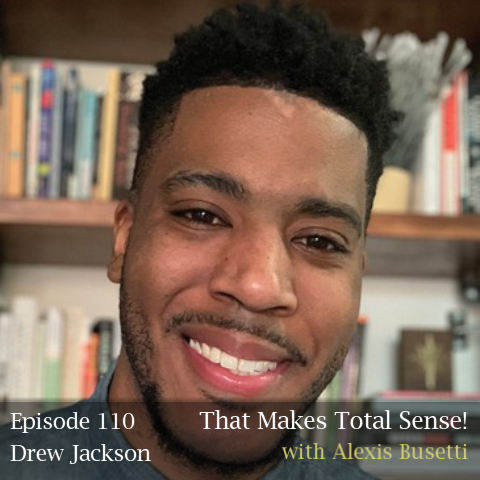
Speaker 1 00:00:07 Welcome to that. Makes total sense. A podcast dedicated to exploring God's generosity and justice. I'm Alexis. We setting the Christian aiming to ask good questions and encouraging you to do the same. Every one of us is wired by God to live out generosity and justice, but the how sometimes alludes us that makes total sense is a way for us to get together. Posture ourselves as learners and challenge one another to practice generosity and justice in a tangible way. Every day, everybody I'm so excited to be sitting down and I was going to have a virtual coffee with you drew, but I ended up getting like a little bubbly water instead. I'm kind of hoping to save my copy for the afternoon when I have a little bit more work to do, but I'm sitting now across from drew Jackson. Hey, drew,
Speaker 2 00:00:59 How's it going, Alexis. He
Speaker 1 00:01:01 Is going well. He is the author juicy author of God speaks through wounds, poems on God's unexpected coming. And, um, drew is a pastor. He is the father of twin girls. And I forgot to tell you that when we were chatting before I'm Al I'm the mother of twin girls. Yeah. Our girls are 11. How old are your girls? Seven. Our youngest is seven. So we have two girls and then two boys that followed right after. So yeah, we're, we're serious.
Speaker 2 00:01:34 They're
Speaker 1 00:01:34 Not twins. They're not twins. I just, I just don't even know. I said, I think the only thing that could be more work when I saw a girlfriend of mine from high school who had twin boys and I thought that's more, at least at the young age, you know, they were like three, they came over to our house and she was like, see, this is why we don't have a coffee table. And I was like, okay, I hear you on that. It's like legit. No, our boys are nine and seven. So yeah. So 11, 11, 9 and seven. So we're, we're moving into the, everyone can buckle themselves in the car stage and it's, it's, it speaks to my soul. I love it. Um, drew is also part of, uh, PACS, uh, this organization it's oh goodness. They make this beautiful curated content to, um, encourage us as Christians and peacemaking in the world. And I will link, um, Drew's bio and the link to PACS and his church in the, in the show notes. But before we talk about the book, I have asked drew and he is so graciously agreed to open us with one of my favorite poems, uh, from the book called turning cheeks. So drew, I'm going to hand it over to you.
Speaker 2 00:02:46 Yeah. So this poem is called turning cheeks. It's written in reflection on Luke chapter six, verse 29, um, where Jesus talks about turning the other cheek. Um, and so this is just a poem, a reflection on that turning cheeks. His words sounds sweet and DASA, but there's a reason he's treated as a hostile threat. I would not be found in his company if his goal was for me to be trampled like a doormat, his talk of cheeks sounds meek and mild, but I can see inside his strategy, teaching us to subversively, reclaim our dignity by insisting that they see our humanity. You will not backhand me. I will not be treated as your underling. You must look me in the eye and slap me with the forehand side. We are equal.
Speaker 1 00:03:49 Thank you, drew. That's beautiful. That's beautiful. I want to say before we talk about that specific poem that this, um, book covers the first eight chapters chapters of Luke, which is a lot, which is a lot, but it's these formative years of Jesus really that we see. And I think that if we allow, um, those formative years of Jesus to form us, like what, what could happen, right?
Speaker 2 00:04:37 Yeah. It's uh, those, those first eight chapters is so packed, packed with so much. I mean, I'm just sitting with them over the course of the time that I was writing this. And I, I actually didn't start out trying to write a book. It wasn't, it wasn't my intention. It was more of, I was just kind of exploring my own curiosity and imagination about, um, poetry about, uh, the gospel of Luke and just kind of seeing, seeing what would come of it. And then it kind of turned into this thing, but yeah, it was just it. And if you allow it to like the, this text, it takes you so many places. And that was one of the things I wanted to do was just allow my holy imagination to be active and free and writing these poems.
Speaker 1 00:05:29 Yeah. I, I think I told you before we started recording that, um, I recently read through the gospels in a class and, um, you know, one of the things I think that, that strikes and, you know, scholars is that, um, Luke, when we read his writing, he's, he's super efficient, right? He's he lays it out for us. He's really organized, you know, he, he, um, he lines things up in a way that as readers, many years later, this many centuries later, we can really appreciate. Um, it's well-documented I would say that. Right. Um, so I particularly appreciate you taking us through Luke because people who have minds like mine, that aren't prone necessarily toward artistic imagination, um, read, look, Luke, like a report sometimes, and to have a work of art, like yours kind of accompanying the gospel. It, it, it spurs on the imagination.
Speaker 2 00:06:36 Yeah. No, that makes, that makes a lot of sense. I know, I love that. I love that. Um, but yeah, I didn't even think, I didn't even think about that, that like Luke B being a, sort of a historian and like our reporter in that sense kind of writing in that genre of things and what, what this poetry do alongside of that. I didn't even think about it like that. So thanks for saying that.
Speaker 1 00:06:59 Yeah. That's I mean, that's what I kept, that's what I kept thinking when I was reading it, but I want to go back to this, um, to this turning cheeks. Cause I told you I had like a list of a dozen that I thought if he, if he will indulge me, I'm going to ask him, you know, to pick off this list, but turning cheeks is underlined on my, um, on my list. And I'm just wondering if you just, as the author of that, can you just help, help us unpack that poem a bit? Okay.
Speaker 2 00:07:26 Yeah. So, um, I think this is when Jesus, when Jesus talks about turning the other cheek, I think it's probably one of the most misunderstood passages in scripture. Um, because it's often, it's often, um, kind of interpreted as Jesus telling people to be doormats, right. Um, be, you know, accept what's coming to them or all these things. And so, um, I think there's a lot more that's happening there and there's a lot more subversive than, than we've been taught. Um, and so in writing this poem, I sort of wanted to get inside of someone who may have been hearing what Jesus was saying and understanding like, okay, what is the sort of space and the social location that a person who is listening to Jesus would've occupied and, um, knowing that they would have been a person who has known and experienced oppression. Um, like I say, at the, the beginning of the book, right?
Speaker 2 00:08:40 Experiencing life from history underside, right. Just, um, being trampled on being, you know, at the hands of the Roman empire. And, um, knowing that one of the ways that Rome would assert its dominance over people, um, is through gestures like a backhand. And that it's sort of to communicate that you are, that you're underneath me, that you're not even, you know, worthy enough, don't have the dignity to sort of receive a forehand slap, like, um, and so it's it's so when you, when, when Jesus talks about turning the other cheek, it has has a lot more to do. So, so certainly there's a non-violence element in what he's doing. Right. Um, but it's nonviolent resistance. It's not acceptance of, um, okay. This is my lot in life. It is when someone, if you, if a Roman say a Roman soldier were to backhand you, right.
Speaker 2 00:09:51 Your sort of natural movement would be to sort of turn your head down your eyes, go toward the ground. And then in order for, to turn the other cheek, what you're saying is no, no, like I'm, I'm, uh, I am a human being. I I'm not underneath of you. And so if you're going to, if you're going to try and assert your dominance over me, treat me as someone who's equal to you. So I'm going to actually turn my cheek so that you're forced to then one observe what you're doing to me, take it in and then take your, take you the forehand side of your head and slap the other side, because you're not going to diss this communicate that I'm some, some doormat underneath of you. Um, I am, so this is more of an act of claiming my dignity, um, rather than just kind of accepting my lot in life.
Speaker 2 00:10:47 Uh, and, and so I think that that is, um, it's, so it's such a subversive texts. Um, it is giving, it was giving people tools, you know, a tool in there in that context, in that society, um, to resist as a small act of resistance that they could do in their sort of everyday encounters with the authorities that would constantly try and observe like exert their dominance over them. And so, um, the same is the same thing goes for like in the sort of parallel texts that accompanies this when Jesus talks about, um, carrying, uh, the pack, the backpack and extra mile, right? It's this sort of same, same sort of resistance that's going on where like, in that, in that specific instance, um, it was actually against the Roman law to have, um, someone carry a soldiers, armor carry their, their goods more than a mile, right?
Speaker 2 00:11:50 You, you, you weren't allowed to do that. Um, and if it happened then, then someone superior would punish them for that. And so to say, no, no, I'm going to carry it. Another mile is to, one is to say, I'm not just going to sort of fit inside of this little, this little system that you have, and I want you, you're going to have to accept the consequences for what you're doing to me. Right. This is, this is not okay. And so I'll carry this an extra mile one so that you have to reckon with what's happening, um, and, uh, really consider the consequences of treating me as less than a human being. Right. So, um, I think there's, there's, there's just so much to unpack in these little statements that Jesus has said that we don't fully understand the weight of. Um, and so I just, I love, I love what Jesus is doing here.
Speaker 1 00:12:42 Yeah. I'm, uh, my imagination is going while you're talking. Right. So on the first one, I'm like, you're, you're going to have to find my eyes to do that again. Right. It's down in your, I'm going to have to, you're going to have to stare me in the face when you do that again. And the other one, and I don't, I don't know if this is right. I'm just, I'm just talking at my house. Sometimes we call it talking to think, and I don't do that. But on the, on the second one with the, with the carrying the pack, I almost, when you were explaining that could see the Roman soldier as just almost like Kleenex is out of a box, right. We're just going to keep, continue to use these people as we go, he's going to carry them out and she's going to carry them all then, you know, and it's almost it's in that non-violent resistance. It is also could be, I don't know, again, talking to think like a way to say, and I'm not going to allow you to use my neighbor because I'm carrying it an extra mile. So if you thought you were going to get Jack to do this part of it, you're wrong,
Speaker 2 00:13:45 I'm
Speaker 1 00:13:46 Doing it right. Um, so that's good. You're right.
Speaker 2 00:13:50 When I was done, when I was writing this, when I was writing this, I was also just thinking about, um, some of the acts of resistance during, uh, during the civil rights movement, particularly, um, the sit ins and how, uh, just, you know, you you've, you've seen it throughout history that, um, communities who have been oppressed and, and actively resist find these ways of reclaiming their dignity, um, and, and calling those who are demanding, that those who are doing the oppressing, having to recognize what they're doing, having to kind of see the humanity of the people that they are, that they're oppressing. And so, um, uh, like with the, with the sit-ins at the lunch counters, just, no, we're going to sit here and you, you can spit on us, you can do whatever. We're not gonna, we're not gonna kinda react to that. You have to reckon with what you're doing and, um, you know, it's yeah. And, and not to keep going in this direction, but I mean, even in Jesus's, uh, the, the way that Jesus sort of approached being crucified, you see these elements of putting on display before humanity before, before, um, like I love, I actually have a poem in my it's in the next book is coming up in the next book on Luke, but it's, it's, it's called
Speaker 1 00:15:32 Good. I'm glad to hear there's going to be another one. There's another, There's a lot of chapters, but do we have to stop at the first day?
Speaker 2 00:15:42 There's more coming in, but, um, uh, but when Jesus first tells his disciples that he's going to be crucified, he says, the son of man is going to be delivered over into human hands. And it's, so is this just sort of what he's doing, what's happening? Part of what's happening there is it's actually putting on display the, what human hands are capable of and us having to reckon with ourselves. Right. And see it, see, see, see what you're doing. Right. Because, you know, when, um, when Jesus says, forgive them, they don't know what they're doing. It's almost as if like they have, they have no idea, the depth of dehumanization that they're engaged in, and they have to see it in order, in order for them to actually be transformed and changed and be renewed and actually be the image bearers that they're created to be, they have to see. Right. And so I just see these echoes of that throughout, um, even in something like turning cheeks.
Speaker 1 00:16:48 Yeah. Yeah. I can't, I can never remember the, the theologian who brought it out on, I'll have to go back and look at my notes, but this like, idea that humanity, we thought we were exposing Jesus on the cross, but us exposing him was really us being exposed. Right. Yeah, exactly what you're talking about being exposed. Um, so let's go back. We've gotten a taste of, of one of my favorites from the book, and you already said, this is not exactly what you set out to do was write a book. So where, where did this project come from for you? Like what spurred this in you to examine, um, this part of Luke in this way,
Speaker 2 00:17:35 There were a lot of things at work for me. Um, I think on one level, um, so this was a quarantine project.
Speaker 1 00:17:46 Some people garden, some people painted
Speaker 2 00:17:49 Big vacant bread. I was. Right, right. So, um, yeah, so this was, this was a quarantine, uh, projects for me and living and living in Manhattan. Um, at the, you know, at the beginning of the pandemic, it was just so heavy, um, here, living in New York city, um, not being able to go outside, but just hearing constantly sirens, just going by and just knowing that, not knowing what was happening, knowing who was in those knowing, you know what I mean? It's just, uh, so it's con constantly hearing that, um, and having this weird, I think it was sort of, it was sort of weird where you have, um, I look out my window and spring is in bloom. There's so much life in that sense. And then the backdrop of that is just sirens. Right. Um, and so I, I was like, I don't know, I need something to process to engage to, you know?
Speaker 2 00:19:00 And so I just started reading a lot of poetry writing. Um, I didn't, um, like me writing poetry sort of in this context is pretty new. Um, but I always say that my, my love of words and poetry came first from my mom. My mom was a poet. Um, she wrote and did, you know, was very artistic, uh, but also through my love for hip hop and just listening over the years growing up. And so it was just in me, like in college, I used to write just a lot of hip hop. So, uh, so that sort of resurfaced and this, and this way during this time. And, uh, but we were also, um, going through at church, we were going through a series, uh, we're looking into songs and, um, there's a, um, sort of a, a tradition within the rabbinic thought, uh, sort of that they would talk about and Jewish Midrash, which is just commentary on the Hebrew scriptures.
Speaker 2 00:20:08 Right. And, uh, but they, one of the schools of thought was that the five books of the songs are in conversation with the five books of Torah and that they are, um, not meant to be exact commentaries or anything like that, but that they, they are conversations with the themes. And so, um, we were in particular going through, uh, some of the songs in book two, so that some 42 to 72. And, um, you know, I started to reread some of those with the backdrop of the Exodus, um, trying to think through. So like, alright, themes of freedom and liberation and God's activity on behalf of the poor and oppressed, like all of these things that are so prevalent Exodus. Um, what if I read, you know, the songs with that as the background. And so, um, it sort of just re brought to light some things, even in my reading of the songs that I hadn't thought about before, when you, you know, Psalm 42, which opens up book two, um, is, you know, the, the, the famous song, right, as the deer pants for flowing streams, my soul thirsts for you, right.
Speaker 2 00:21:25 For God, the living God, and just like crying out, when will you come, when will you help one more? You like, I'm thirsting as in a dry and weary land, like all of these things. And I'm like, oh, like this, this isn't just a personal reflection for, I need God, this is a communal expression of God. We need you to come and rescue. We need you to, to liberate, like, you know, so you hear it, you hear the backdrop of that. And so with that, I just started to like, think about what would, what would it sound like? What would it look like if, um, the gospels and gave rise to poetry in our time? What would that look like? Would that sound like, what would it feel like? And, but, but for that to be, to always like remembering who, who was writing these texts, right.
Speaker 2 00:22:20 That it's, it's I always say to, to our church, right. That, that Rome, Rome didn't write the scriptures, Babylon didn't write the scriptures. Right? This, these texts were written by people who had experienced histories, underside, uh, who knew oppression. It was, and there were written first and foremost, primarily for them. Right. And so one of the things that's happened through history throughout history is that these texts have been co-opted by the powerful, by those who have sat at, you know, at the center and the seat of power and interpreted through that lens. And so, um, but what would it look like and sound like if we were actually here to, you know, the, the gospel story, um, from those who, who have been most marginalized and the gospel of Luke, I was like, you know, I think that's what Luke is trying to do anyway.
Speaker 2 00:23:16 Um, and, and how he specifically, throughout his gospel is trying to highlight the voices of the poor, the voices of women in his, in, in his gospel in ways that I think the other gospel writers do, but don't do as like strikingly as Luke does. And, um, you kind of see it throughout, throughout his gospel. And so I just really wanted to sit with that text. And, and one of the things that did for me, um, during last year, you know, there's so much going on, there's the pandemic, and then there's so much happening with just George Flor and Brianna Taylor, and just the responses to that and how everybody's processing that. Um, I, I wanted to write an approach, the text and write poetry, just unapologetically as a black man processing and coming to the text with everything that I'm feeling and processing, um, and understanding that like for, so for so many years, right.
Speaker 2 00:24:25 I was told that in order, like I've got to put those things to the side. When I come to the scriptures, that there's a quote unquote, plain reading of the texts and which I just think is just not true, right. It's not, we all have lenses when we come and we read, and it's not about putting those lenses to the side, but about acknowledging which, what lenses we have theology neutral, there's no neutral theology. So, um, and I think when w w when we're actually able to acknowledge that and bring those interpretations to the table, the larger table, it just adds to the beauty of this text, um, when we're able to hear it in that way. And so I just wanted to bring my full self and my full imagination to the text. Um, and I think one of the things that happened for me as I was doing it was, um, I, you know, for so long, I, you know, kind of navigating the landscape of American life as a black man navigating white spaces, having to, uh, being told in so many different spaces that my, my own story, um, and the things that I've experienced are either somehow made up, or like, they're not real, like, you know, when to talk about the experiences of racial injustice.
Speaker 2 00:25:50 And, and it's like, I, I needed to be in the community of people who were saying, you know, what, like this w we know this life, we know what, you know. And so, um, finding that community in the gospel of Luke, um, during quarantine was, was just a balm for my soul, um, which is why I start off this collection of poetry, um, with a reflection on the first four verses of Luke, where he's just writing to the awfulness, right. Uh, this is what I I'm undertaking to write sort of an account of the things that I've heard and seen so that you can have confidence in what you're hearing. And as I read that, it was, it was the, I finished that poem with, uh, with this stands up, it just says, have confidence in what you hear from them. Right. And that this narrative, the story what's being said, like from those who have, have been marginalized and oppressed have confidence in what they're saying, have confidence like you. And so I just, that was something that just hit me in a particular way. And I think that then sort of set the trajectory for the whole, the whole project.
Speaker 1 00:27:12 Yeah. I've got like, my mind is kind of, kind of racing, but it keeps coming back to this, um, what you said earlier about this text, which is really written by and for the marginalized, um, and that people with power have kind of overtaken it, um, you know, over the years. And, um, you know, there's the, the kind of understanding that we have almost the adage of that, like history is written by the winners, right? I mean, we, we, we get that. Um, but I had an old Testament professor say that she thought this was so beautiful to me that, that one of the miracles of the scripture, particularly the old Testament, but one of the miracles of the scriptures is that it was written by the losers and it's survived. Right. And we're still engaging with it. Like you said, like we're still finding community in the writers.
Speaker 1 00:28:14 And if we're, if we can be so open-minded and wise, we're finding community in the original readers, right. Who was this written for, as you said, um, and the people who have engaged it over the centuries, right? Not just the people with power who haven't engaged it over the centuries, not just the people who have insisted that this is the, the quote, like you said, the plain reading, the way that we're supposed to read it, but people who have been willing open and vulnerable enough to bring themselves to the scriptures and read it and respond to it. And we're in community with them over the centuries too. And now that's us and prayerfully people in communities in the future will be able to look back on, on works like this and other, you know, conversations that we've had and engaged with us and our responses and our thoughts on this, um, as a community, not just of contemporaries, right, but of, of, of believers over time who have brought this living word into our own contexts and named it for ourselves and, and let it be bread for us, right?
Speaker 1 00:29:35 Like, this is part of what Jesus is talking about, right? Like we have to let this be bread for us for today because that's the only way we're going to live, because we can't have yesterday's bread. It's going to be moldy. And we can't try and have our kids bread. Cause that won't last either we have to take this and let it be bread for us today. And, and you are, you're helping us do this in, um, in this book. So, um, what were some of the places, you know, you mentioned that those first four verses, what were some of the other places in these first eight chapters of Luke, as you were reading that really just, you know, struck you, maybe you can remember, oh, I was sitting here when I read that and I thought, wow,
Speaker 2 00:30:24 It's ridiculous. Yeah. So one of the places, one of the things that struck me, um, was in chapter three when I was reflecting on John the Baptist and, um, in particular Jesus's hearing the news that John was arrested and it's one of those texts that it's just a verse and it's easy to sort of pass over as just like, oh, this is just moving the narrative along. But I wanted to remember that the people in this text, including Jesus are real people. And when you hear and to sort of find community with Jesus in him hearing this news, that his cousin, his cousin's just been arrested by the state. How do you hear how, like, how does Jesus receive that what's going on for him internally, emotionally, you know, as a, as a human being, um, who's hearing this news. And I started to think about, um, a time just so I used to work, uh, in ministry with InterVarsity, um, years ago.
Speaker 2 00:32:01 And, um, our, I was working with students out in the greater Los Angeles area. And in particular, one of the things that I did was work with, with black students across the area. And we, one thing we, we did, um, we took, um, a group of black men, uh, away for a retreat one weekend and we just got them together, um, wanted to sort of make it an intergenerational thing. So, uh, invited some, some older black men to come. Like I flew my dad out. Like my father-in-law flew out. Like it was just, uh, we just wanted to kind of create this sort of communal field. It was a beautiful weekend, one of the most memorable times, uh, for me in ministry. Um, but one of the things that we did that weekend was we wanted to just create some space for lament. And one of the ways that that happened was we're all sitting in a, in a room and we asked this question, how, how many, how many of you in this room know someone who right now is in the prison system and every single person in that room raised their hand.
Speaker 2 00:33:15 Right. And so when you think about the statistic of, you know, one in three black men between the ages of 18 and 35 is in the prison system, and there's really one of two ways to interpret that in mind, there's either you read that and you come away concluding that black men are just more prone to criminality than other people, or you look at that and you say something is definitely wrong with this system. Right? And, and, and, and so no, it knowing the reality of that and sort of having in that space, everybody raised their hand. And then we, there was this moment where as everybody's raising their hands, people look across the room and there's just tears. People are just weeping, like grown black men, just weeping. Um, and I thought about that moment, and I thought about Jesus receiving this news about his family and how this wasn't sort of this like one-off event in the life of Jesus.
Speaker 2 00:34:36 Like this was a reality of living under the Roman empire. This was, uh, this was, he I'm sure grew up with others who had experienced the same thing. Right. Jesus grew up in the shadow of CROs as being lined up and down the road. Like this was his reality. And so just allowing, allowing Jesus to sort of meet me in that space and, um, sorta just to write poetry from that, um, I, that was one of the zone. There's a poem called the waters of my weeping, that, that came out of reflection on that specific verse. Um, so that that's, that's, I mean, I could share others, but that's one specific moment in Luke that, um, seems can kind of small and insignificant. You're just reading through, but just pausing in that space was, was really significant for me.
Speaker 1 00:35:47 Yeah. I think, I think something that's getting, um, that I'm trying to engage more with lately. Um, and it comes from, from my tradition and my social location, which is one in when, in which we, um, I don't think anyone in that tradition right now would say, oh, yes, that was our, that was our theological goal. But I think I grew up with it with an understanding of the kind of in disembodied Jesus, um, where he came to earth. Right. We have succinct songs about it. Right. He came to earth to show us the way right there, you know, and, and, but what you're talking about, like to reflect on his experience as a human, you know, both in that one, he had experience as a human. Right. And, and to that, we miss that part of his purpose. Right? Like, like when he, when he came to, to show us the way kind of in quotes, like, like yes.
Speaker 1 00:36:57 And he came to experience what we experience. Right. And I don't, I think for so long I've, I've always kind of envisioned it like, oh yeah. But you know what? It was fine. Cause he knew what it was coming, you know, like he knew John was going to get arrested because like he's all knowing and he's omnipotent and blah, blah, blah. And so he had time to prepare. It probably didn't really hit him that hard and he knew how it was going to end and yes, John was going to die, but then he was going to go to heaven. Yay. And so, you know, and, and I minimize, you know, and I, I think I I've, I kind of, I feel like I was almost conditioned to minimize, um, the humanity, the embodied part of Jesus, right? Like when we talk about him being a hundred percent God and a hundred percent man, and we skip over verses like the one you're talking about, we skip over versus like Jesus wept. And we use that as a moment and say, see, he was a compassionate Lord, but not necessarily see, like, he really felt what we feel like deep down in our guts, you know, like
Speaker 2 00:37:59 Jesus was vulnerable. This was a vulnerable human being. And in that shows us the vulnerability of God that God is it, you know what I mean? We often talk about God is all powerful, but not God is an all vulnerable guy, right. That is that, that identifies with us and knows the pain and knows our struggle knows our weakness. Like if we say that Jesus shows us fully what God is like, then we, then we see a God who, who, who knows what it is to weep who right. Hey, I still like, we haven't, I don't think we've sat with it really enough.
Speaker 1 00:38:47 No. Right.
Speaker 2 00:38:48 And that's what I mean to what I say when, when I talk about the, the narrative of scripture being co-opted by the powerful, it's easy to then interpret God is all powerful. Right. Right. But, but what about the vulnerability of God? Right. That's not something that comes through, it comes through from those who have known the, the, the pain of the world in a particular way and who have found the God in the midst of that. Right. Yeah.
Speaker 1 00:39:23 Okay. I'm going to bring my social location at this for just a moment. And this is just kind of, it's like coming to me as we're, as we're talking, this is, this is so rich, but you know, Luke, he spends a ridiculous amount of time on Jesus being in the womb.
Speaker 1 00:39:38 Right. Like he spends a ridiculous amount of time on this pregnant Miriam. Right. And, and this pregnant Elizabeth. Right. And so as a woman, and then I thought, okay, I'm going to do like a little bit more than I thought, but so we have four kids I've been pregnant twice, so we have twins and then a boy, and then we have an adopted son and, uh, a woman in her pregnancy, this is a very vulnerable place for the woman and it, and she can feel the vulnerability of the baby, right? Like, it's this weird thing, like it's happening inside your own body and you have no idea what's happening. Right. Like you just, you can't see it. You can't, you can feel some things. Right. But that's what, you know, now in our technology, it's like, give me the Doppler. I want to see the heart.
Speaker 1 00:40:22 I want to feel the heartbeat. I want to, you know, all of this, you know, and you probably remember when your, when your, your twins were in the women's, like, you just want to know everything's okay. Right. And you kind of wake up and fall asleep with those ideas. Um, as a, as a mom, as a parent that you just kind of want to, that you just want everything to be. Okay. And, and it just struck me when you were talking about the vulnerability of God, that, that Luke spends so much of his gospel on like the most vulnerable state that a human being can be in, which is in utero. That's Nettie. I never thought about that
Speaker 2 00:41:02 Before and that we only get Jesus as a child in Luke. And I just think there's, there's, there's something that Luke is trying to do.
Speaker 1 00:41:17 Yes, yes. Yes. Cause you look at mark, I think it is right. And you're, and you're like, wait a minute. Was he even born? Like we just skipped straight to the miracles. Right. Like first thing we know he's, he's doing stuff.
Speaker 2 00:41:27 I, this is, this is, um, this is the point that I'm trying to make them of God at hand repent and believe in the good news. Right, right, right.
Speaker 1 00:41:36 Here's some, here's a show for you. Yes. Yeah. And Luke is, Luke is slow on the uptake.
Speaker 2 00:41:42 We'll go slow. And I think, I think if you were to pull a loop back, right. He would say, yes, the same thing, the kingdom of God is at hand. Right. It's here. But it, we got to pay attention to how the kingdom is coming. Right. How, how the kingdom breaks in through, uh, an elderly woman named Elizabeth, who said to be barren and a young, poor brown woman named Mary. Right. Like we have to, you have to think. And so I love that Luke invites us to pay attention to those things, to how the kingdom shows up, where the kingdom shows up. Um, and it's just, it's beautiful. It's a different sort of engagement with it. And, um, yeah. I think that's why I'm so drawn to this gospel.
Speaker 1 00:42:40 Yeah. I have to admit, I've been impatient with Luke before. I'm like, we're on chapter two and he's not even here.
Speaker 2 00:42:48 You've been here yet. Not even here has,
Speaker 1 00:42:54 And now we have to hear about this like political situation when he was a toddler. Yep. Where are you going with this man? Mark gives us miracles.
Speaker 2 00:43:03 Mark. Mark gives us miracles. Yeah.
Speaker 1 00:43:05 Matthew, you can skip the genealogy if you're uninterested. Right. But
Speaker 2 00:43:11 Yeah. Just thought his own thing.
Speaker 1 00:43:14 Yeah, yeah. Right. Exactly. Love John, but yeah, you're on your own there, bud. Um, but you know, and that was the other thing I thought about too, not to bring like too much of myself into it, but just, you know, thinking about it out loud. So our fourth child was, was, um, I didn't bear him in my body, but when he was a toddler, there was a political situation going on in his home country where we couldn't bring him home immediately. And the vulnerability, right. That we feel the, the, the, you just feel like you're walking on eggshells, like everything's up in the air and you wonder every day you cry every day going, when, when are we going to, when are we going to be home? When is he going to be home? And I had never, I had never transferred those emotions. I had never, I don't know how I couldn't have as obvious as it is to, to Mary and Joseph and Jesus, just thinking you're, you're, you're refugees to go away when you get to go home, you know, they're, they're not concerned about miracles at that point that he's going to do.
Speaker 1 00:44:22 They just want to be home.
Speaker 2 00:44:24 Um, this wouldn't be safe. They want, you know, uh, and, uh, you know, I love the, like that Luke does take time to sort of paint the picture of like, what's going on politically at a certain time, because then it gives context to even to some of the other things that Jesus says, right. That happened throughout. And, um, like one of the things that, um, one of the spaces I was reflecting on that was when Jesus has given his sermon. Right. And Luke the sermon on the plane. Right. Um, and he launches into his teaching around enemy love. And, um, just like, I just was like, okay, who's hearing this. What, what is the, what is the, the history that this is being spoken into and how, how is this being received by people who may have been sitting there listening to Jesus teach? And I don't know, my mind, my imagination was just drawn to, uh, mother who may have been sitting there and it's staring at Jesus who was able to survive heritage brutality, right.
Speaker 2 00:45:53 The slaughter of the innocence, but maybe her, her son was not right. And so how, how does she receive that? How does she hear Jesus saying, love your enemies? What, in her mind, the picture that comes up is my enemies are the ones who snatched my baby out of my arms and killed him. Right. Like she does not want to hear that. She doesn't want to hear that. Especially not from Jesus who survived, what her son did it. Right. And so it's like, I don't know. I just wanted to like, what, what is she thinking? And so like, I don't know. That's why I just think a lot of times we just read over these things and we don't take the time to think about like the reality of the people who were sitting right there, who are hearing these things and then doing the work to then bring that into our time and space. Right. And to think about, I mean, like I talked about this, right. This summer, there've been so many, right. Um, mothers who were crying because their sons and daughters were gunned down by police officers. Yes. Love your enemies. Right? Like what do you, how do you process? So I think there's this allowing the of life and this, the sort of the political climates of things that were very real for Luke when he was writing, but to also inform how we read and hear and interpret these things.
Speaker 1 00:47:41 Yeah. I just keep hearing in my own mind as a mother, easy for you to say. Right. But when we, but when we try to understand who Jesus is, we know that wasn't easy for him to say, like, because he understood, right. So she can look at him exactly how, as you said, it's easy for you to say you survived. You're out here preaching. You can, you you're multiplying bread, easy for you to say, right? Your mom has her baby at home. But I think that's the miracle. One of the miracles of Jesus is that scripture tells us he doesn't come to us as one who doesn't understand he, when he said that he knew,
Speaker 2 00:48:34 That's why. Yeah. That's why Jesus is often described as someone who was moved with compassion, right. That this idea of suffering with right. Compassion to suffer with, like Jesus, Jesus was able to know and identify with that pain in a very real way. Like it wasn't something that was removed for him. Um, and that's, I mean, that's, that's what makes him the Christ like it's, it's that, that's, that is, that is, that is our salvation. We need that. We need that. Um, and I think the, the, the journey then is that we are then invited to follow Jesus into that same compassion in the world to be those who suffer with and alongside of those who are suffering and saying easy for you to say,
Speaker 1 00:49:38 Right. Drew, will you read us one more? Yeah. Will you read us the one about Jay Bab? It's funny because I had read, uh, a new Testament book where the author abbreviated John, the Baptist with Jay bap and all of it. And I, and I went, as soon as I read that term terms ago, I just said, okay, that's it for me from now on? He's no longer John, the Baptist he's J bat. But the other thing I was saying earlier this week, I was reading another author who was, who was quoting Jaybob quite a bit. And I here's the honest truth about him. He's always been one of my favorites, but I just really wish I was smart enough to understand more of what he said. I'm like, I need an interpreter for Jay bap. A lot of times, you know, I'm like, he's, I can tell he's this brilliant, but man, if, if I were to, if I could just understand and, and, and glean, you know, much of what, of what J Bev said, but anyway, um, you can set us up as you wish and, and you'd read it. That'd be
Speaker 2 00:50:40 So, so this poem is called goat status, right? Um, and this is so John, John is in prison at this point. And jeez, John's people come to Jesus because John is questioning whether Jesus is actually the Messiah, because the Messiah is supposed to set captives free, right. And Johnson and prison. And so they asked Jesus, John's asking, are you the one? Or shall we look for another? Which is just so real. Like I, yeah, it's just a real, but Jesus has his conversation with them. Right. He's like, tell, go, you go and tell John that the, the sicker healed, the blind, received their sight. Right. And, um, bless it is anyone who's not offended by me. Right. And just, um, basically letting John know, Hey, this, what, what has been talked about for so long is happening. Right. I know, I know you can't see it right now. It's happening. Like, so just kind of giving him that, that reassurance is things. And then he turns to the disciples and everybody else was standing there. And Jesus says, John is the greatest person to ever be born of a woman. And, and I just, I don't know. I, and so the poem, the poem comes out of just reflection on Jesus's statement, right? Um, that John's the greatest. Everyone goes to that itself. So there's the goat status.
Speaker 2 00:52:29 Tell me how can it be that a crazy seemingly deranged man who wears camel hair. And flails about in wild places is worthy of such high praise. I raised my eyebrows at such a ludicrous notion, the one who shouted wrath and made them take baths and unsanitary rivers could be given such an unheard of title, like greatest human ever born, never. He is criminal locked, inherits, prison, hands and feet in chains. Perhaps his insistence on change is what makes him great. And I who remained content with what is, and the problem.
Speaker 1 00:53:26 How can we not sit with that one? True. There's not one of us who wouldn't benefit from those unsanitary waters that how's the baptism of repentance that John called for. There's not one of us who it wouldn't be true of us when he, at least at some moments in some contexts, when he called out to the brood of Vipers that were on the shore who have bowed to empire. Right. All of us have John didn't bow to empire.
Speaker 2 00:54:16 No, he did not. That's what got them in trouble.
Speaker 1 00:54:21 I wasn't interested in that.
Speaker 2 00:54:23 No, I just 'cause that's I sat with that a lot in terms of like, okay, what, what is Jesus actually saying about John? Like why, what makes John the greatest human ever born? Can you give all sorts of answers to that? Like I've heard people say, well, John was the one, you know, to prepare the way for the Messiah. John was just like, I just think there's something about John's insistence that it does not have to be this way. It doesn't right. Like, and John knew that, like, that was so deep within the core of his being. And he called people, moved people into that direction, into the living, under the rule and reign of God and bringing that into the present, like that was John's whole life. And he knew that and he embraced that. And I don't know that maybe it was that maybe that was what may, what, what caused Jesus to St. John's the greatest because of every human being could be John in that regard could, could be so insistent that it doesn't have to be this way.
Speaker 2 00:56:04 Then what we see in front of us would be drastically different, you know? And, um, I don't know. So I still, I, I think about all that Jesus may have been saying there, and John in prison questioning doubting, I mean to come off, to come on the heels of this doubt of Jesus, are you who you say you are? Are you the one we should be looking for? Should we look for another? And Jesus's response to that to be John's the greatest human ever born. It should, it should challenge everything that we think about what faith looks like. Right. You know, and what we do with doubt.
Speaker 1 00:56:47 Yeah. No, that's good too. I was, I was thinking when you were talking about his insistence and I thought, man, but, but John's a prophet, right? Like his insistence had to come from his understanding, right. His insistence that it didn't have to be this way. I think had to come from his understanding of actually how things were. Right. Cause you have other disciples who can see a little of how things are and they don't want it to be that way either, but they're ready to solve it with the sword. Right. Like, Jesus, aren't you going to come and just like, make it better. Aren't you like you, this is cool. This is how it works. You can be the emperor. And then you see, when you do, then we'll all be here. We'll get our swords. We'll do the thing. We'll do it this way. Yeah. And, and I think they see it and they have some insistence, but I don't think they see it as clearly as John. I don't think they understand it. Like John, because the insistence that you're talking about, the, that insistence is a complete override of the kingdom. Yes. Right. This is not, we're just going to remodel the house. I think sometimes the disciples wanted to remodel the house is cool. We'll keep, we'll keep the frame. We'll just gut it. And it's fine. And John is like, you can't even build on this land. Like
Speaker 2 00:57:55 It reminds me of what you're saying. Reminds me of a famous quote from Audrey Lord when she says, um, she says the master's tools will never dismantle the master's house. Right. And, and that John was just like, we're not, we're, we're not working with those tools anymore. We're not doing it in order to build for God's new world. We can't use the tools of the empire and, and, and who he's inviting into those waters. He's inviting those who have longed for change and have, and know that things need to come. And he's also inviting those who are, who come down to the river and are the, you know, they're in cahoots with the empire bought in. Right. And John said, look, look, come and be new. Like, I'm not, I'm not going to just, I'm not going to write you off and say that you have no contribution to God's and they will not come and be made new. Right. So he says that to the religious leaders, he says that to the soldiers who come down and for John, it's like, listen, it's all of us, right. It is us. I'm not, it's not necessarily about there, there being this, us and them thing. It's only us. And we all need to be made new
Speaker 1 00:59:19 Right. Made new. But I can hear him saying, I'm not baptizing your empire. I'm not. If you came down here thinking
Speaker 2 00:59:27 SI SI SI what John understood what he had, what formed him was the words of, of right. The prophet. Right? The words of Isaiah, right? When, when, um, when you come down to the Riverside, you gotta lay down your sword and shield. Right, right. You can't bring that into the waters. Right. And I just, um, I just, I love, I love that about John, that, that, that he's inviting everybody to come to be made new. But like you said, don't, the empire will not be baptized. There is no, there is no baptizing of this that, that needs to be burned down. That needs to be done away with
Speaker 1 01:00:10 Yeah. Yeah. Community drew. See, I feel like I understand J bap a little bit better.
Speaker 1 01:00:19 I'm not going to make him my thesis project. It's not like I can, I'm not, I'm not there yet, but you know, a little bit, a little bit, um, as we close, um, cause the truth is, I feel like I could just talk and listen to you for the rest of the day on this as the real truth. But, um, as we, as we close out, um, what do you want to leave us with? Like, was there, I sometimes ask my guests, what question did I not ask? You know, what, what, what place did you wish we had gone that we didn't? Or just what concept or idea would you want to leave us with as a result of this conversation?
Speaker 2 01:01:06 So I think, I guess what I'll say is this, I'm a poet, so I'm going to plug poetry. But, um, I, I, you know, I have grown, I, I love poetry and there, I, I know that for a lot of people, poetry is hard. Poetry is often feels, it feels inaccessible to people. Sorry. That was my, my wife and children walking by.
Speaker 1 01:01:44 Oh, nice. I've seen people up and down the window, you know, over, down the stairs and back and forth. That's good. That's your
Speaker 2 01:01:50 Yes. Um, but yeah, so poetry often feels inaccessible to people is it's kinda feels like esoteric or like what, or why can't we just get to the point, right? What are we trying to say here? Um, but one of the reasons I love poetry is because it really invites us to slow down, right? Uh, it invites us to pay attention what's going on within us. What's going on around us. And it's able to say things oftentimes that can't be said through just kind of regular prose. And it there's a reason that so many of the biblical writers, particularly the prophets were poets and that they intentionally used poetic devices to even Jesus. Right. We don't have to think about Jesus as a poet. Right. But when you, when you start to read the parables of Jesus, he uses a lot of poetic imagery and poetic devices in particular, his refusal to explain himself, right.
Speaker 2 01:03:11 When he will say something and just say, whoever has ears to hear that the mirror and to me, every poet that that's that's that closes out every poem that's ever been written, whoever has ears to hear, let him hear. And if you, if you want it, sit with it and it doesn't necessarily have to be the meeting in this point, like there's not one singular meaning all the time, there's it. Poems, poetry meets us in different ways. And I can write something here that meant something for me at the time I was writing. But when you read it, it's going to, it's going to do something and for you that maybe I didn't even think of. And now that's part of the poems meeting. Right. And, and that's okay. And I don't have to guard as a, as the poet. I'm not trying to guard against like your interpretation of this, how this meets you.
Speaker 2 01:04:12 It's like the poem is its own thing. It's going to do what it wants to do. And, um, and so I would just encourage any of you who are listening. Um, if poetry is something that you have not wanted to pick up or have maybe haven't picked up since high school, like engage it. Because I think that there are, there are prophets in our time who are poets, who we need to listen to. And they're saying things that may, not that other people aren't saying them, but one of the things that poetry does is it often disarms us, like when we come into conversations sometimes about various things, like we're already having our guard up, we already have our, this is how we're going to answer poetry. Doesn't really give us that opportunity. And um, it says, no, no, put down your guard, sit with this and let it do what it's going to do. Um, and so I think that's just the, the invitation that I would give, um, is to give poetry, attract.
Speaker 1 01:05:31 Amen. Amen. That's that's a good word. So this book of poetry again, is called God speaks through wounds, poems on God's unexpected coming this. I think by the time this airs, this will be out already. I think the published date is September 14th, is that right? Um, this by IVP university press, and I will put the link, um, so that you can see that and purchase it in the show notes and then drew, I'll also get your social media handles. And, um, and we'll put those in the show notes too, so people can follow along with the poetry and the, and the work that you're doing. Thanks so much for coming on.
Speaker 2 01:06:13 Thank you. Thank you. So enjoy this conversation.
Speaker 1 01:06:18 The links for all the resources mentioned in today's episode can be found in the show notes, music and podcast production by Seth B city. Be sure to give us a review on iTunes and subscribe at your favorite podcast listening app, you can also visit us at that. Makes total sense.com