Episode Transcript
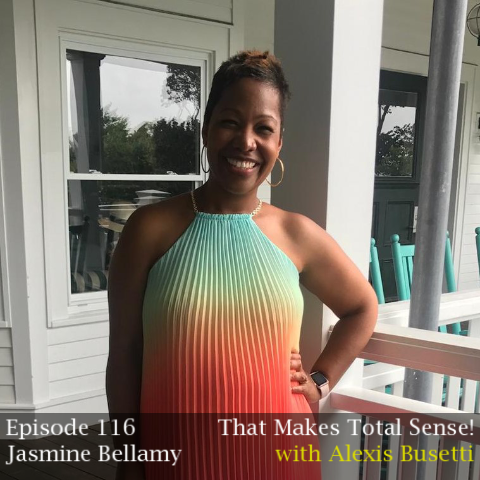
Speaker 1 00:00:07 Welcome to that. Makes total sense. A podcast dedicated to exploring God's generosity and justice. I'm Alexis. We setting the Christian aiming to ask good questions and encouraging you to do the same. Every one of us is wired by God to live out generosity and justice, but the house sometimes alludes us. That makes total sense is a way for us to get together, posture ourselves as learners and challenge one another to practice generosity and justice in a tangible way every day. All right, so you guys missed it. My guest today, and I have already, like, we've already been there and back, I've already teared up a little bit. Um, I don't know where this is going to go today, but I'm so thrilled to find out, uh, with my friend, Jasmine Bellamy. Hey Jasmine, how are
Speaker 2 00:00:57 You?
Speaker 1 00:00:58 Oh, I am pumped to be here with you today. That is for sure. How are you?
Speaker 2 00:01:05 I am well.
Speaker 1 00:01:07 Oh, I'm so excited. So Jasmine has like this really amazing resume that I'm not even going to start with because I will say I know Jasmine because we're, we're colleagues, we're students together at fuller. And so that's how I was first introduced, uh, Jasmine, you and I were introduced to each other through the council. And then as we, you know, as we do, when you're, when you're working with new people and you get to know one another better and better, and I'm like, I think she's corporate. I think she's kind of like, okay, I think she's kind of like New York corporate. And then like, I keep going, keep going. And I'm like, okay, Jasmine spill it. Your current gig is Reebok, but this is like, you're like, you're like in this industry, you're like in this fashion industry in a big way. So, I mean, tell us what you want to tell us about that. Sure,
Speaker 2 00:02:06 Sure. So I've been in the B hospital. Let me start first by saying thank you. Thank you so much for the invitation. Um, to me, one of the most, um, the most exciting things about life are invitations. And so I really like to look at things that way. Um, so I thank you for inviting me here and allowing me to be a part of this conversation. Um, and, and, and I also have to say, I remember who you are in that med student council forum. I loved you instantly. And so it's, so I'm super excited to be able to have this time with you. Um, and I'm, I'm, I'm here for wherever it goes and it's going to be fun. So I know that, um, so I have been in the, um, retail fashion business for almost 30 years. And, um, it has been a career that I've tried to lose at different points in time, but I got my, when I got my MBA at one point, I was like, ah, you know, I've always seen myself as a marketer. So I was like, I'm going to go, is it consumer packaged goods? But I was so already entrenched in retail that it just didn't make sense.
Speaker 2 00:03:22 And so I stayed, um, and you know, I've worked for great, um, corporate brands, um, department stores, specialty stores, um, you know, one of my highlights of my career and just in terms of brands, cause I am a brand lover. Um, I worked for gap. And so for me, one of the things so happy to hear you say that what I was going down, like, that's my favorite, it's one of 'em, it's such an iconic brand. Um, and I will tell you, um, my favorite part of being a part of that was being able to walk the streets of New York city because I am a native new Yorker. Um, and literally every day, wherever I was, I would run into humanity wearing a gap, arch logo, sweatshirt t-shirt whatever, every day there was not a day that didn't go by whether I was in the streets of Manhattan, um, you know, up on the upper west side or downtown or on a shuttle, you know, between the train or in a Starbucks.
Speaker 2 00:04:35 And what I loved about that is that, you know, I would bring me into my office, the view of those people because they were our customers and when we would be in meetings and we might think our customer was away, I had the reality check of who our customer was because I saw them every day, every day wearing our brand proudly. And so I always say that the one thing I wish I would have done it was like, literally take a snapshot of everything that I saw. I mean, from babies and strollers to construct men in construction, jobs, walking from place to place that I wish I took pictures of each one of them and that I could have just done a collage of the humanity that really embraced our brand. So I would always, that was just to me, I remember the one that, that I felt most impacted as I walked around, um, outside of work, if that makes sense.
Speaker 2 00:05:33 Um, also had the opportunity to work with celebrities and help bring their brands to, to commercial success. Um, you know, I particularly, I worked for Venus Williams, um, in the beginning and helped her create her brand, um, 11, um, seeing her win Wimbledon, wearing her brand that I helped create. Um, it's just, I can't even begin to tell you what that feels like and what that means. Um, I worked with Sarah Jessica Parker and helped her create her collection bitten. I worked on the other side with people like Nicki Minaj. So, and again, but understanding who they were, understanding people who had an affinity for them and how to make commercial success out of that in a way that that really resonated. So I've had a lot of fun things to do, um, throughout my career. Um, I've always said that what I've loved about what I do is that, um, you know, my part of my purpose in life is, is creating possibility.
Speaker 2 00:06:38 So it is that there is no blueprint, there is nothing in front of you, but you actually can ideate it and create it. And for me, because I am both head and heart and right, and left brain and analytical and creative, it all kind of converges together. Um, and I'm able to really rely on both. Um, and, and my strength as a collaborator, bringing all of the skill sets from other people to bear on that task is what really, really makes it sweet. So, you know, I would say that in terms of where I am now in my career, um, I'm having the time of my life because all of that is coming together. Um, and you know, particularly not only just me as a business person, but in my theological capacity, um, I never, in a million years would have thought that one, that I would have been in seminary two, that I'd be a law practitioner and three, I'd be doing those things at work right. Pre ever in a million years. And so that has, that actually has, is really, for me, made this season the time of my life, because I really am coming to work as my full self.
Speaker 1 00:07:55 So I had to stop myself from kicking up my leg, but I'm in my gap button flies right now.
Speaker 2 00:08:01 I love it. And,
Speaker 1 00:08:03 Um, it's, it's funny. I, I love the brand. Um, I worked at the gap in college and so, um, you know, cause everybody like what we work retail, we wait tables, you know, I, I did all of those things in college and, um, it's a problem when people do it in colleges, they never bring home a paycheck because they just are constantly wearing their paycheck was a problem for me. But anyway, I was a denim specialist. So anybody, you know, that, that was a thing 20 almost 20 years ago. It's fine. It was a thing. It was a thing for the business. And so now when I go in, you know, I at least know how to read the tags a little bit. The style is different, but anyway, so yes, I love that. When you talk about the humanity though, right? Th the humanity in the, in the brand, right. Um, just wearing it and going about our business, um, you know, going, going about that, um, good night. You never thought you were going to be in seminary. Never. I never thought I was going to be in seminary. I feel like that's how we connected originally. It was, we're like, we're two women who have no idea. Like how did we get here?
Speaker 2 00:09:10 And I remember specifically in 2018, someone saying to me, someone that knew me very, very well and saying, oh, I see you, you know, doing all these things. And I was like, I have an MBA. I'm like, I'm done with school. Like, I don't see it. I don't see any of that. And I remember like, what do you see? I see, like, as a minister or a counselor, I'm like talking about like, and I remember thinking I was the craziest thing in the world. Yes. And then I remember coming home and having that conversation with my daughter and she completely affirmed it. I absolutely agree with that. I was like, what? Like, I just remember feeling like what has just happened here,
Speaker 1 00:09:56 But isn't that great when people, I guess, this, this would be a great place to go. I think because when people call out in you sometimes what you can't see in yourself. Right. So, um, we were actually chatting earlier. I'll call out my friend, Michelle, this is one of the things she does. Well, um, she's been on the show and I'll, I'll link. It. She's super fantastic, but she calls out in people what sometimes they can't see for themselves. And one of the ways she does that, she did this with me when she was coaching me. And it was terrible is she had me text like 10 of the people who were closest to me and she wrote it. She wrote out this text, right. And she said, I want you to text this out and see what comes back. And sure enough, when we did that exercise, we started seeing these patterns, right.
Speaker 1 00:10:51 Of the people who were closest to me, the people who know me the best, and they were, they were calling out what they saw in me that they were all, a lot of them were calling out some of the same things, but I couldn't really see those in myself. So like your friend and your daughter calling these things out in you that were hidden from you, at least at that point in time. Um, and I feel like that is one of the things, that's one of the things that struck me. And after I'm doing a little bit more kind of really fun research, listening to some of the places where you've been recently in reading some of the places where you've been recently, this is one of the things that you're doing at your job.
Speaker 2 00:11:32 Yeah. Yeah. And it's so funny. I did the same exact exercise with, um, which is exactly how I got to the place where I understood. I created possibility. Wow. I had this ability to see what was not there. Um, and I hadn't, to your point, identified that as a strength, um, you know, I would also add plug for fuller, um, where we do Clifton StrengthFinders seminary. And when I tell you my Clifton strike binders are me to a T and what I will, but to that same point though, I had a conversation with someone recently. And when they sent me back a note and their words were almost identical to the Clifton StrengthsFinder summary, I knew that was a breadcrumb from God. Wow. Right. Because when you can start, so, so my number one and number two are strategic and connectedness. So I see all the dots and I see the big share and I see how they connect.
Speaker 2 00:12:36 And I see them in really quickly, in a way that can be overwhelming to most people. And one of the things that person identified that Clifton strength finder is also identified is I also have an ability to help people understand these very complex things, just the way I'm able to put it together. So, but to your point, what you, when you started talking about that ability to call out, I, I see it as honoring. Yes. Right. It's being, you know, one of the, and we didn't talk about this piece yet, but I'll just jump there for a quick second. One of the DEI behaviors that I, um, I rolled out into my organization. So Reebok is about being open to difference. And when you are open to difference, you actually can see the beauty in the other person. You get to see them as a gift, you get to see what they have to offer and what they are bringing to the table.
Speaker 2 00:13:38 Um, and oftentimes we just are moving too fast that we don't stop to honor. Um, I love it most, really from Martin Buber. Um, I, you know, seeing people as Val and not it, and when we do that, you are open to these other possibilities that you would have missed and moving so fast. So that's, so I love to do that. Right. Um, you know, I stopped meetings all the time when I did it literally yesterday, um, in the middle of a, of a meeting to be able to see people and let them know that I see them. And, and to be able to acknowledge whether it's the progress they've made, um, how, how inspired I am by the things that they've done, helping them to see how they grown in a way that they might not even had seen it. You know, I challenged my team yesterday to write their story.
Speaker 2 00:14:38 Like we've had an amazing year and to make sure they take the time to think about how they shared in that success and how they contributed to that success to honor. And so for me, um, honor is, you know, being hospitable, all of those pieces are so critical, um, to drawing out. Um, you know, I say it a little bit differently when we see each other as the, a Mongo day, we will see each other very differently. And so when I can see you as God's image, and I see the unique creative imprint of you, I can, I can receive that as the gift you were intended to be to me, but it's it. And that's because I really do practice in this space of, of love. And a lot of times we're just, we're really busy. We're moving too fast. We're on our own agendas. We're not thinking about anybody else. We're thinking about the to-do list and the a hundred things that we have to do. And we're actually not sitting in honoring the image of God in front of us.
Speaker 1 00:15:59 Let's take it there, Jasmine, cause that's really good. Um, and you're doing this in this space at Reebok, which is just super fabulous. Now, you know, Reebok has not turned into a theological organization or something. It's not a ministry, but you have a ministry at Reebok, um, in, in what you're doing and you officially are the head of, okay, help me head of direct to consumer us direct to consumer, right. Um, merchandising, planning, um, allocating logistics. But you're also this new title, head of change management for the United against racism yes. At, at Reebok. So connect those dots for us in part, because, um, in part, because I think one, I think a couple of things that we've seen, especially since, you know, 2020 is we can see, okay, are there orgs out there or are there people out there, but more specifically orgs and institutions out there who are saying, oh, look, we had some crap hit the fan in 2020.
Speaker 1 00:17:22 And, um, it, that was really gross and messy. And so we're going to have to like put on this DEI hat for a minute and, um, you know, satisfy, I dunno, shareholders, customers, whomever. So that's kind of one, you know, thing. Um, but the other part of it is, you know, so there's kind of maybe like the facade, I guess like maybe this veneer of like DEI, because that's, you know, is kind of trending and super important. And so we, so we say that, um, but then there's people and words and institutions, I think who are actually trying to do it, but there might be kind of this intangible heart piece missing. Right. Because it's easy to check a box. It's easy to say the right things. It's easy to have everyone sign into a meeting and say that this is happening. Um, and for nothing really to change inside of that institution or that organization or that family or that church, or, you know, whatever it is. And I think sometimes that ends up dissipating because people will say, well, I tried it and I did it and nothing really happened. And so then they just go back to status quo. Right. And the little view that I have had from what you guys are doing does not look like either one of those things.
Speaker 1 00:18:56 Well, what are you doing? And how are you making the connections?
Speaker 2 00:19:00 Yeah. So first I will tell you, when I got the call to take on this role, I actually said out loud, why did you ask me? And as those words came out of my house, my, my mouth, the holy spirit was like, you know what I asking you? And I was like,
Speaker 1 00:19:25 Don't you love how he's so quick sometimes though, right? It's like, what do you mean? Like, put 'em on hold. We're going to have to have a conversation doesn't matter. Apparently.
Speaker 2 00:19:37 Um, so, and I, I, I think the first piece is this, when I was asked to take on this work of culture change. Cause that's what it was, you know, as an organization, you know, we had been doing the things, you know, we had the employee resource groups, um, but we got to that moment and we knew there had to be more. And not only did we get to that moment and knew they had to be more, um, we were, it, we were very clear also the, at that particular moment that the success of the organization was directly linked to the black community and, and so much. So if you go back in time, you will see our social media campaigns. And then we then turned them into t-shirts that talked about that that brand had been built on the black community. And so we knew there was no way we could go past that moment without really a reckoning and a need to do something different.
Speaker 1 00:20:56 Yeah. Pause you right there. Because the thing that I, that the word that just like came into my mind was what, if we all realized our survival depended on one another? Yeah. Like what if, what would this world look like? What would the church look like? What would our communities look like? If we literally exactly what you said, like this is a brand, yes. This organization, the survival of what if we all had that in our heads, that my survival is dependent on you, Jasmine and yours is dependent on me. And mine is dependent on my sons and my husband's and yours is dependent on your daughters and we're all, and your neighbor and your pastor and your coworker and pure,
Speaker 2 00:21:42 You know why? Because love is interconnected. Yes
Speaker 1 00:21:45 Ma'am
Speaker 2 00:21:46 But then it goes back to the very premise of your podcast. The problem is we do not come from a space of abundance. We do not operate out of abundance consciousness. We operate out of, uh, out of a scarcity mindset. And so therefore you actually are inhibiting me from getting all the things that I think that I think I should have. And so I've got to push you out the
Speaker 1 00:22:21 Way, because the is big enough.
Speaker 2 00:22:23 That's right. Because I can't thrive if you're here too. And so, so we're going to get back to the other question, but the whole point is we have to change how we see and if we can see and understand that there is abundance, literally all around us. And if we can see each other as the image of God, if we can see each other as gifts, if we can see each other and receive them, hug each other as is spiritedly and with honor, and understand that we are actually receiving blessing as we receive others, like it changes everything. It changes your whole posture. And so I can come to this point in my career because I made an intention to practice love. And I made up a, made an intention to cultivate a love practice, because I wanted to understand how to live a life of love, right?
Speaker 2 00:23:25 Because this is the thing we like. And I've said this before, do we take the word of God seriously? And what it, like, what it says, like, there's a reason why it says love. God love your neighbor as self everything, everything, every law, every, everything falls from that. But we don't actually take that seriously because we actually don't think loving our neighbor is a realistic thing to do. We think it's some pie in the sky ideal, but what I know to be true, it is the hardest work I've ever done in my entire life, but it has transformed my life. And not only has it transformed my life, I've just watched the transform a community for the very thing that you just said. So we just celebrated global week of inclusion. Reebok's global week of inclusion that I raised my hand to say, we've come a long way.
Speaker 2 00:24:36 And we have our own work to do. And we're and our own story to tell, and our own moment to sit and reflect, and we need to do this for ourselves. And so in one of the reflections of a team member, they said, we're still here talking about it. Like I've never been in a company that we're still here talking about it. And so, so what has happened is we've made this a part of our culture. So it wasn't just that we said, okay, we need to educate everybody on what are the issues of the DNI diversity equity inclusion? Um, so yeah, we did all of the trainings on microaggressions and privilege and unconscious bias. We did all of those things. We did 23 hours worth of training within our teams, but I knew that that was fundamentally not enough. And so it wasn't just here, go watch this training, check off a box, have a conversation and say you did it.
Speaker 2 00:25:39 I created a platform called courageous conversation. And the whole premise behind change management was that one, we needed to see ourselves as a community too. We needed to be able to communicate and have courageous conversations. We needed to have courage and we needed to be committed to change and change doesn't mean that I get to decide how you change change is all of us doing the internal work and being honest with ourselves on, and also being graceful with ourselves, understanding where we are opening to difference and being open to where we might go. So we create a courageous conversations as a platform to create a bridge of understanding and empathy.
Speaker 2 00:26:42 And that's where we, so when we were, so you weren't just doing the training, we had a courageous conversation after the training where we could be in community and have a courageous conversation about it. So we were also deepening the education. So we were going beyond whatever video content you went through and we were educating. And so I bought in, um, uh, a courageous, courageous conversation partner, um, and, and, you know, professional consultant. And we led the organization through, let's talk about this even more. Um, and then let's open up and have conversations. Now people have called those conversations, a mix of therapy and church. Wow. And I mean, and that's people just in the chat, just throwing up, like, I felt like, you know, this person ministered to myself, like, so it has been, but then other people have said, this is my therapy for the week.
Speaker 2 00:27:46 Like I'm ready to sign up for that. And so to date, we have had 15 courageous conversations since October of 2020. Wow. And they have become the lifeblood of our organization. And so we, our last conversation, courageous conversation, we have over 550 people holding space. And we use that as an opportunity to talk about educate, um, uh, announced our global DEI behaviors, that we are all going to live by in community. And they came out of all of those courageous conversations that we've been having. They came out of literally the words that out of those, those dialogues were just naturally arising. I'll tell you a funny story. So I got it. So this is the funny part about it, right? Like everybody feels like they know me. Right. And I I've been in space with them, but I don't know them personally, but people know, they know me, which is, which is sweet.
Speaker 2 00:29:00 Right. It's very, very sweet. And so I got an email from somebody this week and they said, I just want you to know I'm such a fan of yours. And like, I'm, I've been with you and I, and they, and they have, they actually have. And they said, and you know, one of the things I noticed that have, has come up all the time in our courageous conversations is paused this ability to pause, see what's happening here. How am I feeling in this moment? Um, what might be happening here? How can I be conscious about the next step that, I mean, do you know, she made a sticker and all of her teams have pause sticker on their laptops. And so someone said, you should tell Jasmine about them. And so she reached out to email me to tell me about her potstickers and then with like, would you like, and I was like, I would like one.
Speaker 2 00:29:54 So I like one. So I say that to say, that's like, it is a it's seeds being planted. And it is, it is definitely reaping a harvest all over the place. Um, but just like a little example of that, you know, I had a colleague who wrote me a note after I started to share my story. And he said to me, you know, white male, he said, you he's like, thank you for what you were doing. Thank you for having this platform. And he said, you know, like you were waking me up cause I was asleep for far too long. Those like bat his words, I carry with me to every speaking engagement because that's what it is about. It is about opening to difference. Um, and really, you know, I, I love the words of Jeremiah, right? Different does not mean deficient and like, but, but what we don't realize that we're up against in culture, particularly in business, that's not how be it, the age of enlightenment has shaped us.
Speaker 2 00:31:05 When we see each other as competitors. When we see that we're looking to weed out the weak one, when we're like, that is all the antithesis of love. And so I, I call it joyful disruption and that I'm really looking for a new way to do business. And so if we can do business where we can honor the human that is in front of us and, and, and we allow humans to really come to work fully integrated as their whole selves, their gifts can bear on the organization and collectively we can produce great food, but I'm going to tell you the one thing that I tackled the most is the culture of fear that is prevalent in business. And that is the opposite of love. Talk more about that. What'd you have perfect love, casts out, all fear, right? But that, that whole spirit of fear is what prevents me from showing up as my full self.
Speaker 2 00:32:18 It is the thing that makes me smaller. It's the thing that keeps me silence in muted. It's the thing that doesn't make me feel good enough in the space of other people. So as we dismantle this, this culture of fear, and then alternatively create a culture of love of welcome of belonging. It allows people to really show up as their full self. And that is where, when people are really showing up in their full selves with their greatest potential, that is what produces the greatest creativity. And then therefore that turns into product services that we deliver to our customer and increases our, our, our shareholders. Right? So that's the thing it's like, we don't, we're not realizing that by, um, the, that we, that it's about harnessing that collective creativity that produces what we're delivering to the marketplace.
Speaker 1 00:33:24 So what, what on this subject of fear, because when you say you see it in the business world and talked about how the business world is effected by the alignment, we're all affected by the enlightenment, right. He goes, you know, kind of goes back to what you had originally talked about, the difference between scarcity, scarcity and generosity. I I'm in abundance. Um, but I'm thinking, what, what are you seeing fears of what in the business world? Because I think that it would probably just translate to us as individuals, as Americans, right? In this American culture, which is very much a driven business. Individualized, I get mine, you know, kind of culture. So what kind of, what kinds of fears are fears of what are you seeing, um, in the business world? Because I just really think that it will translate to us.
Speaker 2 00:34:18 Yeah. I mean, one, I, you go back to Maslow's hierarchy of needs, right? It's it's based in security. So if I am fearful that my job is at risk, that goes directly to making me insecure. So if I think saying something in a meeting is going to put my job security, a risk, I'm going to take an approach that tries to keep me safe, but keeping me snake safe. If we're focused on that, it can make me small. And it means I'm really not showing up is me. So for me, I will tell you, I am at a place in my career and in a place in my love practice that my security only comes from one place and that's the divine. So I love my job. I love what I do. I love my team. I love every single thing that I do there, but there's only one person or one being who holds me secure.
Speaker 2 00:35:36 And I have, uh, I'm at a place of surrender and trust that I know that is that the safest place for me is in the center of God's will what I also know. And this is another piece that goes to what the fear is around. We think we have to know everything. We think we have to, we have the answer to everything. And if I know anything, and Paul says it in first Corinthians 13, nine, we know in part. And so I'm real comfortable with the fact that I know in part, but I know who is on mission. And so again, if I can be in the center of all that, I don't need to have the answer, but that goes back to the, when we think we are driving to our own conclusions all the time and things don't look the way that we are, then we start spasming out. But it goes, and I literally just wrote about this earlier this week, self-reliance versus God realized, I know which way I'm going.
Speaker 2 00:36:42 Like, it's a no-brainer for me. Right. So I don't have to know. What's like, I'm, it doesn't mean that I don't have a vision for my life or the things that I think that is doing and where I might go. But when I tell you, I am focused on being present, because if I am focused on being present that's first of all, that's the only moment we have, let's start with that. Right? So if I, if I'm focused on being present and I am being aligned, or I'm in alignment with the will of God in this moment, God, God is the one directing where I'm going next. So to me, my biggest focus is on making sure I'm following me and I'm, and that I'm alive. That I'm, that I'm because that is the supernatural power that is gonna make all the things that, in my limited mind, I can't do. Anyway.
Speaker 1 00:37:31 The thing that came to my mind when you're talking about that, so security one, right? Which that's like, I, I don't, I don't know how much you do Enneagram stuff. I'm an Enneagram six. And this is like, there is nothing more important to your average, six than feeling safe and secure. And that is the absolute truth. I used it at my husband's previous company. He would, he would come home and I would say things like this was, we were, we had just had our first kids and I was staying at home. And so this was kind of like all this life shift and he would come home and, and he would say, I was like, how's your day? And he's like, he's like, yeah, it's fine. It's like, I had some meetings, like one of them was boring and I knew I wasn't, it doesn't need to be there anyway.
Speaker 1 00:38:10 And so, so, you know, I stayed for about 30 minutes and I left and I was like, whoa, whoa. Like what you left? You know, because I'm like, this does not feel secure to me. Like, I need you to be everything. I need you to do all the stuff and check the things so that, you know, but he was of course his incredible employee. And he did, you know, and he was not in any danger of losing his job, but I could not handle even his decision-making at work. Right. Because I was just like, I had to have, I had to have the security I had to control let's stop. Anyway, I had to do all those things. Right. Because I was afraid it was what you're saying. It was a fear-driven it wasn't, I wasn't trusting. I was just, I was just afraid. And, you know, because at that moment, my security felt like it came from the paycheck that came from that company.
Speaker 1 00:38:50 Right. And not necessarily from the Lord, but when you were talking about having the answers, right. There's this, to me, the place that, that went was identity. And, and, and I'll, I'll tell you why. It's kind of a weird, it's kind of a weird thing, but I started thinking, as you were talking, when I started the podcast, one of the things that I wanted to do was have a space where we could ask questions, right. Because my faith tradition, I grew up in a space that was very much focused on having the right answers. And if you have the right answers, then everything's good. Um, and then I started realizing, I don't know that we really know the right answer to a lot of this stuff that we kind of think we do, or that we, we, we say as black and white, you know, I don't know how much of it necessarily is what would happen if we just started asking better questions, you know, um, more thoughtful questions.
Speaker 1 00:39:51 This is a question I'm asking of myself, right. Alexis, what would happen? You know, if you, if you quit trying to have all the right answers all the time and just started trying to listen enough to ask some semi-intelligent questions, which is what I attempt to do on the podcast every week. Um, but there's also this movie that my kids and my husband, like, that's super annoying to me, but one of the, one of the lines in it is that the main character says, okay, okay, fine. You were right. And I was slightly less, right. I love that. My kids just love it. My husband laughs and I laugh because that's him. Um, you know, but it's like, but this identity piece is kind of where, you know, if I can have the right answers, if I can be right. If I can know the things, at least for me in my experience that says some that says something about me, um, except that's really not true.
Speaker 1 00:40:50 Right. Because my identity is found in who God has made me to be and who I am becoming. Um, we talked earlier about Mikayla Donnel and other, another fuller woman. And, and she talked about what freedom there is in becoming amen. Right. So if we're, you know, that, that part of our ID, but for me, the identity has been, what do I know? What am I right about? Right. Like, you know, the place and, and becoming, it does feel a little bit unsafe in some ways if you're not used to it. Right. Because it feels a little bit unstable, um, in some ways, but when we're able to get over that a bit and just say, you know, you're, you're, you're unstable. You feel unstable because God is forming you. Like you are becoming like you're growing. And so it's like, you know, I mentioned earlier, we have a massive, and like when she was in her weird puppy stage, you know, I'm like, she is not a graceful looking dog when she runs and she's real lanky and weird, you know, as she's, but when she was growing, right, she was like, growing through this, her legs hadn't caught up with her ears yet.
Speaker 1 00:42:00 And it was kind of this bizarro look, but I mean, it's okay to look like that. Right. Because we're, we're becoming,
Speaker 2 00:42:08 Let me tell you, becoming is one of my favorite words next to transformation. And the difference that we're talking about is being versus doing right where we're talking about identity versus the performative and culturally, we are very geared toward the performative. Right. But even, you know, but it's funny, I'm, I'm results driven. I mean, I don't, you could ask my team, but I, but, um, it's, it's much more about me almost competing with myself and to your point asking the questions that make me grow even more that, I mean, I use the same thing in life that I use for business in that sense that I'm constantly doing introspection to see where I can keep growing and where there's opportunity. Now there's a couple of things I want to just share with that, to balance it a bit though, I'm also a huge practice of, um, or grace is, uh, a major practice as well, because in all of these things, we can be overly self-critical and all those things.
Speaker 2 00:43:36 But what you said that I love is curiosity, right? We can, I literally just posted a reflection today that I wrote two years ago and it was written, um, and it was about ego fun topic and what I could, what I love about all those lovely Facebook memories. And I then in the beginning of the ministry, I wrote every day, that was how God trained me, honestly, to be able to be able to have this conversation with, you know, I wrote every day for, I had a writing practice for a good two hours. But the beauty of that now is that I can actually see those things that I wrote several years ago. I can see how I've actually grown. I can also see how those, those trues are timeless. And I can actually see the result of my practice because I can see the growth that has happened.
Speaker 2 00:44:39 So curiosity is asking ourselves, you know, it's funny in one of my classes, I think they, we had to ask one of the things that we were going to do from a developmental perspective or whatever, as a cause I'm also a practical theologian. And I said, I'm like, I am committed to keep like, finding better questions to ask, like that is such a worthy endeavor. Um, whether it's of ourselves, whether it's other people, whether it is of institutions and cultures asking the right and better question, it's such a skill. Um, and so I say that to say, I can, I can ask myself questions that honor myself and also offer myself grace at the same time. But also in doing that, it allows me to open up to see what the holy spirit is doing and when we are, and that allows me to then be, be in this posture of becoming versus in terms of what are all the things that I am doing.
Speaker 2 00:45:49 What is the thing that I think I have to pack my cell phone back. And it's funny, I'll give you this an interesting way to think about it doing versus being. So I was recently named as one of the top hundred influential black women in sports couple of years ago that would have felt like a check. Like you've accomplished something, you've reached some milestones, you've done some great thing. What I was asked, like when the person was like, we wanted to do, we want to tell your story? And I was like, you want to do what? Like make, like, why? Like, but what was the gift for me in that was not that I was put on some list to be top. It was the gift of the conversation and the exchange. And what was beautiful about it was that the woman who interviewed me Madeline woods was an icon and on black enemy and entertainment television, what in the nineties, when I was being shaped as an adult, going out into the corporate world and she was brilliant and beautiful and bold. And she helped me see myself.
Speaker 2 00:47:13 So after she got all her interview questions out and she did a skillful job, looking into my story and asking the great questions I poured into her, I, I, and I was like, okay, now that done, I need to tell you what you meant to me. And that not only just what you've meant to me, so many women that look like me, you helped us have confidence in ourself. So you'll never ever know how many of us, you have a generation of leaders who you shaped and who you were the model for. And you have no idea, but I need you to know that you were, that spirit wrote that article. That was the beauty. Is that for me, I could do nothing but weep when I read it, because the way she could tell my story because of how I also hoard into her, it was such a beautiful exchange and honoring that took place in that space.
Speaker 2 00:48:29 That to me, was the beauty of that acknowledgment, not a list, right? So that's what I'm talking about. When I go, there's just a whole nother way to live life, to live a life full of love. That is Paul's challenge to us in Ephesians. And what I've learned is to actually put that word into practice. That's what I'm building. And so what I know, I, and I say these, all these words all the time, I know it to be true. It is my lived experience. And so my invitation is really for others to do the same, to walk alongside me in their own journey, living a life full of love, because we have no idea. <inaudible>
Speaker 2 00:49:33 if I go back to your other question too, it is supernatural power that comes to bear on our behalf. When we do that, it is not about us driving to our own conclusion. It is not about us operating in our own strength. When we operate from a, or through a lens of love, we bring the holy spirit to bear with us, to knock down walls, to push through tension, to create transformation, to plant seeds that later grow to change in a way that we can not do by ourselves. So Reebok couldn't be transformed on my agenda.
Speaker 2 00:50:26 Reebok could transport transformed because I opened up an opportunity for an exchange and for conversation and for understanding and from inquiry and from openness and for people to see each other into find strength in community. And that is transformative because what I knew before I started that work, this work is spiritual work, and I will tell you, I got hit with when I, when I really came to bat, I sat there and I literally said out loud, how do I do spiritual work in a secular space? And the moment I said it, the answer was already there. And if the answer has guided me through it all, but it's recognizing it. I literally allowing the holy spirit to guide me to, to have access to this space, to change hearts and minds, renew hearts, and minds, to transform people, to help people grow in a way that Jasmine Bellamy never could.
Speaker 2 00:52:04 I just was able to use my influence to create the space for it. And so that's when I, I can't even begin to tell you, um, I get included on so many people's emails where they give their testimonies about what they feel about being in the community and the culture and the war. The reason why they came here, because they knew I couldn't have done that. That was not in my own human strength, but it is the change agent. It is the counselor. It is the transformer. It is the breath of life that is creating new life in the hearts and minds of people. And when we, when we position ourselves for, for love to enter, all of those things are accessible tests.
Speaker 1 00:53:07 Jasmine, we just went to church,
Speaker 2 00:53:09 Listen
Speaker 1 00:53:13 And therapy. I mean, I'm, we're in a courageous conversation right now. So We are, but, you know, I mean that, that's kind of, it, that's kind of a good place, you know, when, when, when I was about your creative conversations and kind of exploring that a little bit more before we talked, I thought, yeah, because if love is anything it's courageous
Speaker 2 00:53:35 Sure is.
Speaker 1 00:53:36 Right. Um, and, and it, and it fills us with courage, but, but love is not easy that that's not in the Corinthian chapter right there. Oh, love is easy. It's fine. It's no, let's love is love is a courageous to act out of love is to act in courage,
Speaker 2 00:53:55 The hardest work you've ever done. Yeah,
Speaker 1 00:53:58 Yeah, yeah. Um, gosh, here's the truth. I would say I could talk to you all day, but unlike some of my other guests, I get to talk to you at school and in meetings and things like that. Um, and so, and so I'm super thankful for that. Um, as we start to close up this conversation though, um, I have, uh, a couple of questions and I'll just, I'll just leave you to answer them. Um, first, you know, as we end, I want you to tell us, I'll put it all in the show notes, but the places that, where we can find you, but the other thing is, and I did totally do not prep you for this. Um, but do you have off the top of your head, any, um, resources that you just think if people are interested in their own spaces and communities, or for their own edification, at least to start, because it's about the community, for sure.
Speaker 1 00:54:46 It's about connectedness, um, any resources that you have found that really, it doesn't, it doesn't have to be necessarily like on topic. Doesn't have to be DEI, doesn't have to be anything like that, but just some of those, um, places that have been really meaningful for you or that you've seen have impact, um, in, in communities that you have worked with that maybe are accessible for other people, just to kind of get those balls rolling in the head, right. To, to start to think about what are some questions that I could start asking, or how could I move towards love and towards people, um, in a courageous thing.
Speaker 2 00:55:23 Yeah. I mean, I would, of course first send people to my website, um, or to the ministry's website loved 1 0 1 ministries that come there in there is a seven day devotional to, to prac to begin to figure out what it is to practice love. Um, because to your point, it's not easy. It's not emotional, it's not some warm, fuzzy feeling, right. It is, it is, it is a, a conscious, um, act of, um, unselfish concern for another, without losing yourself right. And honoring God, right. That the image of God in YouTube. And so I would just say that's an easy place to start to, just to get to feel, especially that connect that theological to the practical, because that's what my whole work is, is that it's not just some words that we hear. We don't just say, God is love and keep it pushing that it's actually, that means my DNA at me.
Speaker 1 00:56:25 I'm going to put that on a, t-shirt just say, God is love and keep it pushing.
Speaker 2 00:56:30 So right then it's like, it is literally about how do I build a house on that foundation, right. That that is not sand, right? Like it's, it's, it's all events. So it's, it's really, um, it is really the good, I mean, I'm, I'm of the mindset that love is a critical element of the Missio DEI. That's just, we don't talk about it, but it is. So I'm really about helping us to understand that because when we have that as our, our foundation, we will, um, operate appropriately in, in terms of any challenge or tension that arises. And that's why for me love is the practice. That is the framework for the justice, diversity equity and inclusion work that I do. It, it is all from a posture of love. I will say what I'm reading today. Um, that I, I mean, first of all, there's a hundred books literally on the side of my bed.
Speaker 2 00:57:28 Um, but the one that, um, I've been reading slowly, um, that just sets my heart on fire is all about love by bell hooks. Um, but you know, the interesting thing is, and I'll say this really quickly as we come to what I love about my journey for me is that it literally has been revealed truth along the way. What's funny about that is it's revealed truth to me. Like literally things I've never thought of heard of, but the words have come to me. But the beauty of being a seminary student is that I've been able to go back to central across centuries and actually find that people said the very same thing. And so, while I believe that when I came up with, or it was revealed to me that love is a practice, I had no idea that bell hooks said it before me and Eric farms that it before her, or even, probably even Augusta, right. Do you send and say, like I had no idea, but it was revealed in me and, but what's been great is now I can go back and see that the building blocks. Um, so I say that to say, um, bell hooks has, is, um, all about love has just definitely been warming my spirits these days. Um, so that would be, um, a particular recommendation that I would offer. Um, in addition to the, the loved one-on-one ministry is website.
Speaker 1 00:59:02 Isn't that? So, um, that's just been really affirming to me too, right. To see, um, the, our church for parents and what they experienced and what was revealed to them, you know, by the holy spirit. It's exactly, as you say, um, you know, and, and I think, well, we look so different, you know, than our, you know, we don't, we don't practice asceticism in the same way, or we don't do you know this or that, or I'm not living in a monastery for sure. You know? Um, but it's like, but people are, are people right.
Speaker 2 00:59:35 Well, and to be honest for me, Augustine, Teresa of Avila Henry, now when bell hooks, all of them equally impact me.
Speaker 1 00:59:47 Yes, yes.
Speaker 2 00:59:48 All of them together. Um, I just finished reading interior pass the other day and I was just like, oh, everything that I've just gone through my own personal transformation. She understood it. Wow. Yeah. Like, so I'm, now I know I'm not alone here. Right? Like, like holy spirit. I knew, but now I, for real know that she knew too, and that feels great in confirmation. Like, I love it.
Speaker 1 01:00:15 That's like a whole other conversation that I'm like, well, we'll just come back. We'll have it in another time, we'll have virtual coffee, but this whole idea of the church community, including our ancestors. Right. Hello. I'm like, this was, this was like, not on my radar for, oh, I don't know. 38 years is fine. Yeah. Right, right. And it's like, but this is part of our community. You took Dr. Bantu. And he always talks about the Hebrews versus the right of like, of, of, of the, of our forefathers. Right. And it's like, oh my goodness. This is just so good. So anyway, um, well come back and we'll talk to theology, like, um, oh, thank you. Thank you. Thank you, Desmond. This time has been so special for me. And so, um, as we prayed before we started, and, and I just wanna, I just want to say that now I just, I just pray that it is a blessing, um, that first, that it was a blessing for you and that it will continue to be, but also that just everybody who's listening and everyone who hears this, that, that, um, they would just take, be able to take something from this, um, from the spirit and, and run with it wherever, wherever he would have them to go.
Speaker 1 01:01:28 So thanks for joining me. Thank you. The links for all the resources mentioned in today's episode can be found in the show notes, music, and podcast production by Seth B city. Be sure to give us a review on iTunes and subscribe at your favorite podcast listening app, you can also visit us at that. Makes total sense.com