Episode Transcript
Speaker 1 00:00:06 Welcome to That Makes Total Sense, a podcast dedicated to exploring God's generosity and justice. I'm Alexis Bassetti, a Christian aiming to ask good questions and encouraging you to do the same. Every one of us is wired by God to live out generosity and justice. But the how sometimes eludes us that makes total sense is a way for us to get together, posture ourselves as learners, and challenge one another, to practice generosity and justice in a tangible way every day.
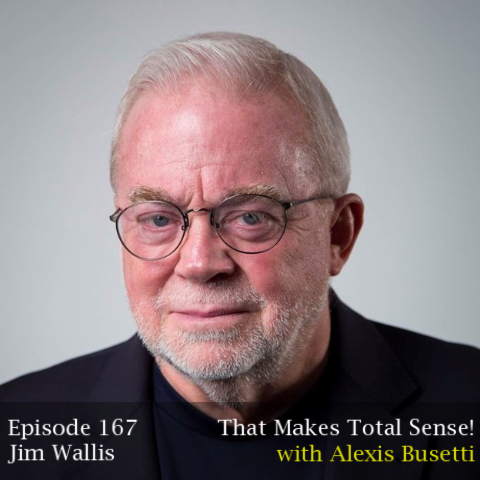
Speaker 1 00:00:41 I feel like I should start this episode by saying like, I'm sitting with the man, the myth, the legend <laugh>, Reverend Jim Wallace has joined me today, and I am incredibly grateful, Jim. I'm grateful for all of your work. I'm grateful for how this isn't just work for you. This is not just an office, a place where you go in and, and, and clock in and clock out, but you have made pursuing justice your life. And, um, we're so grateful. Those of us who are in the community now are so grateful for the, the trails that you have blazed and, uh, and that you continue to, to blaze in this space. So thank you so much for being so generous and coming on with me today.
Speaker 2 00:01:33 I'm grateful that you and I are in this work together, <laugh>.
Speaker 1 00:01:38 Well, that's very sweet. Um, Jim, we got to spend some time together this summer at the Georgetown Center on Faith and Justice that you have just started in the last year or two. And that was an incredible time. And some of the words that you spoke to me personally and that, um, and that I heard that week will just continue to ring in my, in my ears and in my heart. So I'm, I'm so grateful for that. For people who may not know, um, Jim founded Sojourners. What year was that, Jim?
Speaker 2 00:02:18 Well, that was, uh, <laugh> a long time ago. 1971. About 50 years ago now. I was only six at the time.
Speaker 1 00:02:27 <laugh>, right? I mean, yeah. So, I mean, complete, complete genius in this space, really,
Speaker 2 00:02:32 <laugh>. 1971.
Speaker 1 00:02:34 Yeah. 1971. And you have recently stepped down from that and moved on to, as we mentioned, the Center on Faith and Justice at Georgetown. And so who is, um, who's kind of at the helm at so drummers now?
Speaker 2 00:02:45 Adam Taylor. Adam Taylor, who's, uh, actually, he was in the first class I ever taught at Harvard on faith and politics. Wow. And he was there. And, uh, he's been involved with us ever since, uh, on our board chair of our board for a while. And I brought in the executive director for two years before he's, and now he's the president of Sojourners. And he's really, I, uh, I could see the 50 years coming and I decided I didn't want to be at my desk the morning after the party. Uh, founders often screw up their, their legacies, and I wanted to not do that and turn this over to a new generation. So the next 50 years I wanna start with the new, new generational leaders. And Adam is so, uh, archetypal of that. But then, uh, you know, the Georgetown, I didn't know Georgetown was coming at all. Uh, and Jack Joy, the president there, offered me this wonderful, uh, new venue. And when somebody wants to take your, the two favorite words in your life for me, faith and justice, and turned them into a chair in the center to kind of make you a happy camper. Yes.
Speaker 1 00:04:01 <laugh>, Yes. And amen. Yes.
Speaker 2 00:04:03 Time.
Speaker 1 00:04:04 Yes. Well, Jim, one of the gifts that we received, the, the, um, participants in your inaugural, uh, summer program at the Center on Faith and Justice at Georgetown the summer was one of your, I mean, you've got a lot of best selling books, but this was, this is like a really special one, partially because you begin with your story, but this is called America's Original Sin, Racism, White Privilege in the Bridge to a New America. And this is gonna be, of course, the topic of our conversation today. But I feel like it's crazy because I had heard this America's original sin and really had no idea for years where this term came from. And so, if it's okay with you, I wanna start there. And then I want to, um, just read this quote, this, this sentence that you wrote, and then, and then let you kind of take over how that <laugh> Sure. The consequences of that, uh, of that statement. Sure. So you wrote, The United States of America was established as a white society, found it upon the near genocide of another race, and then the enslavement of yet another. And these are what you have called America's Original Sin.
Speaker 2 00:05:36 When I first wrote that down, I was in a, a study guide actually, that we started with a study guide called America's Original Sin. And I wrote down that sentence in an article in Sojourners. It probably is the most controversial sentence I ever wrote. Uh, and I got just floods of responses saying either that it was outrageous or it was courageous. And if in fact it was neither, it's just simply a statement of fact that's right in our founding from the very beginning. And, um, sin to use that language, America's original sin in all art traditions, uh, sin requires repentance. And repentance does not just mean feeling guilty or sorry or ashamed, and then go back to your binge TV watching in all in, in Judaism, Islam, and Christian faith. Repentance means a turning around a turning around into New Testament. It's metanoia, uh, metamorphs turning around. We're going the wrong direction, turn around and go in a whole new direction. So repentance requires that turning around, and that's what, that's what we're, uh, wrestling with every single day now.
Speaker 1 00:07:00 Yeah, I mean, this book covers, I, I was kind of shocked when I cracked this cover of, of how much you were able to, to, to cover in this book. Repentance is one of the main mm-hmm. <affirmative> subjects, though of this book. Because if we have, as a society a sin that is this long, this big and lurching, then repentance has to be a part of our future, or we'll, we'll die
Speaker 2 00:07:37 <laugh>. Mm-hmm. <affirmative>, Well, repentance, uh, is gonna require, uh, repair, repair and restitution and redemption of that America's original sin. And you mentioned conversion before. And I remember, I'm from that evangelical tradition. So I remember my first conversion. There was a revival. Preacher was coming to our church on a Sunday night, and all the unsaved kids had to sit in the front row where they thought, the closer you are to a sermon, the more impact it'll have on your life. So it was fire in brimstone. He pointed his finger, it felt like right of me and said, If Jesus came back tonight, your mommy and daddy would be taken to heaven. You would be left all by yourself. It got my attention. Um, and I realized, uh, I was getting up in years. I was six. The, I would've a five year old sister to support if that were to happen.
Speaker 2 00:08:44 My care mother told me about the love of God. The God loved me, and wanted me to be God's child. That sounded better. So I signed up. But my second conversion came later when I was a teenager. I was born and raised in Detroit. When I was about 16. I began, I would say, listening to my city, um, hearing the news, reading the papers, and then some books and, and having conversations with adult people. Uh, and I soon realized they didn't want to, uh, talk about the things I was learning, cuz I, as you just suggested, I began to feel like something very big and very wrong was going on in my city, in my country, and my church. And so I ask these questions, I tell my students at Georgetown, Trust your questions and follow them to wherever they take you. And so, my questions took me into what we call back then, the inner city.
Speaker 2 00:09:47 You know, uh, and I, I, I, I took, I needed money for college. So I took some jobs alongside young black men in Detroit hoping they could help answer my questions. Why was white Detroit so different from black Detroit? Um, why hadn't I ever heard about, uh, that there were black, black churches or, or visited them or have them visit? So then I met these young men, and their life stories were so different than my life story. And eventually their life stories would change my life story. Uh, and then I went to black churches and just showed up. And they were so kind and warm and welcoming, patiently answered my obvious questions from this naive white boy. Um, and I learned how to be a black Christian in America was quite different from being a white Christian. And, and, and I had these epiphanies, you might say, and maybe the one that struck me most deeply was I, one of my new friends, uh, fellow janitor and, uh, elevator operator, that's how old I am, uh, invited me home for dinner with his, his, uh, his family.
Speaker 2 00:11:04 And, uh, his mother responded to a conversation he and I were having about the Detroit Police Department and how they treated black people and how that was causing these confrontations in my city. And I, I'll never forget her word, she said. So I tell my kids, if you're ever lost and can't find your way home, when you see a white leaseman hide under a stairwell, hide behind a building and literally passes to come out and find your way home on your own. And when she said that, my mother's words to her, five kids screamed in my head, Um, you ever lost and can't find your way home? Look for a policeman. The policeman are your friends, and they'll bring you home, home, take you by the hand, bring you home safely. So here's two mothers giving very different, uh, advice to their kids, depending on them being black or white.
Speaker 2 00:12:06 Uh, two mothers, two worlds. And I realized Butch and I had been born in the same city, but lived in different countries. And I found this whole other world, um, waiting, <laugh> still waiting to be fully, freely and safely included in America, these two worlds. So, so to me, um, I've always learned, my worldview has been shaped mostly by being in place that was never supposed to be. And being with people I was never supposed to meet or know, or talk to or become friends with. And so, for, for me, um, uh, those two worlds, uh, now, um, <affirmative>, we have this prospect of a multiracial democracy. Crossing the color line has changed my life again and again and again. Now we have to cross the color line to democracy. And that's the only way to repent of this sin and redeem it ultimately.
Speaker 1 00:13:15 Well, this is one of the things that stood out to me when, um, when you and I had our one-on-one conversation in dc and then it, it comes out so prominently in your book is exactly what you're talking about. So, um, so I shared with you that I'm a mixed Hispanic woman. I I check a lot of boxes, right? When I'm, when I'm asked to, to check them. And you told me, and this is, this is one of the things that, that has impacted me. And I, I, I hope I, I keep this moment in my head. You told me, A, you encourage me to continue doing the work and b, because the future of America looks like me.
Speaker 2 00:14:02 Mm-hmm. <affirmative>,
Speaker 1 00:14:05 And that I, I've been hearing that since I was in grade school, right? That, you know, by the, by the time we have kids, and by the time we have grandkids, you know, all of this and all of the stats. But to see it happening, you know, and then, and then to ask ourselves, you know, you and I in our communities and the people listening to this as faith leaders, what our role is in that, in this country, in this time, in this space, um, is a really big deal. This is what you're, this is what, in this book you call the bridge to New America mm-hmm. <affirmative>, But like the bridge in Selma and what happened on Bloody Sunday, unfortunately, there is still a lot of resistance to exactly exactly what you're talking about, this growth that you're talking about in democracy. Now, there's, there's just like, there was physical resistance on that bridge. There's political resistance. Now there's, I hate to say it, but there's religious resistance against that now. Um, so I mean, help for, as someone who's been in this work since you were six, Jim, I mean, <laugh> help us out. What do, what do we, what, what does that look like for us?
Speaker 2 00:15:29 Well, you know, there's, there's a lot of white people I talk to who, uh, who wanna put all these questions behind this, um, you know, slavery's over, right? And didn't, not King and Rosa Park's civil rights move wouldn't fix all this stuff. And can we just stop talking about this? The answer is no. And now, more than ever, uh, America's original sin is making a big comeback. It lingers. And it, as Brian Stevens said, it, it evolves. Now it's making a comeback because of what you just said. Uh, the threat of a genuinely multiracial future in America is the elephant in the room. And all the politics in Washington are on ev every issue. So now, this old ideology of America's original sin, as I call it, is combining with an old heresy called white Christian nationalism. And that's not new either. Uh, it goes way back to the founding of our nation that's making a big comeback in churches.
Speaker 2 00:16:43 Uh, a lot of these megachurches are really, uh, preaching what I call the false gospel of white Christian nationalism. I mean, the name spells the heresy of it. Uh, it's white. Well, you know, with the most inclusive, uh, diverse, uh, call in all the world, the body of Christ is the most diverse human community on our planet. So to say white is a heresy, uh, Christian. It, it implies domination, not service here and nationalism. We have this call from Jesus to go into all the world and make disciples of every, every nation. So this is a heresy, it's a grievous sin and, and a heresy, but it's coming back. And so, um, and at the polls, I'm working in 10 states now, uh, where voter suppression is, uh, is most, uh, threatened. And we're working with, uh, a network of clergy that's multi, it's multiracial, it's multi-faith, it's multi-generational, and trying to protect the vote.
Speaker 2 00:17:57 Uh, when, uh, I got to march up the Edmund Pettus Bridge in Selma with John Lewis at the 50th anniversary of Bloody Sunday, um, I realized that, uh, uh, we're not done yet. We're not done yet. And John Lewis called the vote, He said, Almost sacred, uh, almost sacred. Uh, and, and I think what's at stake is really, uh, from the first book, first chapter, first book of the Bible, Genesis 1 26, where I love the text. Imagine all the political noise going on right now before the election, but the text be begins with then God said, and all the noise. Then God said, Let us make humankind in our own image and after our own likeness. And God did mean all of us in the image of God. Imago Day is the ancient word. Voter suppression on the basis of skin color is literally an assault on Imago Day on assault.
Speaker 2 00:19:11 So we are the Imago Day movement, and that text is coming back. It's on all of our calls with all these clergy. I've talked about the Imago Day with secretaries of state <laugh>, election officials, because this isn't for us. Um, uh, just a political thing, certainly not a partisan thing. This is really theological. Uh, this is a theology for democracy that comes right from the heart of the Bible. And so that's a movement of faith. Uh, and we're up against enormous odds and even e even threats now. And an election commissioner and Arizona, I said, What keeps Shep? And that he says, Worry for the safety of my workers and my staff. There's death threats. Uh, uh, there's physical intimidation. There's, uh, threatening of challenging people at the polling places where they're gonna vote. Used to be the polling place, You're okay, <laugh>, after the civil rights law was passed in 65, now they're gonna challenge people. And they're targeting, of course, of course. Uh, those polling precincts where they're black and brown voters. So to me, this is the battle, um, for the Soul of the Nation. That's the title of my own podcast. The Soul of the Nation is at stake here, and this really is an issue of faith.
Speaker 1 00:20:42 Jim, I'm really glad that you, that you went there with the, with the voter suppression that's happening right now. I, I don't know that you know how far in the weeds you wanna get, but I do wanna ask a couple of questions about that, because we can look back and say, now we can look back and say, Well, the Voter Rights Act was passed in 1965. Now, there are some places who are actually trying to just completely take that law off the books. I believe I live in a state who, whose Republican party platform has come out and said, this is one of our agenda items, is we want this law revoked. And that's pretty explicit. Um, but there are also factors when it comes to voting rights that you won't see in the policies. We are doing this on the basis of race. We're doing this on the basis of skin color, but it's hidden.
Speaker 1 00:21:46 So maybe there are certain, um, throwing this out there, maybe you can help me. Like identification laws that, that, that are required that automatically target certain racial and ethnic demographics. So what are some of those examples I'm asking so that, so that we as constituents and voters, people who try and hold our representatives accountable and, and who are, are voting as well, How, how can we read these proposed, uh, policies? How can we read our lawmakers, uh, you know, bullet points on their websites to help us understand what exactly it is they're trying to accomplish with, with some of these recent measures?
Speaker 2 00:22:36 Well, getting down into the weeds, as you say, is critical now because we had the biggest, uh, voter turnout in 2020 we've ever seen because of Covid. People are trying to make it voting more accessible. So, uh, absentee ballots, uh, were more, uh, open, uh, drop off place early vote voting, and it worked well. And, and so, and there was, there was no evidence of any fraud anywhere in the country. It worked well, and more people voted, including more brown and black people voted, which, which ironically produced a myriad of voter restrictions the very next year, all over the country in your state. And every state, uh, things like ID laws and, and, um, uh, challenging absentee ballots and having now shorter early voting days, uh, and fewer dropout places and changing polling place sites. And as a North Carolina Court said, Not Wallace, but no Crown Court, these laws are surgically targeted to, to, uh, uh, impact black and brown voters.
Speaker 2 00:23:57 So, uh, voter suppression can be overt or covert. I was just in Georgia where this is going on, just, uh, <laugh> with a great focus on Georgia and, and Stacy Abrams is running there. And Rael Warnock and Stacy Abrams puts it while she says, Now it's not police dogs and hoses and clubs. It's, uh, it's voting procedures, administrative rules, regulations, things that happen in the dead of night. And she's got it right. It's a new Jim Crow, but a Jim Crow, not with sheets, but in suits. Um, and now though, um, the, these are people who are, I'll just say it bluntly. They are committed to the persistence of white minority rule, and they'll do it by any means necessary, meaning overt or covert voter oppression, gerrymandering, redistricting, uh, restrictions on immigration to keep more brown voters from becoming citizens, um, ju judicial bias all the way up to the Supreme Court.
Speaker 2 00:25:14 Uh, and, and when all else fails, they will resort to political violence as we saw on January 6th. And we're gonna see more of that coming in the future. So, so I think, um, uh, this, these issues are, are a test, huh? A test of both democracy, uh, and of the churches, of faith, of faith communities, uh, of our theology. Uh, it's a moral test for democracy, but it's also a theological test for particularly the faith of our churches. So, um, I was, I was in, uh, Atlanta last week and, uh, did a, did a, a Ted talk on why Christian nationalism. And the next day I met with pastors, young pastors at the Caner School of Theology, Maller of the South, unpacking this whole white Christian nationalism and the black passes because of the evening before and the morning of felt free in that space to really say they're deep concerns.
Speaker 2 00:26:32 Uh, they're deep worries. They're, uh, feeling threatened in their hearts and minds and their kids and fa families. And the white young pastors were agreeing with their brother and sister, black pastors, but they kept saying, Yeah, but there's this cost. Um, I could lose my job, I could lose my parsonage. I could lose my pension. Uh, I'm getting, I'm getting calls and pushback and even death threats when I talk about race, uh, or even vaccinations. And it's interesting, um, who came up in that conversation was Dietrich Bonoff, a young German pastor, the age of some of the ones in the room, and the cost he paid for standing up to another racialized autocracy a long time ago. Now, history doesn't repeat, but it does kind of rhyme sometimes. And now, uh, you know, the, the rise of Hitler wouldn't have happened without the support of the German church, and yet the German church was the only place that could have stopped it, and it didn't.
Speaker 2 00:27:47 So vaha for, uh, and others just formed this confessing church, confessing Christ against, uh, this, um, ideology that had taken over, uh, the German churches. Uh, and, and, and he said he, one of the students, one of the pastors quoted him, Didn't Bon Hoffer say, when Christ calls him in, he bids him come and die. Yeah, he did say that. Uh, so what will it cost white pastors who speak up and show up to the gospel, um, to, to die to self and live for Christ? And what would be the cost? We don't know yet, but there will be a cost because why Christian is making a big comeback and Bon Hoffer comes to mind. And so it was in a meeting last night here in Washington, dc uh, to talk about Bonoff. So this is all very current and very real, and I think, uh, we need a confessing church in America. And the wonderful year, wonderful presence at our thing this summer. Uh, it was the Academy of Faith and Justice, and the subtitle was Training Leaders for a New American Church, Assuming We Need a New American Church.
Speaker 1 00:29:16 That's right. That's right. And you know, when you bring up Bonhoeffer, he has become a, a picture and rightly so in many of our hearts and minds as, as someone who, who did those things that we all feel challenged to. And I think in this book you mentioned what, um, what sometimes does get forgotten about Bonhoeffer's experience was that he wasn't just a German pastor who came and came to these conclusions on his own. His story was much like yours, right? He had proximity and relationships with black Christians who deeply, deeply impacted his faith and, and who he was in Christ, and gave him courage, uh, and conviction to be able to do those things that he did. And, and, and for Bonhoeffer, even unto death. And it was his time in New York that really changed his, his life and how he lived out his, his faith as the disciple of Jesus. And, um, and I think that that is so that his life and his legacy speak to us in, in that today.
Speaker 2 00:30:34 Well, he, as a white German kid at Union Theological Seminary in New York City on Sundays, uh, he went to Avastin Baptist Church in, in Harlem. And, uh, he must have been the only white person in the room. <laugh>, I don't know. But he clearly has said that black, the black church and, uh, black theology and, and black music, all of that really shaped his confessing church. And I think that's why most of my mentors are people that have crossed the color line. Uh, and, and, and crossing that color line to, to democracy in this country will be the beginning of the repentance that we're talking about. The beginning of the, of the, uh, repair, beginning of the restitution, beginning of the redemption, and what it will do, it will create this whole network <laugh> of creative relationships across all of our boundaries that will be become the, the fabric and foundation for the common good and for what, uh, King and so many other civil rights leaders called the beloved community. So that's where we're going. And if it wasn't the right thing, there wouldn't be so much pushback. So when we have all this pushback, uh, uh, it's about the resistance to, um, to becoming, uh, who the gospel says we're supposed to to be. So, uh, I don't know the costs, I don't know, uh, you know, how this is all gonna play out, but I see people deciding, uh, younger pastors in particular, that they want to be part of an American version of the Confessing Church for our time.
Speaker 1 00:32:35 Mm-hmm. <affirmative>, you know, you've, you've mentioned it a couple of times, people who have, who have crossed the color barrier. And, and again, I think this, this, this language, although it is, it is accurate, can be confusing because there are, as you started the podcasting, there, a lot of white people you talk to saying, Isn't this behind us? Isn't this in our past? We don't have segregation anymore. We don't have Jim Crow anymore. We don't have all of those things. And and you shared a statistic in your book that I've shared before on the podcast, which is when we were talking about crossing the color barrier, we're talking about church, which you mentioned in the book, we're talking about neighborhoods, which you mentioned in the book, and most, I think pointedly our own personal social networks. So at the time of the writing of, of your book, 75% of white Americans did not have anyone in their social circle who wasn't white.
Speaker 2 00:33:37 That's right.
Speaker 1 00:33:38 Three out of four white people only knows and hangs out with white people. That's a color barrier. <laugh>.
Speaker 2 00:33:45 Well, and, and we gotta understand this is structural and not just personal. Yes. Uh, in Butch's family, my, this young young man that I met became friends with comparing his family to my family. My dad, my father, James Wallace senior was, uh, was graduated from college, commissioned in the Navy, and married all on the same day. Wow. Sending troops out.
Speaker 2 00:34:15 Big day, busy day and Europe. And he went to the Pacific. And when he came back, when he came back, uh, all the gis like my dad, were eligible for two very big things. Uh, and this is important to know from our history, the FHA loan for a first house and GI Bill to pay for education. All the gis, like my dad, uh, got those two big, the two biggest affirmative action programs in, in the country to, to the World War II gi. So our neighborhood was only three bedroom ranches headed by a gi, but no black sailors from my dad's ship got those benefits. No, black GIS got those benefits. So the end result of that racialized geography was my living in a white neighborhood, a white school, and a white church. Now, if, if in fact, it would've been just so right, natural to give all the gis the same treatment after World War II fighting alongside, dying alongside, uh, my neighborhood and my school and my church wouldn't have been all white, and there would've been people having relationships and moms bonding over talk about the future of their kids or their fears for their kids, or the health and the family.
Speaker 2 00:35:45 When people bond like that, uh, it brings them together. And when 75% of white people don't have any, uh, relationship, uh, with a person of color in their inner circle that's created by a society structures politics that doesn't want people to bond, is afraid of people bonding and finding Thomas Merton, I'm a Georgetown Na, I'm quote Catholics like Thomas Merton. Everything he said is about relationships. And it really is. So it's structural and relationships could change those structures. So again, now we're in this place as we were at the, uh, the academy where you were, that you were a part of last summer, and, and this last week in, in Atlanta, Georgia, with all these pastors, they're, they're, they're, they're black and white, they're Hispanic, Asian American, male, female, They're all in the room. And if that group could really bond to together, that's the foundation, uh, for the repentance that lead us to generally what the Catholic world we call the common good. And in the black community, we call, uh, the beloved community. That's the future.
Speaker 1 00:37:09 No, it's, it's so, it's so important. And we, when we have a, an incomplete, I think Brian Stevenson is the one who, who calls it when we, when we understand an incomplete history of our country, right? Then we run into these problems in trying to move forward. So for example, I just spoke with someone, um, for the podcast, Jasmine Super, who runs an organization called, uh, Green Line Housing Foundation, where she is fighting this injustice in home ownership. Exactly what you just spoke about that began, uh, not began, only began, but, but has, was really prominent in some of those policies that you just la named out. She said in the first 30 years of the fha, that all of the government assistance of all of the government assistance, I was given billions of dollars, that less than 3%, She may have said two, but I'll say three just to cover my, my bases here. Less than 3% was given to non-white right. Homeowners, right? Mm-hmm. <affirmative> less than 3% Yep. To non-white homeowners.
Speaker 2 00:38:19 And that's deliberate,
Speaker 1 00:38:21 Absolutely <laugh>, absolutely deliberate. But when we look at, you're exactly right. When we look at our neighborhoods, when we look at our schools, when we look at our churches, when we look at our workplaces, when we look at our societal circles, it's not a coincidence that we're surrounded by people who only look like us. Mm-hmm. <affirmative>, it's, it's not a coincidence that it takes real effort to make friendships and relationships with people who don't look like you. Um, I remember in the, in the heat of everything, in, in 2020, and in, in Houston, I mean that literally, Ann figuratively, where at the neighborhood pool, and I'm having some of these conversations because I bring books, you know, like this, and stamped from the beginning, right? Was my pool reading, part of my pool reading in, in 2020. And other moms particularly that we, you know, talk about those kinds of things that you're talking about with family stuff, and they see me reading something like this.
Speaker 1 00:39:24 And then we get into these conversations, and I can't tell you, I would have white moms ask me, I know this sounds crazy, but how do you make black friends <laugh>? How do you make Hispanic friends? How do you make Asian friends? Like I have white moms, Like really just saying, I actually don't know. And they're, they're sincere, right? They're sincere and just going, I don't know. Because they look around at their circles and their school is white, and their church is white, and their other peer groups are white, and their mom's group is white. And they, they want to build friendships, but they honestly just don't know. Ha don't know how, because they've been generationally and on purpose, intentionally put in these places where they're only surrounded by people who look like them. And these are Christians, Christian moms asking me these things.
Speaker 2 00:40:22 So this has been done, uh, intentionally, uh, to prevent those moms from being around the pool with black and Hispanic moms, and understanding how <laugh> how, um, to this day, uh, every black parent that I know is worried about their kid going out the door in the morning, um, to school or, or when there's 16 year old gets his license and he wants to go on a road trip with his buddy. White parents are worried about whether he can handle the expressways yet. And black parents, are you kidding me? A road trip, Two black men. No, no way. Not
Speaker 1 00:41:08 A chance.
Speaker 2 00:41:09 So there's a whole black parents, Hispanic parents and white parents today live in different worlds, still about the safety of their kids. Now, that was being talked about between parents, It'd be a whole different conversation. So if this is done intentionally, it's gonna have to be dismantled intentionally too. And the three areas where I think, uh, we're gonna become the laboratories for a multiracial democracy is, uh, let me start with, with, uh, sports. My, my two boys are, uh, now college baseball players. And all through their careers, their, their best friends are their teammates, best friends always. So if your teams are multiracial, your best friends are multiracial too schools, um, it's hard and must be very intentional to create multiracial schools. But I remember after nine 11, my son, Luke, who was about, you know, 10 or 12, we were watching the news one night and he said, Dad, listen to what they're saying about Muslims.
Speaker 2 00:42:27 Listen to what they just said about my Muslims. That's not true about Muhammad at all. He's going to school with Mohamed, Right? That's not true, Dad, what they're saying, you know? And then churches, I mean, uh, <laugh>, let me just, when I said these pastors in Atlanta, they said, it's, it can't just be our politics. I said, Yeah, it can't be it. We need a calling. I said, How's this? Galatians 3 28, this text, we quote all the time, in Christ, no male or female jile bond or free wonderful text. We love to quote that. Well, that means, those, those categories are race, gender, and class. The three most divisive, uh, human categories always dividing us. Always. All three are always there. Um, well, I learned that text Galatians 3 28 was a baptismal formula in the early church. Baptism was always public. You go public as a Christian, they read that text for every baptism in the early church, in effect, saying, Okay, we're following this Jesus, who, who.
Speaker 2 00:43:51 And because of that, we're trying to break down these, overcome these barriers and divisions, uh, that have been with us for so long. We're trying to break down these barriers. So that's, we're not perfect, you know, but that's what we do. That's our job. So if you don't wanna do that, you should go somewhere else. If you don't wanna do, do that, this isn't the community for you. Imagine if the American churches were saying that publicly, you know, I, all the polarization going on, we see that, we read that, but we, our job, our vocation, our mission is to break down those barriers. Now, lately, I've learned, not only wasn't was that just a baptismal text? It was an early creed in the church, the Galatians 3 28 texts and early creed. And one scholar says it was the first creed. The first thing about these disciples is there breaking down the barriers, right?
Speaker 2 00:44:53 So unless the churches do that, we're headed down the road toward, um, um, well, I would just say if we don't reach multiracial democracy soon, we're gonna lose democracy all together. And that could happen in the next two years running up to the 24 elections. So this is not just about politics and elections, uh, it's about, you know, whether we're, whether we're living by the creed, that we are the community that breaks down the barriers. That's our job. That's whom we've been called to be. That's who we are. So we're helping the pools and the schools and the sports teams help to change that. And that's what our congregations should be. In the middle though.
Speaker 1 00:45:56 Jim, I was looking for a place to start wrapping up, and I feel like you just gave us our call to action, um, as believers as the church, um, in this space. But I, I do wanna ask you, um, two more things. One is, I may have thought that was a great call to action, but if you have a different place that you would, there's something burning in you that you're like, Man, if we could, if I could leave listeners with anything, it would be this. I wanna invite you to go ahead and, and share that. The other thing is, after that, um, you know, pastors on my podcast, sometimes I ask you to pray because this is a space where we are, you know, we are posturing ourselves as learners, and we want to do this with our intellect, but we also recognize that none of this that we're trying to, that we're trying to accomplish in ourselves and in in the world around us is possible without the work of the spirit. Yeah. So, um, so yeah, if there's anything that you would like to share with us as like a, as like a final call or encouragement, that would be amazing. And then if, if, if you're willing, would you just, would you just pray over us as we confront, um, this original sin and we're, and we're moving into what, what America is looking like next?
Speaker 2 00:47:24 Well, this does call us to prayer, that's for sure, because our are on a trajectory that I would define as this. Uh, it's the promotion of fear, which leads to hate, which can result in violence, fear to hate, to that, to violence, that that's the trajectory of our politics now. Fear, hate, and violence. Um, and so that won't be overcome just by politics. It's gonna need to be overcome by, by faith, by a spirituality of democracy, by going back to the roots of, of our faith. Um, and I think, I think, um, that is gonna cost us, uh, it's gonna cost all, all of us. And, uh, when I talked these pastors last week, I said, You remember Bahara failed. He didn't stop Hitler. And this brand new book just coming out about Bonoff and all the resistors. I read the last chapter, and it's <laugh>, it's a description of all their executions.
Speaker 2 00:48:40 Mm. I said, How many pastors from the German church that supported Hitler, Do you remember today? Bonhoeffer inspired the South African Church in the South African movement to overcome a apartheid. Bonhoeffer was looked to there. I said, Who are we talking about here in this room? Bonhoeffer <laugh>. So I don't know the cost. We don't know the cost, but you know, uh, he talked about difference between cheap grace and costly grace. And so, um, this is about our faith and our vocation. Everything we say we believe is at stake, and, and, uh, we don't know what the outcome will be. And that's when, uh, uh, we're called to prayer and to trust in the, what the Holy Spirit will do among us. But the Holy Spirit clearly will call us, um, to risk and the courage. And, um, I had a wonderful experience yesterday. I was, uh, Senator Raio Warnock from Georgia, uh, at the Black and Congressional Caucus, was invited me to do a panel with him for the caucus on, um, faith and politics.
Speaker 2 00:50:00 And I said, um, I'd love to, but the same time as my class at Georgetown on faith, race, and Policy, he said, Bring the class. So the class all showed up to this thing with, with my friend Raia, we and Ibar William Skinner and, and the wonderful, uh, Dean Chapel at Spellman, uh, college in Atlanta. Um, and, and, um, all these students. And they, they were just so pumped and so excited, and they got to talk to Rael afterwards and get a picture taken with 'em and all that. But, but mo a lot of the students aren't necessarily practicing Christians or anything. Uh, some of them are, uh, former Catholic or former evangelical or former, not sure where to go. Others never, never been anywhere near religion. But they're part of the, this group called the, the check the box, None of the above for their religious affiliation.
Speaker 2 00:51:01 The nuns, the nuns, nuns. And, um, and I love the NUS because most of them believe in God or something bigger than themselves. They just don't wanna affiliate with religion cuz of what we're saying or not saying or doing or not doing. And yet, what they're drawn to is courage and authenticity. That's what they're drawn to. So what's at stake here in the things we've been talking about today, um, are the future of democracy, the future of the church, and whether a new generation will have any future with the churches at all. If we don't stand up and speak out, they're gonna never go near us again. But if we do, if we do, then they'll be drawn back to this gospel message. So all three things are at stake, uh, future of democracy, the church and the future of generations becoming part, part of us. So that's a big deal. Bigger than ourselves, bigger than all my strategies and all the rest. It will, it will cost us, but it does call us. I, I think, to pray and to risk and to a dependence on the Holy Spirit. Amen. So let us pray. Thanks Jim.
Speaker 2 00:52:30 Lord, we are, we are, we know we are in a moment, um, perhaps a chiros time where a time that changes everything for years to come. Not just a tick of history, but a time full of meaning that will change so many things. And we are also very human. We know our, our fallibility, our weakness. And, but we trust what you can do through people like us and people like Dietrich Bonoff and, and, uh, all those listening on this, on this, uh, to this con conversation. All the pasts I was with last week in a, in, in Atlanta from all over the south, They're, they want to go forward and, and, and they're afraid. But this is no, they know this is their calling and this is what what they want. So for all of us, we pray, uh, for your spirit, for your presence, for your sustaining us, uh, for telling us that even though we walk through the valley of the shadow death, we're not alone.
Speaker 2 00:53:47 And that's how it's gonna feel in some of the days ahead. We're not alone for your rod and your staff. They come for us. So we're not alone. We have each other and we have your presence. And so help us to, um, to just trust, uh, this vocation that we have to bring people across boundaries together. You've given us that job. And if we help this nation make the pilgrimage to a multiracial democracy, we as people of faith will be called the peacemakers, whom Jesus called the children of God help us to be. So we pray. Amen. Thank you.
Speaker 1 00:54:33 Amen. Thank you so much, Jim. Um, again, this one of your many books, but, but this one that I just finished this morning and could hardly put down is America's Original Sin, Racism, White Privilege in the Bridge to a New America. Thank you so much for your work, Jim, and thanks for being with me today.
Speaker 2 00:54:52 Well, you're a blessing. Thank you.
Speaker 1 00:54:54 Thank you. The links for all the resources mentioned in today's episode can be found in the show notes, music and podcast production by Seth bti. Be sure to give us a review on iTunes and subscribe at your favorite podcast listening app. You can also visit us at. That makes total sense.com.