Episode Transcript
Speaker 1 00:00:06 Welcome to That Makes Total Sense, a podcast dedicated to exploring God's generosity and justice. I'm Alexis Busi, a Christian aiming to ask good questions and encouraging you to do the same. Every one of us is wired by God to live out generosity and justice. But the how sometimes eludes us that makes total sense is a way for us to get together, posture ourselves as learners, and challenge one another, to practice generosity and justice in a tangible way every day.
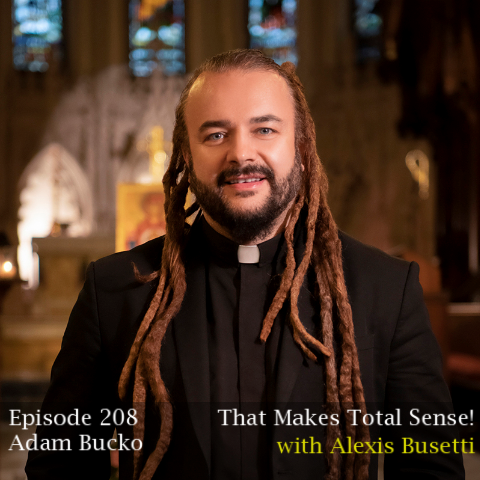
Speaker 1 00:00:41 So I'm super excited this morning. I sometimes just get to spend a whole day with our guests before they even sign on through their books. And I did that with Adam Bucko yesterday, and Adam, I just spent, I woke up early and I spent most of the day just off and on finishing, um, this book, let Your Heartbreak Be Your Guide. And it, it was wonderful. It was a wonderful, wonderful day, way to spend my day. So I just wanna start off by saying thank you. Thank you for writing it. Thank you for sharing it, and thank you for coming on to talk about it today.
Speaker 2 00:01:25 Well, thank you for reading it and for inviting me to be in conversation with you. I'm really grateful.
Speaker 1 00:01:34 So I wanna start with what is probably gonna seem like an obvious thing to you, but I will say in my faith journey, the contemplative life is not something that I was really introduced to at all until just a few years ago, probably. So the subtitle of your book is Lessons and Engaged Contemplation. So I'm wondering if, if you could help us, I know this, this might feel a little remedial for you and for some of our listeners, but for people like me who are like, I have no idea what that even <laugh>, what that even means, or what Adam might mean by that. Mm-hmm. <affirmative>, can you just kind of start us off by what, what do you mean or what do people mean when they talk about a contemplative life or, or contemplation? What does that look like in our faith lives? Mm-hmm. <affirmative>.
Speaker 2 00:02:30 So in our Christian tradition, uh, this idea of contemplative spirituality, of course, goes back to Jesus, who oftentimes, uh, before different events and different things that he did in his ministry would simply venture, uh, into a place of solitude and, uh, spent time with his abba, with his father. Um, early on in the history of our tradition, uh, especially around fourth century or so, uh, many of the people somewhat unhappy with where the church was going and how close it was kind of aligning itself with the empire of, of, of, of that time. Uh, many of those people, especially in Egypt, Palestine and Syria, uh, simply left the world, so to speak, and moved into the desert. Uh, and there they tried to kind of experiment with what it would mean to be in a constant, uh, kind of connection with the divine. Uh, you know, trying to really figure out what this, uh, mandate from scripture that tells us that we should pray without ceasing.
Speaker 2 00:03:56 What might that mean? And so, essentially the contemplative tradition in the church goes back to those early North African Syrian, um, experiences, um, and utilizes some of the methodologies that were developed. And those methodologies are essentially about helping us to cultivate receptivity, where we might simply show up before God with everything that we have and that we are, uh, and ask God to flow into our lives, uh, and do something with it all. Namely to take our heartbreaks, to take our difficulties, but also to take our joys and transfigure them into something that could become our gift to the world. Um, you know, one of my early mentors used to say that, uh, his mission for his prayer life was to let God live through him as much and as often as possible. And I think that this is what we mean. This is what I mean by engaged contemplation.
Speaker 2 00:05:14 The contemplative part is this receptivity and consent when we simply sit in the presence of the divine consenting to God's love and action. So the work of healing that we all need may be done on us, the work of transformation, the work of realigning us. Uh, so we may truly be not just kind of carrying within us God's image, but also kind of express God's likeness, uh, in the world. Right? So the work of contemplation is about that receptivity and consent, and the word of action is how then that overflows into the world. It was Saint Augustine in some of the early centuries of Christianity who had this beautiful teaching. Uh, when he was commenting on scripture, um, he said that, um, within the inner cabin of our hearts, there is a sleep in Christ. And essentially our faith lives, uh, somehow, uh, position us, you know, our openness to the presence of Christ as he wakes up in us and then begins to live and love and maybe even sometimes protest through us kind of taking whatever it is that we have, which much of it is broken and kind of, you know, in need of healing.
Speaker 2 00:06:52 And somehow transfiguring all of that into something that is usable as we begin to do the work in the world on his behalf. Building up, you know, what is often referred to in scripture as the kingdom of God, um, in the here and now, uh, becoming channels of God's peace, of God's compassion, of God's justice, of God's tenderness and care. So that's more or less, uh, I think what I mean by engaged contemplation. And of course, to do that we need practices. You know, in a Christian tradition, people are sometimes very skeptical of techniques for prayer because, um, for many people that means that somehow we're trying to produce the experience of God. Uh, the contemplative tradition is very clear that contemplation is always a gift, a gift in fact, that has already been given. But all the techniques and ways of practicing are really just to train our systems, so to speak, to not, uh, to miss that gift that is so available, uh, to recognize, um, you know, when it's present, when it's given, when it's offered freely, uh, to us.
Speaker 1 00:08:24 Adam, there are some conversations that I end up taking more notes during the conversation than I had when we started. And I have a feeling this is gonna be one of them. Um, that receptivity and consent piece is one, um, that I'll be sitting with for a while. Um, 'cause I just don't know that I've ever heard, um, the contemplative experience described quite that way. Um, but it's really beautiful and, and it makes me think of, I mean, you, you've talked about it already, but, you know, the monastic tradition of, of, of withdrawing or separating into the desert. Um, and then we can see that there are also traditions within the contemplative life, like what you talk about in your book. Um, I'm thinking of Howard Thurman right now mm-hmm. <affirmative>, um, where, um, that I don't know. I mean, I don't wanna, I don't want to disassociate like a, a monastic situation from work necessarily.
Speaker 1 00:09:32 The work looks different. Um, but we are familiar because some of this work piece of people, um, like Howard Thurman is in places where we're really familiar, right? Like, we're walking around and, and in the same, and in the same places. So, um, I'm, and I wanna, I wanna touch on that. There's a place in your, in your book, and I'm jumping around a bit because this was just, it came up while you were talking. In my mind, there is a place in your book, and I wanna talk about the work. So just elaborate on this however much you want. Um, where you, you talk about an old Anglo-Catholic saying that essentially says something like, unless we're willing to see Christ in the rejected people around us, we have no business seeing him in the Eucharist. And so I think that sometimes when people think about a contemplative lifestyle, sometimes if they don't know anything about it or if they're just becoming familiar, it can maybe seem a little bit like that monastic, it's withdrawn, maybe it's individual. This is about you and God. Um, and it is about those things this receptivity to, to hearing God and to the healing and all those things that you talked about. But it is also a ministering life. Um, so can you talk about, I mean, that's a really big thing, but maybe, maybe kind of using that old saying to talk about what that looks like a bit.
Speaker 2 00:11:11 Yes. Uh, so, um, the early monastic traditions were really, especially those of the desert, were in many ways more focused on withdrawal. But even within those early accounts, we hear stories how, uh, you know, a monk would go to an elder and would ask, who's the most advanced person in prayer in this town? And the elder would say, it's so and so in Alexandra, who works as a doctor or as a gardener. Uh, basically letting us know that yes, some of us may be called to be more on the side of, uh, the withdrawal spectrum of spirituality, but even then, uh, you know, we have to be very humble about it. And even then, what happens, you know, some of my mentors who are hermits, yes, they spend a lot of time alone, but they take the whole world, uh, into their prayers. Um, you know, so it's not so much that they are really separated from the world.
Speaker 2 00:12:23 They bring all of our difficulties, they bring all of our problems and hold it before God as they sit before God with all of us on their hearts, right? So I think that that is very important to understand. And then there are other traditions, you know, starting with Benedictines, um, and then Franciscan carmelites and, and some of the other religious orders all the way to then, you know, Quakers and people like Howard Thurman, uh, and of course, the black church tradition, which also has a profound sense of mysticism and contemplation. The kind of contemplation that is not disconnected from the world, and that is not disconnected from justice. You see? Um, and then of course, in Latin America, uh, and other parts of the world where liberation theology came into being with people like Lanar Debo or guava Gustavo Gutierrez talking about contemplation and the contemplative process in such a way that it kind of involves not just our personal transformation, but the transformation of social structures, realigning them with the will of God, naming things like racism for what they are, which is they are sinful, uh, to use this kind of very Christian language.
Speaker 2 00:13:49 Right? And so this idea that I talk about, uh, that, you know, unless we see Christ in those who are rejected, in those who are on our streets, in those who are broken, we have no business seeing God in the Eucharist. What that saying points to is that in religious life, it's very easy to sort of fetishize things, uh, you know, to make the church and even the sacraments and all the wonderful things that we like to do in church to turn them into some kind of a game that we can win, that we can, you know, kind of, um, essentially accomplish and be taken into this place of, uh, of, of certainty and then sit there and judge everyone else. But as we know from Jesus, that kind of behavior is a very tricky business. He had a lot to say about religious leaders, about, you know, all kinds of hypocritical attitudes.
Speaker 2 00:15:05 And he also had a lot of things to say about people who clearly were not part of the game, um, so to speak, the religious game, um, and was very clear saying that those people may, uh, venture and end up in, in the kingdom of God much sooner than those who are on the right behaviors who are winning the religious game. And so I think that the saying points to that, that it's very easy, you know, if we're part of the high church tradition to get into our vasts and rituals and make sure that we're using the right kind of incense, and that the words are pronounced in the right way, and that the chanting happens in the right way, if, you know, we're more kind of, of a, of a free church, you know, with more contemporary music, uh, you know, we can make sure that our songs produce tears and specific responses, and then based on that create this whole hierarchy of, of making it within that system.
Speaker 2 00:16:10 But the spirituality of Jesus is not about making it, uh, in fact, Jesus didn't make it according to the standards of his contemporary world. I mean, the guy was executed, uh, you know, that's not necessarily a definition of success. That's not a definition of winning whatever the game of his day, um, might have been. Right? And so I think that this points to the fact that our spirituality, yes, all of those tools like church services, prayers that we may be so familiar with, um, different kinds of activities, all of them are wonderful to an extent that they can help us to encounter the divine. But once we encounter the divine, our eyes, especially the eyes of our hearts should be open. And then we can begin to see God's presence all around us, and especially in those who are hurting. You know, when, when Paul had his famous experience of, of, of conversion, what did Jesus say?
Speaker 2 00:17:26 Uh, why are you persecuting me? Right? You see, that's the identification that he has with those who are persecuted, who are broken, or that famous saying, you know, like, uh, whatever you do to the least of these, uh, you do to me, I think that, you know, oftentimes in church we're so, you know, strict about, uh, some teachings that usually, you know, correspond to whatever our, uh, you know, positioning on the spectrum of cultural wars of the is. But we almost never take those words seriously. Uh, you know, and in fact, Jesus says that that will be one of the, uh, few criteria by which we will be judged, right? And so that's what this teaching is pointing to. Yes, to contemplative prayer, yes. To beautiful church services and celebrations, but all of those are meant to assist us in as encountering the living God. And that encounter should change everything for us. If it doesn't, and especially if it doesn't kind of transform us into people of love, that means that we're not there yet, no matter what religious game we think we're winning.
Speaker 1 00:18:53 Yeah. Thank you for that. Um, let Heartbreak be Your Guide is the title of the book, but it's also the title of one of the chapters mm-hmm. <affirmative>. And I'm hoping that you can share the story, um, from that chapter of, um, of the woman who you gave that advice to. Mm-hmm. <affirmative>. Uh, because I think, you know, in, in the US culture especially, and this goes into US church culture, especially Evangelicalism, um, where, you know, the question is, um, if money were no issue, you know, what, what would you do? Right? Follow your passion, follow those, you know, this is a passion project, or this is, you know, whatever. And, um, and this is not what you told this woman when she was, uh, trying to discern, uh, kind of her next steps and what work she might participate in. So do you mind sharing, sharing that? 'cause that felt really profound to me.
Speaker 2 00:20:07 Yeah. So this happened, uh, in London, uh, a few years ago where, um, I was giving a talk and after the talk, one of the young people, uh, who attended the talk, but who were also connected to that particular center in London called St. Berger Center, which is a wonderful center for peace of reconciliation. It's in an old, beautiful church that was kind of bombed by, um, I r a, um, I think in, in the eighties, uh, and then rebuild as a center for peace and reconciliation. Um, and so some wonderful things are going on there, and I was invited to give a talk there, and this young person, uh, came up to me afterwards and asked me if we could meet, um, because she needed advice. And so we went outside and they have this kind of a beautiful bedwin tent, you know, um, in their garden.
Speaker 2 00:21:10 And we sat there on the floor and talked for quite a while. Uh, and that's exactly what she said, what you just kind of summarized, you know, she said, I'm not quite sure what to do with my life. Uh, everyone is telling me to follow my passion, to follow what makes me feel good, and that somehow that will lead to a good life. Uh, but I just have this feeling that that's kind of a very cheap advice, so to speak. And I'm paraphrasing, you know, and we talked and talked, and to be quite honest with you, I, you know, felt like nothing really was coming, you know, in spiritual direction. And in those kinds of conversations, sometimes we just simply, uh, rely on the Holy Spirit to bring something, because, you know, who am I to know what's the right advice? And, you know, there was a moment where it just kind of came together.
Speaker 2 00:22:12 And I found myself saying to her, why don't you just follow your heartbreak? Just see what breaks your heart, and let your heartbreak be your guide. And then I rushed to the airports to get back to New York. I almost missed my flight actually on that day, you know? 'cause we talked for a long time, and I forgot about that conversation until several months later. I received a message from her, and she sent a message from, um, from Greece, and she said, this is what happened to me. I sat with that question for a very long time, and that question made me feel so frustrated. I was just so frustrated sitting with that question. And I felt that nothing really, I was not able to reach some kind of clarity. And then finally one Sunday afternoon, I was just done with it. I just was like, screw this, you know?
Speaker 2 00:23:19 And she said, you know, she left wherever she was sitting for prayer. She turned on the TV and was just, all right, I'm done with it. And then all of a sudden she realized that the tv, you know, which was b b C as she was in England, was playing all these horrifying images of Syrian refugees arriving on the island of, of Lesvos, um, men, women, children, you know, many of them dying in the waters of the Mediterranean Sea. And she said in that moment, just something happened. And she knew that she had to just get on the internet book a flight to Greece and leave the next morning without telling anyone about it. Uh, she just called her work and said that something came up. She needs, you know, time off. And so she went there and, uh, joined all the volunteers who were coming from all over the world, picking up people from the sea.
Speaker 2 00:24:31 Uh, some of them were barely making it, you know, as the waters were cold. Uh, some of them died in the process. And she said, you know, being there and seeing all of that and being involved in all of that broke her heart. It shattered her into pieces. But she also said that it gave her a sense of joy, not the kind of joy that needs to be protected from heartbreak, that needs to be protected from pain. Um, she experienced the kind of joy that can survive heartbreak and tragedy and, and pain. Uh, and, and she said, now I know who I am. Now I know what is my purpose. And she went back to London after a week or so, organized her friends in that alt church, you know, that is now the center for, uh, peace and reconciliation. And they became one of the leading centers in London, uh, for dealing with, you know, with refugees.
Speaker 2 00:25:48 In fact, uh, a year later, uh, in New York, I had a rabbi who visited me from London, who was connected to their work. And he told me about some initiatives that were inspired by all of that. And the initiative that he was helping with was gathering all of the, um, Jewish people in England who were refugees from, uh, you know, some of the Arab countries who were fluent in Arabic so they could serve as counselors to the people who are arriving in Syria. I mean, you know, speaking of like, holy connections. And I think that that's what happens when we, when we move from this passion paradigm, which, you know, I mean, passion is very important. You know, we all want to have passionate lives, but to just rely on that is sort of a cheap advice, you know? Um, and so when we approach heartbreak, when we sit with it, when we allow it to shatter us in the process, we often also realize what it is that makes us truly alive, and how our vocation, uh, emerges out of that intersection of what makes us truly alive and what breaks our heart. That's where we find how God is calling us, uh, to be God's hands. Uh, God's microphones, god's, uh, hearts in the world, you know?
Speaker 1 00:27:31 So this is not, I'm not, this isn't in my notes, and I'm not thinking of a particular part of the book, but I'm just, I just wanna ask you as a, as a priest and as a contemplative, when you were talking about this, this woman's story, something that came to my mind is just this idea of, of bearing witness. Mm-hmm. <affirmative> to, um, to someone's tragedy, um, to someone's brokenness. Could also be to someone's joy mm-hmm. <affirmative>, um, and someone's triumph for sure. Um, but I, you know, this has been something, just this concept that the last several years I've begun to think about, and I haven't necessarily landed in any certain place, but it's just that I have this sense that something really kind of spiritual and mystical happens when we, when we bear witness in a, in a really, um, you know, kind of connected and intentional way. Um, so I'm asking you, because I don't really know how to talk about that, but, um, can you, can you give insight into maybe that, um, idea of, of just being someone there to bear witness to those things in those people's lives?
Speaker 2 00:29:01 Yes. Uh, so, you know, bearing witness for me emerged out of my work with young people who experienced homelessness. I spent 15 years accompanying them, uh, on the streets of New York City, uh, providing spiritual care, but also helping them to get into shelters, go to college, you know, be able to reemerge as people, not only who are surviving, but who are thriving. And the early years of my work with that, were focused on, you know, just utilizing different therapeutic skills, essentially, trying to kind of help people solve their problems. And at some point I realized that that was not working. And, and that the approach that was called for was a different kind of approach. And that was this approach of bearing witness. Um, and I think it came maybe from one of my mentors. Uh, what I received was to approach each person in the way that I would approach contemplative prayer.
Speaker 2 00:30:15 And so I started doing that, showing up for each of those young people who would show up in our center, um, bearing witness to them. And what that meant was that I would need to put everything I knew about how to respond to the site and to simply be there with them in the state of this kind of curious, not knowing, uh, removing any buffers of professionalism, which, you know, for so many clergy, uh, being kind of a middle class professionalism is the model of, of, of, um, I think that's what is destroying priesthood and ministry, uh, because we all didn't want to be relevant with specific things to do and et cetera. And that's not, I think, what priesthood is, as Henry Nowan said, that, you know, like the temptation to be relevant, uh, is a temptation. Um, and so I just started being there without any BS accompanying them into the depths of their pain, uh, putting everything I know aside and just kind of being there in the state of cur not curious, not knowing.
Speaker 2 00:31:36 And what I realized is that that leads to heartbreak, but 'cause how can you not break, you know, witnessing the pain, the abuse, and everything else that was present there. And I realized that when that happens, when we are there, kind of shattered into pieces, as we experience life, there's something else there. We realize that underneath all of that, there is this ground that can hold us. There's this impulse of God that can arise in our midst. And then again, our job is to welcome it, is to consent to it. And then, uh, the work of healing begins as this kind of an action of the Holy Spirit that naturally arises. And then we may be surprised by what kind of words come out of our mouths by how well we are able to be present, by how loving we can be, just in terms of holding space.
Speaker 2 00:32:43 You know? And the beautiful thing about that is that then it's not really clear who's helping whom, uh, because we are being helped just as much, if not more. And I think that for me, this is an invitation that that ministry gives us in many ways, you know, this kind of way of being, which is about bearing witness, bearing witness to the joy and the suffering of the world, putting everything we know, especially all of our certainty society. And simply being there in this state of curious, not knowing, waiting for God's action to arise, understanding that the best action that we can do is to allow God to work through us. And then all of our skillsets are used, but in ways that we normally maybe wouldn't use. You know, mother Theresa had this beautiful saying where she encouraged people to become, uh, a pencil with which God can, la can write a love letter to the world.
Speaker 2 00:33:55 And I think that this is what good ministry is, this is what engaged contemplation is. And I think especially now where, you know, our world in many ways is sort of falling apart. Um, I mean, the young people that I talk to and that I mentor are horrified. The jobs that were promised to them are no longer there. You know? Um, all kinds of realities are in place that, that simply don't make them too certain about the future. Um, and I, and so I think especially in this day and age, it's important to cultivate that, that posture of receptivity, that posture that can enable us to bear witness, because then we can ensure that the actions that arise in us and through us are actions directed by the Holy Spirit, not just by some ideology that we may be subscribing to, whether, you know, on the left or on the right or in the middle.
Speaker 2 00:34:59 Those are limited. We are called to something more than that. We are called to, uh, become icons of Christ, uh, who's beyond tho those labels. Yes, he cares about justice, but he also cares about forgiveness. He caress about accountability, but he knows that getting even is not what justice is. Mercy and healing also need to be present there. You know, as Desmond Tutu used to say, our God is big enough to liberate both the oppressed and the oppressors. And I think that that's what we're going for. To me, that's what being Christian, uh, is all about. And that's countercultural. But it should be, that may not, you know, win many. Uh, I don't know. That may not increase our average church attendance, uh, numbers to the best of my ability as I read scriptures. I don't think that's Jesus Jesus's metric, <laugh>, you know, for success.
Speaker 1 00:36:19 When you talk, when you talked about, when you use the phrase, this, this curious, not knowing, um, that applied to our religious lives will make some of us sweat.
Speaker 2 00:36:39 Yeah.
Speaker 1 00:36:40 Because we know things Adam <laugh> Yeah. We are certain about things. And, um, and this, uh, approaching prayer, Jesus, with a, with a curious, not knowing that you described, um, I think is scary and can be scary for some of us. And, and beautiful. And one of the places in your book, I'm, I'm, I'm hoping you can elaborate on this a bit that I think that was illustrated well was when you talked about a residential home in India mm-hmm. <affirmative>, um, where you had some lots, lots and lots of folks living there. And of course, like many ministries, it was supported financially by people who were outside of the ministry. And some of those donors came mm-hmm. <affirmative> to visit and like donor visits, do they, they toured, I'm sure, and they, uh, talked and they asked a lot of questions. Um, but you didn't have the, the in air quotes, you didn't have the right answers for some of those questions. You're nodding, and you know what I'm talking about. So can you, um, can you tell us about that a bit? I'm asking specifically, because as you talked about these metrics, we, uh, many of us in the states have been trained to look for certain metrics when it comes to success in ministry. And, um, and those aren't, I think what you said, wow. How Jesus would necessarily measure, uh, success and what that looked like.
Speaker 2 00:38:35 Yes. Thank you for this question. So the story that you're referring to is about one particular, uh, facility located in the slums outside of Delhi, where I lived and worked for some time, uh, as a young person. Uh, it was surrounded by, um, you know, Hindu, Sikh, uh, temples and, and monasteries. It was, uh, right next to Islam, who most of the residents in that Islam were in Muslim. And we were serving many of those people as well as other people, people who were picked up from the streets of, uh, Delhi, um, who were oftentimes addicted to heroin, who were homeless, who were h i v positive, multi-drug resistant positive. Um, oftentimes with nuggets in their bodies, by the time they, they would, they would make it to our community house. Um, and something extraordinary was happening there. Those people were brought back to life.
Speaker 2 00:39:51 And all of a sudden, an elder who was thrown out in the street because he was no longer needed, could serve as a grandfather figure or a grandmother figure for a child who was rescued from the street because they came to Delhi to make a living, and then were abused, and then started taking drugs to deal with the emotional, uh, consequences of that abuse, you know? And so this was this kind of a beautiful community of broken people, so to speak, where Christ was so present. In fact, one of our seek friends, you know, from across the street would come to meditate with us every morning. And he would say, you know, every time I close my eyes here, I see Jesus, uh, of course as a Sikh, uh, you know, he honored Jesus greatly. And it was not a problem for him to, to have that experience.
Speaker 2 00:40:44 And then you have, you know, coming into that, uh, churchgoers from the US coming in who were actually, I think sending us four or $500 a year, but bought us, you know, uh, a set of big speakers or something like that, you know, so we could, uh, play some music for, for our residents and et cetera. And they toured and they went to different places, and they had a lot of questions, and they initially loved everything. And then slowly they started getting nervous. And the one question that they really cared about was how many people here accepted Jesus as their personal savior? To that, her answer was actually none of them. This is not what we're about. Uh, and if you're having difficulties experiencing Jesus in this community, or what God is doing here, we would say that what you are about maybe needs to be reconsidered.
Speaker 2 00:41:59 Um, you know, and so they stayed with us for a few days and then went somewhere else, and then wrote this big letter, uh, to different churches that were sponsoring our project. Uh, basically saying that we're not Christian enough. They suggested that the founder of our facility should be sent, uh, to an, uh, indoctrination camp where, uh, his theology could be aligned with the true teaching. Uh, um, and, you know, I mean, it was just, to be quite honest with you, crazy, like seeing people being raised back to life was not enough. There was enough God in that for them, what counted was, can we add new names to the list of people, uh, that now say they're Christian, you know? And that's what happens in India. You know, many Western missionaries go there, throw out these big events with cameras, and then they say, do you accept Jesus as your personal savior?
Speaker 2 00:43:09 And people say, yes, 'cause for a Hindu, you know, Jesus is, uh, honored and venerated as <laugh>, as, you know, as a God figure. Uh, uh, and, you know, then they film it, and then they tell them, you know, now you can start eating meat 'cause you've been freed, you know, not like your Hindu neighbors. You can even have an occasional glass of wine. And of course, that then destroys the fabric, the social fabric of their villages, you know? Uh, and that just takes people into this kind of pride that the West brings. And, uh, it, it's really very sad, uh, that that happens. Anyway, that's what happened, you know, and for us, it was, it was unthinkable to just shift and to change, because we've been long enough around Hindus, around Buddhist, who in many ways oftentimes had a deeper grasp of who Christ is than than many of the Christians, uh, that we knew.
Speaker 2 00:44:20 Uh, and you see, that is what I'm talking about, approaching the world, listening to the world with the ear of our hearts, as St. Benedict would say, listening for the presence of Christ where it already may be, because we have to accept that what we know is just a piece of the story. And again, Jesus had a lot to say to people who thought they knew the whole story. Uh, and we will be surprised by how generous God is, how mind blowing God is, uh, and what this love that, that, that we're talking about, he's actually all about, uh, we will be freed, uh, freed from our pettiness, free from our small-mindedness, free from our self-centeredness, uh, free from seeing the world somehow. You know, on one hand, preaching the economy of grace, and on the other hand, thinking that it's up to us that we're the ones, uh, who will change everything. How small minded that is, you know? Anyway, that's the story, more or less.
Speaker 1 00:45:48 Thank you, Adam. Um, I thought that was gonna be a great place to end, but I have one last very short question. Um, because you, you have a list in the back of your book. I'm wondering if you can just throw out one or two you of these techniques that you mentioned earlier, and you say in your book, contemplation takes practice.
Speaker 2 00:46:19 Yes.
Speaker 1 00:46:20 I have experienced that in my own life. That contemplation takes, uh, takes practice. Um, it has felt embarrassing for me at times, how much, you know, practice if I, I try to sit down for 15 minutes or 20 minutes, and I end up looking at my watch. Um, so I'll throw that out there for my, from my experience. Um, but it is so beautiful, the receptivity and and consent pieces that you, that you spoke about earlier. Um, so if someone is curious about contemplative practices, do you have a pla, I know everyone's different, but do you have a place that might be kind of like, this is a really good place to just start exploring that?
Speaker 2 00:47:09 Yeah. So I would encourage people to commit to a very simple practice that they would do, maybe starting with 15, 20 minutes, twice a day. And the practice is very simple. They simply go to a place maybe in their homes that they set for prayer. It could be a corner, it could be a room. Um, maybe they might want to light a candle or have some kind of an icon or a sacred object that can help them to feel connected to the divine. And to simply start by closing their eyes, taking a couple of deep breaths, and then becoming aware of, uh, what is it that they're bringing, naming all of their heartbreaks, naming all of their difficulties, naming all of their worries, naming all of their joys, naming all of their gratitudes, but not hiding, naming all of that. And then engaging in an out loud conversation with God, really kind of expressing it, voicing it.
Speaker 2 00:48:12 And sometimes there are tears with that, and that's a good thing. And then talking, talking, talking, talking. And once they feel that they're done with naming what's present in them, just simply resting in the presence of the divine, imagining that God is holding them just like a loving mother would. And just staying in that embrace for 10 minutes. And if the mind takes you somewhere else, just returning, saying, here I am God opening to you, here I am receiving you. And so I would encourage people to just do that twice a day for 15, 20 minutes. That's a good place to start. And then concluding with our father or any other prayer that that one may, uh, feel drawn to, in my opinion, this kind of praying could very quickly give people a sense of just God's presence being with them at all times. Because that's what it is.
Speaker 2 00:49:17 God is here and now, and we can touch God with every breath. Uh, we just need to work on that a little bit because our minds want to take us somewhere else, you know, somewhere other than here and now, somewhere other than God. So that would be my beginning practice. And then once a month to spend a day if people have time, uh, in silence and solitude where they fast on bread and water, and just simply spend few hours in this kind of a practice, relying on one book alone, which is the Bible, but not reading it for information, but rather reading it for inspiration. Just reading few lines here and there, and simply sitting and waiting and waiting and waiting in silence for that life giving word that will come. And, you know, and it comes because it fills your heart with a sense of new life. And that word can be spoken to us through our feelings, through our intuition, or through the word of scripture. And so those two simple practices, I think can change people's lives. And it's a good way to start this kind of contemplative ave adventure into love, because this is an adventure of love.
Speaker 1 00:50:45 Thank you so much. Um, again, the, the book, I'll have a link to where people can get a copy in the show notes. It's called Let Your Heartbreak Be Your Guide Lessons in Engaged Contemplation. Adam, I'm so grateful. I'm grateful for your work, for this conversation, um, and for your encouragement. So I'm just, I'm so appreciative. Thank you for coming on.
Speaker 2 00:51:09 Thank you so much. I, I'm so grateful for this opportunity to be in conversation with you and to share
Speaker 1 00:51:17 The links for all the resources mentioned in today's episode. Can be found in the show notes, music and podcast production by Seth Busti. Be sure to give us a review on iTunes and subscribe at your favorite podcast listening app. You can also visit us at that.