[00:00:10] Speaker A: Welcome to that Makes Total Sense, a podcast dedicated to exploring God's generosity and justice. I'm Alexis Busetti, a Christian, aiming to ask good questions and encouraging you to do the same.
Every one of us is wired by God to live out generosity and justice, but the how sometimes eludes us. That makes total sense is a way for us to get together, posture ourselves as learners, and challenge one another to practice generosity and justice in a tangible way every day.
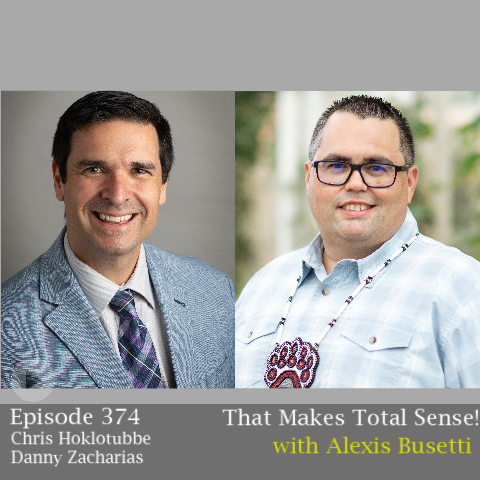
So I will say I'm already not disappointed. I don't know how. Sometimes I tell my kids, let's put that in the positive. I feel like I always, like, use these negatives. So I would say I'm already thrilled that this conversation is as much of a fun, easygoing way to spend my Friday as I thought it was going to be when I read this book. So I'm here with Chris Hochlatabi and Danny Zacharias, who are the authors, co authors of this incredible new book called Reading the Bible on Turtle, An Invitation to North American Indigenous Interpretation.
And folks who listen to the podcast regularly know that when I read these books, I annotate. I put stars. I'm a dog ear person. Don't come after me. And this book, I had so many places where I was like, had LOLs in the margin. Hilarious. I mean, there's even jokes in the footnotes. I forgot to tell you guys, I went searching for the drum circle and I couldn't find it on YouTube. Anyway, so thanks for coming on. Thanks for being here.
[00:01:52] Speaker B: Oh, we can simulate the drum circle for you if we.
[00:01:57] Speaker A: Yeah, I know. I was looking at the wrong videos, I guess, or maybe at the wrong timestamps.
[00:02:01] Speaker C: Anyway, the Internet changes. Internet changes. Or maybe I secretly changed one of the little letters. I was wondering it would not.
For the listeners. It is an embarrassing video where I am so offbeat on a drum, literally, the drum circle comes to a pause.
I will say, though, I was not given the greatest advice on the drum and Danny has since fixed that with me and I've appreciated that.
[00:02:32] Speaker A: I almost spit my coffee out because I didn't get to see it and I thought, like, it came to a pause. Chris, this is.
[00:02:37] Speaker B: Anyway, it was.
[00:02:38] Speaker C: It was awkward. I. It was before I was about to give a huge lecture for the Nate's community and it was my first one. I was really excited. And then all of a sudden, without asking or expecting this, I was called to sit on the drum because they needed one more person.
And in my mind, like, why are you doing this to me? I am just not good at anything musical, but it was a good lesson. And it underlined one of the principles of Turtle island hermeneutics, that we don't take ourselves seriously and we laugh and we have fun.
[00:03:14] Speaker A: This is amazing. Tell everyone what Nate's is, since you mentioned it before, we get into everything, so that we have a little bit of context.
[00:03:20] Speaker C: Yeah. So nait's originally stood for the North American Institute of Indigenous Theological Studies, but we don't use that spelled out acronym anymore. We just go by nait's, because now we have relationships in the Philippines, in Australia, New Zealand, and even Taiwan.
But the heart of it is it's an indigenous learning community. It's the first indigenous design developed, delivered, and governed theological institute to be accredited by the association of Theological Schools and is founded in Canada and it's got a presence in the United States. It's online, so it's present with me right here in Iowa.
[00:03:58] Speaker A: This is so great.
I do want to mention, just right off the cuff, this book was.
This book was so good, guys. I just. I have. I could just. I'm raving about it. There's just so many amazing things. I do want to point out something that you named at the beginning because you said it used to be North. North America. When you're talking about Nate's. And this. The subtitle to this is An Invitation to North American Indigenous Interpretation. Now, I will say, coming at this as a mixed Hispanic woman, part of my. My Hispanic side is Mexican American. And I was like, where's the Mexicans? Like, where are we in this, you know, in this representation? Because obviously us mestizo folks, we are, you know, indigenous and Spanish and. And you guys name.
Excuse me, sorry, you name. Early on in the book that. I mean, because we all know when we're doing research, when we're writing anything, there's going to be limitations on what we can cover, what we can't cover. And so I was actually grateful to you both for naming.
I'll say. Naming us. Naming us.
And then, like, it felt like we couldn't cover you in this volume, but you're not forgotten. And so I just want to say thank you for that. And also a recognition that there is some. Some I don't know the history like you guys do, but from what I do understand, there is a connection between the tribes in the US And Canada that make this kind of a special connection that is a little bit different, I think, than what has been found south of the US Border now. So. Any comment on that, Danny?
[00:05:35] Speaker B: Yeah, No, I mean, we really wanted to signal that. And like you just said, one of the reasons we.
I didn't necessarily feel the need to rope that into it is because there's been a rich tradition within the Mexican, Central America and South America of liberation hermeneutics. And, you know, that was like, those are voices that we're learning from and hearing from as a unique community. And so I think if we would have tried to rope it in, we probably would have not done justice to it especially.
And this just wasn't the need. There's so much rich material there already that, like you said, hopefully we, we gave a good nod to it and explained why.
Why we didn't include the tail of the turtle, as it were.
[00:06:24] Speaker A: Yeah, yeah, yeah. I do appreciate that. Oh, go ahead, Chris.
[00:06:28] Speaker C: If I could add, I want to direct people to the work of our colleague Cecilia Tiziano, who is Catholic and from Bolivia and is indigenous there. And she just received a large scale Lilly grant along with Nate, to work in partnership with Barry University, Catholic University, to hold a center for South American Indigenous theological studies who are living in diaspora in the United States.
[00:06:57] Speaker A: Amazing.
[00:06:57] Speaker C: So this is really exciting and kind of knowing the work of Cecilia and wanting to eventually walk alongside her as they lead what would be a celebration of South American Indigenous and Central American Indigenous interpretations of the Bible.
I knew confidently that that work was already being done and was going to be furthered by this network that she is establishing. So if you find yourself as Quechuan or Amazonian and you're being erased by the Hispanic Latino label, know that there is something good coming along the line. So be on the lookout for the work of Cecilia Tiziano.
[00:07:35] Speaker A: Yeah, thank you so much for that.
This isn't in my notes, but I do want to go there with Canada. Okay. So I'm going to just confess. The listeners may as well hear this.
Chris pops on my screen first and I say something to him about being Canadian, because I don't know why, I don't know why I flipped their bios in my head. So literally the whole time I'm reading this. Chris is Canadian. Danny, you're Canadian. I am, yes, you're Canadian. And I would say I was so grateful. As someone who was born and raised in Oklahoma, surrounded in many contexts with wonderful indigenous traditions around me, I learned so much from the Canadian parts of this book.
One thing that I just want to name up front, front that I. I was like, I think this is true. You guys help me and correct me.
I'll say we have A laundry list of, anyway, history that we have not dealt well with in the United States anyway, continuing and even worsening today.
But I feel like even though you do write there's. It is not perfect. There have even been, you know, kind of relapsing since there have been real efforts made. I think we can look to Canada as an example of some things that could be done to reckon with the terrible history that Canada and the U.S. both have with Indigenous communities. And I was really grateful to see that.
Yeah. To see that spelled out in the book. So I won't ask you, Chris, because you're not the Canadian, but Danny, I mean. Yeah, I will. I actually want to ask Danny and Chris. So, Danny, like, what has that been like as a Canadian? And then, Chris, what do you think that we could learn from that in the US As. As we watch how Canada has reckoned with that?
Yeah.
[00:09:40] Speaker B: No, thank you very much. That's good to hear that from the interviews we've done already, there hasn't. No one's really named that. And you certainly are right that there, in some way, Canada is ahead in the process.
It doesn't mean it's being done perfectly here.
In fact, I would say probably in the last year and other people have named that, that the reconciliation work after the TRC calls to action really slowed down in this past year.
And that has to do, you know, in some ways, not to. Not to blame, but, you know, the instability caused by our relationship with the US and kind of the rise of polarization that creeps its way up into Canada, that some of those efforts have been stalled in churches and in government, etc.
So, yeah, it's. It's always a bit of a one step forward, two steps back, two steps forward, one step back process. But the big thing, you know, really, is that we did engage in the TRC process, a deliberate process of listening, not rushing, documenting all of those things. And. And that itself, we learned from South Africa that truth reconciliation process.
[00:11:05] Speaker A: Yeah, yeah, yeah. Thanks for that, Chris.
[00:11:10] Speaker C: I have been impressed by all of that. And even this whole culture that's come up as a result of this openness and interest and curiosity about what does reconciliation look like. And you have these calls to actions that involve both seminaries and churches to take responsibility of learning about Indigenous spirituality and also what occurred at the boarding schools.
We're still in the United States even getting that account down. And there are different nonprofits and church groups that are doing this.
You know, Brian Newland and Deb Haaland did their federal Indian Boarding School Initiative investigative report. They had two volumes produced during the last administration that was really wonderful, but we're, you know, we're still trailing behind. I think there would have been a lot more done had things gone differently in this political landscape. But that report's still there, and hopefully it can be picked up again and we can think about what that means as a nation for us to do right by our history.
So it's. It's neat. And I will even say that, you know, we've been invited multiple times by our friends at Providence University for Truth and Reconciliation Week, and it's just beautiful.
And I haven't seen that yet at any American seminary. I'm sure people are doing some things, but it's just this. This collective awareness and openness to this issue, which is beautiful.
[00:12:46] Speaker A: Yeah, thank you so much for talking about that. I mean, I have other questions to ask about the Reckoning and our history, but before that, I want to lay out and start talking about the.
The hermeneutics.
And I know this is, like, a weird thing to do, but I kind of wanted to start at the end of the book because it is. So this reading, while Redbone chapter, you talk a lot about culture and faith. And so just a little bit of my background, like, theologically, I got my M. Div. From Fuller, and I'm studying as a woman. I'm studying as a mixed Hispanic woman.
And even though, like, shout out to Fuller, they're super great about our theological lenses. There's. There's a lot of diversity there. But I still felt like. And I think this is kind of what you guys talk. Talk about. Like, there's like, a theology with a capital T, which is, like, white European theology, and then there's all of these other theologies that get a lowercase T and a modifier. So there's like Latin American liberation theology or feminist theology or womanist theology, or there's all these other things.
And I'm using that as, like, a connecting point to say this capital T. Theology is as if it's objective, like, that it hasn't been influenced by culture. Like, it hasn't been influenced by, like, anything. And it's like, this is just not. This is just not legit. Like, this isn't the way to look at this. And you guys. Actually, I rarely do this in a. In a podcast interview, but I love this quote so much. So if you'll bear with me for a second, I just want to. You guys said it better than me, so I want to say it the way you said it, you say, when non indigenous groups ask us to justify the relevance of our identity and cultural practices to our faith, how often we would like to offer the same challenge to them if only they would look in the mirror and they recognize that their own expressions of Christianity reflect modern Euro American expressions of faith.
And then later in that paragraph, you say, Christianity has always syncretized to some degree to the host culture.
And I just think in the US the host culture has been this white Euro American. And so it doesn't feel syncretized to many. It feels like this is. And then anything else you try to add or take away is in some way detrimental to what is.
Gosh, I see Danny nodding. So I'm going to take that as a cue and say, can you elaborate on this and how in your context, kind of what, what that looks like for you is if you were to explain this to someone?
[00:16:00] Speaker B: Yeah, I mean, I think American, the Canadians, kind of in the, in the, you know, generic culture of the church, you can really start to recognize this if you seriously enter into relationship with, for example, someone who recently migrates from another country who is also Christian.
And I know that because we have international students where I work, you know, and eventually it comes up, it's like, why do you guys do this this way?
Why do you do that? Why do you think that? Like, you know, they're confused and it's a chance for them to understand that they have an assumption about what Christianity looks like from their culture.
And we have that same thing. Right. And so it's not until you have those conversations that you recognize, oh, my, Christianity looks a particular way.
And that's okay in the same way that theirs is okay. And at the same time, it should challenge us to think is the way we're practicing Christianity is the way we're embodying our faith.
It does it, you know, should it be expressed a different way or should there be strictures on that? And that's, you know, for indigenous people, that's really been, that's been what we've always been met with, like a paternalistic church kind of telling us, no, this is how you dress now. This is how we do our worship gatherings. This is the type of, you know, so a very paternalistic and, and judgmental kind of look at our culture and our spirituality with no concept that Christ can enter into these spaces and, and make use of those things and join those things and transform those things and challenge those things. For us, it was all just, it was just rejection. You need to reject those things, but they don't ask those same critical questions about themselves. Like you said, it's just assumed that.
[00:18:07] Speaker A: Right.
[00:18:07] Speaker B: That theirs is the Christian culture.
And Richard Twist, who is one of the founders of Nates and has a couple really good books, you know, he said, like, you know, we were, we were told, you know, get rid of our culture. And he said, but why are you telling us to get rid of our sin stained culture just to adopt your sin stained culture? It's not like yours is inherently better than ours.
[00:18:29] Speaker A: Right.
[00:18:29] Speaker B: Shouldn't there be a challenge on both sides?
[00:18:33] Speaker A: Yeah, yeah, yeah. I appreciate you saying that. That quote was really powerful. When I read it, I want to, Chris, turn to you and ask for a little bit of elaboration on kind of the tail end of what Danny just said. There was a quote on the page before that in the book from someone else. I lost the page already where she says, for many people, kind of what we've just been talking about, it feels like they're saying to indigenous people, Jesus loves you, but he doesn't like you.
And there was another quote in the book where you talk about, I'm sure this isn't just a singular thing where people are asking like, can you be indigenous and Christian?
And you know, I would say I kind of laughed at that because I'm married to a research geologist and ever since we were, you know, we met in, at the University of Oklahoma actually and he was doing his graduate work there and people have been asking him that for that long, like, you know, 20 years. Like, wait a minute, you're a geologist and a Christian? Because there's something that doesn't connect, you know, for them, I mean that could be a whole different. I should have had him on and you guys could talk about creation and you know, all of that stuff, but this, like there's a, there's a disconnect. And so it's. People have. Christians have asked you, not asked you, but enforce in many ways that you trash your culture and like, like Richard Twist says and replace it with another one. Because Jesus may love you, but he doesn't really like you, or he doesn't like your culture, or he doesn't approve of your culture.
Can you talk about that a little bit, Chris?
[00:20:18] Speaker C: Oh, I think you did a wonderful job of talking about it and I will take it to the next step in that. So much of the argument of our is what if we start off with the assumption that Creator was always present with our people, that Creator's fingerprint is in our Rituals, ceremonies and stories and values.
Because, you know, any culture to have survived this long is doing something right about how they live and treat one another.
And most cultures don't wake up in the morning and be like, how can we be terrible and self destructive, right?
And when missionaries came in, and this is a posture that is true of a lot of Christian culture that I grew up and I participated in. And so I kind of cringe at that, where there's no curiosity about how God is already working in other communities or the person that you're speaking to, that they are an empty vessel where God has been absent and you're going to bring God to them.
And for them to fully embody the Christian life, it is to become wholly like what you know and what you are and not to reclaim or to even enliven what is already good and beautiful and true in their life and their culture.
Because then you have this like, disconnect. Because we all have these beautiful stories and moments of our, or hopefully most of us do, of our grandparents or our parents teaching us wonderful things that have meant the world for, for us and have been that star by which we anchor ourselves and go toward. And for someone to say, well, that is, there's nothing good in that, or that your experience, you should doubt that can be really disorienting. And so if missionaries across the globe have found it to be much more productive to build relationships and to learn deeply about the culture and to see where God's acting and to tell a story within those stories, why don't we bring it back home here? And why did we ever do this?
You know, I just preached at my church last week and it was on the Magi. I called it a late epiphany because it was a late 12, you know, three wise men story.
But when you go to that story in Matthew, what's interesting is that these three Persians, Parthians, they're Magi, they're probably priests in the court of Babylon or some other area that's supporting their intellectual studies.
Because we all know scholars are poor and they need other people to pay for their, their work. But God works through their Parthian Persian astronomical knowledge.
They don't become Jews. They don't. It's not this like secret incursion, but it's their, we could call even an indigenous genius that God is working through, then to point them to the star of Bethlehem.
So we can go through many other passages that talks about that God is walking with other people. I think of Amos where he says, you know, do you think you're the only ones I walked with? Like, I walked with other people in their exile and their diaspora. Like I care about the whole world.
So if we see these moments, do we look at these moments and reclaim them as. Yeah, God's working with these people to bring them to himself, to God's self.
So I'll pause there.
[00:23:57] Speaker A: Yeah, no, I appreciate that. I think that's a great lead in to get actually to the hermeneutical part that is really the meat of the book.
One of the things that I was taught in one of my biblical interpretation classes, I don't know, we could say as a technique, I guess is. And this might make some folks feel uncomfortable, but I thought it was fantastic, which is like inserting ourselves into the story, right? So we're reading this story and we say, how would I feel? What would I be thinking if I was such and such character?
And I so appreciated the parts of this book where you do that with indigenous communities.
I want to say again, there might be folks who are like feel uncomfortable about this, but you guys specifically name in the book and I'm appreciative that you do that. It's really common for Christians to just by default if we're going to do that. And I think we do. Even if it's unconscious, I think we do.
We just, we're the protagonist, guys. I mean it, duh. Like we are the heroes in the story.
So if we have situations where we see Israel being the protagonist, which again, I don't always see Israel as a protagonist in every story, that's a whole different discussion probably. But we are. Then we align ourselves with them and we are the heroes, we are the protagonist. You know, we, it's, you know, I'm reading something, oh, I am David. I'm never Goliath. Right? Or like I'm reading these stories and I am, I am the protagonist. I am the hero.
Which is problematic in and of itself.
But I also, I just want to name like you guys, you guys name the work of Smith Christopher, who was like totally helpful for me when I was studying about exile. Theology of Exile was like just a crazy important class for me that really helped me reframe a lot of the ways that I read scripture.
But I just want to start with what is kind of hermeneutically, I think some, it's not easy, but it's kind of some low hanging fruit of like Israel and the Canaanites. So before I read your book, I had some introduction to some First Nations Hermeneutics where they would say we don't see ourselves in Israel in this story, we see ourselves as the Canaanites.
That even feels kind of shocking for some folks. But maybe we can use that story as a jumping off point because you name so many other fabulous places where Daniel, the Psalms, you know, all this. But maybe just help us understand this kind of hermeneutic, this kind of interpretation maybe with, with that Israel in the Canaanites story.
Danny?
[00:27:21] Speaker B: Yeah.
So, you know, I really appreciate what you're saying, and you're right, that the initial inclination, I think for a lot of people who've been trained in seminaries as well as just via pulpits, is that this text is just static. Right.
But if you think of the scripture as communication, then that's always a two way conversation, multiple voice conversation, and you are the one of the hearers of it. Right.
There's always a complex mix of it. And so because of that, you know, different type of hermeneutical approaches or critical questions, you know, that we learned in academia encourages us not to stray away from asking, you know, what do we think the author or speaker meant? I mean, that's certainly everyone wants to, is striving for that, but there's also that that next question then is are there new ways to ask new questions, to also maybe hear what we haven't been hearing for a long time or from, you know, the underside. So reading from a marginalized position in our text, reading from the perspective of creation rather than from humanity, and in this case, you know, reading from the perspective of the Canaanites, because we are talking about land that's being invaded, conquest.
And so what does that do? When we bring our history as indigenous people, we, we shine this kind of different light on it. We put on a different set of lenses and we say actually this brings us to some different conclusions as we hear it as the people that we are and it doesn't negate.
And this is important and maybe, you know, something that we want to make be sure to say, because that same text has been an important text and should be an important text for liberative readings of the Scripture from other communities within the global church. And we're not trying to juxt, we're not trying to say actually this is the right way of reading.
We're trying to say this same text when we encounter it, we hear something different and we understand that you hear this and we value that, but we hope that you can value how we hear it as well.
[00:29:48] Speaker A: Right. I think I'm going To interject there before I ask to go to Chris, because I think that that part is so important when we, because we often talk about the global body of Christ or we often will, you know, kind of quote Paul of each of us having these different roles, you know, different parts inside of the body.
But. And so, and so I really want to hone in on what you said and just re. Emphasize it that it's not like saying any one of these readings is like the reading, just, just like I mentioned earlier, like this. I don't think the white Euro American way is like the capital T theology either. It has some things to offer. And so do these other readings, you know, have something to offer. But we may not get that unless we ask someone who might have a connection to that text that we don't have.
So, like, I may be wrong about this. I was reading. It was one of my interpretation. I won't say exactly which story it was, just in case I am wrong, but I was reading there was a woman character and I put myself in that, in that story. And I noticed for the first time when I like intentionally did that, that she had no dialogue. Like there were no words from her out of her mouth in this entire pericope. And I was like, how is that even possible? But as a woman entering myself in there, I was like, oh, this feels important.
There are lots of things about her, but we don't actually hear from her. And like, what does that mean? But that might. It wasn't something I had noticed before, but it was when I entered my. Entered in as myself as a woman. Then I was like, oh, this feels meaningful to the text. Maybe I can bring that in. We can combine that with some other things. And so I appreciate that and say, yes, this is an important text. You're right. All of those things you said are true. And we've got to listen to each other. We have to say, Danny, Chris, when you read this, what do you bring away when you, when you read this as your full self with your history, your heritage, your culture, what does that bring out for you? Chris? What do you have to add to that?
[00:32:02] Speaker C: So I've been thinking about how stories are like hyperlinks or like have baggage and not always in the negative way here.
If I can move this to another analogy.
Those of you who are listening, who are in marriages or have long term relationships, boy, every one of us, I've been married for about 16 years here, have arguments or have something right, that. Not Dan. Dan's got great.
[00:32:32] Speaker A: Not Danny.
[00:32:33] Speaker C: He's shaking his head. Right.
[00:32:34] Speaker A: We established he's super saved before we even started this recording. So, yeah, absolutely.
[00:32:38] Speaker C: The rest of us, we all have those unresolved arguments that if you say something about it or you bring something up or if you touched on that nerd, it. That nerve, it brings up everything. And even though it's not about that and you're in a different context and you've healed over that, it. It. All those scenes come to mind and affect your emotion.
And I want to say there's something similar with how these stories exist in relationship to community.
Like we are a body of Christ. We are in some way in this kind of messy relationship and marriage to all of us. The.
The Euro American church is in a relationship with the Native American church.
And there have been things I've done and said that trigger all these memories. And if we want to be in good relationship and that's all always the hope of all these things. When we talk about boarding schools, when we talk about land being taken away, it's not to move into this victim, oppressor, oppressed dichotomy. It's ultimately to be in right relationship, to be in harmony with each other where everyone is flourishing. So that's always the goal. I think that is something I always want to emphasize. It's not about power over, it's empowering us in. Into relationship.
So you know stories about the. The Canaanites in the United States, the story that the pilgrims told was this was the promised land. This was empty land.
And to their credit, they don't call the Native Americans the Canaanites as much as you would expect.
But Cotton Mather and others certainly do call us the Amalekites. And in that story, then the implication is that we're disposable, we're killable. And that is deemed okay by God because this is advancing their story.
Boy, that feels.
That feels different.
Or this is not just for us as Native Americans, but certainly in the African American community. When you look at the story of the Samaritan woman, you know Jesus is going to try and take a break. So he's going to the opposite of cheers. He's going to a bar where nobody knows his name. And this woman comes up to him and says, hey, I know you. I've got a daughter who's in trouble. Can you heal her? And he's like, you're not my people, right? Like you're not Israel. What am I? What do I have to do to you?
I'm here for the children of Israel. Is it fair to give food to them, to the dogs?
And you know, in the Euro American church, we just kind of pass out. We see this as Jesus, we know she's going to get healed. We don't think about this. But if you exist in a body that has been denigrated, a culture that you have literally been called dog or treated as dog, that just hits differently, that, that hits that nerve that brings up all those stories and this beauty of shifting the spotlight to someone else. And I see this and I took this move from my friend Mitzi Smith, who's a wonderful African American woman, especially theologian, and says, and she speaks back, she gives sass to Jesus and she says, oh, but even the dogs get food, right? We oftentimes don't spend enough with how bold and courageous that statement is. And then Jesus turns back and says, by your word, your logos, right? That there's power in what you said, you are saved. Right. And, and from an indigenous lens, there's multiple ways in which you can interpret this story. But I called to mind the role of the sacred clown in some traditions, in indigenous life ways that they say controversial stuff, they hit that nerve precisely to bring attention to it. To say this is how terrible this racist ethic is, or this is how terrible this thing that we are all living by, that we're just not talking about it, let's talk about it and provide an opportunity to undermine it. Now, was that the original intention of the gospel author in telling the story?
We can't know that for certain. But having this paradigm and putting that interpretation on the text just makes it come alive and helps us to deal with it because otherwise we really don't know what to do with this text.
No biblical author knows what or scholar knows how to fully address this text. And we all kind of hand wring or we wave it away if we say it's not a thing.
But at least this way of engaging I think is honest in an attempt.
[00:37:10] Speaker A: Yeah, yeah, yeah. I'm who I hand wring at that one. I still haven't. Yeah, I'm like everyone, yeah, everyone has their own, their own take on that. Or they wave it away. What would happen if we didn't wave it away? We just said, yeah, what about looking at it this way, I want to hang out here for a minute.
I mentioned Smith Christopher's work. That was really helpful for me. You guys name him in some of these exilic texts, but I want to hang out with Daniel for a minute. I did not read Smith Christopher on Daniel. I Read you guys on Daniel. And it was an incredible way to read it.
Gosh, there's so much here.
I'm thinking about growing up as a kid in Oklahoma.
Thankfully, even though it, I'm sure, didn't get the time or attention it deserved, I did almost every year receive some sort of instruction on the Trail of Tears.
You guys talk about it pretty extensively, and I mean in what you can in this volume and on subsequently. And I think these are. Gosh, there's so much. There's connected, obviously, boarding schools. You've mentioned boarding schools a couple of times, Chris. There was a boarding school in my hometown in Oklahoma.
It's still operational in a different way now, but I went to high school with kids who lived there.
And its history goes back to the 1800s.
So this isn't in some ways very historical. This is, you know, very present now. But I would say there was land theft, obviously, we've talked about that. Treaties that weren't honored, and there was identity theft.
My dad, who has had a connection with the Indigenous community for decades, who is. He is not native himself, he often would use the quote that you guys have used in the book when he was talking about these kinds of things of the. The rhetoric was, kill the Indian, save the man.
This was the goal.
Kill the Indian, save the man. There were many different ways that the government went about doing this. And I would say the government and Christian communities, white Christian communities, sometimes in cooperation with the government, went about doing this.
And I've probably gotten away a little bit from the Daniel story, but the Daniel story was really helpful for me in kind of understanding your interpretation of Daniel was really kind of helpful for me in understanding those things and connecting some dots that I hadn't really connected before.
So, Danny, choose your own adventure. I've kind of thrown a lot of things out at you. And we were talking about treaties and land theft and identity theft in boarding schools and the story of Daniel. So take it where you want to take it. Maybe make some sense out of what I just threw out.
[00:40:33] Speaker B: Yeah.
So one thing that you mentioned, that quotation, kill the Indian, save the man.
The residential schools in Canada, the boarding schools in the States.
We know historically, we're kind of learning back and forth from each other in how do you erase a culture? Like, you know, and we call it cultural genocide.
In our Truth and Reconciliation Commission, this was, you know, targeted work of trying to destroy culture and then have working people, you know, having then, you know, working farms or whatever it might be, putting them to use in some way for the new overlords. And again, circling to Daniel.
That's exactly what we see. And we see Daniel and the young, other young Hebrews who've been taken out to be put to use for the empire, to erase their culture. They're renamed.
That was a common thing. It was even worse in a number of residential schools where they were just given numbers and called by those numbers.
And, you know, the. The removal of. Away from family, same type of thing, changing of diets, which usually, I mean, that's what resulted in so much malnutrition and death in the residential schools.
And, you know, we see these exact same type of things.
Like you said, we. We walk through that in the text and, you know, when we kind of zoom out to the big picture, we see that this is what.
This is what empires do when their work is about making sure that they get the resources and they get the riches and they get the land. The result that the fallout of that is the youth and the children and the people of the land.
And we see that really clearly with the Babylonians and for indigenous people the world over, we've seen it.
Indigenous peoples everywhere throughout the globe have faced these types of ways of trying to erase them, silence them, get rid of them.
And we see it manifested thousands of years ago in the Daniel story in the same way that it manifested here.
[00:43:12] Speaker A: Yeah.
Chris, do you have anything to add to that?
[00:43:20] Speaker C: So in case your listeners are curious thinking that we bait and switched a book about biblical interpretation with a book about history, it's two points. One is in seminary, we talk about, to be a good preacher, you have the Bible one hand and the newspaper in the other, that you interpret the Bible in light of the stories, that it matters matter to your community, both past and present.
So part of us telling our stories is to say that our stories matter and scripture speaks to them. That scripture has a lot of parallels and actually has gone through the same stuff and is processing the same stuff like Daniel was in a boarding school. When you frame it that way, oh my gosh, all of this just hits differently. And you can see all these parallels. And so watch. Talking through the story of Daniel became comes a wonderful opportunity to springboard into other discussions of things that our communities have experienced, that my great grandfather experienced at Jones Academy, that we fully haven't recognized and reconciled with. And it's good to talk about because, you know, as I tell my daughters, you know, we can easily say cheap apologies, but reconciliation doesn't happen until we fully acknowledge, okay, I hit you or I did this and I'm sorry and how can I make it better? Right. These are just basic human conversations. And for some reason our culture just feels like, oh, well, we can't talk about this anymore. That like, you're just grieving, get over it. And when have we ever discovered as parents that that usually, like, works for handling anyone's emotions?
So we do have a section where we talk about not just boarding schools, but the Trail of Tears because that resonates with the story of Judeans being on their own long walk from Jerusalem to Babylon. And this, you know, there's these wonderful parallels between the Christian hymns that the Cherokees and Chatha sang to the psalms that both were composed and sung during and certainly at the end of that Trail of Tears for or Judeans going to Babylon. So there's these resonances that we can see ourselves in scripture and that they become really poignant moments that we hope for preaching. And all of this, again, is this invitation for non indigenous people to learn from these interpretations, but also for indigenous people to go and do likewise, go do better than us, and to find those stories in scripture that resonate with their stories and, and feel that permission to tell those histories and tell those stories from the pulpits.
[00:46:01] Speaker A: Yeah, I appreciate that. I think, I guess I'm glad you pointed that out because I have been.
I'm okay to say this, like, I have been trained to look at the history as inseparable from the interpretation. So I'll just go on record and say I didn't feel like a bait and switch at all. I thought it was quite necessary to include.
To include these things. I would have been disappointed if it wasn't there because how can we talk about, oh, we're encouraging our community to read the Bible in such a way without actually talking about the community and the history and the culture and the things that the collective memory that the indigenous communities have. Even though, as you point out, there are lots of differences, there are lots of stuff, similarities, especially in the US And Canada. So, yeah, I really appreciate you bringing that to the forefront, Chris.
Okay. I'm looking at the time and I'm thinking, trying to make decisions here. There's so much, oh, can I add
[00:47:09] Speaker C: one more thing about the structure of our book? Because we're kind of in this space now where emotionally I'm like, okay, we've talked about boarding schools. We have talked about 60 scoops and the Trail of Tears, and we put this in like the back end in the middle of the book. And there's actually something pastoral behind that is that we believe that we don't get the hard stories until we have a relationship. Because, and I feel like so much in our culture, and I'm guilty of this as someone who's taught at a liberal arts community, like, we want to jump into those really hard stories because we think that's what's going to keep our students attention and then we don't solve them and then they become those stories and sit with our students and it's like everything's terrible, everything like. But we don't sit with the stories of where things are working well. And a big element of our whole program is something we've learned from our elder, Terry LeBlanc, as an asset based theology is that we want to start the conversation of where does life look like at its best? Where is God active in our communities? And let's start with those stories because I like feel fills up the chest, we need to talk about the hard stuff. But the way that those hard stories are going to stick with anyone is when there is this relationship beforehand. So we have four chapters of relationship building, Getting to Know Us. And we're going to tell some of the benefits that we think are things are active in our community that we don't own the trademark of. We don't own the trademark of hanging out in the garden. We don't have the trademark of having dreams and visions or caring about the ancestors. But these are important to our communities. That can hopefully be these moments of reigniting people's own curiosity about their experiences, whatever culture they come from, and then validating that and then we tell the hard stories. But we also end with that final chapter we started off in our conversation which it's called Reading While Redbone because that famous song Come and Get yout Love. And that is the beautiful arc is that we want to end with indigenous joy because that is the eschaton for us. That is the hope of where we are all coming and get our love. And as Danny so beautifully says in this beautiful round dance, in that the circle of all nations, like we just think they're standing there, but what if they're doing a little stomp dance? What if they're doing a little movement around singing their songs around Creator? And that's what we want to get to. And I think that's what fills our heart hearts up and I think is missing in a lot of how we talk about hard things in our culture. We just, we, we get to that blaming or we get to that anger and we don't have that catharsis of that shared vision of, we're saying this because we love you and we want to be in relation with you.
[00:49:49] Speaker A: Yeah. Thanks so much, Chris. You, in part read my mind. I have been accused of being a little melancholy before, maybe by putting people who live in my house. And I accept that it's a gray day here in Austin, so maybe I was feeling a little bit gray, but I was actually. Yeah. So I'm so appreciative of that. I was actually hoping that we could. We're kind of working backwards through the book, as you mentioned. I said we started with this ending chapter, although I didn't mention the Come and Get yout Love.
And then I really was hoping that we could round out at the front. When I'm thinking of, oh, my goodness. I'm looking at the time I. Thinking about the circle that I mentioned, I was like, I didn't even have that in my notes, but it's feeling right. But also, we've talked about some things that we can learn from indigenous interpretation and some of the hard things. But one of the things that feels most curious to me is kind of when I said, oh, my husband's a geologist, and he gets all these questions about, can you be a geologist and Christian?
I thought of that. Oh, dear, my printer is going off. Can you guys hear that through the mic? I don't even know what's. It's like a ghost. It's. Something's happening because I'm the only one home anyway.
But I was thinking about, what can we learn from indigenous experience, culture and interpretation about creation and our relationship with the whole of creation.
One of the things that stood out to me was this kind of like. Kind of like an Oda moment. When you're talking about, like, John 3:16 being one of the most famous verses in the Bible. And when we read it, and we read God so love the world, and we actually only think of humanity. I think we've been probably trained to only think of humanity, but that an indigenous interpretation by default does not think of only humanity in that. In that phrasing, Chris, you mentioned being in the garden. You know, I'm wondering when we look at an indigenous interpretation of the Scriptures and we think about creation and our relationship to creation, even taking what one of you said at the beginning of, like, what if we said Creator was always present, always present with us and with our culture and with, you know, all these things? Like, how would we look at these places in the scripture differently? How would we look at it differently when We're. I love how you guys, when you talk about asset base, you guys talk in the book about being a Genesis 1 versus the Genesis 3 interpretation and which is just one of my favorite things.
So I don't know who wants to start there? Because I'm going to ask both of you. Danny wants to start. At least that's what Chris said. Danny wants to start. And then Chris is going to round us out on that part.
[00:52:35] Speaker B: Yeah, so you said a lot of good stuff there, and I'm missing the question part. So could you repeat that?
[00:52:41] Speaker A: I wish there was a real question part. I'm saying, how can readers of the scriptures who are not familiar with indigenous hermeneutics benefit from how indigenous hermeneutics talk about creation as a whole?
[00:52:57] Speaker B: Okay. Yeah, yeah. Thank you. Thanks for the reminder. Well, I mean, the, the simplest. The simplest thing is just go buy our book, maybe several of them, give them away to people.
Because Chris and I really are in this for the money.
That's why we went into academics. So.
And it hasn't panned out yet. We're getting frustrated. No, yeah. Starting.
You know, it is such a simple thing to say in one sense, but we hope, you know, when you said it, but just to repeat it again, you know, to, to recognize that our scripture starts in a story of beauty and recognition of goodness.
Because we have predominated in our theology in always talking in the negative. So often, you know, humans are basically bad. And, you know, God is, you know, even though we say God is love, God is Father. I think when you strip down, if you were to tear back the theology of. In Western Christianity, tear back. They really think that the primary role of God is being a judge, not a father, not a creator. And it just changes how we move in the world if that's the way we think. And so, so grounding ourselves in that goodness, grounding ourselves in our central story, in which what we see God doing is creating, that helps us to say, okay, what does that mean for me to reflect God?
If he's placing me in a garden, he's made all of these things. How do I reflect the Creator then? Because that's. It says that we are to be the imagers of God. In the New Testament, we're called to be walking and being like a Christ. Well, what does that mean? It means trying to help creation, which includes humanity, but not just humanity, to flourish.
There really is a creation centric focus, and we mention it in the book, but, you know, Old Testament theologians, you know, really strong ones, like Walter Brueggemann, you know, says, as you read the Old Testament covenant, it's clearly a triangular relationship between God, the people in the land.
And so if that was the case with our Jewish forebears, why do you think it's not the case when we're Christians, that God has always thought of us as embedded into this. Into this creation and holding us accountable for how we are living and moving and acting in this space?
[00:55:35] Speaker A: Yeah. Thanks so much, Danny. Chris.
[00:55:40] Speaker C: I think Danny said so well. And what comes to my mind is something that Robin Wall Kimmerer and Brady Sweetgrass talks about as she talks to settlers of about how do. How do you build a relationship with the land?
And it's. Start with something small.
Do a garden. Get yourself in there. Like this is. Again, the Bible starts with a garden and ends with a garden.
That tree at the center of the City of God. It's not just like Central Park. It really is something that's more expansive and taking over the river that runs through is a city garden.
And if you want to get back at those moments of what life adds best, just start there. I have these wonderful memories of me and my grandmother gardening and. And being together. And I just think that that's something I want to do with my daughters. And they're slowly kind of into it, not as much. But again, we don't own the trademark on this. We're just trying to return to things that worked well in our community and have worked well for a lot of communities. I think we are becoming more and more distant from.
As we objectify the earth and think of it only in terms of these kind of transactional relationships.
And we're finding out. We're finding out the. What happens when we do this? I live in Iowa, and our water quality is terrible. Cancer rates are up. All these things because we have not been good neighbors to the land here. And Danny does this wonderful thing in his classes where he has this, like, inventory project that leads people to think about, well, what are their waterways? What's their air quality?
What are the systems of need that around them? Are there endangered species? Are there homeless camps? Like, just to get a sense of where are you located and how can you be a good neighbor in that context that you find yourself in? That because be indigenous is to have some roots to the land you're in.
[00:57:48] Speaker A: Yeah.
Okay. I'm gonna wrap this up in a way that I haven't ever done before, so I'm curious. We'll see if it works. I feel like you guys are okay with Me taking a little bit of a risk here.
So normally I will end and ask, you know, ask you guys to speak to the listeners and give them some sort of encouragement. Or I'll say, I have two professors, so sometimes I'll say, what's the question? I didn't ask, you know, like, what. What is something that you really wanted me to. To ask? And so you'll have to table that one. We'll have to do it next time.
But I think. I think the way I'd like to wrap up this time is to ask each of you to reflect on one thing that you learned while you were writing the book.
So it could be like a fact. It could be like research. It could be something about the process.
You know, any. Really and truly anything. It could be something you learned about God or about yourself or about your neighbors.
But I want to do that. My thought behind that is to encourage all of us to continue to be students, to be students of our communities, to be students of our culture, to be students of how we interpret and how we go about interpreting when.
When we're reading. So I'll give you a minute.
I don't know. I feel like we could. We could ask Chris to drum, to give us, like, a little segue, like a little pause here. We could practice.
[00:59:24] Speaker B: Throw us all off. Throw us all off. People would tune out.
They did switch off their say, it's done.
I can go and say, so. One of the things that we did in preparation for this book, thanks to the support of the Louisville Institute, was Chris and I both spent time going across our respective countries and meeting either people we knew, people we knew about, or entirely new people and spent time with them, asked them questions, listened to the stories of their lives.
And in a lot of different venues, in sweat lodge, building teepees, just sitting in coffee shops.
I had a very profound conversation in a terrible coffee shop in Vancouver in which I was watching drugs being dis. Being sent out by the drug like it was. It was a wild space to listen to some profound indigenous wisdom from a lady.
But one thing I learned there is, during that process early on is that I am shaped like we all are by the educations we receive.
And it was something that I appreciated about how Chris approached the relationships that I didn't initially, I. I kind of went, as bad as it sounds, I went thinking, they're going to give me all this raw data, like, I'm gonna. I'm gonna record them, then I'll be able to quote them. And it was not as Relational as it should have been.
And you know, I realized a little ways through this isn't good.
Doesn't feel right. Even though, even though on paper it's exactly what a lot of people do when they do ethnographic research, it didn't work in this context.
And as we started kind of debriefing together, Chris is like, yeah, I just asked them to tell me a story about and. And I. And then they just rift. I'm like, geez, why didn't I do that?
You know, I. I went in with like these survey type questions initially and it just, it didn't work. And it reminded me that we're so often shaped even by things like methodologies that actually depersonalize our learning and our. And then our relationships. So that's something I learned in the process of working on this book.
[01:01:54] Speaker A: Gosh, thanks for sharing that, Danny. And thanks for being a good support about my risky end here. Chris, what about you?
[01:02:02] Speaker C: It's actually very much related.
And you know, Danny's crediting me with this insight, but I just learned that insight the same way I asked really awkward survey questions because you have to submit these questions anytime you interview humans for research. You know, this is a doctoral student. It has to go through this board and you have to follow it. And you realize indigenous elders don't have conversations like that. And in fact you maybe get one or two questions and then you are on for the roller coaster.
So what I keep thinking about is relationships, that life is all about relationships. And all my roles and responsibilities, my identities come from relationships that I'm in and that relationships take a lot of tending and you sometimes get it off and you have to get back to the road. And so much of indigenous ceremony is this constant need to maintain and restore relationships. And that gave me a fundamental different appreciation for even thinking about the. What ceremonies did in ancient Hebraic culture.
Because in my own theological upbringing, we only kind of think of like one ritual, right? It's.
[01:03:18] Speaker B: It.
[01:03:18] Speaker C: I mean, there's Eucharist, but it's all coming back to this one story that what Christ did on the cross is done. And I may come from an evangelical background, so it's very low church, almost anti ceremony, suspicious of what ceremonies do.
And the way in which we talk about other religions was they're doing all these ceremonies because they're trying to like, like get God's approval for one and done. But we have this one special ceremony that covers everything all the time, and you're always good, but that's the sales Pitch to get into Christianity, to actually be a Christian, to live the life of Christ is really hard. And it is a relationship and it is like this path that we divert from and come back on, just like all our relationships. And I feel like that theology and that way of thinking about ritual ceremony really put blinders on, actually helped caused me to misinterpret what all these ceremonies and things are about. And actually the importance of lifting up relationships and the constant need to tend relationships again to go back to marriage. Right.
You say these oaths and vows to always commit to each other, that's great.
And yet to live out those vows are really difficult and challenging because humans are complex, pathetic beings. Right. And we make mistakes all the time. And so I'll just kind of end with this is that, you know, I've got an 8 year old and a 12 year old and it's really tempting and exciting to be where I'm at professionally. Like, oh, my books come out and I got this new job and I can devote all my life to it.
But then, like, where is my relationship with my daughters and my kids and how am I balancing that? And will I be remembered for this book or will I, you know, because my daughters are so will certainly remember me on the therapy couch about how active I was or not. So I am so grateful for being within indigenous communities and even working with an indigenous seminary that prioritizes relationships both spiritually and interpersonally.
[01:05:31] Speaker A: Yeah.
[01:05:31] Speaker B: I just want to say too, I'll be remembering Chris on the therapy couch too, but for very different reasons.
[01:05:38] Speaker C: And I was also going to say that when I first teamed up with Danny, it was purely transactional, like, what can I get from him to write a book to make tons of money? And then at some point I said this would work a lot better if I actually tried to form a relationship with him.
[01:05:50] Speaker A: There you go. I want to say, just as a reader, this banter is in the book and it was a total joy. I. And really, I just, I loved, I loved reading you guys go back and forth and I just loved reading it.
[01:06:05] Speaker C: So we had to cut out 25% of our banter too. Now, they weren't all great shows, but
[01:06:11] Speaker B: yes, it's a shame. That's a shame.
[01:06:14] Speaker C: I love our editor. And she was like, yeah, you might want to cut some of this out. I'm like, okay.
[01:06:20] Speaker B: It was hard.
[01:06:20] Speaker A: Envy her. Yeah, I mean, that would be a hard job.
Thank you guys so much. I just can't tell you what fun this has been for me. I'M going to say the name of the book again. And of course, I'll put in the show notes where folks can grab it. It's called Reading the Bible on Turtle Island. An invitation.
An invitation. Guys, this is beautiful. An invitation to North American Indigenous interpretation. Thank you both again, so much for being here.
[01:06:46] Speaker B: Thank you so much.
Great conversation. Thank you.
[01:06:49] Speaker A: Miigwec the links for all the resources mentioned in today's episode can be found in the show notes. Music and podcast production by Seth Buscetti. Be sure to give us a review on itunes and subscribe at your favorite podcast listening app. You can also Visit
[email protected] Sam.