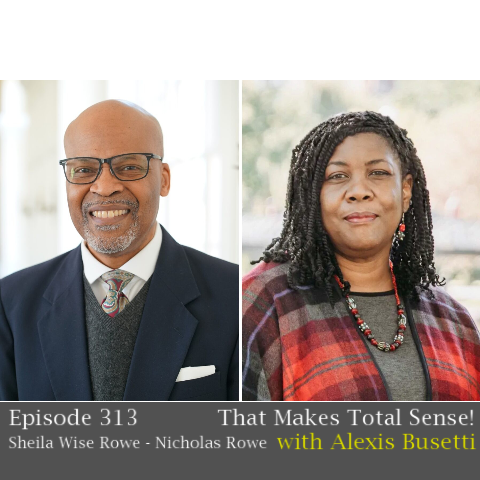
[00:00:10] Speaker A: Welcome to that Makes Total Sense, a podcast dedicated to exploring God's generosity and justice. I'm Alexis Busetti, a Christian, aiming to ask good questions and encouraging you to do the same.
Every one of us is wired by God to live out generosity and justice, but the how sometimes eludes us. That makes total sense is a way for us to get together, posture ourselves as learners, and challenge one another to practice generosity and justice in a tangible way every day.
Well, I am just thrilled, thrilled, thrilled today to host Sheila Wise Rowe and Nicholas Rowe on their newest book, Healing Leadership, Finding Emotional Health, and Helping Others Flourish. And you two. This was.
I feel like this was an amazing book.
And full disclosure, it's one that I probably need to go through the ends of the chapters again and take time to fill in those blanks that you left for me and take space to fill in those blanks that you left for me. When I was prepping for this, I was like, this will be good for the content. And then I probably need to work this like a workbook, like it was intended. So thank you so much for the opportunity for all of us as readers and listeners to go through.
Go through that space. So I want to. I want to say that up front, there's a lot of content in this book, but I could tell that the heart of this project really is not just for the flourishing of others that leaders encounter, but also for the flourishing of the leaders themselves. And that was really obvious in their project. So thank you both so much for that.
[00:02:03] Speaker B: Thank you.
[00:02:07] Speaker A: I'm hoping that the undercurrent for me in this. In this book was the things I tried to keep in mind. Let's say that for me, in this book were kind of twofold.
Number one, that you were writing two leaders, and we obviously know leaders have an impact on those whom they serve, but also, you name that, pretty much everybody in some sphere of their life would fall into this category of leader.
And so that felt really important to me. The other thing that felt very important to me is the humanization of leaders that you two do up front in this book. So can you talk about that part? This humanization, like, leaders are just like everybody else. Good days, bad days, issues, trauma, all of the things. And why it was important for you to write to leaders.
[00:03:11] Speaker C: Yeah.
One of the things that we thought about a lot and one of the things that I tell my students, I'm professor of leadership at Gordon Conwell, and one of the things I tell my students often is that leadership is a relational function.
Objects can't have real relationships with each other. People do because people were created in God's image. That sets up a dynamic that must be honored simply by tint of the fact that we all bear God's image.
We are people who are, you know, we. We are beings that require love to function.
And so becoming a leader does not negate the need for that. It does not negate human need for that. It does not negate human relationship. And I know that there are styles of leadership today that peddled the belief that as a leader, you can treat your people like they're chess pieces on a board, that you can just move them around the way you see fit to accomplish your ends and purposes. But. But in reality, those chess pieces can talk back to you. Those chess pieces won't stay in the squares where you put them.
Those chess pieces, you know, might jump up and rebel against you if you kind of manipulate them too much. There's all sorts of human dynamics involved in this. And so healthy leadership requires an acknowledgment that the leader is a human with needs and the followers are humans with needs. And we have to relate to each other basically according to the way God designs.
There's no shortcut to that.
And if we forget that, all sorts of chaos and mayhem ensues, it just does. And it leaves wounds on people.
That's the other dimension. I don't know if Sheila wants to add another face to that, but I'm just thinking just in terms of the need to remember we're all human beings in this at base and we must relate to each other well for any dimension of leadership to take place.
[00:05:23] Speaker B: Well, yeah, I think the one thing that I would add is just that the reality that leaders are facing this preconceived kind of notion in the public sphere or just even within the context of churches or ministries, etc. Where there's this belief, as Nick has highlighted, that the leader doesn't have needs or shouldn't have needs, that the focus everything needs to be on those that are kind of under them, they need to be on, they need to perform.
And that is just a recipe for disaster.
And also the fact that there's not a lot of real spaces within the academy and elsewhere for leaders to. Or potential emerging leaders to even look at what is going on inside of me that potentially could trip me up.
[00:06:24] Speaker A: Yeah, I was just particularly struck. So.
Yes, and amen to everything both of you just said.
I was particularly struck by the title Healing Leadership Trauma.
And so Sheila, you've practiced. Nicholas, you're teaching.
Tell me about the importance of addressing trauma in leaders. Because I feel like, as you said so well, Nicholas, it's like leaders are humans with needs. But I think a lot of times leaders are called on, I think rightfully so, to help walk with people that they serve who have undergone trauma in some way or another. Not as a therapist, but, you know, supportive.
But what about the leaders who have experienced trauma and then maybe, like, is this a bigger group than we. Than we think it is? Maybe. Or is there. Yeah. What. What is it about the trauma piece that felt so important to you to. To create this project?
[00:07:32] Speaker B: I mean, just, I think from a clinical perspective, a lot of what we see, we see these huge, you know, falls that happen. It's very public, it's very messy.
And there doesn't seem to be a real understanding that there are issues in this person's life that have not been addressed. And often it is around past pain and trauma. I think the other piece is just when we look at the term leadership trauma, the way in which we've coined it, is that leadership trauma is about just traumatic things that have happened early formation and within the context of our families or community or church, what stressors a leader carries in the present, in their work, and in their ministry. And then the reality of being a leader is that you're also supposed to be setting vision and, you know, getting. Galvanizing everybody to come along. And so in the context of being. Having to be forward thinking, other things come in, like fears. Fears that, is this gonna work? Is this gonna be a success?
Is this gonna fail?
And so all three of those are what a leader is carrying. And that's very weighty. And so when they're not addressed, we see the public falls and they're private falls. There's tons of private kind of falls where even if it isn't a fall, it's just a sense of, I don't want to do this anymore.
I'm totally burnt out, and I'm done.
[00:09:05] Speaker C: Yeah, we forget that we are in a broken world. Right. That sin is in the world. Sin is in the. In the context. And it's foolish to act as though that doesn't affect us.
It doesn't affect us individually and that it doesn't affect us collectively. It does. And one of the things that sin loves to jack up, basically, is the nature of relationships. And so.
And Sheila's laid out the definition of leadership trauma in particular.
When a person comes into a role of leadership, there could be so many motivations going on in terms of that.
And one of the things that I think is very common that we see is that in a person's early life and early formation, they get the things that leave wounds on our hearts because of sin, either because of malformation or bad things happening to the person leave gaping wounds that need healing.
So then when the person grows up and enters into the role of leader and they have not addressed those earlier things, all of a sudden, leadership, rather than the sort of servant mandate, which is which Jesus always talked about in terms of folks who lead, it becomes a means that leadership becomes a means to an end for me to try to fix myself.
Right? You have a lot of people now becoming leaders, and they use it to somehow address all the screaming needs of our souls.
Right, that have come about because of the. Our broken contexts of formation. And even people who.
For who growing up was relatively healthy, they still have needs, frankly, that only Jesus can fulfill. And so there's always that temptation to try, try to be in leadership, not just to serve, but also to make sure that I get sorted out.
And that's where we start to see problems. That's the breeding ground for crises. That's the breeding ground for people getting hurt again.
And so it becomes the responsibility of every leader to look, to take a good look inside in terms of, okay, what is going on inside my interior spiritual landscape, emotional landscape, for which I am trying to use leadership as a means to an end as opposed to a context for servanthood.
[00:11:42] Speaker A: Yeah, that was so helpful for me to.
To read and also to remember this. We're all leaders in some sphere. And so there is.
Temptation may not be the right word, but there may be the tendency for each of us to do that in different areas. You know, someone may say, well, I don't. I don't. I'm not the leader of a team or I'm not. What? Well, but you might lead a community group. You might be a parent. You might, you know, so I'm thinking of some of these things where I'm like, oh, dear, am I. Am I in a situation where I am attempting to do exactly what you just said, Nicholas. And going back to the early formation stuff that both of you just talked about, I'm thinking about this as a parent of four kids.
One of the things that. I think it was a language that a different professional coined, and you all used it, but a good enough parent.
So even as you said, Nicholas, even people who had a relatively healthy upbringing, maybe with good enough parents, still have these things that they're trying to sort out. And I'm wondering if we can go there next because I've read a few books recently where the authors have touched on attachment. Attachment styles, attachment theories.
Way back in the day, in my social worker days, with this was language that was familiar to us. But what was particularly interesting to me was in this section where you all write about attachment styles, you also write about embodied practices.
And so I'm wondering two things. One, about the connection for you between attachment styles and these embodied practices. And then just even more generally, I'm thinking about evangelical adjacent Americans who.
Embodiment has been a hard thing to grasp theologically.
I'll use myself as an example.
I grew up in a Southern Baptist, very white, even a Bible Belt context where dualism was the norm.
So it was kind of an interesting thing where the sin that you talked about, Nicholas, you could sin with your body, but you couldn't, like, do good with your body or the spirituality wasn't connected to our bodies necessarily.
And that was just kind of an incongruent, kind of a confusing space. And so it took me a while to embrace the idea of embodiment, first of all, and then to embrace, you know, things that I've practiced, let's say, with my spiritual director. You know, let's just.
Let's just sit here and be for a minute, you know, let's just breathe. Or let's, you know, these other prayer practices, you know, maybe prayer, walking or centering prayer or things like that, that are really involve our bodies and not only our minds or our words.
Yeah. So I'm curious for each of you, maybe especially Sheila, thinking about the practitioner part, and you're the clinician, that embodiment piece, what is the significance and the importance of that, of bringing that into this for you?
[00:15:16] Speaker B: Yeah.
You know, the reality is, obviously the Lord created us, crafted us in a certain way in which all the parts of our body are significant. And that includes our brains, that includes our emotions, all of it.
[00:15:33] Speaker C: And.
[00:15:33] Speaker B: And if we look at Jesus, we see Jesus modeling all of it.
And the reality that, you know, in. In when he resurrected, you know, the wounds were still there, so they literally, it infected his body.
And we can easily kind of swing all the way to the place where it's all about the spiritual.
You know, the body is irrelevant, but the.
The truth is that we're human beings.
We're walking around, we're walking this earth.
We are having experiences that are affecting not just our minds, but our bodies as well.
And so. And one of the things that we Talk a lot about is that whole thing of really paying attention to what is going on internally and not that we should just focus on, like, our interpretation of what that means, but more around, this is what's happening in my body, Lord, what is this?
And oftentimes in the context of that, the Lord reveals that our body is saying something to us, like, you need to stop. You need to rest.
You need to be quiet. You. You know, there are so many ways in which our. Our bodies are made specifically to inform us of something, that something is happening. And I think about even Jesus in Gethsemane, and it's saying that, you know, his.
His crying out to the Lord and his, you know, it's like. Is. He's, like sweating blood. Like, there's a. There's a realness about our body and the connection between our body and our. What we're experiencing.
And so it's important to. Whether you're a leader or not to pay attention to that. And I would say too, you mentioned about having kids that even with your young kids, paying attention to, what is it that you're seeing them exhibit in their body?
And maybe it's some emotional things that you pick up, but sometimes there are ways in which a kid is experiencing physical symptoms that are trying to say something, communicate something to us as parents.
[00:17:44] Speaker A: Yeah. Thank you so much, Nicholas. Anything to add to that, even connecting that to the attachment styles?
[00:17:56] Speaker C: I think a couple of things come to mind. I think there's a lot to be said, obviously, but I think a couple of things come to mind is that our. If we don't pay attention to the messages that our bodies are sending to us, okay, eventually they get louder.
I mean, the whole notion of rest is all about the notion that somehow, you know, we could run 24 7, 365 without needing to stop and refuel.
And so, for instance, just blowing off Sabbath. Because, you know, and I'm thinking leadership contexts and things like that, blowing off Sabbath, blowing off the need for rest, blowing off the need to stop and attention can eventually resort in your body basically saying, that's it, I'm done.
You know, I. And I know some personal experiences like that, you know, you know, all of a sudden you're. You're, you know, you end up getting ill for no reason at all.
Or the stress, the issues of stress and all the stresses that come about being a leader and trying to manage these things, but also the stress coming, because I have not attended to historical wounds. And so what happens is when it. When it occurs in the present, I am engaging with a situation that I don't know what I'm doing or I can't control. And I'm feeling like I'm incompetent. I mean, I'm being reminded of things of my childhood. And all of a sudden I'm taking it out on my staff.
My, you know, my blood pressure is going up, you know, all these sorts of negative signs that your body is trying to tell you that something is out of order and needs to be attended to.
So when we. Looking at those practices at the end of every chapter, it's. It's really an invitation to pay attention to what your body is saying.
It's an invitation too, to also.
[00:20:02] Speaker B: Use.
[00:20:03] Speaker C: Historical things that a lot of other cultures have used really to release stress to, to turn off anxiety, you know, whether it's deep breathing exercises, for instance, or, and, and you see this, for instance, in a lot of African diaspora church churches moving, right.
Moving in worship, moving, you know, as a physical response in worship which does, which is very healthy. Right. For the body in that context, taking care of the stresses and other sorts of challenges that it might not have been safe enough to do during the week.
Right.
So our bodies matter. They matter a lot. And so we need to give them attention and, and to realize what God is trying to say through our bodies as well. Right. I mean, God is trying to communicate. He made this thing. He made this thing and it. He's done a good job of it and it, and it works according to a very divine plan.
[00:21:13] Speaker B: I, I also wanted to just add that, you know, when you. When I think about, like, attachment and how does it connect to this reason which those very early relationships, like if we in a. A home where. Or we were cared for by adults, where there's a secure attachment, in essence, where we had this sense of like, we were loved, we were cared for like our time, and it wasn't perfect, but we felt good enough. That, yeah, that's the good enough. That's definitely the good enough.
And so we may come at leadership and relationships very differently.
We may come at our relationship with God very differently. Like, what was modeled for us is that, you know, God is loving, God is caring, God's going to provide.
But that's not everybody's story. And, and so when we look at like, attachment, we look at how, you know, there was some. Was insecure attachment where we weren't sure, we weren't sure whether they were going to be there or not be there. There was an inconsistency in that and so then we project onto God, like, you know, God is like that. I can't really rely on God. I'm not really sure what God's going to do.
We have anxious attachments where there's some concerns about, you know, is this, you know, because of our parents, like, is this a safe space for us?
There's a lot of anxiety about, because sometimes they're good, sometimes it's not good.
And then we have disorganized attachment, which is both of those attachments. And so it kind of swings between the two of insecure and anxious. And all three of those, all four of them actually impact our relationship with God and our relationship with other people, I would also say.
And in some ways, how we relate to our bodies, you know, because if we don't feel like our bodies are, you know, the. A lot of the attachment stuff is coined by Dr. BBY and he talks about this internal working model that we have about, like, this is like, I don't deserve. Or I, you know, my body is irrelevant or, you know, I can't expect anybody to care for me. And we have these messages and there are many others, but they affect how we navigate through life just generally, but also in how we lead.
[00:23:39] Speaker A: Yeah. Thank you all so much for that. I.
I often think of, gosh, it's been 20 years ago, probably my, My little sister, my baby sister.
I was just kind of venting to her. I'm like, I just didn't know how I felt, you know, I was like, I feel. I don't, I don't know what, what's going on.
And she said, it sounds to me like you need to cry.
And I was like, now I'm. I'm a crier. So I was like, I don't. I feel like if I need to cry, I cry, you know, like, it didn't, didn't feel like some sort of like, revelation to me. I'm not like somebody who, you know, def.
Generally is like dry tears wise. I, I cry a lot, actually, and, And I was struck by that. I'm like, I need to cry. And she's like, I think you need to cry. But I didn't maybe have that one thing that was gonna like, make the tears come, you know, I just kind of felt overwhelmed. And she said, here's what you need to do, you guys, a lot. You may not even remember this movie. She said, you need to rent. Of course. This is 20 years ago, right? So you need to go. You need to go to Blockbuster, right? You need to rent.
I know, she was like, you need to tell your husband, give you the night alone. You know, he needs to go to the bookstore or whatever. You need to rent a Walk to Remember. I hadn't seen it before, but this like teen kind of romance thing, I mean, she gets cancer and it's awful. She's like, you need to rent a Walk to Remember and take out some really good Mexican food. And you need to sit and you do watch this movie and it will make you cry and you need to sit alone and just cry. And I thought, this is crazy enough, it just might work. So I did exactly what she said. I can see myself if I close my eyes now. Picture myself on my couch in our first little rental house. I was married, you know, I sent my husband off. I said, my, my sister says I need to cry, so can I have, you know, the house? And it worked. I just, I didn't have, you know, I sat there and watched this horribly sad movie and ate delicious Mexican foods. I tended to my body in both of those ways and I just bawled my eyes out. I mean, loud, ugly, screaming, snotin, everything kind of cry. And I felt so much better.
But I was so grateful to have someone in my life in that moment who could maybe help train me even to pay attention to those kinds of things, you know, because I think I was, I love this language that my, I was getting signals then. I needed to do something with those signals and not ignore them. And I don't, I didn't, I didn't solve all my problems, but I felt a lot better. And I was probably more clear headed after that to move forward with whatever it was I, you know, was, was going on at the time. I don't remember any of those things if that's a clue to myself. But I do remember sitting and with that Tex Mex on my coffee table at that movie, just crying.
[00:26:37] Speaker B: That is, you know, that is something I recommend all the time.
And what was wonderful when we actually did go to the theater, yeah, long time ago.
But when we'd go to the movie theater and it was an opportunity to not just be alone, which is, that's important too, but in the context of other people. And so whether it's the movie where you're going to scre, like it's legit, like you can scream, no one's gonna call the police and think what is going on in that house? Like, you know, is she being abducted? What's going, you know, or cry and, and there are people around you who are crying as well, yes. And, you know, I just think of some of the movies that I've been with, and even with Nick, and I'm just like. I'm like nasty, snotty.
[00:27:21] Speaker A: Yes.
[00:27:22] Speaker B: Tears.
[00:27:23] Speaker A: Just.
[00:27:24] Speaker B: But it was. It's a relief. It's. It's pouring out and tapping into something that is already there and that's important. So we're looking for. For those opportunities and.
[00:27:34] Speaker A: Yeah, yeah, yeah. Can I. Yeah.
[00:27:37] Speaker C: Can I flip the script on that for a second?
[00:27:39] Speaker A: Do it.
[00:27:39] Speaker C: Because I'm. Because, yeah, there's. There's that type of an emotional release, but there's another type of emotional release that needs to be attended to, and that's our anger and resentment. It.
Right.
[00:27:55] Speaker A: Talk about it.
[00:27:56] Speaker C: So, I mean, I do talk a little bit about this in the book. There are a couple of occasions where I talk about this in the book, but just the story of my upbringing and my relationship with my. With my father and how really, I mean, my coming to Christ is largely a function of seeing my father become a re. Was. I grew up with him being really angry and resentful person because it was in the context of a lot of racism he brought at work, and he just. He couldn't get rid of it. And so when he came home to us as small kids, he just couldn't shut that off. And.
And I think I. I look back and I think a little bit about how he probably acted, and it was an act of safety that he. That he kept emotionally distant from us because, you know, he just couldn't, you know, park this anger someplace.
But then he surrendered his life to Christ and it completely became the opposite. Right. Became the father that we all wanted and everything else.
But we only had that for a short time. I mean, when I. When in my early years in. In university, he passed away.
Now, looking back on it, I knew that I was tremendously angry. I was angry at my father for checking out just when I had him. He checked out. But I was always also very angry at God for taking him like, you know, how dare you? I really needed him, you know, But.
And you talked about your experience in the Southern Baptist space about not, you know, really divorcing our bodies from.
From our feelings in particular, you know, I. You know, in the context in which I was raised, one of the big messages that came across often is that we have no right to be angry at God.
Or at least this is what I concluded. Here's the maker of all the universe. He's done all these great and powerful things. He's strong, awesome, Mighty. And he saved you. You need to be grateful.
And, and in my broken theology, right, being grateful, obviated, being mad at. And it's probably because of, you know, even my upbringing too, and my relationship to my father earlier on, you know, So I remember at the, at the funeral, I didn't cry at the funeral. Speaking of crying, I didn't cry at the funeral.
And I left like three days later. I went back to school.
I didn't. I was out of touch with that anger for 10 years, I kid you not.
And I managed it by being like the total Vulcan for all you Star Trek fans out there, right? Just totally emotionally sort of flat. Everything was all up here and everything else, but there was nothing going on in my heart.
And it lasted for so long that I realized, I realized. But, you know, in the middle of this, I, I get married.
The grace of God, I have no idea. I got married. In the midst of this, we have kids.
And what I started to notice was that my relationship with my, my eldest, my son, was starting to look exactly like my relationship with my father when, when I was young.
And that was a signal to me that something was off that. God, I need, I need your intervention here because I don't know how to be any other way, right? I don't know how to express my, my anger in healthy ways. And so out of fear of that, I just shut it off. But it's affecting me in all other different ways. I mean, I know my body felt it and everything else. There's a whole lot of other things I can discuss about that, but.
And it really took a miraculous intervention from God to really reveal where his son was, where Jesus was, when I was holding all that pain and all that anger. And, and that was the beginning of a significant healing process for me because that anger was coming out in very unhealthy ways, very unhealthy, broken ways.
And I can imagine if I had gotten into a significant leadership, I mean, I was functionally with my kids and I could already see the problem. But if I was in a sort of a major leadership position someplace else, I mean, it would have been a, it would have been a horror show. I mean, going all out like that and not knowing how to relate to somebody else, if there's displeasure in a healthy way, expressing anger in a healthy way, or just fundamentally believing that, okay, God and I, we are in a relationship. And in relationship, in loving and close relationship, there is safety in being honest about all of who I am, including how I feel, being angry at God is not going to, A, piss God off or B, make him run away because he can't handle it.
I had to learn that. That I can be free and. And that God's love for me doesn't diminish because I'm angry at him.
And I had some legitimate reasons. I mean, legit reasons, but that doesn't scare him away.
Right. Or that doesn't cause him to reject me.
It was a major discipleship lesson and a major healing lesson for me to start to do that.
How many leaders do we have walking around today who have not done that, that work, that type, that. Who've entered into that realization that it is safe? So if you're growing up in a context of.
And for me, obviously, it would be disorganized attachment. Right. I mean. I mean, and even the later years where there was some redempt in my relationship with Father, that. That's. Those are early years. You don't kind of snap those things off. They kind of run around with you unless the Lord really. You know, we allow the Lord to do that. Seriously. Deep healing into that space.
But how many leaders are running around with this unresolved. All these unresolved things that have not been resolved, our relationship to God, too. We have things that are not resolved because we are afraid of being honest. Because we learned early on that being honest could get you into trouble.
Right. Or, you know, a variety of other things. Being afraid to express these. These types of motion, whether it's crying or whether it's just being really ticked off.
Right. Or. And everything in between. Right.
Yep.
[00:34:35] Speaker B: Yep.
[00:34:37] Speaker A: The healing part.
Thank you for sharing that. The healing part.
Here. Here's what ticked me off. You want to start. But ticked off.
Being reminded in your book that healing is not a linear process.
And it's. It's not instant. You use the word work.
I mean, Sheila, I'm like, I. I rem. When I had moments similar to what you shared, Nicholas, where I was like, crap. What happened? And then I'm like, I don't know if this is common, but I get to my first year of therapy, and I'm like, oh, I had trauma.
[00:35:25] Speaker B: Yeah.
[00:35:26] Speaker A: When I was a. How? What?
[00:35:28] Speaker C: What?
[00:35:30] Speaker A: And I used the body as the picture in my head. I'm like, I did not know that for 20 years.
I was walking with a limp.
[00:35:41] Speaker B: Yeah.
[00:35:42] Speaker A: I had grown accustomed to it.
[00:35:45] Speaker B: Absolutely.
[00:35:46] Speaker A: I thought that was my gate.
[00:35:47] Speaker C: Yep.
[00:35:49] Speaker A: Emotionally, spiritually, you know, all of that. That was not my gait. That was wounding.
And I did not know that. Oh, yeah. And then what happens when you overcompensate anyway? There's a whole bunch there, but this is what, this is what I learned. And it gave me an amount of self compassion and also compassion for others that I didn't have before. Because the healing work, this figure 8, as you all describe it, that really ticks me off because it's not just this beautiful little process of you just climb the stairs and then you're done.
That's hard.
Like, that is.
That is hard work to, to embark on, to continue, and then to realize, I think everything's pretty good. And then you come across that, that point in the eight again, you know, and you're like, this is.
Oh, man, I gotta. I haven't seen my therapist and I have to call her back right now. You know, like, I thought everything was great and, you know, things resurface or whatever it is. Hopefully we have, you know, tools and the ability to perceive this, you know, in ways that maybe we didn't have before.
But gee whiz, I mean, this is tough. And when we think about this in the context of leadership, whether we're talking about, you know, we've all mentioned being parents, which is like, sometimes it feels like we don't have time for the healing work as parents, which is not true, and we need to do it more.
But it's like, no, because I have to drive carpal, so I can't spend an hour crying about this because I have to be able to see, to drive my kids to school and all of their activities.
But when we think about leaders in other areas, church leaders, school leaders, organizational leaders, work leaders, that hard work inside of those roles feels almost overwhelming because this work is consuming in so many different ways. I mean, it's time consuming because we have to, you know, make the appointments or make. Take moments to listen to our bodies and what's happening. I remember early on with my therapist when I was like realizing, oh, crap, we got some stuff. And I, and I, I messaged her and I said, okay, look, I'm a wife, I'm a mom.
You know, I'm all these things, and I am finding myself during the day where I'm just, I'm just kind of breaking down, you know, can you help me? So she gave me some tools. But the moral of the story was I had to find a way to live and do the work, you know, simultaneously. So she, so she offered me some tools that I'm very grateful for, but I didn't even have enough wisdom at that point in my healing process. To know I would need those tools. Tools, you know, until that showed up. So, and I'm thinking, and I wasn't a CEO, I wasn't, you know, I, maybe I was a community group leader or something like that at church. But it was like, you know, kind of not low stakes, but you know, you know, just a few people I was doing Bible study with. It wasn't some of these other, you know, I wasn't a pastor, I wasn't a non profit leader, I wasn't a boss at somebody's office.
Gosh, talk about that healing process for leaders. You're inviting them to it. Gratefully, you're inviting them to it. But then once you get in, and I'll say, this is the last thing I've seen. And I've seen people stop.
[00:39:55] Speaker C: Yes.
[00:39:56] Speaker A: Where they have said, I've physically heard people with my own ears say to me, it was too hard.
So I stopped whatever it was, stopped thinking about it, stopped calling my therapist, stop, you know, stop listening to my, I just stopped because it's hard. Yeah, it's really hard work.
[00:40:15] Speaker B: Yeah. You know what? I, I think that if we really have a, a real sense that this is not a small thing and that the, the implication of, you know, of not doing it, of not doing the work will have repercussions not only in your own body, your own personhood, your relationship with God, but the people around you, people around you that you cannot not deal with this. And at the same time, I totally respect that people have to go at their own pace.
So if people, rather than, this is too hard, I'm not going to do it at all.
This is too hard. I need to stop and pause and take a moment to, yes. Check in with my therapist. And maybe even if you're not feeling like you can do that, but can you take a moment just to be with God in God's presence? Can you take a moment to pray? Can you look at some of the practices and just say, which help to regulate our nervous systems? Like, can we just do that right now?
But, and then wait until we can do the next thing rather than just jettisoning the whole thing. Because it's not gonna, it's not gonna, it's not gonna end well if we, if we decide we're just gonna stop and, and that somehow magically things are going to change.
[00:41:47] Speaker C: Yeah.
[00:41:47] Speaker B: It's hard work and, but you know what? We do have this commitment from God. He said, who said, I have begun a good work in you and I'm faithful to complete It.
[00:41:59] Speaker C: Correct.
[00:42:00] Speaker B: And so in light of that there's a place of, you know. Yeah, we can, we can pause and we can go to the, we can even go to the Lord. And I mean Nick talked about anger and are not feeling. We can express that, but we can go to the Lord and just say I'm tired and I, I can't do this. I, I need a break. I need to just pause.
The Lord is walking with you. He's walking with each one of us. And so this should not be this pressure thing. Yes. It is a recognition that this is wider implications, but it should not be one where get it together, get into therapy. Just that doesn't really work well that often either.
[00:42:45] Speaker C: Yeah.
[00:42:45] Speaker B: You know, and so can we.
Self compassion. You mentioned of really talking to ourselves, caring for herself like we would do a dear friend, someone that we actually love. How would you walk with that person? Can you walk with yourself in that way? Can you speak to yourself in that way?
Can you like you. If you saw a friend who's hurting, you would want to take that friend to someone who could help them. If. And, and you would do your part to the best of your ability. But they need more help. You would walk with them there.
[00:43:18] Speaker C: Yeah.
[00:43:18] Speaker B: And so that is. So it's so important that we, we use self compassion. We're not beating ourselves up at the same time. We are taking this seriously though.
[00:43:30] Speaker C: Yeah.
You know, it.
One of the reasons why writing this and writing this book was difficult to talk about co authoring a book. Everything else, but one of the reasons why it was a delight in some senses is seeing other people read it. I mean, I had the opportunity of teaching out of the book this past semester with some seminary students. And for many of them, you know, you know, mind's blown. I understand. But, but I think the core thing is that this is gospel.
This is, this is the good news here. Right.
One essential part of the gospel is realizing that my attempt to fix myself will fail.
Right.
So, so here's here, here, here's the thing. And this does not negate what Shield just said about self compassion or anything else like that.
I think folks who are sensitive enough to know God, I need some help.
Please help me.
God is also gracious to show you how to do it.
And God is not like a professor who says you must have a deadline by which you must have this done, otherwise you'll get. No, no, no, that's not how God operates. You know, we have all these sorts of weird models about improving ourselves. That's not how God operates. But I, but, but there is a warning to be uttered for those who think, yeah, I've got problems, I'll work them out.
I will do all these other types of things to work it out.
And here's the deal. It will fail.
It will fail.
We have to realize within ourselves. We have to come to the point within all ourselves that I, I can't fix this, God, I need your help.
You need to show me the way out of this.
I need to surrender.
And that can be a scary word for, for leaders because the whole notion, the whole sort of distortion, I think for those who enter into leadership in, in sort of unhealthy ways is that it's an opportunity to control.
I get to control what happens around me. I get to control my environment. I get to control these people so that they do what I want in order for me to feel better about myself from whatever reasons I don't feel good about myself. I get to control and fix people and everything else like that.
You know, we don't get to control people. Leadership is not about controlling people.
Right?
Leadership. You are walking with them toward a common objective as given to you by the Lord.
That's what leadership is. It is not fixing and controlling people.
And God will disrupt that.
He will disrupt it.
[00:46:35] Speaker B: So it's important to recognize that it's subcon. Often it's subconscious. Most people are not walking around literally.
[00:46:43] Speaker C: Some people, some people.
[00:46:46] Speaker B: But most people are, aren't. They're not like, I want to control people, whatever. Like, they, they're coming out of their early dysfunctional attachment and they're, you know, they've learned how to do this and, and they've, they've come to believe that this is normal and it's. Yeah, kind of okay.
[00:47:05] Speaker C: And yeah. And okay. Which is.
[00:47:07] Speaker B: Yeah, yeah, that it's okay. And so that's the place where there has to be God removing the veil, the. Of the eyes so they're able to see and to open up their ears to hear exactly what is going on internally, but also around them. Like looking at. How are you affecting your, your team, the people, you know, you're. They're seeing it in living color every day. You know, how's your team reacting? You know, if your motivation and you learn that the only way to do this is to create chaos or inside or, you know, kind of take a look at that and look at.
How am I.
Either we're not dealing with people who intentionally do it, but how am I unconsciously creating an environment where people are fearful and or they're shame based or they feel, you know, I'm. We're tapping into their attachment issues.
[00:48:01] Speaker C: Yes, yes.
[00:48:02] Speaker B: And so it's, it's important for us to recognize that, that sometimes we're doing stuff. It's just like when you talked about, you're like, wow, you know what? I actually, it was trauma that I experienced.
And that's often the case because there's so many ways that within our family and in society, we're told that's not what that is. There's a different label put on it, say, well, that's just what we do. That's how our family is. It's just.
And then you look back and you actually sit down with someone, you go, you know what? That was abusive.
And I've gone around, walked throughout my life thinking that was okay and normal.
[00:48:40] Speaker C: That was normal. Normal.
[00:48:41] Speaker B: Yeah. And it wasn't normal.
And that's a hard thing to look at.
[00:48:46] Speaker A: Yeah, yeah, that is a hard thing to look at. That was one of the places I wanted. I'm glad that you brought that up, Sheila. There were a couple of places, Nicholas, when you said this is gospel, this reminded me of it. One of the things about the book that I found very compelling was when was the utilization of scripture passages. So the one that you just, when you talked to Sheila just now about, I thought this was normal and it wasn't.
You bring in the story of Dinah, we look at Jacob. That's a hard one for me. I might set that to the side for a second.
But one of the other stories that really stood out to me as interesting to read through this lens. So Nicholas, you're at Gordon Conwell.
I did my M. Div. @ Fuller and I remember going through in my NT class, OT class, in my biblical interpretation classes and reading passages through different lenses.
And this was really helpful for me to look at this through a leadership lens. Some of these scriptures through a leadership lens and also through a trauma lens.
And so the. So the story of Dinah and Jacob and their family was helpful for me in that. And I'm also. So go there if you want to go there. Choose your own adventure. I won't hold us back from that one. But I also was thinking about Aaron and Moses when Moses was gone. So when you're talking about you can't control people, I'm like, and Moses figured that out.
Not like he was trying to. I don't think he was through the story.
But the people were not doing what Moses wanted them to do almost at all. In some of Those stories. But then Aaron is left with. Moses is gone. Aaron has left. And you talk. I won't spoil it. I invite you to talk about that. But Aaron's. Some of Aaron's potential early formation. You know, what did he live through in his. In his family of origin? How did that impact, how he led in those moments and those days when Moses was gone and the people had requests of him that felt very powerful for me. I had never really read that story or even thought about Aaron in that way. You know, the story of the Exodus is in many ways, and I think this is intentional, of course, but it's very much focused on Moses and the Israelites. And so when Moses is gone, not not just at the mountain, but meaning when he flees Egypt and he's gone, his people, including his siblings, are enslaved.
[00:51:51] Speaker C: That whole, the whole time.
[00:51:54] Speaker A: That whole time. He's gone for four decades.
Moses is gone. I mean, he's herding sheep. It's not like he's like living the celebrity life or something. But his family are enslaved.
[00:52:08] Speaker C: Yes.
[00:52:09] Speaker A: And Moses. And Moses is gone, but Aaron is there living that life. Okay, my mind blown is for a sec now. I'm just gonna invite you guys talk about this. This was real, you know.
[00:52:22] Speaker C: Yeah, you're right. I. I think this is an under explored story.
It really is.
When you look at the difference between a person who is formed under oppression as opposed to a person who is not. So remember, Aaron is Moses's older brother because Aaron is born before the edict of Pharaoh that says all Hebrew boy children must be drowned in the river because it's becoming too plentiful. There's too much of them around.
Of course, by miraculously Moses, life is spirit. But then he gets raised in the household of Pharaoh.
[00:53:15] Speaker B: Yeah.
[00:53:16] Speaker C: To functionally assume some role of major authority. He's trained how to be a leader in that context. Realize, I mean, he's given all the cultural privileges.
[00:53:29] Speaker A: That's right.
First 40 years, I put him straight to. I put him.
Yes.
[00:53:34] Speaker C: He gets all of that.
[00:53:37] Speaker A: That's right.
[00:53:37] Speaker C: And then he goes into ex style, right?
[00:53:40] Speaker A: That's right.
[00:53:42] Speaker C: So he never lives under slavery.
[00:53:46] Speaker B: That's true.
[00:53:48] Speaker C: And you know, we can talk a lot. There's a lot to talk about. Even just what Moses is dealing with, seeing he knows who his siblings are. Remember his mom raised him. Yeah, we. It's. We know that Pharaoh's daughter raised him, but his mom nursed him.
Who knows what. She was talking to him at night, speaking all the words. Your mama's. You heard the word of word. Your mom. Your mama's tongue. Right? Your mother tongue.
Yeah. So he. He. He knows the stories.
He knows everything.
And of course, in his unformed. Immaturity. Leadership immaturity, he figures he will strike a blow for freedom for his people by killing this Egyptian. And that turned out to be a hot mess.
And he runs up into exile.
Aaron doesn't have that option.
Right?
I mean, I, You. You can just leave it to the. To the reader to imagine, but particularly I think this is a word is interesting we're having this conversation, particularly in light of the fact that tomorrow is Juneteenth.
Tomorrow is Juneteenth. What is it like to be raised under oppression? To be raised in the context where you're basically told you're all you're good for is building bricks and doing stuff that you have the potential not to do anything else. You. You will. You're being told you will never be a person in control of your own life or destiny. Your. Your life is just dedicated to doing stuff that other people tell you to do.
So. So this is. This is Aaron's trauma. Big T trauma that he's carrying with himself. And now all of a sudden, he's supposed to be leading people in the.
You. You, you know, talk about it's a leadership failure, but look at his formation. Look at his formation compared to his brother's formation.
And we. We can project it today. This is not an old story that it applies. Look at the formation of people who grew up in a context that doesn't value their humanity or their personhood.
[00:56:16] Speaker A: It.
[00:56:17] Speaker C: And you don't. And you don't have to be a slave for that to be true.
So we know that there are a lot of people today for whom they grew up hearing you're not good enough. You can't do this, you can't do that. You're only worthwhile to do this. You're only worthwhile to do that. Scripture says you shouldn't be doing this. Scripture says you shouldn't be doing that. Which is all lies, by the way. I mean, all these messages, and then you find yourself in leadership someplace with all this potential. Despite hearing all these earlier messages. Those. Those don't just switch off.
Yeah, they don't.
[00:56:54] Speaker B: Yeah.
[00:56:59] Speaker C: I could preach a whole sermon here. We. We don't have the time. I. I wonder if my better half might be able to come in and kind of shield some things too. But. But you. It just hold that. I mean, just hold that. And maybe you, as a. Whoever's listening there may be Somebody as a who. Leader who's listening or somebody who's. Who's live with those messages of being told, nah, you know, I don't think you're good enough for that. I don't think you're good. You. You'll never amount to this. Why. Why are you even bothering to try somebody telling these words to you?
[00:57:39] Speaker B: Just. I think the other piece is just in light of. If you look at Aaron's story and we see what happened with the golden calf, we see his leadership failure.
Is there a way in which we can extend some level of. Of compassion towards Aaron just given what he. What formed him up until this point? This is not to. This is not a critique or saying, well, what he did was okay or whatever. Like, but it does give an. A bit of an understanding of why.
Why he responded the way that he did.
[00:58:23] Speaker C: Yeah.
[00:58:23] Speaker B: What, what contributed towards that.
[00:58:25] Speaker A: That.
[00:58:27] Speaker B: And so it's one of. Of extending some compassion. But also the call, you know, in the errands of this day is that of, yes, having. Extending some compassion around their story, but the need for them to get help.
[00:58:46] Speaker C: Yes.
[00:58:47] Speaker B: And to get on a healing journey. And the, the end of that is not like, oh, a couple of months and then you're back in. In.
You know, it's some. It may mean the best thing would be for you not to return to that job or not to return to that pulpit or that ministry because the wounding is so deep. That was done to. And. And that you did that. It. It is not safe.
[00:59:20] Speaker C: Yeah.
[00:59:20] Speaker B: The people. Or for you to actually do that.
Because there can be this sense of, well, you know, the gifts and callings are without repentance and like, well, you know, so they can't be taken away. It's like, but you know what? The ability to actually practice that gift and calling in many cases and in some cases needs to be taken away.
[00:59:44] Speaker A: Yeah.
[00:59:45] Speaker C: Yeah.
[00:59:45] Speaker B: And. And that is for the greater good.
And so it's holding all of that. And like, we can hold that we can be the compassionate around somebody's story, but at the same time holding them accountable and holding them to account. Like, all of that can happen at the same time. And.
And I think that that's something to really be concerned about as we look at many of these very, very public falls. And then people, you know, a couple months later they've started a new church or they've done whatever, and it's like, what? But no, no, no.
[01:00:19] Speaker C: Yeah.
[01:00:19] Speaker A: No, no, no. All kinds of no, but you're right. I mean, we're, we can. We can hold all of those things together? We. We really can. And I appreciate you adding that and saying that.
I am realizing what time it is. I was going to say I was ticked off again. I was ticked off about the figure eight. I'm checking. Now I'm ticked off because I looked at the time and I'm like, dang it, we just. We don't. I want to. We almost need a part two.
I'm realizing that we're coming to the end, so I want to prep each of you with this.
Think of. Would you please share in just a moment, kind of a last word, each of you.
So. And that can be whatever you want. Sometimes, Nicholas, I'm thinking when I talk to professors, sometimes what I say is, what's the question I didn't ask? You know, like, what's the thing that you're like, oh, if she would just ask this, I would, you know, or you, you know, or for both of you. I'm thinking about clinician and professor. Like, what's your assignment for next time? You know, like, before we meet again, you know, maybe for the, for the readers, for the listeners, what would you like to leave them with to think about while you're thinking about that? I just want to say to both of you and to the listeners, there's so much we didn't get to like. There's so many rich components of this book. One of them is the participatory things that we're invited to. There's appendices, there's the end of every chapter with reflection questions and embodied practices and prayers that invite us to look at ourselves as leaders, that invite us to ask God to show us things about ourselves as leaders.
Gosh, there's a chapter on racial and ethnic trauma. There's chapter on gender related trauma.
Oh, there's a quote I wanted to talk about from Thema Bryant. May you recognize dysfunction for what it is, no matter how familiar it's become. Like, that could be a whole podcast.
So I just want to say to listeners especially, we did not even begin to cover the goodness that's in this book. So grab a copy and there'll be a link in the show notes where you can do that.
Okay. And now I want to ask each of you, please, if you would just whatever you would like to leave us with, challenge, encouragement, assignment, you know, whatever that is. As you think about the leaders who will be. Be listening to our conversation, what would you say to them?
[01:03:03] Speaker B: I think on a basic, like, what could you do? I would say there are many online free tests on how to assess your attachment style. And that is a very, very eye opening and a good way to look at it. One thing I appreciate about the whole attachment style thing is that, that your attachment style can change.
And this is not a personality thing where it's like, well that's, this is my personality. It's like, no, this is not what we're. And they've actually done research where they've shown that actually positive relationships that counter this, the malformations can help heal us.
But it's important for you to know what those are. What are your attachments issues? What's your attachment style, how and in the context of your family. And so in reading the book, we ask questions and kind of unpacking that. But there are, there are quite a few online assessments that you can take to really identify what your style is and then begin to connect the dots with how you currently live and your family and lead in your family and lead, you know, outside the home as well.
[01:04:24] Speaker A: That's helpful, Sheila. Thank you so much.
[01:04:26] Speaker C: Yeah.
[01:04:27] Speaker A: Nicholas.
[01:04:30] Speaker C: The word redemption comes to mind very much.
Let's get down to basic. God loves you as a leader, period.
He loves you. He loves the people you lead as a leaders, as a leader, period. He loves you and the people who follow you more than you can ever imagine. It's.
And part of, and part of the demonstration of his love is that he's the one who redeems all things.
[01:04:59] Speaker B: Yeah.
[01:05:00] Speaker C: You know, that which you know, was a hot mess.
He's very, very good at coming into hot messes and fixing them and making things right.
And this doesn't just mean the situation that you're in or the leadership context you're in and which you're hoping to succeed. Whatever definition of success means or anything else, that it's also you as a person being a leader.
Because that's where it starts. Right.
I think one of the things that we could have expounded on is the difference between who we are as, as beings and what we do.
What we do comes out of who we are. And, and we need to understand our fundamental identity as people bearing God's image. Right.
For whom he sent his son to die. That that is who it is. And because of that, God is at work and will continue to be at work making you more conformed into the image of his son. This means healing and restoring and redeeming the broken places. And it's a lifetime project.
[01:06:11] Speaker B: Yeah. Yep, yep.
[01:06:12] Speaker C: You right.
[01:06:14] Speaker B: Absolutely.
[01:06:14] Speaker C: You know, it's, it's. We see through a glass darkly now, but soon we'll see face to face and everything will be sorted. Right? God will have done everything complete in you. But until then, until then, you are in process. And out of that process of God, continue to making him, making you more like his son.
And as you lead in the middle of that process, look on God to continue to demonstrate his love for you, his great and awesome power, his ability to redeem, his ability to make things right in his glorification of Himself through you.
That's. That's what we're here to do, is to glorify him by allowing him to work through us and to continue to make us more like his son. That's. That's the deal. That's who we are as a leader. You thought being a leader meant, you know, getting all these accolades by getting all these nice things done? Nah, nah, nah. It's God glorifying himself through you and.
And healing people along the way. Right? Because I, you know, you as a leader, have submitted himself, submitted yourself to God's process.
[01:07:21] Speaker A: Amazing. Thank you both so much for being here with me.
[01:07:26] Speaker C: It's a pleasure. Pleasure. I enjoyed this conversation. This is really good.
[01:07:30] Speaker A: Me too. Me too. You have no idea. Let me say the name of the book again. Healing, Leadership, Trauma, Finding Emotional Health, and Helping Others Flourish. The link for folks to find that will be in the Show Notes. Thank you. Thank you. Thank you. Yeah, just bless both of you and your work, your. Your beings and your doings.
Yeah, I'm just so. I'm so grateful for this time today.
[01:07:57] Speaker C: Every blessing to you and keep well.
[01:07:59] Speaker A: Thank you.
[01:08:00] Speaker B: Thank.
[01:08:02] Speaker A: You.
The links for all the resources mentioned in today's episode can be found in the Show Notes, music and podcast production by Seth Buscetti. Be sure to give us a review on itunes and subscribe at your favorite podcast listening app. You can also Visit
[email protected] Sam.