[00:00:05] Speaker A: Welcome to that Makes Total Sense, a podcast dedicated to exploring God's generosity and justice. I'm Alexis Busetti, a Christian, aiming to ask good questions and encouraging you to do the same.
Every one of us is wired by God to live out generosity and justice, but the how sometimes eludes us. That makes total sense is a way for us to get together, posture ourselves as learners, and challenge one another to practice, practice generosity and justice in a tangible way every day.
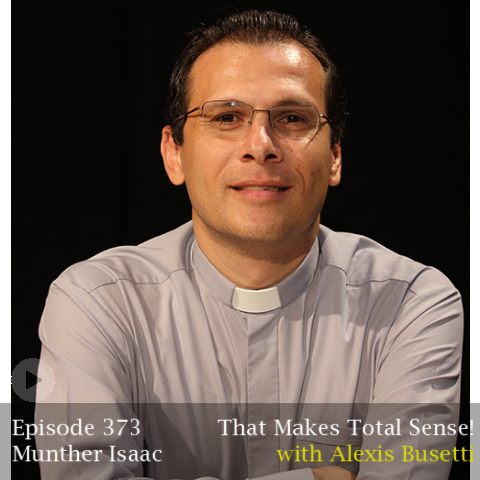
I wish I could, say, express the kinds of things that are going through my head right now. Sitting across from the Reverend Dr. Munther Itzhak today.
Munther, we have met a couple of times and had some really great interactions.
Your work is incredibly influential and impactful here in the US and so I just want to start off by saying thank you.
Thank you for talking to us. I mean, thank you for sitting here with me today.
But specifically, you know, I was reminded I even saw recently a sermon that you gave to the West. And I want to say you don't have to talk to us in the loving ways that you do. You don't have to speak these kinds of truths to us. But I appreciate how your ministerial presence is, is helping us understand, is educating us, is impacting us here in the US and so, yeah, so I just want to start off by saying thank you for being here, but also thank you just largely for your work.
[00:02:05] Speaker B: Thank you, Alexis, for your kind words and I'm grateful for this invitation and look forward for a good conversation.
[00:02:14] Speaker A: So. Me too. So we could talk about 100 different topics today.
And the one that we've kind of narrowed down on is one that I'll just be real honest, I am a little bit intimidated to talk about with you, and that is Christian Zionism.
I'll say a little bit of my background.
You and I met for the first time in, I think it was 2022, where I had made several trips to the Holy Land. That was my first trip where I had been in Palestinian territories.
And even though I had started shifting some of my views and understanding things differently prior to that trip, that trip was incredibly impactful in just how I about different theological things that I. That I had kind of just, I don't know, almost by default or been kind of encouraged to think about in other ways.
I don't know that I ever would have said I was a Christian Zionist necessarily, but I would say my circles definitely were that. And it was kind of a default setting. And I think not just for me. I think for many American evangelicals, it is kind of a default setting. So I want to ask first, a, does that resonate with you? Is that something that you think you've seen or you agree with?
And two, if you could just define that term for us as we get started so that we're all just kind of on the same page when we're talking about it.
[00:04:12] Speaker B: I think the introduction you just began with is extremely important if we are to take this question of Christian Zionism seriously. And I'm grateful that you began there, because pilgrimage to the Holy Land is actually part and parcel of a greater, bigger matrix that involves the erasure of Palestine and Palestinians, so that a new discourse, a new narrative, a new imagination of what the Holy Land is and should be is created in the minds of Western Christians, namely that you come and visit our land.
And I've heard this from numerous people who visited the Holy Land numerous times. In their mind, they're visiting Israel because that's how it is promoted. That's how it is spoken about in churches. It's Israel and it's the biblical sites. And so you might spend 10, two weeks, 10 days, two weeks in the land going from one place to the other and only being exposed to the Israeli site.
And you leave with the impression that Palestinians don't exist.
And so the default position that you mentioned has more to do with just this is how we understand the Bible. It has to do with how preachers preach about the land, how pilgrimage is conducted.
And one of the things that Christian Zionism has managed to do is change the perception or the image of Palestine in the imagination of the Western mind from that of the Holy Land with an indigenous Christian community into this is Israel, home of the Jewish people. And the Palestinians are erased.
Now remember, we were physically and literally erased when Israel was created. This is not something that is spoken of much in Christian circles. When Israel was created, it was not created on empty land.
More than half of the Palestinian population back then were forcibly displaced, ethnically cleansed from the land as a fact, and they can't return. From 1948 onward, including, by the way, many Palestinian Christians, close to 450 or 500 Palestinian towns and villages were completely destroyed, no longer exist. In some instances, the Zionists would plant trees in the place of the village so that no one remembers where the village was. So this is how much erasure we've experienced as Palestinians. But then the Christian element of it is that in the psyche and the imagination of the Christian world, we were erased as well.
The name of the land changed, transformed from The Holy Land, Palestine into Israel.
The indigenous Palestinian community that includes the Christian community is now marginalized, is now sidelined at the expense of the new Jewish immigrants who became the citizens of the state of Israel. And as I said, as you said, many, many pilgrims come and at best spend two hours in the Palestinian site visiting the Church of the Nativity where Jesus was born.
And so it's important to begin here, because Christian Zionism, there have been many, many definitions to it, and I'd rather choose a simple definition. It's Christian support to Zionism based on religious beliefs. So you support the plight or the ideology of Zionism, namely the creation of a Jewish state in Palestine.
Or some would say Zionism is the creation of a home for the Jewish people in Palestine. But actually the early Zionists said explicitly a Jewish state.
And you support Zionism, you support that because of religious convictions.
Then that support becomes, then translated into a political movement, into a political ideology.
And there are many ways. Now, remember I said for religious reasons, some evangelicals support Zionism because of eschatological beliefs. Others in the mainstream liberal side, support this idea of Zionism based on the belief that the covenant between God and Abraham continues today with the Jewish people. So there are different strands, theological strands, theological reasons why some Christians support the idea of Zionism. But the end result has always been we must support Zionism in its plight to establish a home for the Jewish people in Palestine. And that's how I would define Zionism. As I said, evangelical Christian Zionism actually looks different from mainline Protestant Christian Zionism, but oftentimes the end result is the same, which is an endorsement of Zionism. And that's why many times when we discuss Christian Zionism, yes, we need to discuss the biblical elements. Does the Bible say this? Does the Bible say that? But we can't avoid discussing the reality, the political reality of Zionism itself, what it has done on the ground to the Palestinians, and then judge it based on those, on our moral standards. Is Jainism morally justified in what it has done to the Palestinians?
[00:09:48] Speaker A: Thanks so much for that, Munther. I want to talk about that last part a little bit more maybe, before we dig into the Christian religious side of it. And that is what Zionism has done to the Palestinian people. And as you mentioned, there is an erasure.
And I want to emphasize that from the perspective of a pilgrim, from the perspective of someone who's been a tourist. And on the trip that I referenced earlier, just a few years ago, I spent phone calls with my husband who has, who has also Been to the Holy Land several times.
We traveled together quite a bit. We've each gone separately from one another, and we've done things like driven rental cars and things like that, kind of slightly off the beaten path kinds of things.
And I would tell him, like, oh, my goodness.
It's pretty common here in Texas, for example, to have, like, big kind of retaining walls up on the sides of the highways, and they have big Texas stars, and it's kind of like over the top.
And so it's not unusual. Like, those sites are familiar to me. But there were places where we're just riding along in highways in various parts of Israel that are adjacent to Palestinian territories, for example, to the West Bank. And you. And I look and I go, it doesn't. It doesn't. Nothing seems that off to me because I've traveled down these highways multiple times. But then when we turn and actually go into the Palestinian territories, you know, some days it's like, if we could get in, you know, checkpoints and, you know, all of these various things. And then we come in and we go, oh, that's the retaining wall.
I don't know for certain, but it surely seems like that wall is there for no other reason except for to hide what and who are on the other side of it.
And that's just a small kind of logistical or geographical data point for me when I was there going, wow, this really, really feels intentional, that traveling around in Israel proper, the Palestinian people are out of sight, out of mind.
And I think there's a lot of aspects to that that could be discussed. But in part, you know, I can't tell you how many American Christians I know who make a pilgrimage to the Holy Land as kind of this once in a lifetime, you know, very big deal. I want to walk where Jesus walked. And I'm not saying anything against that, but I will say that that feeds a theological and religious imagination as you're talking about that disappears a group of people.
And so I'm wondering if you can speak to Zionism.
And I mean, gosh, this is. Yes, we know volumes and volumes and volumes have been written on this, but for you and your community particularly, what do you think is important for us to realize about that connection between Zionism and the attempted erasure of the Palestinian people even prior to October 7th and the events after that?
[00:13:42] Speaker B: Yeah, you touch on a very, very important and serious issue.
What the Wall does, but also what the Wall says and how the Wall speaks, what it conveys.
Let me go back to Zionism as I define it the creation, not azite, but aha, what it is, it's a creation of a Jewish state or a homeland for the Jewish people in Palestine.
There are at least two serious problems with Zionism.
The first one and the most obvious one and the most serious one is that Palestine is not empty.
You're creating an exclusive homeland for a certain people defined by ethnicity, religion, nationality, on someone else's land.
And how do you go around this?
Then Zionism realized from the very beginning, and actually, and you go and read the writings of the early Zionists that they need to find ways to push Palestinians out. They said it, they talked about transferring Palestinians.
So in a sense, when they spoke of Palestine as a land without people, it wasn't a land without people in a literal sense, but in terms of people of equal worth.
And that's important.
For Zionism to work as a colonial movement, then that necessitates the displacement of the indigenous community.
And then of course, it's the idea of a Jewish state, an exclusive state. But we can talk about that later. So from the outset it was clear to the Zionist that there is no room for both. And that's why the Nakba was the 1948 was a perfect opportunity for them to drive, as I said, more than half of the Palestinians out.
But that didn't stop. And you rightly pointed, for example, to the wall, and here is where things come together with the wall. Because to justify driving out Palestinians out of their land to create a Jewish state, the Zionists needed to do two things. And this is where Christian Zionism comes to aid. The first is theology. They needed to say, well, the Bible says this is our land.
Read the Bible. Two thousand years ago or 4,000 years ago, God promised the land to our descendants, to Abraham, and we are the descendants of Abraham. It's Israel's land and all of that. And that's where Christian Zionism actually was more prominent, was more influential than political Zionism, which was to a certain degree secular in promoting this idea that this is Jewish land, that it belongs to them by divine right.
And the second thing needed by the Zionist to continue its plan was the dehumanization of Palestinians, maybe even the demonization of Palestinians, because how else do you justify the ethnic cleansing of 800,000 Palestinians back then in 1948? Well, it's their fault.
They did not accept the partition plan and so on. And then this keeps going on and on until now. It becomes its Islamic ideology, it's Islamic terrorism. And what happened in Gaza in the last two years and a half. The massacre of close to 100,000 Palestinians, a genocide by many, many scholars, human rights organizations, legal entities.
And it goes on. The starvation goes on, the siege goes on.
How can we understand it? Well, you need to look at years and years of systematic dehumanization of the Palestinians to the extent that it became acceptable not only to justify this massacre, but to blame it on the Palestinians and to make it actually a moral and just act. And shamefully, I would say shamefully, many Christian theologians participated in that, including evangelicals in prominent mainstream outlets such as Christianity Today and others. So it's not just the usual suspects of John Hagee and Christians United for Israel and so on.
So this dehumanization of Palestinians, which reach its peak when we were described as the Amalekites, remember what Amalek did. In other words, we deserve to be completely annihilated, has been going on for years. It's systematic.
And so the wall, when you saw it, I always use it as a metaphor, of course. It's an ugly, concrete wall that separates us from the world and besieges Palestinians into concentrated communities. And you've seen how Bethlehem, for example, is completely squeezed.
But that wall has long existed in the imagination of many Christians who spoke of our land as an empty land, a land without people. The wall today tells you, don't go there. It's dangerous.
You don't want to be associated with those on the other side of the wall. And in fact, if you travel with Israeli tour agents, they might tell you, before you enter into the Palestinian territory, watch for your wallets to. Don't buy from there. Be careful. You're there just for two hours to visit the church and leave. So the wall speaks volumes because they call it the security wall, because they're telling you, basically behind that wall is a group of terrorists who just want to destroy us. No one talks about the history. No one talks about the fact that we were in our land before the Zionists came and so on.
And so Zionism and Christian Zionism need this idea, not just of theology, to say the Bible gave us the land, but they also and tragically and shamefully relied on this systematic dehumanization, even demonization of Palestinians over the years.
[00:19:54] Speaker A: Munther.
I phoned a friend before we got together today as I was preparing for our discussion, and I asked a few friends, what should I ask Munther?
What, you know, what would be helpful, you know, for us to. To try to understand. And so one of those questions is coming to my mind right now as you're, as you're talking and I'm asking, as I'm asking you as a Christian, as a pastor, as a theologian, and also as a Palestinian person.
And my friend asked, he wondered what. It's kind of a two part question, I'll ask it in reverse, but it was, he was wondering about this.
What is this mandate to love our neighbors as Christians, but specifically in, in kind of two senses. So what is it like to love your neighbor when your arguably some of your closest spiritual neighbors, Christians, many, even, even American Christians, but other global Christians who, who understand Christian Zionism to be, you know, theologically sound.
What is it like to love your neighbor when your spiritual neighbors are often in support essentially of your oppression?
And then the second part has to do with your physical neighbors kind of on the other side of the wall. What is it like to live with an understanding that some, and I will say like some because I've been actually very encouraged by some of the things that are coming out of Israel, that it's similar in some ways, I think, to the US Government right now where we've got kind of far right people in charge, but that doesn't necessarily represent, you know, everyone who's, who's there. So I would say some Israelis or specifically the Israeli government seems to be obviously committed to the political and physical oppression of Palestinians. So how does love your neighbor fit in with those spiritual neighbors and those physical neighbors?
[00:22:25] Speaker B: Yeah. Now I think it's important to say before answering this question is that for me and for most Palestinian Christian leaders, I think theologians, at least in my circle, the idea of loving God and loving neighbor, even loving the enemy, is something we can't compromise, is a characteristic of the Christian faith. It's what sets us apart.
It's non negotiable.
It's not whether we should, it's how we should.
And failure to love the neighbor and love the enemy is at, you know, really determines whether you're a good Christian or not. Actually, you know, it's, it's, it's the ultimate test that Jesus put in front of us.
Palestinian Christian theology actually is so much fixated on the sermon on the mountain and on the commandment to love, even love, as I said, not just the neighbor and the enemy. So I hope you understand how central this theme is for us. And it's not like one element of Christian discipleship. This is discipleship. This is what it means to follow Jesus.
Now in our context, we live first as Palestinian Christians among 99% Palestinians now who are Muslims. And so for years, we were probably 10, 15%. And then after Israel was created, many left. And now, sadly, we're left with only 1%.
You know, you just have to learn how to live with your own community, not as a religious minority, because we're not an ethnic minority. We're Arabs, we're Palestinians, but how to share neighborhoods together, how to build schools together, how to. And I think that helped us over the years engage with the broader questions. When it comes to our Christian siblings, it's in the West. Many times it's a challenge because we feel that many of them look at us as dispensable. Maybe, you know, how do you deal with those who aggressively call for.
And there has been some who said, just get it over with quickly in Gaza, as we did in Hiroshima and Nakazaki. This was a quote from a politician who actually went to two important evangelical seminaries in the United States. I talk about him in my book.
How do you respond when someone is literally calling for your life and supposedly, you know, a theologian or a pastor? How do you respond when we are constantly being erased, when our identity is set in doubt, but also when our experience is questioned, when our reality is questioned?
You know, we cry for years, the occupation is suffocating us. And they respond, no, no, no, it's not the occupation, it's the wider Palestinian community. So they think they understand our reality better than us, and then they frame the problem the way that fits their ideology. So clearly they not only dismiss our plights, they don't care. So how do you respond? It's really a challenging question.
And for years we tried to engage.
For years we organized conferences. We invited people come and let's talk.
I've been leading the Crisis at the CheckPoint conference since 20, 2010. What's the idea behind it? Let's have a conversation at the checkpoint where we don't talk theology and eschatology in libraries, but we talk theology and eschatology as it relates to the lived reality of both Palestinians and Israelis. We wanted to ask the question, what would Jesus do if he is to stand in front of a checkpoint, whether to the Palestinians who are trying to cross that checkpoint and being humiliated and interrogated by the Israelis just to go to work or to go worship in Jerusalem, or what would he say to the Israeli himself?
And so we tried to engage. We invited. We hosted delegations.
You were one of those few delegations that come and engage with us because the vast majority don't.
And I think there are times when we need to also, in love, challenge our siblings and call them to repentance.
And since the war in Gaza, if you look at the tone of Palestinian Christians, it changed a lot because now all of a sudden we were confronted with a big segment of the wider Christian community, especially in the west, that completely not only ignored or dismissed us, but called, whether through silence or through aggressive calls for our annihilation.
So how do you respond when you hear churches adopting the colonizers narrative, or calling for the destruction of Gaza, or condemning one violence while ignoring the violence of the other, and so on.
And in that sense, we feel that our love compels us to call our siblings to repentance, in some instances to boycott them, to say, we can't have fellowship when you deny or you assault our humanity when you deny the genocide that's happening against us.
And so sometimes you need this tough love that speaks in love, of course, but we need to speak truth without compromise. And as I said, in certain instances, call people to repentance at the same time, even when it comes. Now, the challenging question, how do you love the enemy in such a contest?
And you don't choose your enemies. You know, I was born under military occupation. I still live under military occupation.
Every time I have to leave a city, whether Ramallah or Bethlehem, I have to go through the military checkpoints.
All my documents are, you know, more or less regulated by the Israeli military. With the water we drink, the electricity we get, everything is controlled by Israel.
And today we see an unprecedented rise in violence against Palestinians. Not just in Gaza. We've seen there are hundreds of thousands.
What's happening is truly horrific, but also now in the West Bank.
And this is a difficult question, honestly, especially in such a context when you are literally trying to survive. And that's our concern now.
And I think there are times when our first priority should be to survive.
Yes, granted, I don't want to be sucked in into the ideology of revenge and violence. We've promoted that. To me, it's part of loving the enemy. Non violence is part and parcel of that.
But sometimes I feel it's not really a good time or appropriate to preach or to talk to the oppressed. You need to love your enemies. When we literally try to survive a very, very brutal period of our lives where there seems to be no support.
But if you look at the wider Palestinian theology over the years, we've reflected a lot on this issue.
And one very, very helpful articulation of this is found in the first Kairos document, a document by a group of Palestinian Christian leaders.
And in it they say that to resist evil is a right and duty of every Christian, but that resistance must be grounded in the logic of love.
And so when you resist in the logic of love, it means you insist on seeing the image of God even in your oppressor, and then ultimately seek to liberate the oppressor because you know too well that only when both are liberated, then that's where true peace is achieved. And so part of the commitment to resisting evil in the logic of love is the commitment to non violence. In Cairo's document, they intentionally call it creative resistance because they felt that nonviolence conveys passivity. And they want to say, when we see evil, we're not passive, we're not neutral. We side with the oppressed. And when we are oppressed, we resist the oppression, but we resist it in this logic of love. And the document goes on listing ways, whether it's through boycotts, civil disobedience, whether it's through art and reviving memory, reviving identity, but also through calling for sanctions because we have means in the international community, we have the international law. It's not perfect, but it's what we have to call for countries to respect their treaties regarding human rights and when human rights abuses and war crimes are committed, to hold those who commit accountable, so to lobby and advocate and raise awareness. And that's where Palestinian Christians have been very, very active in the last years, trying to call for justice for our people, trying to resist evil with good and trying as top of that, as I said, to survive. And I feel many times there is a big burden on our shoulders, not only to try to survive, but try to do it in non violent ways.
And many times, as I felt, we even feel, is it really appropriate to continue to preach this to our people? When literary people, you know, you have settlers coming with weapons, stealing their homes, I mean, how do you respond? It's a challenging, challenging question, honestly.
And I don't want to sound noble and to say, yes, it's easy. And I'm always conscious that, you know, when I speak nonviolence among Palestinians, it's not easy. I know myself, you know, the violence we're facing is so harsh, the injustice we're facing.
And faith is tested in these difficult, difficult times. So I hope I shed light on this issue and the struggles we go through as Palestinian Christians and trying to live out what we feel is an essential part of our Christian identity, namely to love God and love neighbor.
[00:33:28] Speaker A: I've got kind of two more questions.
They're kind of big Ones, though.
And then I want to just prompt you now to say, I'm going to ask after those two for you to share anything left that's on your heart or things that we didn't quite cover because this is a giant topic. Obviously, this first question, they both have to do with land. But the first question wasn't on my list and it really wasn't on my radar until something you just said was you just, you mentioned settlers.
And I'm wondering if you would be willing to give us a picture of what, what the. When you say settler, what that means, what that looks like. Even particularly in the West Bank, I think there is obviously a lot of focus on Gaza, which is appropriate, important, and all of the things. But I'm asking this because I want to maybe open up the conversation a little bit and help people remember what you just said. Said you were born under military occupation. You continue to live under military occupation. This isn't something that was a brand new problem after October 7th with new violence or new ways of colonialism or genocide or any of these things that, you know, when, when I visited in 22, I just, I kept feeling kind of shocked at myself to say this is apartheid. Why does. No, why is no one calling this apartheid? This is like kind of by definition what this is.
And then as I saw settler, some settler occupation there, I was actually quite shocked because in my imagination, it was one or two tents or something. I didn't picture full cities, you know, communities like I saw with permanent buildings and things like that. And so I'm wondering if you can shed a little bit of light on what that looks like. You also mentioned, you know, daily life for Palestinians who are just trying to commute, you know, to, to work and, you know, to visit, you know, family or friends or to worship.
This is.
I just, I want to just ask you if you would share a little bit of what that atmosphere is like, because again, I think the walls, literally, in Israel, but also metaphorically, for especially Christians in the US we just don't have a picture of what life looks like for Palestinians and what it has looked like for decades. That's not what we see. That's not what we hear from the pulpits. That's not what is depicted in the media oftentimes.
And so even for folks like me who are, you know, like, I was trying to be, you know, very open and things like that, and when I got there, I thought I knew, and I just, I just didn't know.
[00:36:59] Speaker B: Settlements did not begin in October 7. Settlement building Settlement building began after 1967, when Israel occupied the west bank, let's be clear, and then intensified after the signing of the peace accords, the Oslo Peace accords, and let's dwell on that. So you sign an agreement with Israel that's based on common recognition, and then that is intention designed to lead to a two state solution. And then where you're supposed to have your state as a Palestinian, Israel then intensifies building these settlements in the West Bank.
And then the wall was built in the 2000s.
And what we've witnessed in the last three years and a half years, maybe since this current Israeli government took office, and this happened before October 7th, is an intensified effort to expand and recognize more and more settlements. So what is a settlement? Settlements usually begin by Israeli groups setting, as you said, caravans, tents on a hilltop, and then they began expanding. And usually they rely either on this state land, as they call it, although it's in the west bank, recognized as occupied land, they don't care, or in some instances, privately owned land by Palestinians. And they go around it by saying, okay, if you can prove it's your land, then it's ours. And they apply the absentee law. So they literally pushed you out of the land, not allowed you to return.
And then they say, if you can't come back to prove it's your land, then it's ours. I mean, it's insane that when you think these things are happening in plain light, plain day, everyone knows what Israel is doing.
It's institutionalized land theft. They're trying to make land theft legal.
And in some instances, they rely on security measures to confiscate the land. So usually they have what they call the buffer zone to protect the Jewish settlers who come and live in the West Bank. How do you do? So you have to establish a buffer security zone that the military controls there. It doesn't matter if it's privately owned land or whatever. It's for security. And under the pretext of security, Israel can do anything, including building the separation Wall, which suffocates Palestinian land. The wall was not built on the borders acknowledged by the international community or any of that. The wall was built to confiscate more and more land and to suffocate Palestinian lives.
So when you remember that most of the time, especially with new outposts, it's religiously motivated settlers. And now over the years, we've witnessed the shift of identity between secular Zionism into religious Zionism.
And the religiously motivated settlers hold very frightening theologies.
They claim God gave them the land. But they also use the example of Joshua.
They think what they're doing is a new Joshua mandate.
More recently, in what then became a viral interview, a Zionist settler leader said and defended the idea that one Jewish life is worth more than millions of Palestinian lives.
Under the pretext of theology, God has chosen us.
And he told the interviewer from BBC, and you're jealous because of it.
So these are religious fanatics and they don't mind applying terror, killing people.
What's happening right now is they're trying to empty the land.
And it's important, Alex, to dwell on this because some might think, okay, Mundar is exaggerating when we use terms like ethnic cleansing. Actually, it's Israeli politicians themselves saying, yes, what we're doing is ethnic cleansing.
The religious leaders are calling it, we need to volunt, you know, to.
We need to encourage immigration. They call it voluntary immigration. What does voluntary immigration mean? I make your life as difficult as possible.
Where you need to go through checkpoints every time you try to go to work, every time you try to go to your. To farm your land, every time you try to go to school, where our day routine becomes for these villages, especially three to four hours on checkpoint every day, or where you plant trees and then the settlers come and uproot them, where they burn your homes, they burn mosques, they write graffiti on the streets, on your cars were going to get you. So that ultimately you decide you either to move to a more Palestinian, like a city in Ramallah or Bethlehem, or you leave the land entirely and they take over.
And this is exactly what they're doing.
It's a plan. And we shouldn't get caught in these attacks as if they are isolated incidents. These are the implementation of the plan. The government, by the way, supports them, funds them, and the military protects them.
The Israeli military accompanies them in these raids and protects them. They're never held accountable unless in very, very.
How they describe it, you know, rare incidents when they became public discourse and everyone is filmed. So they try to defend the image of Israel by saying, okay, we arrested the one who did it. And then, you know, we know, at best one or two years and then they're let out.
So when a settlement is created, it's not as if they find land and live in it. The whole area lives in terror and fear and your life becomes literally hell on earth. And as I said, sadly, this is where we have to speak up.
It's not just that these Zionist settlers, who are religiously motivated and promoting terror and I'm grateful that many Jews are speaking out. There are some Jewish groups that come and protect the Palestinians, try to fight against the settlers, but honestly and sadly, it's now becoming the majority. The Israeli government keeps shifting more and more to the right and the elections decide how far to the right you can go.
The voices, let's say on the left or the so called peace scam are becoming more and more irrelevant in Israeli politics. And that's another scary part. Part of it has to do with regional politics and global politics, the impunity that the right wing governments from Israel enjoys and the support they continue to receive from other right wing governments, most notably from the Trump administration.
So they don't find a good reason why we should put aside this inclination.
But let's also remember that many Christians share these views. Many Christians believe that they are entitled to this land. Many Christians completely ignore not just, you know, our human rights as Palestinians, our lived experience, also for the sake of what they call the biblical rights of Israel.
The answer of many, many Christian pastors when confronted with these realities on the ground might be, yes, it's complicated, violence is unfortunate, but God gave the land to the Jews and that's it.
Let's be honest, this is the ideology of many, many Christian pastors, many theologians, and that's why we need to confront this ideology that is behind probably the support of many politicians in the United States to the state of Israel. And that's what we've been trying to do for a while now as Palestinian Christians through our writings, through our theology initiatives, through our conferences. I mentioned Christ at the checkpoint, Bethlehem Institute for Peace and justice now doing conferences in the United States on these issues because we feel that. But it's the credibility of our Christian witness that is at stake when Christians through theology, support so much violence and so much of the injustices and dismissal of the rights and plights of the Palestinian people.
[00:45:51] Speaker A: I'm glad you brought that up. My last question before I want you to just end it, however you want to end it, is this. And this is, gosh, this is asking you to do a lot of work in concentrating some of these bigger theological ideas that you've been sharing for years now.
But this is another phone a friend question.
But it is how then when you talk to especially American Christians who hold to some of these ideologies that you've just mentioned, especially Israel's right, and I kind of want to use that in quotes, but right to the land, what are some, what, what do you, how do you help Christians engage with healthier ways to engage with the Holy Land. Like what are some of the ways that you suggest Christians who have kind of taken these as their default views, how do you suggest they engage differently? What is that?
What does that look like for them?
What do you hope it would look like?
[00:47:26] Speaker B: Yeah, this is our message. Our message is.
Do the teachings of Jesus and the ethics of the kingdom of God, can they guide our politics or not? Whether in our countries, in our own countries, or whether how we relate to other countries, Our experience has been that when it comes to Palestine, everybody puts the ethics of Jesus aside. Even the prophetic traditions of the Old Testament, of the prophets themselves, and then the biblical promises to Abraham and the assumption that they extend to every Jewish person today trump every ethical mandate of Jesus or even, as he said, the prophetic tradition. Because by the way, I mean, and I always say this, even if for the sake of argument, we assume that the promises that God gave to the Jewish people or to Israel, biblical Israel, extend today to Israel. I mean, just for the sake of argument, let's just agree that the Jews of today are the legitimate receivers of the Abrahamic promises. That includes the land, okay? And I mean, we've challenged this in many ways in our writing, but let's just assume this is what you believe.
Even the prophetic tradition themselves, even the Abrahamic promises themselves guarantee equal rights to those who live in the land who are not of Israel. I mean, it's 101 prophetic tradition, prophetic justice, social justice. In the Bible, you shall treat these strangers as the native born.
You shall allot the land to them as you do to your own children. I mean, it's basic biblical teaching. I think this is Ezekiel 47.
And so it's amazing to me how Christians dismiss huge portions of the Bible.
The ones that teach on justice, the ones that teach on the dignity of every human being, the equal worth of every human being, the idea that you shall not steal, you know, the vineyard of neighbors, that story, if you know it, a beloved story to many Palestinians, then the ethics of Jesus themselves.
And Alexis, I'm not even touching on the theological questions of who are the offspring? Who's the offspring of Abraham today? Is it Jesus? Is it the ones who are in Jesus? Is there a physical one or spiritual one? I mean, these are things we've challenged on the biblical theology sphere, if you know what I mean.
Namely that it's Christ who is the offspring of Abraham, not offsprings and Galatians 3, 16 and. But I'm just talking now about the Ethics of Jesus.
Why is it that when it comes to Palestine, they are always dismissed? Not only that, why is it that the international law and human rights always put aside when it comes to Palestine? I mean, show me any other context in which a political dispute is solved by asking the question, to whom did the deity promise this piece of land thousands of years ago?
Imagine if we take this to other contexts and ask these questions, you know, we would be called religious fundamentalists, right?
Does history matter? Does lived reality of people matter?
And so we're faced with this dilemma because when Palestinians say this is our land, they usually mean this is land we've inherited and farmed for generations upon generations upon generations. You know, we have it. We know every tree in this land. We know every wall, every house and so on. When the Israelis said, this is our land, they say God promised us the land. Of course, with the exception of some Palestinian Arab Jews who lived in Palestine for generations with us and who were part of the history of that land. I'm talking about the colonizers who came later.
And I'm not denying the Jewish history of the land, but the fact that, you know, you read the Bible and you read about Israel and so on, does that entitle any Jew in Brooklyn to come and kick me out of the land and live in it? I mean, it's ridiculous when we use these arguments. It's ridiculous when we try to frame it as a conflict between the gods, you know, and so our message is that as Christians, we can do better. There's a wealth in our scripture, in both its testimonies, in both its sites, in the prophetic tradition, in the teachings of Jesus, in the ethics of the kingdom of God. There is a wealth of material that talks about justice, equal rights, the dignity of all that talks about truth. Can we find a solution for the fact that today 7 million Jews and 7 million Palestinians live in this land that's based on equality, justice, and truth?
Or will we continue to promote ideologies and theologies that preach supremacy, entitlement, and lead to the injustice and oppression of the other?
We've seen the result of that harmful theology, and that's why we've called evangelicals and Christians who adopt these issues to repentance.
The consequences are catastrophic for us on the ground. They are. It's about death and life for us, literally.
And I hope that Christians can do better.
And I'll end with this idea that, you know, I grew up with the understanding that, you know, a prayer can make you a son of God if you Accept Jesus, let him into your life. That's how you become a child of God. Romans, sorry, John 1:12 says that one way or another, at the same time, Jesus also said in Matthew 5, Blessed are the peacemakers, for they shall be called children of God.
Why is it that many Christians prefer the easy raise my hand kind of approach rather than the difficult, more challenging?
And I think there is a reason, of course, blessed are the peacemakers. And let's remember Jesus said these words in a religious, in a politically charged environment.
He didn't refer to two neighbors not getting along and then drinking coffee together and talking about their disputes. No, it was politically tense charge. Religious ideologies were everywhere and Jesus called us to turn the other cheek, to love the neighbor.
How can we be as peacemakers, as Christians?
And how can we peacemakers in the context of genocide, in the context of apartheid, in the context of oppression, can we speak truth and love? But can we speak truth to power? Can we call for accountability? Can we call for justice, sanctions, calling those. So peacemaking is difficult because it means taking side. It means speaking against those who oppress.
But let's remember this is how we are called children of God according to Jesus.
And my message to evangelicals and to Christians who hear this is that from the perspective of Palestinian Christians, the global church, the Western church, has been part of the problem rather than part of the solution.
To us, this is an existential question and we hope that they turn to the good, you know, that they turned into the peacemaking that's based on justice and accountability side and that we rediscover afresh the wealth of teachings in our scriptures that point us to this concept of justice and truth.
[00:55:22] Speaker A: Amen.
Thank you so much for being with me today.
Where can folks find you and your work? And I'm specifically maybe just going to ask you to give a give a quick pitch for Bethlehem Institute for Peace and justice, if you will.
I just heard about it recently and immediately added it to every everything that I follow. I'm just really excited. So do you mind sharing just briefly about that where folks can find you in a little bit about that institute?
[00:56:01] Speaker B: Thank you. I mean we're on social media, the Bethlehem Institute for Peace and justice or bipj.org that explains our programs.
And I encourage you to consider either attending our next gathering in Atlanta, Georgia this November, where prominent Palestinian Christian voices will speak on the issues on Christian Zionism, but on justice on discipleship alongside many other speakers from the United states. In Atlanta, Georgia from November 5 to November 7, Church at the Crossroads is the name of the conference Church at the Crossroads. Also you can find the website we have also the Conference in Bethlehem, Christ at the checkpoint December 27th what better way to spend the week after Christmas than to come to Bethlehem itself? But also to engage with the living stones, with the people, to walk in the streets where Jesus walked. Also to engage with the people who have been carrying that witness for thousands of years in that land. But listen to our plights, walk alongside us, pray with us, empower our presence and then listen to the theology, how faith is lived in context of checkpoints, oppression and and and so on.
And please follow our in our social media you'll find links to two amazing podcasts across the Divide by my friend Daniel Banura and my own podcast, Another Isaac Podcast in which I tackle issues related to to the conversation we had just now.
[00:57:47] Speaker A: Thank you so much. All of those links and everything that Mutra just mentioned will be in the show Notes for folks and so we'll get that out there. Thank you again so much for being with me.
Have a great week.
[00:58:02] Speaker B: Thank you.
[00:58:04] Speaker A: The links for all the resources mentioned in today's episode can be found in the Show Notes Music and podcast production by Seth Buscetti. Be sure to give us a review on itunes and subscribe at your favorite podcast listening app. You can also Visit
[email protected].
Sam.