Episode Transcript
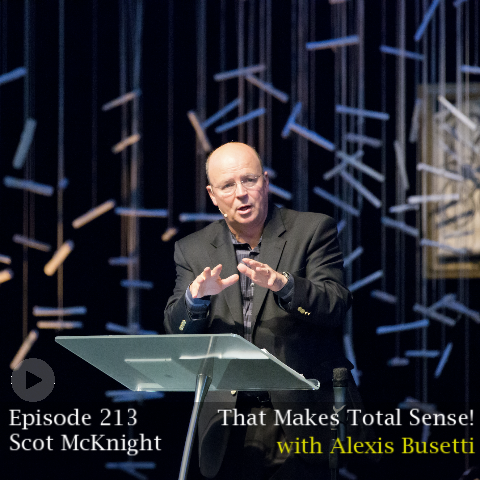
Speaker 1 00:00:06 Welcome to That Makes Total Sense, a podcast dedicated to exploring God's generosity and justice. I'm Alexis Busi, a Christian aiming to ask good questions and encouraging you to do the same. Every one of us is wired by God to live out generosity and justice. But the how sometimes eludes us that makes total sense is a way for us to get together, posture ourselves as learners, and challenge one another, to practice generosity and justice in a tangible way every day. Well, I am just thrilled beyond words here to be well, people who listen know, I don't usually get thrilled beyond words, and that's not the case here either. I will <laugh>, I'll have plenty of words, but Scott, hopefully you'll have more. Um, thank you so much for joining me to chat about this book.
Speaker 2 00:00:57 Well, thank you for inviting us.
Speaker 1 00:00:59 It is, um, it is really incredible. This is actually kind of a funny story to get us started. My husband, I never know what he's reading. He is a scientist, a PhD level research scientist. Um, but he's often reading something theological. And so for me as a theology student, it makes for some pretty fun conversations at home. And, uh, just not long ago, he said, have you read Scott McKnight's new book on Revelation? I think you should see if he'll chat with you for the podcast. And I was like, I didn't know Scott had a book on Revelation <laugh>, but it's, but if you think it's good, it sounds pretty good. And I read it and I loved it. So he, he was reading it on Kindle. I had to get the hardback because I require a pencil when I read. And there was plenty to annotate in this book. Although, as I've said, I don't have deep annotations usually. It's Wow. I had one wahoo I think in this one. And a lot of yes and amen. So thank you Scott, so much for coming on to ta to talk about it.
Speaker 2 00:02:05 You know, we remember a lot more when we read a book, uh, uh, that we hold in our hands than we do if we read it on Kindle.
Speaker 1 00:02:12 There you go. I feel a little affirmed by that already. That's fine. I have this, you know, big, uh, you know, library of these paper books. 'cause I just need to have something in my hand. Um, so the book we're chatting about, you wrote with a former student. Did I read that correctly? Uh,
Speaker 2 00:02:27 Yeah, I guess, yeah. Cody was my graduate assistant. He was a student at Northern and a graduate assistant. He's now, um, working on his PhD with Mike Byrd in Australia, but Oh, nice. He, he lives in Canada and I don't, I don't even know if he's been to Australia yet, so.
Speaker 1 00:02:45 Oh, wow. Well, hopefully he'll get to go to Yeah. When he's, when he's in his studies, uh, this is called Revelation for the Rest of Us, a prophetic call to follow Jesus as a dissident disciple. And it's endorsed Beth Allison Barr's endorsement is on the front. And this says, she says, this is the most powerful interpretation of revelation I've ever read. I would say, a, I agree with her. And B, it is one of the rev, one of the interpretations of Revelation I have read that does not line up with what you and I both grew up with <laugh>, which is maybe where we should start. Yes. Which is this speculative interpretation of revelation through the lens of dispensationalism. So can you start there with kind of how were you trained, maybe not, you know, in, in your, in your formal theological training, but how were you just kind of raised and discipled to view Revelation as you grew up?
Speaker 2 00:03:44 Well, um, you're down there in Texas, so there's a lot more dispensationalist there than anywhere else in the United States, I suppose, although you got California might have it's share too 'cause of Talbott and Viola. But I like to, I'm a teacher and I have to explain things to lots of people. So I always try to start with the basics and then kind of move out. Um, you know, people in my profession of pro uh, professors are notorious for getting lost in weeds before they even get to the point. And, uh, I was taught by a, by a publicist one time answer the question that you're asked, not something else. And I went, that's good. Okay. It basically, it is the dispensational approach of speculation is trying to figure out who in the book of Revelation lines up with who in the modern world. Okay. So there's always this, this is what Revelation says, and here's the fulfillment.
Speaker 2 00:04:44 So they'll talk about the nation of Israel, they'll talk about the United States, they'll talk about the European Union, they'll talk a lot about Russia, and they'll now start talking about Putin for his invasion of the Ukraine and the speculation that he's trying to create this pan, Russias empire that will go all over Europe. Okay. And then, uh, added to that are major events in the, in the, in the future that dispensation all agree on. Uh, and that is that there is, we are in the present church age. There will be a rapture that will be the next thing on the calendar for God. And that means believers in Jesus Christ will be taken up into the sky. What they don't tell you is that they hang out in the sky until the tribulation is over. So they're sort of, you know, kind of weird kind of thinking about this.
Speaker 2 00:05:43 And then, uh, there's a seven year tribulation, which is designed both to provoke Israel to repent from its rejection of the Messiah and to prepare the world for the battle of Armageddon. Uh, God will be victorious over the armies against him, the disciplines of of God in this era judgments involved increasingly ghastly destructions of the earth and of the sun and light and all this sort of thing. And then, uh, even when I was in high school, we even had scientists tell us what would happen if the sun was cut in half or something like that. What would happen? I don't know how they knew. And it was scary enough. And then, uh, there will be a millennium of a thousand year reign on earth through Jerusalem, and for many of 'em, there'll be a rebuilt temple. And then after this, there will be the great white throne judgment and, uh, heaven and eternity in new Jerusalem.
Speaker 2 00:06:52 So that's, that's the basic thing that I grew up with. Um, my pastor did not talk about this stuff much. So on Sunday morning, you know, I don't remember anything. I think I caught some of it in Sunday school. I caught some of it from my mom and dad. They weren't too obsessed with this Sunday school teachers at times, but it was when I was in high school that my youth pastor was into this. And I read a book by Salem Kurban called Guide to Survival, which was a book written for people who did not get raptured, and it was their guide to survive the, the tribulation. And, uh, I was da dating Chris, my wife now was my girlfriend at the time. And we both read this book, and then one of my friends read it, and he became a believer. And some of the people in our Sunday school in our youth group read it, and our past youth pastor read.
Speaker 2 00:07:50 And the next thing you know, we were totally into this. Um, so I grew up in this. And, uh, by the time I graduated from high school, I was, uh, uh, convinced, uh, dispensationalist, I guess, although we weren't into the dispensational hermeneutic, but we were into dispensational eschatology, uh, and Daniel Mann calls this populist, uh, dispensationalism. And then when I was in college, some very serious critiques of dispensationalism pre-trib came out by Robert Gundry and others. And I began to read that. I shifted toward post-trip, then I went to seminary and I put away childish things, and I quit thinking about this kind of topic, <laugh>. In fact, my seminary professors weren't really interested in this. So it, it really wasn't a discussion for anyone at the time. And when I did my PhD in England, no one was talking about this sort of thing. So it wasn't until I got back to teaching, I was teaching at Trinity that I encountered students who were really into it.
Speaker 2 00:09:00 A lot of 'em from Moody Bible Institute. And I, I just began to interact with it and think about it and change my mind and adjust and not say things that were too offensive, but say things enough that we're provocative to get people to think and shift and stuff. Um, but it wasn't until later that, uh, I began to read a more geopolitical approach to the Book of Revelation. I read Jewish apocalyptic literature, um, and just became convinced that the dispensational approach lacked sophistication in the Jewish context. And you know, I, I know I have a friend at Dallas Seminary named Darrell Bach. He's a very sophisticated guy, and he knows all about first Enoch. So yes, I do know that, that, um, some dispensationalist understand apocalyptic literature. But I, uh, I think there, I think the proper understanding of apocalyptic literature contextualize the book of Revelation and teaches us to read the book Theo politically. So is that term okay? Have I talked too long?
Speaker 1 00:10:12 That's a, that's a great term and absolutely not. I would, I would, I, I would love for you to talk all day. Um, and, and I wanna, I wanna, I wanna stay there for a second this in a, in a theo political way, because reading revelation in a theo political way, because one of the things, um, one of the themes throughout this book is, um, imagination mm-hmm. <affirmative>. So we, we learn about, uh, John's imagination a bit. And, and also how this reading, this interpretation of revelation that you've just described, it comes from, and I almost wanna use quotes, even though you don't in the book necessarily, it comes from this kind of literal reading of the revelation. But several times you state, okay, well, this is like a literal reading, but at the same time, I'm, I'm using my own terms now and saying, but it's pretty imaginative because there's lots of, uh, story involved in that dispensationalist interpretation that actually doesn't come from the book of Revelation.
Speaker 1 00:11:14 As you mentioned, you talk about, um, the millennial reign <laugh>. And this is really a very, you know, like, how, how do we get that from this, right? Or how are we getting, you know, Russia or you name B 50 twos and Locust, right? Like these things, you know, like, it's like, there's like this literal reading to it, but there's like a different kind of imagination I might, uh, argue. That's, uh, that, that has to kind of be in that mix, um, when you're reading it that way. And, and I would say, I, I, I sometimes say I may not have been parented in a certain way, but I was youth grouped in a certain way, and I was youth grouped in a similar way that you were youth grouped. And I grew up in Oklahoma, so this is also very, there may be more dispensationalist in Oklahoma than there are in Texas per capita.
Speaker 1 00:11:57 I don't know, <laugh>. So it might be a pretty close one. But the, um, the, the, uh, the interpretation there was actually pretty scary for me. So I, I was one of those teenagers who had nightmares about being, you know, left behind, right? Like I, I, I was having, you know, these nightmares about everyone else in my, in my wonderful beautiful Holy Baptist, you know, Bible belt family getting raptured, and then it's just me, you know, and I'm there to fend for myself or take care of maybe a stray family member who also didn't make it or something like this. Um, but that took my imagination in ways, in places that I think weren't helpful. And, and, and arguably some might say, could have even been harmful in some ways to my spiritual formation. But that's kind of another different thing. But John is writing back to the question, John is writing, using an imagination that is very different than what you have described.
Speaker 1 00:12:51 And it's helpful when we can think about it this way. Um, you give us a, a playbill, a book of characters so that maybe we're not tempted to say so and so equals so and so, or this place equals this place literally geographically on the map or as an actual person. And there's only one of him or her. And even how John's imagination allows his writing to morph, where I love the example of the woman doesn't remain the same woman throughout, um, this, so can you help us a little bit understand John's imagination as an author here, and how the people that he was writing to would have connected with his imagination, that it wouldn't have been something that they were really struggling to kind of get what he was saying. I mean, one, one example I might use, I was reading on Ezekiel, and you don't use this, but, and, and, and so if it's not helpful, we'll just forget about it.
Speaker 1 00:13:57 But, um, I was reading a, a, a scholar on Ezekiel, and he was describing one of the passages, and he said, it's almost like a political cartoon. Like you see these symbols, you see, and, and his audience would've known, kind of similar to a donkey and an elephant, what he was referencing, kind of what he was talking about. And that was in Ezekiel some of his prophetic, uh, language, but that John maybe similarly, is using kind of these characters that his, that his audience would've definitely been familiar with. And that his imagination kind of utilizes those things and, and goes from there and connects with his audience.
Speaker 2 00:14:30 Well, you're, um, you've, you've, um, embraced and understood and absorbed, uh, a major element of reading the book of Revelation. And that is the significance of imagination and how you've described it. John, um, was on the island of Patmos, which by the way, is a pretty cool place to be. If you're gonna get, if you're gonna be exiled to Patmos, that's not bad. It's an absolutely gorgeous place. And, um, plenty of places to be safe. At any rate, John is on Patmos, and he has these visions. He says, I saw, I saw, I heard, I wrote to two scholars of apocalyptic literature who've written major commentaries on apocalyptic literature and are known for their work in these fields. What did I saw mean when John said, I saw, and both of them wrote back to me quite quickly, um, they saw this in their imagination, a reverie, I said, so they didn't, there wasn't something on a screen.
Speaker 2 00:15:40 No, they didn't think that's what was going on. And I, and I think that's where we began. John is soaked in scripture, and he has these visions. Let's just say he sees a woman, and he be, and this is Revelation 12, he begins to describe her, what he saw, and the language he uses suddenly sounds like prophets like Daniel and, and e and Isaiah and Ezekiel. And then as you listen to him describe this woman, he sees her move from what sounds like Israel having 12 stars and their crown. And then all of a sudden she gives birth to a son, and you realize that's Jesus. So that's Mary. And then, uh, there's this big battle between the dragon, you know, and where the dragon come from. This is language that can come from the Greco-Roman world, but from the Jewish world as well. Um, and then this dragon is trying to kill her, and she so almost morphs into a woman, I mean, into a, into the church.
Speaker 2 00:16:57 So who is she? You know, I asked my students, and they, a lot of times they want it to be one person. And I said, why, why do you want it to be one person? I said, I think John gives you the language. He, he, he provides the language for us to imagine what he saw and what he's describing. And it takes us in places that will not allow us to limit this to one person, to one woman. It, it, it's an, an image that morphs John John's language is such that it invites imagination. We see this, and we want to think about what does that look like? That's what happens to us if we're reading it carefully. So I like to say that John's images are not literal. They're literary. And, and there is a big difference between, a literal one tends to say there's going to be a woman <laugh>, an actual woman.
Speaker 2 00:17:56 Uh, and there's going to be an actual dragon. Now, even Dispensationalist and Literalists eventually will say, well, I'm not so sure that dragon's a real dragon, and I'm not so sure that the beast is gonna come out of the sea. So they, they, they're going to shift, but they wanna see a lot of things as literal in the sense that there's gonna be an actual city called Babylon, and maybe that's Rome, but it's going to be Rome, it's not gonna be Berlin, and it's not going to be Washington DC and it's not gonna be Beijing. It's gonna be, uh, Rome or Babylon. And so it gets very literal. And I think that that ruins the book, is the book uses imagery and language to try to get us to imagine what this is like, and to let it take us where it goes or where it wants to go.
Speaker 2 00:18:54 And I tell my students, I want you to read the book of Revelation, the way you read Lord of the Rings, the way you read Chronicles in Aria, the way you read Harry Potter, the way you read imaginative fiction, and let the author do what he wants, and don't start trying to figure out who fits what. But you talked about the play Bill. This is really, this was really fun. I, Chris, my wife and I were at Hamilton, and I was given a play bill. It was, it was an amazing production, really was Hamilton, Alexander Hamilton. Um, but I saw that play Bill, and I thought, those are the characters in Book of Revelation. I need to do a play bill. So I had a lot of fun composing the playbill in this book on pages 38 to 39, uh, of, and two teams, team Dragon and team, uh, lamb.
Speaker 2 00:19:48 And they are, um, they're brought, they're brought together in as characters in a staged drama. And we need to understand them as characters rather than predictions of actual people who are going, there's not going to be a lamb. There's not gonna be a lion who morphs into a lamb. Uh, Jesus can be understood as a lion, who in the book of Revelation is a slaughtered lamb, who as a slaughtered lamb somehow can ride a horse and somehow can have a sword coming from its mouth and slay, uh, pagan nations who are opposing the people of God. This is, this gets to be impossible, but when I was in college, Tim Lehe produced a commentary on Revelation in which he actually had an artist draw all the figures in the book of Revelation, and they were grotesque. And I thought, my images in my head are a whole lot better than, than this.
Speaker 2 00:20:50 Leave my brain alone. I want my imagination. And I've thought this many times when, when we've seen movies of books that we've read, I prefer the imaginary world than the actual movie world. Although some of these movies are pretty dang good, but let's admit that. So, um, at any rate, uh, I think we need to use our imagination and let the book take us where it does and let, and, and when that happens, there's not real specific things we look at. There are evocations of what the book's trying to do. And, and that's a healthier place for reading revelation.
Speaker 1 00:21:31 Yeah. I love how you compared it to all of those list of kind of fantasy books that you, that you just named. I am not a huge fan of that kind of book. I have read Narnia, because, you know, it's Narnia. Um, but, uh, but I appreciate that because the, the story I think comes out in those kinds of books, sometimes almost in a more clear way than if you were reading like a, a literal history of something, because we can use our imaginations. And, and where I'd, I'd love for you to take us next is what I found to be, and I, I know there's, there's lots of wonderful, meaty stuff in this book. The thing that I could not get away from is who is Babylon <laugh>? Yeah,
Speaker 2 00:22:18 Yeah.
Speaker 1 00:22:19 I am I this idea. So I'm thankful, I'm thankful for that. I won't skip straight to the end of the book, which is kind of partially my mo almost where I wanted to, to start was like, implications for us today, right now. Um, but first I think it's important that we, that we hear about who is, who is Babylon, maybe not just for John and, and the people he was writing to, although I think that's very important. You already, you already mentioned how John, you know, was absorbed in these Old Testament scriptures. These are his stories. So who was, who was Babylon to the people that John was writing to, and who is Babylon for us now?
Speaker 2 00:23:03 Very good. Yes. Okay, here's the, uh, here's the idea. Babylon is timeless. Babylon was an ancient city in Mesopotamia that captured the Southern kingdom 5 87 BC and took the people back out to Babylon, just took them and all the best people, smartest people, and, uh, turned them into slaves. Babylon then becomes a trope or an image in Jewish apocalyptic literature for an empire that both destroys the city of Jerusalem in its temple and takes the people captive. Aha, Rome 67, 66 to 73 ad approximately, that's about seven years, by the way, um, is destroyed by Rome. And the temple is burned and everything is taken away. Josephus describes this in a, a little seven book thing called, we Call the Jewish War of Josephus. And he just goes through detail after detail of what happened in this battle, in these, this war. Eventually, uh, also destroying Masada, the last fortress that was left.
Speaker 2 00:24:22 Um, so Babylon becomes a trope. Babylon, uh, was also used by other Jewish writers at the time for Rome. So it, it becomes an image capable of being used for any violent imperial nation against the people of God persecuting. So John uses Babylon for Rome in the first century. He's talking about the city of Seven Hills. This is not even hard to figure out. This is Rome, the eternal city, supposedly. So John uses it that way. But here, here's what I think is so important, John is teaching the believers of Western Asia Minor, how to think about Rome as Christians with a Jewish past. So they don't have to be Jews, but with the Old Testament as their scriptures, with some New Testament books. He's trying to teach them how to think about Rome. And so he describes what he saw about Babylon in Revelation 1718, and a little bit of chapter 19.
Speaker 2 00:25:32 And there he describes the major marks of Babylon. What is it like? And you know, we, we need to, to keep these things in mind. I say 'em so many times, I keep a little piece of paper here. For me, it's idolatry. It, it's idolatrous. And they're against the Jewish God of one of one God. They would think that the Christians' belief that Jesus is God is just ridiculous. Um, so, so they're anti-God. They are full of opulence. The description of the woman, it's a whore of Babylon. I mean, this is just an insult to Rome, to call her, because Rome has a goddess named Roma. So John is, it's, it's violent language to describe Roma as a prostitute. I mean, that's mean, uh, at some level. It's to turn everything upside down. And her dress is just ridiculously opulent. They are murderous. And so one of the descriptions of Babylon is that Babylon, the who of Babylon kills the people of Jesus who follow Jesus branding and image is everything, everything about, you can't talk about Rome in the first century without realizing it leaves.
Speaker 2 00:26:56 Its mark everywhere. As in World War ii, people left the thing, Kilroy was here, um, which is used in chalk on all kinds of places. Rome leaves, its mark everywhere, every street, every shrine, every city, every coin, all the gods and goddesses. It's just constant reminder that Rome has been here, and Rome ultimately owns displaced. You don't even have to have military personnel walking the streets. That's, that wasn't common in cities outside of Rome, but they, they, it was a reminder that they were everywhere. There was militarism. The mark of Rome was to conquer other countries and to rip its resources from the grip of that country and that city, and to take it all, put it on boats, and take it to Rome. And so Rome could use it. They were economically exploitative. And this is one of the big pictures in Revelation 17 and 18, is all these boats, uh, carrying cargo from all over the world to Rome.
Speaker 2 00:28:06 But this was not, uh, a fair market price. This was not, this was, we take it and we use it in our, in our place. And then ultimately the mark for, for John is that Rome is arrogant. Is that it? It thinks that it is the eternal city, and no one will ever remove, remove us from our place. Well, here's, here's what happens. When you start listening to these things, you start asking a question, who is like that today? And the next thing you're thinking, okay, I could say this is about Putin. I could say this is about the tyrants of, of China. I could say this is about North Korea, but if I really look at it carefully, it's about my own country. And then all of a sudden we're reading the book the way it's meant to be. 'cause all of a sudden we have become, uh, we have a Babylonian hermeneutic.
Speaker 2 00:29:10 We can see Babylon present, and we can say, yes, we're opulent. Yes, we can be murderous. Yes, we are really into our brand. And boy, we are arrogant. We think we run the world and we have the biggest military in the world. And yes, we do not operate with fair market prices in foreign countries. So all of a sudden, Babylon becomes characteristic of our country. Then we wonder about our state. And then all of a sudden, if we're reading the book carefully, chapters two and three, the so-called letters to the seven churches, we see Babylon creep in those seven churches. The very things that Mark Babylon are beginning to show up in the church. And that's why John writes the book. He wants, he, he, he makes some clear points in chapters two and three, but we don't realize in that sense what he was actually doing until we get to chapter 17 and 18.
Speaker 2 00:30:08 And they'll be go, whoa, this is really serious. Babylon is beginning to creep its way into the church, and the church is being corrupted by Babylon. And the message of John is that we need to resist Babylon creep, and we need to become dissident dissidents in two, in two ways. We are dissident of and resistant of Babylon itself, let's say our government. And we are dissident and resistant to the presence of Babylon, the church in two ways. We have to become dissident. And I, I think that's how John wants us to read it. And I would plead with people to, to, um, if they fear, if they read Revelation and feel fearful, their misreading revelation, it should be in many ways, a song of victory. That justice is gonna be established. And if we're on, we're on the Team Lamb, then we're gonna watch, we're gonna watch the lamb win this thing. So there's a great guy in Texas, he is in Abilene. His name is Randy Harris. He says, the only three things you need to know about the book of Revelation, I heard this some 20 years ago. So that's pretty good from a sermon. And he said, God's team wins. Choose your team. Don't be stupid. That's the book of Revelation <laugh>,
Speaker 1 00:31:34 That's also very Texas. That's a very Texas way to say something. Um, that's, that's a very Texas way to say something. Thank you for Thank you for that. And the, the infiltration of Babylon in the churches, in the seven churches and then looking at us now is, it feels very haunting. And I think because it is easy to say Babylon is the other guy.
Speaker 2 00:32:00 Yeah, yeah.
Speaker 1 00:32:02 Babylon is these, these violent rulers in other parts of the world. It, it is kind of even easy to say, you know, Babylon is some particularly ruthless ruler in the US or even political idea here. Um, and those are valid, but, but some of those are easier to say than, wow. But what does that look like when those things that you just listed come into the church and we have to admit it, and we have to, we have to look at it, and we have to see what does it mean for me to be a dissident disciple inside of this church culture or church system that has been influenced and continues to be influenced by these characteristics of Babylon? That's a, that's a really, really tough question. It gives me hope to, to know that John was communicating the same things. <laugh>.
Speaker 2 00:33:10 Yeah, yeah. Before
Speaker 1 00:33:11 Constantine, John was communicating the same things to these churches. And we continue to struggle with it.
Speaker 2 00:33:17 We, um, we, we need to get away from thinking that this is about one tyrant in one nation, going against the official church and going to Jerusalem and begin to realize Babylon is timeless. Babylon has been with us the whole time. All the images of the Book of Revelation have been a part of the entire history of the church. And we have a hermeneutic, we have some clues on how to detect the presence of Babylon in our world. And we need to use those clues in order, not just so we can say, Hey, we know things that nobody else knows. It's not, it's not so that we can become critics. Is it so that we can become more faithful by recognizing and discerning the presence of Babylon and learning to live in a way that resists the ways of Babylon?
Speaker 1 00:34:12 I want, I wanna take this in a place that I didn't think I was gonna take it in just the last few minutes that we have. The, the last section of the book is really an incredible section. You talk a lot about, um, Christian nationalism. You quote some authors who lots of our listeners would probably be, um, familiar with, um, Kristin Kame, uh, Samuel Perry, Andrew Whitehead, who was, uh, on the podcast recently talking about his book on Christian nationalism. And one of the things that I have gleaned from their, uh, research and writing on Christian nationalism is that it's, um, it's very exclusive. Um, it says, you know, it's, it's very us and them. Uh, and that's one of the characteristics of that. I wanna contrast that a bit with something that you bring up, I think in one of the middle sections of your book.
Speaker 1 00:35:00 And that is when you talk about how inclusive the lamb is, we have all of these nations, and even when you talk about the judgments, you don't, you change the name, you change the wording of the judgments to disciplines, which I have to say was one of the places where I annotated like it was, I don't even know. Okay, Scott, where are you going? <laugh>, right? When you, when you do this. But, um, because there is something to say, God's heart for us, this is me, my words, where after I read this, God's heart for us is to, is to bring us in. These, these gates are open. Uh, all of the nations will be there, as opposed to a mindset that looks like Christian nationalism, which says there are certain folks who will be here and, and everyone else who's kind of not included. Um, which it's, it's, there's a, there's a, yeah. Anyway, there's a little bit, um, there that doesn't exactly match up. But this is, I think one of the, one of the things that we have to fight, um, when we're, when we're realizing that we've been influenced by some of these kind of team Babylon ideals and forces. So any thoughts on that? No.
Speaker 2 00:36:16 Yeah. Yeah. This is, uh, I think I learned this from Richard Baum, but at least it was in reading him that I began to think this way. And he's one of the great scholars, the book of Revelation. When you read, read the book, you realize if you, if you study history at all in the first century, you know, the number of Christians in Western Asia Minor was not exactly big. Um, you know, seven churches, maybe a hundred in each one. Ooh. You know, that's not even a good sized church in Texas. That's a baby church in Texas. Okay? So, but 700 out of all of Western Asia minor, and I'm just guessing at numbers, what I can say is there weren't very many. Alright? But when John describes the victory of the lamb, there are people from every nation, every tongue, every tribe, the whole world, men and women.
Speaker 2 00:37:18 And it is myriads and myriads several times there. It's uncountable the number of people. So you ask yourself the question, how can we get from revelation three with a little bit on four and five, which is worship stuff, to six through 16, which are these so-called judgements, and then have the Babylon judged in 17 and 18 and 19. Then all of a sudden, during the, during this, during this descriptions, we get these interruptions of songs, but all of a sudden we realize there's these multitudes and multitudes of people. Where did that happen? This is why I think it is a mistake to think of these as vindictive, punitive judgements. That this is the work of God in the world of God that will lead people to reconsider their choices and to turn away from Babylon toward the lamb. It's that sort, I think, and that's why I suggest we call 'em disciplines.
Speaker 2 00:38:24 I know there'll be a lot of people who disagree with me. And, and that's fine because I'm taking a minority translation here, but not because I think judgment is wrong, but because when we think of judgment, we think too easily imp punitive retributive terms rather than its impact. But there is, there is this sense that w will you now believe in light of all that's going on in the world, will you now rethink your posture toward the lamb? That I think is a fresh way of looking at chapter six to 16, because it is so scary in that sense. It is such, it's, you know, the moon not given its light and the sun and all the rivers being poisoned. I mean, this is not good. Um, but it, these are just scary images. It's sort of like Morris Sandeck book, uh, where the wild things are that you read for children that the more familiar they become with these grotesque images, the less afraid they are. That's what John is saying. You don't need to be afraid of this because God is at work and he's going to bring about justice, and the lamb is going to win this, the lamb that brings peace and justice is gonna win, and that's what we need to focus on. So that's why, um, I call 'em disciplines, but I know it's only part of the story, but I think it's a, it's a neglected part of the story. Mm-hmm. <affirmative>. Mm-hmm. <affirmative>.
Speaker 1 00:39:55 Scott, will you wrap us up maybe with just some pastoral words of encouragement for those of us out here who are going Yeah, we're gonna nodding our heads and saying that's, you know, that's, that's kind of how I wanna see myself as a dissident disciple of the lamb, knowing we are living and have been influenced in BA by Babylon in ways that we pro are not aware of, no doubt. Mm-hmm. <affirmative>. Mm-hmm. <affirmative>. What would be some maybe pastoral words of encouragement for us? Okay.
Speaker 2 00:40:24 I'll give you three wss. That'll be pastoral and it'll be sermonic. That's right. The three Ws. All right. The first is this. Um, the Book of Revelation teaches us wisdom to recognize Babylon wisdom, to recognize the corruptions of Babylon in the church, the wisdom, and to discern the corruption of Babylon in our own lives. So first wisdom, it'll do that for us if we read it fairly. Secondly, it teaches us to become a witness. We are witnesses in two ways in the book of Revelation, by our experience that we verbally speak of. That's what a testifying our witness is. The Greek word is all combining this stuff. And secondly, we are a witness in how we live, and we put our life on the line for the lamb because we've discerned the presence of Babylon. We speak up and speak out, and we stand there and resist.
Speaker 2 00:41:28 And some of those people have been put to death for that. That's a, that's a witness. The Greek word for a witness is a martyr, a martus. So those words work together. Um, and then the third thing is worship. This is one of the major themes of the book of Revelation. Those chapters six through 16, which are all about those disciplines or judgments, are interrupted frequently by songs of worship. The people of Jesus, the people of the Lamb in Western Asia, minora were formed spiritually by John when he taught them to sing the glories of the Messiah. The praise that is worthy of God, knowing that this God will bring justice to the world. He will destroy evil and sink it in a pit forever. And the more we sing these songs, the more dissident we're going to become. They're like singing African-American spirituals where they used the words of the slave owners and the slave owners could sing along with the African-American slaves, not realizing that these songs were subverting the master's ideas. That's what John does. In, in with these songs. There's eight of 'em where, where they sing these songs and if they sing these songs with full throated worship, they're chest filled with air, they are dissidents of Rome. And it will form them into thinking the thoughts that lead to the wisdom and to the witness. How's that?
Speaker 1 00:43:14 Amen. Thank you so much. Amen. Thank you again. It's uh, revelation for the rest of us, a prophetic call to follow Jesus as a dissident disciple. I'll put a link in the show notes for people to grab a copy. Thanks so much for coming on, Scott.
Speaker 2 00:43:27 Thank you so much. It was fun to be with you.
Speaker 1 00:43:31 The links for all the resources mentioned in today's episode can be found in the show notes, music and podcast production by Seth Busti. Be sure to give us a review on iTunes and subscribe at your favorite podcast listening app. You can also visit us at. That makes total sense com.