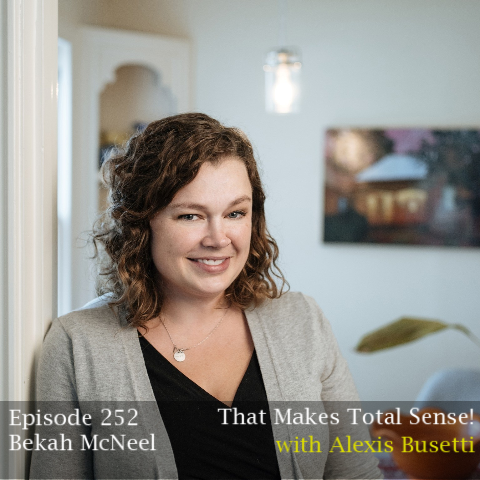
[00:00:07] Speaker A: Welcome to that makes total sense, a podcast dedicated to exploring God's generosity and justice. I'm Alexis Busetti, a Christian aiming to ask good questions and encouraging you to do the same.
Every one of us is wired by God to live out generosity and justice. But the how sometimes eludes us that makes total sense is a way for us to get together, posture ourselves as learners, and challenge one another to practice generosity and justice in a tangible way every day.
Okay. I was just telling Becca that I hope we don't have to have too many interruptions because my mastiff came in at the last minute, as she often does, and she's snoring behind me, and she's worse than a human snoring. She's so. She's bigger than many humans, I was going to say.
[00:01:01] Speaker B: I don't hear her, and if I do, it'll just be endearing, so.
[00:01:04] Speaker A: Well, let's hope so. I may have to nudge her.
Okay. So I'm stoked because my conversation with you, Becca, was one of the ones that I think I laughed the most. I had just so much fun the last time we talked about your previous book, and I want to say about that one, too, that even though it is a book, kind of with parents at the audience, I have recommended that book more to either single friends of mine or friends who are married without kids, just ones that I knew would resonate with your story in. In that and kind of how you're thinking about theology and church life and things like that. So I just want to throw that out before we get into your next book, which I finished, like, 20 minutes ago.
[00:01:54] Speaker B: Perfect. Well, thank you. I did hope that, because I would tell people it's for people who have. The previous book is for people who have kids or were kids. That's right. I think that pretty much covers the market.
[00:02:06] Speaker A: I mean, almost everybody. Yeah. Okay, so let's talk about this one, because. Oh, this one. I. Okay. I want to. I feel like I need to start over because I'm all over the place again. I just finished it 20 minutes ago.
Becca, you.
On the back of. At least on the back of the advanced copy, there's the quote. If you see me at a party and I'm speaking, you need to come rescue the person I'm talking to, because they're not having a good time.
[00:02:38] Speaker B: I mean, I can bring witnesses if you need anyone to confirm that I'm.
[00:02:43] Speaker A: Dying, but this is because. Okay. The title of this book is called this is going to hurt following Jesus in a divided America.
But I felt the latter part of that quote. Or better yet, I would like to invite you, the reader, into a corner with me to talk about the story. I write over and over again, people are suffering. And I promise I'm going to let you talk in just a second, Becca. But when I started this book, not today, but a week or two ago, I mentioned to my husband, I've got Becca McNeil's new book, and it's about, you know, she's talking a lot about suffering. And then he. That's all I got out. And then he's kind of like, well, you know, if I'm going to read a book on suffering, and I'm like, no, no, no.
Like, this is not a book about theodicy. This is not a book about cancer or, you know, death, as, you know, these kinds of things where we're kind of seeking solace or wanting some questions answered or things like that.
This is more. Now, I'm going to say my part, and then you're going to correct me what the book actually is. But this is more of how do we engage ourselves recognizing that everyone is suffering, and how do we engage ourselves in a community, recognizing, especially when our neighbors are suffering, specifically at the hands of systemic issues. Okay, now you tell me what it's really about.
[00:04:20] Speaker B: No, you got it.
And I will say, just for starters, that when I pitched to Erdman's a book on suffering, there are many good books out there on, like, therapeutically or pastorally or theologically exploring the topic of suffering. And those books are so good and so needed. I am not a therapist. I'm not a pastor. I'm not a theologian. And so the.
The voice I bring to it is the story. I am a journalist. I look at stories about suffering. I witness suffering, and I write about it in a systemic context. Communities are systems, education system, immigration system. Um, and so that's. You are correct. That's the lens that I bring. That's the light I can shed. But it's kind of that old, way overused story about plucking babies out of the river, and then you go upstream and, like, stop people from throwing them in. A lot of the suffering that people are needing to go to therapy if they're lucky enough to be able to afford therapy in a healthcare system or seeking pastoral guidance or those stories of an individual's suffering are related to the larger stories, cultural stories, that we tell about suffering, who should suffer, who should not suffer, what suffering is tolerable, what suffering is not tolerable.
And when I took this idea to Erdmund's, the first thing they said was, we'll let you do a book about suffering. If it's funny.
I was like, great.
[00:06:20] Speaker A: That feels no problem. Right? Yeah.
[00:06:23] Speaker B: But their point being, if you're going to engage people on the topics that are in this book, which are hard topics.
[00:06:29] Speaker A: Yes, yes.
[00:06:31] Speaker B: Uh, you can't just. It actually, that opening anecdote about me being not fun in a party was kind of like a. It's almost a funny, ironic twist, because the mandate was, you gotta be fun at this party, or no one's gonna want to talk to you.
The other thing is that I said, I want to look at culturally the stories that we use to understand whose suffering is tolerable, whose suffering is not what kind, etcetera. And the editor came back and he was like, but isn't the truth that your suffering is always tolerable and mine is not?
And I was like, oh, no.
My whole book premises is one liner.
But then we got into like, okay, let's look at what qualifies as suffering. Let's look at who is you and who is me in the larger context.
And thus we still had a book.
[00:07:29] Speaker A: Yeah. No, and it's a fantastic book. And I annotate, as I often say in the podcast, and I'm super deep, as I often also reference in the podcast. And so lots of ha. Like, ha ha. Like that one got two and then an lol. And then these are my very deep annotations on the sides of the, on the margins of this book.
But I think it's good that you point out, I'm really glad you brought out what your editor said, because before we started recording, I said, I don't know. My instinct, my kind of gut, is to go with, like, the framing of this book. And in a minute, I want you to share your response, because here's the truth. I told Becca. I'm like, we should already be recording when we, we were having kind of our pre show conversation. But I'm really glad that you brought up what your editor said, that your, your suffering is tolerable and my suffering isn't tolerable.
And, and that I had kind of rolling in the back of my mind as I was reading this, because. And then I think, too, even closer to the end of the book, when you kind of talk about, I don't remember how you framed it, but I had, like, concentric circles in my mind as you're, you know, who, who is close to you, who is furthest from you, but even as I have, as my lifestyle has changed and my communities have changed, then my idea of whose suffering is tolerable has also admittedly changed. And I hate saying that out loud, but this is just the way it is.
And so, you know, we've got like, as, you know, as I became. When I became married, then all of a sudden I have this other person who is close to my circle. Then when I had kids, yes, but as my kids aged, have aged. And, you know, infants have different needs, different ones, different, you know, than teenagers. And then I have girl children and boy children and some of these things. And so as I have put my people, I'll say that just the people that live in my house, right. As I have put my people inside some of these scenarios of suffering in my mind, I can't think about some of these topics, some of these what ifs. I can't think about some of those things in the same way as I used to.
[00:10:09] Speaker B: Yep. And that is the beautiful, the beauty of connection is that it opens the door for us to start considering who is us, who is them, and the radicalness of the gospel, which I get into as kind of a way to frame who's the US and who's the them, is that Jesus is saying, all right, and people will talk. I mean, my mom used to talk about this a lot. Like, you get married and that's the first real step of like, whoa, I am bigger than myself. You have kids. And then it's like, whoa, I have other people whose needs often contradict what I feel like are my needs, as you are sleep deprived and whatnot. And so you start to do this negotiation. But the radicalness of the gospel is that it says it's inside out. And I use an inside out.
The term upside down kingdom is pretty, pretty popular and has been used since Donald Crabel in the seventies talked about this inverted kingdom. We talked about the beatitudes, etcetera.
I use inside out since I'm talking about suffering as instead of hoarding safety at the center and being less and less concerned, the further it gets from me, the gospel inverts that.
Not to say I'm no longer concerned with my own safety, not to say I'm martyring myself, but to say we are all included in the primary concern. We are all. It's the oneness that union with Christ, that kind of mystical part of it is what inverts it not so that what was outside was once at the inside, but so that it's all at the inside. The inside is now the. The encompassing container. And that means that as things are rebalanced, as things that were out of balance come back into balance, it's going to feel like suffering. And I think that's the take up. Your cross mandate, is to say, yes, to divest of some of your power in order to include us, because power over someone else doesn't have a place in oneness. You are going to have to die to that power. And yes, it is a form of suffering. So you are called to take on some suffering, but it's not martyrdom in the way we think of, like, becoming a doormat or having no boundaries or just like, I will take all the, you know, you're not Jesus.
You are called to be one with Christ because resurrection, you know, the resurrection completes that, that oneness so that you're not outside of the oneness either. You're not dead and exiled so that everyone else can thrive. You are welcomed into the oneness through resurrection. And there's a spiritual renewal component that is offered to us. And the argument I'm making is that we have to learn to think like this as a society. And the christian tradition gives us tools that allows us to do the impossible, which is to take ourselves out of the center.
[00:13:42] Speaker A: Right? And I think I'm going to say two things that are maybe just adjacent to that because they came into my head as you were talking. The first one is when I'm imagining, like, an inside outness of that, and I'm imagining margins coming in. Um, I'm also thinking to myself, yes. And part of the reason that this is, this can be possible is because. Let's be honest. Okay, I'll be. I'll be honest with myself, um, and with you and with whoever's listening. Um. I, uh. I'm never going to not think about me. Sure. Like, there's no danger if I try to flip this inside out and bring the margins in and be inclusive in this way. I'm actually not ever gonna like me thinking less, you know, like, that. I'm not gonna, like, forget my own safety. Like, I'm not gonna forget to try to provide for some of. For some of those things because it's just human nature. Like your, you know, your reflexes will help you do some of that. Right? So I don't think we're in danger of, like, completely neglecting ourselves or kind of like you're saying this isn't like a martyrdom kind of thing. The other thing, I'm just gonna. I'm just gonna say it like a bullet point is, um, every. Yes, and amen to everything you said. And decentering isn't the same as suffering or persecution. Right, right.
[00:15:04] Speaker B: Oh, yes. And. And I get into that because I'm like, now, listen, we need to be very clear about the difference between suffering and what feels like suffering.
[00:15:14] Speaker A: Right.
[00:15:14] Speaker B: When I have that my suffering is intolerable. Yours is tolerable. Often what we're talking about is your suffering is tolerable, and my discomfort is. So I. I do call us repeatedly, because I don't think that. I mean, I keep systems of power very much in the foreground.
[00:15:34] Speaker A: Yes.
[00:15:34] Speaker B: And where you're located very much defines what suffering means. And I'm not.
I'm willing to let you call your discomfort suffering if you want to. The key is that you're going to have to do it right and call.
[00:15:51] Speaker A: It whatever you want. Right.
[00:15:52] Speaker B: Call it whatever you want. I am. I think. I believe in greeting people with the empathy that we want them to show to others. And if that means it's hard for you to let go of the idea that the south, for instance, had a righteous cause in the civil war, I am willing to let you grieve. If it's in the service of the work of truth, that's fine.
I don't think that. I think that I, as a white person in the south who benefited from those same systems, am the right person to hold your hand through that. I am. I do not think other communities should have to hold your hand through that. That being said, I don't think that the.
The harsh, like, rejection of that discomfort and the denial of that discomfort has gotten us anywhere. I think it's created animosity. I think reaching out in compassion and saying, as you come into the oneness with all of us, as you come into the inside out kingdom, your cross is that discomfort, and you are going to rise.
Resurrection is offered to you in oneness and in a better connection to. To all of life. And so I want to be very careful that this is not. This is neither a, hey, people with power. It's time for you to suffer, to save everybody else, because that gets into a little bit of saviorism. I believe that the call. I think Jesus was talking to everybody, and I think there's dignity and beauty in a choice to love sacrificially, to take up your cross for the sake of your community. I think you see, in communities of mutuality, you see people choosing to put the needs of others first. And I don't think that dignity only belongs to people with power to give up their power. I think that it belongs to all of us. That said, I think, and I get into this in the book in a very big and, like, critical way in the very end, to say, like, autonomy, personal autonomy, the choice to make that sacrifice has to rest with the individual.
I think what happens often is that we're told this is where you need to suffer, this is what you need to do. And it's often someone who's trying to avoid their own, like we. It flows in the same direction of, you know, I'm protecting what's at the core, at the expense. And so I'm telling the people on the margin, sorry, you're just going to have to suffer because I'm protecting something at the core.
That's why autonomy. The people at the margins get to decide what the gospel requires of them and the people.
And I'm talking from a societal sense, the core of the big us that's powerful in society.
But I think that Jesus was very clear that what it means to follow Jesus as a person with lots of contact and access to power is a lot of laying down. So the cross that you're going to need to take up is going to look different than the cross of someone who is, let's just say, immigrating for the sake of their family. There's suffering involved with that, leaving a place, taking the risks of the travel, living in a way that is insecure and not fully integrated into the systems of a new country. That's all forms of suffering that people are doing for the sake of the people that they love and so is divesting from fossil fuels for the sake of art. They look different.
They are both dignified.
And I think that we need to be very realistic about and not do the. I'll suffer. If you suffer, you take up your cross first, because that always creates a system of power that ends up pushing people out.
[00:20:32] Speaker A: Yeah, yeah, yeah. I want to return there because I think how you address lament and sadness has a lot to do with that.
Because even as you were talking, I'm like, yes, but when it's forced on you, that really only creates resentment. And as you mentioned earlier, animosity.
And it's also not about guilting. I don't know if you used to watch the Goldbergs, but that was one of my favorites. The mom was just always guilt. She guilts her kids or tries to doing everything, but that doesn't work either. That's not what I mean when I say. When I'm referencing your call to lament, which I think is really important.
Before we get too much further, I just want to mention. I just want to name the topics that you wrestle with in this book.
Becca and I have kind of pinky promised through the screen not to get super in the weeds with every single one of these topics or to let ourselves go nuts on one or two. There were one or two that I could go nuts on, just confession time.
But there are also, I would say, one of the things about this book that I loved hated was that it increased my reading list by like half a dozen.
[00:21:47] Speaker B: Sorry about that.
[00:21:48] Speaker A: With your references. I know it really. It sucks, but, um. But that to say, if something really strikes anybody, you. You have lots of references. There's. I mean, I've. I've done interviews on, like, most. Many of the topics I think that you have. So other people have, you know, resources as well. But I want to name these because especially folks who have, and I would say especially not just like, cultural evangelicalism, although that is partially your lens and mine as well. But all of these are familiar to people who just, like, live in the states right now. Oh, yeah. If you turn on the television, if you have a news app, you have read something about the. About these topics. So. Okay. Ready for Becca being really fun at a party with.
I don't want to list them like a game show.
[00:22:46] Speaker B: You can expect to hang out to talk. If you want to come hang out with me, we're going to talk about more than likely one of these six things.
[00:22:53] Speaker A: You offer lots of ice cream in the book, though, and lots coffee. You're going to need it breaks and all that. And so I took all of them except for the ice cream, which now I'm feeling regretful about.
Immigration, critical race theory. Becca. Abortion, climate change, Covid-19 that's where you're like, okay, do you want to skip it? Cause I kind of want to skip it. I didn't skip it.
Mass shootings.
Okay.
This is where the want want goes. Yeah, I mean, all of these, you're like, what? Why would I what? But I say after finishing this, this is. This helps me to think.
I just feel like I can think about these things in an even more nuanced way. I'm hoping that this, you know, I want to think better about these things, but what your book helps me do specifically is thinks better about them in terms of my neighbor, because I will tell you, I mean, I'm just. I'm gonna lay it out there.
My family's immigration story. I'm for. I'm fourth generation. So there's. There is not a person who lives in my house that I've been affected by this, um, you know, critical race theory. It's kind of the boogeyman, but there's nothing out there, you know, like, no one's come and, like, threatened to punch me in the face at a school board meeting because I've, you know, anything like that. Right. Abortion isn't something or even miscarriage that has directly affected me or the people who live in my house. Um, climate change is. But as you say, like, this is. This is also kind of like an out there that we feel the distance, you know, in this kind of thing. I mean, you know, my children have not been out of school, right, with these mass shootings. So these are things that are.
But what I'm saying is, it is easy.
It is easy. And I have found this to be very, very true for myself. It is easy to have a very strong opinion, to become dogmatic, to say, these are the rules. This is the ethic even, that guides me in these situations when I have not been directly affected. And I don't want, you know, any of those, whether it's these topics or anything else. I don't want a tragedy to have to hit my house before I'm thinking about, how can I love my neighbor better? How can I be concerned with my neighbor's suffering better, how can I show compassion in a better way. I don't want tragedy to have to strike my house. I don't. I want, for my part, to be that. I don't want tragedy to strike my neighbor's house. I don't want, you know, I don't want that.
And so I appreciate you going through those topics, because they're really, really hard topics to think about. But this helps me with this exercise my compassion, maybe I could say this helps me exercise my compassion and in a way that I can act better, hopefully, without the tragedy directly in these particular topics striking me or my house. And again, even saying that feels real gross, like, it feels real selfish and all this kind of stuff, but I'm also just kind of naming my own reality.
[00:26:41] Speaker B: Well, I think that unless people are brave enough to do what you just did, we can't have the real conversation. I think that the only way a call to compassion makes any sense is if we understand the walls and the boundaries that we've put around our compassion. Otherwise, there'd be no point to this book. There would be no point to, you know, Jesus saying and doing all the things like the gospels would be kind of a redundancy if we were doing this. I think that without that radical honesty, you come to a book like this or a conversation like this, defensively, you come self justifying, saying, and what that is is a protector in your system, saying, don't ask me to give more than I already feel like I give.
And the. The compassion I want to offer all of us is that you're living in a world full of suffering.
There's a danger inherent to even feeling it, to being exposed to it. And I do advocate, you know, moderating your news and taking whatnot. But I don't moderate, um, taking where your compassion is now and saying, this is as big as it can get. I think a lot of times we say, oh, I'm feeling overwhelmed, I've reached my limit and I'm going to not expand my limit. I think what you're doing is you're acknowledging, oh, I see where my limit is now. And I feel the discomfort in going beyond it. It would basically be like if you went to the gym, you were like, oh, I can't lift the 20 pound barbell more than twice. I guess that's all I'll ever do. Like, you go to the gym to exercise. And you said it, exercise compassion, it grows.
And getting to the point where you can look, I wrote this book completely. It was all completely in and being edited before the current events in Gaza.
But this is an exercise. This is a time for all of us to figure out what we do in the face of suffering. And you see people handling it differently. And the call is to both be non judgmental toward each other as we negotiate how much exposure we can handle, where we can engage what our empathy looks like, but also to be honest with ourselves about where am I growing and leaning into this? So I think that radical honesty is the only place to start. And I think starting with and what you're basically owning is what my editor said, my suffering is intolerable. Yours is tolerable. And if you start by admitting, yes, that is my natural disposition, it's much easier to say, okay, then let's grow me. Rather than like, let's fundamentally defy my biology and stuff. Like, let's see our connectedness and our oneness. Bigger, bigger, bigger, bigger. Until I can feel what you feel.
And, you know, again, not saying that you're walking around completely unboundaried and uncontained, but that you can choose to enter into the suffering of others in a way that motivates actual action or change or compassionate action.
And I talk a lot. So the book is about narratives. It's about the stories we tell that generate this discourse, this environment where the suffering is both taking place and being responded to. So it's looking at this dialogue between the sufferer and the people with the power to alleviate that suffering.
And I talk about distance as one of the critical pieces of that narrative. There's, like, five components to the narrative, and one of them is distance. And media scholars have been watching for a long time and noting that if there's distance in the media coverage there, like, if there. And there are tools that you use, names, angle shots, it can get very technical, but also, just in our language, the distance that we create has a lot to do with how we respond to the suffering.
And it gets a little more nuanced because you can bridge that distance with compassion, or you can bridge that distance with blame. And so, a lot of time, what keeps us from responding to the suffering with empathy, with compassion, is that we bridge it with blame and say, you're responsible for my suffering. And you see that in immigration and Covid, in a lot of narratives.
[00:32:02] Speaker A: Yes. And you're responsible for your own suffering.
[00:32:08] Speaker B: Right. There's. That's a narrative, too. I don't have to have compassion. And so that's where you see a moral us in them. We. The moral, oh, nothing to you, the immoral for your suffering. So that's an us in them. There's also a.
If I alleviate your suffering, it will cause my suffering. You're the cause of my suffering. There's several different mechanics of how this works, and they work differently in each particular subject.
And I think. But I think that not get. If we get into the roots, will understand so much more about what we're seeing on the surface, that it manifests differently. But if you see that root.
That root story of. I'm trying to avoid my suffering by tolerating yours, you see how the narrative shifts and changes flowing out of that root system.
[00:33:10] Speaker A: Yeah. So, okay. I'm feeling all kinds of ways right now, but you mentioned Gaza, and so I'm just gonna. So I'm just gonna say this. So you. I think. I think may cannon endorsed your book. Did I read that somewhere? Okay. Yes.
May has been on a couple of times, and I traveled with May at the end of 2022 to Israel Palestine.
And when I had her on, we specifically. One of the episodes I had her on, we specifically talked about the conflict. And this has been. Gosh, I want. This may have been three or four years ago now.
But one of the things that we talked about that really I just started thinking about when you were, when you were talking about this, is you've heard the rhetoric. And I, again, keep me accountable. We're not getting the weeds on Gaza. Okay?
[00:34:08] Speaker B: I don't even talk about it in the book. So I don't know.
[00:34:11] Speaker A: I don't even talk about it. But related to what you're saying, I asked May because May, I'll put the episode in the show notes, but May is an expert in the conflict and she's working on the ground right now with churches for Middle east peace. So shout out to them for all the work that they're doing. She is very vocal, very educated in this space, and very, very well versed at examining nuance and at physically, like, practicing compassion.
And one of the things that I asked May about, because I had been traveling, I'd been traveling to the Middle east, specifically to Israel for 20 years when I went with May. And I said one of the things I hear often is, well, the people specifically of Gaza. The people of Gaza, basically they brought this on themselves because they voted.
[00:35:10] Speaker B: Right.
[00:35:10] Speaker A: They voted in Hamas, they voted in this leadership. They brought this on themselves.
And may really, of course, completely not just, like, not just says that that's wrong. Like, she disputes that fact, especially with, you know, when was the last time an election took place and how many people were actually able to vote and what did this election actually look like? And we have, and, you know, I would say sit here and say we also have different understandings of election, living in a different kind of election system. And all of these things. Right. Are true.
But also she kind of took it one step further in this conversation, if I'm remembering all of it correctly, where she basically said that this was something that they had to, this rhetoric that they had to fight against when she was working for a particular non profit because people were willing to basically, you know, let just basically say the children even deserved to sucker because of this. And this is very striking. We've seen this. You know, we, like I said, we had this conversation three or four years ago. This kind of conversation has come up again here. But it, again, it just, I think speaks to this whole thing that we're, that you just mentioned is like this is, I hate it that this is our disposition, you know, not, and we say individuals may say, I would never say that or I would never think that. And I, and that is true for many of us. This is appalling, right, for us to even think about this. But at some point, as you mentioned, in order to have this conversation, we have to realize that there's something in many of us, I would argue, maybe all of us, who says, oh, like, yeah, your suffering is tolerable and my suffering isn't, and maybe you did something to bring yours on. Last thing I will say, I saw this, and this is, again, you have this. Oh, I hate this book. Becca, you have this quote in my copies on page nine. I don't know where it is, but it says, taking joy and suffering is more human than most would like to admit. And I'm like, I hate that you wrote that, and I hate that there's truth to it. But I was watching this art imitates life kind of thing. I was watching an episode of a show called the Good Doctor, and there was this part where this tragedy happened. Of course, again, art imitating life. A person, a character in the show had a patient who became a patient in this hospital, had run over people with his car at a.
[00:37:48] Speaker B: Sure.
[00:37:49] Speaker A: At an event outdoors, which we have seen, and it killed many people and injured many people. And then one of the residents, who is a black woman in this show, sees this white man, who is one who has. He's the one who ran over everyone, and he was injured himself. And I think he thought it was going to be a suicide mission. It was not. He did not die. And he is suffering. He is in pain. It is intolerable for him. His mother shows up, and this doctor is wrestling with herself in this whole episode of basically not wanting to provide care for him and relieve his pain at the same level that she wants to provide care for the people who he injured.
[00:38:38] Speaker B: Yeah.
[00:38:38] Speaker A: Because in her mind, and not just in her mind, in the reality, he was the one. He was the cause of not just his own suffering, but the suffering of those around him. And so she is wrestling with that in her mind and in her practice, in her actual physical practice during the whole episode. You know, if there's a limited, you know, there's only two surgical suites open or there's a limited amount of pain medication, and who kind of deserves, in quotes, like, who deserves to be the recipient of these things? So I'm just bringing it up. There's not, like, a real question there with either one of those things. I'm just saying.
[00:39:18] Speaker B: Okay, you wrote the book.
[00:39:19] Speaker A: Talk about it.
[00:39:20] Speaker B: Yeah. And it comes up a lot. It comes up a lot because the.
We are very quick to triage using deservingness, who gets compassion?
And I am not here to tell you how to do that or even not to do that. All I can do is point out the hazards of doing that.
I think Jesus, the gospels, as they present Jesus, give a pretty good model for the alternative. But the hazards of doing that are that one day you're the less deserving. I mean, you can't.
Trying to live like that is eventually ifra and I leaves the whole world blind. Not really. That's not really the.
You eventually can constrict the sphere of deserving so tiny that even you don't fit inside of it. And I think a lot of us actually experience that. People who wrestle with intense shame understand this. And I have. If I. If there was a follow up to this book, one of the subjects would be capital punishment. I hadn't done any reporting on it before I wrote, but I have since then. And the idea, the readiness of our society to say, all right, you've crossed the threshold and are now no longer human.
We don't want. You deserve. You got what you deserve, and we're going to hide you away from us and our awareness so that we don't have to question that. So, like, we're also going to guard against any potential, like, you know, anything that would pierce our hearts. And that is really appealing to, I mean, okay, on the enneagram, I'm a one. So I'm just like, yes, give me some criteria for who's in, who's out, who gets compassion, who doesn't. I can call it a day thrilled with this.
And I do believe that being open, there is spiritual work to becoming open to these stories and then encountering them. And I have. I mean, reporting for me, has led to profound shifts in my understanding of humanity. And one of them is going to report on death row. And when I was interviewing Mae Cannon for a story about Gaza, she was talking about her concerns for the children of Israel, the children growing up in Israel who are now had no choice in being pulled into another generational cycle of violence. And as she was talking, I could feel myself. I'm always feeling the story. And I was like, oh, bringing up compassion for Israel right now while I'm writing a story about meeting the criteria for genocide in Gaza feels like, oh, my gosh. Like, oh, gee. But May's compassion, one of the things I respect so much about her is that her compassion doesn't follow politics. Her compassion isn't set up by who. Who gets. And I make the argument in the book that we do use politics to say, okay, your suffering makes my political side look bad. So I'm going to find a way to write it off because I don't want, we don't just want to win. We want to win and feel good about it. And so that's the whole hiding. Hiding the death row prisoners away in the middle of the forest, which they are in Texas. They're in the middle of nowhere and they're so tucked away. And the, the call here is to see it and sit with it and know that we are connected by a spirit that's going to open up painful things and show you the cross and show you, ah, this is the work I have. This is where the work is. And so I feel like I've kind of lost the thread now.
[00:44:10] Speaker A: But no, it's good. It's good. And I feel like I'm like, but let's, but let's talk about that because right now, this is what I'm feeling a little bit like we're at the party and we're talking because my husband lovingly sometimes calls me a Debbie Downer. He's like, oh, yeah, a Debbie downer. Right. I'm also a one on the enneagram. So this is probably some of my oneness showing. But we want justice, right? Anyway, but I, so I feel like we're at the party and we have people that come and they're sidling us, and then they go, and they go get nachos. They sidle us and they go grab another glass of wine, and they're like, I don't want to be in that corner.
So I'm like, okay, but like, but with all of that, like, we see and you, and you do bring up Jesus and the gospel quite a bit. You do also, in some of these chapters, I'm like, becca, I don't think it's a stretch, but I even feel uncomfortable with how you have said, okay, but what about, but what about this? What about that? Because sometimes my eye for justice says, no, we can't, you know, kind of like, in a similar way to what you're saying. It's like, okay, slow your role. She's right, you know, and it is good.
It is good to think about, to try and blur the, the sides. You know, it is good to try and do that. It is good to engage in a way that's not so partisan, you know, minded. It is good. Even I try to watch my language of saying, like, the other side or both sides or, you know, something like that. Like, just to remind myself that where it's not an us against them in real life, you know, that we really all are children of God and we're, you know, trying to get along. We want for the other person's thriving, not just survival.
And so, and so I think, you know, maybe we can start to look at this and, like, how, you know, like, how can we, you know, start thinking about this? One of the things, when I said, you bring up Jesus a lot, but you don't talk about him in some of these ways or don't try to label him. It's just like, let's just look at what he did, you know? And I think one of the places that was really meaningful for me was like, yes, I think there is a call, and I think it is appropriate to say these systems are bent, man. These are messed up. Like we have, like, I mean, this is, we've, you know, we, let's call these things for what they are.
And at the same time, we see Jesus. One of the places that touched me was, you know, we see Jesus healing the blind and not just advocating for this system to change or not in, you know, not advocating for the system instead of, like, just touching the person who's right there who needs the thing right now, you know, and what, how does that translate for us? You know, like, how can we look, look at the things that Jesus did? Look at his healing ministry, you know, also look and see, like he was not a governor, you know, so, like us, he's just kind of walking around working, trying to do stuff, you know? So, like, yes, you know, how do we see him and how can we try to act like him in these spaces where we are, where we, where we do recognize? But Jesus was also, no, he wasn't ignorant to the systems.
[00:47:46] Speaker B: Right.
[00:47:46] Speaker A: Like you spoke directly to them.
Refugee is like, you know, his, his neighbors had boys in their families who were killed at the same time that Jesus was fleeing. This is, this was real life for him, living in occupied territory at the time. And so, yeah, so he wasn't, he saw the systems. He recognized the systems and addressed them.
[00:48:11] Speaker B: I don't.
[00:48:11] Speaker A: And he did address them.
[00:48:12] Speaker B: I think it is present in the gospels.
[00:48:15] Speaker A: Absolutely. It is absolutely present. I agree with you. And he also spoke and touched to people who were right there. You mentioned Zacchaeus. You mentioned his healing ministry. There's lots of things. So again, terrible at this. Not a specific question here, but I'm just kind of like, okay, now for people who sidle us, now for people who are coming in this part of the party conversation, you know, they don't have to run, right.
[00:48:44] Speaker B: Well, I think when people, when people encounter someone, like, when they get that enneagram one energy off of you, they're waiting for the scold. They're waiting for you to say, yeah, what you're doing isn't really enough, and, oh, really? You give to philanthropy. Well, philanthropy is replacing the state and systems of mutual care and creating a donor class. So, like, actually, you're doing a bad thing by giving malaria nets to all those kids.
And I'm like, ah, yeah. How to not have a coalition?
And we can get really puritanical about it, and we can say, oh, the good that you're doing isn't good enough. It's not the kind of good that.
And here's the thing. I will say this, and people can hate me for it.
Show me a government that has healed the world. Show me a philanthropy that has healed the world.
Show me anything that we have not healed the world.
We haven't figured it out yet. I. Government's power is primarily in telling you what you can and can't do and putting boundaries. I have serious questions about a government being able to be an agent of healing. I think there can be agents of healing who work through the government, but I have serious questions about, you know, peacekeeping forces and whatnot. Like, talk about an oxymoron.
Do I love government? Pay taxes? Do I want everything to be regulated down to the. Yes, absolutely. Like, I.
My politics lean that way.
My beliefs about the evolution of humanity in its future as it moves in the direction pointed to in the gospels. I think the gospels are largely directional. I think they're not necessarily. They're definitely not limited to the events. Like, they're not frozen in time. I think they are setting off a trajectory, and I think what moves us in that trajectory is not putting all of our eggs in the basket of any current system. I think it is.
It is. It's create. It's finding the oneness.
And yes, it's idealistic, and no, it's not going to happen perfectly, and we're going to have to negotiate governments and stuff. But in that work, and that's where you have people like Howard Thurman and Henry Nouwen who are saying there is spiritual renewal necessary in this work. You will not be able to do it without spiritual. Jesus, spiritual renewal, social action, that's. That's the push and pull. And that's why I think that as I talk, I mean, the chapters. So each chapter is a two parter. Each subject comes in the good twin and the bad twin. We start with the bad twin. That's like, here's our current broken narrative. The second one is, here's a healing narrative, and the people who are working toward it, the healing narrative, the story, how we make meaning out of the human experience, how we live together in society, all of that. I'm very, very deliberate in not saying it's this political position. It's this party, it's this.
It's putting all of our support behind this power.
I'm very particular in looking at who are the people who are doing the narrative change work so that we collectively find ourselves together and connected.
And that's, um.
It's very much taking a note. I tried to take a note from Jesus and to be public and engaged in what I would call policy and the issues of the day, but without being political in the sense of finding a system of power to negotiate toward an end that I want to see.
[00:53:17] Speaker A: Becca, I shouldn't have just looked at the time, because I'm like, I think especially a couple of ones, we're just going to sit here. We could really, I think just this.
[00:53:27] Speaker B: All day, chew this till there's no flavor left.
[00:53:30] Speaker A: Really? Really can. We really can. And often I do.
I'm also feeling like, oh, my goodness, we just didn't cover enough of the meat of this book. But I'm wondering if I'm feeling that way because I'm still processing so much of what I just read.
But I think that that might be a good place for us to kind of wrap up. Is this healing narrative that you offer, really, to each of these? But again, I think these are really good examples that just help us think better about this subject as a whole.
And it really isn't. The answer isn't in partisan politics or in us and them or in any of those things. It really is in our connectedness, as you. As you, as you mentioned and us, you know, exercising this compassion. So I want to give you a shot at the end. I don't want to have the last word in this conversation, but I'm wondering, like, for folks who, you know, maybe have heard us talking or have been with you at a party, and they're like, oh, my goodness, this is like. So this is. This is Debbie Downer. This is depressing. I'm overwhelmed. I'm feeling whatever it is.
Like, what words of encouragement do you have for folks who maybe don't just sit and mull this over? Like you and I might just.
These kinds of. But it's important to them, right? It's still really important to them. So.
So what words of encouragement do you, do you have.
[00:55:26] Speaker B: That? I'm thankful for them.
I'm really, really thankful for the people who can be connected and not consumed.
I need them.
I will sink to the bottom of the ocean without the people who know how to swim at mid depth and the people who know how to float really well, but who want to be connected. I don't think there is a level of intensity required to be part of the growth of humanity. I think that we are all so uniquely connect our connection points, and what it looks like to manifest the holy spirit is so necessarily and beautifully different. And so I would say that, you know, as people are reading this book, to find peace with the way, not the level. I don't even call it a level. Find peace with the way that you engage with it and be open to the place where you feel the tug of discomfort. And is this a growth edge or is this like a finding my relationship to it? And I think the growth happens. Compassion is a naturally growing thing. And so I don't think, I don't want anyone to dive into this and be like, oh, this is going to be chapter after chapter of I'm not doing enough.
[00:57:11] Speaker A: It is not that at all.
[00:57:13] Speaker B: It is, this is going to hurt. Is very different from you're not doing enough. Yes, it's going to hurt regardless of what you do.
[00:57:21] Speaker A: Yes, that's, that's a good word, Becca, thank you. Thank you so much. Yeah. And I, and I will, I will say I agree with that. That is not chapter after chapter, if I'm not doing enough. It really felt beautiful and encouraging and wonderful and hard. I mean, yes, um, all of those things, because suffering is hard. Um, but really, really good and encouraging. So it comes out this summer, uh, this is going to hurt. Following Jesus in a divided America by journalist Becca McNeil. Thank you so, so much for spending time with me today.
[00:57:55] Speaker B: Oh, my goodness, Alexis, thank you so much for having me. I could talk to you all day.
[00:57:59] Speaker A: The links for all the resources mentioned in today's episode can be found in the show notes, music and podcast production by Seth Buscetti. Be sure to give us a review on iTunes and subscribe at your favorite podcast listening app. You can also visit
[email protected] dot.