Episode Transcript
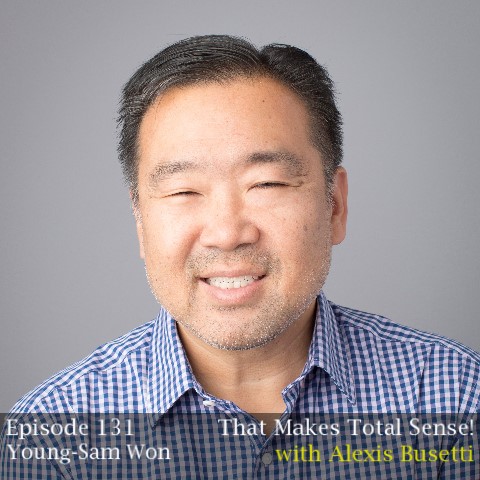
Speaker 0 00:00:07 Welcome to that. Makes total sense. A podcast dedicated to exploring God's generosity and justice. I'm Alexis. We setting the Christian aiming to ask good questions and encouraging you to do the same. Every one of us is wired by God to live out generosity and justice, but the house sometimes alludes us. That makes total sense is a way for us to get together posture ourselves as learners and challenge one another to practice generosity and justice in a tangible way every day. Everybody I'm here today with Dr. Young Sam Watson. He is the associate director of ministry formation and an adjunct professor of old Testament at Dallas theological seminary. Hey Sam, how are you today? I'm good.
Speaker 2 00:00:55 Thank you so much for having me on.
Speaker 0 00:00:58 So this is kind of a weird, uh, podcast, uh, story, because I have been just following Sam on Twitter for, I don't know how long months and months and months. And it was like every time, you know, you know, for, so for people who are on Twitter or maybe you're not on Twitter, when you have your timeline, it's probably similar to Facebook or Instagram or something. It'll show you the comments and the responses on other people's tweets from the people that you follow. And every time I see something from Sam, it is always like so loving and encouraging and thoughtful and thought provoking. Um, and a lot of times hilarious. And so I had been selling Seth for months. Like I really want to have Sam one on the show. I have no idea what we'll talk about, but I want to have a month. And every time he was like, you shouldn't do it, you should just ask him. So finally, one day I got up the courage and I asked Sam and he was so gracious and said, yes. So thank you. Thank you. Thank you again for coming on.
Speaker 2 00:01:59 I appreciate the invite. It's great.
Speaker 0 00:02:02 So we did kind of settle on a topic, um, for everybody. So, um, Sam is like I mentioned an old Testament professor, um, but he has also served as a pastor and a pharmacist. I think we just needed to ask you about that in a second, cause that's a wild. Um, but we, um, we decided to talk about justice and righteousness from a biblical perspective, which I will say as someone who's been involved in these kinds of conversations for a long time, for over a decade. And then, and then, you know, acutely here on the podcast for a couple of years, I feel like I would say, I would say in all of my guests would say what we're doing, that we are engaging in the topics of justice and righteousness from a biblical perspective. Um, and I think that that's true. We do that lens some times it can get a little foggy or lost and we kind of lose our way when we focus on the issues more than we focus on the biblical foundation for why we're responding to the issues. At least that's been my experience. What do you think?
Speaker 2 00:03:20 Yes. And I, I think, um, on that note, there's, there's also probably an exterior reason for that, that we need to just be aware of, which is that in evangelicalism, there is a really tragic history of creating an artificial divide in which the, the political and cultural forces that were at work within evangelicalism. And I should say primarily white evangelicalism, um, created this perception that the work of justice is somehow, um, either antithetical or at least, um, separate from the work of the gospel and by the work of the docile. I think what most people had in mind was this idea of evangelism missions, um, planting churches, and, and so what we did and, and what we are still to this day, triaging and doing autopsies and post postmortems that have been so helpful is what we're finding is that that division really had very little to do with the scriptures or even theology.
Speaker 2 00:04:32 But that often it was really race at the heart of the matter was that there was this incredibly powerful undercurrent of racism that was creating these impulses. And so we, and I say, we, because I largely identifies evangelical, although these days there's a very complex way in which I understand that. And so, um, I, there's a lot of nuance and a lot of qualifying, but, uh, th the main point is this, um, we are not at this place where we struggled to see justice in scripture by accident. And I think that's an important reality to be aware of.
Speaker 0 00:05:18 Yeah. Thank you for that, Sam. Uh, you know, currently I mentioned to you before we started recording that, um, that I'm a student. And so, so this is actually a really fun, uh, dynamic for me because I just get to pretend like I'm in class, right. I've had the, I've had the privilege of interviewing a couple of my previous professors on the podcast. And so sometimes it's fun for me just to, you know, just to sit as if I'm in class, but when you mentioned that the work of the gospel, which was primarily seen as that, um, evangelism and planting churches and, and all of that stuff, I was actually just reading about that. Um, in some of the work from, uh, Dr. Soon, Sean rod does some history of evangelicalism in America that I was just unaware of. Right. And, and kind of that separation that you speak of, um, to a focus on evangelism kind of versus almost a focus on justice.
Speaker 0 00:06:15 And I think what we saw in kind of mainstream American white evangelicalism is that the justice stream kind of lost out. Like, it, it kind of went weak, but as you point out it wasn't because of some sort of lacking of biblical reasoning for that. It was really largely focused on race. Do you want to elaborate on that at all? And you don't have to keep it right there, but I think that that's, um, a point that if I were reading it, I would go, Ooh, I want to see the footnote on that. You know, so, so can you elaborate at all on kind of on kind of what that looks like, and, and you can take that anywhere you wanna go.
Speaker 2 00:07:01 Yeah. Um, so I was, I'm really thankful. Several years ago, I was introduced to a, uh, a monograph or a published dissertation called doctrine and race. And this was a fantastic historical, um, scholarly, uh, look at, um, basically, uh, the archives and the documents associated with the African-American black church tradition between reconstruction. And I believe somewhere around world war two or world war one. So you're looking at a 50, 60, 70 years swath of history. And one of the really remarkable takeaways from Mary Beth sweat numbs work is this, the black church was not this liberal, um, progressive theological entity, as we were so often led to believe in our seminary classes on theology. Um, there's this perception you are given if you attended a conservative evangelical seminary, that liberation is from Latin American, south America, as well as black church theologies were all somehow defective because they were rooted in social and progressive agendas rather than in scripture.
Speaker 2 00:08:22 And then the perception you were left with as a student of these types of seminaries, is that the true truly biblical and faithful theologies Orthodox theologies were found mainly in the Western, uh, kind of Eurocentric tradition. Um, so I kind of bought into that, um, when I was a seminary student, just kind of assumed that, but Mary Beth sweat Adam's work is fantastic because what it reveals is that where the black church diverged from fundamentalism in the early late part of the 19th and early 20th century was not on doctrine. They were actually some of the most faithfully Orthodox churches, pastors and believers in America. Uh, they refuse to actually be co-opted or joined the progressive movement because they refuse to give up some of the foundational Orthodox beliefs. And I mean, things like their Christology and even their soteriology were so much closer in line than what you would find, uh, in what, in what would we would call evangelical mainstream than they were with any kind of progressive, uh, Neo Orthodox or, uh, liberal mainline theologies.
Speaker 2 00:09:40 So they never found themselves at home there here's, here's what, why they never though fully became part of the fundamentalist movement, even though they agreed in a large part with many aspects of fundamentalism. It was because when it came to the issue of the treatment of black people in America, it was clear that the fundamentalists were working from a racist worldview and would never support the progress of African-American people as a citizenry in America. And as a result, they were kind of left in this like a homeless space. They were, they were never going to become fully liberal, progressive, but at the same time, they could never fully support fundamentalism because in that they would be almost, uh, you know, cutting their nose off in spite of their face. And so they were faithfully biblical that's a term we love to use, and they were also incredibly active activist.
Speaker 2 00:10:45 And so I think one of the great gifts of the last several years has been a recovery of black church tradition and a, uh, reform and a resuscitation, and even a rehabilitation of some of our misperceptions of that tradition. And I think it's long overdue. And, uh, so, um, so all that being said, we should just be aware that there is still so much of that hanging over the rhetoric and the discourse within evangelicalism. That's why social justice itself has such a negative connotation among a lot of these circles, because it was always a tainted term. It was intentionally tainted though. It wasn't an accidental poisoning, unfortunately, and you see that in Dr. King's life. Uh, we just celebrated him and he's kind of in microcosm that whole process, because he wanted to attend the faith of his fathers is incredibly, uh, conservative. Actually, if you understand the Baptist black Baptist church traditionally comes out of, but he was not allowed because of blatant racism to even attend those seminary.
Speaker 2 00:11:55 So here's a man who wants to dedicated his life to the work of ministry and the gospel, but because of the color of his skin, he's not allowed. So he goes and studies at a more progressive and, and yes, a more of a main line seminary. And then as a result in this kind of circular way, the fundamentalists could say, well, look at him, you know, he's, he's on biblical, but I think what we've seen in recent years is a wonderful kind of study of his life work and really taking seriously his own words and writing. And what you're finding is that there really is this arc in which he went to seminary, I think really entertained a lot of those, um, kind of mainline, progressive, uh, ideas. And yet as his, um, as he left and became more active as a civil rights leader, he never stopped being Reverend Martin Luther king either.
Speaker 2 00:12:50 And what you find is that somewhere along the way, he never lost. And in some ways he re-embraced the faith of his fathers. And I don't think we heard that enough. And it was because the danger, I think was just the whole slippery slope thing. If Dr. King may be right theologically, then he may be right in his civic teachings. And that was terrifying to the white Southern church, but let's not forget that racism really wasn't a Southern thing. And so whether it was Jim Crow in the south or James Crow in the north and the west, um, they could never fully accept Dr. King. And I think in microcosm key becomes a good emblem of how the white evangelical movement and fundamentalism treated the black church. So, so that's why I would say that we always have to be aware of how those things still hang over our conversations today. Okay.
Speaker 0 00:13:49 Yeah. I mean, wow, thank you so much for that. Um, you know, as you were, as you were talking, I was thinking about, I think I stole this from Daniel Hill. I'm trying to think of who I took this from, but, but it is, um, you know, this, this kind of theology with a capital T right. That you're talking about. So all of these other doctrines and theologies and places that come from anywhere, except for really kind of like white reformed, um, you know, spaces and, and white evangelicalism in America, what we, what we have clung to, um, become these, these, not just off-centered theologies, but they become off-centered. And then the theology with a capital T has to make disclaimers for, for them, you know, all the time. Right. Um, of why they're not up to snuff with, with this, right. Well, well, maybe you could take that particular thing, but don't go too far.
Speaker 0 00:14:46 Don't go, don't go too far down this, this road or this rabbit hole, um, when really the truth is exactly, as you're saying, like in that particular example, like the theology was, was there, it was just as, you know, kind of justice conservative or justice just as biblical for sure. Um, as anything that was happening in white evangelical America, but it was the race card that was, um, that was the kicker for the reasoning. And I think that's important for us to understand the history that we didn't get, where we are now a by accident and be that when we, and I I'm using the pronoun, we too, because I also consider myself an evangelical, but when we use certain language or invoke certain ideas, that those are not without historical context, both for us who may be unaware of it, but also for our brothers and sisters who may be very aware of it.
Speaker 0 00:15:43 And then even as we don't understand what we're saying, we continue to promote those cycles. Right. And we're not bringing ourselves closer to unity in diversity, we're bringing, we're just maintaining the status quo, um, because we don't really know where we have come from. Um, and we don't really know where we've, where we've been. Um, now there's part of me that wants to take us on a, on a trail off to the right. But instead of doing that, I'm just going to mention it and say, we could have the conversation right now about race as a social construct. We could talk about the history of, of all of that, but instead I'll probably just put some really good resources in the notes. I want to bring us back to the Bible. Um, so before we started recording, I was like, Sam, can you just start us with Abraham, you know, and get us there because we can see racism.
Speaker 0 00:16:41 We can see the mistreatment of, especially in America, we can see the mistreatment of people from, from multiple ethnicities for lots of different anyway, horrible reasoning and all of this stuff. We know that that exists. We're we, we are aware of that, but when we go back to Abraham, we say, here's the thing. We can have the conversation about racism, social construction, and all that stuff. But what we also know is that God intentionally created people differently. We have different tribes and nations and tongues and all of those things that are beautiful in God's sight and in his creative design and Abraham, and God's covenant with Abraham, um, they, how, what's the word I wanna use? Um, they really kind of showcase that, right? And they showcase God's plan for diversity and inclusion in the language that we would use that we might use today.
Speaker 0 00:17:44 So, um, so I want to say that's a thing. If you're interested, I'll definitely put some, put some notes in the, for places where you can read all about that. Um, but let's go back to the Bible where we're saying, we know that we're, we're different. God has, God has created this beautiful mosaic. Um, what does that have to do with our faith? We can care about it now for social reasons, which I think is good and we can care about it because it seems like from Abraham way, way back, we're supposed to care about it because God cares about it. So, um, can you take us back to Abraham?
Speaker 2 00:18:19 Sure. And that's a great place to go and I, I, I appreciate you starting there because, um, theologically that's really, my understanding of the biblical covenants is really the foundation for so much of my theological thinking and frameworks. And, and as well as the, how I see art, um, narrative arc, as well as meta narrative arc in the scriptures. So the Abrahamic covenant to me is very foundational and here's, um, but what's really fascinating about Abraham. The figure is that he is a mixed bag because what you see even in Abraham's own life is a really, um, very human narrative. It meaning he is both, um, someone to look up to, and he is also someone that really causes us to just shake our heads and wonder how did you do that? Um, and so, uh, but what Abraham, uh, it's good to look at the structure of Genesis and see how these narratives are, are, are structured in.
Speaker 2 00:19:28 That's really important to how we understand these things. We do too much of pulling texts out of context and just really kind of make them serve our purposes. So when you look at Genesis one through 11, what you have is this, um, beautifully written primeval history, and it's really giving you, uh, eons of history in 11 chapters. So you have to keep that in mind. So it's not what we consider like modern historiography. Now I know there's a lot of conversations about, is it myth? What's the genre, what's the ancient near Eastern background. Those are great conversations, but I'm gonna focus on where we go. And let me create a little bit of context for Abraham. Um, there's this, this kind of misperception or misunderstanding of babble that also, I think shapes the way people misunderstand conversations about race and ethnicity. And that is, uh, you may have heard and people who may, uh, listening may have heard at some point that the only reason we have diversity in humanity is because it's a curse that at the, at the tower of Babel, that somehow because of our rebellion, that God's curse, was that, okay, then you're just going to be divided.
Speaker 2 00:20:42 And so the concept of race already has a negative connotation in the minds of many who misunderstand the Babel story. Uh, so I'm going to dispel a couple of things to set up a ramp. Um, there was race in, in a sense of diverse human, human tribes and nations. And, and then at ethnicities, before the tower of Babel, it's very clear. And so that was not the thing that God was cursing at Babel. It wasn't the diversity, wasn't a product of God's judgment upon humanity. What the judgment actually was, was the failure to understand one another. And it was a way to judge us for our, yes, the primary way you hear that taught about the pride of humanity is true, but there's also that nuance of, they were actually gathering into this one city and which was actually kind of opposite of the movement.
Speaker 2 00:21:42 God had desired of humanity, which was to fill the earth, not come all to one place so that you could marshal your resources and then try to become like God. So, um, so that's really important to understand that the existence of nations in and of itself was never a negative thing. It wasn't the product of the curse. So we need to get that out of the way. So chapter 11 leads into chapter 12. And so you have this table of nations, you have this kind of picture of the world that Abraham would be part of, and it sets up who he is. And so the call in chapter 12, it begins with this call to, for Abraham to arise and go. And that in Hebrew is what will frame the end of the Abraham, um, especially the covenant narrative in chapter 22 after, uh, in the binding of Isaac.
Speaker 2 00:22:38 So, uh, you have this 12 to 22, is this really important 10 chapter arc involving Abraham, but you have to keep in mind that the context leading into chapter 12 is that all of humanity now exists in what I love this expression east of Eden, meaning we are now post-fall. And so everything about life is defaced, even if it's not even if the Mago day, even if the order, even if all the Shalom was not fully erased, um, there's that wonderful phrase, the, the vandalism of Shalom and my friend Barry Jones, uh, pastor, uh, Irving Bible loves to use that. Uh, and, and that's a planting of res I think, but the point is, it's a, it's a wonderfully evocative phrase because that's where Abraham was born and that's where he lives. It's east of Eden. And he lives in a world where the vandalism of Shalom is now the reality of all humanity.
Speaker 2 00:23:39 So, uh, Abraham is called and, and that becomes verses one through three of chapter 12 becomes kind of like this preamble or just announcement. That's not the covenant in itself. And what you find is that you have this wonderful arc in chapter 15, where the Lord brings Abraham even further into his plans and you have him kind of setting Abraham to sleep. And, and there's this really elaborate Theophan ceremony. And a lot of people say, oh, that's clearly God illustrating the, um, kind of the unilateral nature of this covenant. And there may, there's some of that going on there for sure. But I think actually the symbolism of the fire passing between the animal parts is, uh, just as much Theophan in significance, meaning just an appearance of God. Um, and this is really important because it kind of creates this understanding that this covenant is very intimate and that it is a singular.
Speaker 2 00:24:38 Um, so Abraham then is, is starting to realize this is really going to happen. Now in chapter 12, he does take that huge, significant step of leaving his home and his people to go where the Lord has called him. And that, that really sets in motion, this arc, but in the interstitial chapters between 15, 17 and 22, you see the east of Eden life that Abraham still lives in. He is still guilty of misogynistic, patriarchal, uh, activities, views his treatment of Sarah, his own wife, his treatment of Hagar. Um, it's, there's clues in the narrative that show you that he is not the good guy in several of those narratives. And yet in 17, the Lord advances, this kind of movement of the covenant making. So it doesn't happen all at once, but it's almost like there's this dance between God and Abraham, and he's saying, I'm going to, so we often think that Abrahamic covenant is unconditional.
Speaker 2 00:25:41 I don't think that's the best way to frame it. I think there was a lot of, uh, interaction and genuine contingency in the making of that covenant. And I think it becomes irrevocable after, uh, the binding of Isaac. But up until that point, I think there's a lot going on. That's kind of open-ended. Um, so I don't think of the Abrahamic covenant necessarily as unconditional, just as I don't think of the mosaic covenant as just conditional. I think both covenants have so much contingency as well as promise. So I think, uh, all ancient near Eastern covenants are, have a mix of conditions, as well as promissory aspects. It's just that one's more pronounced than the other in the Abrahamic and then vice versa in the mosaic. So I liked the language of revokable versus irrevocable better than conditional unconditional. So after Abraham then passes this final test in 22, I think now what you have is this irrevocable, ironclad, promissory, covenant from God.
Speaker 2 00:26:50 And what are the terms of that? Well, it's, if you saw it kind of announced in chapter 12, one through three people land, and this makes total sense because this is the hallmark of ancient near Eastern Nan nationhood. So if God's going to make Abraham into a great nation, you kind of have to have those two ingredients. So it makes sense that those are part of the promissory terms, but then this thing then, and I think this is where, you know, you were kind of leading us is, um, that they would be a blessing to all nations and we cannot overlook that. And so by 22, after the binding of Isaac, after the Lord is pleased, it then says in the Hebrew that the Lord swears this oath and that's that's language we did not see previously. And so now I, that's why I think you saw this arc that combinates there.
Speaker 2 00:27:43 And I think it's also fair to say that you see that same exact arise and go expression and chapter 22. So it's like a nice, inclusio saying, this is the, these 10 chapters go together and something is happening in these 10 chapters. You need to pay attention to excuse me, so that it was always part of God's irrevocable promissory plan. That what Abraham's blessings would culminate in is not only the existence of a nation. And we see that with the mosaic covenant establishing by constitution, the very people that Abraham was promised. And then we see through the conquest of the land that they become a nation. And then through the Davidic covenant, we see their definition of nationhood further sharpen, and now they have a king. Um, but in all of this is still part of this overarching promise that how are all the nations going to be blessed through this nation?
Speaker 2 00:28:45 And so the Torah that mosaic covenant gives us a glimpse of that because what God is creating in the Torah is this beautiful law code that on the one hand reflects the realities of the other nations and the political and civic kind of conventions of the day, and yet in a very, uh, divine design sort of way. It also reflects a fight back against the east of Eden violation of Shalom that was so prevalent in the world. And so the, so the, so you get a glimpse is that, oh, one way that the Abrahamic covenant is going to be fulfilled to all nations is this nation of Israel becomes a nation of priests, meaning they are mediating nation. They are there to be a bridge between man and God. And that is a servant position fundamentally. Um, but it was also meant to give a standard for mediation that would counter the prevailing ways of the world.
Speaker 2 00:29:51 And that's the Torah. And this is why it's really important to see that Jesus never once says that the old Testament laws obsolete or that it's wrong, he affirms it every aspect of it. And he says that I have come to fulfill it. And so we need to take that seriously because I do see, and in Western American Christianity attend to attendancy to misread the old Testament or ignore the old Testament and both are harmful both tendencies. So I see some Neo Marcy aneurysm, this, this belief that the old Testament is irrelevant, not true, or the belief that the old Testament was the bad part, that the new Testament then correct. Also not true. So, um, so anyway, I, I know that went all over the place, but I, to your point, it is, it is hard baked right into the promissory aspect of the Abrahamic covenant, that the whole purpose of the Abrahamic blessing and the creation of this nation was supposed to eventually be for all the nations of the world.
Speaker 2 00:31:02 And so you see that wonderfully play out in the Davidic covenant, because now you see, ah, this gives us an understanding then of the agent by which these blessings come to fruition because David's son will be the Messiah who will bring to fruition. What no earthly king really could. And so I am very much a, um, this is why this is going to be kind of awkward for some folks, but I'm not, um, I very much, uh, am a fan of progressive dispensationalism. And to be clear, this is not the dispensationalism of Schofield or rye re even it's not a, it's not a belief system centered around prophetic readings of revelation or the rapture. It's actually this idea that there's a progressive revelation in the covenants of the Bible of the narrative. So it's Abrahamic then mosaic, then Davidic and then new, and Jesus does not say for no reason on the night of the last supper, that when you drink this wine, you are commemorating the inauguration of the new covenant. So there is, if you don't know the covenants and you don't know how they interact and how they relate to one another, you miss such an important foundation in your biblical theology, and then that's going to shape your systematic theology. So
Speaker 0 00:32:34 Sam, you just took me to school. I'm thankful. I think you just took all of us to school and I'm thankful. And, and, you know, I think for, for me personally, um, I mean I'm 40, I grew up in the SBC and I've seen, you know, been a big part of different traditions or different traditions have been a big part of my life and my formation of my theology since then. Um, but when you said that we tend to misread the old Testament or tend to kind of negate it with this Neo Marcy aneurysm. And I would say, gosh, I feel like what I've seen, um, in a lot of traditions is that we just somehow were able to do both at the same time, which is wild to me. Right. And so I think in part we, we misread it and then because sometimes of our misrepresentations of what it actually says are the points that God is actually trying to get across to us.
Speaker 0 00:33:29 Then we discount it because it must not actually be that important because this is really weird stuff that's happening there. And so we misread it and then we discount it, you know? Um, and, and a lot of times I think we ended up doing both, but I think when, when you, when you talk about that progressive revelation, are you, or are you talking about Jesus saying that he hasn't come to, um, to nullify the law? I think though, because we have misread it and because we have discounted it, we really don't even fully understand what he means by that statement. Right. And so this can turn into various forms of legalism. This can push us toward different, um, aspects of, uh, fundamentalism that tend not to be that great for our spiritual formation. Um, because we don't really understand fully what he meant by that.
Speaker 0 00:34:20 And, and honestly, some of the ways that I comfort myself as to say the disciples had no idea either. I mean, they, he was walking with them and they were clueless. Right. Like they did not know, um, what he meant when he said a lot of the things he said, right. And even still one of my professors just kept pointing this out in acts, but it was like the disciples weren't dumb, but even still, when Jesus was about to ascend, it was like, okay, but now you're going to come and be the military. Can we thought, right. You know, like it's happening now. Right. And so it's like, it's not that, you know, they're dumb or we're dumb or whatever. It's just that we just can't really wrap our brains fully around these revelations, even as you described them as they, as they have progressed.
Speaker 0 00:35:06 And, and, and so I think that when we hear Jesus say things like that, we don't really understand. I think sometimes we don't understand his Messiah ship, right? Like, like, like what that really meant when he came to do those things. And so when we read stuff like Paul and Ephesians talking about this enmity being torn up by Jesus torn body, or when we read stuff in Galatians about, you know, who has be witched you and things like that, like in part, this part of the law that you're talking about that refers to the Abrahamic covenants and those things that were involved with the people groups, we don't really understand how Jesus came to, to, um, kind of, I don't know, ratifies not the right word. Right. But it kind of live into these permanents. Then the words of Paul sometimes get lost on us.
Speaker 0 00:35:58 Right. Because I'm, don't know that we're connecting his letter to the Galatians or his, the circular letter to the Ephesians. We're not really connecting that to, for example, Jesus' experience with the Sierra Phoenician woman or the Samaritan woman at the well, right. Like we're not really making those full ethnic covenantal, Jew and Gentile now one connections in our mind because we don't really fully understand what God was doing through those covenants as we see them progress through scripture. So this isn't really a question, I don't know, but, um, but how do you, how will you respond to that?
Speaker 2 00:36:37 Yeah. Let me give you a, a framework that I might, some of your audience might find helpful. This was really important for me personally, in starting to create like a better, what I believe truly a better biblical theology of understanding Torah. So, uh, my, when I was back in seminary and my THM days, it was back in 1997 to oh one. So yes, I am older. But, um, in my first Hebrew class, I'm taking this version of the Hebrew here at DTS that they no longer offer is called turbo. Hebrew is basically a five-hour course that you could take all in one semester, but I am so glad I did that because I got to work with a professor here named Gordon Johnston. Who's fantastic. And he's still teaching here. He's, he's one of my mentors and he put it this way. And to this day, it helps me so much when I try to think about what's going on with law, especially in the new Testament.
Speaker 2 00:37:39 So I want you to picture a two kind of like parallel structures. So it's almost like two buildings side by side. And, um, there's a bridge at the very top. And so there's like maybe an arc between them. So the arc is going to be the central timeless core of the law. And this transcends both testaments and Jesus is the one who validates this. And so in the old Testament, it's expressed as one that's Shamar do Newmar and may six, like love the Lord with all your heart, mind, soul and strength. And that gets echoed in the new Testament. Jesus asked these law teachers, Hey, what is the greatest commandment? And they all kind of echo that. And that's totally makes sense because by, by first century Judaism standards, that's like not even questioned. But then the second part of that, that Jesus affirms is there's also a second.
Speaker 2 00:38:35 Like it meaning it's right on that same level. And that is to love your neighbor as yourself and James calls that the Royal law. And so I think there's something to be said. So I say at the very top of this paradigm or framework is this dual law. It's basically love the Lord, love your neighbors. And you've heard this a lot in recent years because this is kind of the way a lot of more progressive evangelicals are trying to push for more justice work. And I think that's fair. So love the Lord. Love, love your neighbor, uh, the Shema, the Royal law, and that does not change. It's. It's going to be a bridge over both structures. Now in the old Testament building, what you have now on the next, uh, at the top of that building is the 10 commandments. So the DECA log becomes your kind of timeless principles express the kind of sum up this entire Torah into 10, really concise and powerful, uh, principles.
Speaker 2 00:39:36 So that I would say the 10 commandments, the 10 words, the deck log is really more principles than they even are laws. I mean, they are commands, but, but there's something timeless about them. So the first part is the relates to the Shamal. How do you love the Lord with all your heart, mind, soul and strength? Well, you do not take his name in vain and you do not worship any other God before him dog. So the first part of the DECA log is the Shammah just now in timeless principles. The second part of the DECA log pretty much is the Royal law. Well, how do you love your neighbors yourself? Well, first you begin by respecting their property. You respect their lives, you respect their family relationships and all and so on. So that's the 10 commands. So that's the top, that's the penthouse.
Speaker 2 00:40:27 And then the rest of the law in the Pentitude is actually what I would call case law. So all these complicated laws you get in Leviticus and numbers and Deuteronomy, this is, and this is where most people's like yearly Bible reading plans pretty much get shipwrecked it's because these are case laws. So if you're a lawyer, you you'll know this, you don't go to law school and memorize every single case. Uh, example of case law, what you try to learn are precedents and principles. And then when you take on a case, you then go into the books and you dig because you want every case law that illustrates the point you're going to try to make in court. And that's what Deuteronomy is. That's what numbers and Leviticus give you. So there's a holiness code in Leviticus that applies more to the priesthood. And then there are daily case laws in Deuteronomy that go to all the details of life.
Speaker 2 00:41:29 Like what if my ox kills somebody? What do we do? Well, here's how you're going to handle that. Now here's something we don't always recognize. And in numbers, you even have an example of case law being in real life, real time adjudicated because, uh, when, uh, the daughters of Zillow had, um, come to Moses and say, our dad died and there are, there's no mail in like to inherit his land or his inheritance. We don't feel like we should just get thrown out into the cold because of this. And so Moses brings this, they bring it to Moses and the elders and the people. And then Moses says, I better check with God on this one. And it's actually the Lord who directly adjudicates this. It's like a real-time example of how case law works. And so from then on, they now have this precedent that says you can't a family, can't lose their inheritance just because they didn't have a son.
Speaker 2 00:42:31 And so it's really important to see how protective the application of law was meant to be. So that's, that's building one. Now, how does that relate to the new Testament? A lot of people think there is no building in the new Testament that corresponds, and I'm going to say there is, and I'm so grateful to Dr. Johnston for pointing this out. So now the bridge of Shama and Royal law goes over to the new Testament and you find out, wait, this building looks a lot like the one in the old, and here's why at the very top, you don't have the deck a lot, but you know what we have in Matthew, you have the beatitudes and you have the sermon on the Mount and the sermon on the Mount. If you really go back and read it, well, you realize, wait, this is Jesus expounding on the DECA lock.
Speaker 2 00:43:23 And he is expressing the 10 commandments, the 10 words in new covenant terms and meaning this, what is the biggest difference between the new and the old covenant, meaning the mosaic covenant. So when Jeremiah prophesies that there's this new covenant coming, it's not made yet, but he's telling the people keep your eyes open and your ears open because it's coming. And what it's going to do is it does, it never wants to Jeremiah say it will invalidate the old, but what he says is now God will put the law in your hearts and you will no longer have to have it mediated. And you no longer will have to have the priest necessarily mediating every aspect of what holiness looks like applied, but it's internalized. And even Jeremiah did not understand at the time what God was giving him a glimpse of was the holy Spirit's ministry in the new covenant era.
Speaker 2 00:44:23 So as Christ ascends to heaven, the gift of the holy spirit comes upon the church and all believers, the people of God. Now, given the Torah in a way that we had never expected or thought was possible. So what the new covenant is showing us is that the law itself was never bad. But now Jesus, in the sermon on Mount is saying, now it's not enough just to say I didn't kill my neighbor. The question is in your heart, did you Harbor hate for your neighbor? Because in a new economy where the holy spirit is the mediator of the Torah, it is now internal matters. What you thought, how you viewed that woman, even if you never touched her matters how you viewed your neighbors, possessions, even if you didn't act on it matters and how you view God, even if you didn't outwardly swear.
Speaker 2 00:45:18 Um, or, and by the way, it's not saying his name in a cursing sense that we're talking about in the DECA log. It's about the improper use of God, um, for, for, to make claims and in any way. So Jesus is giving you the 10 commandments. You just missed it, probably because that's really what the sermon on the Mount is doing in the beatitudes become this wonderful timeless expression of what the kingdom ethic looks like in humanity. And if you pay attention closely what you realize that looks a lot, like we're going back to Eden, it's a restoration of the violated Shalom of humanity. So now you're going, okay, well, what about the rest of the building? I don't see Deuteronomy numbers in Leviticus in the new Testament. And I would say actually, it's there it's the epistolary literature because what was Deuteronomy numbers in Leviticus?
Speaker 2 00:46:15 It was detailed for the administration and application of the law into the everyday life of Israel as God's people. Well guess what? Paul's writings, John's writings, James Peter Jude. What they are doing is they are taking the sermon on the Mount. They are taking all the teachings of Jesus and with the help of the spirit and with the benefit of time and processing, they are now able to say, this is how this looks when you practice it, when you apply it properly. And that's why Paul does comment on how do we handle lawsuits. That's why Paul does comment on sexual abuse. And he does comment on racism and ethnocentrism and nationalism, because these are outworkings of the good Torah that Jesus fulfilled, not, um, nullified. So these two buildings do exist. The one in the old and the one in the new, and in a sense, the one in the new is better because now this building it's mediated by the ministry of the holy spirit, under the redeeming work of Christ as established in the new
Speaker 0 00:47:28 Covenant. The thing that caught my attention the most may have been at the end when you said these, these letter writers with the benefit of time and processing, right? Because I think that, um, you know, white, white evangelicalism, American evangelicalism definitely has its roots in forms of fundamentalism, like we've already talked about. And so, um, sometimes there is a temptation to, um, to kind of take the letter of the law, this black and whiteness that we see and, um, and determine our actions or judge people on their actions based on that, when you just explained, and we, we know when we read the beatitudes, it's actually not what Jesus is trying to get us to do. Right. He's trying to get us to, to participate in some introspection, right. He's trying to get us to, um, to live out this law on our hearts, um, that, that, as you said, I think, I think appropriately that Jeremiah didn't even really know what he was fully talking about when he, when he, um, got a glimpse of it because it didn't exist yet.
Speaker 0 00:48:42 And so with the benefit of time and processing these letter writers got to, they got to kind of look at that. And when, and when we think about this being the law written on our hearts, um, you know, to me that invokes an amount of, um, emotion, right? That, that we can't fully explain always what we're feeling or the commitments that we hold dear and true to us in our hearts, because they're so deep and they go beyond words, um, or actions sometimes. Um, and so to think about, uh, the law being written on my heart, kind of in that way, um, it just makes it seem and feel a bit different than what I have. I don't know what I have personally kind of found that I try and I just kind of try and check boxes or make sure that I'm not doing anything wrong or make sure that I'm doing things right.
Speaker 0 00:49:46 Um, when really this, uh, you know, kind of not kind of when this relational nature that we have with Jesus looks very different than that, you know? Um, and even going back, I love this, I love the story of when the daughters come to Moses and he just kind of says, I really don't know the answer to that. I don't know what that's supposed to look like. And we see y'all weigh himself, do that, you know, come in and say for himself, um, what he thinks would be just right in that situation. And he, and he, and he tells at Towson what would be just in that situation. So now that we have these two buildings and we have this bridge, um, and the bridge is we're familiar with the arc is we're familiar with being the Shema and the Royal law. You touched on it.
Speaker 0 00:50:42 You said it doesn't matter if you, if you don't kill your neighbor, but it matters how you think about him in your hearts. And in some way, I'm talking to think here, but in some way, you know, my mind gets taken back to Martin Luther king, as we, as you've mentioned him before. Right. And saying, and then there's this juring right. That says, gosh, if, if this thing on your hearts, isn't going to matter, then maybe we got to put it in writing that you just can't do this. You know? And, and, and there's this love of neighbor that we just don't understand well enough to do it well. Right. Because we're, I don't know, we're not just ethnocentric where self-centered, which I think is Jesus' point, right. We're supposed to love our neighbors as much as we love ourselves. Right. And, and normally we're not, we're not loving ourselves.
Speaker 0 00:51:37 So, um, with those two buildings coming together with that being like the hinge at the top, take us back toward this justice conversation, but from there, and I love starting from there because it's, it's, it's appropriate. I think, to look at things that we see and say, can't, we see that this is wrong. Don't we see these things going on. And then we want to pull back and kind of make, and then take our bridge back to the biblical source, but let's start from the biblical source so that when we see these things that are happening, we can recognize how that doesn't line up with what God has, has called us to as people who are clinging to him. Right. I love that old Testament picture. Right. Of like people clinging to the Israel lines, because they knew that their God was God. Right. And so we have made a choice to clean to him, like Ruth or some of these other, um, you know, foreigners I've chosen to do, to claim to the God of Israel. And so, as people who have chosen to cling to him, what does that matter in how we have this neighbor left? Let's start make that the starting point, that bridge.
Speaker 2 00:53:00 Sure. Um, so there is a, um, I think the, the more you study, like the Pentateuch or the Torah, the books of the law in the old Testament, what you come away with is you realize, number one, you probably never really studied it as it should be studied. And number two, we miss a lot because we are, uh, it, the, the lenses you bring to the text really do matter. Um, seminarians have heard that, but it's true. And so if you are coming constantly to find, um, your soteriology and Christology in the law, you'll find things there that are incredibly important and foundational, but you will also miss things, because if that's all you're looking for, you will forget or not realize that the law also has incredibly important timeless principles to offer us regarding also civic engagement and societal structures and things like that.
Speaker 2 00:54:02 So let me just give you like a very general way that you can reread the law and maybe gain new appreciation for this. Uh, first of all, the concept of righteousness in the old Testament and really in the whole Bible is the idea of doing what is right by the standard of God. It's a very simplistic way of understanding, but that's exactly what it is. And so the concept of justice is to do what is right in the civic and societal sphere. It's just an extension and organic extension of righteousness. So one who is upright, who is characterized by righteousness, set a car is going to be one who issues and lives by right judgments, mish by team, in a sense. So, so they're very intertwined ideas. In fact, uh, in the new Testament, the word dickeya sooner, sometimes it's used interchangeably, um, between those terms, because they're so closely related.
Speaker 2 00:55:04 So the idea of justice is if I, if I can just offer, instead of thinking of social justice as being about race and politics, just think about it in a much more simpler way. It just means, is it right in God's eyes? That's what justice really is. So the old Testament law is incredibly informative in one major way that I think a lot of evangelicals miss, and that is how God sees and how God protects. So we think of the law as legislating, um, our holiness, and to an extent that is true, but we're thinking too much in terms of ceremonial. Uh cultic and maybe even in our spiritual holiness. So we're thinking in reformed, um, terms. So, so much of the conversation around the study of the Bible changed after the reformation and some of it for the better, absolutely. The reformation was a game changer in the best way we needed a major shakeup because the Catholic church has doctrines on things like justification.
Speaker 2 00:56:11 Soteriology, um, had some cracks that we needed to address. And so I'm grateful for Luther and Calvin and some of these reformers, but here's the thing. If you look at, uh, even in academic research, what I found was that so much of the literature about the old Testament is about what is the old Testament say about justification? What does the law have to do with grace? And what does the law have to do with gospel? And we don't see enough, really good writing on the law itself and what it tells us about God. Um, in that sense, I would say that Catholic and some of the more main line Protestant to philosophers and Christian ethicists have run laps around the evangelical scholarly world because the evangelical scholar world is not dumber or less educated. They just weren't asking those questions. And so, um, when you look at the Torah and ask the question of how does God see and protect those who need to be seen and protected, you find that the Torah is incredibly rich and answering those questions.
Speaker 2 00:57:21 So I would say that's one thing you can create as a new lens for how you want to read the Pentateuch is how does God see and protect and what you will find that this helps you get around. Some of the mess we get into when we center the conversation on race and the creation of race during the colonial era in Europe, which is an absolutely legitimate reading of history. And it is a social construct. I get that. So, but I hear people who are arguing in bad faith when they try to do this end around and say, well, so race is, we're talking about it didn't exist in the old Testament. I'm like, yeah, that's true. But the injustice is that you are perpetuating did, and God did speak to that. So here's the lens. Um, and I use Nicholas Wolterstorff expression because I just love it.
Speaker 2 00:58:11 He just nailed it. There's a group in the law called the quartet of the vulnerable. And Walter store identifies these four classes as the poor, the widow, the orphan, and the foreigner. And you, you can change the order. There's no particular order, but why is it that it was those four particular groups that Valter store saw as having a singular kind of different standing in the Torah? It's because they were the ones with no land. That is the essential key to understanding how the Torah understood vulnerability in that world. So who was most likely to have their Shalom and their rimando day violated. It's either those who are economically poor, it was either them or the orphans and orphans make sense, because once you lose your family, you have lost your inheritance in ancient Israel. And now you are without a place in society, the widow, again, in a patriarchal society, if you do not a husband, or if you've lost your mail link to society, then like the daughters of Zillow, Pahad you find yourself incredibly vulnerable.
Speaker 2 00:59:31 And finally, the foreigner, and this is really important because what we see is that from the very outset, it was not an addendum. It was not an exception, but it was right there in the law established from the very beginning that God assumed that there would always be interaction with people from other lands and other places. And so here is how I try to circumvent all the discussions about race as a social construct. And it's not in the Bible and stuff, I just say, yeah, but the Bible does talk about how you treat those who are different from you. And at the end of the day, we can argue endlessly about CRT and definitions of social construct, all you want. But one thing you cannot deny is that there is groups of people in every society on earth, who are the other, sometimes it's defined by the color of their skin or by the appearance of their hair.
Speaker 2 01:00:28 Uh, other times it's defined by a passport or documentations, but sometimes it's even defined simply by, uh, the way you talk, even if you look the same and within that area. So there are always the other, that class of people exist in every place and in every time in history and the Torah gives us a wonderful template on how you're supposed to see and protect them. So that's how I would argue that we re uh, frame the discussion of how you understand, and then keep in mind that all the things that you gleaned them from your study of the Pentateuch and the law regarding the quartet of the vulnerable Jesus is saying all of that. I did not come to abolish, but to fulfill. And so that's a really, I hope that if you can take something away, that might be one of the things to take away is that the Torah is filled with examples of how God has specifically said, I'm going to protect these people because you will not be able to help yourselves.
Speaker 2 01:01:34 They will have less power than you, and make note so much of how power is understood within the Torah's understanding of ethics. It's defined by finances and money. So when we say race is about money, there's so much truth to that. Racism was always about money. Mammon is a real idol, and it has, I believe almost like an animate evil force to it, and the way it works. And this is why God did not say money was necessarily evil, but he said, you cannot serve me in mammon because there is this God out there that competes with me, and it creates a different world that it's trying to suck you into. And it's trying to create its own anti Torah that it wants you to buy into. And if you do, then you become susceptible to patriarchy, misogyny, classism, and racism. All of these are forms of violence against the other, ultimately for power and power is ultimately tied to money. So that is if you can buy that, uh, kind of like framework, the Torah will make sense.
Speaker 0 01:02:49 Good night, Sam, this is like, yeah, you're just laying it all down. And I'm, and I'm having so much fun. And then I looked at the clock and I'm like, no, don't we have twice as long, but we don't because I know you have glasses and I have studying too. So, um, I'm going to ask you to kind of choose how you want to close this out so one thing that I love to do, um, is to say, you know, to, to, to pose to my guests, what question did I not ask? You know, what, what, what is in you left that's burning still? Um, and so, so that's an option, but I also, um, love to ask pastors to say, you know, if you just feel it in your heart, even just to pray for us, as we close out, you know, everything that we've talked about, you know, I used to have someone who would pray over me, he would say, just, you know, seal it up.
Speaker 0 01:03:42 Right. You know, just, just bring it, just bring it into us. So you can do either one of those or both, but I just want to, I want to leave it in your hands because this has been, this has been incredible. And here's the truth that I'm just going to open it up to you and say, you can come back anytime because the notes you sent me, I have tons of notes on those notes that we didn't even get to. So this is, uh, so, so just to say that this is a rich conversation, that is, that is ongoing. And when we start from the, from the biblical place, um, there's lots of different, there's lots of different veins. There's lots of different kinds of tributaries that we can follow on this discussion. And so I'll just, I'll open that up and say same. You're welcome back. Anytime. I would love to have you, there's tons of notes that we didn't get to, but, um, but how would you want to close this out today?
Speaker 2 01:04:31 Sure. Let me, let me maybe just end with this. Um, people will ask me, um, who are actually kind of further to the left of me in a lot of ways. Like how do you even, why are you even at a school like Dallas seminary? And that's a fair question. Um, and I do get a lot more Mo more from the people to the right of me who will say things like, did you just, are you now full on liberal? I mean, or do you even believe anymore? And I, I kind of chuckle because I see why both sides asked me those questions and it's because in some ways I don't subscribe to necessarily everything that some certain political versions of progressive agendas will ask me to. And that's because, um, and then there are many ways in which I have just absolutely moved on from kind of white nationalistic Christianity.
Speaker 2 01:05:26 And so in both to both, I kind of say the same thing, actually, you know, why I'm where I am and doing what I'm doing is because I am trying to simply be the best, most faithful disciple I can possibly be. So here's where I think you can sum up kind of why this is such a struggle for so many in evangelicalism. We talk all the time about the great commission and we've faced based so much of our understanding of what the Christian life should be about based on the idea that we should be great commission blanks, whether it's great commission Baptists or great commission, uh, church planting, whatever. And so here's something I've asked people in recent years and I'm shocked because you will, I will get this response more often than not. I will ask them, tell me, quote, the great commission to me.
Speaker 2 01:06:23 And what I will often hear is, uh, love, uh, not sorry. That's the, let me go back. Um, make disciples of all nations, uh, and, um, baptizing them in the name of the father, the son and the holy spirit. And then they kind of trail off and I said, okay, but you didn't quote the whole break commission. That's not verses 18 through 20. And they go, oh, I mean, but that's, that's most of I'm just paraphrasing or something. And I'll say, wait, what about the tart part where Jesus also says, and teaching them to obey every thing I taught you and they go, oh yeah, of course that's part of discipleship. That's a disciple of me. I go, okay. So let me ask you, what do you think con constitutes everything? Jesus taught his disciples. So what was he telling them? In essence, when you go out into the world and you are baptizing people into my name, which is an incredibly sacred and holy mission, and then you are supposed to pass on to them, what I have taught you, what do you think that includes?
Speaker 2 01:07:34 And this is where I will always hear things about evangelism and planting churches. And, and I go, you know, what's funny is actually Jesus hardly ever said anything about those things, but he did say a lot about fulfilling the law and you, and that is the problem I think with evangelicalism is that because of our history, tragic history of trying to create a theological justification for racism, what we have done is we have lost the second part of the great commission. And we have reduced the great commission to evangelism and baptisms and just recording membership roles. And we don't talk enough about what it looks like to form followers of Christ that actually know what Jesus taught, but more importantly, as Jesus commanded, do what Jesus taught. And I say, if you do that faithfully, and if you take that seriously, you will be surprised at how much of what we disparagingly call social justice. All of a sudden appears on our plates. So I would just kind of say, let's not do a truncated, great commission. If we're going to be a great commission, churches and believers in communities, let's do it fully as Jesus meant it when he said it.
Speaker 0 01:09:02 Amen. Sam, thank you so much. Thank you so much for your time today. My final request, I think is for you to say your Twitter handle out loud so we can put that in the notes. And, um, and that's, you know, that's where I first became acquainted with you. And I would say anybody who just, you know, needs a bright spot in their Twitter timeline, follow Sam. So what, what are, what are, what's your ad?
Speaker 2 01:09:27 It's at Sam Obi Obi one, w O N
Speaker 0 01:09:33 I love it so much. Um, thank you so much, Sam again, and we'll put, um, all of the links and everything for what we talked about in the show notes. And, and I meant what I said. You can come back anytime and we'll continue this conversation. It's been such a blessing to me. Thank you so much.
Speaker 2 01:09:49 Thanks again for having me. I really enjoyed it.
Speaker 0 01:09:54 The links for all the resources mentioned
Speaker 3 01:09:56 Today's episode can be found in the show notes, music, and podcast production by Seth. be sure to give us a review on iTunes and subscribe at your favorite podcast listening app. You can also visit us at that. Makes total sense.com