Episode Transcript
Speaker 0 00:00:01 <inaudible>
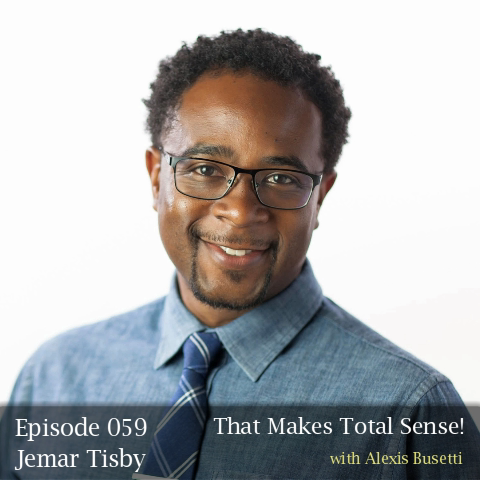
Speaker 1 00:00:07 Welcome to that. Makes total sense. A podcast dedicated to exploring God's generosity and justice. I'm Alexis resetting the Christian, aiming to ask good questions and encouraging you to do the same. Every one of us is wired by God to live out generosity and justice, but the house sometimes eludes us. That makes total sense is a way for us to get together. Posture ourselves as learners and challenge one another to practice generosity and justice in a tangible way every day. Hi everyone. I am Alexis. We study and I am like beside myself, thrilled to be here with jemartisby today. Hi Damar.
Speaker 2 00:00:50 Thank you so much for having me on your show. I'm excited to,
Speaker 1 00:00:53 Oh, I'm so glad GMR is when I wrote these notes actually a while back, we we've had some scheduling conflicts and I was like so thrilled when I was writing these notes up that you are old news now, but New York times best selling author of the book. Uh, the color of compromise, the truth about the American church's complicity in racism. Gemara is also the president and cofounder of the witness, a black Christian collective. And he is the cohost of, or a cohost actually pass the mic podcast, which we were talking about before, when Seth came in to shut the door after the Mastiff walked in. And, and it is one of his favorite podcasts. I love it too. But he specifically said, please, your Mar, if you talk to him, pass the mic is just one of my favorites. So that's kind of a lot Jamar.
Speaker 2 00:01:44 Yeah, well, listen, uh, the Lord has really blessed this work and I think there's book came along at a time when really an exceptional number of people in general and Christians in particular were ready. They were looking for more information, more knowledge about racial justice. And it just so happened that, uh, particularly history has an Avenue to do that really resonated with some people. And then of course, the George Floyd, uh, protests and, um, uprisings around Brianna Taylor happening in the summer of 2020 that actually opened up a new audiences and a renewed interest. So it's been quite the ride,
Speaker 1 00:02:22 Man. I, I will tell you I'm embarrassed. I wasn't going to share this on air, but I'm just, I'm just going to go ahead and put it out there. I have followed you on, uh, social media for a while and screenshotted, uh, the color of compromise when it released, but I probably like a lot of book nerds have a list, a mile long of books to read and it had just kept getting pushed. I don't know if that ever happens to you. It just kind of kept getting pushed for one reason or another. But when, um, for me, it was actually just prior to George Floyd's death and that was when the death of a Arbery became public knowledge. Um, we had, that was just such a bizarre phenomenon. We were all, I think, had our heads buried in the news because of quarantine and COVID and, and, and when this came out, we're like, wait, this happened in February.
Speaker 1 00:03:13 Like, Oh, how am I just now hearing about this? And we were, we had kind of made our front yard, the new living room, uh, because with four kids, quarantine is a little tough in tight spaces. And so we have been out on the front yard and, and I said, okay, this, this, everything else, weights, color of compromise gets moved to the front of the list. I don't care what else I'm reading right now. And I read it. I mean, I feel like I read it in a, in a weekend and just a few days, because it was exactly, as you said, it was, it was, I was hungry for it. It was the information that I needed and then I still need right now. And so thank you for this. I just, this, this work is a, is a gift to the church. And so I just want to say, thank you for this book. It's
Speaker 2 00:04:00 Well, that's an answer to prayer. I mean, you sit there and write something and you have no idea you're doing it alone and in isolation and you cannot control, you know, what the culture will be like, or the moment when, when the book will come out and the book came out January, 2019. So for people to, uh, sort of experience it and read it a year and a half later, it's something I never would have predicted. So I really do say it, it is, it's an answer to prayer and I wrote it as a historian, but also as a person of faith, hoping that we can build up the church through truth.
Speaker 1 00:04:37 Amen. Amen. That's so good. And, and just for people who haven't quite ready yet, there's probably a few people out there who haven't yet picked it up. It is a historical survey. And so you start pre founding, um, of our nation and, and go through until now. And our, our collective history is so important and I want to get there, but on that note, I would, I would kind of love to start with something that you, you put out on Twitter a few weeks ago and it resonated with me. And, um, and I'm just going to go ahead and read it because Twitter short. So I'm going to go ahead and read it and I would love it if you could speak to it right now in these, in these moments, especially as we get going on the book. So at the near the end of August, you, you tweeted this out and this is obviously everything that's been going on since George Floyd, um, to the present in case you, weren't sure this is the civil rights movement of our time. It is happening right now, how you are responding in these moments is exactly how you would have responded during the movement of the 1950s and sixties. And I'm going to say that because it resonated with me, but then I don't even, I don't even know. I should say this. I, then I looked at the comments and I thought, wait, what, Jomar, what is happening? You talk to us about this.
Speaker 2 00:06:08 Yeah. So, so the comments are actually part of why I think this is the movement. So we are seeing a, what I call, um, a situation where people are declaring them selves. And so it's not that their beliefs are brand new or anything like that, but we're living in such a time that the sides are becoming much clearer. The lines are becoming much clearer and you can see it in the comments, right? Like people who are continually resisting any hint of racial justice and progress toward it. And, and, and even becoming, um, you know, they're getting offended at less and less. I mean, you know, it takes less and less to offend them. So that's part of it, right? We're seeing this, this strong polarization, which again, you know, the, the sides have always been there, but it was like, you know, even just five years ago, uh, you could have been in a church let's say, and had a vague idea that your fellow congregation members believed a certain way.
Speaker 2 00:07:14 Let's say about politics, right. But then a 2016 election comes along, right? And then we have three and a half years of this particular administration with all of these things happening, racially and over and over and over again, people are getting an opportunity to declare where they stand on these issues. And so now it's much clearer, and I think that's one of the signs, but there's, there's so many more. So, um, number one, this has been building, I think this is from, uh, even just the last 10 years, the Trayvon Martin in 2012, Mike Brown Ferguson black lives matter 2014. You have this slew of people, human beings who become hashtags from Eric Garner to Kalief Browder, to Sandra bland, to Philando Castiel on and on and on. It goes, but then this summer, and this is what really made me say, okay, this is the movement.
Speaker 2 00:08:03 You had this string of horrific incidents. You mentioned the mud are Berry, uh, killed in February. But then the video gets released a months later in what could accurate, accurately be described as a modern day lynching, right? And then in March, Brianna Taylor shot eight times by police and killed by them in what's called a no knock, great where they burst into her home in the middle of the night, was she sleeping, um, shoots her dead. You know, killers still have not been brought to justice. May 25th, a black man named Christian Cooper is in central park, literally birdwatching, how much more innocuous and nonthreatening could you be? And there's a white woman with her dog, not on leash, in an area where there should be a leash. And he tells her about it. She calls the police acts like in physical danger. And so now we have to add birdwatching wild black to the list.
Speaker 2 00:09:01 And then of course in may as well, you get the murder of George Floyd and this haunting video of a white police officer with his knee on his neck, hands casually in his pocket for eight minutes and 46 seconds. And George Floyd dies as a result. Then you get those wave of uprisings, right? And we've seen uprisings and protests before, but usually they might last, you know, a week, a weekend, a couple of months even, but this was sustained over weeks and weeks and months and months. And not just in the cities where it happened like Minneapolis, where George Floyd was, but across the country and even internationally. And the other thing we see is this massive involvement of, of white people in it as well. So that it's not just black people protesting for our humanity and our rights and our lives to matter. It's across the racial spectrum.
Speaker 2 00:09:53 Really. And, um, I was struck because there was, um, an article in the New York times that sort of estimated the amount of participants in these protests. And it said, uh, depending on the poll between six and 10% of the total total us population, which is between 15,000,020 6 million people overall, which absolutely dwarfs even the largest protests of the 1950s and sixties, then you get all these changes happening, like NASCAR, NASCAR fans, this Confederate flag. And that was like, but then the one that even overshadowed bet for me as a student who goes to school in Mississippi is that after 126 years, the state flag of Mississippi, which with its Confederate emblem finally finally came down. So all of those things, I think add up to the fact that this is the movement right now of our day. It never really stopped. And so historians talk about the black freedom struggle and the black freedom struggle is sort of the long arc of any sort of resistance to racism.
Speaker 2 00:11:03 And then there are these particular moments such as the abolitionists movement, civil rights movement, black power movement, and now black lives matter, uh, where, where you can say, okay, this is actually like, um, a critical juncture in our society where things could change, um, and they could change for the better, but they could also change for the worst. If we're not taking advantage of this moment, recognizing what MLK called the fierce urgency of now or what I think the, the biblical equivalent is for such a time as this. And so that tweet was a call to say, okay, this is it. If we want things to change for the better, don't wait for another wave. Don't wait for another time. Don't wait for another opportunity. Now is the time,
Speaker 1 00:11:47 Right? And, and this is why I think that your book and your work is so important because there, there are people now, and, and you don't follow burners, Bernice King on Twitter for about two and a half minutes. Right. And you'll see her call out people saying, don't quote my dad and then say this, or then do this. Right? Because the movement, especially for people my age, I would say, and younger has been romanticized. I think I don't, I don't know if you feel like that might be semi accurate, but I feel like it's been romanticized. Right? And so we pull out kind of these pull quotes from, you know, black history month in February in all of our schools. And we pull these out and then we say, this is it right on I'm with it. I'm here. But when it's actually happening, then all of a sudden it's like the story changes.
Speaker 1 00:12:50 Right. But I feel like the story changes or people give permission for the story to change because they don't know the real story. And one of the things that struck me about your book, I hope this is, I hope this isn't like, I'm not, I'm not saying this to offend you. When I got your book, I read the foreword by Lecrae. I looked over to my husband and I said, well, dang, that forwards worth the price of the book right there. I haven't even started it. I said, that's, that's it right there. Um, but part of what he said was he pointed out and a quote, he, or a, uh, post you put on social media, July 4th, 2016. So this kind of frames, it of seven African American people picking cotton in a field. And the caption read my family on July 4th, 1776. And he talks about the pushback.
Speaker 1 00:13:51 Right. But what he pointed out and that's what your book expands on is the incomplete narrative that we as Americans as a whole, specifically as white Americans, white Americans have this incomplete narrative of a, our American history as a whole, and then white evangelical Christians mainly, uh, have an incomplete narrative, I would say, as a group of the churches, the American churches history. And so when your subtitle says the American church has been complicit, well, there's pushback, right? Because I say, because I quote Martin Luther King and I went to a parade, I mean, I'm kind of being facetious, but you know, that's kind of what it is. Right. But there's this incomplete narrative that your book really fills in. So talk, talk to me about why, why is that important? What was it in you that said, this is something that has to be written more? This is something that has to be read.
Speaker 2 00:14:57 Yes. Well, I, I liked that language, um, an incomplete narrative, uh, because it says two things. Number one, there's these, these other narratives already exist. Right? We're not inventing things. People have been speaking and it's just have we been listening. Um, and the other aspect of that is, um, while there are some errors and misconceptions out there in our understanding of history, I think it's important for people who are defensive to, to understand that it's not in every case that we are saying that what you have learned is not true. We're just saying there's more to this story, right? Yeah. So it's, it's, you know, yeah. There's a lot of examples there. Uh, one thing I'll say is when people hear that title, the color of compromise and then language of complicity, uh, some reactions, some people say that that language is not strong enough to indicate the role of Christians in creating
Speaker 1 00:15:55 You read the book, for sure. It's like complicit, you were being,
Speaker 2 00:16:01 But I wanted to get at the, the tendency for us to look at extremes, right? And so on the one hand, we can look at the extreme overt forms of racism, the people who are putting on white robes and hoods burning crosses in lawns, people who are, you know, stringing up people with nooses. And we can look at those folks and say, well, those are the real racists. And then thereby exonerate ourselves. Well, since I don't do any of that stuff, I went to the March or I went to the parade, whatever I'm not racist. Um, the other extreme is to be very selective in our history and say, well, what about the William Wilberforce's? What about the Christians who fought against slavery and Evernet and claim that very small group of Christians who really did overtly push back against the racial system, as you know, indicative of the entire tradition.
Speaker 2 00:16:53 So compromise gets at that big mushy middle, right? So as we record this podcast, it is on the anniversary of the ninth, 1963 bombing of the 16th street Baptist church in Birmingham. And I begin the book by talking about that bombing because you have this, this, this overt act of racial terrorism, somebody's plants sticks of dynamite and blows up a church and kills kids, little girls, right? Even the most staunch, segregationist is looking at that and is outraged, right? But this young white Laureate named Charles Morgan jr. The next day gets up and tells his all white audience at a young men's business club meeting, who did it, who threw that bomb? Was it a Negro or a white? And he said, the answer should be all of us. And what I recently learned as I was digging more to this story is that there had been over 20 bombings in Birmingham.
Speaker 2 00:17:54 In the past eight years, Birmingham had earned already the nickname Bombingham. And this bombing at the 16th street Baptist church was the fourth in four weeks, week after week after week, there was a bombing, much of it was in resistance to school integration, which we got to, you know, public schools and races that is a deep and sensitive topic, but it's something that's there. So anyway, all of that to say, um, you know, how could a city let these 21 bombings these four in a row? And then it finally kills four little girls, and then you get outraged. Well, what happened? What did you do before that? Right. So what I'm trying to get at is the silence, the complicity, the pacivity, the apathy, uh, of, of many Christians in the face of overt acts of racism and that's creates the context of comfort.
Speaker 1 00:18:50 Yeah, I was, I was actually really hoping that you would go there. Um, I have you, you did a little tweet thread on it today. I promise I do more than look at Twitter. I mean, you know, it's, it's kind of addicting, but it was on it that way, it's out there. But, um, but you, you have a really great, uh, tweet thread on this anniversary today. Um, I'm going to ask you to go there with the, um, what George Wallace had said.
Speaker 2 00:19:18 Mm yeah. So it's really important. So George Wallace is the governor of Alabama at the time. And during the height of some of these civil rights, um, events like the March on Washington and things of that, by the way, this, uh, bombing of the church took place just, just over two weeks after the March on Washington, and King's historic, I have a dream speech. And so that tells us so much like when black people and their allies push back against racism, there's always a backlash, there's always a backlash. And so, um, but to the George Wallace thing, one of the, the, the background context that we need to know is that Wallace gave an interview to the New York times. And they asked him about racial integration in schools. And of course, Wallace is not only a staunch segregationist, that was his platform. So that if he voted for Wallace, that was because you were pro segregation. And so in this interview,
Speaker 1 00:20:17 You know, obviously he was in office. So we want on that platform.
Speaker 2 00:20:20 Exactly. Yes. He went on to have a very successful third party candidate bid for president, which is rare. So anyway, uh, as governor though, he tells, um, the, the journalist in this interview that in order to stop or slow down racial integration, what we need is quote, a few first class funerals, a few first-class funerals that stood out to me, number one, because it's so not just but violent, right? Um, but at the same time, it stands out because you have this political leader using language and rhetoric that creates a context for people to get rattled, radicalized, and act on their violent tendencies and go plant a bomb at a church. Right? So the, the, the, the words and the language and the rhetoric of our political leaders actually really matters and can directly lead to acts of racial terrorism.
Speaker 1 00:21:18 Absolutely. And, and you end this thread with a sign with this sentence that is haunting, which reads silence, passivity, and apathy can kill as surely as sticks of dynamite. And in your book, you, you present this idea that history demonstrates that racism never goes away. It just adapts. And so we're, we're talking about fifties and sixties. We opened talking about fifties and sixties. Now we're talking about a movement. And I, I kept thinking, we, we always hear the phrasing about history repeating itself, but I think she was, it doesn't even have a chance to repeat itself because we're just continuing and it's not ending. Right. So at the same time that I was reading your book, I was reading a book by a journalist named Timothy Tyson called the blood of Emmett till, and it was heartbreaking and striking to read this book, as, I mean, I'm in Houston.
Speaker 1 00:22:31 Uh, I was able to attend the viewing of George Floyd, um, that they had here, the public viewing that they had here before his service, uh, the day before. And I could not stop thinking about Emmett till I could not stop thinking about his mother and how she, so bravely opened his casket so that America, but the world could see the violence and what was happening in Jim Crow America at that time and page after page after page, I just kept thinking this guy is making this up. You know, I mean, it's, it's, you know, probably 200 pages of this, of this one event, but there's so much historical and cultural context. And I just thought, he's, he's reading my Twitter feed. Like this is right now. I mean, the names are slightly different, but this is right now peop people then who were pro integration were communists. Now they're Marxist, right? Like this is, this is just one similarity of going, this is, this is a continual, this is a continual thing. And, um, and I had pointed, pointed that out on social media at one point. And I had just, you know, one comment or something saying how in the world is it is, is, do you see that 20, 20 America resembling 1950s, 1960s, you know, South Mississippi, and I'm going, how do you not see that it is resembling what we saw Ben? I mean,
Speaker 2 00:24:15 Yeah, very much so. So, um, one of the things, my professors in grad school, as I'm studying history say is that history doesn't repeat itself, but it runs by saying history doesn't repeat itself. I think it's important because, uh, the content stuff was specific and so different. Right? So even in the fifties and sixties, um, you're having these, uh, massive legal battles over something like school integration over, uh, voting rights. Well, are we still having legal battles over those things? Absolutely. Yes, but it's not within, you know, 10 years of the Brown V board decision in the shadow there and, and really the cultural, um, attitude of people that this is not something that we should do. You had Christian prominent Christian minister saying that segregation was biblical, right. And if you read between the lines, you still kind of get there today, but there, the vast majority, even of white Christians would say, yeah, no, we should have church members of any race.
Speaker 2 00:25:21 Whoever wants to come can come. Right. That's actually not true for out throughout U S history, right? So it's different, but actually there's it rhymes though, because we're still, um, having these issues along racial lines that are manifesting themselves in ways that seem really familiar. All of that being said, it doesn't have to be this way. And I think that's really important for Christians because, you know, we think of God's plan and things being sort of preordained or quote unquote, meant to be racism is not God's plan for humanity. And the fact that we are dealing with it is, is due to specific human choices that people made for various reasons, but we don't have to make them, we can't do anything to change the past, but we sure can do something about now and in the future.
Speaker 1 00:26:16 So talk about, because in your book, I just love how you talked about racial reconciliation. I hope I didn't mess this up. Racial reconciliation being a reality that we need to receive because of jesus' finished work on the cross.
Speaker 2 00:26:32 Oh, that's good. Yeah. So I'm glad you brought that up. So I think this is paradigm shifting for me, um, because we are so divided racially and ethnically that reconciliations, however you define it can seem so aspirational and almost impossible really. But, but if we reframe that and go back to Jesus on the cross saying it is finished, right. And what he's talking about is a lot of things, but, but certainly including his, his mission of reconciliation in the sense of, of offering a pathway for humanity to be reconciled with God and then therefore reconciled with one another. Right? And so if, if Christ's work is sufficient, then as believers, this is a reality that it's already true. And what we have to do is embrace it and live into it. Um, uh, more than saying that it's something that's not real or realized, and it's not possible, or is only possible in some idyllic utopian world. I think at least in the church, right. That needs to be our attitude. And, and obviously that needs to be what we do so far. It's only been done in pockets and the national story tells a very different story, but for me, it's incredibly empowering and encouraging and hopeful that, that, you know, reconciliation is not something to achieve, but something will receive as part of being part of the household of God.
Speaker 1 00:27:57 Right. But I, I, my mind just, just went back. I don't know why, but it went back to, uh, to Jesus healing, the man who had been laying by that pool for 38 years. And his question to him was, do you want to be healed? And I thought she was, you're absolutely a hundred percent right about us receiving this because of the finished work of Jesus on the cross. But your book helps us to recognize the places that were broken, because how do we reach out to him for healing, if we cannot see that we're broken. And we can't see our brokenness without understanding our history without understanding what happened. Right. Like my kid comes to me with a bruise and I say, Oh dear, what in the world did you do what happened? Right. Sometimes it's, I have no idea because they're kids and they were climbing a tree or something like that. But sometimes they can say, I stubbed my toe on that coffee table, you know, or whatever it was. But it's like, you, we, we've got to go back and see and find out what happened. I think, I think some of us need to go back and be convinced something did happen.
Speaker 2 00:29:14 Mm Hmm. Mm Hmm. Look, I'm going to borrow this. Do you want to be healed? That's so good preaching. Um, that's so true. Right. And I think that's part of the reason why this book, because it's not really just the book, it's the approach. Right? So as I surveyed the, the sort of literature on race, right. Um, especially that, which was geared toward Christians, I saw a few things. I saw some books that took a sociological approach. I saw some books that took sort of a memoir type approach and personal experience, um, books that, that took various avenues to make their point. All of them touched on history, but none of them used history, um, as the main vehicle. Right. And, and, and so this book does, it's a historical survey from the colonial era on up to what I call the era of black lives matter.
Speaker 2 00:30:11 And it shows in each era how, at specific moments and with specific people, denominations, et cetera, Christians compromise with racism instead of confronting it. They were complicit instead of courageous. Right. And the reason I think history works for this is it does force you to sort of ignore, um, obviously his history. There's nothing, there's no such thing as objective scholarship, right? There's always some interpretation in there, but there's also a certain sense in which, you know, the facts are the facts, right? Like we can, we can demonstrate, uh, through primary source documents that somebody said this, or somebody who did this and you got to deal with it. And I think for a lot of people, not only dealing with sort of the factual data aspect of history, but also seeing the long, long, long pattern of it, like this, wasn't just true in one era. And there's no, um, you know, era in time where we can go back and make America great. Again, like it was always a problem. I think that is really what sits heavy with people.
Speaker 1 00:31:21 Yeah. Yeah. I know. I mean, it's, it's, what's, it's, it's what set heavy with me. Um, it, to see the history of the denomination I grew up in, and I would say the history, not just the civil war history, because that's really easy to separate myself from, Oh, come on. That's been 150 years, like, come on. I can, that was then this is now. Okay, thanks. Jomar thanks for bringing it into the now. Right. They'd spray. Thanks for going this. Isn't just the history, then this is something I have to deal with. I have to deal with the church that I got baptized in. You know, I have to deal with that. And, and you brought that up to me. You brought that up to me in history.
Speaker 2 00:32:22 Well, good, but sorry. I mean, I know it's difficult.
Speaker 1 00:32:28 It is. I mean, but, but it's, but it's a call, right? It's, it's a call to all of us. I think, I think this history that you present is a call to all of us. And, and at the beginning of the books, you know, kind of a spoiler alert, you, you kind of present this information, you, before you even present anything, you say paraphrasing, there are some of, some of the people are going to have a problem with this.
Speaker 2 00:32:58 Right. You'll know it's coming and no one's going
Speaker 1 00:33:03 When you, when you get a warning like that, you better just, just take a pause and see if this is really where you want to go, but it's, but it's, um, but I think you're setting, you're setting the stage for the truth. So I think instead of T instead of shrinking back from that we, as the readers and as the learners, um, it can use that as, um, as a moment to pause and take a deep breath and say, I need to, I need to get myself ready. You know, when, when someone calls and say, Hey, we got to talk, your book is kind of, your book is kind of, Hey church, Hey, church, we need to talk, you know, um, man, what happened? Yeah. It can be good on the other side of that conversation, but we need to ready ourselves to really get in a posture of listening. Um, and so, and so I just really appreciate you doing that with, with all of this that we've covered in the time that we have left, what would you want to leave us with right now?
Speaker 2 00:34:16 So, I mean, if you had any questions about the extra, the sort of history I present in the book, right. Um, I think it's really important to, to actually go back and examine one of the, one of the facts in the, um, research that really stuck out to me was that in 1667, the Virginia assembly, which was a group of white Anglican men, Christian men passed a law that said baptism would not emancipate, uh, and enslaved native American, African, or person of mixed race background, which was mind boggling to me because, um, number one, you have a group of Christians, right? Making a law about religion. Uh, that was, that was fashioned along racial lines. And so you got race, religion and politics all tied up together. And I think that's so instructive because they continue to be wrapped up together. And so you can't talk about one without implicating the others, right?
Speaker 2 00:35:18 Not that you can't differentiate and talk about one at a time, but, but understand that political things have, uh, ramifications for religion and race and race has ramification for religion and politics, et cetera. The other thing that stuck out to me was that this is 1667, which is over a century before the, uh, uh, the declaration of independence before the constitution. So before anything we know now, as the United States came into being, this was already being baked into the foundations, right? And so that actually gets to current events. Um, this happened, you know, in the 17th century, but in 2019, Nicole Hannah Jones spearheads the 1619 project, which is really a thought experiment that says, what if our nation's true founding was not 1776 and the declaration of independence and these noble, uh, this noble rhetoric about all, all people, um, being endowed by their creator with certain inalienable rights.
Speaker 2 00:36:21 What if our, what if our nation's true founding was 16, 19 when 20 and odd Negroes were sold on the coast of Virginia in colonial Virginia. And how would that reframe our understanding of the nation? And boy, the push back against that has been bracing because it disabused this people have these myths of the noble founding of the nation, right. Which goes back to what we talked about at the top of the show, right? It's not saying that somethings aren't still true, right. What it is saying that it's incomplete and it's certainly incomplete from the perspective of the marginalized and the oppressed. Uh, so I just think that's fascinating, right? How that, how the past has so much to bear on the present and particularly how we think of the past and how we therefore think of ourselves. This is another thing that I'm marinating on that history.
Speaker 2 00:37:18 Isn't just about true knowledge and facts or data. History is actually about identity. History is where we come from and who we come from history is the story of us as the sitcom is named, or the, uh, television show is named. And, and we tell ourselves stories that make ourselves the hero, right? That's, that's just human nature in a fallen world, but on a national level. And with the racial narrative, that means the founding fathers quote unquote, are virtually unassailable, even though they held slaves. You know, even though, uh, everything they wrote about democracy applied mainly to land owning white men and not everyone else. So anyway, all of that stuff, this is why we need to study history. And I would love to give some tips on that USA. We should end the show. I want to quit.
Speaker 2 00:38:13 So I'm like, this is just the tip of the iceberg. And I say in the introduction of the color of compromise, think of this as a hallway, and there are many doors branching off from it, and you can go into any one of those doors and just sit there with different parts of history. So what I recommend for people, if you want to dive deeper into history is a couple of things. Number one, uh, read academic historians, and you can find them publishing with university presses. And so this is, you know, university of Illinois, press Princeton, university, press university of North Carolina press. Those are scholarly kinds of works of history. Uh, what you find, um, on a popular level. A lot of times isn't even trying to be honest history. It's, it's extremely, you know, politically biased, et cetera, et cetera. So academic historians certainly come with a perspective, but it's been peer reviewed.
Speaker 2 00:39:10 It's been vetted. Um, it's, they're trained professionals in the field of history and you get a lot more in depth. History is a huge field. So the second thing I recommend is start close to home, start with something local, start with something that interests you. So it could be about your own city. It could be about your church denomination. It could be about your family, even, um, uh, it could be about the, the Confederate monument that's in your town square, right? Um, do something it's hard to get into history because it's such a broad field. It can be global. It is as far back as you want to go. You know, so I say, start with something that interests you and usually that's something local and present to you. Um, the other thing I say is when it comes to racial history and your church, if your church has been around since the 1970s or before I guarantee you, there's an interesting racial history, guaranteed. Um, and he'd been after that really, but, but to really interrogate your faith community, which is going to be the hardest thing to do, because that's your, you know, family, so to speak. Uh, but that's the only way that we can begin to speak truth that will bring the confession that will bring the repentance that will eventually bring the reconciliation. So those are some things going forward.
Speaker 1 00:40:38 Oh, that's so good. And I want to mention, before we get into where we can find you that you, you have a new book on the horizon. I mean, when, when, uh, Zandra been to send out some stuff a while back, and then I saw you actually posted a, that you had turned in the manuscript. So real quick, just give us at least the title on that one. If you can,
Speaker 2 00:41:01 How to fight racism, courageous Christianity, and the journey toward racial justice. So the first book was outlining the problem, and this book is recommending some ways to move forward.
Speaker 1 00:41:13 I'm so excited about it. You have a timeframe on that one.
Speaker 2 00:41:18 Yes. Thank you. Uh, January 5th is when it officially releases it is available for preorder now. And so, uh, you know, you can, you can get ready. So if you haven't read the color compromise yet, no worries. You got a couple of months and then you can go ahead. Pre-ordered this, uh, it will be available on audio and we're doing a video teaching series with it as well.
Speaker 1 00:41:40 Oh, I'm so excited. And Jamar tell us where we can find you and follow you. Obviously you're on Twitter. We talked about that a little bit. What's your handle?
Speaker 2 00:41:48 Yes. So on Twitter and Instagram at jemartisby J E M a R T I S B Y and I am on Facebook. facebook.com/remarks is B. And the number one.
Speaker 1 00:42:00 Nice. Thank you so much, Shamar. I appreciate this has been enlightening. I feel like I'm going to take notes on my notes. So thank you so much for being here.
Speaker 2 00:42:09 Great questions. I enjoyed it.
Speaker 1 00:42:13 The links for all the resources mentioned in today's episode can be found in the show notes, music and podcast production by Seth blue city. Be sure to give us a review on iTunes and subscribe at your favorite podcast listening app. You can also visit us at that makes total sense.
Speaker 2 00:42:28 <inaudible>.