[00:00:10] Speaker A: Welcome to that Makes Total Sense, a podcast dedicated to exploring God's generosity and justice. I'm Alexis Busetti, a Christian, aiming to ask good questions and encouraging you to do the same.
Every one of us is wired by God to live out generosity and justice, but the how sometimes eludes us. That Makes Total Sense is a way for us to get together, posture ourselves as learners, and challenge one another to practice generosity and justice in a tangible way every day.
Matt this was one of the first times when I felt like I couldn't quite press record fast enough. Like, I love chatting with guests pre record. And this time I was kind of feeling probably my own sense of urgency a little bit, but also I was imagining what. And I have been since we booked this, but I've kind of been imagining what your world has been like over the last several months, specifically since this new administration has come in. And so many things have changed in the worlds of US migration, immigration, refugee policies.
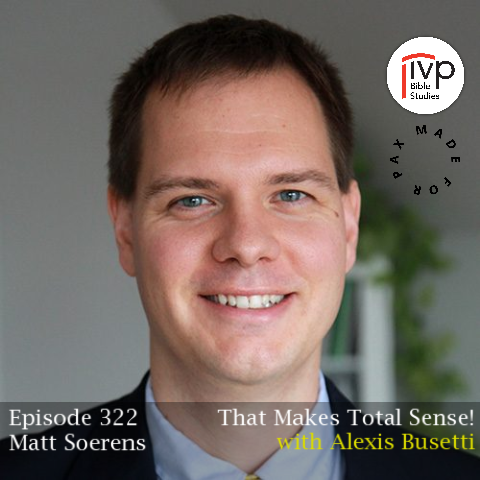
So I'm sitting here with Matthew Sorence, who's been on the podcast before. I'm so appreciative. This is the last in the series of our IVP PACS series, and we're going to talk about migration today. As a reminder, the Bible study that Dorcas and I were so grateful to help put together, it's called Migration Experiencing God's Care for Immigrants. And Matt, that subtitle is one of the things that, when I think about your work and I think about what we've talked about before, the things I've read that you have done, that subtitle is one of the things that I think comes out very clearly in how you communicate about migration, refugees. Immigration is really, this is not just an issue, but these are people, groups that God cares very, very deeply about and I know impacts what you do. So maybe to start with, if you could give just, I don't know, almost your LinkedIn of like, what do you do?
What is your kind of place professionally in this world? And that might help folks as they're listening have kind of a foundation for the rest of this conversation because this is something, not that you just care deeply about, you do, but also professionally, this is the world that you live in.
[00:02:53] Speaker B: Yeah, I appreciate that, Alexis, and I really appreciate the new resource. I was really honored to have the chance to review it and do an endorsement for it. I think it's something I would encourage everyone to go pick up.
It's focused very much on something that has been a passion and a real conviction for me for many years, which is that Immigration is an important policy issue, but it is also an important biblical issue because immigrants are people, and they're made in the image of God. They're neighbors whom we're called to love. There are very often brothers and sisters in Christ. And so that's very important to me personally. It's also very much at the center of my. My professional responsibilities. So I lead the advocacy and policy team at World Relief, which is a global Christian humanitarian organization that's been around for about 80 years.
And world Relief's mission is to boldly engage the world's greatest crises in partnership with the chur. And we've engaged lots of different crises over our eight decades of existence. But we actually started with a displacement crisis in Europe at the end of World War II.
And displacement has really been the primary crisis that we're focused on. So migration, people who've been forced to leave their homes. And that's true in the work that we do in the Democratic Republic of Congo and Sudan and South Sudan and Ukraine and Haiti. It's also true in the United States, where historically we've been one of 10 refugee resettlement agencies that partners with the US State Department. And again, right. Because of our mission with many, many local churches to welcome refugees as they rebuild their lives in the United States and many other immigrants who have different legal statuses as well, we can get into kind of the complexities of legal status.
But I started my role at World Relief kind of in direct service, working as a legal service provider on our legal services team.
Actually, that's not even true. I started as an intern with our. One of our programs in Central America 20 plus years ago at this point.
But then I joined our staff on our legal services team in the Chicagoland area.
And then after a few years in that direct service role, I transitioned to a role focused primarily on public policy and really not just government relations. So that's a part of the team that I lead. And I have amazing colleagues in D.C. who are up to their neck and past it in changes in governmental policy. But because our mission is really focused on partnering with the church, it's also really advocating communicating to the church and with the church for people who we believe from a biblical and theological and missiological perspective, are close to God's heart.
And there's churches that get that and that are amazing and that do amazing thing. And we've. We've seen some of that even in really unique ways in the last, you know, nine to 10 months. And there's also a lot of churches Who I think sort of stay away from this issue because it is viewed as a political issue. And even though I care about the policies, I worry that sometimes we start with the policy and the political questions and we skip over the how do I interact with my immigrant neighbor? Questions. And so a lot of my job is starting there and inviting local churches, denominations, Christian colleges, and, you know, ministries to think about issues of refugees, asylum, immigration, borders from a distinctly Christian perspective, and then to apply that. And of course, given the changes in public policy in the United States, particularly around immigration for those who are already here and those seeking to come here, but also the way our international foreign assistance programs have been restricted, that have a profound impact on displaced people overseas and on those who might have been stable but suddenly are not stable and are potentially to be in the likelihood of being displaced.
It's been a very difficult and busy 10 months, and I'm happy to talk about that.
But also, again, we've also seen God's provision in some really beautiful ways. And I think those biblical truths of God, to quote Psalm 146, Loves the foreigner and sustains the orphan and the widow, and frustrates the ways of the wicked. I haven't seen the wicked frustrated in every way that I'd like to, but I do see, like, discrete moments where that's true. And that's something that, you know, we have seen God provide in some really beautiful ways as well.
[00:07:02] Speaker A: Yeah, thanks for that background, Matt.
I am.
There are so many questions, so many places that my mind is going that I want to go. But. But maybe one place where I might start is in your work with Christians.
Let's talk about these last 10 months particularly, and I'll give an example from even what you just shared. I knew that the work of World Relief specifically was going to be impacted when the funding changed at the beginning of the year, at the beginning of this administration.
One thing I didn't think about necessarily was how the populations impacted overseas included many displaced populations like that. That was one of the main causes of their vulnerability, was their displacement. I hadn't really thought of that. So even in just what you shared just now, I'm like, oh, like that's drawing my attention to something included in this topic. That where I realized kind of holistically this was a problem. I kind of didn't realize that specific population, what was causing some of that vulnerability.
What I'm wondering is what has been some of the things that you might have heard from other Christians when you talk to them, when your team talks to them. And they say, oh, I did, just like me, I didn't realize kind of that was what was happening right now or that this was the way that these policies or whatever it is are being, are impacting certain people groups. What, what are you hearing from folks?
[00:08:50] Speaker B: Yeah, I mean, I immediately think of about a dozen sort of things that we're hearing, but I'll mention three to try to stay coherent.
First is maybe that international point. I mean, I think a lot of people are aware that in the first several days of the new administration, there was this stop work order for the United States Agency for International Development, usaid, which is sort of has historically been the way that the US Government provides foreign assistance for the most part.
And that affected. It actually didn't affect most of the countries where world relief works because we, in most of the countries where we work internationally, we didn't have any US governmental funding, it was privately funded. But we did have funds in a few countries, and they were some of the countries facing the most severe humanitarian crises where people have been displaced. So, for example, in South Sudan, we've been one of the largest healthcare providers in the largest internally displaced person camp within the country. And so you think about migration and the internally displaced are those who fled their homes. They're still within the boundaries of their countries. They're not technically refugees. There's actually far more internally displaced people in the world today than there are refugees.
Sometimes internally displaced people, when the situation becomes sufficiently severe, become refugees, because usually the first place you flee to is a neighboring community or, you know, a place where you'll be safe within your country because people don't want to leave home, they want to stay as close as they can.
But all that to say we were in a situation where we were having to make very difficult decisions. Basically, we had funds for malnutrition treatments for children five and under who were. I mean, we were able to keep them alive. And some of those programs we were able to sustain because churches and individuals stepped in with private support, which has been amazing and more needed than ever. But it didn't compensate for the cuts that we saw from the federal government in the US And I should say some of those programs have come back and we're really thankful for that. Some have not come back. Overall, U.S. foreign assistance is down dramatically, and that has real impacts on the situations around our world, including many people who've already been displaced and many people who are likely to be displaced because the fragile stability that was there is taken away.
That's one dynamic I do think that story, for some people, that's top of their minds, just what's happened around the world because of the withdrawal of US Foreign assistance to particularly humanitarian crises, health situations, situations like the president's emergency plan for AIDS relief, where people are reliant on antiretroviral medications to survive.
Some people are very well aware of that. And I do think a lot of people have no idea. Like, that's just been kind of a minor story amid so many things happening.
[00:11:26] Speaker A: Can. Can I pause here? Can I pause here before 2 and 3?
Because I just want to say. I just want to say out loud, when you're talking about internally displaced people, our family just moved. So, like, we moved within the state. Okay. So not even. I mean, some people would argue Texas is its own country. We're not quite there, but, you know, so we just moved from Houston to Austin. So family of six. And I would say it was basically kind of the best possible of circumstances.
It is still incredibly disorienting. It is still incredibly dysregulating. I was communicating with someone who I'm working with this term at school, and the response that I got from him was, I can hardly think of anything more stressful than moving.
And there are things more stressful. Of course. There are, you know, life losses and gains. You know, all these things. There. There are things, but just moving is incredibly stressful. Moving when you are the one with the choice, moving when you are the one with the agency moving when you have resource, moving, you know, all of these things, it is incredibly disruptive.
And so when you name folks who are internally displaced, so not refugees, they don't have that status, but they're migrating nonetheless. And people who are displaced, because none of those things that I mentioned are probably true about them or about their situation. This is not a choice that they made because they wanted to. This isn't. They're going somewhere because they have a better opportunity to be somewhere else. This is. I'm guessing this is either push or pull, probably push out of wherever they were into a place where they. They don't necessarily want to be, but it's safer than where they were. I'm kind of making up a narrative there, but I think there are some things that are true. And then the. The proximity to say there is a hope for many of these people that they can return to their home, to where they came from. And. And I just kind of want to name that because I think that as I'm hearing you, it is.
I have to pause. It's good for me to pause sometimes and think like the, to, to try and gain some empathy for that. Which is easier for me to do now than it was six months ago. Like I said, just having gone through it. And, and this is a situation that I recognize is entirely different in many ways, but still disruptive and stressful. And so the folks that you're naming of like they're vulnerable, you know, their, their kids are at risk of death because there's not enough food, affordable food where they are.
And they're extremely vulnerable. And there are folks who like you have been practicing these things and now you're, now you're having to figure out where, where is this next thing going to come from for these kids. So I won't interrupt you every single time, but I just was like that. To me this internally displaced means something to me because my, the migration is, the meaning of migration is changing for me even as I experience some of these things anew. You know, it's been a while since, since I've experienced some of those things. But even the migration there to say that is, that is a real, that is a real thing to even have to move from your place to some, some other place and try and be close enough that you think maybe someday I can come back. But as you named, maybe things will get worse and we'll be forced to move again somewhere that is even further.
[00:15:03] Speaker B: From home and if some other country will let you cross the border.
[00:15:08] Speaker A: That's right. That's right.
[00:15:09] Speaker B: Yeah. In some ways internally displaced people. And again, this is not like I can resonate with your experience of moving. My wife and I moved 10 years ago and decided we'll never move again because.
[00:15:18] Speaker A: Exactly.
[00:15:18] Speaker B: All our marriage, because the same was one move.
But it's also very, I mean the people in South Sudan, it was fleeing for their lives because of conflict and then they're in a displaced person camp where there's relative safety and protection, but maybe not food, especially when the, in the foreign assistance that was there gets pulled away.
So that's maybe one the foreign assistance dynamic and has so many layers in different countries around the world. But that's one that I don't think has gotten the attention to most Americans. I think that I think it needs from. Especially from the church.
[00:15:52] Speaker A: Yeah.
[00:15:53] Speaker B: The second I would say is around refugee resettlement. So refugees are people who have crossed a border because of a well founded fear of persecution for specific reasons under the law, race, religion, political opinion, national origin, social group.
Historically a small share of the world's refugees get resettled to the United States. Right now, there's somewhere between 35 and 40 million refugees in the world.
Last year, under the previous administration, 100,000 refugees were resettled to the United States, which is about a quarter of 1%. This is not most refugees coming to the United States, but that was a high year. That was actually the highest year we'd had since the mid-90s.
[00:16:29] Speaker A: Where is everyone else going? I'm stunned by this. I mean, I knew that number, and I'm stunned.
[00:16:33] Speaker B: Yeah, 70% or so of refugees are in a country neighboring the country they fled.
[00:16:38] Speaker A: Okay.
[00:16:38] Speaker B: So the South Sudanese go to Uganda in many cases, or in some cases to Sudan, which is also, I mean, literally, you have countries that are. Have their own civil wars swapping refugees. In some cases, people from Sudan go to Ethiopia or to Chad, which are two of the poorest countries in the world, but at least, hopefully, they're safe from the violence that they're facing. And Sudan is, again, it's the largest conflict in our world right now and gets very little attention. And that's not to minimize the importance of caring about Ukraine or Gaza or other crises. But, like, very few people are paying attention to Sudan. It's actually World Relief has more staff than any other country than the United States. And so it's very close to our. Our hearts and the situation that, you know. And then we're also in Chad receiving refugees on that side, but that's refugees globally. A very small share of those refugees end up historically, under the authority of the Refugee act of 1980, invited to the United States to rebuild their lives. And usually this is after many years of vetting and processing and being given that it's a small share of the world's refugees. They're looking for those who are theoretically the most vulnerable.
Well, what happened on January 20 with inauguration of President Trump? He fulfilled a campaign promise and he suspended refugee resettlement on day one.
Actually, he announced that he would be suspended on January 27th.
So within a week, it was suspended, and with very limited exceptions, largely for a special program that they created. And then for.
In response to some legal challenges, almost no refugees have been resettled since the new administration began. So, you know, we also saw that changes to, you know, some of World Relief funding was a per refugee resettlement grant that allows us to do some of our work. I will say even the funds were cut for refugees who had already arrived, so who came in December or November.
And that was a huge challenge for us because we had committed to provide housing for about 4,000 people who came in who were still within their first 90 days of arrival on January 20th.
And I will say the beautiful thing was how churches and individuals stepped up.
We have had our best private fundraising year in our organization's 80 plus year history.
But we need that. We need more of it, honestly. But also that that does not allow new refugees to come in because that's a policy decision that is beyond what level of funding is available.
And I think that that is a surprise to a lot of people because a lot of people remember we're going to build a wall. That was part of the campaign rhetoric. A lot of people might even remember mass deportations. That was part of the campaign rhetoric. And that'll probably be my third point.
But you had to listen really carefully during the campaign to hear we're going to suspend refugee resettlement. I think the president then, you know, as a candidate only said it once or twice like he did say it, but it wasn't like the repeated refrain of the campaign.
And I encounter people at churches who care a lot about refugees, who have no idea that refugee resettlement is suspended right now. And I want to give the benefit of the doubt to the administration. I hope that they're assessing this suspension, which is what the original executive order said. And at some point we'll announce that it will reopen.
And I hope when they do so that it will prioritize people who have genuinely fled a well founded fear of persecution on account of their race, their religion, their political opinion, their national origin or their social group, the way that the law suggests. I think for Christians in particular, it's sometimes shocking to realize that all of those five grounds matter, whether you're persecuted for your faith or your opinion, political opinion, your race.
That people persecuted for their faith in Jesus can no longer find refuge in the United States is surprising to a lot of people. But that was, I mean, the majority of refugees were settled. Of those 100. The majority of those 100,000 refugees resettled last year were Christians of some Christian tradition or another.
About 30,000 of them were actually Christians from the 50 countries were open doors says that Christians face the most severe persecution in the world.
So these are people whom we could presume are persecuted on account of their faith in Jesus. And I know lots of those people, Iranian Christians and Burmese Christians, Iraqi and Syrian Christians.
And it is really upsetting and devastating to then see that those people at this point can't access resettlement. And when American Christians, especially evangelicals, I think Catholics as well, for whom the persecuted church is a really high value. And you hear the president kind of at least giving lip service to this because he knows that this is a high value for a lot of Christians who supported him.
When they understand that actually we've closed the door on those people. They're disillusioned if they believe me. Sometimes they don't believe it, but it's not an opinion.
The president ordered the suspension of refugee settlement. That's just a fact. And it has not yet been reopened with the exceptions that I noted in terms of this in very limited ways.
That's, I think, the second thing. And that's something we continue to advocate on and really try to make that point of if you care about the persecuted church. And again, we care about people who are persecuted for other reasons as well. We care about people who are Muslims persecuted of their faith, like the, the Rohingya out of, of Burma or the Uyghurs in China, or other religious minorities like Yazidis or Zoroastrians or others from Iran. But it turns out most people persecuted for their faith in this world happen to be fellow Christians and that it seems like that could be a commonality where there are, we could say, hey, what if we had a program that really protected people persecuted for their faith?
The third thing that I think a lot of Christians don't realize or are surprised when they hear goes to that question of mass deportation. Because a lot of the rhetoric has been we're going to detain and deport violent criminals, the worst of the worst.
And I should be really clear. If you killed someone and you get, I want you to have due process and be found. But if you're found guilty, you killed someone, you raped someone, you committed some heinous violent crime, you should get due process and then you should face the criminal justice system. And if you're ever released, I think you should be deported, if that's possible under the law. Right. If you're a non citizen. I don't object to that at all.
What I object to is the reality that right now, or at least the last data that we have publicly available, is that 7% of the immigrants who are detained have been convicted of a violent crime.
I'm pretty concerned about the other 93% and a few of them have maybe been convicted of very serious nonviolent offenses. But most of the individuals currently held in emirate detention facilities have not been convicted of any crime at all.
And again, even some of those who have been convicted of a crime, it's an immigration related offense, like it was their unlawful entry into the country, that was why they've been charged criminally. Or it's a traffic offense. Like, if you drive 20 miles per hour over the speed limit in certain places, that's a criminal offense as opposed to just a civil violation of law.
I'm not condoning driving 20 miles per hour over the speed limit, but I've probably done it and you probably have, too. And I know, like, there's a moral difference between that and killing someone. And I think that's why our criminal laws have, like, differentiations.
I mean, the other dynamic we're seeing right now with detention is people who actually came into the country lawfully, who have been lawfully present on January 20, have had their temporary legal protections withdrawn. So that's true for at least a million and a half people, probably more. It's a little hard to count because some people had temporary protected status and they also had humanitarian parole. And, you know, if one was taken away but the other wasn't, in some cases, both were withdrawn.
This affects people who came to the border and were lawfully allowed into the United States. It affects people who are sponsored overseas in countries like Haiti and Venezuela, Ukraine, with either family members or churches in the United States who said, that's a humanitarian crisis. We'd like that person to come and be safe. And they were told, well, you've got two years of parole. And in some cases, that parole was just terminated with seven days notice. And they were told to go back to that humanitarian crisis. We know of Afghan Christians who are lawfully allowed into the United States.
Obviously, if you're a Christian from Afghanistan, like, the threat of deportation is basically a threat to martyrdom. But they got these very aggressive letters in the mail that said, you've got seven days to leave or you'll be subject to criminal prosecution, civil penalties, fines and or deportation back to your country. Abortion.
And I don't know that we've actually seen that threat of deportation carried out for Afghan Christians specifically. And we've seen some really good advocacy. I mean, a really broad range of Christian organizations, some of whom are very generally very supportive of President Trump and his administration, have said that's not what we should do.
But we have seen Iranian Christians deported.
We saw the re establishment of deportation flights to Iran, and among those deported were followers of Jesus. And again, very similar situation where if you converted from Islam to Christianity, you were at very high risk if you end up back in Iran. Now, those are not the only cases we're concerned about. I'm also concerned about The Spanish speakers in my church who came in 30 years ago, who did enter the country unlawfully, and they would acknowledge that they would be thrilled to pay some sort of a fine as some sort of a restitution for their violation of a law. And that's the sort of policy that World Relief has supported going back to when it was George Bush's proposal, when it was Barack Obama's proposal. There's legislation now with both Republican and Democratic co sponsors in the House of Representatives called the Dignity act that would look at people in that situation who came into the country unlawfully or who overstayed a temporary visa, and they would be able to make things right for that violation of law, which is, is a violation of law, but you know, also is not, does not require malicious intent. In fact, it's often motivated by intention to care for your family, to flee persecution or other harm. They'd be able to pay a fine and make things right and have legal status.
We think that would be such a better solution.
And actually that would be a net fiscal win for the US Government because people would be paying fines instead of right now in the, the budget reconciliation bill, the so called, one big beautiful bill that passed last July, the Congress appropriated and the President now has access to $45 billion for immigrant detention, just detention, not including another $30 billion for ICE operations, not including another 70 billion or so for border protections.
And again, I think we need a secure border. We actually support that. We want our government to know who's coming into the country and to do what's reasonably possible to keep out those doing harm.
I don't think it costs $70 billion, but that $45 billion for detention, I mean, there's just no really good way to help people understand what $45 billion looks like. Except for that.
For a basic math reminder, it's 1000 times $45 million.
It's a lot of money. It's actually significantly more than the budget of USAID was last year.
And those $45 billion may not necessarily be used all in one year because they could be spread over a few years. But it seems like they're going through it pretty quickly.
It's dramatically allowed them to ramp up immigrant detention. And that's why when you've got to fill detention facilities, there's just not that many violent criminals who are detainable under the law. So you're going to go broader than that. And even though the administration will say we're going after the worst of the worst, if you look carefully, they'll say we're going after people, including the worst of the worst. They're not saying that they're the majority or they're the sole group that's being targeted. And in fact, we've even seen people who, under the law, cannot be detained lawfully, like US Citizens or who have been caught up in detention situations. And eventually, if they can prove it, they're usually released.
But, I mean, I was talking to my pastor the other day, who is from. Originally from Honduras, but he's been here for a long time. He's a naturalized U.S. citizen. He carries his passport around now. And I think, honestly, that's a good idea. But it's sad for me to say that. And honestly, I don't carry my passport around because the color of my skin is different than the color of his skin. And I think I'm unlikely to be wrongfully detained as a natural, as a U.S. citizen. But there are people in my community for whom that is a very real fear and not an irrational fear based on some of what we've seen in the last number of weeks and months.
[00:28:23] Speaker A: I want to stay here for a minute because for me, trying to keep up with the news around ice, around detentions, around deportations and deportation threats over the last several months, I would say, especially in the last few weeks, has felt like trying to drink from a fire hose.
There is not water coming out.
[00:28:55] Speaker B: It's like venomous poison. Right?
[00:28:57] Speaker A: That's right. That's right.
There's so much there and so much that's happening.
[00:29:04] Speaker B: The.
[00:29:06] Speaker A: The statistic that kept it just stayed in my head, kind of like a filter. As you were talking was 7% of those folks who were detained have actual some sort of, like, violent crime in their past.
93% don't.
[00:29:28] Speaker B: And I should say 93% haven't been convicted. They haven't been. A small share of those might have done something and be convicted, and then I think they need due process before we punish them.
[00:29:37] Speaker A: Absolutely. And I think, you know, I mean, that's kind of where a lot of this started, was some of this like, whoa, whoa, whoa. What about due process? Way, way back several months ago. But you're. Are you in Chicagoland still?
[00:29:51] Speaker B: Yeah, it's been rough.
[00:29:54] Speaker A: I mean, I.
Not just rough. I'm wondering, I mean, can you talk a little bit about what's been happening in Chicago? Because I think that this. This is one of those places. And again, let me just say where I am right now, why I'm kind of stuttering. It's. It's like, I'm hearing 7%. I'm hearing 93. I know. I kind of know in my head and in my. In my gut, right? Like, this is not. There's something that's not right. There's things that aren't adding up, and I think there's.
There's part of me that is kind of not necessarily an optimist, but I'm kind of like this. Like, well, you just got to give people the benefit of the doubt. Like, there's enough of that in me, and probably a lot of it is disbelief where I'm like, no, no, no, no. If I actually read in black and white what I'm reading from journalists who are on the ground doing that, if I actually, like, kind of let that sink in, then that's gonna. I'm gonna be on a whole different plane than where I am right now. And I'm just not sure if I'm. If I'm ready some days when I'm. When I'm hearing this.
And also, we're in a different. I mean, we're in a different media world now than we were when you and I were growing up and being taught about journalism in school and things like that.
We're also in a different place than we were right then. But here's what I do know.
I have a friend in Chicago who was involved in one of the protests and.
And being manhandled by an ICE agent because of his role in the protest. And.
And this is folks that are out here as Christians saying, this is not okay. Like, what's happening in Chicago right now is not okay. We saw the same thing. I was in la, happened to be in LA when a lot of the process were happening there earlier in the year at the beginning of this summer, same thing. Friends involved in protests, and we're going.
I knew from talking to folks who I. Who I knew who were involved and going, this is not violent. There's nothing about this that's violent. There's no reason for troops to be deployed to these areas, and yet here we are. And so it feels kind of unbelievable, I guess, is kind of what I'm trying to say without. Without actually saying it. But I'll just go and say that it feels like what's happening is unbelievable, and I feel like that about Chicago right now. So I'm hoping you can shed a little bit of light on, like, what is actually happening in Chicago, because as I'm understanding it, what you were just talking about detentions and deportations, but specifically detentions are at the, at the heart, I guess, of what's happening there.
[00:32:49] Speaker B: Yeah, I mean, first of all, I think it's really important to underscore what you said. Like people hear protests and they have different things come to their mind. What the only thing that I'm aware of has been very peaceful protests. Like literally like pastors and Catholic priests.
[00:33:01] Speaker A: That's right.
[00:33:02] Speaker B: Praying in front of facilities and encountering not like respectful instructions to back away and move over this other place, but just profound, very stark opposition, including in physical ways.
I think that they're even protesting is a response to this larger question of immigrants being detained who are not a threat to public safety in any way.
And in some cases US citizens being detained because they were in the wrong place at the wrong time. Like eventually those people usually do get released if they can PROVE They're a U.S. citizen. Some of them don't have those documents with them when like we've seen situations and this is in the city of Chicago, it's in some of the suburbs as well, including where I live, where people have been, you know, detained on their way to church, detained on their way to the grocery store, detained on, on their jobs and kids not going to school because their parents are afraid to send them. Church attendance has been affected profoundly. This is true actually nationally, but especially in communities like Chicago and LA and other places where we've seen a real stark increase in immigration enforcement.
I heard one Hispanic evangelical leader say recently, I've heard estimates between 30 and 40 and 50% of the decline in attendance at Spanish speaking churches. Again, that's not all immigrants who are actually under the law of vulnerable to deportation. It's their relatives who might have lawful permanent resident status. It's their US citizen relatives who don't want to get caught up in the wrong situation. I've talked to church pastors wrestling with should we go back to COVID protocols where we just worship online so that we're not putting people at risk?
To me, I don't fault them for having those conversations, but it's devastating that we would have to have those conversations.
But church attendance is absolutely, profoundly, negatively affected by some of the enforcement that's been going on.
And that speaks to the reality that so many of the people who are affected by this sort of seemingly indiscriminate immigration enforcement are our brothers and sisters in Christ. Again, not that I'm only concerned about those who share my Christian faith, but this actually profoundly affects the church in the United States.
We did a study at World Relief, but with the national association of evangelicals and the U.S. conference of Catholic Bishops and then the center for the Study of Global Christianity at Gordon Conwell Seminary a few months back in we actually started this before inauguration just like based on the rhetoric of deporting mass deportation, we wanted to understand, well, if the US Government would actually try to deport all the people who are deportable under the law, all the people who either have no legal status. They can have a copy of the report here.
All the people who have no legal status or who have a temporary legal status that could be withdrawn. And we put the caveats. We don't know that they will for sure. We hope they won't. But if this would happen, it would basically be 10 million Christians in the United States of regardless of your one Christian background or another, who would be removable under the law.
They've got another 7 million US citizen relatives who live in the same households. All in all, we're talking about 1 in 12 Christian households in the United States that could be directly affected by a mass deportation process.
And we're getting frankly, things have moved much faster than we anticipated when we released that report in the first few months of the administration because we have seen so many groups of people with temporary legal status have it withdrawn very abruptly.
And we've seen a lot more resources than I anticipated would be possible. Those $45 billion for detention, that was kind of the primary limiting factor in January. You can't actually deport all these people because where are you going to put them while you process them? There's only detention capacity for maybe 40,000 people. But you add $45 billion because it used to be $3.4 billion. That's just an incredible increase.
It creates a lot more capacity for detaining people, and that's also more resources for ICE officers using resources for Border Patrol. We didn't used to see the Border Patrol in Chicago. I interacted with Border Patrol, which, by the way, I think is an important function of the US Government. I affirm that I interact with them regularly at the border. But now we have them in Chicago because frankly, they're bored at the border and they're realloquating their resources to places like Chicago and Los Angeles.
And 1 in 12 Christian households seems to be affected. And I've talked to people. They think I don't think it's 1 in 12 in my church. And I'm sure that's true for a lot of your listeners. It's not 1 in 12 in your church because it's probably 1 in 3 or 1 in 4 in my church, which is a Spanish speaking church.
And yet from a theological perspective, if we believe 1 Corinthians 12, if we believe that when one part of the body suffers, every part suffers with it because there's one body, this is not just an issue of concern for Spanish speaking churches or Farsi speaking churches or Korean speaking churches or those who have a lot of immigrants within their congregations is an issue that is affecting the church overall. And I'm also not, I don't want to speak on behalf of the national association of Evangelicals, the U.S. conference of Catholic Bishops. I don't think anyone is taking the position that no one should ever be deported again. There are people who, I think that's a good public policy who have sort of lost their privilege. They have done something that means they need to be removed from the country.
Our concern is the vast majority of people who have been abiding by the law, who have not proven in any way to be a public safety threat, and even those who maybe did break a law once in coming into the country unlawfully or overstaying a visa, but for whom there could be a better consequence under the law than disrupting them from their families. I mean, there's 4 to 5 million U.S. citizen minor children in this country who stand to lose at least one parent and nobody has a plan for that. There's not a foster care plan for 4 to 5 million children. And some of those kids will go with their parents to their parents country of origin. A lot of them will stay with the one parent left behind. So you'll have a lot of single parent households, which, you know, sometimes is just what it has to be. But it's really heart heartbreaking when our government is creating kids growing up without their dad, without their mom, when they're a good parent who loves them, who wants to be with them.
It creates incredible economic challenges obviously as well.
And here's what I will say. I don't think, you know, we're not a partisan organization at Water Leaf. I'm not here to tell you, vote for Donald Trump, vote for Kamala Harris or anyone else.
But I, I encounter people every day who voted for both of those candidates and people who couldn't vote for either of them voted for somebody else or who stayed home and didn't vote for anyone. Among Christians, I actually do not think this is a popular policy.
There's some people who don't realize what's happening and there's others who realize what's happening and saying, well, I wanted the price of eggs to go down, or I, you know, I wanted a different foreign policy, or I'm concerned about unborn children. And all those things are legitimate and important.
And yet this is not what they wanted. And maybe it was immigration. They wanted a secure border. I want a secure border as well. I mean, I was critical of the Biden administration for some of the ways that they operated at the border.
But what we're seeing now goes well beyond the border. It's restricting legal immigration. It is shutting down processes for people who have fled persecution, and it is detaining people who in no way present the public safety threat and separating families on a profound scale. That I don't think is what most Americans want to see. And there's polling that backs that up as well. Lifeway research finds among evangelical Christians, specifically, 90% say that they want policies related to legal immigration to respect the unity of the immediate family. There's not a lot of people cheering when children are taken away from their mom or their dad.
[00:40:26] Speaker A: I think I keep thinking about in the study, one of the things that we talk about is that migration is just kind of a part of a normal part of human life.
And, you know, and I think that we don't have to talk about it here in this conversation. But. But one of the things that I think the administration has been. I would say the administration and also folks, public figures who don't necessarily speak on behalf of the administration but are supportive of the administration. There's an undercurrent to this immigration conversation that leads into white Christian nationalism.
They're connected there.
We don't have to talk about this here. And you. I'm free. Feel free to push back against me on that as well. But. But when we talk about this, I just keep thinking if movement, like human movement is just a part of human life, and it always has been, I think one. I think maybe a lot of us haven't really experienced that in our own personal lives or in the lives of our immediate families. And so maybe that is lost on some of us, that just movement, that kind of movement is a part of life, but also that the world is in a situation where, for many folks, I was very grateful for the work of Dr. Alexia Salvatierra, who, I think, you know, who first introduced me as a graduate student to these push and pull factors of immigration, that a lot of times it is not necessarily because someone just like, wakes up in one morning and they're like, hey, I think I'll just try to get into the U.S. you know, it's like there are these. These lifestyle factors that are causing people to engage in. In migration, but that it's not a bad thing. Like, to move is not a bad thing. Internally or into another country is not a bad thing.
But that sometimes we have been maybe conditioned to view it like it's a bad thing, like it's not a part, not kind of how it's supposed to be. Or.
Or I think sometimes we. And. And I've had conversations with other folks like Karen Gonzalez, who is. Is an immigrant who has said she was kind of conditioned to kind of say, well, the door can be shut after me. You know, like, now I'm here, and then everyone else is just gonna have to chill where they are because, you know, I've done this. And so I think there's a lot of, like, emotional factors is kind of what I'm getting at of like is this place mine does so and so belong. Is this okay that someone is here or not here? How long is. Is too long? What are the okay factors to.
To. To have someone be here?
And. And much of that, I think I. I'm not sure. I think much of that has. Comes from. And I can implicate myself in this and say a lot of us just haven't ever had the experience where we or people close to us have not had to or not had the exposure to have to make those kinds of decisions.
I'm kind of stumbling over my words, but I was thinking about.
I had two Uber drivers a few months ago, one on the way to the airport and one on the way home.
And I am not the check the box for a quiet ride person. So I'll just.
[00:44:10] Speaker B: We'll.
[00:44:10] Speaker A: We'll chat with my Uber drivers. And one of them shared that while he and his wife and his children were all citizens, they were all born in a. Actually, he and his wife were born and met in a South American country and Central American country, and his children, who were teenagers, were born here in the US and that his neighbor, who was his family. There's a family that he was neighbors with. The husband of that family had been deported just a few weeks before.
And that they all kind of knew, like you were saying, they were feeling the threat. They were understanding what was happening.
But before he was deported, his family had made the decision this. My Uber driver's family had made the decision for his wife and two teenage kids to move back to the country where they were from, even though it was politically dangerous, even though the economy was not good. Even though his children were not born there. I don't even know if they had visited. Thankfully, they did speak the language because they spoke the language at home.
But his wife and his children self deported, even though they were all citizens because they were fearful and they kind of just took their own agency. I would say not everyone has the resource or the. Or the desire to do that, but they made that choice as a family.
And he stayed because the economics were better if he were to stay. So he stayed. He has like a, like a regular job and he drives Uber so that he can support his family in their home country.
And their fears were reaffirmed by the deportation of their neighbor whose family was also separated. But in that case, they did not make the choice for that to happen. That happened without their agency. And so that makes a huge difference in how, in the, in the aftermath of that separation, when you. When you were doing it because it's choice that you've made versus you're doing it because it's something that's happened to you.
And I felt devastated by, by that. But just this simple, random Uber driver was one of those things for me where I was like, it really helped humanize this whole situation that we're in right now that I'm talking to someone who's my neighbor. We were both living in Houston, and he and his actual physical neighbor, both of these families were being affected by what was happening right now. It wasn't just a news story. In fact, their stories didn't make the news.
[00:47:09] Speaker B: Yeah, most stories don't make the news.
[00:47:11] Speaker A: Right, right. And so anyway, so there's.
I don't know that there's a real question there. I think it just. Part of me, part of this strikes me to say, I think we've gotten lost somehow. And even how we think about human movement and how we think about how to care for people who are moving or who have moved and in the US Unfortunately, a lot of the political rhetoric that I am hearing, again, not necessarily straight from the administration, but also folks who are maybe not speaking on behalf, but. Or supporters who are kind of making blanket statements involving this immigration of like, who belongs here and who doesn't belong here. And that feels something that is strikingly counter to how Christians ought to think about our neighbors, how we ought to think about migration.
I'm curious if you have thoughts on that or if that feels. I don't know how that feels for you.
[00:48:13] Speaker B: Yeah, no, I mean, that triggers lots of thoughts. I don't know which direction to go in One thing I would say when you mentioned kind of the push and pull factors, which Dr. Salvatierra, who's a brilliant scholar and a friend and many other scholars, have used that way to think about the reasons that people migrate. So push factors are the bad things in your country of origin that make you decide to leave.
Hunger, poverty, persecution, corruption, unnatural disaster, you know, like. And often more than one of those. And, you know, the. They layer on top of each other.
The pull factors are basically what determines where you go to, like, if you have to leave or if it. You decided maybe I should leave, well, where am I going to go? What's going to pull me in?
It's usually the opposite of those things. It's prosperity, or at least opportunity. It is freedom, religious freedom, freedom of speech, political freedoms, economic freedoms. It is safety, a place where you can generally be safe.
And often when we talk about immigration, we have this idea of, like, people come to the United States because of the American dream. And that's always been a little bit simplistic, but there is something there. Like, this country has a lot going for it. It's never been a perfect country. I don't think it's is like the new Israel that, you know, to get away from sort of that Christian nationalist sort of motif. I'm not saying that at all. But there's a lot to be grateful about about the United States of America and our Constitution and the way that we are set up, that we do offer religious freedom, that we do have political freedoms, that we are generally safe and, and all sorts of opportunity, like in terms of economics. And that is what has drawn immigrants specifically to the United States more than to any other country in this world.
I think, first of all, it's really important to know that very rarely do people start thinking of the American dream, and that's why they start to migrate. It usually starts with a nightmare somewhere else. It usually starts with like, I cannot stay here. There's a British Somali poet who says, you know, no one leaves home unless home is the mouth of a shark. And that, I think it just speaks to the like, people would prefer to stay in their homes, but it is not always possible.
And some of those reasons that push people out will qualify them for refugee status or qualify for them for asylum. Some of them won't, like, if you're fleeing an empty belly for your child, if that was not a direct consequence of an intentional effort to persecute you because of your race, your religion, your political opinion, or one of the other reasons under your Law, you're not going to qualify for asylum, but it's still really rational and human that something is pushing you to go somewhere else.
And sometimes the first place you go is a city in your own country or a different part of the country. And sometimes people say, you know what they're, I'm still not safe or I still can't feed my family or et cetera, et cetera. And then the pull factors are the American dream. Those factors of, you know, there may be this opportunity, maybe there's safety.
One thing that I'm really concerned about right now is I. This connects to the story you shared of your Uber driver and his neighbor who made the decision to self deport even as American citizens. That's actually happening quite a lot. And what I actually think that speaks to is we're losing the American dream, that people don't want to be in this country, not entirely. And I'm hopeful we can reclaim it. But that's to me the sad, you know, it's just a profoundly sad commentary that people don't think that there is hope for them to thrive in the United States of America because of the color of their skin, because of their country of origin, even if they've gone through the right process and are lawfully present.
That I don't want us to lose that. And I, I think there are ways for us. I also want to be really clear. You don't have to be a Christian nationalist to think that we should have secure borders, to think that we should have, you know, that there are people who should be detained and deported in certain situations. Like I think that those are all appropriate policies. And I'm not someone who says like open borders, let everyone in. I think those are, you know, we need to have policies that carefully define, even as we treat everyone humanely, who, how many people should come in each year, under what circumstances, what are the priorities? Like, I think it's important to have a priority for people who have a genuine well founded fear of persecution and not only take people because of their economic brilliance and what they can offer the country. I think that's great too. I think it's in our own interest to take people who are brilliant and let them start businesses in the United States.
But I think it's, you know, those are fair and conversations to have. I don't think that there's like one biblical Christian response to those questions, but I do fear that sometimes we're so focused on the policy questions, which obviously I'm, they matter to me. I work as an advocacy in policy. But sometimes we're so focused on those questions that the church has lost sight, in some cases not at all, of that question that was asked of Jesus, which is, who's my neighbor?
And then we forget to treat people in the way that God tells us to treat people as neighbors who are called to love. And if there's any, you know, like, lack of clarity on who your neighbor is, the example Jesus gave us In Luke chapter 10 was a vulnerable stranger, traveler of a different ethnicity and a different religion, who was in need. Like, that's the Good Samaritan story. I'm not saying that's your only neighbor, but that's definitely your neighbor.
And no amount of, like, governmental policy should distract us from that call to love our neighbor as ourselves.
[00:53:24] Speaker A: Say what you said again, Jesus. Answer the vulnerable stranger who.
[00:53:32] Speaker B: Yeah, I mean, Jesus's example of what it looks like to love your neighbor was a man who cared for a vulnerable stranger, traveler of a different ethnicity, different religion, who was in need.
I don't think that's an all inclusive identification of who our neighbor is. Probably lots of other people as well. But the, the effort from some Christians to explicitly exclude that category of people from who we're supposed to love does not make any sense. When you read Luke chapter 10, or frankly, if you read Leviticus 19, where we're told to love your neighbors yourself, and then a few verses later, we're told, when foreigners reside within your land, you shall not mistreat them. The foreigners residing among you shall be to you as your native born. You shall love them as yourselves. And again, that was for Israel. That wasn't for the United States of America. But there is a principle there, and it's actually rooted in the character of God. You see this in Deuteronomy 10. We see it elsewhere.
We are called to love those people because God loves them, and we are called to emulate him. And how that gets translated to how we encourage our democratic form of government to create immigration policies is a good, you know, prudential discussion. But how we treat our actual neighbors, there's not actually a lot of room for debate there.
[00:54:37] Speaker A: I think it is, as you said, it is.
This is in the character of God and we are to emulate him.
When God is telling the children of Israel, a lot of times, as you recall, he was telling them because you were also strangers, so you ought to do this. And even though, as I was mentioning earlier, many of us haven't been strangers, but we do like to live by the Golden Rule. And so we can imagine ourselves as strangers. And I think that would do us a lot of good to imagine ourselves as strangers and say we may not be in the place of Israel where we have been strangers, so we have to remember what it was like and treat others the way that we would want to be treated if we were in that situation. We may not be able to remember like Israel, but we can imagine and we can say if. If I were the vulnerable stranger of a different ethnicity in a foreign land, in a place where I was trying to feed my kid, I was trying to go to this grocery store and get a job and worship and do these things, but in a foreign land, how would I, would I. What would it be my desire? How would I desire my neighbors, my government to treat me so that I could just live my life, you know, in a place where it wasn't necessarily my first choice to be there in the first place?
You know, how might, how might that, you know, how might, how might that change how I think about this and how and how I act?
Matt, I don't want to take up too much of your time. I feel like I could really just talk to you all day about this, but I would say maybe you can close us out by giving us just a little bit of encouragement from your work pre record. I was kind of just asking, like, how has this been for you?
And you've shared a lot of that. It's been rough. It's been a rough 10 months or so. But one of the things that you said prerecord is but there's, but there have been some hopeful moments.
And so I'm maybe ask you, like, what are some of the things that are bringing you hope right now?
As, as devastating as some of the things that are happening are, what are some of the things that are bringing you hope as you continue? And then that might just give some of us some ideas of, like, things that we could engage in even, you know, to, to. To help as. And, and to act as Christians, especially during this season.
[00:57:11] Speaker B: Yes, I feel like God has been very kind in showing me little moments of, of light in the midst of some dark seasons. So just a few of those, you know, I mentioned we got as world relief, got the notice, it was January 24th, that the federal government was actually not going to provide the funds that we use for housing for refugees in their first 90 days in arrival. And suddenly we looked at our numbers. We had about 4,000 people across the United States whom were still in that window. We had to basically figure out how to cover rent. And you can do the math on that. 4,000 people's rents is a lot of money. And we didn't have the money.
But we basically very quickly put out the word to our church partners, to donors, and we saw people step up. And I can't speak for all the other resettlement agencies, but for world relief for those 4,000 people, none of them went without housing in that initial 90 days.
And that, I mean, we had churches do just amazing things to sacrificially say, we're not going to let these people who were invited to our country by our government because they'd fled persecution for various reasons go without housing, go without food, churches running gift card drives with all the gift cards and you know, all sorts of amazing things, and stepping up personally to do some of the things that frankly, previously the staff that we had to let go would have been doing.
And so it was a really beautiful season. And I will say, without some of the press attention on that, we need to sustain that. And that's a challenge. But, but we've continued to see churches be really amazing. And I want to say that as much as sometimes I'm critical of like I don't feel like the church does enough, but I also see lots of local manifestations of the church doing beautiful things.
And that's true on the international side of the work that we do as well. I mean, we still had to make difficult decisions, but some of them were minimized because of the way the individual stepped up.
I would also say it's, I, I've seen some really brave pastors and I've seen this especially from immigrant congregations stepping up to advocate for their people. I mean, one of my favorite stories is a guy named Ara Terosian who's in Los Angeles. And I saw this video on Facebook 1, one day he filmed people from his church, Iranian Christians, being detained on the sidewalk not far from their church. And these are people who entered lawfully who had a pending asylum claim because of their fear of religious persecution if returned to Iran. And they were being detained. In fact, as we're recording this, they're still detained. This couple, this was, it was in June, so I mean it's been four months or so.
Another family from that same church was detained with a three or four year old child. They got released after about a month in part, I think honestly because of the advocacy that their pastor did for them. He basically would talk to anyone who would listen and, and he himself came as a refugee fleeing religious persecution in Iran.
But We've seen pastors step up and advocate for their people in really bold ways in ways that were a little scary for them.
And honestly, I don't believe everything I see on the Internet. So this was one of those situations where I saw. And I thought, wait a second. I've, like, preached at that church. Like, I. I know I had an extra Methodist pastor before he came after I had been there, but, like, I know people that church. This is like, I knew that they had a Farsi congregation.
And, yeah, I've had the opportunity to meet him now, and it's just been really, you know, we want it World Relief to do everything we can to uplift those people who are trying to advocate in obviously nonviolent, peaceful ways.
And then I guess the third thing I would say is just like, in your own community. I was so proud of my wife. This weekend. I was off at a conference in Colorado, and she texted me and said, like, our church, like probably a lot of other churches, has, like, a food pantry sort of thing. We have these boxes of food, and traditionally, people come and pick up the boxes of food. That's how we do things.
Well, she put up a note on, like, the.
The mom's group for our neighborhood and said, if there's anybody out there who's, like, a little nervous to come get food but need food, let me know. And she said immediately she had just. I mean, we live in an immigrant community. There was a lot of people, given what's happening in the Chicagoland area, who said, that's like, yeah, could you please bring me a box of food? So she spent Saturday driving around our minivan dropping off boxes of food with total strangers who. Who are afraid to go to the grocery store right now.
And, you know, I think there's all sorts of those opportunities to just let your immigrant neighbors know that you're glad they're here, because that's not the message that they're receiving from a lot of our society right now.
Not in, like, a weird way, but just, you know, be kind to people and look for those opportunities to advocate as well. I think people are a little bit burnt out on advocacy. They're like, I already sent the letter to, you know, the email to Congress. I made the phone call. And I know that that's.
It can feel like, well, that isn't working. But I also have seen it work. In fact, this year, we saw an effort to cut hundreds of millions of dollars for the President's Emergency Plan for AIDS Relief. And then we saw a lot of people Advocate. I mean, literally, like Amy Grant, who was like, an essential part of my Christmas celebration, was, like, on the phone to her Tennessee senator, saying, respectfully, we don't want you to cut those funds. Evangelical Christians have been about PEPFAR since George Bush started it in 2003, and we care about human life. And we saw enough advocacy, and there was enough senators. Senator Collins out of Maine kind of led the charge. I don't even know who was all with her. I just know they didn't have the votes. And so the administration backed off on that effort to rescind those PEPFAR funds. It does actually make a difference when it's loud and respectful and, like, you know, but, like, I saw that in the first Trump administration around family separation, taking little children from their parents at the border. It's actually profoundly unpopular policy among Democrats, but also unpopular with most Republicans, among evangelical Christians and Catholics, and pretty much every subgroup you pulled, it was majority not supported. And even some very vocal supporters of President Trump at the time didn't want to support that policy. They were saying, this is not good.
And I was on Capitol Hill in June of 2018.
I mean, I only heard one side of the conversation, but I would hear the interns and the congressional offices picking up the phone and saying, oh, no, my boss is definitely against tearing away children from their mothers.
And within a few days, we saw that policy shift. The president signed an executive order undoing that policy. And that was after, I will tell you, for about a month or so, I was aware of this policy and hitting my head up against the wall with, why does people not care about this? But it hadn't, like, hit the news. It hadn't been. I was aware of it. I had friends working with unaccompanied children with Christian ministries who were saying, there's this weird thing happening where we're getting all these little kids and they're saying they were taken from their parents. Is that possible? Like, is that. Could that be happening? And it was happening. And eventually it kind of became public and became a big news story. And when people became aware they didn't want it, and their advocacy actually changed the policy. Now, that's probably the only, like, advocacy win. I can remember the first Trump administration related to immigration. There are some other policies that we didn't see reversed. But I do know that it does work when enough people make those phone calls, and we've got resources for that. At the World Relief website, WorldRelief.org click on the Advocate link again. Giving is an important way to Contribute right now, I can't tell you how urgent that is for World Relief and for other ministries caring for immigrants and for those around the world who are in vulnerable situations. And then prayer. I mean, that sounds like kind of a trite Christian thing, but I'm really convicted that, you know, we're called to be faithful in prayer and pray. I pray for certain people in the Trump administration to encounter Jesus and have radical transformations, you know, sort of Salt to Paul, Road to Damascus, sort of movements that lead them to repentance and to change and to back off of really, really harmful policies.
[01:04:36] Speaker A: Yeah. Thank you so much, Matt. I mean, this has been great. And as you were talking about in the first Trump administration about the separation of children from their families, I am feeling a little bit right now kind of how you describe some, like, could this actually be happening? And some of the things that are happening right now, those are some of the questions I think I alluded to earlier that I'm kind of like, could this actually be happening? And so I'm really grateful for your work because that, like I said, like you just said, awareness is a huge part of this. Like, if we don't know what's happening, then we are unable to advocate. We're unable to kind of, you know, to figure that out. And so I'm just so incredibly grateful for your work and the work of World Relief to help us become aware of what is happening, to be on the front lines advocating, even when you're tired of advocating and working, even when you're tired from the work, because as you know, it. It. It matters greatly. And I'm just, I'm so appreciative of you to help us, you know, help. Help us do what we can do in our own.
In our own context.
I also want to mention your book and the conversation that we had before that you wrote with Jenny Yang welcoming the stranger.
A lot of the things that we talked about, not necessarily policy specific things, but just some of the biblical things that we talked about are in that book. And so it is, along with this study, a great resource for churches, for individuals, for small groups. I read it in class with Dr. Salvatierra, and it was great in that context as well, but it just shines a different kind of light sometimes that we don't necessarily hear from, you know, from the pulpit or. And it's several years old, I think.
[01:06:21] Speaker B: But, yeah, first edition was 2009, so, yeah, so we get. Now is a little. It was 2018, but still excellent resource.
[01:06:29] Speaker A: Nonetheless, because the things that you talk about in that are the are the timeless truths that don't.
[01:06:34] Speaker B: Bible's not changed a bit. Right.
[01:06:36] Speaker A: That don't change. So I'll put the link for where folks can grab that in the show notes as well. And anyway, thank you again so much for being with me for spending this time, especially in this season, for you.
Yeah. And just all the blessings for you and your team as you continue to work.
[01:06:53] Speaker B: Great, Alexis, thank you so much. We appreciate it. And thanks for the new resource. We're excited about it.
[01:06:58] Speaker A: The links for all the resources mentioned in today's episode can be found in the show notes, Music and podcast production by Seth Buscetti. Be sure to give us a review on itunes and subscribe at your favorite podcast listening app. You can also Visit
[email protected] Sam.