[00:00:07] Speaker A: Welcome to that makes total sense, a podcast dedicated to exploring God's generosity and justice. I'm Alexis Busetti, a Christian aiming to ask good questions and encouraging you to do the same.
Every one of us is wired by God to live out generosity and justice. But the how sometimes eludes us that makes total sense is a way for us to get together, posture ourselves as learners, and challenge one another to practice generosity and justice in a tangible way every day.
Jerla, can I just start by saying I am so grateful that you made it back to New Jersey?
[00:00:47] Speaker B: Yes.
[00:00:50] Speaker A: When we met, it was, like, just almost starting to rain. And Houston, as you know, was hit by Hurricane barrel the day after you left town. So I'm grateful that we got to meet before you went back home, and I'm grateful that you made it.
[00:01:09] Speaker B: Yes.
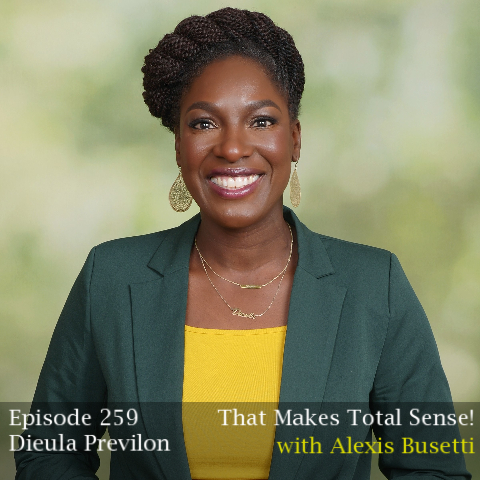
[00:01:10] Speaker A: That was a crazy, crazy day. It's funny, I have your book sitting here in front of me, which is going to be the topic of our conversation today. And when I pulled back into my house, Jerla and I met. She was preaching at our congregation, and I was like, I think I better fill this car up with gas. It was, like, on the light, it started pouring cats and dogs. And I got home and I, like, called, and I was like, can someone please help me? I had, like, arms full of stuff. My youngest son was so sweet. He, like, came out with his umbrella. He was so, so precious. And everything still got soaked, including your book. So anyway, oh, my gosh, it got dried off and read this week, and I'm really, really grateful for it. Um, so maybe let's start there. Um, I'm sitting with Jerla Previllon. She's written an amazing book called does God see me? How God meets us in the center of our trauma healing journey. And I want to just give a little sneak peek that part of this title and much of the work inside of this book comes from the story of Hagar, which I can't wait to discuss because there's, like, anyway, so much Hagar that I'm ready to discuss. But before we get there, I'm wondering if you could maybe just introduce the kind of work that you do so that we have a little bit of context for where this book came from.
[00:02:44] Speaker B: Yeah. So I am a licensed professional counselor. I'm also a certified coach, and I am an ordained minister. And I share all of that because sometimes I cringe when I talk about my titles and all of that. But I think it's important as we're discussing the book, because the work that I do is really sitting with women and the people of God because I have clients that are men and I do some couples therapy as well. But the majority of my work is in the space of therapy and helping people heal from trauma, particularly women from trauma. I work with women here in the US who are dealing with all kinds of trauma. Just yesterday I was talking about how traumatic infidelity is for people who go through it, not just women, because both sides can be unfaithful. That's a type of trauma. And so for me, I hold space for people who are processing their trauma, who are processing pain, who don't know what to do with pain in their lives, who sometimes are discovering that they do have pain in their lives in my counseling office, because partly their lives is upside down and, you know, their husband or their wife is telling them they need counseling. They don't know why they need counseling. And in my counseling office is where we start talking about trauma because oftentimes when people's lives are not functioning as they would like for it to function, we have to go back and see where the break was, where the pain is so that they can get on the path of healing. I also work with women on the international scale as well, through our organization called Elevate Hurt International, where we come alongside women, whether in Haiti or on the continent of Africa.
And we do conferences, we do healing circles and workshops and things like that to help people learn the language of trauma, because information is power. So we educate women about what trauma is, how it impacts, impacts the body, how it impacts relationships, relationship with self, God and others, and how they can get on the path of healing. So that's what, that's the space I've been in for the past, almost 20 years now is the space I've been in to. My first trauma healing course was probably in 2006. So almost 20 years that I've been studying, I've been a student of trauma. And I'm still learning. I'm still learning from my clients and from the women I meet around the world. So I'm still learning.
[00:05:58] Speaker A: Thank you so much for giving that backdrop. I think that those three things that you mentioned, those titles that, yeah, sometimes we're like, I don't want to put that out there, but it's important because as you mentioned, you're, you've, you're a student. You continue to be a student. You've been a student. But the therapist, minister and coach, those, those three kind of ways of working with people and ways of ministering to people and being around people, I think a really show up in your book, but also just kind of help us to understand where you're coming from in this. One of the things you mentioned.
So I'll just throw this out there right now.
One of the things you mentioned of, like, people sitting in your counseling office and going, I don't even know. Like, I just, you know, so that was me. I'll just confess right now. That was me. I told you pre record that. Um, so I'm going to. I'm going to try really hard during this conversation, but as I was annotating and dog earing and underlining, I was, like, trying to figure out, okay, what code can I put that's like, this is. I'm highlighting this for the purpose of the conversation with Jerla, and then, slash, I'm highlighting this for the purpose of recircling back.
[00:07:11] Speaker B: Right, right.
[00:07:11] Speaker A: For me. Um, but that was me. I'll just say briefly, I was caring for someone who had experienced trauma, but it wasn't obvious to me. And this is eight plus years ago, and I was falling apart. Like, I was not myself. I was. And it was like, like you said, it was like, I don't think my husband at the time was like, you need therapy. But I was like, I've never had therapy. And if I don't, I just knew I needed something. It felt like an emergency to me. And so I had some connections, and I was able to connect with a wonderful therapist who had a lot of her background, had a lot of things that I had shared. And so I was like, okay, she kind of gets it. Not just, yes, I'm not discounting the education that we receive in these things, but she had also had lived experience, which was helpful.
And so it was kind of both. And I. And I think I was in session with her for probably a year before she was like, we finally were like, okay, let's talk about that trauma. But it was like. And the way I described it at the time, I was in my thirties, and I was like, I didn't realize I'd been walking, like, with a limp for 20 years. Like, I just gotten used to it. That was just kind of the way that I thought I got around, like, analogy wise. And then I was like, oh, I was not upright. Like, I just didn't, I didn't even know. Like, I just didn't even know. I was kind of, like, dragging a broken limb around. And that's really how it felt for me.
But gratefully, we started some work. We've continued to do good work. I've continued to do good work through, you know, things like this. Your book included a great resource.
But trauma is tricky.
[00:09:12] Speaker B: Yes.
Yes.
[00:09:15] Speaker A: It's really tricky. So I'm grateful for that. One thing I wonder if you could say out loud is what you said Sunday.
You said it from the podium, and you talked about women specifically, how they experience trauma and then also the effects that it has when they start to experience healing.
[00:09:37] Speaker B: Yeah, I can't remember exactly what I said on Sunday.
But, you know, for women, the way that we experience trauma, women, we're socialized to be social butterflies. We're socialized to connect with people.
We sometimes turn into people pleasing and I. And different things like that, because the front side of women is to be acceptable, to be likable, to be loved on the physical side, on the front side. And so we hold a lot of things in. We mask things very well. I think women, we are very good at masking. We are very good at playing the game. We are very good at being chameleons. Right. And so oftentimes when there's trauma, when there's pain, a lot of people won't know. Right. So one of my sister in law's sister in laws, and I've been married 26 years, and she read the book, and we grew up together. We went to youth group together. So a big part of my story, you know, my family, my in law family, they were there because we were all in church together. And she came to me, and after she read the book, she said, I didn't know.
I would have never.
I never knew that you were going through so much because you were always so jovial. You always had a smile on your face. You always laughed. You were always so pleasant and so kind and so gentle and soft. I never knew.
So for women, we can be the masters of holding trauma, of masking that it hurt. And sometimes we even gaslight ourselves for when we feel the pain, right? We tell ourselves, stop being a big baby.
Tough it up. And that's not such a big deal. You're making too much of it. That's not what they really said.
That's not how it was supposed to come out. So we keep making excuses, making excuses, and that delays our healing journey even more because there's nothing to deal with. There's no pain. There's nothing. And we just go on with the smile on our face. So for women, it can look different than men when there's trauma.
[00:12:30] Speaker A: Yeah, yeah, yeah. Thank you for that.
One of the other things you talked about that stuck with me is how women there ends up being kind of a trickle down effect when women experience trauma because of the people that are involved, like you mentioned, we connect, we care for people, but also when we heal from trauma, when women are experiencing healing, that, that can also trickle down.
[00:13:06] Speaker B: Absolutely.
[00:13:07] Speaker A: That we are caring for and the people we're connected with.
[00:13:11] Speaker B: Absolutely. You know, we're, we're, women are socialized to take care of the homes, you know, take care of the children, take care of in laws, especially in developing countries like Haiti. And we see more and more of that because we don't know the nursing home. So everything we do, we're socialized to take care of all of community, children, spouse, the in laws, and we're even responsible for cousins and aunts and uncles. The nuclear family is expansive in places like Haiti. And so when trauma happens, none of these people get help. They feel the impact of trauma. They feel the pain of trauma as well. The same is true for healing, because when we do our conferences around the world, wherever we are, we always bring packets. And in this season, I'm trying to find ways to bring my book for them. Everyone wants not just one note packet. They want a second one for somebody else, whether it be a spouse, whether it be their children, whether it be a neighbor, somebody they meet. They want something. And that's why it's so important for us as women to be on the path of healing. Even here in the US, our healing trickles into others as well. It translates into others, because automatically, the minute we get healing, we're already thinking, how can we make this information accessible to other people? How can we teach it? How can we share it? How can we do something with it and not just hold it to us? So it's so important for women to get healing.
[00:15:04] Speaker A: Yeah, all of that. Amen to everything you just said. I think even in my own life, what I've experienced, my prayer, for sure, and I've observed, observed some of it, is that even just my mood, just the way I'm interacting with my kids, hopefully with my husband, with my friends, with my family, with my other members of communities that I'm part of, as I continue to experience healing, my hope and my prayer is that just in my interactions are more healthy, they're more loving, they're filled with more compassion, you know, those kinds of things. And, you know, I think over these several years, since I've found myself intentionally on this healing journey, not that God was not already working in that space, but that I kind of, became aware of what needed to happen and what was, what God was doing.
And I was able to, in some ways, you know, actively partner in that. I have noticed, okay, I'm not, not that I'm not making parent parenting mistakes, not that I'm not making mistakes in my interactions with my relationships, but when those mistakes happen, I can repair in maybe quicker or in a healthier way, or those mistakes look different now than they did before, or I'm able to see interactions in a different way. And I just think when you mention that about the, the trickle down, I just thought, wow, I really, I really feel that. And that's not that. That's not true for men or children who experience, but I think it is in, I can kind of vouch for the particularities in my own life of when a woman, you know, is able to kind of experience that. So I appreciate you naming that and kind of putting that at the forefront. That was at the front of my mind.
[00:17:00] Speaker B: Absolutely.
[00:17:00] Speaker A: When I was reading the book.
[00:17:02] Speaker B: Yes, yes. For sure. For sure.
[00:17:05] Speaker A: One of the places I'd like to start with regards to the book is that just to kind of give us a little bit, like kind of a lay of the land. You shared a lot of your own stories, also stories of women who you've ministered to, you know, in prisons, in, domestically, also internationally. But a lot of the stories also in the book come from women in the Bible.
[00:17:37] Speaker B: Yeah.
[00:17:38] Speaker A: And I would say for, for us as seminarians, I just kind of want to pause and name that and really kind of give, like, expressed permission in this space for us and for people who might be listening to, say, let's ask the really hard questions of the text.
I mean, hagar, oh, I really want to spend some time with her today if we can. But you also, I mean, you talk about Naomi, you talk about Bathsheba. And as we look at these women, I'm like, for me, okay, I grew up in, like, Southern Baptist convention Bible belts, you know, whatever. I'm like, let's take these women off the felt board. That's my context. Let's take these women off the felt board for a minute and let's talk about that. One thing I might add in this conversation, just as background as we get into that, is I took a class a year or two ago when I was doing my M div with. It was an old Testament. It was a biblical studies class, but it was on basically, I forget the name this names at my seminary are like, really long for class names, but it basically was like, looking at the major prophets through the lens of trauma.
And so one of my favorites that I read about in that class was Ezekiel.
And there's this whole section in a book that we read a textbook about what if, right? Just kind of asking these questions, what if? Because Ezekiel is, like, weird. Like, there's some weird stuff happening in Ezekiel. Ezekiel does some weird things. He says some weird things. Like, a lot of this is wild, but it's like, okay, we've got the history part, which is super important, but let's also look at this, like, through the lens of trauma. You've got Ezekiel think about the things that have happened in his life. And we see some of these things. You go, these are symptoms of PTSD, you know, like. Like, what if we just looked at this through this lens exactly. You know, and feel that, like, allow ourselves to feel that through the prophet's point of view.
[00:20:03] Speaker B: Right?
[00:20:03] Speaker A: So, um. So I just kind of want to throw that out there as a. As a theology student, as people who have, you know, we've studied this, we've looked at it. People who are listening, I'm sure, have these questions of, like, oh, my goodness, this Hagar story is really weird. Or, you know, what about Naomi? She's just kind of expected to go and do this thing.
But what if we look at these people like, yeah, they have experienced some pretty traumatic events in their lives, and where was God in this? We see them in the text, but allowing ourselves maybe to ask some of those questions. So I'm wondering if you might get us started with maybe even the title of the book, but also, you know, and maybe kind of move into Hagar from there.
[00:20:47] Speaker B: Yeah. You know, I think. I think we often dehumanize people overall when there's pain. Right?
Especially for those of us who live in the west, that often we have hospitals near. We have, you know, all these resources where we don't feel pain, not for long periods of time. So we can't even fathom the types of pain we read about in the Bible or the types of pain that would cause someone to leave their home and cross a border and walk hundreds of miles, you know, to make it to safety, to seek asylum. So, on this side, and I always have to mention that partly because I don't think we have the memory or the experience of the type of pain that we read about and that we hear about in the news. Right. That would cause someone to ask the question, does God see me?
That question is a question of lament. It's a question that's asked in deep pain.
And this is not a question that you ask when you have a broken ankle and then there's emts and all these people who will come to your rescue and help you get back on your feet again literally the next week, right? This is a question that someone who's been sitting in pain for weeks, for months or even years, and I believe that was Hagar.
That was her situation. That was her scenario, right?
The Bible doesn't tell us how long, but we know it was at least nine months, right?
Because she had to carry a child. We know it was at least nine months. And I don't know, I don't know how long if I can sit in that kind of pain for at least nine months.
And then there's not enough alignment in Hagar's story because we don't call what she was going through painful. I don't think we call it painful enough.
We celebrate her naming God is the God that sees me. We celebrate that. We're very quick to get to the celebration. We're too quick to get to the celebration because we don't really understand what Hagar was celebrating because we don't understand her pain. How can you understand the celebration if you don't really understand the pain, right?
I mean, if we were to count from the time we met Hagar and if we were to really humanize her, let's think about this woman lost her home. She lost her family, she lost the food that she's used to. She lost the language. She lost the familiarity of her home. That's a lot of losses. And not only that, she was taken.
Know how many of us that can really resonate with that story because most of us have never been taken, you know, against our will, right? And not only was she taken, you know, now she's made this slave and, and, you know, as an immigrant, the story of Hagar hits deeply because there are so many immigrants and refugees and people who are seeking asylum, who are humiliated daily. You know, now these are people who walked around with pride in their countries.
You know, they had a sense of self, they had a sense of who they are. And then they come to this new place where there's very little pride, there's very little back, there's very little, you know, regard for them or honor for people, right. That's what I'm thinking was going on with Hagar in her country. People knew her name and knew who she was and knew how she, you know, her character in this place she's at all that was stripped away. So we have to slow down at the pain because the pain wasn't just when Sarai started beating her. The pain started happening way before that. And now, you know, she's forced to conceive a man that she barely knows, is forcing her to have a child and then the child is not even going to be hers. Like, it's pain upon pain upon pain. And then, you know, the Bible says something which I really don't understand, how a slave can really be indignant to slave masters because from what I know about slavery, you know, you really can't. You know, because then that would be the end of your life. Right? So I have some questions about the Bible about that and what that sentence meant. I, that Hagar, you know, was the aggressor in the situation.
A slave, somebody with no, no, like privilege, no voice, no nothing, becomes the aggressor in the story. But that's what we've done to Hagar. We have said that she deserved what she got because she was the aggressor in the story. And I don't understand that. I really don't understand. What I can say is that I know pain and trauma. And what I can say that is I doubt that Hagar was the aggressor because she did not have the power to be the aggressor in the story. Right? And so.
And so for me, it would make more sense to treat Hagar as a victim rather than the aggressor in the story so that we can understand. When she gets to verse 13 and says, God, you are the God that sees me. Now we're like, this woman has not been seen. This woman has been in pain. This woman had doubted that God saw her. This woman had count God off because God had not really come to her rescue. All these times that God could have come to her rescue, he didn't. But now God shows up and Hagar's like, you do see me. You do see me. So I think that story I resonate with on so many levels, so many places, as an immigrant and even as a black woman living in America, you know, that story resonates with me deeply.
And then she gives us permission to ask questions of God because I believe that's the question Hagar was asking of goddess. Does God see me? Has God forgotten about me? And for her to come to the place of exclaiming, you are the God that sees me, now we can celebrate with her, Hagar, because now we know her pain.
[00:28:46] Speaker A: Thank you.
You're right. We can't.
It is a low key halfway celebration.
[00:28:58] Speaker B: Yeah.
[00:28:58] Speaker A: Celebrate that without recognizing her pain. It was, I think it was before I started seminary.
I was just reading.
This is probably, maybe I'm guessing right now, five years ago, I'm just reading, just going through my normal, like, daily Bible reading thing, and I come to Hagar, and I was like, what the heck? If there was something that I read that story differently that day, this is before. I don't know anything about womanist theology at this point. I don't know any, you know, I don't know anything about anybody. And of course, as it usually is, and there's nothing new under the sun. And so when I'm realized, I'm like, oh, people have been talking about this, but just not, I haven't been hearing it. I haven't been hearing these interactions of how, how could we, how. And I felt like, how could I miss this? How can I miss this was Hager. But what hit me first was I, I was like, oh, Sarai. Like, that was, that was what hit me first was not necessarily Hagar's victimization, although it's connected, obviously. But it was kind of like I was talking about this story with my kids the other day when I, when I come home. We were, we were chatting about at the table, and, and everyone's like, yeah, but Abraham's the good guy. And I'm like, abraham's complicated. Let's talk about how complicated Abraham's complicated. Yes.
These forefathers and foremothers that we have in the text are complicated. I was telling him, we have a friend who is a messianic rabbi, and he told me a story once, and I've heard it in multiple places as well, of saying, part of what draws some people to Judaism, for example, or the God of the hebrew scriptures is the fact that it feels really bizarre. It feels true. Right. It feels honest and sincere, but also, at the same time, very bizarre that if people would record their own history in such a way, you know, Jacob, who was, who was actually like, you, the God of Abraham, Isaac and Jacob. Three messed up men.
[00:31:20] Speaker B: Yes.
[00:31:22] Speaker A: And the text records it as such. And so I think part of that, again, I just want to, like, kind of lay, lay that out and maybe keep that as a thread through this conversation of, let's ask these really hard questions of the text. You know, one of the things, and I'm going to go there because, because you went there in the book, was, this is hard. This is hard. Jerla, there's a place in the text where it is recorded that Yahweh tells Hagar to go back.
[00:31:56] Speaker B: Go back.
[00:31:58] Speaker A: Hello?
[00:31:59] Speaker B: Yeah, go back. And I don't get it.
[00:32:02] Speaker A: No, me neither.
[00:32:03] Speaker B: I don't get it. I've heard all the sermons on this. I've heard all the, you know, theological, you know, commentaries and all of that, and I don't get it.
And I don't think anyone have given an explanation that is humanistic enough for me to say. I can see that I haven't seen too many that does that aspect of the story justice. So that leads me to being at a place of not knowing. And I think in the west, we hate that. We hate when we look at things in the biblical text and not know because we believe we should know all things the text is doing.
And I think that's a, that is doing the text of disservice our faith. A disservice. Because if we were to know everything, where's the mystery?
Where's that mystery? Where the Holy Spirit reveals things? Where's that wisdom that we need to use when applying scripture to our lives? Where is it? Where's that discerning? Where's the power of the Holy Spirit? Even in the now we are to know everything, the Holy Spirit is still revealing new things. It's teaching us new things. Right? So, of course, there are things in the text that we won't understand. But what I caution people, and I do that in the book to not do is to interpret it, you know, by saying that a woman who's being abused and victimized or in a domestic violence situation, for her pastor to say, just like God told Hagar to go back in this violent situation, you should go back to, no, we have to use wisdom.
We have to use wisdom because I believe God wants us to flourish. I believe God wants us to experience joy. Even now, even in the now, I believe God is doing it. I believe God is offering us healing and peace and shalom and all of that. And I don't think violence is from goddess.
[00:34:31] Speaker A: Well, you say in your book, amen, amen and amen. And you say in your book something that I think it's tough, I would say, especially in just white american evangelicalism, fundamentalism, there are some of these categories that kind of are Venn diagrams and they overlap.
But there's a part in your book that's kind of phrasing that stood out to me where it's like we shouldn't be.
I don't know if you were that, like should or whatever, but it was something along the lines I don't have it right in front of me. It was something along the lines of it's not helpful. Maybe that's a good way to put it, to use the Bible in this way that it's a conversation stopper.
[00:35:17] Speaker B: Right.
[00:35:18] Speaker A: Let's use, let's, let's, let's look at the Bible like a conversation starter. And I think it was that, you know, because you, because I have encountered and I will just name it for myself. I think there, I think lots. I know I've seen other people name it for themselves as well. But culturally, even in the US, patriarchy reigns in a lot of religious settings. And so I would hear this often from men, male leaders, male pastors, where it looks like this is what the Bible says, well, why can't this be that way or why can't we do this? Well, because the Bible clearly says, you know, clearly we're sitting here like two women, you know, an ordained minister. I have an M. Div. I'm on my way to doing things like this and preaching. And I have had men tell me my whole life that the Bible clearly says women can't do that, you know, because these couple of verses, these pauline passages that people pick out. But what if we looked at the Bible, we read some of these texts and we said, this is a place to start a conversation, not, as you put it, a place to end the conversation. And, you know, when you have that with Hagar, it's like, well, God told Hagar this, so go back. I mean, this is, this is crazy. Like, this is not wise. Obviously, violence is not from God. But when we cherry pick, you know, I know that phrase is kind of old and overused, but when we do that and we say this is what the Bible says on this, I think we're missing God's love, we're missing God's character. We're missing these things and we don't understand some of those things. And I am feeling more and more comfortable with leaving some questions hanging.
[00:37:06] Speaker B: Yeah.
[00:37:07] Speaker A: And also asking questions. This is one of the reasons I started this podcast. It's been almost five years ago, was what I had in my head. Washington. I grew up in a faith tradition where having the right answers was really important. And if I'm being honest, that fit with my personality pretty well because I kind of like, I mean, there's a part of me, I'm moving in some different spaces now and evolving in some different ways. But, you know, there's parts of me that really like the rules and rigidity and I just you know, some of those things, you know, they provide some safety, you know, feelings of safety, security.
But, you know, my faith started evolving to say, what if it's not as much about having the right answers, but what if it's about asking better questions, you know, finding ways to ask those questions and then even being okay when the answers are different from different people or being okay when the. The answers aren't even there, you know?
[00:38:12] Speaker B: Right. Right.
[00:38:13] Speaker A: The question just kind of leaves, you know, left hanging. And like you said, you people have preached sermons on Hagar. There's commentaries out there. There's all sorts of stuff. But, you know, is there anything out there that feels real satisfying? No, not to me either.
I'm okay with that, too.
[00:38:28] Speaker B: Yeah. There's a book by Peter Enns, how the Bible actually works. And he talks about, you know, what the. What. What the Bible is actually about. You know, like, it's a book of wisdom. It's like, for you to discern how to apply these things. Not necessarily. It's a direct application, you know, from word to application.
I also like the book by Rachel held Evans years ago when she wrote the book, you know, a year in biblical womanhood where she tried to apply all these biblical things throughout a calendar year. And her point was that it's kind of impossible. That's kind of like, not the point. Right. How do we apply wisdom, though, in every situation, in every unique family? How do we apply wisdom for different things that every last one of us will be going through? So I think that's the point. Rather than trying to squeeze, you know, everyone into this. This hole that doesn't quite fit all the time, you know, it doesn't quite work, not just for everyone, for anyone, you know, like, violence is violence wherever it is, you know, and it doesn't quite apply, you know, in all cases. So. Yeah, so I totally, totally agree that there are some times we just need to park different questions and say we don't know, we won't know, and for us to be okay with that.
[00:40:23] Speaker A: Yeah. Yeah.
You tell a little bit of your story in the book, bits and pieces of your own story, which I really appreciate.
One of the things that stood out to me at the very beginning, and I just love this. And I want to read just this sentence or part of a sentence from the beginning, first couple of chapters of the book. But you said I created my own rigid categories for where God could and couldn't be.
[00:40:54] Speaker B: Mm hmm.
[00:40:56] Speaker A: And one of the places he never dare show up was in the life of a young unmarried pregnant woman. Yeah, but that first part of creating those rigid categories, again, I think it's connected to the stuff that we were just talking about. But creating rigid, your own, though, I mean, and that's the thing. I've done the same thing. God can't possibly move here. God can't possibly show up here. God can't even be, I can't even feel or experience God's presence here because it doesn't fit this or because of XYZ. But I think your story, as we read the stories of the women in the Bible, all of the things, the way that you described Hagar's life, like the losses, the brokenness, the abuse that she experienced, the abandonment, and.
And God is just there.
[00:41:50] Speaker B: There. Yes, right there.
[00:41:53] Speaker A: Can you talk about that and what that means for those of us who have experienced traumatic events in our lives?
[00:42:03] Speaker B: Yeah, I think a lot of times, you know, the relationship we have with God has been taught. It has been what we have been handed generationally. Right. And so in the churches, in the youth groups, and, you know, in the prayer circles, in the communities that we grew up in, the pastors, we trusted those that made us feel safe. And all of that, you know, we learn that relationship with God through them. And so it's inherited. Right. And so we continue that.
We had been taught when life happens to us, well, when life happens to us, when trauma happens, we're going to go back to what we know and apply it to what's happening to us currently.
And that's very common how we do. But then something starts happening to us in the midst of pain, is that you become dissatisfied, you know, with some of the things that used to work or with some of the ways that we would position ourselves, and they no longer work. Right? And so for me, when I became pregnant, because I think growing up in our church, either I didn't notice or pay attention to other pregnant women or people didn't really talk about it, but I would, too, hold those same behaviors of, you know, oh, she's pregnant, you know, stay away or she hasn't been married, she's very sinful, or, you know, she must not know God.
You know, I think that that probably is the biggest accusation or the biggest thing we have put on people is when we see someone struggling, we automatically equate it to them not knowing God or God not knowing them. Right.
And for me, in my case, that was the farthest from the truth because I was in the, I was in all the circles. I was in the prayer groups, the youth groups, the choir groups, all of it. I did everything, and I memorized scripture, everything.
But I think there came a time in my life where I had to have my own experience with God. And I think that's, that's what, that's where we struggle is, you know, what we used to know and what we're experiencing it, what we're experiencing in life. Do the two fit? Or how do we have our own sets of posturing with God in this new season? Because I think that must happen for every last one of us in the faith. We have to have our own experience with God, where we come up with our own posturing with God so that we can continue to live this life of faith. And so my pregnancy was that for me. It allowed me to have my own relationship with God, my own posturing, where I came on the other end and I'm like, wait a minute. God was always there. God didn't hate me. God did not hate the child that was inside of me. God did not want to punish me. God was celebrating with me, with this child that was inside of me, you know, because every child, you know, is from the Lord. And so God was celebrating. And so that, I think that experience in my life is what's made me into the therapist and pastor and to the, even the language you read about in the book, how gracious and how gentle and how kind and how forgiving it is, is because of that experience I had with God.
[00:46:21] Speaker A: That's amazing. And, and I think about how, as you say, like our own experiences, we have, we have inherited a certain, you know, certain ways kind of, of our faith. But when we have those experiences, what I'm, what I think I'm hearing you say is, you know, there was a rigidity, there was a shame. There was, you know, a punishment associated with these things in the faith that you inherited. But when you had your own experiences with God, then that started to shift how you saw him, and you saw him now as more gentle and compassionate and celebratory and generous and, you know, these things that were different than how you had seen or been taught to view Goddess before. Those experiences that you had.
[00:47:15] Speaker B: Yes.
Yes.
[00:47:18] Speaker A: I want to hang. I want to hang in this realm for a minute, the way that the book is set up. And again, this was one of those that, as I mentioned earlier, I wrote some notes and stuff and did some of the, there's a prayer, there's some questions and even some activities at the end of most of the chapters. But one of the things that stood out to me in those sections, and it's something that I have been exploring a bit more, and I explored quite a bit in seminary, is some cultural contextualization of our faith. So let me say a little bit what I mean by that. In fact, I was just listening to a podcast before you and I before you and I got on today, and it was a jewish christian guest, and he was talking about how when he feels kind of a kinship with indigenous Christians, because many times when they come to faith in Jesus, they experience some ostracization. I'm not going to say that, right, from their families and communities, but that also they're told by then, they're told by the christian community that they can't bring their culture with them and they can't bring some of their practices with them. And we see that a lot.
And I'm curious because you have some mentions of that in some of these, especially in some of these activities and other parts of the book. So as a haitian american woman, as an immigrant, as someone who has practiced your counseling and these administered in, you know, as we mentioned, domestically but also internationally and also in prisons with women from all different walks of life, I'm wondering if you can just kind of talk about some of those healing practices and how they might, you know, I think they're, you mentioned, you know, like, oh, this may make you feel uncomfortable or you may buck up against this, you know, whatever it is. Maybe talk about how some of those can be, can be, can be healing. And specifically, I'm about to shut up, but I'm thinking about this in the same way that you said. When we have our own experiences, we learn these different things about God. And so I think that's also applicable for some of these cultural contexts and maybe some of these practices that you might, people might think, oh, I don't know about that, or that didn't feel holy, you know?
[00:50:06] Speaker B: Yeah, I think, you know, throughout the history of the church, you know, Christianity has been made into a western religion, you know, and so that means the west has been the center of Christianity, which means that anyone who wants to be a Christian must drop everything and follow the christian faith of the west.
And what that's done is that there are certain drums that can't be played in certain church services in Haiti. That means there are certain things that we can do to honor our loved ones whose past we can't do. That means there are certain ways to remember our loved ones or to heal or certain things we can do, we can't do. Because, again, we're following the way of practicing Christianity from the west. In the west, they don't know what to do about drums. They don't know what to do with singing. They don't know what to do with candles. Sometimes they don't know what to do with a lot of different things. The West, Christianity is more of, you know, one plus one equals two. There's not much space for nuances for, you know, for mystery, for, you know, connection even to the earth or I. How to utilize the earth as part of our healing. In the west, it's more of a cognitive thing, right?
And we don't just heal from our cognitive healing like we think it. We want to think differently. We want to change our thinking. Very cognitive behavioral, right? We're not all cognitive people. We're physical, we're metaphysical. We are spirit, we are soul. We are the things you can't see. We are the things you can see. Right? So for me, healing has to be expansive. Healing is not just you coming into a counseling office, which is very western, a very western thing. Even as a counselor and I work with different groups, I have to get out of my western thinking to help certain groups because they don't get it, you know, and asian families coming to me, I can't use the same strategies. A woman from Uganda is coming to me. I have to figure out what else is going. I have to be. There are certain people that I. That comes into my counseling office. I have to be less western and more integrated into their story so I can help them. Right? So, so what that means is that it needs to be expansive. Our faith needs to be expansive. There are certain practices, and the women around the world have taught me that, you know, they have taught me to not let go of our culture, of who we are in order to be Christian. That I can be haitian and Christian, I can be ugandan and christian, I can practice the ways of my people and still be christian and still maintain a relationship with God. It doesn't have to look the same. And so I bring some of these exercises into the book so that we can all tap in with, you know, the faith from around the world. You know, how other people practice, how other people show up. Sometimes in church, we show up with clapping and singing and dancing and carrying on because that's how we get on, that's how we survive, that's how we heal.
We connect with each other differently. So I bring in some of these things to help us and to be a little bit more expansive in our healing journey.
[00:54:30] Speaker A: I am realizing I still have a half a page of notes, and we don't have a half page of notes worth of time. But so maybe. Maybe what, um. Maybe what we can do, as we kind of start to wrap up, is I just want to name some of the things in the book for. For folks who are interested. Um, we've done a lot of, like, high level talk, um, in this conversation, which has been really fun for me, and I think it's really helpful. You hit the high level, but you also are, like, really on the ground in this book. And so I just kind of want to name some of those for folks who are thinking this might be helpful for me.
You talk about different categories, different kinds of trauma, sexual abuse, racial trauma. That was one of my favorite sections. Abandonment, grief. You also talk about lament and hope and these things that are really, like, nitty gritty, you know, just. Just practical, practical things to help. Yes. And also, I felt like you were just kind of in my business a little bit, which was good. I think as a pastor and a counselor, I kind of expected that a little bit, but it felt really personal, you know? So for those of us who have. Who have experienced trauma, we can, you know, read through this and see some of those things named. Maybe named again. Maybe named again in another way.
So maybe, as we start to wrap up, is there maybe one thing that you might say to the woman, let's stick. Let's stick with her, to the woman who is going, you know what?
Maybe she. Maybe she's like, and I don't want to limit it. I was going to say maybe she's thinking, I might have some work to do. But like I said, I've been working intentionally for eight years, and I still found a lot of stuff in this book to be helpful. But maybe for the woman who's like, I think I know I have either need to start this work or I have some work left to do.
What would you say to her right now, with everything we've said, with everything you've written, what would you say to her right now as an encouragement maybe, to keep going in that work?
[00:57:06] Speaker B: Yeah. One of the things I tell everyone is that healing is not just black and white.
One day you're healed, and the next day you're not. One day you're broken, and the next day you've been delivered. I don't believe that. I believe healing is a journey. I believe there are days you will make great, great, you know, take great steps forward, and there are some days you will take a step back but the main thing about healing is to keep taking steps forward, however small it is. And I'm, you know, all of my clients know this. I work in very small steps. You know, I keep having to remind them baby steps, keep taking baby steps. And the baby step might be, I walked today, you know, the baby step might be, you know, today I said no to something, and I said yes to myself. You know, I slowed down a little bit. I was able to manage a trigger today. You know, those are baby steps that I applaud all the time in counseling sessions.
So for the woman who is listening and who is overwhelmed or who is not sure how to get started or anything like that, I say, be gentle to yourself. The spirit will show you exactly how to take the next step and the next step and the next step. But you have to be willing, you have to be open for God to do something new, for God to bring about healing one day at a time. In this microwave society, we want to be healed overnight. For me, with the work that I do on this side of heaven, it does not happen overnight, but it does happen day by day, by day by day, a little bit at a time. So keep going, keep taking steps, keep talking, keep being curious, keep being open to the healing that God can offer. And I think being in that posture will, will pay, pay out for you. It will.
[00:59:25] Speaker A: Jerla, this has been delightful.
I just want to thank you again, and I'll say the name of the book again, and there will be a link where you can find it in the show notes for for this episode. Does God see me? How God meets us in the center of our trauma healing journey thank you so much again for being with me today.
[00:59:45] Speaker B: Thank you for having me. Thank you.
[00:59:48] Speaker A: The links for all the resources mentioned in today's episode can be found in the show notes, music and podcast production by Seth Buscetti. Be sure to give us a review on iTunes and subscribe at your favorite podcast listeners app. You can also visit
[email protected].