[00:00:10] Speaker A: Welcome to that Makes Total Sense, a podcast dedicated to exploring God's generosity and justice. I'm Alexis Busetti, a Christian, aiming to ask good questions and encouraging you to do the same.
Every one of us is wired by God to live out generosity and justice, but the how sometimes eludes us. That makes Total Sense is a way for us to get together, posture ourselves as learners, and challenge one another to practice generosity and justice in a tangible way every day.
So you're pointing again.
[00:00:43] Speaker B: I'm pointing again?
[00:00:44] Speaker A: Yeah, you're pointing again because you don't want me to say that we just went through this whole little thing that was really fun, and then you took it away.
[00:00:52] Speaker B: Take 23.
[00:00:53] Speaker A: But you're the producer, so that's your prerogative.
[00:00:56] Speaker B: Yeah, well, I get to do those things and no one knows. But behind the scenes, I get to edit. You're just gonna all the good stuff out.
[00:01:02] Speaker A: You're just gonna cut it all out?
[00:01:03] Speaker B: Cut it all out.
[00:01:05] Speaker A: I was going to start this episode by saying I'm so excited because I get to interview my best friend today.
[00:01:11] Speaker B: Yay.
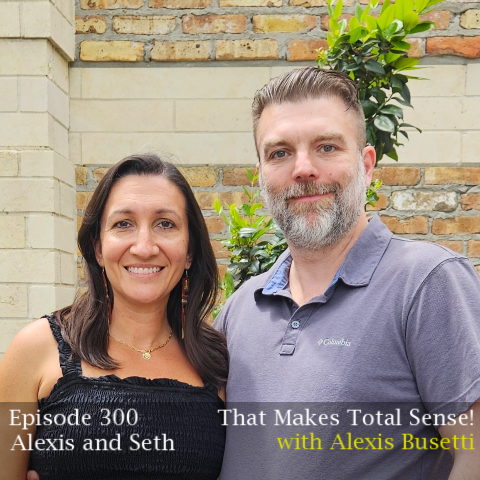
[00:01:12] Speaker A: Which is kind of what I'll go ahead and say. But yes, my best friend, slash husband, slash editor and producer of the podcast. Welcome Dr.
Seth Buscetti.
[00:01:25] Speaker B: It's good to be here. Thank you for finally letting me have a microphone. Usually I get my hand slapped if I get anywhere near it.
[00:01:33] Speaker A: This episode may end the same way.
[00:01:35] Speaker B: That's right.
[00:01:35] Speaker A: We may just cut.
[00:01:36] Speaker B: This would be like the last time I get the microphone.
[00:01:38] Speaker A: This will be the last time you get the microphone. The reason that we're doing this is because I thought it would be fun and you agreed. I mean, you agreed to come on. But I thought it would be fun to record something together. Kind of a behind the scenes, ish kind of thing. Because this is episode 300 of the podcast.
[00:01:59] Speaker B: 300? That's right. That's a lot.
[00:02:01] Speaker A: That's crazy.
[00:02:03] Speaker B: 300 is a lot of episodes.
[00:02:05] Speaker A: I mean, for us. Yeah, 300 is a lot of episodes.
[00:02:08] Speaker B: That's like, what, six years?
[00:02:11] Speaker A: No, it'll be six years in September.
[00:02:15] Speaker B: Wow. Okay.
Well, congratulations to you.
[00:02:19] Speaker A: And you.
[00:02:19] Speaker B: And you.
[00:02:22] Speaker A: Okay, so I do have a list of questions. I have notes and a little bit of a list of questions. I'm going to start not with the one that our daughter told me to start with.
[00:02:31] Speaker B: Well, normally. I mean, normally you actually have, like, real guests on.
[00:02:36] Speaker A: Well, you're a real guest.
[00:02:37] Speaker B: Yeah, but I mean, like, people who wrote a book or. Or, you know, publicly speak about some topic that People are interested. So it's. This is. This is not normal.
[00:02:47] Speaker A: This is not. Well, there's a lot of things that are not normal. This is not normal. But say you have written and published a lot of things and you publicly speak about a lot of things. Just nothing a. That I am kind of maybe versed in. I used to say I wasn't smart enough to figure it out, and I'm definitely not in that. In your actual area of expertise. I'm not smart enough to figure it out. But also I don't know how to talk about the things that you publicly speak about. So it wouldn't be a very entertaining or interesting episode.
[00:03:20] Speaker B: Yeah, no one has ever asked if I was going to talk about my kind of stuff on the podcast. That's nets never come up.
[00:03:27] Speaker A: Are there podcasts? Geology podcasts? Yeah, yeah, yeah. Do you listen to them?
[00:03:33] Speaker B: No.
[00:03:33] Speaker A: Not a single one?
[00:03:34] Speaker B: Well, I mean, I have, like I've.
[00:03:36] Speaker A: You have. You have listened to a geology podcast?
[00:03:38] Speaker B: Yeah, but it's generally not like what I. When I'm going for a podcast. It's not the content I'm looking for. But yeah, there are people that, that are. That are doing like work related podcasts that are about geology. Sure.
[00:03:48] Speaker A: So you're out on a run and you don't choose geology podcast?
[00:03:52] Speaker B: No, no. But they, but they do have them.
[00:03:54] Speaker A: So that feels kind of sad to me.
[00:03:56] Speaker B: A little bit sad that I'm not doing one.
[00:03:58] Speaker A: Well, that maybe that you're not listening to them.
[00:04:01] Speaker B: No, I'm not listening anyway. But I very much appreciate the people that are doing them.
[00:04:04] Speaker A: I'm grateful. But I don't know enough about geology to have a podcast about it. So we're not going to talk about that today. But you do.
You said, you know, have people on who write and talk and speak and stuff, and you do those things. Just not about any of the stuff that this podcast is about.
You're behind the scenes in this podcast and at the end of every episode you are listed as music. Oh, there's new music coming out with this episode, isn't there?
[00:04:31] Speaker B: Yes, episode 300 has brand new music.
[00:04:33] Speaker A: Ooh, that wasn't even on the list. Talk about the music.
[00:04:36] Speaker B: Well, I hope people like the music. So we, you know, instead of like stealing music or buying music, we.
[00:04:44] Speaker A: We do our best stealing it. Instead of pirating.
[00:04:46] Speaker B: Instead of pirating, we. Instead of using AI to generate music using stolen material from other famous artists, we try to make our own here. So all of our music is.
[00:04:57] Speaker A: And we is the royal We. It's you.
[00:04:58] Speaker B: Yeah, it's me. But this one is actually kind of fun because our 13 year old son Boaz, who is very good at music, very, very good at piano, very good at all things digital, plays a little bit of guitar.
He has helped out and so he helped do on, on our kind of our digital studio here. He did the drum beat, a lot of the drum beat.
[00:05:20] Speaker A: And I say he laid the beat. That's what I want to say.
[00:05:22] Speaker B: Yeah, he laid the beat. It's not. Yeah, he, he was the mix master.
[00:05:26] Speaker A: This is awesome.
[00:05:26] Speaker B: Yeah. And then, and then he also helped set up some of the kind of the synth sounds, the organ sounds. So it was a, it was, he calls it a collab. It's a collab.
So he and I did a collab.
[00:05:38] Speaker A: But a father son collab.
[00:05:40] Speaker B: Yeah. Well, we do, we do the music. So I hope, hope people like, if not just fast forward through it, it's totally fine.
[00:05:45] Speaker A: That's true. I mean, that's true. So I was gonna say normally at the end you're in the, like, in the outro, like music podcast, production, editing everything by Seth Busetti. Yeah, that's all you.
[00:05:59] Speaker B: Yeah. So normally I do the, I, I take the, you know, the stuff that you record, you do it on Zoom. So we're gonna tell people some of the behind the scene things. If, if you wondered, we are an indie podcast, right? So we do it all in house. We do it, we do it in house and we do it on the cheap and we enjoy doing that. But that gives us pretty much complete control.
So if you think it's, it's really great.
[00:06:22] Speaker A: I feel like one of the girls would be like, muah, haha. And you like their little hand, like their little finger gestures when you said complete control.
[00:06:28] Speaker B: Yeah. There's no like podcasting network or there's no, there's no radio sponsors or there's like, there's nobody who's going to tell us that our content is unlistenable or that the way we produce it is really hard to hear. So if it's really bad, you have one of two people to blame and they're both here in the room today.
[00:06:49] Speaker A: Okay. Okay, now I want to get to some of the questions.
One of them is, I'm wondering because sometimes people like, if I say it's weird now because we're almost at 300, this will be 300 episodes when this airs and sometimes it comes out of my mouth and it feels weird and then occasionally when I'm just chatting with people about, you know, like what we do or hobbies or whatever. And someone will be like podcasting, like, how'd you get into that? And my. I won't share my answer right now. It usually starts with something like, it's not like this is something I wanted to do. Like this wasn't like, you know, a long time dream of mine or something. I feel like I kind of fell into it in some ways.
But I won't share my long answer. But I am curious about your answer. Like, if someone's like, podcast, what in the world? Like, what's your version of like the origin story of this podcast for you.
[00:07:47] Speaker B: If I remember correctly and so I will correct. Yeah, I may be mixing up some facts at the time.
We were doing some.
We. We had a, like a little side gig where we were doing financial coaching stuff. And so Alexis was meeting with clients and I was helping writing materials and keeping the website up and stuff like that. And so we were.
But we were creating some content for that and some of the content was, was stuff where, where you would talk, you'd record a video or you'd record something and, and then we'd, we'd post that content. And I, one of, one of our friends had come to you at some point and said I could just listen to you talk forever. Like, I don't like this, I don't like this stuff at all. Like, I don't like the, the money stuff you guys are talking about, but I could listen to your voice forever. You should, you should start a podcast. And I think that sometime around that is when we're like, well, I mean we could.
And, and I said, well, I mean, I've got recording stuff. Like I've got microphones, I've got some software that we can use.
We can, we can figure out how to, how to do that. We. If you're interested, we can do that. So I, I think that's kind of what the story looked like was we were, we were putting out a little bit of material for this other side business and, and one of our friends had, had said that she could, she could listen to you talk about just, just about anything. Right?
[00:09:13] Speaker A: Yeah, it was similar. We. I had been on. Yeah, all that Stu. All that's true. I had been on one or two podcasts that as a guest that someone else had put out.
Yeah. And I think what, what I remember her saying is I don't really care to listen to anything about money and I don't listen to podcasts, but I could listen to you talk about money on a podcast. Like, it was like, these are two things that I really don't care about. Like, I'm not a podcast listener, and I don't care anything about money. Like, to, you know, to hear about that. But.
Yeah, but I could just listen to you talk, which was very kind. It was a very kind thing for her to say. But it was also like, oh, yeah, I mean, I guess we could. And at the time, and I still feel that way a little bit. I'm like, I mean, it's just like the blog of right now. Right.
[00:10:02] Speaker B: But if you. But if you think of the time period that was. That was.
[00:10:05] Speaker A: That was 2019.
[00:10:06] Speaker B: Yeah, almost six years ago. So that was. That's pre Covid.
[00:10:09] Speaker A: Yeah, it was right around this time in 2019. It was about six years ago right now.
[00:10:14] Speaker B: And that was when podcasts. I mean, the podcasts have been out for a long time before that, but that's when they were really starting to pick up. And I. At that time, it was really before everybody had a podcast.
[00:10:25] Speaker A: Yeah, I mean, a lot of people had them, but.
[00:10:27] Speaker B: But it wasn't. It hadn't really peaked out. Like, it hadn't really saturated yet. So we. We kind of got in a little bit early enough that it. It didn't feel like everyone was doing one. Why don't we just do one, too? So I think. I think that that made it kind of for us not feel like, I don't know, everyone's doing one.
[00:10:43] Speaker A: Yeah, I mean, I think that's probably true. And I knew at the time, like, I guest on a. On a couple of podcasts, so I knew a couple of podcasters, and I think that is where some folks who were getting in. And then it was like a lot of people maybe were dipping their toes in the podcasting water. Maybe that's how I would. Maybe that's how I frame it, kind of how I remember it. So, like, I think at that point, like, if you were to look at catalogs, you'd probably have a lot that had maybe like 30 episodes or six episodes or, you know, 18 episodes. And then people are kind of like, I don't know if I. I don't know if I'm really into this. I don't know if this is really me, you know, whatever reason. And kind of people got into it, and then they're like, ah, maybe not.
[00:11:26] Speaker B: Yeah, then people were kind of starting to think like, oh, this is. Maybe this is like a side gig also, maybe I could. Maybe I could get some money. Off this. And I think, yeah, a lot of people around that time were like, oh, yeah, you just, you just, you just get a few sponsors, you. You put it on the Internet and then you watch your bank account explode.
[00:11:44] Speaker A: Right? That's what our kids think about YouTubers.
[00:11:47] Speaker B: Yeah. Yeah, YouTube. Anyone who puts anything on YouTube, just.
[00:11:49] Speaker A: Yeah, money just pours in. It just pours in. It does not pour in for us.
[00:11:53] Speaker B: Well, thank you. Yeah. Thankfully, as an indie podcast, we are not.
We don't make any money from it, but we also don't worry about that. So we are fully free to do things whether or not people would pay for it.
[00:12:04] Speaker A: It's a fun hobby.
[00:12:05] Speaker B: Yeah, it's a fun hobby.
[00:12:06] Speaker A: And I think that's what I like to hear you say is that it's a fun hobby because it's super fun for me.
But. But no one would. It wouldn't ever get out if it weren't for you. Well, I appreciate it.
[00:12:19] Speaker B: Well, thanks. Yeah, it's, it's, it is a fun hobby.
[00:12:22] Speaker A: Okay, so now I'm gonna skip. I'm gonna skip our daughter's question and come back to it.
One, I want to know is.
[00:12:32] Speaker B: This is.
Well, interrupt a second because she kind of gave me. Alexis, you kind of gave me a few things you wanted to ask. And I wanted to say the last episode that I just finished producing.
[00:12:44] Speaker A: Yes.
[00:12:44] Speaker B: With Philip and Substance Podcast is kind of like the opposite of this, where he's asking you similar questions like what was your favorite podcast? Or what do you like about this?
And so if people like. So there's. There's kind of this kind of like a part. Part two of that one.
[00:12:58] Speaker A: Oh, okay. I guess you could look at it that way. Oh, that's fun. Yeah. I forgot because I recorded with Bob a while back.
[00:13:04] Speaker B: Yeah.
[00:13:05] Speaker A: Which is also some of the behind the scenes stuff is like sometimes these things get recorded like two months, three months before they come out. Sometimes it's the week before, depending on what the scheduling looks like. Okay. Okay. That's cool. So what were you wanting? You want, you want to say the question that you want me to ask you next?
[00:13:19] Speaker B: No, no, no. I'm just saying, like, if people like. Because you're just about to ask me questions and that's not normally how the podcast goes, but it, but the one that we just released or are going to release this weekend that I just.
[00:13:31] Speaker A: Finished stitching together, it will be 299.
[00:13:34] Speaker B: Yeah, 299 is going to be kind of like this, just with you on the other end.
[00:13:38] Speaker A: Oh, yeah, that's true. I forgot about that. Okay.
One is in general for you as a listener.
So it's funny sometimes you have said, oh, my goodness. Yeah, your podcast is great. I've literally listened to every single episode. And then that's kind of a boom, you know, because of course you produce.
[00:13:57] Speaker B: Every episode all the way through.
[00:13:58] Speaker A: Yeah, all the way through. All the way through.
[00:14:01] Speaker B: No fast forwarding on 1x speed.
[00:14:03] Speaker A: No skipping on 1x. That's right. That's right. So anyway, I feel really privileged and blessed that, you know, I have someone who listens to every single episode all the way through on 1x speed. But I want to know for you, and it'd be different for everyone. So this, you know, don't get it twisted. It's not like this is the answer. But I'm just curious for you as a listener to this podcast or to other ones in general. And I'll start by saying this.
When we very, very first started the podcast, we were chatting about it, brainstorming. And one of the things you said that has.
That has stayed with me is you said, I think it'd be cool if the podcast was kind of like the listeners getting to eavesdrop on you having coffee with your guests.
And that has kind of stuck with me, but that's pretty broad. And so.
So I appreciate that that's kind of stuck with me, but I want to hear from you as a listener. What for you, either this podcast or others could be others. What makes for, like, a really great conversation as a listener? Because it's different when you're actually engaging in it. You know, like, you're actually at coffee with someone and you're having a conversation. Those answers might be different. But what makes a good conversation for a great conversation for you when you're listening?
[00:15:14] Speaker B: Okay, so. Yeah, and. And that's because, I mean, I don't. With. There's probably only a handful of guests that I suggested. Hey, you. You might, you know, interview them or you might do this. And so there's. There's a few. But. But for the most part, I don't have anything to do with. With the pre. Selection of the content. You know that after editing. Yeah, but not. Not before the content. So. So a lot of this as a listener, I'm kind of like fly on the wall, like, you know, and you imagine you're. You're sitting down, you know, coffee or for breakfast at your house or something, and two people are engaging in a conversation, and they don't mind it that you're there.
And you. You're like, oh, what are you guys talking about today? And you're like, oh, we're. We're talking about, you know, we're talking about Victorian purity culture. And you're like, oh, I don't know much about that. You know, mind if I sit in? And. And they're like, yeah, whatever. And you don't see KSP drop from you guys.
Like, you might like, oh, so, you know, so Karen Swallow Prior and Alexis are going to sit and talk about, you know, Victorian literature and things like that. And you're like, like, I don't. I don't know much about that, but. But I wouldn't mind sitting in. And so you sit down for an hour and they don't mind that you're there and you're drinking your coffee and you learn a little something. Or you're. You're kind of like, I don't know, these people are crazy. But.
But that's kind of what I envision. You know, I think from the beginning that maybe the strength of kind of your conversation style would be, is sit down and have coffee with someone and talk about some. Some topic that you're both interested in, and maybe a few people would be interested in, you know, putting on their podcast channel and listening.
[00:16:53] Speaker A: Okay, so we. This will be episode 300.
We have had only a handful of replays, which has just been really incredible.
Tons of people have been super generous with their time and their energy and their effort in talking with me.
And I want to know, I mean, 300 is a lot to think back through, so the best you can, like, what were some of the conversations that, I don't know, really stood out to you, that you just. That were just a good listen, you know, that you just enjoyed ones that you learned something. I mean, like, 300 episodes in. As the producer, what were some of the ones that were like, standout episodes for you?
[00:17:41] Speaker B: Yeah, yeah. And there's. There's a lot of variability, you know, a lot of variation and variability in the content and sort of the thematic stuff. And as. As we got, you know, access to different guests or, or our circle changed, whatever, you had a little bit more access. So. But I think the ones that I like a lot are kind of true. True to the name.
And we say that makes total sense, and that makes total sense as a, you know, as sort of a trademark thing. I don't think it means that you listen to this. And now I agree with what you and the get and. Or the guests are saying. Like, I don't think that's the point is to say, right, I didn't understand this, and now I am fully in understanding. And, and now we're on the same team, like, right. I don't think that's the thing. I think what, what I think the, the impact for me is here's someone who has spent a lot of time, maybe they're a professor, maybe they, they're a writer, but they've researched something.
They're professional in some area, and they spent a lot of time in some area, and it's an area where there's kind of, on the Venn diagram, overlap. And that overlap is generosity and justice and faith related issues. And so we say, okay, well, we, like, we like those things and you like those things too. And so then the guest comes in and, and kind of outlines whether they're summarizing their book or whether they're talking about their professional work.
They, they give some clues into why they do what they do or why they think what they think. And then you walk away from it at the end. And whether or not you agree, what makes total sense is like, I can see where you're coming from. Yeah, yeah, I see, I see what you're getting at. So.
[00:19:20] Speaker A: Sure.
[00:19:21] Speaker B: So when I, when I say, you know, the guests that I think for me are kind of the most impactful are people, I'm like, oh, yeah, like, okay, I see why you would say that.
I, you know, we replayed one a few weeks ago and it was, it was Sam 1.
[00:19:42] Speaker A: Ah, Sam. Juan. Yeah.
[00:19:44] Speaker B: And.
[00:19:44] Speaker A: But I used producer's choice, but I.
[00:19:47] Speaker B: Use that one as an example because I interact with Sam, you know, every now and then on, on social media. And, and I think probably if we lived in the same town, maybe we'd go get coffee and hang out. Maybe, maybe not. But, but I think that would be kind of fun.
But I don't think we're kind of necessarily coming from the same theological construct.
I don't, you know, I don't think we necessarily agree on those. But, but Sam's a, a professor at Dallas Theological Seminary, and that's, that's not necessarily my vein of theological thinking. But when he explains sort of his vision for justice, his vision for being able as, as people of faith, as Christians to use that subject matter and that inspiration to address racial issues, I think I say, yes, I can see where you're coming from, and I see what work you're trying to do in your community. So that's, that's an example of one that we we just posted.
[00:20:45] Speaker A: You.
[00:20:48] Speaker B: You mentioned Amy Jo Levine.
[00:20:51] Speaker A: Amy Jollibee.
[00:20:52] Speaker B: Yeah, that was when you guys talked about in 299, and that was one of my favorite ones, too, because I, I really like.
[00:20:57] Speaker A: You are a big AJ fan.
[00:20:59] Speaker B: Well, yeah, I've. I've read a number of her books and I've listened to some of the public lectures, and I really like her content. She's. She's a Jewish New Testament scholar who is not. Not a Christian, not a Messianic Jew. She's.
[00:21:13] Speaker A: She says she's a regular Jew.
[00:21:14] Speaker B: Yeah, regular, regular, regular Jew. And. But she, she knows a lot about New Testament. She teaches, you know, teaches right. At, at the university level and.
[00:21:25] Speaker A: Right. She's at Vanderbilt.
[00:21:26] Speaker B: Yeah. And being able to understand why would, why would someone who's Jewish but does not believe in the Christian theological foundation of why Jesus is important to Christians, that, that doesn't resonate with her. But she still is very, very interested in Jesus and very interested in the relationship between Jews and Christians, both in the first century and today in our communities. And that I, you know, that's a good example of a, of an interview where, like. Oh, yeah, like, I can see. I can see why this is important or I can see why maybe changing some of our language or changing some of our expectations is really important.
And so I think, you know, AG's interview is. Is a great example of.
She doesn't come to the same theological conclusion as maybe a lot of our listeners do, but she's really interested in a lot of the same topics.
[00:22:23] Speaker A: Yeah.
[00:22:24] Speaker B: A lot of the same characters.
[00:22:25] Speaker A: Yeah. Yeah, that was a fun one. She's. She's a really, really gifted teacher.
[00:22:30] Speaker B: Yeah.
[00:22:31] Speaker A: Yeah, that was a fun one.
[00:22:32] Speaker B: And what was, what was the other one you just mentioned his name. And this is one that I, I like to talk about a lot. The guy. So the historian guy who's talking about the, the mainline denominations in Christian nationalism.
[00:22:45] Speaker A: Right. We were talking about that this morning. I think that's Brian Kaler.
[00:22:48] Speaker B: Yeah, yeah, yeah, I like, I like that one is. That one's kind of true to the podcast name. That makes total sense of a lot of our current dialogue about Christian nationalism, about certain types of conservative Christian trying to basically use the government to accomplish their theological vision, and then when they have access to that power, being pretty forceful about it. So this is, this is our political reality now. And in our dialogue, a lot of that is. Oh, yeah, those are. Those are white evangelicals. Those are.
Those are either very conservative kind of fundamentalists or those Are Nar Pentecostals, who, you know, seven mountains kind of stuff. You say, well, yeah, that's what's going on right now. But not Too long ago, 70, 70, 500 years ago, a lot of those foundations about Christians taking over the government and making it a Christian nation, that was happening also in a previous time period, but it wasn't the evangelicals.
[00:23:50] Speaker A: That's right. He starts the book with a.
With a recounting, if I'm not mistaken, a recounting of January 6th commemoration, January 6th, 2022. Kind of a, you know, music on the steps of the Capitol kind of thing. And, you know, if you. If the names were different, you would think it was like Sean Foyt, but it wasn't. It was like, you know, maybe Nancy Pelosi and her crew kind of leading this. And so, yeah, so anyway, that was. Yeah, that was a really.
Yeah, that was a really good one. And I think that was the one where, in that episode, what I noted about the book was he just has the receipts, like, they're all there.
[00:24:28] Speaker B: Oh, yeah. And the exact same language that if you're, you know, if you're a little bit center left and you're freaking out about stuff that, whether it's Franklin Graham or Sean Floyd or President Trump or someone else is saying about, we're gonna make Christianity great again. And, you know, all that kind of dialogue, if that's the kind of thing that just kind of makes you gag right now, it's the same language, a lot of the same talk. But it was coming from what we'd call mainlines, right?
[00:24:57] Speaker A: Yeah.
[00:24:58] Speaker B: And it's coming from them.
[00:24:59] Speaker A: Mid 20th century.
[00:25:00] Speaker B: Yeah, mid 20th century. Yeah.
[00:25:01] Speaker A: For sure.
Okay.
I was thinking in between some of those answers we already went through.
So these are not the things that you, like, write about and speak about, which is fine, but I think people might be interested in the kinds of things that you read.
So it's like, no. If folks listen to the podcast, then they know that I read the books before the authors come on. You do not.
[00:25:34] Speaker B: So that's a. I've read a few of them, but I definitely do not read majority of them.
[00:25:37] Speaker A: Right. So that's. That's the point. Well, that's like a side note is that's one of the reasons that I love that you edit and produce the show, is because you're coming at the. You're coming at the content fresh, which is amazing.
What you do spend your time reading, though, I would say, no, I am not reading any of the same Kind of stuff you're reading. So I want you to share, if you will. This was not on your pre. List of questions, but what are, what kinds of things do you like reading? And, and specifically I would say like kind of faith related things because they're very, I mean, well, they sure podcast related topics, but I'm more interested in like not podcast related topics, but still in the realm of like Christian, like Christianity kind of text or religious text.
[00:26:25] Speaker B: Yeah.
And this has probably changed, you know, it's changed over the years what, what I like, but I've always enjoyed, you know, history.
[00:26:35] Speaker A: Say it. That's what I'm waiting for.
[00:26:36] Speaker B: Church history. Yeah, the history.
[00:26:39] Speaker A: Yes. But we're not talking about like, I mean a lot of people you're like, oh, church history. Like reform reformers. No, like way, way back. Yeah, like reformers is like too recent for you almost. Yeah, well say more.
[00:26:53] Speaker B: Well, like, you know, I like everything from. I read a, read about Persian Empire recently. Right. A big, a big boring text about the Persian Empire.
There's you know, one of my, one of my favorite books for navigating this political moment is. It's a book about Mussolini and the Catholic Church. The Pope and Mussolini, I think is what it's called. But it's, it's, it's about how when Mussolini was rising to power and his fascist organization was, was kind of taking legs, the back deal partnerships that were being made with the Vatican that were for the most part under wraps, they. They had kept that secret. That information had been hidden for, for decades. And then fairly recently a lot of that had been released for the public. But this, you know, this was a book that was detailing, you know, Mussolini, Mussolini who was definitely not a religious person, converting, kind of doing public, public conversion things and baptisms and things with their family to, to show that he was a baby Catholic. He was, he was a Catholic who was, who was really aspiring to all the right things and he was going to bring back purity and he was going to get rid of the smut in Italy and he was going to make it a holy nation and all of these things.
[00:28:21] Speaker A: You sounded old when he said smuth.
[00:28:23] Speaker B: Well, I mean this was the language, right? This is, this is the language that, that the Catholic Church at the time in Italy was, they were upset about film and media and all the stuff that was coming in. Yeah, the smut. And so but he, but he, he partnered with them and partnered with the church and promised, you know, so he was going to make Italy a great again and he was going to bring back the great, you know, Roman, their, you know, their side of the Roman Empire. And, and in doing so the, the Catholic Church would be brought back to glory and all that. And, but it's, but it was a real interesting history book. It's about, it's about religion, it's about politics, about fascism.
[00:29:00] Speaker A: You're also reading about totalitarian. Totalitarianism. You're also reading. You just finished the Mishnah.
[00:29:06] Speaker B: Yeah, I just finished the Mishnah. That was a lot.
[00:29:09] Speaker A: People don't know what the Mishnah is.
[00:29:11] Speaker B: The Mishnah.
[00:29:13] Speaker A: Some people know what the mission is. Not everyone knows what the mission is.
[00:29:16] Speaker B: Jewish legal commentary on Torah.
I think they generally say it's, it's written, written in the Galilee area for first to second century. Right.
[00:29:26] Speaker A: So it's Jewish legal commentary on the Torah.
[00:29:30] Speaker B: Yeah.
[00:29:31] Speaker A: Who is spending their free time reading Jewish legal commentary on the Torah?
[00:29:37] Speaker B: Yeah. Yeshiva students.
[00:29:41] Speaker A: And you.
[00:29:42] Speaker B: Yeshiva students and me that I. My study, my study method may not be approved. Approved for, you know, yeshiva. But, but, but I like that stuff because I like, I like trying to understand, you know, get getting around to some of the questions that, that we ask in our, our daily lives. Faith stuff, but taking it from a different angle. And of course that's an angle that's been around for 2,000 years. So it's a very well established. But you know, probably. Yeah, probably most people would be bored by that, I guess. But I like it.
[00:30:13] Speaker A: Many would be board probably many probably would not pick it.
[00:30:17] Speaker B: Yeah. I mean, how many times do you have to dip a clay vessel in order to make it ritually pure? And you know, if you. How many. How, you know, what's the size. What's the size of a piece of food that becomes impure? And if it's bigger than this size, how do you decide and all that? It's.
[00:30:32] Speaker A: I have a seminary and I'm not reading the Mission.
[00:30:34] Speaker B: Yeah, it's a lot.
[00:30:36] Speaker A: Okay, now to our daughter's question.
I love it because I feel like she's not necessarily a podcast listener. I mean, none of the kids listen to our podcast for sure, but she's not really a podcast listener. But this felt like a podcasty question, so I felt like really proud of her. So this was. Tell me about your journey throughout the podcast. Doesn't that feel like a podcast question?
[00:30:59] Speaker B: I'm going to do some. I'm going to lean in to some soul searching. I'm going to use. What. What is. I need some spiritual formation language.
[00:31:05] Speaker A: You do need some spiritual formation Language. I don't think she's necessarily thinking spiritual, spiritual journey, but she's talking about your like, personal journey through, like your work on the podcast. Well, yeah, so that's open is what I mean. That feels like a very open ended question.
[00:31:22] Speaker B: Okay.
[00:31:22] Speaker A: So you could answer it however you want.
[00:31:24] Speaker B: You know, a lot of, a lot of the reason I do it is because I like you.
[00:31:28] Speaker A: Oh, thanks, that's sweet.
[00:31:29] Speaker B: And this is, this is something that, you know, it's basically, it's your podcast and I just help you out, get it out the door.
But, but I like to be able to listen to where you know what you're thinking about, what you're reading about. So I, I very much enjoy doing that. And I think in terms of a journey, it's, it is kind of fun to watch.
If you go back to like, who were the first few guests that we got and how, what were the, what were the terms of getting guests? And I, you know, and the first season is very, very different than the later seasons and the guests are, they were all very gracious. All of our guests have been very gracious.
[00:32:05] Speaker A: Amazing guests.
[00:32:06] Speaker B: At a time where we had amazing guests. Almost no episodes and no listeners and no content and no idea where we were going, we still had guests, we still had people who were like, you.
[00:32:17] Speaker A: Know, we do people who, they were just like, yeah, they're willing to come.
[00:32:20] Speaker B: On and take an hour and talk and with no, you know, we didn't pay them with no expectation or anything. It's just, and so even, even if, you know, we go back to the early, some of the earlier episodes, which I'd like, content wise, I don't know if I would, I wouldn't necessarily pick all that content now or I might even disagree with some of the content.
But, but the fact that people were just very kind and willing to come on, I think that's fun. And then watching that, that journey, you know, for both of us, because we talk about a lot of things behind the scenes. But for you, as you've kind of changed, what are you looking for and what are the questions you're asking?
You're looking for material that helps you understand the topic better or that maybe people that are, you know, kind of in the same place in life as you, they might be interested in. And I think it's kind of fun just to watch, you know, who, who are, who are you listening to now or what, what's helping you kind of wrestle with the issues of your day now versus in 2021 or versus in 2019. That's real interesting.
[00:33:21] Speaker A: Hey, that was great.
I don't have. I don't have a ton of other questions, but I want to know from.
From you, because this is something that was like. It wasn't like, yeah, we just set out to do this. It was really something that we kind of like stumbled into. And I'm super grateful because we have all. All the stuff here to do it. Oh, I know. I. I missed one. I don't even. I don't remember if I told you about this.
Anyway, we kind of stumbled into it and it's funny. So we don't have video content right now, but you always record video with the guests. And we record in the same room that we're recording in right now, which is known in our house as the music room.
[00:34:04] Speaker B: Yeah.
[00:34:05] Speaker A: And one thing that's funny to me is that every time.
So this will be like the next to last question because I. Because I forgot about this one. Every time someone comes on so often. Not every single time. So often guests will comment about the room that I'm in because I don't blur the background or use some. One of the zoom. Like artificial backgrounds or something. It's always. It's always in here. So we have like the mastiff will come in and she'll kind of, you know, circle around and stuff, usually before she plops down. And then behind is like the rack of your guitars.
[00:34:38] Speaker B: Yeah, there's. Yeah, there's a bunch of guitars back there.
[00:34:40] Speaker A: And everyone is always impressed. And they're always like, oh, my goodness.
[00:34:43] Speaker B: Who.
[00:34:44] Speaker A: Who's the musician? They always ask.
[00:34:46] Speaker B: We're all musicians of a different variety. We have different.
[00:34:49] Speaker A: See, that's the.
[00:34:50] Speaker B: We practice different amounts and we have different.
[00:34:52] Speaker A: That's the kind answer. Yeah, that's never my answer. Who's the musician? Because they're staring at the guitars. Who's the musician? I'll actually tell you what my answer is. I usually say, this is my. It's my husband. My husband is the musician. He is a hobbyist, usually because you. You have gear that people might think you like, did paying gigs or something.
[00:35:15] Speaker B: But you're not that never. I mean, I was always interested, but that never worked out for me. And so I never. I never put in the work or tried to make that happen. So that's. That's just sort of a. An unfulfilled. Unfulfilled dream that will never happen someday.
[00:35:29] Speaker A: But you're. But I usually. I usually say that you're hot because I. Because I'm like this is neither one of our J jobs. Like, this is, you know, something that we do for fun. But then I usually say. And the way I tease him is by saying they're all of their. All those guitars. There are his, except for the biggest one, and that's mine.
[00:35:46] Speaker B: The bass guitar. Yeah.
[00:35:47] Speaker A: Because I am the bass player, but I'm not even a bass player compared to how you are a guitarist.
[00:35:54] Speaker B: It. It doesn't matter. I mean, if you're. If you're trying to, like, if you're trying to sell out auditoriums or get a record label, then that's a different conversation. But if you're just enjoying playing for whatever reason. And, I mean, we used to.
We used to play for church stuff a lot. We don't do that really anymore, but that used to take up a lot of our time, and we enjoyed that and used to jam at friends houses and that was. That was fun, you know, so things have changed.
We're not, you know, life. Life takes different turns. And so that's not really filling our time anymore. But we still have the gear. We still fiddle around every once in a while.
[00:36:31] Speaker A: Yeah. And you do the music for the podcast and. Okay, then we'll have another, like. Because I have, you know, we can put links in and everything.
Like, you read weird things like the Mishnah and books about Mussolini and the Pope, and you listen to what kind of music? Generally, what kinds of music?
What are your favorite things? You're not listening to what the kids are making us listen to in the car.
[00:36:56] Speaker B: No, I mean, I was today. I went on a run.
And when I run, I need to listen to something with a little bit more intensity.
[00:37:04] Speaker A: Right? Yeah. You're not.
[00:37:05] Speaker B: Let's get. You gotta have.
[00:37:06] Speaker A: Not slow jams. No.
[00:37:07] Speaker B: You gotta have a beat. So today I was listening to Ozzy Osbourne.
[00:37:14] Speaker A: Of course you were.
[00:37:15] Speaker B: Yeah.
[00:37:16] Speaker A: Ozzy Osborne today.
Who was it last week?
[00:37:21] Speaker B: Lizzie Hale, Hailstorm.
[00:37:23] Speaker A: I don't even know that. Yeah, I don't even know who that is.
[00:37:25] Speaker B: Yeah, you know, Megadeth, Iron Maiden.
[00:37:34] Speaker A: Oh, my goodness.
[00:37:35] Speaker B: I like. I like new stuff. I like, you know, but, yeah, I like, you know, I like things with loud drums and sometimes screaming.
Dog. Dog barking.
[00:37:46] Speaker A: That's not true. Not the dog barking, I don't think.
Anyway. Ozzy Osbourne, Megadeth. Who? Lizzie Hale. I don't know who that is.
[00:37:55] Speaker B: Hailstorm. You don't listen to Hailstorm? They're good.
[00:37:57] Speaker A: Have you met me? No, I don't know what that is.
[00:37:59] Speaker B: I was listening to them lately. Yeah.
[00:38:01] Speaker A: But Hailstorm. No, I don't know who that is.
[00:38:04] Speaker B: Yeah, you know, I. I started. I was trying to get the girls interested in Paramore, but they weren't that. No, they didn't end up getting that. But I like. I like. That's good to run too. Paramore is good to run towards.
[00:38:16] Speaker A: Yeah, I have a couple of Paramores on my running list.
[00:38:18] Speaker B: Yeah.
[00:38:19] Speaker A: On my. On my. Like, I, you know, like, I make a list. I don't just listen to an album straight through on a.
[00:38:24] Speaker B: But I like. I like metal and progressive stuff and, you know, I like.
And then we listen to all the pop with the kids in the car.
[00:38:31] Speaker A: All the pop.
[00:38:32] Speaker B: So we know all the Sabrina Carpenter songs and all that stuff is.
Which is not what I would put on for myself.
[00:38:41] Speaker A: Right.
But there it is. Anyway. Okay, so now I'm gonna wrap up the way that I often wrap up, except.
Oh, no, I will. I'll do it. I'll do it the way I. I There for the while. I had this, like, one question. I was asking anything, and I was like, I'm not gonna ask it. Yeah, I am, because I love it. Okay, what's the question I didn't ask you?
Like, what's the thing that you were like. Oh, man, if. I wish we could talk about that. And then we just didn't get to it.
[00:39:11] Speaker B: All right, so I'll turn it on you. Because It's. So we're 300 episodes in.
[00:39:17] Speaker A: Yeah.
[00:39:18] Speaker B: And I doubt anyone has listened to all 300 episodes.
[00:39:22] Speaker A: You have.
[00:39:22] Speaker B: Well, besides me.
And so if you were to summarize over 300 episodes, not like season by season or number by number, but if you were to sort of summarize what. What your kind of current thematic moment is when you're, you know, you're putting something out and you're like, I just hope. I hope someone gets something out of this. Versus several years ago, Covid era, versus when we first started, kind of. How might you describe over 300 episodes?
What you think, what fly on the wall conversation type things do you think you're hoping people will listen into now?
And maybe how has that changed? Versus a few years ago or even at the very beginning?
[00:40:14] Speaker A: Okay, so I think I'm irritated, by the way. Cause this was supposed to be your question. So maybe you can.
[00:40:20] Speaker B: I don't know, you'll need, like, jeopardy. You can frame it, phrase it in the form of a question.
[00:40:24] Speaker A: So you need to say something to. To wrap us up after.
After I'm done here. But I think that the, the phrase that comes to me. There's, there's, there's phrasing around this theme, which is, which is question asking. Now pause for a minute because we're on an interview style podcast. So you're like, yeah, of course there's going to be questions, but sometimes there's an interview style thing and whether it's on like a, you know, daytime talk show or it's on the, you know, a radio, you know, a host on a radio show, or it's on a podcast, or even just in conversation with a friend and someone will say, oh my goodness, that's a really great question.
Now sometimes people mean that. Sometimes it's just filler because they're just like, they just want to say it or they're just like waiting until they know, you know, what, what they're going to say.
But I think right now, what I'm hoping, and it's evolved a little, but it's, but the main idea has stayed the same.
Where I want, what I want people to get out of it is for people who listen to have the desire to, and to actually ask really great questions.
So questions of themselves, questions of God, questions of their peer groups, questions of their faith, questions of the text, like, what are you reading? And, and if you could sit down with the author, what would you ask?
And that was because when we started the podcast, I was at a place in my faith where I was just starting to learn that questioned asking was permissible.
[00:42:12] Speaker B: Yeah.
Because it's not in, in every faith tradition or kind of religious culture. That's not, that's not always safe space.
[00:42:20] Speaker A: That's right. That's right. And when, when I was growing up, even in like youth group and stuff, and people would ask questions like in Sunday school or youth group, and then there was always the joke on the side where everyone would say, well, what's, well, you know, that someone would ask a question and they were like, the answer is Jesus, you know, God. And we say, okay, well, you can give the Sunday School answer. And that's what we would say. Like you can give this Sunday school answer. And I think what I'm looking for for myself and then what I'm hoping to encourage listeners is to ask questions maybe that don't even have a Sunday school answer, or if someone gives a Sunday school answer, like, tell me more, say more, you know, to, to be curious about these things, to ask the questions that maybe you, you might feel or someone may, has told you, whether directly or implicitly, that this is not permissible. To ask these kinds of questions. I, I may even change the beginning. I think I heard when you guys were messing with the music the other day that the intro says, aiming that I'm aiming to ask good questions and to encourage folks to do the same. And I think that's even evolved for me of like, I don't know what is a good question. You know, maybe it's, maybe it's. I'm aim for myself. I'm aiming to ask better questions. You know, I want to ask questions that are more.
That will lead to more insight, that will lead to more depth, that will lead to more questions, you know, that lead to more curiosity. So I think 300 episodes in, I was just now kind of starting to, to ask maybe the questions that I'd always wanted to ask. And then now I think question asking has become a habit for me. And so the kinds of questions that I ask are evolving and. Yeah, anyway, so I'm really grateful to my guests who have been, who have been just so willing to engage with me, but I think that's, that's. It is. I'm like hoping I'll wrap it up here. Like, I'm hoping that the content that we provide prompts folks to ask their own questions.
[00:44:29] Speaker B: Sure. Yeah.
[00:44:30] Speaker A: Is that what you're looking for?
[00:44:31] Speaker B: No. That's great. Yeah, that's, that's, that's perfectly good answer.
[00:44:35] Speaker A: So what's the question I didn't ask for you. Are you going to give.
[00:44:39] Speaker B: So I think I'll follow up and just give, give some examples to kind of riff on that idea.
Being willing to not just ask a question, but ask unsafe questions, questions that could actually looking for the answer or even answering with a possible answer could undermine the premise by which you are asking.
[00:45:05] Speaker A: Yeah.
[00:45:06] Speaker B: So in sort of the, in the joke format, it's like, when did you stop killing baby seals? Right. And there's an assumption behind that. Like you're setting, you're setting someone up. But I think.
And you say, oh, you're, I guess yesterday. Yeah, but, but I think a lot of the times when we ask, whether it's theological questions or questions about how to navigate life, worldview kind of questions, I think we, we definitely stop short whenever the question or the line of questioning is, could possibly undermine the premise by which we're asking a question. And, and I give, you know, give a good example. You asked like, oh, what have you been reading lately? And I. The, the book that I just finished most recently was that book by Gary Rensberg, how the Bible was written He's a, you know, a scholar scholar in, in ancient, you know, a ancient near east studies and, and Semitic languages. And. But it's, but it's a book about understanding what the, the literary tone of Torah especially. But, but the Tanakh, the Christian Old Testament. What, what is the, what is the literary and stylistic elements?
And not in the sense of yes, something is poetry or something is, is metaphor. But, but even more fundamentally, when, when this word or these lines of words are being being used is there, you know, maybe there's a contradiction there. And maybe, and maybe the contradiction is not something that requires apologetics to sort out. Maybe the contradiction is there because the, the author was trying to find words that rhyme or trying to put it in a certain meter.
[00:46:55] Speaker A: Yeah.
[00:46:55] Speaker B: Or was invoking some sort of historical, some sort of historical tradition and using this language is actually invoking Sumerian characters or is, you know, the, the, the part is in Aramaic, but they're, but they're using language that is slang that would come from, from an, a northern Israel speaker versus a southern Israel speaker. And so you have contradictions or you have things in there. But the whole idea being like we sometimes try to smooth things out in the Bible in order to justify the position that we're hoping to prove. Oh no, this is, this is apologetic or this is a, some sort of futurist prophecy or this whatever. And, and I think that was a good example. And I, and I had first read of, of this guy Gary Rensberg, from book that he had done with his PhD advisor, Cyrus Gordon, which was a study through the Torah, but from an archaeological standpoint. Right. And, and it's, and it's certainly if you get into, you know, biblical studies and stuff like that and you start asking these questions, you won't necessarily come up with things that Christian tradition, it doesn't all line up right. It doesn't all match. And so you can, you can ask the question in such a way that validates your assumption. To start out with, I'm assuming that Moses wrote this. I'm assuming that the dates given in, in this chronology are factual.
But you could also ask the questions in a way you'd say, well, and like, like you we mentioned with Karen Swallow Prior, I'm assuming that this is just sort of what a Christian, a good Christian ethic is. And then she's helping you understand from Victorian literature. Actually, this is, this is sort of a, an imported, you know, it came to the south, but this is an imported Victorian culture thing. This isn't, this isn't coming from some sort of biblical narrative. This is Victorian ethics. And so these are the kinds of things that I think for me are real interesting. And I think hopefully we get with some of these podcast guests, we get some insights on how some people are doing that in their areas.
[00:49:04] Speaker A: I love it.
That's it. That's all I had.
[00:49:07] Speaker B: All right, they made it to the.
[00:49:10] Speaker A: End of this episode, but we have more.
[00:49:13] Speaker B: Yeah, that's right.
[00:49:15] Speaker A: We have lots more. Actually, we've already recorded quite a bit, but we're gonna interrupt the flow to post this one. So happy 300 episodes, babe.
[00:49:25] Speaker B: Well, I hope we have another good 300.
[00:49:28] Speaker A: Me too. All right, the links for all the resources mentioned in today's episode can be found in the show notes, music and podcast production by Seth Buscetti. Be sure to give us a review on itunes and subscribe at your favorite favorite podcast listening app. You can also Visit
[email protected].
[00:50:08] Speaker B: SA.