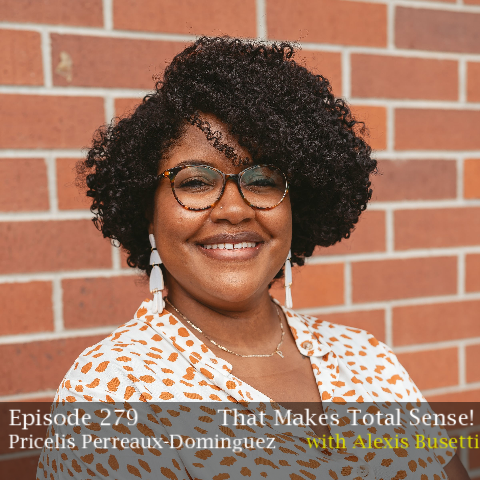
[00:00:05] Speaker A: Welcome to that Makes Total Sense, a podcast dedicated to exploring God's generosity and justice. I'm Alexis Busetti, a Christian, aiming to ask good questions and encouraging you to do the same.
Every one of us is wired by God to live out generosity and justice, but the how sometimes eludes us. That makes Total Sense is a way for us to get together, posture ourselves as learners, and challenge one another to practice. Practice generosity and justice in a tangible way every day.
Andrew, I feel like often I start the podcast by saying, I just finished the book because it's often true.
[00:00:50] Speaker B: Right.
[00:00:51] Speaker A: One of my kids said to me the other day, mom, I don't know why you always wait until the last minute. You know, it's like, when are. When are you interviewing these people? I'm like, oh, in three days or in two days or something.
But, you know, there's a lot on the shelf to read. And I literally did finish this one, actually, this morning in the coffee shop. I switched from PDF to print because they were out.
Yeah, they were out of the print copies, and I originally asked for it, and. And then I got it, and so all of my annotations had to change. But anyway, say all that to say I am incredibly grateful for this book, so thank you for writing it, thank you for giving me a copy, and thanks for coming on.
[00:01:31] Speaker B: Oh, yeah, no, I'm so glad to be here and to have this conversation, and. Yeah, thank you for the kind words. I mean, it means the world, as you know, with being a creator, when people interact with your work and just want to be a part of that conversation, that means everything. So thank you.
[00:01:49] Speaker A: Yeah. So if you haven't guessed, I am here with Dr. Andrew Whitehead, and he's written a book that comes out August 15th. Is that right?
[00:01:57] Speaker B: Yep. August 15th.
[00:01:59] Speaker A: August 15th. It's got a great cover. I feel like we could go 30 minutes on the COVID but I'm gonna. I'm gonna hold myself back and try and get to some of the other stuff first. It's called American Idolatry.
How Christian Nationalism Betrays the gospel and Threatens the church, and. Okay, let's start there. From someone who tends to be a little bit conflict avoidant.
[00:02:24] Speaker B: Mm.
[00:02:24] Speaker A: I'm grateful for this subtitle.
[00:02:27] Speaker B: Wonderful. Yeah, I'm. I'm the same way. So thank you. Yeah, yeah, yeah.
[00:02:32] Speaker A: I mean, it betrays the gospel and threatens the church. I mean, this is real. So I think I want to just start by naming for myself, by the time I got to the end, the last chapter, the phrase that I wrote out in my notes was white Christian nationalism is not benign.
Like, this isn't just something.
And I think it's hard. I'm in Texas. You spent some time in Texas.
[00:03:01] Speaker B: Love Texas. Yeah. Lived there for five years. Yep.
[00:03:03] Speaker A: Bible Belt. You know, I grew up in Oklahoma. We used to call ourselves buckle of the Bible Belt. Okay. I mean, and. And I think that for folks like me who grew up in white churches, I'm mixed, but I grew up in a white church, so. Grew up in white Protestant, not mainline denominations, who. I pledged allegiance to the Christian flag every summer at vbs.
[00:03:30] Speaker B: Right.
[00:03:30] Speaker A: Because it was there along with the Christian flag.
I think when we have experiences like those, I think the tendency can be, at least it has been for me, especially in the past, to just say, I mean, I know it's not ideal, but kind of like, is it really that harmful? Who's it hurting? What's the big deal? Can't we be patriotic some, you know, some of these kinds of things.
And I was convinced before, but when I finished your book, like I said, the phrase I wrote was, white Christian nationalism is not benign.
So I'm wondering if you can start with a few of the questions that you raise at the beginning of the book, because this is, as you've said, a personal and professional journey for you. You are a white Christian who grew up in America and have experienced a lot of these things for yourself, and you started asking some questions.
So can you share those, you know, just a few of those with us and like, kind of how you, you know, how these. These have fit into your journey? Because I think when you start that way, I thought, oh, yeah, probably lots of people have asked these same questions.
[00:04:45] Speaker B: Yeah, definitely. No, I really appreciate that, I guess, reaction too, because I. That's my story as well. And I think for many white Christians who were born here, that that is our shared story. Because, you know, throughout the book and as you get to the end, then it, hopefully the. The puzzle pieces kind of come together and we can see why it's that way and it's that way on purpose, essentially. So if we look at our history and. And as you said, I'm a social scientist and so, you know, analyzing large surveys and there are no figures in this book at all, so no stats in that sense. But as we start to take the evidence that historians hand us, that social scientist hands us, we can start to see, or I think for me, along my journey, that's when I started to have those questions of, well, if this is a Christian nation, you know, why why were Native Americans pushed off their land? You know, if we look at the Trail of Tears or we think about the literal genocide that was committed in the Northeast against those Native American tribes, and those folks were Christians. But then in Chur. And, you know, I grew up in church. It was a warm place. I felt accepted. I had trouble in my home life at that point. And so this was a place where I could come. And, you know, I learned so much about loving Jesus and loving the Bible. And then I hear those stories and I think of, well, that doesn't sound like what they're teaching me or what I grew up believing or, you know, when we start to think about how folks who were Christians could enslave other human beings, or we think about Jim Crow and. And we start to read about the accounts of lynching.
And, you know, growing up, I knew these things happened, but then when I started to listen to those voices and. And really hear those stories and sit with it, and I think of, wow, okay.
One story I share in the book is that I went to graduate school at Baylor.
There's a really famous lynching that happened in Waco, Texas, in the 1900, early 1900s. And so I'm there as a grad student, and of course I knew that lynching happened and. And knew this is horrible. As a Christian, I hated it, but it was just kind of sanitized. But then I read that account, and in that time, then I really start to wrestle with the emotional and physical and mental. Mental anguish and turmoil that that would have caused black Americans at that time, and the fact that there were thousands of way Cohen at that lynching, and many of them were in church on Sunday.
And so then I'm like, okay, so how does this fit together?
And so those were some of the questions I think that across my journey I just could no longer ignore.
And then. And as I started to study Christian nationalism, you know, as an academic, and I start to look at the evidence that it was handing me, and I was seeing how, you know, Americans that embrace Christian nationalism, and again, it's maybe, you know, we'll talk in just a little bit about defining it, but essentially this idea that a certain expression of Christianity should be privileged in the US and should be the distinct cultural framework that kind of orders our social and civic life.
Americans that embrace that idea were more likely to be not at all comfortable with interracial marriage. We're more likely to believe that blacks are shot more often by police because they're inherently more violent. They're more likely to believe that refugees from the Middle east pose terrorist threats and more likely to fear that immigrants bring disease and are crime rich. And so all of these things. And I'm thinking, that doesn't look like Christ to me. It doesn't look like what I was taught. And so that's literally kind of where it begins on this journey for all of us, I hope, or was for me, and maybe for you. And so, yeah, some of those questions, I think, can start us off. And then it's a journey of, well, why?
Why were those things the way that they were? And how did Christians kind of stand by? And so what I find in the past and then even today, Christian nationalism is a part of that story. And if we're going to, you know, the end of the book, give it away, but if we're going to follow Christ, we have to disentangle that from Christian nationalism, and we have to do that work. And so I love how you put it. It isn't benign.
If we believe that it is, we'll just be carried along like many of our white brothers and sisters from the past who stood by silently as racial minorities, ethnic minorities, were crushed on the margins. And so I think that's a long answer to a great question.
Sorry it's so long. But I think that really was kind of the motivation of where does this story begin for me? And then looking at my journey and trying to draw those lines forward.
[00:10:02] Speaker A: Yeah. Thank you. I love long answers here.
I didn't say this before, and I love interviewing professors. I've interviewed lots of my own professors. And this is one of my favorite things. I'm like, we get like, these mini classroom lectures, and they're. And it's my favorite.
So first we. I do want you to define it, but before you do that, I want to go through some of the fruits that you name early on in the book. And this is why.
Because I think, okay, I'm not a gardener, right? Like, at all. Like, in any sense of the word, I will kill everything. But I'm imagining myself in someone's garden, in a space, and you kind of go, oh, I wonder what that is. Look at these. Look at these pretty flowers. Or it looks like something's budding here. You know, I wonder what that is. Or as things, you know, begin to grow. That's what we notice, right? Like, we notice the fruit, we notice the flower, we notice the stuff that this is bringing. And I think one of the reasons I want to start there is because I think the fruits of white Christian nationalism We have all seen, like, they're not.
They're. They're. They're undeniable in our American society. And so then if we can start to ask ourselves where we see these, what is the root? Like, what. What is underneath it? Could it be something that, you know, we're going to define as Christian nationalism? I think that maybe that could be. That could be helpful. So I am.
These were some of the things that I jotted down from kind of early on in the book. Feel free to add to these. Or, you know, what.
What was, you know, if I got these right.
But I've got. Okay.
Power, control, domination, fear, violence. Like, when we see these things, sure, these things can be rooted in lots of things. Right. But the fact that Christian national. They're a natural outpouring of Christian nationalism, I think should, if we're believers, freak us out.
[00:12:27] Speaker B: Yeah.
[00:12:28] Speaker A: That should cause us to not just pause. Right. Like that should. That should make us really kind of like, snap out of it.
So what did I miss?
Talk about the fruits a minute, if you want. And then please define for us when we're talking in this conversation today about Christian nationalism, even you use the modifier white often in the book.
Define it for us. What are we talking about?
[00:12:55] Speaker B: Yeah, no, I really like that angle. Right. And thinking about the fruits, because I think ultimately that we can work backward from that, like you said, because when we look at the fruits of the spirit and then we look at our own lives or our politics that we're involved in or how we interact with other groups, are we evidencing those fruits? And I think for those who are outside of Christianity, who are a part of this country, and we're in a pluralistic, democratic society, and, you know, how. How are they viewing us, you know, and are they seeing. What fruits are they seeing? And I think that's a really quick and easy way to be. Like, okay, are we.
Are we following, you know, the path that Jesus laid out, and are they seeing that or not? And so for me, those fruits of power, control, domination, fear and violence. You know, there's one way I can answer that by just listing out the social scientific studies of when we ask certain questions. Right? So with power, we find that Americans who embrace Christian nationalism, again, they're much more likely to say that people should be compelled to offer their allegiance. Right. Whereas in this country, I think historically, as we think about the Declaration of Independence and all those things where there were some values there that the early founders obviously weren't living out fully and completely, but if we think about the values and we aim towards those, this idea of compelling people to be, to pledge allegiance, that that seems contrary to what it means to, you know, voluntarily give that up. Or when we look at power, we ask these questions about whether they believe certain folks should have access to the democratic process, right? So if you're convicted of a crime, you can never vote again. Or that there needs to be a basic civics test in order to vote, or that voter suppression is, is not happening anywhere, or even believing that again, I always feel like I have to state it. There's no evidence that the 2020 election there was any impropriety. And even the lawyers for, you know, Donald Trump in, in court said yes, we have no evidence.
But many Americans, and especially those that embrace Christian nationalism are more likely to believe that there was. And so when I look at that, it maintaining access to power and a power in the book, as I, as I kind of explained it is a self interested power. It's a power that benefits us at the expense of others.
Because if we look at the Civil rights movement and the Civil Rights act, that is an act of power, right? It's setting a law for the entire nation that everybody has to follow. But it benefits everyone, right? Everybody can vote.
Whereas with Christian nationalism and we're looking at power, it really comes down to we want to be able to enact what we believe is correct on everyone else, whether they're secular, whether they're Muslim, whether they're Jewish, right? All these things.
And so power and domination are central to it. And so in the book I highlight that as kind of the central idol. And then from that, when we have power and we see it as a zero sum game, right, either we are on top of, or they're going to be on top and we're going to be, you know, crushed or whatever, then you're afraid of losing power. And so that's where fear comes in. And fear is such a powerful motivator politically in, you know, our media, politicians for decades and centuries have used fear, right, of what could happen. So you need to get on board. So as Christians when we come to this, trying to think through those messages and thinking about, well, how do they make me feel? And I'm talking about fear at the group level because to anxiety, those types of things are very real. And so this isn't speaking to, you know, folks that may, you know, struggle with that, but this fear at the group level that my group, us, we are going to be harmed.
I think Jesus over and over shows A way forward.
And when we are feeling afraid of some other group taking what we feel is rightfully ours, what are we willing to do?
We'll do anything to hold onto it. And that's where this third idol of violence comes in. Because fear creates really strong boundaries of us versus them. Right? It shows us who we are, who they are. And then if we believe they're coming for us, well, now we need to be able to, under either the threat of violence or through violence, maintain our access to self interested power.
And so that's where too some of this, these social scientific studies can help us. Because we see that Americans who embrace Christian nationalism, they're much more likely to agree that real patriots may need to resort to violence in order to restore America to it on its rightful course. And so when I think of that, and we think of January 6th, it isn't just, I think the question we should have in our minds as we look at those videos and we see those pictures. And I've studied that day quite a bit. And with others there's no denying that Christian imagery and symbolism was there on that day. So our question should be is why are they so comfortable holding Christian symbols and then, you know, beating police officers, right. Or destroying, you know, parts of the Capitol building? I think that's what we have to wrestle with.
And that's part of, I think this journey that, that we're on or that I'm on and hope others join me on is thinking through how, yeah, the symbols of Christ, the cross, sacrifice for others, all of that can be wrapped up into this. And so that's, I think, where we have to really look at Christian nationalism, this desire to privilege a particular expression.
So here's the definition, right? So Christian nationalism is this desire to privilege and fuse together a very particular expression of Christianity with American civic and social life, saying that our government should vigorously defend and preserve this cultural framework as structuring and organizing society. And it needs to be according to again, this particular expression of Christianity, which we find over and over in our studies, is particularly ethnocentric.
So it is focused on privileging, you know, white Christians and white Christianity and politically and religiously conservative and again, a very particular type because there are political and religious conservatives who reject and confront and oppose Christian nationalism. That exists, that's a thing.
And then obviously there are progressive or more moderate forms. So there are many expressions of Christianity we can move toward that aren't this, that aren't Christian nationalism, that aren't saying this should be at the top of the hierarchy and everybody else should come after.
But rather hopefully moving toward a Christianity and a political stance of we're a part of a pluralistic, democratic society. There are people with different beliefs, but these are the values that we all share, which everyone should have the right to participate in.
Everybody should have the right to, to find flourishing and to receive the benefits of a country that in many ways is, you know, I, I, I love being an American. I, I'm thankful that I was born here. There's a lot that I get to enjoy because I'm a citizen here.
And so I want to, and I hope other Christians could move toward, well, let's make that available to everyone, even if it costs us some. Right. We, I think that's what Christ calls us to. We can do that. And so another long answer, but I think that's kind of the flow as we see this fruit. It's because of these idols, and those are the idols of Christian nationalism, this desire to privilege a very particular expression of Christianity in the public sphere.
[00:21:11] Speaker A: Yeah, I just, I just want to say, I don't know that we'll necessarily get into it, but something that I don't, I don't tend to do probably as often as would be helpful for me is I don't tend to take a really broad view, especially when it comes to history. I'm just not a history buff. But I just kind of want to say that, and you do name it in your book in one of the chapters. But this Christian nationalism, Christian nationalism as we know it a didn't begin with the 2016 election. It didn't. The 2020 election. Right.
It's not that we see, you know, Marjorie Taylor Greene and we're like, oh, it's her, she's the problem. You know.
But it also didn't begin with, I mean, as we know, didn't also begin with our founding meaning, you name, you know, colonizing. Right. Doctrine of discovery, things like this that have a much, you know, a broader, bigger, more historic view. And so this, so what we're living in is fruits of people, ancestors, ideals that go back centuries. And so it's a really difficult to dis, to disentangle because frankly, it's just so big and rich and deep.
And so I just kind of want to, I just kind of want to throw that out there. I think probably at this point, most folks realize that. But I may list a couple of, you know, you, you talked about unsettling truths in, you know, in your book. So I may, I may, you know, List just a couple of those things. If people have, you know, further questions or want to delve deeper into that. Because this isn't something that is, like, only Americans have dealt with this problem. Like, this is something that Christians, unfortunately, we have brought this with us. And especially you even go back to Constantine.
[00:23:07] Speaker B: Hello.
[00:23:07] Speaker A: I mean, let's, you know, we could talk about that too, right. Fourth century, where, where Christianity got fused with political power.
And this created this. There's this monster that came out of Christianity being fused with political power, which we don't, as you point out in the book. See, in the life of Jesus, even when his followers are saying, okay, now are you going to do the thing? Right? Like, I love this first chapter of Acts. You're like, okay, like, you're here, you're. You're back. Like, now is the time. And he's like, actually, I'm leaving.
[00:23:38] Speaker B: Yeah, yeah, yeah, yeah, we're going to
[00:23:40] Speaker A: leave this to you guys. And don't do it by the sword, right? Like, this is not your call.
And so I think that, you know, that kind of, I think, is important to me. We have a particular flavor, but it is just as harmful and gross and ugly and devastating to the people around us to, to us, to people who may, you know, subscribe to some of these beliefs.
And it's. And it's harmful to our faith. And so I just kind of wanted to. I just kind of wanted to throw that out there.
I, I didn't.
You don't need the prep. But I didn't prep you with this before because it didn't come to my mind. It's not in my notes. But as you were talking, I started thinking about some of the ways that Christian nationalism presents. So you name it. Pretty early in the book, there are kind of like congregational ways or like communal ways that it presents and then kind of personal ways that it presents. And that felt really helpful for me. Not as a litmus test necessarily, but like, oh, let's just look around at some of these things that feel very normalized but maybe are really, you know, have their, have their roots or they are symptoms of, or whatever the wording we want to use of Christian nationalism. They're related to Christian nationalism. So can you go through some of those? And I, I want to say again, I'm sorry, I'm talking too much now, but Andrew's a professor in Social Scientists, so this isn't just stuff that you've, like, decided you're just going to pull out of thin air. I mean, there's no data in this book, but we could turn people to America back for God, right? It's in the notes. It's in the book you wrote with Perry. There's lots and lots and lots of figures here and. And data that represents what you're saying. Okay.
[00:25:31] Speaker B: No, no, I really appreciate that. And I think, you know, that gets at the heart too, of. Of where I'm at with this and want to do with this book is that I hope folks that pick it up or that, you know, they want to. And you don't have to feel as though this is like pointing a finger at you or folks feel put on the spot.
You know, in our work and in my work and in my writing, I never want to label anybody a Christian nationalist. Just not interested in that. Because empirically, we see it's a spectrum, right? People embrace it more or less, and it matters how strongly you embrace it. And we'll give kind of a name to those at kind of the upper end of the scale. But I'm not really interested in trying to do that, because what happens is when try to label somebody, then they feel it's a part of their identity. And then if we start to critique Christian nationalism, they feel like they're being critiqued. And I would rather us focus on the ideology, the Christian nationalism, because then we can take a step back and think, well, there might be parts of this that I implicitly hold or, you know, kind of in a benign way, I'm just kind of silent about.
And I'm still on that journey, too. And so I'm still trying to discover how I can disentangle my faith from some of these aspects of Christian nationalism. And so I, you know, I appreciate that. That kind of point that you're making.
And then, yeah, in the book, too, trying to highlight a field guide of sorts where as we look at our Christian organizations or even some of the messages we give each other at kind of that individual level, where can we notice this creeping in? And again, this is part of a very long history, you know, as you point out, where there's nothing special about Christianity as a religion being used by those in power to essentially do their will and have God baptize it. Right? Other world religions do this. So it's not as though Christianity is the only one and other nations have done this with Christianity and other world religion. So there's nothing unique about America and the fact that we're struggling with this. This is a part of apparently being human, right? We get together and we create these societies, and it's just really easy for us to get pulled into this. Us versus them, and then protection. And so I think Christians, again, are called to something different, to be aliens in this world. We should stand out. We shouldn't be just in one party or another.
You know, whether that's in the US or elsewhere, we have to do that in community. So all that to say, I think, you know, part of the things that we can think about as we look around us. And I grew up with this. And you just, you know, you shared earlier in a congregation with the American flag and the Christian flag at the front.
And so, you know, a pastor friend, you know, said once that if you ever wanted to anger half his congregation, move or remove the American flag, right? Because people will react. And so then that raises a question, well, why? Why are they reacting, right? What is it about that American flag having to be at the front of a sanctuary that is so important?
And so when we get really angry at something that should be, one little alarm is, okay, is this an idol, right? Am I looking to this for protection provision? Is it requiring my allegiance? And where is my allegiance supposed to be?
So we can start to think through that and just start to ask ourselves questions. And so if you are, you know, I talked with someone from Australia last week, right? And as a Christian, she came here and she saw a US Flag at the front, and she was just kind of astounded, like, what is that doing here? And she's been in the US For a while, so now it just kind of. It doesn't bother. Not that it bothers her or anything, but she doesn't notice anymore, right? So it's that same thing where for many of us, we just accept it's there. But then my question is, well, if we take it out, what do we think we're missing? What does that say about our conception of Christianity, right, And its place and America's place in God's plan for the world? And those are thinker questions we have to wrestle with. And so, you know, this book wrestles with those in different ways.
You know, another kind of in the field guide, right, Is. Is thinking about the types of messages that are preached. And so one way to think about it is, is this message pushing me more towards fear of those out there?
Or more, Is this message pushing me more towards love and moving towards those outside these walls? And I think that's another way we can start to try to think about, well, how much of this, you know, is of the Christianity we're practicing together, how much of it is due to this ideology. How much of this cultural framework has been with its cultural baggage brought into the practice of the faith?
Because we're not called to fear those out there. We're called to move toward others, no matter who they are. You know, we're taught to break down the dividing walls of hostility rather than build them up. And so I think the messages we hear from the pulpit. Is it about maintaining power and ensuring our way or the highway for everybody else?
Are we supposed to fear those out there?
Are we convinced in the ultimate, you know, victory of the United States, you know, that type of stuff? Because Christians in other countries would not feel that same way. And so, again, listening to those voices is key. So those are some of the. The things we can start to notice around us and think through why is it this way?
And really, it has to do with, again, this cultural baggage that has been added on to. If you're going to be a faithful Christian, you got to be American, you got to be all these other things. And I think we really need to disentangle that and wrestle with that in order to faithfully follow Christ, in order to not betray the gospel, which I think a lot of times this causes us to do. So.
[00:31:25] Speaker A: Yeah, thank you for that.
There's. There were lots of things on that in that field guide portion that I was kind of like, check, check, check. You know, like, this has either been my experience. I've been, you know, in services like this, you know, but. But yeah, I mean, this is.
[00:31:40] Speaker B: This is.
[00:31:40] Speaker A: This is very cultural for me. Right.
[00:31:42] Speaker B: Lots.
[00:31:43] Speaker A: Lots of things in that field guide.
I want to pivot a little bit because you spend quite a bit of time in the book on this, and I think for some folks, this does not feel intuitive. Okay.
Okay. So you mentioned January 6th, and I chatted with Jamar Tisby right after this occurred. And I'm gonna. I'm gonna. I'm gonna link that there because this was one of the things that we talked about, was this linking between what was happening In January, on January 6, what had happened, what had just happened on January 6, what the people the writers claimed to be mad about. And then also kind of looking at, you know, he. He's mentioning, like, look at what had just happened in Georgia. You've got, you know, black senator, you've got a Jewish senator, you've got, you know, all these things. And I think for some people, it's like they can see data points, but they're not able to connect the dots. And. And you spend a lot of Time in the book Connecting the Dots, or at least showing where Christian nationalism and racism and Christian nationalism and xenophobia are really well aligned. That's the best that I'm going to be able to, to say it right now because I really would like for you to elaborate on that. Again, I think it's something that for me, I'm like, yeah, this is, this, this, the, this is the same ideology. Like, I can see the relationship, or maybe that's not a very good way to say it. I'm getting nervous talking to sociologists. I'm like, I'm probably not stumbling over my words here, but I'm like, you know, I'm like, I can't see. Like, to me, it's not surprising.
[00:33:35] Speaker B: Yeah.
[00:33:36] Speaker A: But I think that for some folks it is, or they might say it's kind of a coincidence. Right. Some of the same folks happen to hold this or that.
And you talk a little bit about what is it. Causation is a correlation. What's the deal? Maybe that's less important than the fact that they're always found together.
[00:33:53] Speaker B: Yeah, yeah. Well, I think, you know, it's really straightforward empirically. So when we, we can do these surveys and this I think, has just been part of my journey where I'm like, goodness gracious, these things always are tightly associated. So what is that telling me? And like you said, correlation, causation. Does Christian nationalism cause you to embrace racist attitudes or folks with racist attitudes, are they more likely to embrace Christian nationalism? Whichever way the directionality goes, and it probably is reciprocal.
[00:34:22] Speaker A: Right.
[00:34:22] Speaker B: They're influencing each other as Christians, we should not want to be a part of it. Right. Like no matter which way. So that's my point is like, hey, these things are strongly linked and the argument isn't which causes which. The argument is we need to step back. Right. We do not, I think, want to be a part of, of any group that is saying white people, either explicitly. And that's rarer, but almost not as rare anymore in the last couple years, but implicitly too. So the, the studies behind that. Essentially what we do is we ask folks these questions about Christian nationalism and, and we use that to create this scale. And these questions are level of agreement with statements like the United States is part of God's plan, or the federal government should advocate Christian values or the federal government should declare the US a Christian nation. That's what they ask. We're just saying Christianity is kind of central.
There's no mention of race in any of those questions ever.
Then we ask Questions that could be just happening around us, whether it was, you know, explanations of police violence, as I mentioned earlier. So, you know, level of agreement with police officers shoot black Americans more often because they're inherently more violent than whites. That's a question we ask, or how comfortable would you be with your hypothetical daughter marrying a person of a different race? And we name like black or Hispanic or Asian.
So when we look at police violence towards black Americans, or we look at interracial marriage, or we look at, you know, even Black Lives Matter, or we look at affirmative action, or we look at explanations of racial inequality that black people just don't work as hard, right? We look at all these things.
Christian nationalism, over and over is one of the strongest predictors or is. Is one of the strongest associated with agreement with those various things, like black people are more violent or they are inherently less able to, you know, flourish in life because they're not as smart or they don't work as hard or being afraid of interracial marriage or even transracial adoption. It's always one of the strongest predictors. And so for me, as I sit here and think about then, the history, right, of black Americans in this country, and if we were Christian, then why were we enslaving black people? If we were Christian, why did we not allow them to vote? Why did we lynch black people? Why were there sundown towns?
[00:37:01] Speaker A: And.
[00:37:02] Speaker B: And democracy in America is relatively young, right? The Civil Rights act in the 1960s finally made where everyone could vote. And before then, we really didn't allow everyone to vote. And so it's very recent. And so we're wrestling with these things now. But that history is long.
And so that's kind of. That social science, I think, helps us ask the questions of why is this the way that it is? And then we look to history and we can see this has been a part of our story and the reasons that we had to give ourselves and each other for why we could treat in this specific instance, and we treat, you know, white. I'm saying we white Americans have treated various racial minorities very badly at different points of our history. But just focusing on black Americans right now, we see that in order to excuse our actions toward them, we needed theologies and we needed understandings of our Christian faith that allowed us to do that.
And those are rampant. And they were with us in the time of slavery. So you had pastors from the north and the south saying, we're a Christian nation, we should not have slavery, or we should have slavery, like, explicitly from their Christian faith, arguing that we need to stay segregated.
And so these were really influential, and influential people use them.
And so, again, that's where we're thinking of, or I'm trying to think through, okay, to practice my Christian faith. How can I disentangle it from this Christian nationalism that over and over we see is associated with. And again, maybe not explicitly, but implicitly being okay with a society where racial inequality is the norm.
And there's no argument around, is our society racially unequal? I mean, black Americans own fewer homes, have lower levels of education.
Black mothers die in childbirth more often. Black babies die more often than white babies. You know, three times as many black babies die. So there's all this racial inequality. And again, it doesn't just happen.
There's a history that has led us to this moment. And so we just need to do that work of looking at it. And again, did I.
Did I enslave anybody myself? No. But am I still benefiting from systems that were put in place then?
Yes. And so what do I need to do to take ownership of the fact that I don't think it should be this way? It's kind of like, I heard this example, and I'll stop here. Sorry. But let's say, you know, you buy a hotel and you're running this hotel with. With your spouse.
And when it was built, it just had steps leading up to it. There weren't any ramps or anything. But then, you know, people who are disabled, they can't get in as easy. They need a ramp. You can't just own the hotel and say, well, I didn't build this hotel. And so you can't hold me responsible for this.
No, what. What we should do is understand, well, now the hotel is our responsibility, and there are people that do not have access to it. And so what I need to do is make the changes to how this functions so they have access. And I think that's where, for me, as a white American man, that's where we're at. I didn't necessarily put all this into place, but I'm responsible for what I can do in this society. We are. And there are folks that are denied access, and so what can we do to give them access? And I think that for me, that flows out of my Christian convictions of wanting to see.
And maybe we can talk about this, too. The kingdom of God, right? What is that like? What is. What does it mean? What's flourishing. Flourishing for everyone, no matter what. And so that's what I want to be a part of so, again, sorry. I keep giving long answers, but you ask such good questions and it gets me going. Yeah. So thank you.
[00:40:58] Speaker A: I love it. I love it. That's the goal, is for you to talk way more than me.
But I want to. I want to.
It just what you just said, like, it shouldn't be this way. Right? Like we as Christians, it shouldn't be this way because as.
As the subtitle says, Christian nationalism betrays the gospel.
So, you know, if we talk about racism, hierarchy, welcome.
You know, this is you. You. You have, you know, like, you. You're. You're saying this example of, like, I didn't necessarily build the system, but I benefit from it. Let's change it. Let's. Let's change the system.
But I'll just share. I mean, this has been long ago enough now that it, like, you know, it hasn't made me cry in decades. But when I was. And I was crying out of anger, but when I was in. I was in the youth group at my white Southern Baptist Bible belts church that I grew up in, which was one of the places where I experienced the most racist attitudes. Um, so my.
My mother is Mexican American. I'm mixed Hispanic and white. My dad's white. And I remember having a conversation with one of the teenagers in the youth group, and he. I mean, this was. Okay, so. And I'm saying my. I'm in my 40s. Right. So this was that many years ago.
[00:42:26] Speaker B: Yeah.
[00:42:26] Speaker A: And this guy. I mean, you could hear the same thing today from. From some of the politicians or Christian leaders, in fact, that you name in the book. And it's. I don't remember exactly, but it's. Well, so. And so. And they should just go home. Yeah, right. They should just go home. And in this case, he was talking about.
In this case, he was actually talking about Mexican people. Yeah. And.
And I, in my. I don't even know. I was probably 13 or something, I just kind of snapped off and said, well, buy me a ticket, because I, you know, and I'll head that way. But I mean, my. My mom is. Is third generation, but I still obviously felt very hurt by that and very offended by that and recognized how xenophobic and racist that was of him to say.
But the point is that this was, you know, a kid I met at youth group. Right. Whose family was, you know, very, you know, embedded and is, you know, highly respected, you know, just had been there forever, you know, in this church. And so it's really difficult to kind of, you know, I get out My, I'm kind of weighing this and I'm like, I want to, I want to hear what Andrew's saying and like, yes, this is not. Okay, let's, let's do this. And then, and then at the same time, we still hear these ideas espouse like, like it's, it's constant. Yeah.
So I want to go to different places.
[00:43:48] Speaker B: Yeah.
[00:43:49] Speaker A: So I'll either say, choose your own adventure or pick which one you want to go first.
[00:43:52] Speaker B: Okay.
[00:43:54] Speaker A: But there's something that you say early on in the book and it, it was very intriguing to me. And this is, is Christian nationalism growing?
And so this kind of question about the ideals, the people who, you know, who find themselves agreeing with some of these beliefs that you named earlier in some of the surveys. So, so that is, is something because like I said, I'm looking back and I'm going this, I was 13 or something not quite 30 years ago. But you know, this has been decades ago. But folks are obviously still talking this way.
At the same time, I hear a lot more people talking like you are talking. Right. Which is, which gives me hope.
Then we have some of these really mainstream conservative Christian leaders because it's real easy to say, oh, you're an idiot, you're a 16 year old boy. What do you know, who cares? You know, that's easy to say. But when you realize that he was probably parroting.
[00:44:53] Speaker B: Yeah. For sure.
[00:44:54] Speaker A: Some of the speeches that you actually quote in your.
[00:44:56] Speaker B: Yeah.
[00:44:57] Speaker A: In your book, it feels really disheartening.
[00:45:00] Speaker B: Yeah.
[00:45:00] Speaker A: Right. So.
Yeah. So what's happened? I mean, this was almost 30 years ago. What does it look like today? Maybe not necessarily compared to them. What do you see the trends maybe of that and then, and then what does leadership inside the church and Christian organizations have to do with that?
[00:45:22] Speaker B: Yeah. No. Well, thank you for sharing that.
Those are always hard moments. So, yeah. I'm sad for what that meant, you know, for you years ago. And you're right, it's still happening day. And there are children that are still hearing those messages.
And again, as Christians. Right. We should obviously oppose that at all places. But I think, yeah. That requires us to then wrestle with this Christian nationalism because it, it allows for those types of ideologies to seep in, to see you can be faithfully Christian and want, quote, unquote, all those immigrants to go home. Right. There is no dissonance there when you're embracing Christian nationalism. And so that's the danger. Right. That's what we're afraid of. That's what we should trying to disentangle. And so I think, you know, you're 100% correct that these messages that younger folks parroted, whether it's 30 years ago or now, they come from somewhere. We learn these things. Right. They become a part of us. And so, yeah, the leadership, I think, is a big part of it. And so the question of, is Christian nationalism growing? Well, we only have really good data on it back to the late 90s, a particular question that we ask. And so there are a number of ways we can answer this question. And so, Sorry, right. As a professor and social scientists, it's always the answer is complicated, but they're essentially what we can see is that Christian nationalism a does wax and wane based on historical periods. So for one example, 911 happens, we see it spike and we can think about when there's this unsettledness in our culture, we're trying to figure out who we are, we feel attacked. Right? It makes sense. People are like, yes, to be American, you need to be Christian.
And that's all a part of the rhetoric we heard around, you know, Muslims and the Muslim faith. And so it spiked, and then 10 years later, it goes back down lower than what it was in before 9 11. Right. So it waxes and wanes.
So it responds to what's happening around it.
And so what we find, though, too, is from 07 until now, today, the number of Americans who strongly embrace Christian nationalism is slowly declining.
So it was close to 20% and it was, you know, 17% a couple years later. Now it's, you know, around 15%, depending on how you ask the questions.
And so what that's telling us, it isn't growing like wildfire, even though some journalists would love that headline. Right. Because that will get people to click. But mostly I'm saying, you know, I think it's a huge problem. I wrote, you know, a couple books on it, but it isn't growing like wildfire.
But I think what is happening, and this gets to your, your example perfectly, is that folks in powerful positions were much more willing since 2016 to use that rhetoric and to trumpet it from the most powerful position in the world. And so we do hear Christian nationalism more than we used to. Not that he was the first Republican candidate. It's been used for decades, but he leaned into it explicitly. And so that repeated rhetoric, it becomes part of how people think about, well, this is now how we interact right. In, in our culture, society.
And so with that increasing rhetoric, really broadly broadcasts, we see it and hear it more and Then two, kind of counterintuitively, as this group of Americans that strongly embraces it grows smaller, they're more likely to see that identity as more salient and what makes them different from those outside them. So now they're the. The remnant. Right. We need to do what we can to bring this country back, because, look, we're shrinking. And so with social movements that size, and as they get smaller now, it becomes even more powerful of a cultural framework in their minds because it's what separates them from those who are not us, quote, unquote. And so that rhetoric being broadcast counterintuitively, the shrinking group. But now it becomes more salient. That's why we still see it and hear about it, especially from. From leaders, because we've even seen that in the last couple of years, as you mentioned earlier, there are some political leaders and religious leaders who are like, hey, we're just going to embrace this label. They feel labeled as Christian nationalists, so they're just going to embrace it. And so. So you can see that happening. But that's some of what we've seen take place over the years and kind of why it kind of works its way out in the way that we see it today.
[00:49:57] Speaker A: Yeah, thank you for that.
Something that kept going through my head as I was reading and even as you were talking just now was Christian nationalism is loud.
[00:50:08] Speaker B: Yeah. Yeah, it's a good way to put it.
[00:50:11] Speaker A: It's loud. You know, the people with the. With the message are loud and they have mics and.
[00:50:20] Speaker B: Well, I think that's it. It's. It's been privileged, so they have access to those levers of power, so they have the mics, like you said. I think that's exactly it. So you're going to hear it because they're in those positions, and that's what they don't want to lose.
So, sorry, but that. That's a great.
[00:50:35] Speaker A: Yeah, no, that's ex. No, that's exactly it. I'm glad. I'm. I'm glad that you said that.
Okay. Gee whiz. I'm looking at it. I'm realizing. Okay, I need to hone in on one last thing, probably. Okay, gosh, let's talk. I know you. You already talked about this at the beginning, but I'm wondering if you can go a little bit more in depth with the. The topic of power.
This is one of the idols that you named.
Like we just said, people who are. Who are holding these beliefs and trying to encourage these beliefs often have power.
This is just how our country has worked for since its inception.
And, and how talk about the relationship of power and Christian nationalism. I think it's interesting that I noted it as a fruit and you note it as an idol. And I think that it's both.
[00:51:48] Speaker B: Yeah, no, for sure. I mean, so power is the ability to get others to do what you want despite resistance.
And so again, power isn't necessarily something that always has to only benefit your in group. So like the example earlier, the civil rights movement is a wonderful example of power being applied. Because there were many Americans that did not want equality but they had to, you know, through power pass legislation where now everybody gets to vote. And there were many Americans that did not want that. Or everybody gets to attend schools. Right. And desegregation. And so that's power applied despite resistance. So it's not as though that's anti Christian in and of itself.
But the thing about Christian nationalism is a self interested power. It's a power used to benefit only us.
And so we can use that as a litmus test. Are we advocating for political policies that might enshrine racial inequality or only serve to benefit a particular group against an over and above and out group? And I think for Christians especially in conversation with each other because again, we're all going to have blind spots. So I think for many of us, and I'm putting myself, you know, throughout the book, I hope this comes through, but I try to put myself first out there, right? Like this is where I've gotten it wrong in the past. So you don't have to feel attacked because I'm a white Protestant male. This society has been structured to benefit me. I get it right. Like the doors have opened for me.
So what I have to do is I need to read and listen to folks on the margins who don't look like me, don't worship like me, haven't had my history. I need them to tell me, hey, this is where I am hitting barriers. This is where I'm being crushed. So then it's up to me as a Christian then to say, well then what can I do to leverage my privilege to leverage what I have so that they too can benefit like me. Because what I want to do is go to work, do things that I feel are important, go home to my family, live in a house, be able to afford groceries, you know, have access to health care. You know, all these things that I take for granted. I want that. I think that is an American right.
I think that's a right of any human. And so my Christian faith is Pushing me that way so we can get involved in politics.
I don't see how you can be a Christian or an American and not be a part of that. I think we should.
But the litmus test comes with how we think about power. And is it self interested? Is it only for me? And I think for many years, and I lay this out in the book, historically, especially white Christians, we've been focused on political policies that are paired with others that become kind of wedge issues that ensure that we don't have to necessarily sacrifice for the least of these. We can kind of continue on.
And when policies are brought up that might, you know, cost us something, we tend to not want to be a part of that. And so equip within our field of sociology is equality feels like discrimination when you're accustomed to privilege.
Right. And so, yeah, I think in our congregations, in our communities, in our podcasts, in our friend groups, our book clubs, just thinking through and helping each other see, possibly where we have blind spots, where we feel like something's being taken away, but essentially what could be happening is we're allowing others a seat at the table. And it doesn't have to be a zero sum game. Right. The flourishing. The flourishing that you experience, Alexis, and the flourishing I can happen at the same time. It's not as though I need more, more to flourish. And in that sense, you have to have less. It can happen together. And. And that's the hope of the Christian faith and the hope of God that there is more than enough for all of us.
So, yeah, as we think about power, just trying to think through, is this to benefit me and us? And is that the message I'm hearing?
Or can it move to where now all have access? And I think that is power rightly applied.
[00:55:59] Speaker A: Yeah.
Um, so one of the things that I love to do near the end of a conversation, especially with a professor, so I love this with. With journalists and professors. It's totally my favorite.
[00:56:11] Speaker B: Yeah.
[00:56:11] Speaker A: Um, I would say this because I've. I've had the experience.
I'm in. I'm in grad school right now, almost finished. And I.
[00:56:18] Speaker B: Awesome.
[00:56:18] Speaker A: I've had the experience where we're sitting there and you can see the smirk on the professor's face because he's waiting.
Because he's waiting for someone to ask that question.
[00:56:29] Speaker B: Right.
[00:56:30] Speaker A: That no one has asked yet. You're. You have the same thing like, yeah, this is familiar to you.
[00:56:35] Speaker B: Right.
[00:56:35] Speaker A: So I'm gonna ask you that. What's the question that I didn't ask you?
Today.
[00:56:45] Speaker B: So I think, you know, one thing. So this is kind of drawing to. From the book and my own personal experience. And one thing that I hope is clear is that when we confront and oppose Christian nationalism, it doesn't mean that we're confronting and opposing Christianity, that those two can be disentangled. And it isn't as though there's some true version, just one true version out there that you have to move toward or find. There are many expressions. You can be politically conservative and oppose Christian nationalism.
Right.
You can be politically progressive and obviously oppose it. So there are. There are many expressions, and we can move in those directions.
Because I've had family members, you know, where I grew up, this was kind of the air we breathe, like you said in Oklahoma, Indiana was the same way.
But I had those little moments that pierced through the veil, and I started to question this kind of, you know, intermingling of. Of Christianity and nationalism.
And so I've had family members, you know, even question me, like, are you even still Christian?
Because of my writing.
[00:57:51] Speaker A: Right.
[00:57:51] Speaker B: And so that just shows me how closely intertwined these are and in some ways just indistinguishable for many Americans. And so in writing the book, I'm hoping to provide some of those questions or even for those that are already on this journey, maybe to equip even more of how to interact or the questions we can raise with those that we're connected with.
And so, yeah, just kind of more of support that. This doesn't mean we have to leave behind Christianity, but a particular type and expression and desire to see it so we can.
We can tell better stories together. And I hope that we do. We can move towards different narratives than what we were handed. Right? So that young boy and how he treated you wrongly, we can hand that next generation better stories, better narratives, better ways to see the world.
And in doing that, I think that's where we can take part in the work that Jesus came to do and inaugurated the kingdom of God. He said, you know, in that where how he taught us to pray, may God's kingdom come on earth. Now, here in our space, like our bodies, it's not just about our spiritual.
One day I'll die and I'll go to heaven. And so otherwise, just continue on. I think Jesus came to really reshape two.
There is a spiritual and personal aspect of the future, but came to reshape here and now how we live together.
And that's the work, I think, that Christians can be a part of. And so to confront and oppose Christian Nationalism may put you at odds with some Christians, but it doesn't mean that you have to let go of Christianity or that we're critiquing Christianity. There are expressions that we can move towards that allow us to, to love God and love our neighbor and, and see those fruits come rather than the fruits of Christian nationalism like you, you had talked about earlier. So I think, you know, that's a question.
And, and I hope the heart of the book that that comes through.
[00:59:49] Speaker A: And thank you so much.
I just want to go on record to say we didn't get through all of my notes, but that's a good thing because I hope that it will, that it will prompt people to write their own notes, to ask their own questions, to grab a copy of the book, which is just incredible. And. Yeah. And start to delve into some of these things for themselves.
So, again, it's American Idolatry, How Christian Nationalism Betrays the Gospel and Threatens the Church by Andrew Whitehead. It releases August 15th. I'm so excited for this to be out in people's hands. Thank you so much for coming on.
[01:00:24] Speaker B: Yeah, thanks for having me. I really enjoyed the conversation. Hope it can continue. So. Thank you.
[01:00:29] Speaker A: Thank you.
The links for all the resources mentioned in today's episode can be found in the show Notes, music and podcast production by Seth Buscetti. Be sure to give us a review on itunes and subscribe at your favorite podcast listening app. You can also Visit
[email protected] Sam.