Episode Transcript
[00:00:07] Speaker A: Welcome to that Makes Total Sense, a podcast dedicated to exploring God's generosity and justice. I'm Alexis Buscetti, a Christian, aiming to ask good questions and encouraging you to do the same.
Every one of us is wired by God to live out generosity and justice, but the how sometimes eludes us. That makes Total Sense is a way for us to get together, posture ourselves as Lear, and challenge one another to practice generosity and justice in a tangible way every day.
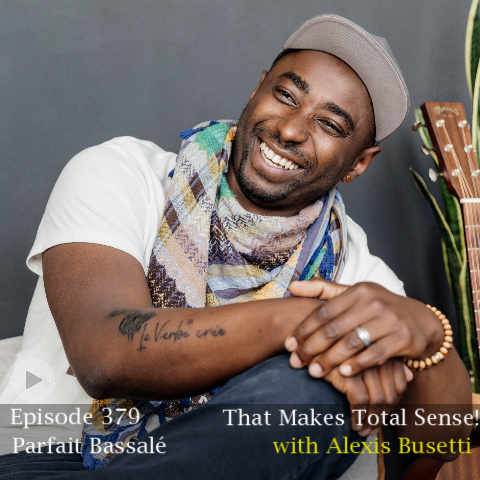
Well, everyone, I am thrilled to welcome our guest today, Parfait Basilet. He has written a beautiful book and music to go along with it. So a book with a soundtrack called the Way of Transforming Relationships and Organizations for Belonging. And that's going to be the basis for our conversation today. So welcome, Parfait. Thank you so much for being with me.
[00:01:15] Speaker B: Thank you, Alexis. Thanks for having me.
[00:01:19] Speaker A: So this.
I will say this book was. It was wonderful. There were so many things going on in my head because I feel like some of my educational background is really, like, kind of. It felt like it kind of like it intersected quite a bit with your. With your work here and, And. And at the very beginning of the book. So I. So I say that to say I think I thought I had kind of an idea. When I went in, I was like, oh, okay. I think. I think I can see this. I think I kind of see where he. Where he might be going. And that was true to a degree.
However, the way that you open the book, I hope you're. I hope you're open to talking about it right now, because the way you open the book, I was like, okay, this feels like maybe I don't know exactly where this. Where this guy's going. And I'm wondering if you might share at least some of that story where you describe your own experience as an international student in the U.S.
an international college student in the U.S. and you were here when 911 happened.
I was also in college when 911 happened. So I feel, you know, for many of us, it is.
For us Americans in my generation, it feels a little bit like when we would ask our parents about where they were when. When Kennedy was shot, you know, or our parents or grandparents, like, where were you in Kennedy? Like, everyone knew where they were when they. When they heard that news. And I feel like 911 is kind of our generation. Like, we all. We all know. We all remember where we were.
And when I read your experience of that event, it was very different from mine or many of my, you know, friends, colleagues, peers, family. And I think it's really, I'm so grateful that you opened with that and that you, you shared it in the book and that. And you know that you'll be able to talk about it here some, because I think it really just, it kind of opened my eyes a bit and set the stage for what you say in the rest of the book and hopefully for this conversation today.
[00:03:48] Speaker B: Yeah, no, thanks for the opportunity. I think you're totally right about how it's one of those experiences that are forever etched in, you know, into our memories, especially as Americans. But interestingly enough, as I was working on the manuscript with the editor who was just a great, great resource, he reminded me also of how much time has elapsed and how much some of the newer generations may not have that memory of that event. So it was really interesting to see to which extent that would be relevant to the topic. But regardless, it was a very defining experience for me. And so as you preface this, I was newly arrived to the United States. I had been in Portland at that time for about short of a year roughly.
And I was just making ends meet as an international student working gazillion of jobs across campus.
I was paying out of state tuition at that time, only allowed to work a required maximum of hours at minimum wage. And so life was hard. All that to say life was hard. And I was also navigating the challenges, if you will, of being an immigrant in a cultural context where people were engaging with me with a lot of stereotypes and lack of context about what life was like overseas. And the realities were overseas.
And I was starting to grow frustrated, if you will, frustrated with Americans believing in this place of tension where I was in awe with American might and the technology, the advancements and you name it, it was just all over, just the amazement of everything around me at the same time, the frustration with the interactions and the lack of context and empathy for what life was like in other places of the world. So when 911 happened, I talk about in the book that I'm moving from my dorm, headed to class, and there's these glass windows of one of the college's buildings and there's students who are just distraught and fixated at the tv and there's this visual cues to a tragedy having happened. And as I get a little closer to notice what happens and it becomes really clear there that there was, you know, an attack.
You know, my initial response, knee jerk response was one of finally they will get it, finally, you know, and obviously I unpack further in the book that it's not a moment that I'm the most proud of.
But it was telling of what had happened unconsciously as it relates to my relationship with Americans. It was one where they had become an abstraction, the other.
And so I go on to really talk about this idea of the other, how we construct the other, and how that becomes the basis of a lot of dehumanization, a lot of lack of creativity and imagination of what peace could look like, what connection could look like. And so, anyway, I start the book with that story, not only to normalize the fact that I'm not above reproach, right? I'm not standing somewhere telling people do this.
I figured it all out. But it's a human tendency to other. And it comes from genuine places of hurt and pain and frustration and anger. You name it. But it's what we do with that in that moment that I was inviting the reader to unpack together through what I call the way of befriending that relies on three key pillars. Courage, curiosity, and compassion.
[00:07:58] Speaker A: Yeah, thank you so much for sharing that.
That was part of the reason I asked you to do that is because of what you just said. It's a very vulnerable thing to share. And so I appreciate you sharing that.
And also I think part of what it did for me as a reader is to recognize that a kind of those knee jerk reactions are like, part of being human. I think, like, we all are, you know, like, we're probably gonna have responses like that, you know, and also what you just said, what are we doing with that? Are we feeding that? Are we recognizing. Wait a minute, why? Where did that come from? Or, you know, are we being curious with ourselves and courageous with ourselves and asking, you know, those kinds of questions? And also, I think, compassionate with ourselves too, to say, okay, this doesn't, like, make me a bad person, but I do need to investigate this further and then, you know, see where, where is that going to take me in my relationships?
I'm glad you mentioned the pillars, because that's where I was going to ask you to go next.
But. And the name of the book, because I want to say this from the outset.
I. I want to have this conversation about the way of befriending the pillars that you talked about, all of those kinds of things. So I don't want to make it what it's not about, but I kind of do. I kind of want to say at the beginning this part, okay, and that's maybe because it may be a cult thing. It's. It's very possible. I live in Texas now. We've lived in Texas for 16 years.
I grew up in southern Oklahoma. You know, I've argued jokingly with other folks in this region of the country of like, where actually is the buckle of the Bible Belt. You know, many of us feel like it's wherever we were at the time. And I certainly felt that growing up in southern Oklahoma.
I say that to say, even though this book isn't explicitly about racism, I'm going to use this as an example because racism is a very blatant form of othering that has very real consequences. And it's an example that culturally I've heard since I was a kid, which is, you know, racism is a, you know, these phrases come up, it's a sin problem.
It's a, you know, there's kind of, let's say there's kind of excuses. And the excuses point to individual friendships being the resolve for like, this is what this.
It's either the resolve or it is, don't blame me because I have friends of people of other races and so I'm not the problem.
What I got from this book is that this messaging is not just be friends with people who you would be other, who you normally would other, and then the world will be a happy place and everything is fine. Like, it did not at all feel to me like it was feeding into this narrative that kind of is intended to discount systemic, real, systemic issues with othering, with racism, with lack of dei, with, you know, all of these things that cause and, and continue perpetuate very serious real world problems.
So the way of befriending what the. Some of what you propose in this book is so much a. It's so much more than that.
And also what I think is the most important is that it fully recognizes othering that happens in systemic ways and that that systemic othering really matters, that it's impactful. In other words, that this isn't just individuals kind of being mean to each other or individuals kind of not just being fully open to each other. I'm not saying that that's not part of it.
But what I feel like you've done really well in this book and in these frameworks is, is communicated.
It is all of the above.
There are very, very big, deep systemic issues, especially in the US the context that you're writing this in.
And we can't expect those kinds of things to be solved if at the individual interpersonal levels we're not willing to open ourselves up to make friends. But not just like, oh, hey, I see you on the other side of the room there, but, like, really deepen our understanding of one another, seeing each other for who we are.
And so I just want to say at the beginning of that that I really appreciate the.
The range that you bring in here, the nuance, and also the depth.
And to say, you know, just for myself, that I was very grateful that. That you brought in all of these levels in. In what you talk about in the book. Because I, for me, in my culture, and it may not resonate with a ton of people, but I think there are a few out there who say this isn't just, oh, in order to solve all of the systemic problems in the U.S. we just, you know, make a friend who looks different than us, and we're like, okay, that, you know, there's. There's a part of that that feels kind of good, but it's also not really recognizing kind of the scope
[00:14:08] Speaker B: of
[00:14:08] Speaker A: the problem.
[00:14:08] Speaker B: Well, I know. I appreciate.
Well, it's pretty obvious that you actually read the book. You didn't just get an AI summary.
[00:14:16] Speaker A: I did.
Don't get me started on AI, but I did.
[00:14:20] Speaker B: I
[00:14:20] Speaker A: figured
[00:14:21] Speaker B: that would be its own conversational topic. But, no, I think you. You captured it very well. It's really nice as an author to be hearing on the receiving end, a paraphrasal summary of the hard labor of love. But I think there's a quote in the book that summarizes this, where I talk about systems change when hearts change and hearts change when one dares to be a friend.
It's that progression that the interpersonal is not dissociated from the systemic. And the systemic is built on the individual.
And so therefore, they feed on each other and impact each other. Right? So we are dealing with the systemic challenges that we have, because at an interpersonal level, there is something broken down.
And so to try to solve things purely at a systemic level, some sort of abstraction, without recognizing that there are real people, real stories.
I think it has its limitations and vice versa, to only think about things at an interpersonal level. Just me. And let me befriend people who are from a different cultural background or racial background or even religious affiliation, and then the world would be Kumbaya.
That's very naive as well. And so what I try to do in the book is really to layer these pieces and to speak about the interconnectedness of them and how they feed into each other and how they're equally important.
If we want to get to that place, at least play our role in ushering what I call kingdom Come, right?
And the role that we all have in making this place a place of flourishing for or all image bearers of God. And so that was my heart in there and how to get to it was kind of a creative process.
And that's why part of the book has elements of memoir in it.
Because I really thought sharing about my story and how I have arrived at really being compelled and convicted about this work was really helpful, would be helpful at least that was my assumption that, you know, as an immigrant, and I'm going to take the liberty and share that in the context of this here, you know, as an immigrant, you know, and I talk about this in the book, how as early as I was two years old, right, I had to move from one country to another because my dad used to work for an overseas organization. And so very similar to military families, there was a lot of displacement.
And so what that did for me was that very early on there was this yearning and longing for a place I would call home, a place where I feel like I belonged.
And I could not necessarily verbalize it at that time. I didn't have the cognitive abilities for that. But deep in my bones there was just this experience of being the outsider looking in.
And so that was the catalyst very early on to me leaning towards my faith tradition, towards Christianity, because of the proposition of God loving me unconditionally, no matter what I looked like, what I sounded like, what I ate at home, you know, what sort of social messages I was acculturated in. Those things didn't matter. He loved me regardless, and also loved Mohammed next door and also loved Aziz. And the list went on. So there was a resonance for me of that message of unconditional love and acceptance.
And so then with that, rather it being just an esoterical proposition, it got materialized through real tangible friendships with people who lived out or embodied that God unconditional love. So they befriended me, they made it palpable. And those folks so happened in my storyline were people from different nationalities, people from different racial backgrounds, from different cultural backgrounds, and you named it different genders. And so they made it visible for me what it means to be friends across our tribes.
And so that gave me a practical, real sense of, wow, what befriending does, what it brings. And it was really liberating. It was life giving.
And so then the rest of my professional career, if you will, or academic pursuit, was really trying to understand why first we do the othering thing. What leads us as humans to really be bent towards that understanding. The psychology of it, the anthology of it, anthropology of it, and so forth, and the spirituality of it. Right. The spiritual lens of it.
And then, yeah, looking at what are ways we can really lean into that movement which is really God condensation of befriending humanity, leaving whatever throne we might see ourselves in, metaphorically to befriend the other, who is different or even perceived as an enemy, as a way to become that bridge towards possibility and community and brotherhood and sisterhood. And so that was the idea there.
[00:20:14] Speaker A: I don't want to be a Debbie Downer in this conversation, so I'm not going to make a commitment to myself, not to and to you. And at the same time, I want to. I want to go here first because I think it's really important to kind of dive in to othering even a bit more before we move into the befriending space. Here are a couple of things.
Othering is so easy right now.
It's just terribly easy. We're naturally siloed. We're also digitally and otherwise intentionally siloed by other folks. Right. My algorithm does not show me the same things that your algorithm shows you.
We have all. I mean, I would say many of us have adopted, even if it's unintentional signaling to folks. So what political sign is in your front yard?
What, you know, clothes are you wearing? You know, these kinds of. These kinds of things that are just kind of out there. And whether we are fully cognizant of it or fully intentional about it, they kind of signal to folks that we encounter who we are, where we stand possibly on, you know, certain things.
And so those even signals make othering super easy.
And.
And one thing that struck me near the very beginning of your book was when you call out that othering is dehumanizing for both parties.
When we other someone, I think it's more obvious how we are dehumanizing that person. But there is also a dehumanizing effect for us when we're engaging in that behavior or in those mentalities. And I'm wondering if before we really, really get into the courage, curiosity, compassion, if you could talk about that dehumanization that happens. I'm partially saying that because I think it's something that we can just fall into because of kind of how our environments exist right now.
[00:22:41] Speaker B: Yeah, no, I. Thank you for. I'll camp on othering along as long as we need to. You know.
No, I think it's counterintuitive because, you know, on the outset, we feel like when the othering is happening, that it's just the victim or the receiving end of it who's being preyed upon and dehumanized, which is true. But there's a more subversive and insidious dehumanization that's happening behind the scene when I treat another human being as less than I begin to lose my own humanity, my own sensibilities, all the what I would call the fruit of the spirit, right?
There's a disfiguration, if you will, of. Of who I ought to be or could be as a human. And to make this concrete. And there's a story that I share in the book about my own experience. And I tell a lot of stories as mea culpa, right? To again, legit, you know, normalize the fact that it's a practice, it's a journey that we need to be on. It's not once and done, I've ingratitated this information and then there we go. I'm done. I'm othering free, right? But I tell the story as an immigrant who, as a black immigrant in America, in the U.S. which is an extremely racialized context that I didn't realize upon arrival because I'm a young 20 some year old, and I knew everything that was still being known about the United States because I studied it in school, right? Very, very humble of me in my 20s.
So I come and at that time, I'm trying to grow an afro and which culturally was kind of like a no, no for my parents. And they were still trying to keep degree of control from thousands of miles away as they could, you know. And my mom, you know, eventually figures out that I'm trying to grow my hair. And she's like, okay, by the time we have our weekly check in next week, you better have a haircut, right? And I'm like, still freaking out, like, oh my gosh. Okay. I need to figure out where the black barbers are in town in Portland, Oregon, which is very segregated city by virtue of its history.
And Portland State University campus was in the heart of downtown, which is primarily, I would say, white collar, right? And so all the barbershops were on the east side, north, Northeast Portland. So I asked around, where can I find a black barber? And everybody tells me, you got to go to Northeast Portland. And so I planned a trip Thursday afternoon, early evening, I don't have class or what have you. I get onto the bus, I'm crossing town, and I can visibly, visibly see the changes in demographics, right? I'm moving from white collar to More African American dance population. And I'm seeing all the stereotypical things you would see. You know, youth outside, corn roses, you know, boombox on the shoulders, hip hop music, bumping, you know, youth with sagging pants. And so I'm looking at this scene through the glass windows. And initially the rush of emotions, instinctual emotions, were admiration. You know, it was like, oh my gosh, this is where. This is where the African American community has been this whole time. I'm super excited, I'm stoked.
And then eventually I get out of the bus, I'm the stop, and then I head to the next to the barbershop. And when that was the first time during my short lived experience in the United States that I was in a predominantly black audience population. So I walk into, you know, at the door of the barbershop and I see the visual.
And what subsided from admiration and awe was out of fear, right? And the only. I joke around in the book about how the only thing that kept me moving forward and getting the haircut was the fe fear of facing my mom virtually a few days later via Skype. But then I have to unpack this after the haircut.
And that's one of the key steps of the whole befriending thing, is really holding the mirror as a gift to really unpack when we feel those aversions, those fears, those impulses to put the other one down rather than leaning straight up into shame or what have you. It's really unpacking what is it?
And the hard work led to this, the realization, Alexis, that at the same time I was consuming popular culture through music videos, movies that presented the African American as this very creative, athletic, charismatic community that I was in awe of because I had a rap group, you know, inspired by the hip hop movement of the 90s and 2000s, right? So I was in awe of that community.
But at the same time there was an insidious message of black is dangerous, black is dangerous that had sifted through my conscious lenses and it was internalized. And I didn't know it was there until I was for the first time in that context and paid attention to how my body responded. And then I had to do something about it. So in that process, I had dehumanized fellow human beings that on the surface looked like me, but I was taught to fear them without realizing. And that's the power of the social narratives and how they're so insidious. And so as long as I would have held that narrative and if I hadn't questioned that narrative or actively worked to befriend members of that community, I would not believe in that. To my own values, I would be less than what I would claim to be. I would be a hypocrite, period. Right.
There's an element of dehumanization and disfiguration of the potential that I'm called to if I don't find a mitigation strategy against that othering. And in this case, it was involuntary, but nevertheless, still there doesn't excuse it.
Right.
And so, yeah, othering disfigures all of us.
And I think we all owe it to ourselves first and foremost to recognize when it's at play to sit with it and understand how it got there.
And then we owe it to the other as well to then figure out how we move towards and restore the humanity of one another, really, in that process.
[00:29:55] Speaker A: Yeah. I'm glad that you, when you were sharing the thing that came to my mind that's. That's underlying. You do name it explicitly as well, but that kind of like in our house, sometimes I'll say like, step zero. Like step zero is this, you know, whatever it is. And I feel like almost step zero in some of this is proximity.
And you, you know, you mentioned Portland was segregated by its, you know, by its history.
I mentioned earlier, it's easy to other because we're siloed. You know, we kind of naturally do it to ourselves, but also there's an intentionality there from other of the powers that be. And. And the US Was built on communities being segregated from one another very intentionally, geographically, economically, religiously.
You know, we could go on and on, on the intentional segregation of communities in the US and because it's perpetuates still, proximity is hard.
Proximity has to be more intentional than. Than the intentional segregation that we. That we just live in, that we experience. And so while you did, you've shared a couple of mea culpas, and. And I appreciate that, but I also just want to bring up some of the places in the book where you share that you were the recipient of someone intent being intentional about your inclusion or proximity to you or invitation to belong and how you report the emotional impacts of those as well that led to, you know, intellectual realizations and, you know, further practice for yourself.
You know, you. You mentioned Aziz earlier. Your story about him in chapter one was beautiful.
I'm also thinking about the one that may have impacted me the most of those stories was in chapter two, when you were the man standing at the door. And I feel like I realized I'm like, oh, my gosh. I'm going to say gateway here, but I feel like this is a good gateway to the rest of the conversation.
If you would mind sharing kind of what that experience was like, even almost. It just came to, almost in like a before and after of this man's invitation to you, because it, it mattered. It had a really deep impact on you and your work as you share it. And so.
So I'm wondering if you can share that as we, as we move. I keep saying this because we're really going to get there as we move into those. Into those.
[00:32:45] Speaker B: Yeah, yeah. No, you. You know, one thing that's interesting about what the research tells us is that those, those stories of befriending where someone actually, rather than othering, or maybe they work to their own othering internally, but still kind of move towards with acts of curiosity and compassion. It has a healing dimension to it. Right. Because it takes one story.
It takes one. I call it the Unexpected Friend.
And one of the ways I've been characterizing it for audiences where I speak or teams that I work with is the call to action is this. How can you be the unexpected Friend, not only in an interpersonally, interpersonal way, but through the systems and policies and procedures that you have a hand in shaping and designing. Can someone experience you and your creation with a sense of, whoa, Someone unexpectedly thought of me here at an unexpected place in an unexpected way. That's a big container for this story because as we've established earlier, there was a lot of displacement in my story and we all wired differently and we experience these things differently based on the way we've been uniquely made.
But for me, what it did was create that again, that longing of where is home? Where do I belong? And that storyline was there all the while. And so it's a place of.
I call it a woundedness. Right.
And so the story takes place in Portland, Oregon.
I was at a conference, it was a national conference on race and ethnicity, which is really big conference, especially in higher education.
3 day long. People travel from overseas to come to it. And so I went there with a team of colleagues. At that time, I was working at the community college in Olympia, Washington.
And so the first day, I'm a total nerd. And what I mean by that is I just signed up to every single plenary and breakout sessions. You know, while all my colleagues are like, let's go hit town and check out some nice restaurants, I'm like, well, did you see the next breakout? I can't Miss that. I was the annoying colleague just not going out there to have fun. And so all that to say, by the end of the first day, I was physically exhausted, I was tired. But more importantly, it was the emotional depletion from all the statistics and just the alarming data points around communities of color that were being poorly served by higher education as a sector. And so being caring and being wired the way I am, I was like, man, this is heartbreaking. When are we going to make a dent to this?
And so the second day, I am less excited, let's put it that way, to hit the conference floor. So I'm dragging my feet to. To the first breakout of the day. And so by the time I get there, there's a huge line at the door.
And, you know, from afar I'm trying to read the room. I'm like, oh, that must be a popular speaker. So I get a little bit closer and I try to leverage every inch of my 5ft 11 frame, right? So I'm trying to peek. And this is what I see visually. I see a very charismatic individual in the room.
And he's commanding the room.
He's wearing a straw hat, he's wearing like a long tunic. He almost looks like a martial art expert. And so that was very intriguing. I'm like, who is this guy who shows up at a conference dressed up like this, Right? So it piqued my interest.
But most importantly, too, what I could see was people were fully engaged and they were moving from full belly laughter in one second. The type of laughter where you fall off your chair and you have to gather yourself and get back on. And the next moment, folks are frantically writing things down because this guy's just oozing some wisdom. So I'm like, I had a serious case of missing out, let's put it that way. Oh, my gosh, Bart. Frank, you should have come earlier, right? And so while I'm having this internal conversation, and then at that point, I'm like, darn it, do I go to another breakout session? Do I linger here? What do I do? Then two white women come from the left field in a peripheral view. And next thing, they cut through the crowd, through the line, and then next thing I see, they're sitting by the projector enjoying the party, enjoying the training. And so those of us on the outside, we look at each other and we're in disbelief. A lot was said without words, let's put it that way. We're like, really? Did you see what just happened? You gotta be kidding me, right? And so I was frustrated at that point. I was about to storm off and leave the scene when then I make eye contact with the presenter who just is waving in signs of come in, come in.
We felt surreal. And I was like, me, right? Pointing at myself. He's like, yeah, come in. You know, I try not to replicate what happened, but moments prior. So I invite some others on the outside to come with me. Some followed, some didn't. The psychology of it is interesting, but long story short, I find myself in and later on, come to. At the end of the training, come to impact what had happened with the presenter. You know, I stayed behind to thank him for making time for me or making space for me, rather in his space.
And what he ends up saying, that interaction, you know, ends up shaking me to the core because he tells me, parfait, no problem. That was really easy for me to do.
He said, but here's my business card. If you were able to reach out to me in the future, just mention you were the man standing at the door.
And that just rocked my world, that phrasing, because nobody had ever put those words together as they were referring to me. And so what it did for me was encapsulated, if you will, my lived story. Up to that point, I was over and over and over again the men standing at the door of spaces. And so psychologically, it landed as someone saw me, like someone summarizes what my story has been. And so it really resonated at a deep level. And then when I challenge him and say thank you, I will refer to myself that way. But tell me, how did you manage to see me in the midst of being so busy with all the intricacies of managing a room? You know, I know what it is like to facilitate. And he said, because I used to be the man standing at the door.
And I'm telling you, Alexis, I was done with that conference. I had to unpack this and go back to the research. And that's where the situational roles of belonging came from in the book. It's just this.
He was succinctly able to tell me, I could notice you because I could tap back or tap into my own story at a time. Again, I'm not sure he was ever physically right on the outside of a conference door and someone invited him, but he could relate to what it felt like to be on the outside looking in. And because he knows that it sucks, he was committed to doing something about it. So he decided to becoming the friend rather than comfortable with a status quo of injustice, or which I call being well adjusted to the way things have been. And it's terminology that I borrowed from Cornel west, who talks a lot about we need to be maladjusted to injustice, we need to be uncomfortable in our schemes. When there are ecosystems of things not being right, not being fair, people being on the outside, it needs to make us feel a little bit malaised. Right?
And so I use that story as kind of an anchor to unpacking what we could all be like in different situations. We could either be the outsider, which there likely are different ways in which we are outsiders in different spaces and being open to noticing who might be on the outside in that setting.
And then we could be those two women who crossed cut the line. Again, in all fairness, no stop signs there to stop them, but yet a missed opportunity, right? They were so sipped into the comfort and privilege that they were unable to notice, or at least they were apathetic to those on the outside. It didn't bother them. What mattered most was I know how to navigate this and it works for me. And as long as it works for me, who cares whether they explicitly stated it or just acted that way, the outcome is still the same. It was a missed opportunity to bring some people along.
I have been dwell adjusted. We all are in different settings.
And then I talk about the gatekeeper going back to gatekeeping here, which is a less visible figure in the story. But it was the person on the people who assigned one of the smallest breakout rooms to one of the most popular speakers for that time slot. Because I went back and double checked the floor plan and looked at all the speakers for that time zone and no wonder that room was packed, because it was Limon Wa, who was a household name at that time in the field of inclusion work. And so he was in high demand.
So those who assigned that room to him could have at the very least given a larger room. Again, some would argue, well, no matter the size of the room, there would have been people on the outside, sure, but less. And that's my point, right in the story. And then the invitation obviously is being the facilitator, being that unexpected friend who notices and he's able to empathize because they can dig from one part of their own story what it feels like to be on the outside, because I believe we all share that. It's just what's the element of it? What's the basis of that outsider experience that might be different then when we can connect back to what it feels like to be on the outside. And use that as a springboard, if you will, for action.
The action is compassionate action. It will look a number of different ways depending on the situation.
[00:43:42] Speaker A: Yeah, thank you for going through those. That was really impactful for me as well.
The outsider, the well adjusted, the gatekeeper, and the friend.
Let's spend the time that we have left on courage, curiosity and compassion.
I want to say also that this, for folks for whom this is resonating, courage, curiosity and compassion is the big frame.
But Parfait, you also have a ton in the way of resources with more, you know, with kind of like a. I would say if that's the. If that's the macro. You've got a lot of micro stuff too. Graphs, charts, acronyms that make things easy to remember, like friend, you know, and appendices, as well as songs in many of the chapters. So I'm wondering, we'll put maybe your YouTube link in the show notes so that people can listen to the songs as well. But I just want to say we're. We're going over kind of the macro framework here. But there are tons of. And even like the one that you, that you just shared from that story that really help folks like me who I jokingly say of myself that I get, I get lost in the weeds sometimes. But it's good because I want, want.
I'm not necessarily a visionary. Like, I want some of these, like, logistical, what does this look like every day? You know, that kind of thing. And so those charts, graphs, venices, that kind of thing were really helpful for someone like me.
But the big picture is good too. And it's really helpful too. And even though that's not my bent, it's helpful for understanding.
So you have this framework that you talk about that really outlines the book Courage, Curiosity and Compassion. They are like a wheel, like a never ending wheel.
And so I was going to suggest. But I'm going to ask you, which one would you like to start with?
Since they do kind of rotate. I had my own inkling. But I want to ask you, which one do you want to start with?
[00:46:01] Speaker B: You know, I'm glad you brought this up. Yeah.
You know, let's start with maybe. Yeah, Courage.
[00:46:07] Speaker A: Okay. Yeah,
[00:46:08] Speaker B: let's start with courage.
[00:46:09] Speaker A: Go for it.
[00:46:11] Speaker B: Yeah. Gosh, how do I do this? Succinctly. Right.
So I'm a.
I won't go as far as saying that I am an etymologist, but I love the root of words because I really think they give us a sense of what things were intended to mean.
And I know that language evolves and changes, but going back to the root of words gives us some insight into what things mean. And so courage is one of those words that share a French root with coeur, which means heart.
And the idea of being courageous is not really defined by a standalone act of heroism.
It really is this having a determination, the heart, to pursue something no matter what.
It's commitment, like language.
So it's more over the course of a time frame, I'm committed, I'm going to pursue this thing no matter what the barriers are. And so I talk about courage in the book as almost like initiating starting point to befriend.
It requires courage oriented in two directions, one inward.
The courage to hold a mirror, investigate, confront, challenge. Our aversions, our fears, our biases, our narratives that we've internalized.
And also the courage to push past all the perceived threats, fears, fear of ostracization, right, fear, whatever can get in the way of moving towards the other tribe, the other, however we've constructed them to be.
And that cultivation of that courage is paramount, to be friendly. Now, like you said, this is big picture. And some might be listening to this and be like, oh, my gosh, where do I start? And that's where some of the micro tools that I've papered throughout the book are there to help us with the concrete. How, in a hard conversation, can I masterfully or skillfully be courageous?
Because sometimes, not even sometimes, oftentimes we suffer from the things that we don't know or the things that we don't know how to.
And so the courage to even just begin saying, you know what? I'm going to sit in this place of discomfort. I'm going to challenge, come through all the narratives and messages and fears and aversions and storylines, and I'm telling about the other and try to understand why, where it might be coming from and where it could be wrong, what I might be missing and sit in that is really critical.
And then curiosity becomes the second piece.
Because once I've done that courageous piece, I'm just one step there now to, okay, I've done my own internal work. I'm willing to push through anything I'm about to find out. But let me find out now. Let me unearth, let me dig out what are the pieces that I may be missing, what additional data points will help me get a better picture, fuller picture, more holistic picture. And so I talk about how God is a great model of curiosity. When we look at some of the interactions in the biblical accounts with us humans. He asks great questions.
And the power of questions, well asked is that they can also serve as a guide. They allow the other person on the other end to also reflect. But they. They communicate many things. They communicate care. They communicate genuine compassion. Right. They bring about new perspective and insight, and they allow us to start getting closer.
Closer. Because then it's not just my construction of what is, it's mine plus what you've shared, and it start to expand the perspective a bit more or add more nuance and complexity than we oftentimes our brains like to. And then from there, moving into
[00:50:32] Speaker A: something real quick about curiosity.
I love asking questions.
That's part of the reason I have this podcast, is that I love asking questions. I also, I'll tell on myself, still can feel myself go back to a natural bent of am, and I have to really investigate. Going back to that courage piece, I have to really investigate myself. As you said, it goes. This courage piece goes two ways. Because am I asking this question because I want them to say something that will give me fuel to show them that I'm right?
Or is this question really coming from a true place of curiosity?
Am I. Am I saying and am I meaning when I say it?
Help me understand.
Like, do I really want to understand, or do I just want you to prove to me that you are who I think you are from, you know, your exterior or whatever it might be?
And so the curiosity piece I've heard in the last several years, especially since the US has become, if it's possible, even more polarized than it had felt in years prior to the pandemic. But this curiosity piece is so vital, and it's one of those places that I think many of us need a lot of practice.
[00:52:04] Speaker B: Yeah. I so appreciate you putting a pin on that. It cannot be stated enough. Right.
It has to come from a genuine place of curiosity in light of the realities that you named earlier. Right. We are siloed and we are literally experiencing different realities.
[00:52:24] Speaker A: Yes,
[00:52:25] Speaker B: because of the algorithms in the virtual space, because of how socialized the journey.
And that's why I so resonated with the etymology of the word media social, which is the same root word that gives us to free, to set us to set free. Right. So to befriend in some ways is to liberate, and I argue in the book to liberate both the befriender and the befriended. Right. Because we are all trapped, whether we realize it or not, by genetics and socialization.
Right. You and I see and think the world the way we do because of our genetic makeup and the experiences we've had up to this point. There's no escaping that. The only doorway into a more expansive perspective and insight is through movement towards someone with a different story.
Right? And so that's what befriending becomes such a liberating force. And curiosity, genuine curiosity is so critical in that I want to understand. Help me understand. We might still disagree, but to disagree from a place of understanding is a different posture than to disagree from a place of judgment or stigmatization or dehumanization.
[00:53:46] Speaker A: Amen. Okay, sorry, go.
[00:53:48] Speaker B: No, you're good.
[00:53:49] Speaker A: Go on.
[00:53:50] Speaker B: We're
[00:53:51] Speaker A: at compassion,
[00:53:52] Speaker B: right? Compassion. You know, I think in Christian circles we're familiar with the word compassion, which is a two part word, con, with passion, suffering.
It's recognizing that there's a story for each one of us. And all of us have what I call wounds, wounds of belonging in our storylines.
The American psychology or association. I think the last time I looked at the data point, it was, I think 7 out of 10 adults in the United States are likely to be recovering from a form of trauma.
The type of trauma is different, but at large we are traumatized people interacting with traumatized people and recognizing that it's part of our shared storylines. And so how do we move towards each other, engage with each other from a place of compassion, walking along with.
And that lens ends up shaping and informing the choice of words, the care with which we engage, the thoughtfulness with which we engage. Right.
And so, yeah, those three levers essentially become kind of. They feed into each other. Because with the more compassion, the more I find out, right, let's say I initiate with the courage, then I lean into curiosity. It's genuine. Then the revelation of the storyline leads to more compassion and then more compassion fuels more courage to do this all over again. And it just keeps going, kind of like the onion, deeper and deeper in a spiral form.
And then we grow in greater insight and more transformation. And I think creative solutions, I think we're lacking some creative solutions in our public sphere right now because there's not, not enough courage to do the hard introspective work and courage to lean into deep and real curiosity that could then unearth some sense of compassion towards those maybe we didn't fully understand where they're coming from.
And so, yeah, I'm going to stop rambling at this point.
[00:56:06] Speaker A: No, no, no, not rambling at all.
I thank you for sharing that. Those kind of. That big picture, like you said, there's lots of micro Tools. But one of the places I wanted to go, and I'm looking at the time and going, okay, this will be like our last kind of big, you know, big topic. And then maybe I'll share some bullet points of places that we didn't get to, that folks can read about in the book.
But I'm wondering if you can talk a little bit about what you call.
And I'm asking because of what I mentioned at the beginning, beginning of the episode. And so I was so thrilled when I saw this in the book. But you call this concept systemic befriending.
And I loved it to kind. I was intrigued when I saw that terminology.
But I'm going to ask you, like, what do you mean by that when you say systemic befriending and what are some of the components of that for, for people who are curious? Because it again, it just kind of puts a, it puts a real life.
You know, I can see these things in action when I, when I read through this, I'm like, okay, I can see, I can see these things in action.
So systemic befriending.
[00:57:29] Speaker B: Yeah.
[00:57:30] Speaker A: What do you mean by this? Why is it important?
How can this change things?
[00:57:34] Speaker B: Yeah.
So much to impact on that.
[00:57:37] Speaker A: So much.
[00:57:39] Speaker B: So there's a few frameworks that come to mind when I think about systemic beef random. Because these things work together. Right. So the situational roles that we talked about earlier are a big part of that.
As a leader, as a decision maker in my community, you can think of all kind of organizations, whether private or faith based, you name it, or there's people going to be impacted. It's important to begin by thinking, okay, who might be the outsider? Who might be experiencing this thing as an outsider, this protocol, the way we meet, the way we provide this service, who might be experiencing it as an outsider? And are we just so comfortable with the way things have been because it's convenient for us? So we, well, adjust it and we just like, who cares? They'll deal with it.
That's the lack of opportunity for systemic befriending.
But when I pause and say, how can I be that unexpected friend to the people who are going to go through this procedure?
I just posted on my substack today a story about me getting the runaround to get my X rays for my knee transferred from one medical institution, institution to another.
And I was like, oh my gosh, why is it on me, the patient, to be needing to advocate for myself right now? It's a lack of systemic befriending. Nobody has paused and say, how would the patient experience this? And how can we be the unexpected friend? In a way, we put a clear process together, right? So that's one way to think about this. But concretely, ways in which we can do systemic befriending is through four core actionable things that the research tells us that when those things are in motion in a setting, people are most likely to feel like they belong.
First one is the extent to which we foster social connection.
And again, we can go granular with this. There's different levels of social connection, but people need to feel connected in that place. So are we intentional about creating opportunities to co create connection or unearth the stories where connection points will be revealed so that people can be like, oh, I connect here. Then support and care is the second one. The extent to which people feel supported and cared for, especially in unexpected ways. When there's an element of surprise and you're like, what you thought of, oh my gosh, I can't believe this. Those moments, oh my gosh, they change, change and shift how people feel. A sense of belonging and then agency.
Do people have a say in shaping and co creating their experience in a setting?
I love. Not to put you on the spot, but I love. When we were getting ready for this conversation, you gave me a sense of agency about, okay, this is what you're thinking, how do I feel about it? Do we want to go this direction? That was activating my sense of agency and that contributed to a feeling of, okay, we are doing this thing together in a sense of belonging. And then the last piece is psychological safety.
How do we intentionally create a sense of psychological safety? And there's multiple things that lead to that. You know, building trust, making sure that people are not ridiculed when they're learning. Right. Or shamed, and then making room to, for pushbacks, you know, for people to dissent or disagree. Right. How do we navigate those things and make those possible in the space? So those are things that leaders, organizational leaders, when they're intentional about working towards those things, they can shape that experience of belonging for folks in the room.
[01:01:23] Speaker A: Thank you so much for sharing that.
It's one of those things where one of my sons is doing some theater tech work and I have, and I'm doing currently, but I have also done some event organizing work. And what you're talking about, I relate them to those two things and kind of vice versa because often what you're talking about there are those like very important, thoughtful, but often unseen moments, items, procedures, you know, these kinds of things that make A real difference in people's experiences, you know, so I'll tell my son. We all know it's true. No one appreciates the sound guy until something goes wrong.
And then it's usually not an appreciation, usually an irritation. Right? And so it's like your job if you're, if you're the sound guy for the lights guy, it's to do all of those things to create an environment where people feel welcomed, where people can. They can hear, they can see, they can enjoy the show, they can do all of those things. And it takes so much unseen work that when people come in, they experience something wonderful and beautiful and they don't, they don't really see, you know, kind of the under workings of that or. I just went to a.
A training recently, like a denominational training, and we're new to the area, we're new to the denomination. And I thought this would be so easy. Easy for someone to say, oh, it's. It was only like 25 people. They, you know, they named the church and you just go into the fellowship hall or whatever. But when I got the email, it was very specifically, this church has like multiple buildings. It's kind of a campus. And it was like this. This is the address of the church, but this address will take you to the correct parking lot.
And this is the name of the building. And when I got to the building, there was a sign. Sign just taped up, but still a sign that had the name of the training, the name of the building. You're in the right place, right? Like all of those things that seem like these small, little in the weeds, as I mentioned, kind of details, but procedurally they matter because as someone coming in, I experienced that as a real and affirming act of hospitality, of friendship, as you said, it was a little unexpected. I didn't know, but I thought, I kind of thought in some of these places you're kind of used. If you're an insider, you're kind of used to it and you're like, oh yeah, I know where to go, I know, you know, whatever. But for me, I didn't.
And so I made a point to tell the, you know, event planner, you know, it was actually his wife afterwards, because they were kind of a team on it. And I was like, thank you, you know, for doing this. I just want to let you know I see this and I. It made a difference for me when I came in because someone thought about those things and provided the information. It was systemic. I don't know them, but it felt like A. And it was received by me as a real act of hospitality. Systemic befriending. I love that phrase.
And it makes. And it makes a difference in kind of how you enter a space. And I didn't. I felt less like an outsider in that space because someone was expecting me to be there. They welcomed me in a kind of way, and.
And it was really beautiful. And I just think that a lot of times as you're bringing this up, like, I don't know that it's. I don't think it's malicious most of the time. I think sometimes it's just that we. We just leave it out. It's just. It often is just like sin of omission, you know, with. With these things. And so what would happen. I start to ask these questions that when I read stuff like yours, like, what would happen if we all took those extra moments to consider, what do people need?
What would make them feel welcome?
How. How could this impact. If we just did these few extra things that. I think the return on investment would probably be huge, you know?
[01:05:21] Speaker B: Yeah, absolutely. Absolutely. Yeah.
And pretty. If we engage in that really soon.
I argue that the stories of those we are so upset about and don't quite understand, they start to make sense.
[01:05:39] Speaker A: Yes,
[01:05:40] Speaker B: but that's another rabbit trail.
[01:05:44] Speaker A: I really want to go on the rabbit trail. Okay, so let's do this.
I know we're like, totally out of time, but can you go on that rabbit trail for just a couple of minutes? And I'm gonna give you time to think. Think about it while I'm going to go through some of the bullet points, my notes that we didn't get to just to let folks know. I mean, obviously there's so much more in the book, but these were some of the places that stood out to me that we didn't quite get to today. But people can read about it on their own, and it's great.
Okay, so top was the impact of music, but we've already mentioned You've got a YouTube link that we can let people go to.
Ugh. This idea of group think religion and othering. You have a section on Christian nationalism.
Good night, Parvey. There's so much here, like certainty and divine justification. Oh, my gosh.
Let's see. Oh, yeah. You tell a story about being surprised that there was a US flag in a church. I really, really. We could. That could be a whole other episode.
Befriending an allyship and how sometimes allyship can actually lead to. To othering, which is like. Was another kind of One of those like mind blown moments.
That befriending involves listening and naming, which you have again, some of those micro tools on that that we can weaken our friendships by lowering the, our expectations of what friendship is, which felt really huge to me.
Comfort being our currency is like, that's like a mic drop right there. That, that whole situation.
Let's see. Got to some of those things.
Yeah, no, I think we got to many of the rest of them. Okay, so those are some of the bullet points that we didn't get to. I look back on them and I'm like, okay, we could do two or three or four, four more episodes on just those. But the book is rich, so. Yeah. So rabbit trail us into the end.
[01:07:50] Speaker B: I love it. I love it. Thank you. For as an author, I mean, you spent so much time on the book and then time has lapsed since you've written it. Right. And then the things you're highlighting there, I'm like, oh, yes, that was another cool nugget. So a couple things I think the rabbit troll I was alluding to there is oftentimes the sense of certainty and strong positioning that we have in some issues, which again, I'm all about passion. I'm a passionate guy.
I will argue things like crazy, but time and time again I found myself in situations where I was so sure I was so right.
But eventually, once I found out something, a piece of information, piece of insight, context or story that just was not in my radar, then I'm like, holy cow, what a fool I made of myself.
Right?
You know, it's happened in my parenting, it's happened in my family friendships. It's happened as an administrator.
I was so convinced that I had all the data and it just took one story to add a layer of nuance. And so what I meant by what happens when we do the hard work then of investigating and doing the courage, the curiosity and compassion thing, or going the extra mile to think, how would someone else experience this?
What do they need that they don't have that maybe I'm taking for granted? When we go through that process, then empathy grows, perspective expands, and that's what I call befriending is happening. Because we're starting to almost be in the shoe, starting to be in the shoe of someone else. We will never be fully in the shoe of someone else, but we're starting to, to get a sense of, oh, okay, that's what it was.
But that distance is what allows us to be so entrenched.
Right.
The closer we get to one another in our stories.
I think don't get me wrong, there are some hard lines on certain things, but there's more round edges as we start seeing the complexity of our stories.
And to wrap things up really, I would say that the data is alarming about how lonely we are as Americans.
My inbox just got hit today by a latest study by Gallup about the state of well being and our perspective as Americans. About is as low as back in the Great Depression and there's a confluence of things that are contributing to it.
But the reason why I wrote this book is because I believe that one of the most self serving things we can actually do for ourselves is to find our way back towards one another. Because right now we are shrinking and shrinking our circle of belonging.
The moment we find out there's something different. I disagree about this. Are you? What? You have this flag on your yard, I'm going to exit this relationship. All this signaling about which tribes we belong to and it's exacerbating our sense of belonging. And if we want a shot at belonging again and seeing the humanity in one another, I do think we need to give a shot at befriending, as we've discussed here. So thank you for the opportunity to talk about this.
[01:11:37] Speaker A: Gosh, thank you so much. Parfait.
Again, the name of the book is the Way of Befriending, Transforming Relationships and Organizations for Belonging by my guest today, Parfait Basale.
The link to where folks can grab this will be in the show notes as well as the other things that we've mentioned today. But thank you, thank you, thank you for your work, for your book and for your time and your conversation today. This was wonderful. Thank you so much.
[01:12:08] Speaker B: You bet. Thank you.
[01:12:12] Speaker A: The links for all the resources mentioned in today's episode can be found in the show Notes, music and podcast production by Seth Buscetti. Be sure to give us a review on itunes and subscribe at your favorite podcast listening app. You can also Visit us at thatmakestotalsense.
Com sam.