Speaker 0 00:00 <inaudible> hi and welcome to that makes total sense. The podcast where we talk about faith, finance and everyday life in a way that makes total sense. I'm your host, Alexis obesity on this podcast, you'll hear the personal stories of friends I'll be interviewing, who are doing familiar things in new and innovative ways. We'll answer questions specifically about money and our relationship with it. And we'll explore faith and Bible teaching together in all of these. It's not about changing our convictions as much as it is about messing with our methods. We'll have a lot of moments here together where we pause then say that makes total sense.
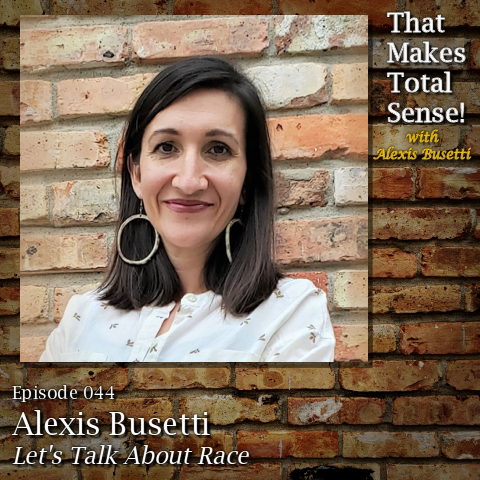
Speaker 0 00:44 Hi, I'm Alexis B steady and welcome to that makes total sense. I am so glad you're here. And if you have listened to the podcast before then, you know, we talk about faith, finance and everyday life. And if you are living and breathing in America right now, then you know that we are talking about racial injustice, systemic racism, white supremacy. Um, we're having all of these conversations in America right now. And I am so thankful and I hope you are too. The reason that I'm doing this specific episode is because here we talk about faith finance in everyday life, across the country. We're talking about racism, and I think it's extremely important that we keep that conversation going. And I wanted to take just a minute and break down this, this larger race conversation into these three categories and give us some context for how racism relates to faith, finance and everyday life.
Speaker 0 01:46 So I'm going to do that in a minute, and I'm going to do it in a, in a couple of different ways. And the first kind of run through those three things. I am going to talk about some, I mean, just a tiny bit. I'm going to barely scrape the surface on the history in our country of racism, having to do with faith finance in everyday life. And then I'm going to come back around and give us as people who are walking through this together, I'm going to give us some suggestions for where we can go next, some action steps for how we can move forward in those three areas of faith finance in everyday life. So hang with me. I think it's going to be a lot of, I think it's going to be a lot of fun. It's going to be really, hopefully informational.
Speaker 0 02:32 Hopefully this will spur you on to good works. Hopefully we can do that for each other. I do want to give you just a tiny bit of background here. I was listening to another podcast I got about halfway through the episode this week and it was NPR code switch. And the title of the particular episode was something like why now white people, which I thought was, which I thought was great. I thought it was hilarious, but you have probably noticed that even though we have seen these kinds of events in our country, before we have seen police brutality, we have seen black men be targeted in a violent way. We have unfortunately seen these things in our lifetime over and over and over again, but something is different right now. There are protests. I think there have been protests if I'm not mistaken every single day, since the weekend after George Floyd's death, we're talking about it in the arena of politics.
Speaker 0 03:36 We're talking about it in the, um, in the church arena we're talking about in education, uh, stores and brands are coming forward there. Um, people are donating to causes like the United Negro college fund and the NAACP in, in numbers and in financial numbers that they haven't seen in a really long time. And so something is happening. NPR code switch said why now white people, um, which I think is valid. And so I'm hoping to kind of walk through this with my listeners. Some of whom are white and many of whom are not, but to walk through this together, I bring up this episode partially this why now white people episode two, recognize that this is an area that many, specifically, many white people in America may have never really studied. It might not be something that has ever, um, peaked your interest. Um, you may not have necessarily felt drawn to, um, you know, watch any documentaries or read any books or anything like that in that area.
Speaker 0 04:43 Or maybe, um, you know, maybe just one or two, but it was in college or something like that. And so I want to be able to be a part of this conversation and kind of walk through this, um, with my listeners, a little bit of my background though, before we get started is that I have been, I'm no expert, I'm no expert and I'm no historian. So I'm gonna throw that out there right now. But I will say, I remember the first time that I was introduced to the phrase white privilege when I was in undergrad. So this was almost 20 years ago. And I remember I'm studying people like Jane Elliott and some of her studies I'm looking at checklists, you know, you might be experiencing white privilege if, and you know, there's a long list. I remember having those conversations with my friends and, and my husband, um, after we got married.
Speaker 0 05:37 And so, so it's been 20 years when I was first introduced to that phrase, that, that honestly, I think some people are just now being introduced to this year. Um, then fast forward through, um, through college and I go onto graduate school and I have a master's degree, um, in organizational studies and social justice. And so I was able to, to look at some of these issues of systemic racism and white supremacy and racial injustice, how do they affect our organizations and how can we move forward towards social justice while keeping in mind, um, you know, cultural, inclusive, um, uh, cultural inclusion and diversity and, and all of those kinds of things. Um, fast forward, more, I'm a reader I love to watch documentaries. And so spattered throughout in my, um, adult life are books and documentaries that I have read on this subject for many years.
Speaker 0 06:37 Um, about seven years ago, we first applied for adoption and, um, we ended up bringing home our son from Africa. And, um, and so before that I was an before that, and during that process, I was reading books on transracial adoption. And what does it look like to have a family that is transracial? What are the experiences, what about self identification for children? Those kinds of things. I actually just skipped over the part of my career where I was in state social work and was I'm doing these kinds of ongoing continuing education, ongoing training, and some of these areas as well. And so I bring that up again, not to say that I'm an expert, not to say that I am a historian on this, but to say that this has been something that has been on my radar for 20 years plus. And so I'm just going to share some of what I have been learning and, um, and open that up to you.
Speaker 0 07:38 And then hopefully you can take some of these resources and I'm going to mention, you can run with them yourself and continue these conversations in your own action steps in your own sphere of influence. So here we go. Let's talk about faith finance and everyday life. When it comes to racism in America, first up faith as Christians, we need to recognize that there has been a 400 year history of systemic racism in our country, beginning in 16, 19, when slaves first hit our shores as colonies. And that the church in America has been complicit in that racism from the very beginning. It is sobering to think that that's how it's been. It's sobering to learn about some of that history, but we need to recognize that where we are now is a product of where we have been. And if we can have open spiritual eyes to learn that, to have godly grief and repentance over that and to change our future, um, then it's going to be better for everyone in the long run.
Speaker 0 08:48 And our church here can begin to look more like God's kingdom in heaven. And so what are some of these areas where the church has been complicit in systemic racism, slavery, slavery itself? Um, there are, I'm going to, I'm going to throw out a couple of books here. Um, one of them is currently on the New York times best seller list. It's incredible. It's called the color of compromised by jemartisby, um, where he specifically does this as a historical survey of the church in America. And it is incredible. It's a wonderful place to start. Um, also if you catch it on Amazon prime, the video study has been, they're free for prime members. Um, and it's several videos where Jomar is talking about this in video study style that goes along with a book and it's, it's also great. Um, another book that is not specifically about church history, but about, um, the beginnings of racial systemic racism in America.
Speaker 0 09:51 It definitely touches on that. Um, not just touches it definitely. Um, definitely goes, everybody goes kind of pre slavery is, um, Abrams Candy's book stamped from the beginning. And so that's a, that's a 500 Pedro. I'm not through that one yet. Um, but that's also a good resource in this area, but back to slavery, there were questions about slaves in America of whether or not slaves could even receive Christ. Could, were they even, uh, physically spiritually? Was it even possible? That was one of the questions. Another question was for people who believed it was possible, what then if they were baptized as believers, um, could they still be slaves? Should they still be slaves? These were all, these were all questions that the church was wrestling with at the time, several denominations split over some of these issues, including could church leadership hold slaves. Um, I was shocked the first time that I heard growing up as a Southern Baptist, that this was the issue that divided our denomination and why the Southern Baptist convention became the Southern Baptist convention.
Speaker 0 11:13 And it was because they were okay with their leadership and missionaries holding slaves while the Northern Baptists were not, they rejected that the same thing happened with the Presbyterians and the Methodists. And so this is, um, a good place for us to kind of dig in, to read about our history and then determine, you know, how we can pray and how we can help our churches and our church families move forward. Um, so that is one kind of little bit that we can talk about on faith. Um, let's move on to finance. This is one of those areas that is also really close to my heart. I have talked about this at my kitchen table with friends. I have talked about this in finance groups, um, with black couples and specifically talking about disparity of wealth and home ownership. So I'm going to give you a couple of stats here in 1968, and these numbers have been adjusted for inflation, and I will link this.
Speaker 0 12:20 This is in a Washington post study in 1968, a typical middle class black household had $6,674 in wealth compared with $70,786 for the typical middle white middle class white household. And this was in 1968. Now, of course, we're just coming out of the civil rights movement in 1968. We can clearly see why there might be a disparity then. Um, but let's look at the 2016 numbers and the typical middle class black household in 2016, the wealth, the total wealth was $13,000 compared with almost $150,000, one 49, 703 for the median white household in 2016. So if you look at the percentages, it's actually slightly worse right now than it was in 1968. And so the, the wealth gap is slightly greater now than it was in 1968, just coming out of Jim Crow. And so we have to look at that. We have to look at that and, and see why, again, the history, this is hundreds of years of history, but one of the major reasons why is because of home ownership, if you have not heard of the, um, practice of red lining, I encourage you to look that up.
Speaker 0 13:54 I will also link a book called the color of law by Richard Rothstein, who talks about this very thing, which basically was a systemic. It was a, it was a, it was a systemic, uh, issue in our country where, um, everyone from banks to govern local governments, to realtors adjusted the housing in cities in America, where black families either were refused to, uh, they couldn't buy homes in certain areas. They could only, they were white only homes, or if they could buy homes at all, they were, the rates were so high. Like all of the terms were completely ridiculous for them to be able to afford a home that they were forced to continue to rent. And if you, um, I'm just going to let you know that you probably know this and you, if you think about your own family's history, then you can, um, probably more easily recognize this as that home ownership is the most efficient, effective way to pass down wealth generationally.
Speaker 0 15:05 So to have that ability to pass anything down from your, you know, your parents, to, to you, to your kids, et cetera, et cetera, it begins with home ownership in America. And so if you're not able to own a home, then you're not able to build wealth. If you're not able to build wealth, you're not able to pass any of that wealth down to your children or your grandchildren. Um, one of the quotes from Darwin, dr. Martin Luther King, that I think encapsulates this so well, is it's all right to tell a man to lift himself by his own bootstraps. But it is cruel just to say to a bootlace man that he ought to lift himself by his own bootstraps. And that is really what America did largely with the practice of red lining is, is we told black America it's all right, lift yourself up.
Speaker 0 15:54 You can do it know, live the American dream, but then put all sorts of blocks in their way so that they actually couldn't fulfill that dream. And so that is one aspect of finance. I encourage you to look up that book. I encourage you just to Google, you know, red lining and America. And, um, and look at that, um, racial wealth disparities, um, regarding race, um, and finance in America. Lastly, everyday life. This one is the, is the hardest one sometimes because I don't know a single person in my everyday life who self identifies as a racist or a white supremacist, but Angela Davis activists, Angela Davis pointed out. She has a quote where she says in a racist society, it is not enough to be non-racist. We must be anti-racist. And again, I'm just going to ask, ask us all to open up our spiritual ears and our spiritual eyes, because I lost some people when I said in a racist society, because there are a lot of Americans who do not believe that America is a racist society, but when we look at racism in a racist society or systemic racism as stemming from power, um, we can see that just in those couple of, of, of hot topics that I've talked about right now is that, um, the majority culture has had the power in America and they have used that power.
Speaker 0 17:27 Oftentimes the majority culture has used that power to oppress, um, specifically black Americans, but indigenous Americans, people of color in America, we have used that a majority culture has used that to oppress them. And so in a racist society, it is not enough to be non-racist. We must be anti racist. And so I'm in this area, I'm going to, I'm going to list a couple of books again, right now. One of them is white fragility by Robin Dangelo. I think it might be number two on the best seller list right now, and also how to be an anti-racist, which I haven't read, but my husband and I have each, um, either are reading or have read other books by, um, dr. Abrams Kendi. And he, um, has that one, like I said, is sold out bestseller right now, how to be an anti-racist. And so one thing that I want to look at here in our everyday life, we, we can see what's happening right now in America, that there is this major shift right now, this major turning point.
Speaker 0 18:33 And I would say, yes, yes. And amen to this. I am. So, um, I'm hopeful and I'm excited to see what's happening right now, but at the same time, I am sobered by what has happened in our past already. So if we go back to the civil war and chattel slavery, predating the civil war, we can see that our country was founded on racist principles, um, that are very much still in play today. And so the civil war was, um, a war fought on slavery, not on racism. And I'm taking this from, uh, my conversation with, uh, the soon to be Reverend dr. Malcolm Foley, which I will, which I will link. He is at Baylor university department of religion, did his, has, is currently doing his dissertation on the history of lynching. And we talked about how the civil war, which again, another turning point, another place that maybe we could be hopeful, um, was a war fought on slavery, but we saw racism continue.
Speaker 0 19:33 Obviously after that, then we go to the civil rights era, Jim Crow era, and we see, um, you know, segregation and voting rights and, and that movement in the 1960s, um, to, to create and give more rights to black Americans, to people of color in our society. And many of those battles were won, but the civil rights movement was a war on Jim Crow, not a war on slavery. Um, not a war on racism, sorry, because we have seen racism continue in America. And right now, um, there is, there are some battles that I think do need to be fought. The, some conversations that do need to be had about, um, police violence and mass incarceration and, um, and these kinds of things. But even in this, those are the topics of conversation and, and it's not necessarily racism at its core. And so we need to step up and fight racism at its core.
Speaker 0 20:38 We need to be anti racist. And so I want to go back and talk about these three things and how can we, what are some, what are some areas where we can take some action toward that anti-racism in each one of those. And so first faith, here's the first thing we need to look at our own hearts and repent racism is a sin problem, and we need to recognize that, but I also would urge you to look at racism, not only as a personal sin problem, but as a Christian community problem. And so here are some action steps, repent. Um, I wrote a blog article and did another episode on that. I've got a sample prayer that you could use as a starting point, just to ask God to examine your own heart. And, and this is something that I have to do continually, um, because I want racism gone in my own heart.
Speaker 0 21:39 I want those roots pulled out. Um, we also need to study for ourselves. We need to listen and we need to learn some action steps. You can do take a look at your own congregation where you currently are, ask yourself some questions. Does everyone look like you? Is my pastor talking about this is the leadership talking about this. Maybe in my congregation, everybody doesn't look like me, but in the leadership, does everyone look like me? Um, if so then maybe it's time for a change. Maybe it's time to raise some of those issues inside your church family. Right now, I'm going to link here the ministry of a couple in Houston who give pastors tools and train churches on leading from the heart. When it comes to increasing diversity and their congregations, it's called the sailor project. Adam and Randy Blair are the founders, and they're actually gonna be on the podcast in a few weeks.
Speaker 0 22:37 So stay tuned for them. But those are some action steps that we can take in the faith department, combating racism, um, finance. This one, there are a few things here we can do. Maybe it's not time to move. I'm not trying to suggest that you, that you pack up and move, but I would say, take a look at your neighborhood and maybe do a little bit of research into your HOA or into your neighborhood's history. Look around. Um, there have been some stories about some subdivisions here in Houston in the last several weeks where racism and red lining were actually made abundantly clear. Once someone just decided to take a look. So the first thing is in your current HOA, are there still provisions that only allow for majority culture to live in your neighborhood? If so, it's time to talk to someone about taking those out.
Speaker 0 23:35 Maybe you say, well, it doesn't really matter cause we don't abide by that anymore, but yes, it's time to remove those. Anyway, we don't want those in our bylaws. And so I would ask you to be the person who steps up and takes a peek and, and looks to see if that still exists. This one might be a little harder, but what about the names in your area? Do you live in an area that is a plantation? Do you live on Confederate court or a Robert Lee drive? Um, if so, let's start to look at some of these and, and see what could be done to changing some of those names, at least bringing at least bringing them up. Um, another finance thing real quick. And I didn't mention it in the, in the red lining section, but I will say support black owned businesses. This is something where we can say we vote with our dollars.
Speaker 0 24:27 Um, several years ago when I was first starting to learn about, um, chain of supply and, um, fair trade when it comes to apparel and accessories and even coffee and chocolate. When I started educating myself on that, I started to make more, um, and make choices that were geared more toward ethical, um, ethically produced products and doing that. I am voting with my wallet, that that's the kind of world I want is, um, is not a world with, you know, child labor and sweatshops and all of those things. And so, and so you can also do the same with your businesses and in what you spend your money on every day, seek out black owned businesses, seek out small black owned businesses, big black owned businesses and support those with your dollars. Okay. Everyday life. Um, like I mentioned, we're trying to be anti-racist here in part of that is going to come from looking at ourselves.
Speaker 0 25:24 And so I want to bring up a story from a book that I'm currently reading, called reading, cycling the white church by David Swanson. And I bring this up because he begins the book by giving a story in his own life where he had a picture in his mind of someone who was causing a disruption right outside of his home and in his mind in a split second between when he heard the disruption. And when he, when he recognized what was happening, he saw a black male teenager in his mind. And when he got there and saw who was actually causing the disruption, it was a college age, white guy. And the point that he was telling the story is we all have internal biases and we really need to look at those and ask God to change those in our hearts. And to start to train our minds where those biases become less and less and less.
Speaker 0 26:20 I have my own stories. I can tell you about that. The reason I'm bringing up David Swanson's is because he's literally written a book on racism in the church. He's literally written a book called recycling the white church. And I'm saying if, if he is admitting his own biases, then we can do the same. And so that's going to be part of what we do in our everyday life, but it doesn't stop with that. That is an action step, but let's take it outside for a minute. What about just speaking up? Not everyone has a blog or a podcast, or is an author, or is a speaker and you don't have to be, um, I'm using what platform I have, I'm trying, but I'm also doing things, um, in my neighborhood. I'm trying to be more bold. I'm trying to speak out in love. Um, not to cause offense on purpose, not to, um, cause anyone to be uncomfortable on purpose, but just to speak up and start having those conversations.
Speaker 0 27:26 So what happens when you're at work and somebody makes a racist joke, um, speak up for what's right. You know, what about at Thanksgiving when everyone starts talking about all the things you don't want to talk about, maybe you can talk about them in a positive way and, and be, um, have those anti-racist conversations in that space. I'm thinking about the term that we all started using after nine 11, which was see something, say something. And when we see something that isn't right, when we see something that's encouraging racism, when we see something in that space, we, I think we're at the point definitely now where we should feel a responsibility and an obligation to say something. And so I'm going to encourage you to do that. It is not easy. I am trying to do those things as well, but it is not easy, but it is the right thing to do.
Speaker 0 28:22 So those are the three areas right now. Again, it's kind of one, right? Kind of one little example, one piece in each one of those topics, but it is definitely a place to start. And so I am going to link all of those resources that I told you about. Plus some bonus ones, just for fun, to give you a place to continue your journey in this. But Hey, reach out to me. You can email
[email protected]. I would love to know what you're reading, what you're doing, what you're saying, how your community is responding and engaging in this conversation right now to be anti-racist in America. So let me know. Um, and so I guess that's it, I guess that's it. I just wanted to have that conversation and give us a little bit of a, a place to go when we're talking about racism in America, in the context of faith, finance and everyday life talk soon. So thank you again so much for listening. Don't forget to subscribe. So you won't miss an episode, share the link with your friends. You can visit
[email protected]. And until next time, this is Alexis Piseti remembering to do well for ourselves so we can do good for others.
Speaker 1 29:48 <inaudible>.