Speaker 0 00:00:00.0300000 <inaudible> hi and welcome to that makes total sense. The podcast where we talk about faith, finance and everyday life in a way that makes total sense. I'm your host, Alexis obesity on this podcast, you'll hear the personal stories of friends I'll be interviewing, who are doing familiar things in new and innovative ways. We'll answer questions specifically about money and our relationship with it. And we'll explore faith and Bible teaching together in all of these. It's not about changing our convictions as much as it is about messing with our methods. We'll have a lot of moments here together where we pause then say, that makes total sense.
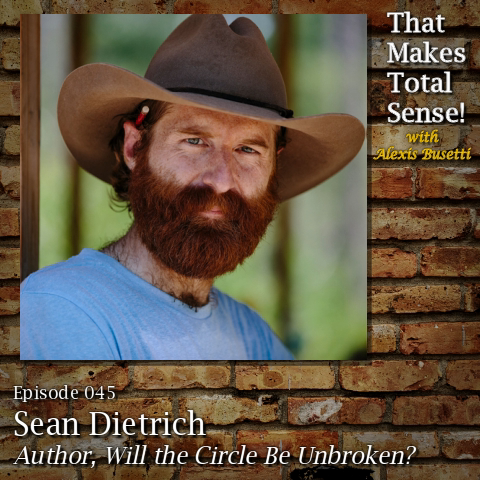
Speaker 0 00:00:44.0800000 Hi, I'm Alexis Piseti. And this is, that makes total sense today. I am bringing you a conversation I had with Sean Dietrich, better known as Shawn of the South. Sean is an author. He has a, an incredibly popular blog and he also has a podcast. And today we talk about his memoir. This is his most recent book. Will the circle be unbroken and memoir of learning to believe you're going to be okay? And I just knew I had to try and get Sean on the show because this was one of the most enjoyable memoirs I've ever read. And if you know me in real life, then you know that memoirs are totally my jam, but this was one of the most incredible memoirs I've ever read. It was of course, well-written Sean is a story teller, I would say by vocation, he's a storyteller. And so, um, and so the way in which he communicates his story is incredible.
Speaker 0 00:01:50.3800000 I have I told Sean, um, that I felt like I got whiplash in the best possible way. I was crying one moment in laughing my head off the next moment. It was incredible. And so we talk about this book, but we also talk about, um, growing up in the South, I could relate to it because of my Bible belt upbringing. And really we focus on the healing nature of a story. You don't have to be a vocational storyteller like Sean, for there to be healing in you telling your own story or us telling our own stories. And so Shawn touches on that as well. So I really hope you enjoy this conversation I had with Shauna the South, Shawn Dietrich. Hi everybody. I am Alexis B SETI and you are listening to that makes total sense. I am telling you, I love, love, love a good memoir and sitting in front of me right now is one of the best ones I have read of late. And it is called will the circle be broken a memoir of to believe you're going to be okay by Sean Dietrich, Sean of the South. And he's with me today. Hey, Sean,
Speaker 1 00:03:07.5399999 Hey, how are you doing?
Speaker 0 00:03:08.9600000 Oh my goodness. I'm I'm doing well. It's kind of crazy times right now, but I'm so glad you're with us.
Speaker 1 00:03:15.8100000 I'm glad to be here. I'm glad to be here.
Speaker 0 00:03:19.3600000 Yeah, no sweat. And you're kind of going through crazy times. Let's just tell everybody in case we get like a, you know, something honks or something like that. What are you guys doing right now? You and your wife?
Speaker 1 00:03:30.2299999 Well, right now we're in the car on the way to Disneyland, to animal hospital, uh, about three times over two counties over from us. Uh, and because last night while we was having supper, this a big smack on our window happened and, uh, my wife and I both heard it and we stopped eating. We went outside and there was a little red bellied woodpecker that had flown into our window, fledgling this to a young bird. I went out there and Jamie picked it up and we, our dinner got cold and we were just, you know, looking at this little bird. And anyway, it was pretty stunned. We'll put it into a little box, those shoe box lined with straw, and this morning woke up and it's still alive. It's pretty feisty. But we figured out we have no idea how to feed it.
Speaker 0 00:04:20.7900000 Yeah.
Speaker 1 00:04:21.6300000 There there's some experts who know how to feed it. So to make a long story, even more tedious and boring, uh we're we've named the bird either Woody or Bernie or what is it? Dammit. Beatrice. We made a name, but what are your bedrooms? If it's a girl? So,
Speaker 0 00:04:36.7600000 Oh my goodness. I love it so much. Well, I mean, I just feel like this is kind of, um, this is kind of life right now, you know? Uh, so anyway, so that's, that's really sweet. So, um, you said to make a long story, even more tedious and boring, but here's the situation you are a storyteller, like your storyteller and this book I told you before we started recording, it gave me whiplash in the best possible way, because you're storytelling throughout this book. And we'll talk about what it, what it's about in just a minute for everybody. But I, there were moments when I have tears in my eyes, I'm crying and then I get to the next paragraph and I like spit out my coffee. Like I'm, I'm like just dying, laughing. And, and, and it's funny because my husband is not, he's not like, uh, he's, he's very emotional, but he's not super, super expressive. And so there were some of these places where I had dog-eared and I'm like, you have to hear this. Like, you, you have to listen to this. And I would read him like some of the funny parts and I can see him like having a straight face, having a straight face, and then he just can't hold it. Like, he, he just can't do it anymore. And he just busted out laughing. So, um,
Speaker 1 00:06:00.0500000 Oh my goodness. I need to give you a raise.
Speaker 0 00:06:03.7800000 That's what my husband always says. He's like, Oh, you know, 20%. I'm like, well, maybe 20% in that. Nothing. I know what that is. So there you go. No, but it's so good. So can you tell us a little bit about, um, what your book is about? Will the circle be unbroken?
Speaker 1 00:06:21.2800000 Sure. Uh, the book is pretty much just a, uh, a lot retailing of my life. You know, I realized when I started riding it, that you really, really gotta be brief when you talk about telling life. Cause there there's so much more, you want to say, so there's so much not that you, you know, there's no room to say, so it's a really, a lot more, uh, challenging to keep a book sorter, then you naturally want to keep it. So my it's my life and index, uh, beginning with when my father committed suicide and I was a boy. So that was the most pivotal part of my life. So that's where the story begins because the me that I am now is a direct result of that. So I start there and I, I tell the story going all the way to present Bay, uh, you know, to, to be kind of interesting to a very, very plain individual that I am now, which I'm proud to be playing in normal, uh, because I, I liked normal things better than I like exceptional things.
Speaker 0 00:07:35.9100000 Well, I just think if, if you call yourself normal, I just, I believe you. Um, but it's just a reminder to me that, you know, in Jesus, we're all exceptional, right? Like we all have a place, we all have a story. Um, he gives us all hope. And, um, and so I believe you, um, when you say, uh, you're normal, but, um,
Speaker 1 00:07:59.2300000 Well, and as I say that sort of, uh, I say that sorta because, uh, growing up the way that I did, which was, you know, I grew up pretty tough. It was, it was a, it was a tough life. We were not normal. And all I ever wanted to be was just a regular guy. I just wanted to be the regular guy. You know, you're going to church, you go to church and all your friends have this degree of normalcy to their lives. And there's such a beauty in being an ordinary. Um, so I liked being an ordinary guy, but yes, I hear with, I totally hear what you're saying and I kinda agree with you completely, but I, I do feel like a regular guy. It just took me a long time to get here.
Speaker 0 00:08:43.6100000 Right, right. No, I love that. I love that. And, and, um, for people who haven't read the book yet, this was a you're right. It, I can, I can hear it in your story when you talk about just wanting, um, just wanting to be normal because how you grew up, wasn't normal. Um, I kinda want to start a little bit by saying that I could relate to parts of your story, um, because of where I grew up. And so you are Shaun of the South now, but the first part of your story, um, I could definitely relate to, because I grew up in Southern Oklahoma, which is not really the South, but it is definitely the buckle of the Bible belt. And, uh, and, uh, you're talk about fellowship halls and church ladies, and, you know, your experiences growing up in that space, um, even in, in Kansas and some of the, in some other parts before you, before you moved South, I'm like, that is, that is, I was picturing it.
Speaker 0 00:10:03.1500000 Like I was picturing the fellowship hall of the church I grew up in and I was picturing, you know, all of that stuff. And so while your, your upbringing and your story is so powerful, but it's also so, um, relatable and, um, in that way, and because I'm like, I don't even know where to start. I feel like I have so many, um, so many nodes and so many places to go because I just dog eared the heck out of your book, but maybe we could start if you just tell us, like, as a story teller. I mean, I don't know, like, I don't know, is that what you put when you have to write down like occupation? I'm like a storyteller,
Speaker 2 00:10:45.8900000 Whatever somebody wants to call me is the right thing. I don't really know what I am because I don't really feel like anything. I don't, I have a hard time calling myself a writer, even though I've always wanted to be one, because I just don't have that much confidence. But of course I do like the ride and I don't really call myself storyteller because there are real storytellers out there. And it's really hard for me to,
Speaker 0 00:11:11.8300000 Well, as a barometer for them as a person who has told his story so well, and I know you blog about it and you and you, and you've written columns. Can you just, I don't know. Maybe we can start there of like, what is it about telling your story? What happens in you? What do you see happen in others when you're willing to put yourself out there and be vulnerable and share your story? Because there's a story. My, my grandpa was a storyteller and some of the stories he told about him were about himself. And then other times he just told great, just stories, just stories. But what is it about telling a story about yourself and making yourself vulnerable? What does it do for you as the person who's doing the sharing, but what have you seen it do for people who, um, listen and read and respond to
Speaker 2 00:12:12.7200000 Telling the story is, uh, is taken a third person view from your primarily, at least when you're telling a biographical story from your first person laugh. So for me to take a third person view spanning outside myself and talking about the little boy that I was or talking about the teenager that I was, or even the adult that I am from a more of a, you know, journalistic voice is really fraying. And by that helps you stop personalizing everything that happens to you as the character of the story, rather than just you, the person. So looking at it from that angle helps you be a little more objective and helps me process and unpack the things that I've been through helps me see the good things that I didn't notice because I was too busy looking at my cuts and scrapes and try not to bleed.
Speaker 2 00:13:20.0400000 You know, it helps me, it helps me probably more than anything. Look at life itself as a work of art, instead of just this thing that's that's happening. That has no meaning. And as a, as a story telling practice, you get the freedom to get that little piece of artwork, whether it's pretty or not pretty, or whether it's, uh, impressionistic or ultra realistic, whatever style of art your life has been painted in, you get to choose the frame and building that story helps you choose, do I, do I frame this and I, and a beautiful gold frame, how am I going to look at this story? How am I going to, how am I going to choose to see this story? So that's how I've always felt. Storytelling is kind of a, kind of a, it's a way of, it's a way of accentuating the, the art and the art of it all. Wow. So
Speaker 0 00:14:29.4700000 That is profound. Yeah. Yeah. That is, that's really, that's really profound. And, and, and I just, in, in that, I hear, you know, you said freedom in that. I hear freedom. I hear healing. Um, I hear perspective. Um, I hear what we've done, what we can all do, even if we're not writers, um, or storytellers, we can practice that. We can take a step back from our own story and look at it, like you said, in a, in a journalistic point of view. Um, that's amazing. That's beautiful.
Speaker 1 00:15:08.6200000 Well, I, I'm an, I appreciate you. Uh, I appreciate you saying it's profound, but truly, I believe that, like you said about your granddaddy, I believe the older generations kind of knew this before we did. And it was to them just totally natural and normal, and to you and me, it's become very unique mile because our culture doesn't really, uh, we don't really do that anymore. You don't really go to somebody's house and see them all sitting on the porch. If they're under the age of 40, or even under the age of 60, you don't really hear them telling the stories like he would have 40 years ago, 40 years ago, you would have gone to the porch, you know, in Southern Oklahoma where you lived. Uh, and you probably have seen, I could almost bet you, because it was all over America. You would see old men sitting on the porch telling the stories about their life. Right. And I just loved that. My just locked that tradition. And I like to bring it back if I can, but in my own life Academy, now
Speaker 0 00:16:16.8900000 It is it's, it's, it's profound. It is profound and you're right. It, it is how it used to how it used to be in an, there were stories we used to kind of say in my grandpa's voice, he's passed away now, but we used to say in my grandpa's voice and, and we would kind of repeat those stories, uh, because you know, we've heard them, right? Like, we've heard it,
Speaker 1 00:16:43.2700000 Remember him, you remember the really good ones they stick with you, there's something about,
Speaker 0 00:16:49.3400000 Right. Right. But now it's, it's, it's reruns have taken the place of that. We'll, we'll watch, we'll watch a rerun over and over on TV. Um, because yeah, because we've lost the practice of our, grandpa's telling us this stories and our, our, our people telling us the stories. Um, what kind of, what kind of responses do you hear from people? And I'm, I'm, I, I can hear your humility and I don't, I'm not asking you to step outside of your humility, but what kinds of responses are you hearing from people who listen to your story, um, and listen to your stories, how is it affecting them, uh, to, to kind of be inside of that culture, at least a little bit to step inside of that culture of storytelling? Again,
Speaker 1 00:17:44.0400000 I don't know. I mean, I don't, uh, you know, I don't really have a message. I don't have a, I don't really have anything to get across. I never really felt like I, I have, like when we do before the quarantine head, I was, we were on the road, uh, 85% of the year, uh, going across the Southeast. And I would do the, you know, I did storytelling stuff at like old theaters and, uh, various, uh, nursing homes and rotary clubs and wherever they had sandwiches. Uh, I would tell these stories and they kept this busy, real busy, and I had never, ever planned on doing this for a living. Nobody grows up and says, you know, I want to be a storyteller. That's not really even a job. It doesn't even, it doesn't even, you're not going to find that on the us census Bureau form.
Speaker 1 00:18:38.8500000 So, so I would go and do this, and I really, really got into it. I did not ever expect to do this with my life. I don't really think I'm great at it, but I enjoy it. I really do. But truly what it turns into when you are telling your story, uh, in front of people, at least you are really trying to entertain them. You're not just trying to, to, uh, you don't have, I don't have anything to get across. I just want them to feel good. That's it, that's really, my only quest in this world is somehow to make people feel good, even if it's just for only about five minutes or however long I'm around them. If I can do that, then I did it. That to me, that's, that's my purpose on the planet if I have one. So I don't really know, you know, if anything honestly makes a difference, but I certainly do know that we have had some fun going around and doing this.
Speaker 1 00:19:47.9400000 We'll have a bluegrass band playing and you know, everybody's clapping and then some guy jump up and he'll just start buck dancing in the center aisle, and then I'll get up and I'll tell a story and we'll laugh. And everybody's everybody knows, uh, a church lady in their life that I talked about. Everybody has one, everybody can relate to funeral, potato casserole, you know, and fried chicken. And, uh, I find out that we're all a whole lot more the same than I ever thought we were. So if anybody gets in and out of the storytelling, it's me, I think, figure out that we're all more alike than I thought. So I don't know if that answers your question or not, but
Speaker 0 00:20:27.0200000 I love it. No, it's good. I mean, it can't. Can I ask you to tell the story? I know Jamie's with you, will she mind, can I ask you to tell the story of how you guys met at that fellowship?
Speaker 1 00:20:43.4600000 Yeah. Eh, keep it short basically. Uh, our church did these covered dish socials. Uh, it was, you know, it was a saying, and so, uh, for me, food has always been extremely, uh, important and ain't nothing better than church food. Right? I love it when the little old ladies get together and give you their best. So, uh, we, we all were at, this was an I covered dish social, and, uh, I heard her before I met her. I could hear her across the room. She's got the loudest voice or had the loudest voice out of that entire congregation. She's a loud talking woman and she gets it. And actually her, her, her, I answered loud. Her daddy is loud. She is a loud woman and it's not, it's not, it's not easy to hide. Uh, in fact, not long ago, we were
Speaker 2 00:21:49.7500000 Doing a show in Milton and when the people were filing into the seats and stuff, and the band was playing, uh, there was a guy in the audience who called one of the, uh, ushers down and said, Hey, can you get that, that lady right there? And in front of me to stop, you know, the show's about to start, can you get her to shut up? And the announcer said, uh, sir, if you want to tell her to shut up, that's on you, but that's Sean's wife. So that's my wife. So I heard her speaking and I heard her, uh, before I saw her. And anyway, we, we really hit it off. And instead of, instead of, uh, acting like we, we, uh, instead of going through any of the bats or motions, we just fell into each other's company, pride away from that first moment when our hands were greasy, eating all that greasy food. And we just touched elbows instead of anything else. Uh, I just, you know, we, it, it just worked. So, uh, so I remember when she told me to go and refill her tea without even knowing me or knowing my name even all the way and knowing who I was, but she just has a red solo cup and says, go get me some more tea. I knew then that, uh, that she would probably be the president of my life.
Speaker 0 00:23:14.8400000 I love it. I love it. It's, it's just, it's my favorite, but it is you're right. We have, um, everybody's been to a church social everybody's drank out of those red solo cups and eaten the fried chicken. And, um, and I just, I love, I love that. Um, I've got one more, um, one more story that it just really stuck out to me when I was, um, reading your book. I mean, lots of them did, like I said, a dog year, quite a bit of it, but, um, that was a very normal thing to kind of go back to what you were talking about. That was, that was a very normal, um, normal situation, but to go back further after your dad died and, um, before and after that, when your life wasn't normal and you just wanted it to be normal, um, and you were, um, you guys had, had moved in and you were helping your mom.
Speaker 0 00:24:19.9099999 And one of the things that was not normal about your life at that time is you were having night terrors. Um, and, and you say in the book, you tell, um, tell about a situation in the book where you're having night terrors and you turned on the TV and there was a televangelist on, at three o'clock in the morning or something crazy like that. Um, and, and I just wrote down the note, God sees you, can you tell us about that moment and what shifted and changed in your life? How old were you and what, what was going on and what happened in the aftermath of that?
Speaker 2 00:25:13.9800000 Oh, uh, well, well, I don't know exactly how old I was, uh, when I was a boy and, uh, not tears are something I still have. Uh, you know, you go through trauma and you don't ever there's, it, it makes a, you know, an imprint opera in the cement of your mind, that's forming. And, uh, but the only time you can really, you know, you, you spend most of your life holding these thoughts back so that you could function. And they had a life. You know, my, you know, we went through trauma with my father and what he put us through before he passed. Uh, and it was, it was traumatic for me, my mother and my sister. So we all kind of had this, but in daily life, you push that back so that it's not there, so you can function. And then it might, you, your restraints kind of Slack, they loosen up because you're sleeping.
Speaker 2 00:26:15.4500000 I'm mean this is what a therapist wants. Don't mess. I'm not, I didn't make this up. And, uh, all these thoughts that you have and all these fears and the after effects of trauma that kind of just come out to play. And for some reason it's worse when you're dehydrated. I don't even ask me how that works, but it is. So the doctor's saying, you know, my treatment, plenty of water it'll help with those. So anyway, uh, I, I, I've struggled with those for a long time. Uh, and I would have these, these not tears that keep me up, uh, this horrible dreams to the point where I kind of got used to him. And when I didn't have him, uh, it was weird. You know, it was just, I was used to having something and when they didn't happen, it's just so like, Hm.
Speaker 2 00:27:03.0500000 That's bizarre. Well, uh, I think it was about, you know, when I wrote that story that you just said that one night, I think that might've been a turning point for me to realize that they weren't a bad thing. You know, they're not, tears were not a bad thing. It was, it was pus and infection working its way out of my, of myself, of my life. And there's so many thoughts and feelings that people, my family or people who've gone through, trauma are afraid to touch. They're afraid to talk about. They're afraid to mention, they're afraid to think about because of the pain that they'll bring. So they don't, and a lot of people even worse. Uh, and I don't mean this to sound critical, but a lot of people that I know, you know, in heavy religious environments will use religious speech to mask that, and they'll explain it away.
Speaker 2 00:28:09.5800000 And they'll say, you know, but this is not how we're supposed to be. And we're, we've not been given this spirit of fear and blah, blah, blah, and they'll use it to, to hide behind, right. Instead of just letting it come out, which I, I feel like is the most healthy. So I think perhaps that lady on the phone, uh, and even to some degree that greasy hair televangelist, uh, inadvertently let me know that it's okay, let them out, let them, let those fears come out and dance around. Let that person infection. That's been building up and that's sore in your mind start to drain because that's the only way you can heal. So the night terrors, the more I quit trying resist them, uh, the less frequently I started to have on, and now I don't have them hardly at all. I still have them, but I don't really hardly have them at all. Like I used to. And when I do nowadays, they don't even bother me. They don't even know they don't even do anything to me. That's just kind of a remnant. They're almost in some bizarre way. They're almost nostalgic like, wow, I had a bad dream and I'll wake up. And I remember the kid I used to be and the brains I used to have, and I think of how far I've been allowed to come. So, wow. That's powerful.
Speaker 0 00:29:42.7599999 That's, that's really powerful because it is, I agree with you. It's, it's like the, the stuff that's, um, that's coming out that needs to be, um, that needs to be led out and you don't have to be afraid of that happening, but that happening is important.
Speaker 2 00:30:02.5400000 Yeah, I agree. I think, uh, I think, you know, not trying to, to hide is kind of a, it's kind of a, been a big theme of my life. Not trying to, to avoid, not trying to, you know, being vulnerable and talking about things that are not easy to talk about has not been the Potter in my family. So when I talk about them and opening up that, that, you know, dialogue, I guess you'd call it, uh, has, has brought up big change in our lives. Uh, and in my personal life, just being able to talk about it, it, it, it desensitizes you to it at first and that helps you. I don't know. It helps you.
Speaker 0 00:30:54.3000000 Wow. That's yeah, that's really good. And, and there are parts of your book. I love how you, you tell your story and you, and you say that exactly what you just said, that this hasn't always been a part of, um, of who you guys are as a family, but this has to have had reaching effects positively for your mom and your sister. And you were so respectful and kind and honoring in the way that your story, um, to, to all of your family, um, including to your dad and to his memory. Um, but tell us a little bit about your, your mom and your sister and the strength that they, um, brought to you. And, um, I don't know, maybe this, and maybe some of the ways that you share your strength with them too,
Speaker 2 00:31:46.6400000 About my mother and sister, you say? Yep. Okay. Um, well we were kinda like a, you know, wounded family unit. And so you kinda hole up together in a very weird way when he goes through what we went through. So, you know, the day after he passed, we were all sleeping in the same bedroom with furniture pod against the doors. That's the fear that we were experiencing. It was pretty, pretty strong. So the only people we had to lean on were each other, uh, uh, my sister was afraid to sleep by herself for a long time. So I slept at the foot of her bed so that she had been actually blown until hours, girl, man, uh, fear became a huge, huge piece of our loss. And it showed itself in all sorts of different ways. Well, when you're afraid, nothing helps like having somebody to be afraid with it.
Speaker 2 00:32:47.8500000 It's really true. Uh, not another say misery loves company, but, uh, so do frightened people. And, uh, we had, we had each other to commiserate with, and that helps me, uh, I hear stories from foster kids if I had to go through their traumas alone and I have no idea how they would do it. I have no idea how anybody could get through it alone. Um, the, the hoard hoard that things that have happened to some kids that I have met personally and watched him kinda try to find their own way in the last one, they're confused and they don't have the throttle figure. They don't have the stable family unit that everybody else has, seems to have around you. And then I get through it alone. It's amazing. So my mother and my sister throughout all our flaws, cause we all have a lot of them and my mother's sister have probably more flowers in your family. We, we leaned on each other and we survived and it, uh, there's a bond there that is hard to explain. It doesn't look like everybody else's healthy family bond necessarily, but it's there. Nonetheless,
Speaker 0 00:34:12.6000000 When you, when you're talking about that, um, I used to be a state social worker and I worked, um, with foster kids. Um, and, uh, this was before, before we had children. That was, that was what I did. And it was convenient that we had kids because I burned out of that job, um, pretty quick because of, uh, because of what you're saying. Um, but we also have, uh, an adopted son. We have, we have four kids and one of them is adopted. And before he came home, even though I had been a social worker, I was reading every resource I possibly could get my hands on about, um, adoption and, um, trauma in children and things like that because even our son came home as a toddler, but even when you know, kids come home as babies, they're still lost, um, in their story, um, just, you know, there's loss in your story.
Speaker 0 00:35:10.7400000 There's loss in my story and there's loss in our son's story. And that's part of our job as a parent to help him, um, deal with his loss, but also to grieve with him and, um, and to, and to carry some of that with him, because that's his story, um, that he had a different family and, and, uh, one that he was born and now he has us. But one of the authors that I have read talks about children from hard places. And, um, and in a way, in a sense, I feel like we're all children from hard places, but she talks about children from hard places and what a difference she uses this term felt safety. And, and she says, because you can know as a parent that your child is safe and you can tell your child he or she is safe. But until that child internalizes that fact in a very personal and profound way, they won't feel safe.
Speaker 0 00:36:20.7000000 And until they feel safe, they will have a very hard time trusting and healing, um, from, you know, trusting anyone really and healing from any of the trauma that they have experienced. And, and I bring that up because I'm talking to you on a podcast after I read your book and, and I'm thinking there was a, there had to be a point though, um, where, and it probably wasn't one singular point, but where you personally moved from fear to feeling safe, to feeling safe enough, to trust, to feeling safe enough, to heal, to feeling safe enough, to tell your story, you know, to feeling safe enough, to go to college and, and, um, and write and blog and, and be a journalist and, and all of those things. Um, and so I don't know if it's necessarily a question, but can you, can you tell us, I mean, were there, if there was, I don't know that there was a defining point maybe, but could you tell us a recognition? Did you have a recognition from, from feeling fearful most of the time to when you started feeling safe?
Speaker 2 00:37:47 Hmm. I mean, that's a good question. It's kinda more like a, uh, it's kinda more like a road trip, uh, without state lines and County lines, and roadsigns, it's kinda like Quill, the landscape has changed a little bit. I'm not real sure which state I'm in. Am I, you know, it's kinda like a, yes. In many ways it has, there are many ways there were, there were points where I would look back and I would say, Oh, wow. You know, I'm not nearly as afraid as I used to be, but kind of, kind of the funny thing, when people write a book like this, uh, it there's a tendency for, for, uh, for some people to say, Oh, okay, well, you know, he's got it, he's figured it out. He's, uh, he's better now. And he's, he's this and that, the truth is I'm not, I have. Um, um, and I tried to communicate that too in the book. I don't, I feel just as feeble and weak now, as I ever did. Uh, I realize in certain situations now that I have learned some things and that I feel less afraid, but I just, the same week, little boy, Ellen, and I shave.
Speaker 2 00:39:08.1500000 So I don't know, I don't really know how totally to answer that. There, there are moments when I think I've come so far. And then there are moments when I think to myself, you are, you are just, you are just a kid. And so I would say it's a daily thing that I'm always thinking about. I'm always thinking about how not to feed into certain unhealthy behaviors. I'm not to feed into certain patterns of thinking that I've grown up with, you know, confidence is a big one. Uh, I didn't grow up with a whole lot of confidence and you don't, you can't really manufacture that stuff. And once you've lost a little bit that you did have, you really can't get it back either. You can always feel situationally proud, but never really never really, as confident as someone who was born with confidence, it was given conference because it's a gift.
Speaker 2 00:40:06.7400000 I think confidence is a gift your parents gave you. Um, you can never really do that with somebody. So that's one thing I'm always having to remind myself, you know, to, to, to not behave in a way that is so self effacing way under confident that you shoot yourself in the foot. Uh, you know, that's just one example. So I don't know. I feel like I've come a long way in my life, but I certainly have a long way to go. I think my highest aspiration and last is to be an old man one day.
Speaker 0 00:40:40.4700000 Right. I loved that. That was, that was something that, that really, that really pierced me when, um, when you said that, okay,
Speaker 2 00:40:50.1600000 Not new. I just want to be, I just want to see old age, that's it. And if I can do that, I'm happy.
Speaker 0 00:41:00.3000000 Well, I love it. Here's
Speaker 2 00:41:01.5200000 One thing I'll say, you know, there's one thing that I am now that I wasn't, then I haven't been until this stage of my life. And that's, that's glad I don't want to say it. I'm happy. Happiness is kind of a lesion that people chase and they, they look at it like a light switch, like you either are, or you aren't, I don't know. I think there's degrees of it. And I don't think unbridled happiness is necessarily the greatest labor, because there's always a flip side to everything you're unbridled. Happiness is just, you know, is just the biggest thing in your life. Well, there's always going to be a day that it's not there, you know? And then when that happens, how far are we out that, well, that sucks. Well, this stage of my last though, I'm really glad. I've never been that way before. I feel, I feel content. I really do. I'm not striving for anything. This is the first time of my life. That's ever been the case. I don't know how that happened, but it bombed there. And I hope to stay at least in that little pocket for as long as I can,
Speaker 0 00:42:13.7200000 Man. That's amazing. I love it. I love it. And I think those are two, those are two aspirations. I would, I would steal from you. I just want to, I just want to be an old lady. I want to be an old church lady. Like, like my grandma, I want to be an old church lady with my sticker on my CorningWare and, uh, and getting back my, my dish after somebody devours my mashed potatoes, I want to be an old church lady. Um, but to be in a place where you're not, uh, not striving and, um, and just glad that's, that's so good. Um, well, when, when you're, when you're glad and you're not striving and you're not on the road right now because of COVID, uh, besides the book, which I'm going to link in the episode notes and, um, and just keep pushing it because it's just so good. Um, where else can people, where else can people find you?
Speaker 2 00:43:17.5900000 Oh boy, uh, I'm not very good with promotion. So I guess just Google my name. Uh, cause there's a lot, there's a lot of junk out there with my name on it. I'm easy to find, easy to find that's for sure. Uh, I guess just to look me up and, and tell anybody who's reading this to drop me a lot. If they want to talk to people, I can't always respond to every email cause we get a lot, but I do love to meet new people so
Speaker 0 00:43:46.3899999 Well, I'll, uh, I'll, I'll Google your name and I'll put all the links that I find that I think are super relevant in the podcast. How about that?
Speaker 2 00:43:55.6800000 That'll work. That'll work.
Speaker 0 00:43:57.2800000 Okay. That sounds, that sounds excellent. And I don't want to keep you too much longer since you are probably getting close to, uh, to take in that bird. But is there anything that you want to say that you wish I would have asked that you want to leave people with, whether it's related to your book or not, whether it's related to this time that we're living in. Is there anything else that you, that you want to say that you wish we could have talked about?
Speaker 2 00:44:25.2800000 I think we covered a lot, you know, when it comes to the times we're living in, I would tell, I would say to anybody listening, just try not to watch the news as much as you can and try to eat good food and, and, and, and laugh a whole lot because good Lord, this is, this is really been harder than I thought it would be. It, uh, it started off from press kinda easy. Uh, we were in a hotel and I think, Oh, it's full winter. When we first saw the news reports about it on the road for this book to her. And then in like, uh, four days, everything was canceled. We had, you know, we had a whole 21 days of, of visit cities and, uh, everything was kind of told next thing, you know, we're back home. And so that was like 70 some days go now 75 days ago. And over time, it's just, it's gotten tough. Uh, and I, I feel like a full complainant cause I'm healthy and happy, but it really does. It really does take a toll on your mental health. So I hope I'm a big proponent of, of laughing and trying to keep yourself mentally healthy. Right. So I don't know if that qualifies as advice cause I don't really give good advice, but
Speaker 0 00:45:46.1500000 Right. But pay attention, pay attention to the mental health situation like you said. I mean, I feel like, um, storytelling is, is therapy in a way, um, it's healing and gives freedom. And so, um, and so that's good. That's good. Thank you so much, Sean, for your time. Thank Jamie for, uh, being with us and uh, and driving while we're, while we're chatting and uh, and you know, the best to, uh, what, what was it he or Beatrice or whoever, whoever fell out
Speaker 2 00:46:20.8300000 Beatrice or Woody, whatever, whatever the sex of the bird is, we will
Speaker 0 00:46:25.5400000 Right. We'll uh, yeah, our best to the best of the bird. Thank you so much, Sean, for coming on. Thanks for sharing your heart and um, and thanks for sharing your book and your story with us. Alright.
Speaker 2 00:46:36.6100000 Uh, it's been a, it's been a real, a real privilege. Thanks for having me.
Speaker 0 00:46:39.6100000 Thanks Sean.
Speaker 2 00:46:42.6399999 So
Speaker 0 00:46:42.9400000 Thank you again so much for listening. Don't forget to subscribe. So you won't miss an episode, share the link with your friends. You can visit
[email protected] and until next time, this is Alexis Piseti remembering to do well for ourselves so we can do good for others.
Speaker 3 00:47:01.8400000 <inaudible>.