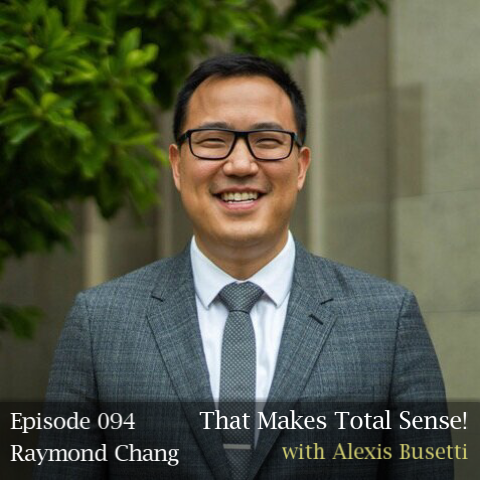
Speaker 0 00:00:07 Welcome to that makes total sense. A podcast dedicated to exploring God's generosity and justice. I'm Alexis resetting the Christian, aiming to ask good questions and encouraging you to do the same. Every one of us is wired by God to live out generosity and justice, but the house sometimes alludes us. That makes total sense is a way for us to get together posture ourselves as learners and challenge one another to practice generosity and justice in a tangible way every day. All right, so I am so thrilled to be sitting with Raymond Chang today. Ray is the, well first I should say, you're on staff at Wheaton, which is totally cool. And the chaplain's office, we have a friend who is a Wheaton grad. He got his master's there several years ago. Um, but we're chatting today because you're also the president and co-founder of the Asian American Christian collaborative. And you guys have been doing some amazing work, especially since the pandemic, which we'll get into, um, and talking about issues that are facing the Asian-American community and larger than that issues that are facing the church specifically in the U S so thanks for coming on, Ray.
Speaker 1 00:01:24 Thanks so much, Alexis. It's great to be with you.
Speaker 0 00:01:27 I am, I'm so excited to, to have you, and I'm going to ask you first, if you can tell us about, you know, in, in a, in a snapshot or as much as you want to tell us about what is the work of the AACC, why were you guys founded and what do you guys seek to do? Um, especially in our current cultural climate.
Speaker 1 00:01:49 Yeah, so we're an organization, the Asian-American Christian collaborative is an organization that's by for and about Asian-American Christians and Christianity. Um, we, you know, like Asian Americans are a very diverse kind of a people group in the United States. And so we can't capture everyone and everyone's views and everyone's perspectives and everyone experiences, but we try. Um, but we really are an organization that seeks to empower, equip, and, uh, encourage Asian-American Christians and friends of our communities to live out a more holistic faith in Jesus, uh, by understanding the contributions and the struggles and the joys and the pains of, uh, Asian American Christians and the Asian American community, uh, and beyond, and to see how God is working in and through our communities to, uh, to bring about, uh, unity, righteousness and justice.
Speaker 0 00:02:43 Amen. Amen. Thank you for your work. Um, when you say that you want to encourage, um, even friends of the community to, to follow Christ in a more holistic way. I mean, I think we probably all have like, maybe some guesses based on our own context for what you mean when you say that, but can you just describe that a little bit further so that we can cap that as kind of a foundation as we go into the rest of it?
Speaker 1 00:03:12 Yeah, I mean, I think that, you know, from the beginning, you know, God created us, uh, diverse and unified, right? And so, uh, the vision of God's kingdom as we go, as we travel throughout the scriptures is one that, um, we see how that unity and diversity was broken through sin and how sin re tremendous havoc, uh, in the lives and in the world of all the people, uh, are outstanding re tremendous havoc in the lives of all the people of the world, as well as in the world itself. And then as we traveled throughout scripture, we see how God is constantly doing this work of restoration reconciliation and renewal, uh, that really, um, climaxes at the, uh, incarnation, the life death and resurrection of Christ. And then from that, a new community is truly formed, uh, one where there's no division, uh, across, uh, the arbitrary line that kind of society and the sinfulness of society has imposed on us.
Speaker 1 00:04:18 Um, and then, uh, we see, you know, especially as we travel and Trek to the end, uh, how, if every nation tribe tongue that gets together, uh, to worship God in one voice. And so, um, I think this holistic discipleship is one that factors in the multitude of God's people in the formation of, um, of those who follow Jesus. And, uh, one of the ways that we do that is by bringing the whole of ourselves into any space and allowing the things that God is, uh, implanted or infused within us into, uh, the whole body of Christ.
Speaker 0 00:05:00 Yes. Bringing our whole selves. That was, that was like what stuck out to me the most, probably when you were, when you were talking about that, and in this, in this vision for the Asian-American Christian collaborative, you talk about issues that are facing the Asian American community at large, but how your goal within your organization is to really start tackling those issues first inside the church, before you kind of try to reach your arms out to the broader community. So talk about that because I think like, I'm like, I just feel like, I mean, yes, it's, I, I, I kind of hate when people say this at this point, but it's like, you know, the oxygen mask or whatever, but it's like, man, like, but even like with ministry stuff in, in, you know, some of Paul's letters, it's like, we've got to kind of figure out how to do things at home. Um, before we just to say, we're just gonna, you know, the whole world, and we're gonna, we're gonna bring this, you know, to everybody else. So tell us what, what does that look like? Like what's your vision? What does that look like for trying to address some of these issues inside of the church first, before you, before you attempt to go out into the broader community?
Speaker 1 00:06:15 Yeah. So I think that, you know, churches a beautifully complex organism, um, that, you know, that we know Christ died for to establish, right. And so, uh, the church should really shine the light of Christ wherever we are planted and wherever we in Christians just shining the light of Christ wherever we go. If you look at the average church today, however, um, it doesn't seem like most people would say that the church has anything meaningful to say about the problems that we see in the world and that the gospel is in big enough or expansive enough to address the, the, the issues that sin is kind of caused and created. And so our public witness is really at stake. Um, I went to a, uh, kind of, uh, uh, like a rally to, to, uh, in, in, in memory of, uh, of, of, of someone whose was, who was recently killed. And one of the things I was pretty amazed by was how the organizers of the rally actually invited a local church pastor to come and pray at the rally. You would think that a
Speaker 2 00:07:26 Church
Speaker 1 00:07:28 Would, you know, churches would, uh, you would think that churches would be actively involved in, in, in issues that impacted the community. But I asked myself cause I'm Asian American, I'm Korean American more specifically, I wondered how many Korean churches, um, would have been invited to participate in something like that. I wonder how many white churches would have been participating in it would have been invited to participate in something like that. I don't think a lot of, uh, especially Asian and white churches would have been invited to engage with issues like that because we're not necessarily known to do kind of proclaim Christ into the public square, uh, through our, through our feet, whether it's by marching or through our hands, uh, by, um, by serving outside of kind of the local church context. I mean, we've been really good at tending to our Jerusalem and to, uh, the ends of the earth, but we've been really terrible at addressing the issues in Judea and Sumeria. And I don't think that, um, that, that the Christian faith, uh, is negligent of, of Judea and Sumeria, it's actually, uh, it calls us to engage with, uh, with, with those communities.
Speaker 2 00:08:38 Wow.
Speaker 0 00:08:39 Yeah. So the pastor is invited to pray, but in some ways we're asking why is the church not organizing it? The ones organizing it, right.
Speaker 1 00:08:51 Yeah. I mean, no, I mean, even if the church isn't the one that's organizing, it's a question of like, would we even cross their minds as people to bring in to the conversation or to bring into an event? And at least what I'm hearing on the ground is that most churches don't seem to have anything to say about issues of justice because too many of our churches have divorced Jesus from justice. Uh, and so we've divorced Jesus from an essential attribute of who got his, um, you know, I think, you know, we've spent much more time focusing on issues of righteousness instead of justice, but we forget that justice and righteousness are essentially two sides of the same coin and they're both essential elements and aspects of who God is. Right.
Speaker 0 00:09:40 Which, I mean, I'm just going to be real. This is probably not a great time for me to even think about that because I, I was studying this morning and my assignment was to read Amos and I read Amos out loud to myself. It just, me and my massive was in the bedroom with me at night and I read it out loud and I went through, you know, my professors questions were over and over. We had to revisit, you know, certain parts of this book again and again and again. And, um, and I'm reading it again and again, and again, and feeling nauseated, right? Um, at, at some of the things that I'm, that I'm seeing. And I think that your point is well taken, that we have divorced. I think we've divorced Jesus from justice. Let me see how I want to phrase this.
Speaker 0 00:10:35 I think we, I think many churches have divorced Jesus from justice, but the argument that I'm hearing from the other side is saying that that's, that has to be done for some reason, because you are, you know, these places are equating and saying, this is the only attribute of Jesus that matters. And I think that maybe coming from this other side is saying that this is an attribute of Jesus that's been hidden for so long that we need to remember that this is part of who God is. This is an essential part of who God is. It's not obviously the whole of who he is, but this is an essential part of his character. And, um, and it matters. And, and we're called for it to matter to us as well for, like you said, four Judea and Samaria, right. For the people, um, for the people around us. Yeah. I mean,
Speaker 1 00:11:30 Yeah. I mean, you're talking about Amos, you know, like what does it look like for justice to actually roll down to many of us have a definition of justice that isn't actually biblical and we've become committed to that definition of justice, um, in a way that's actually hindering Jesus from shining through us and through our churches.
Speaker 0 00:11:50 Right. Right. And, and I mean, I'm reading it and like, I'm, I'm no theologian at this point, right. I'm studying, but I'm like, just off the top of my head, I'm like, some of this stuff is really stuff that we could say is totally reflective in our society right now that matters to me because I could be the one doing it, like taking advantage of someone in my small business. Right. Or, you know, exploiting my name or my neighbor, or waiting until someone else's needs fall by the wayside so that I can get up and make a buck, you know? And, um, and I think that there are all of these aspects of justice that are relatable in our everyday lives. It is not only the big things that cause, um, for us to respond in ways like, like you were saying with, with marches and protests and things like that, but it is every single day we are called to act in ways that are righteous and just to the people around us.
Speaker 0 00:12:51 Right. And, and we are called to that. God's people are called to that. Um, not just, not just everybody else. Um, anyway, um, one of the things that you have done at the AA CC that I want to draw people's attention to is you guys have written two statements in the last year or so, um, specifically drawing attention to violence and racism against the Asian American community. Um, one last year as the pandemic was, we were, we were responding to the pandemic and the lockdowns were coming and then one this year following the events in Atlanta, and I will link both of those. I have signed, um, both of those. I'm so thankful for them. I'm so thankful for the language. Uh, I think that's a, that's a really big gift that those statements have given to me as, um, someone who seeks to be a friend to the Asian-American community, a faithful friend to the Asian American community is you've given me language that I can internalize, um, before I try to respond. And I hope that I hope that I do both of those things well. Um, but can you talk to us about, you can take either one, you want to start first, but can you talk to us about those statements? Yeah.
Speaker 1 00:14:18 No, thank you for your support of that. That's that means a lot in that, even what you just said about, you know, us giving you language, that's kind of our hope because we understand that many people, including other Asian Americans don't understand what it actually means to be Asian American. And that's a thing that we can unpack too. Uh, mostly because we don't understand that Asian American is that racial category. It means that, and it, and it comes with racial baggage and, uh, kind of racialized definitions and boundaries. Um, and so, you know, it's encouraging to hear that, um, not only did you support it, you know, but, you know, um, that it was, uh, encouraged. It was, it was useful for you in terms of, uh, giving you language and, and, and helping frame the issue. Um, yeah, we do ask that people just kind of sign and share the things that we put out and including our articles and our podcasts, stuff like that, too.
Speaker 1 00:15:14 Um, yeah, well, we basically wrote two statements. We've written other statements in between. Um, but they were more kind of functioned as articles. Uh, but the two major statements that we wrote was one at the rise of the pandemic, uh, in COVID-19, as we started hearing more and more rhetoric around, uh, the novel Corona viruses as China flu flu kind of virus, um, and saw that violence was on the rise against Asian-American, against Asian-American communities and wanted to do our best to get the church to, um, kind of step in, to reach from their pulpits, to talk about it in their small groups, to talk about it in their leadership groups, to, you know, send out emails to their congregations, uh, so that, you know, maybe in some ways, uh, churches could facilitate in curbing, uh, some of the violence that was taking place and some of the overt racism that we were seeing happening across the country.
Speaker 1 00:16:12 Uh, we're hoping that that's true. Uh, even though, you know, we continued to see, uh, anti-Asian racism rise. Um, we, uh, I think that there have been over 6,000 cases, uh, in the first year of reporting the stop API hate, uh, and that's just the self reported, uh, incidents that doesn't include, uh, the many that didn't, uh, report. I know several people that have shared with me, uh, things that have happened to them and they said they never kind of, you know, uh, reported it to, uh, to, to, to the database. Um, and so we, we know that that's a fraction of what's actually happened, or we think that the fraction, um, but we, we were basically calling the church to, um, speak on the issues to, to, to encourage education around the anti-Asian hate and anti-Asian racism to understand the histories of Asian-Americans and then to understand the present realities of our communities.
Speaker 1 00:17:10 Um, we continued to do work, you know, we're doing solidarity work with, uh, African-American communities, um, especially here in Chicago, where we organized, um, a prayer March from a historic Chinese American church to a historic African-American church, um, that had about a thousand to 2000 people show up, uh, and over a hundred churches represented. Uh, and, and it was, uh, it was a powerful experience, especially as both of those churches were just a mile, a little over a mile apart from each other and had not really interacted with each other. Uh, and, and since then they've actually started developing, you know, so the work that we are trying to do is to say, okay, we're going to start reversing the tide, uh, of, um, uh, of us kind of not interacting with each other, uh, and, and start kind of promoting, you know, um, kind of cross-racial, uh, cross church, uh, kind of relationships.
Speaker 1 00:18:09 And then, uh, we also hosted a series called interconnected. Um, we brought together Asian and African-American pastors and Christian leaders and scholars, uh, throughout the country to, uh, talk about our inter minority tensions and how we can move forward together. And then we, um, saw Atlanta happen. Uh, and so even before Atlanta, we, we saw a series, a, I think five people were killed, uh, two at the hands of police officers, uh, that were Filipino, uh, several being chuffed that shut, shoved for no reason that were elderly, uh, and then died as a result. Um, and we just saw, we just, we just were heartbroken and then Atlanta happened, uh, and it basically unlocked, um, a valve and the entire Asian-American community throughout the country. And so, uh, I had, I had personally not seen anything like this in my own life. Um, you know, almost 40 years now, um, where kind of people galvanize like this.
Speaker 1 00:19:15 I know that, uh, you know, before in 1992 with the LA riots, it was primarily a Korean and, uh, it was a Korean, Korean American community that was, uh, significantly impacted, you know, African-Americans and Latinos, um, as well, but then it wasn't the whole Asian American community. Um, this is the first time, especially because I think two of the, uh, two of the groups that were represented were Koreans and Chinese people, um, that were killed among the six of them, eight, uh, victims, um, all of, uh, all the, all the Asian, uh, all of those from Asian descent being, uh, being women, uh, we just knew that there was a difference kind of reaction and response. And so we thought that it would be helpful for us to release another statement, which we did on the, um, uh, on the Atlanta area massacre and the ongoing anti-Asian hate.
Speaker 1 00:20:14 And so that garnered a significant amount of traction as well. So I think, you know, for the first statement, you know, within the first month we got over 10,000 signatures, I didn't really check what the second statement had gotten yet. Um, but I know it in the first two weeks we had already had over like, you know, no more between four and 6,000 signatures. And so, um, uh, we were encouraged that people were using that, you know, to, to share with others, to craft language, uh, to reach from the pulpits, to pray about the issues. Um, and you know, it, it was, uh, it, uh, it was an awakening moment for a lot of, especially Asian-American women and men about the, kind of the pain that Asian-American women faced, which is why I think it, it acutely impacted, um, Asian American women in, in, in ways that I had not seen in a long time. Yeah. I mean, this, this
Speaker 0 00:21:10 Statement is, um, it's so well crafted. And part of what I, um, has been helpful for me is, um, in addition to laying out the groundwork and what the statement is responding to, like you just did, um, you have several points, um, at the bottom of this statement that is a call to action for not just for pastors or for church leaders, but for Christians. And, um, I'm hoping we can talk about a few of those, some of the ones that just really stood out to me, but specifically, um, you guys named what, um, what was part one of the major dynamics in this Atlanta area massacre, which was that the perpetrator was a white man who was a baptized Christian, um, and was a, I think the phrase that, that, that you use that, that was, um, partially used to describe him, that he had, you know, he had used was this kind of gods and guns and faithful to kind of gods and guns, Christian, and, and you call Christians to come out of this discipleship, into Christian nationalism and to, um, and, um, stop objectifying women, right? Like, there's this, like this racialized genderized kind of like discipleship there and nationalistic that you're, that you're diagnosing and calling us out of as a church. Can you talk to that please?
Speaker 0 00:23:04 Uh, which aspect, oh, anywhere you want to go, because I feel like, I mean, the, the Christian nationalism thing was, was kind of the thing that had stood out to me directly, um, because it's just like, I feel, you know, there was a, there was, uh, a little album where we used to play when we were kids and it just said, same song, second verse, a little bit louder and a little bit worse. Right. And I feel like this is this Christian nationalism keeps coming up. It keeps becoming this, this louder and worse. Next verse, um, as time is, as time is passing in the U S right now. And this is a, this is a prime example of that one. So maybe let's start that Christian nationalism aspect. Um, first.
Speaker 1 00:23:50 Yeah, I think what most people don't understand is that Christian nationalism is a pretty significant force, um, in the kind of the Western Christian world. Uh, and, and it's not exclusive to, uh, the west, it's not exclusive to the United States. There are other kinds of countries that have Christian nationalists and, and where Christian nationalism plays a significant force in how people view their relationship with the country view the relationship with the church view the relationship with one another. But in a nutshell, Christian nationalism could be summed up as a, a belief that the United States or any nation was, is, or should be completely Christian eliminates any, uh, openness to real pluralism, um, to any real religious diversity, uh, which goes against actually the, um, the desires of what, you know, many of the, kind of, uh, the early settlers, uh, at least w from what we understand, uh, claim to desire.
Speaker 1 00:24:56 And so, um, you know, the pursuit of kind of, uh, religious Liberty is not one that is available, you know, with the Christian nationalistic view, because there, you know, there isn't, um, isn't space for, for true, true religious pluralism. There isn't space for, um, uh, civility across difference. Uh, sadly a lot of Christians in the, in the United States hold to Christian nationalistic views, um, which is why, you know, we've been in such a political turmoil, uh, over the last, uh, several years. Uh, but it didn't just start in the last few years. It actually started far before, uh, and it really kind of biked during the rise of the moral majority in the sixties and seventies and eighties, um, where, uh, kind of the Christian faith was, uh, entered into in somewhat of an unholy marriage to a political party. Um, at least the Christian faith, uh, among, you know, predominantly white Christians.
Speaker 1 00:26:04 Um, and so that's, that's a major kind of discipleship force that we've, we see, uh, I think that, you know, the other piece that you've mentioned is, is, uh, the kind of like the gender discipleship, uh, where women are hyper-sexualized and objectified and, uh, viewed in, in ways that, you know, kind of B grade them. And we've kind of accepted that as normative, uh, because of our kind of interpretations of certain things and our applications of other things. Um, and so, yeah, I think that's a, that's a piece, uh, and I think both of those are, are very challenging. And of course, the kind of the racialized that, that we've all undergone, um, where, you know, we, we end up, uh, kind of neglecting the racial frameworks that actually shape our society and shape us as people within the society that we live in
Speaker 0 00:27:00 On that topic, on the racialized, um, society, you in this, in a statement, um, you link and an article that you wrote for RNs, um, the religious news service. Um, and, and I want to grab a quote from that that really impacted me and ask you to unpack that a little bit. Um, but essentially you said, um, that the church in the U S is called to be an alternative community that doesn't mirror the patterns of the racialized world. And I think that's very specific, and I think that's very important. I think you could insert a different word for racialized in some of these aspects, right? That doesn't, that doesn't mirror the patterns of, I don't know, maybe we could say, um, um, misogyny, you know, misogynist world, or, you know, and you could kind of insert some of these things there, but let's, but let's focus on, um, the racialized world. And that kind of gets us back even to the, you know, the question from the, from the beginning of like, let's, let's deal with this stuff inside the church. So, um, if we're called to be an alternative community that doesn't mirror these patterns of the world, what does that look like on the ground, in that respect?
Speaker 1 00:28:18 Yeah, I mean, I think that we have to account for reality, right? Um, either race is a factor in, uh, race racialization and racism are a factor in how people navigate society, or it's not a Christian or not. Uh, and you know, the ways that white Christians are racialized is to think that race isn't a factor right there. It, it, it's, it's a maintenance of the racial hierarchy by saying that, um, the way that they view the world is the white right way, the right way to view the world. And as they view the world, uh, race, isn't a factor because everyone basically gets what they deserve in society, or everyone gets what they deserve in life. Um, when you look at other communities of color, however, you know, whether it be, they are black, Latino, Asian, or even a first nation or indigenous, uh, there is a different way of seeing things and navigate.
Speaker 1 00:29:21 There is a different way of seeing things and navigating kind of, uh, kind of the, the racial hierarchy that exists. And so what's challenging is that one, one way of being, um, has become so normalized and so normal, so normative that they don't see that, um, that way actually makes it difficult for other people to, to flourish, to thrive, um, even within the church. Uh, and so basically to address the racial issues is to account for the reality of the impact of race. Um, which many people don't do, uh, many people would rather say, oh, if we just pretend like it doesn't exist, or if it's not, if we pretend like it's not an issue, or if we just act like, you know, like they don't see skin colors or facial features, then eventually all the problems will go away. That leads to kind of like an assimilationist mindset that says, okay, then eventually you'll become good.
Speaker 1 00:30:26 Like us you'll become accepted like us by becoming like us, instead of saying, okay, maybe there's something that God is done in and through you in, in light of all the, kind of, um, the, the things that you've endured through as a community, as a racialized community, whether it be black, Latino, or Asian, and maybe there are things that, you know, that there are ways that you have been faithful that can teach us, you know? And so, um, there's a whole different kind of way of thinking about things and viewing things. Um, sadly, you know, there's, the racial frameworks have become so, uh, embedded within our Christian imagination that we don't know how to actually interrogate and dismantle some of those things.
Speaker 0 00:31:16 Right. So, um, I like totally don't want to spoil it because I think I'm going to get to talk to Michelle Reyes soon. Um, but her book kind of like it, I have some of these ideas swimming around here too, but, um, where, because I'm thinking, how do we, how do we, um, see that this Christian nationalism and this like racialized discipleship going together. Right. And, and one of the ideas, um, from, from her writing is kind of talking about, and I'm going to be kind of vague and probable and just kind of, um, for, for just a moment, because of course, I want to be able to have this conversation with her too, but just how there's kind of like this one, there's kind of this one way to be a Christian in the U S um, and that looks like a white evangelical, you know, kind of way, because as you were talking about this, um, this racialized role, either we acknowledge it or we don't, right.
Speaker 0 00:32:13 I'm going, how does this racialized world, um, intersect with this Christian nationalism? And, um, and I would say, I, I grew up I'm, I'm mixed, I'm Hispanic and white. And I grew up with some of the same, you know, white church, people telling me things like, go home, where are you from? You know, this, this kind thing. And I'm like, we're in the same youth group dude. Like, why? Like, what's, what's the deal, but this Christian nationalism doesn't tell the whole story by itself without this racialized piece coming in and connecting it. Right. So can you talk about that connection? Some, I hope I'm being clear, but can you tell me yeah. Yes. I mean,
Speaker 1 00:32:57 It's, it's challenging because, you know, there are Christian nationalists who aren't white in the United States. Right, right. And so there, there is there, it's kind of like a Venn diagram where, you know, there's parts of it that overlap. So there's Christian nationalism and then there's whiteness or white supremacy, and then there's white Christian nationalism. Right. And so there are, there are white supremacists who aren't Christian nationalists, right. Because they're not necessarily Christian and they don't necessarily hold to Christian, uh, kind of ideals. Um, there are Christian nationalists who aren't white, but there is a alarming number of Christian nationalists who are white. And there's a book called taking America back for God, which is worth reading it's by Andrew Whitehead and Samuel Perry. And it talks about Christian nationalism in the United States. And they do kind of address the, kind of the white Christian nationalism piece a little bit.
Speaker 1 00:33:50 But, you know, again, like I said, Christian nationalism, isn't exclusive to, um, isn't exclusive to kind of, uh, the United States, uh, you'll see it in other countries, but it oftentimes does emerge where, you know, other countries have been colonized by kind of white Christians. And so there is something there that is worth unpacking, and I'm hoping that someone does some studies on it when it comes to, you know, the white, the white Christian frame, you know, there is a myth that, you know, a lot of white Christians believe that, that, that the white Christian way is the right way of, um, of living out their faith. And that if everyone just kind of adopted and kind of, uh, embrace those views, that the whole country would just be almost like heaven on earth. It would be a type of utopia. And it actually does not look like that in scripture, by any means.
Speaker 1 00:34:54 Uh, but if you, you, you, anyone can twist scripture in a way that kind of fits their agenda. Right? And so that's why we're seeing so many people actually leave the faith because they've been manipulated by scripture, by people who had alternative agendas instead of allowing scripture to speak for itself and then contextualizing it and recontextualizing it to do today, which is why I think learning the languages and understanding the historical background of, uh, you know, of the, uh, of the, of the biblical books and texts are so important. So go to seminary, you know, essentially is my, is my encouragement. Um, but with, with racialization, it's a framework that has always existed within our society. It's something that has always been there. And Christianity was overlaid on top of a racialized framework. And race is a construct that was actually created in it to try to preserve those who are considered white.
Speaker 1 00:35:49 And then that in opposition, everyone else who is considered non-life. So race exists because whiteness was created and whiteness was created to preserve a vision of what we now would call white supremacy, right? It's a view that white way, the white way is more superior to every other way that the, you know, that the white race is, is more significant. Uh, and now, instead of seeing it as merely phenotypical, it's much more ideological, which is why, you know, so many people say, well, you know, we have, you know, we have African-Americans who think like this, we have Asian Americans with thinking like this. We have Latinos who think like this. And one of the things that you'll see is that they've actually had to give up a lot in order to kind of buy in, and then they've had to basically neglect a lot of, um, the realities that affect other members of the communities or the racialized communities that they're a part of, um, in order to kind of gain more of the rewards that society has to offer.
Speaker 2 00:36:55 Yeah.
Speaker 0 00:36:56 No, that's, that's wow. That's extremely well put, um, I'm going to ask you to go somewhere that we just hadn't planned on, but I, um, but I watched a video. I told you before we started recording, um, of a talk, you gave it Viola, uh, two, I think, maybe to their, to their chapel and that phenomenon that you just mentioned, you talked about that happening to a certain extent inside of the church world as well. So we've got basically majority culture churches
Speaker 2 00:37:35 Who maybe
Speaker 0 00:37:37 Seek to be diverse by, uh, having asking other people of other ethnicities to join, but then really it's not a true diversity because they're doing exactly what you said, just like, um, conforming to the ideals of that majority culture church. And that it actually doesn't happen the other way, which is kind of what I'd like for you to talk about if you could.
Speaker 1 00:38:05 Yeah. So I do think that there is a, uh, segregated discipleship that we've all participated in, um, whether we like it or not. And we have to remember that, you know, people, so whiteness has nothing to do with whiteness. Isn't exclusive to one's facial features or skin type or skin color. Uh, whiteness is much more about power and hedge Emoni and, uh, maintaining, um, hierarchy that defines one group as superior and other groups as inferior. So for example, if you look at history, there were some people that were kind of considered white, you know, early, as you know, um, you know, the 15th century, 16th century, uh, and then everyone else was set in opposition. But when you looked into the United States and you look at the history of the United States, um, you know, if you look at the history of, uh, the Irish, the Italians, the Dutch, they weren't considered white.
Speaker 1 00:39:07 When they first moved to the U S right, when it became convenient for them to become white, then they were absorbed into what we now call whiteness, or like into the white racial category. And so they became racialized as white. And so they would be kind of ridiculed for freckles or red hair or having olive skin, or, you know, in the case of, uh, Jewish people, it would be large noses or whatever. And they would say, okay, you are not one of us because you have these features, but as other populations started to gain political power, like the African-American community, uh, and then, and then other populations started increasing in their numbers. They realized that they were quickly becoming outnumbered. And so they say, okay, Irish people you're one of us, Italians are one of Dutch people. You're one of us. So you are now considered white.
Speaker 1 00:39:59 And then that category expanded to anyone who would do, who would maintain the racial hierarchy, um, that was established whether they knew they were doing that intentionally or not. That's another story. Uh, what they, what they wanted to do was preserve their kind of white rage, white way of life and their white way of being, which is why they would often say, you know, like if you are, this is why Jim Crow laws became. So like, so, so shockingly, um, uh, uh, revealing, right? Cause they were like, no, even if people are free, they're, they're viewed as a second class outsider that they're not welcome to enter into the front door, that they had to go through the back door and they had to pick up their food. They couldn't eat in the restaurant that they couldn't sit at the diner table or the diner counter.
Speaker 1 00:40:49 They had to go, you know, take it to go. And you think of things like that. Um, and so that's the, that's the kind of, uh, framework that the United States was founded on. And then that Christianity in the United States and the churches within the United States inherited as a result, sadly, the churches only perpetuated the problems. And in fact, you know, if you look at the history, it was often times the church that not only birth, but perpetuated the racial structures that we've seen, um, to the point that we have what we have now, not in large part because the church was so negligent of these issues. And so that's why I called, you know, in the RNs article that you cited earlier, I call for a race conscious discipleship instead of a race negligent one, you know, because we've had too much of a race negligent, one where we just believe that if we just ignore things, things will be so much better, you know, that the things will just kind of go away naturally.
Speaker 1 00:41:50 And what that does is it actually just perpetuates weight. It just perpetuates whiteness, right? Because it says, well, if you become an assimilate, like one of us, then everything else will be okay. Like things will eventually get better. That's not necessarily true because we erase cultural distinctions, we race ethnic heritages as a result of that. And it's too much of a cost, you know, there's too much that God has done through people, uh, through the history of his people. Um, in order to like, just throw it away in, you know, in the pursuit of a, kind of a white vision. And so like, I would not want to give up my Korean American kind of faith and cultural heritage, uh, in order to be accepted as a full member of the body of Christ. But oftentimes in predominantly white Christian spaces, you'd feel like you have to in order to be braced.
Speaker 2 00:42:42 Yeah. Right.
Speaker 0 00:42:44 And, and it, and it doesn't go the other way around, like, like, like you talked about, um, the churches in some of the churches in Chicago that you guys were involved with, uh, um, historic black church and historic, I think Chinese American church. But if, but if a white Christian, um, started to attend, one of those churches or white Christians started to attend one of those churches, like there, I don't, they wouldn't see right. You talked about this. They, they themselves wouldn't see the expectation of going in and, and kind of having to, um, assimilate or conform to the cultural norm of that congregation in order to be accepted. Um, and so it's just, I mean, that's like kind of the definition of a double standard, right. That we've created in white evangelical Christian discipleship, right?
Speaker 1 00:43:48 Yeah. I mean, so even if you look at the history of the church, right, I mean, the black church emerged because the white church didn't create room and then create space for African-American Christians to worship, you know, very famous story of Absalom Jones was, was spraying. And, um, one of the things that you hear over and over is that, you know, African-American Christians were praying kneeling, and then they were yanked out of their kind of prayer posture because they were in the main, main area of the sanctuary instead of, you know, up in the balcony, uh, where, where they wouldn't kind of infringe on the, on the, on the, on the white perch goers. Um, this, I think the African-American kind of preachers being the ones that drew more people in the churches growing larger, you know, that, that became a threat to a lot of, uh, a lot of people that were kind of like watching what was happening.
Speaker 1 00:44:44 Um, the Asian American church, you know, in, in a lot of ways the Asian American churches exist because, you know, the predominantly white church didn't create space and margin and, and room for Asian Americans to really engage. And so the, one of the beauties of Pentecost is that the gospel constantly is going out, right? It's, it's, it's, uh, it's the gospel that doesn't say you have to come in, it's a gospel that meets people where they are, and it meets people in their language. It meets people in their kind of circumstance and their situation. And if you look at the book of acts, one of the things that you see is that those at the center of the church are always called to kind of check their biases, their prejudices, their discrimination, as they interact with those would consider social others. So you see that in acts six, when the Helen is Jews came to, uh, came to the fore and they were being left out of the, uh, of the food distribution, and then they had to change their structure, create a whole new leadership structure so that they could be accounted for.
Speaker 1 00:45:43 Then you see an <inaudible>, you know, when, um, Paul Peter meets Cornelius and, and Peter's own biases against the Gentiles had to be a stretch challenge. And then this mantle, because he had to realize that the gospel is for the Gentiles as well as it was as much as it was for the Jews. And he had to like actually put feet to his faith, the same thing with Paul and Lydia in acts 16, he had to do the same thing when it was a Gentile woman who invited him into her home. And he had to accept that invitation of hospitality, which wasn't just, Hey, come and have a meal with me. But, uh, but in a lot of ways, a willingness to submit to kind of, kind of her, uh, invitation. And so as the gospel moves out, it's constantly checking the social barriers. Um, you know, as it sharpens, our kind of our moral compass is, uh, and that's one of the things I don't see enough of as you know, like even today, if you look at the statistics, the majority of churches in the United States, the average church in the United States is still more segregated than the average neighborhood that it's in.
Speaker 1 00:46:48 Uh, schools are just as segregated today as they were during the civil rights era. And, you know, sadly the majority of the diversity that we see within, uh, multi-ethnic churches are not because white Christians are going to be like learning how to be the minority in churches that are led by and shaped by, uh, Christians that aren't white, but it's because Christians of color, whether they are black, white, or black, Asian, or Latino are going to predominantly white churches. So that means that if we stopped going to white churches, all of our churches would be segregated.
Speaker 0 00:47:24 Help us say that again, when
Speaker 1 00:47:28 You start pointing to there would be no meaningful, um, diversity within kind of the American within the churches in the United States, right. Because would be segregated
Speaker 2 00:47:40 And I'll write, and I'll just say it a different way,
Speaker 0 00:47:44 Because in general, the stats show white Christians are not willing. They're just not, they're not willing, and they're not going to churches led by minority ministers and leaders and, and full of, of, of congregants who are of minority ethnicities.
Speaker 1 00:48:07 Yeah. I mean, so, you know, WEV, the boys famously talked about like the double consciousness that African-Americans often have to have. Um, they have to understand how kind of whiteness the law, the logic of whiteness, as well as the experience of, uh, in the, in the understanding of the African-American kind of, uh, uh, person in the United States, white Christians and white people generally can operate with a single consciousness, which is why it's so much harder apart from like traveling or apart from spaces where even if you gravel and, uh, and move somewhere to work where a lot of it's still catered to you, like your, your way of life. It becomes really difficult to kind of submit to other ways of expressing the Christian faith, uh, that are still consistent with, uh, what the scriptures are calling for and, uh, submitting to other cultural ways of being.
Speaker 1 00:49:09 And I think because of that, we find ourselves in a kind of like in an impossible situation where the diversity that we see and the burdens of diversification are on the backs of those who are already minoritized and what you see with like, you know, throughout history, you, you, you know, you would have heard of white flight where, you know, when, when African-Americans moved into neighborhoods, uh, white people would leave those neighborhoods. You see the exact same phenomenon happening in ministries today, though the, when you see, uh, like in para-church ministries or even in some churches, um, when whites become outnumbered. And like, there are cultural aspects of the church that are challenged, uh, and, and, and are changed, uh, that even as they remain consistent with the theological views and the theological convictions, uh, you see a lot of white people leave. And so in some ministries, it's like when 40% is not nonwhite, you'll see white people leave to other spaces, other ministries, wow. Raymond, I have like
Speaker 0 00:50:24 So many notes that I didn't even touch today, but as we start to wrap up our time, um, one thing that I, that I love to be able to do is to ask you my guest, what is the question you wish I would have asked you? What do you, what do you want to leave us with that, um, that I didn't get to today? I dunno.
Speaker 1 00:50:47 I mean, I think that, you know, I I've been doing so many of these conversations that I feel like the, the fact that we're having the conversation is good. Um, maybe the question is why all this matters, right? And I think it all matters because the glory of God is at stake. Um, the public witness of the church is at stake and real souls are at stake. I'm seeing a significant number of people get delusioned from the Christian faith, because Christianity doesn't seem to have any meaningful things to say about the world that, uh, that it's in it as if the gospel isn't big enough to address the problems that we're facing. And they're seeing that their churches don't have anything meaningful to say to the issues at hand. Um, and I'm tired of that, you know, um, hired that those were called the shepherd, the flock, and to bring people into the fold and to, and to protect the people in the fold are actually pushing people away. And so, yeah, that's what I'm, that's what I continue to find. And so it matters because the glory of God is that stake I'll be glorified no matter what, but that the casualty cost of all this is completely avoidable. If there was just a little more humility and a little more willingness to learn and to even step aside for some people.
Speaker 2 00:52:30 Wow.
Speaker 0 00:52:31 That's a great last question. Thanks. I appreciate it so much. Um,
Speaker 2 00:52:38 Well, I
Speaker 0 00:52:39 Have several links that I've already mentioned that, um, the statements and the RNs article, um, where can we, I mean, I've been following you on Twitter for a little bit. Um, where can we find you and AACC online?
Speaker 1 00:52:54 Yeah. You go to Asian-American Christian collaborative.com or AA Christ, collab.com. That's a shorter way of saying it. Uh, and you know, you'll get to listen to our podcast, read our articles. You get to learn a lot from the tremendous amount of, uh, writing that people have been submitting. Um, and we encourage people to submit like, so you don't have to be Asian American to submit, you know, if you have something, a helpful perspective about the Asian American Christian community, you know, please share that as, um, and then, you know, we have a host of video resources that you can watch and, and, and view as well as a list of like, books that you can, you can read. And then of course, if there's any events that we have going on, you can, you can check us up there. Uh, you didn't follow us on social media, through Instagram, Twitter, Facebook, um, Asian American Christian collaborative on Facebook on, on social, on Instagram and Twitter. I think we're AA Christ collab, the at sign AA Christ collab. Um, and then, you know, if you want to follow me, um, tweet rate Chang on Twitter, and then on Instagram, it's, um, you know, re chain five zero two, I think that's what it is that arraignment chain five, zero. I don't remember one or the other. Uh, and, uh, yeah, that's it, it's reaching five zero two.
Speaker 0 00:54:17 Um, thank you so much. Yes. And the resources are phenomenal. Like I said, I've, I've gained, um, some language in trying to, um, and trying to be a faithful friend, um, to the Asian-American community. And so I really appreciate you guys doing this and, um, it does matter and it, it does matter. Um, so thank you so much, right. I really appreciate it.
Speaker 1 00:54:41 Yeah. Thank you.
Speaker 0 00:54:44 The links for all the resources mentioned in today's episode can be found in the show notes, music, and podcast production by Seth B city. Be sure to give us a review on iTunes and subscribe at your favorite podcast listening app, you can also visit
[email protected].