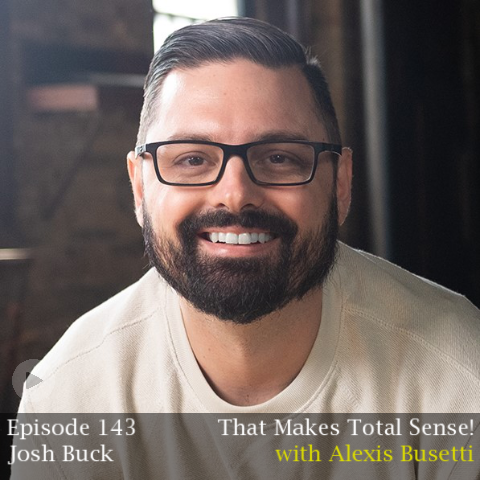
Speaker 0 00:00:06 Welcome to that makes total sense. A podcast dedicated to exploring God's generosity and justice. I'm Alexis, Boetti a Christian aiming to ask good questions and encouraging you to do the same. Every one of us is wired by God to live out generosity and justice, but the how sometimes eludes us that makes total sense is a way for us to get together, posture ourselves as learners and challenge one another to practice generosity and justice in a tangible way every day. So it's super fun because Josh buck is here with me and we both kind of started this conversation. Pre-recording of like, we've talked so much, but great to finally meet in person, but we're done. We're not in person, Josh. <laugh>
Speaker 2 00:00:52 Not yet. No, we've, we've, uh, talked a lot over email and worked together, um, with packs. Uh, but it's wonderful meeting you virtually in person. Not really.
Speaker 0 00:01:01 That's right. That's right. This is like the, this is like the COVID in person is what I told Josh earlier. So Josh buck is with me today. I'm so excited. Um, I have been able to interact with his work for many, many months now, and it has just been so formative for me. So I just wanna hear you say that in the work that I've been able to do with PACS, um, interacting with, with you and with your content has really been formative in how I think through some of these really tough topics that society is engaged in, and that we are engaging with us Christians. And so Josh is the executive director of PACS, and I will put the link to the organization in, um, in the show notes, but he is also a dad, a husband, a doctoral student, someone who's getting ready to move across the country and an author with a forthcoming book. And so Josh, I just wanna kind of give it over to you and let you do a better job of introducing yourself and telling us a little bit about your story before we, before we dig into your dissertation work.
Speaker 2 00:02:06 Yeah, I appreciate that. Thank you so much for having me on, um, I'll, I'll kind of start from the beginning. I was born actually in Texas. I know you're in Houston. I was born in Dallas. I was in Garland for a time. The bucks are like a long line of oil men and bookies and like blue collar entrepreneurs. And so, um, we moved to the Northwest when I was a kid, I got saved probably around 17, 18 years old, even though I grew up in the church, like a, uh, I grew up in a church planted out, out out of a Billy Graham crusade, actually. Wow. Um, and got saved about the time of 18 moved to California to go to Bible college. And that really changed my life where I fell in love with the Bible. I fell in love with the mission of God.
Speaker 2 00:02:50 And I was like, how can I serve Jesus? And it was really during that time that I wrestled with the Jesus, I grew up believing in a Jesus that was like white, who voted Republican, who loved George Bush, who wanted to invade Iraq. And I, I it's tongue in cheek, but it's actually fairly accurate. And then I get to Bible college where I'm like learning about Jesus as Messiah in the historical context of how Jesus grew up and who he is in the scriptures. And I discovered a radical Jesus, a Jesus that confounds our political system of Jesus that, um, that is giving, uh, agency and voice to people who have had a hard time in life. And somebody who is dignifying stories that were previously undignified. And as I read the gospels, it honestly changed my life. Um, and it was like being born again again, where I was like, okay, Jesus is my savior, but now Jesus is my teacher and my leader, um, not just Paul and the epistles as beautiful as those are.
Speaker 2 00:04:02 And that was a paradigm shift for me. That makes a lot of sense of my life as like a white guy, trying to figure out how to lead a, just life in the world. So that happened there. I met my wife who is INO Gane. She grew up, uh, uh, Hindu became a Christian when she was a teenager, moved to the states, we get married. And then we, uh, I, I, I realized that I wanted to start a church. And so we moved to the city to start a church called Antioch. And I'm 35. Now that was about 10 years ago where we really cut our teeth in ministry. And one thing very central to my story is health issues, asthma and allergies that have been re really, uh, challenging for me. And I honestly spent my twenties ignoring my body in a really unhealthy way.
Speaker 2 00:04:57 And so we had to move out of Los Angeles, um, in order to, uh, start over because LA just became so toxic for my body. So we started to church and did some community development work in the city, uh, uh, churches called Antioch and then a, a public nonprofit called amp LA doing afterschool arts with kids. And so that was really, um, you know, Alexis where I was refining my entrepreneurial skill set. And what does that look like in the kingdom of God? And what does justice look like for like a mixed family, you know, but like a white church planter moving into second, third generation Mexican American neighborhood. And, um, and what does it look like to try and be just, and live justly and be like Jesus in like a gentrifying neighborhood and all of that stuff. And then kind of leading to PACS, which is what you mentioned before we moved to Indiana to start an organization called, um, dedicated to resource.
Speaker 2 00:05:55 The next generation was slow, beautiful Jesus centered content, primarily for people of color. Um, and so I'm in an incredible organization with a president, drew Jackson, whom I love so much and a team of diverse voices that are trying to address issues that the church is having a hard time addressing in these early parts of the 21st century. Um, so at, at, on our website, maax.org, we talk about migration and mental health and nonviolence and scripture, just to name a few of the topics, cultural identity, these topics that young people and young leaders are like, we're wrestling with these and the church is having a hard time catching up to the questions that the next generation is asking. So that's a, a lot of where I spend my time and my effort is honestly not answering those questions, but making sure we have enough money to run the org and organizationally things are moving correctly and I'm executing on the vision that that drew has for us and that our team is, is doing. So that's a, a little bit about me.
Speaker 0 00:07:03 Thank you so much, Josh. Yeah. Um, drew has been on the podcast, um, talking about his book of poetry, which was like, yeah, mind blowing. Good, amazing. Um, Oshida has been on, um, she talked about her most recent book too. And so, yeah, I, I actually that's part of the work. I love of pack when I started the podcast. Um, I was kind of coming out of, um, a religious tradition where having the right answers was really, really important. And, um, that really felt good to me because it, my personality just kind of I'm naturally bent that way. I kind of, um, my natural bent is more toward black and whiteness. My natural bent is more toward, um, toward rightness. You know, I wanna make sure things are done correctly. Um, but as I started to enter into a different season in my spiritual formation, I started to realize that those things for me were actually starting to be kind of detrimental to my faith.
Speaker 0 00:08:05 And I was, I was, um, getting caught up in, in kind of some of the rightness for me and I, and I started to wonder kind of out loud and now I'm doing it out loud for, you know, over a hundred episodes. What would it look like to ask better questions? <laugh> right. What if I could just push pause in my own life on like having the kind of quote right answers and just started asking, trying to ask better questions. And for me, in my, in my interaction with pats, that's one of the things that I appreciate that you guys do so well is, um, is you're asking really, really good questions, right? And then you're in interacting with people who have been kind of studying those questions for a long time, right here in, you know, here's, here's what I think, or here's, you know, kind of how this has looked in my life and getting to learn from other people's experiences and wisdom who really love Jesus, you know, in those areas. So it's, it's just been really formative for me.
Speaker 2 00:09:05 Yeah. That's that's um, I, I appreciate that. And, um, we try hard to be nuanced in the way that we go about developing our content. A few observations on, I would say cultural observations on the issue of black and white one is for those of us that either came out of reformed spaces or have been in reformed spaces, it's very black and white because the Bible is a system just as much as it is a story. And if you look at it as a system, then it's gonna be black and white and you're gonna have all the answers, even though they won't necessarily be, be right. But because the system makes sense and two we're children and grandchildren of modernity, where we were taught that mystery is bad. <laugh> right. And gray is bad. And we need to, we need to define everything as much as possible and understand everything as much as possible, which, um, there are so many Christian traditions.
Speaker 2 00:10:09 And I would say even the Bible at times celebrates mystery in gray, um, as opposed to the black and white nature of things and even generationally baby boomers asked the question, what is true? And so the apologetics movement was like such a big deal and a big thing. And then, uh, I don't know what gen X extras ask because they get skipped over. So I'm gonna skip over them. And then millennials, millennials ask what is good and I'm, I'm a millennial. And so we're like way less loyal to institutional, uh, systems. And we're like, let's just change the world. And we're like switching jobs all the time and all this, and then gen Zers, and this is the younger generation coming up or asking the question, what is beautiful. And the gospel addresses all of these questions and, and scripture speaks to all of these questions.
Speaker 2 00:11:00 So when you
[email protected], our organization, we're trying to bring the good news of Jesus Christ to a generation. Who's asking a completely different question. It's not as much about like the neat black and white baby boomer question. It might not even be as much as what is like the intrinsic value of me doing this, but how does Jesus speak to beauty and how is Jesus beautiful in our life? In our setting, in our space, amidst the grief amidst the mental health challenges, amidst like the trauma of like what upcoming generations are, are realizing has happened in out of the colonial era. Speaking like very big picture. And so as an organization, we pressed really hard into the arts as a means of actually evangelism, discipleship, helping people understand who Jesus is. And second, instead of looking at the Bible as a system to be figured out, or like a math problem, which is what modernity did we just let it be, what it is, which is this beautiful story that God is inviting us all into.
Speaker 2 00:12:16 And that's so much of what we're, we're trying to do. And, and I'll say this, like any, anybody starting anything, uh, you're gonna infuse the latest version of yourself and who you are, your strengths and your weaknesses into that organization. And so for us as a group of primarily millennials that have come in and out of evangelical spaces, some of us still in that, some of us not, how do we do things differently, but actually being the solution, not just complaining about how to love God and neighbor. So that's, that's a little bit of the back.
Speaker 0 00:12:55 Yeah, no, it's, it's my favorite. That was, I had a real, um, kind of intimate moment with, with the Lord of the beach a couple of years ago, but it was on that subject of beauty. Right. And it actually interesting ways as you kind of went through that, uh, generational progression, it actually came from like a, from like a gen Z apologi, actually from her book that I had this interaction, it was hilarious, like this interaction with beauty. Um, but I think sometimes I, I find myself in the position, um, of Judas, right? When, when I look at the oil and I say, this is just so wasteful, right? Like when, when I look at the, um, you know, I'm not, not like a naturally, I'm not like a creative or an artist or something like that. And my, you know, I kind of be, I can have a tendency to be kind of like type a check off the list, you know, that kind of thing.
Speaker 0 00:13:42 And so, and so again, some of the ways that facts practice is kind of formative for me is to, is because it's slow, right. Slow, curated, beautiful. And I'm a, I guess they labeled me a geriatric millennial, but I'm a, I'm a geriatric millennial. And, um, and so yes, so I'm, I can relate to that asking what is good, you know, changing the world. I was a case worker. Right. And I changed the world until I couldn't stand up anymore. Right. Which happens to those of us who are in the field a lot of times, um, and, and wanna see, you know, a, a difference being made, right? Like we wanna, we wanna kind of see progress. I think, you know, it is kind of how it was for me, but I think it's so good to interact with these other generations say, yeah, but what would it look like if I just stopped and paused and just let the beauty of the word minister to me, or stared at this beautiful picture and just got lost in it for a while, while I worshiped, you know, and some of those experiences that can draw us into different places with Jesus that, um, that maybe the ways that we're used to interacting with him don't necessarily relationally and, and, you know, kind of like, you know, the, the first time you take a road trip with your spouse or your family, or, you know, the first time you visit, you know, your extended family, you get to interact in a different way.
Speaker 0 00:14:59 Right. And I think that that's some of the way those arts and that beautifully created content has affected me.
Speaker 2 00:15:05 That's wonderful. And it's, yeah, Alexis it's prophetic in my life, cuz I'm a, I'm like a workhorse, you know what I mean? I, I can get a lot done and I love new challenges and I love spending a lot of plates. And so the benefit to me of packs is, uh, our plurality and collaborative model, where there are a lot of people on the team that are not like me and bear God's image to the same extent as me and, and like drew for instance, I learned from him cuz we're so different about what it means to display the image of God through slowing down and being contemplative and pressing into spiritual health. Oh, Sheta was spiritual direction. She a spiritual direction for everybody on our team. And it's so foreign to my personality type to engage in, like for 30 minutes during a staff meeting, like where we're paying for this, we're all just gonna slow down.
Speaker 2 00:16:05 Um, and that's been a gift to me, uh, that I should have adopted a long time ago when I was having health challenges in LA and just the learning curve of, um, life and my stubbornness and my pride and my sin getting in the way of, uh, discovering what, what rest and beauty should be looking like, which I feel like that's the, for me, the proto lifelong journey of like, how do I find that? Well? And so I hope to continue to learn from the younger generation who can shepherd and teach and help me, someone like me understand what that, what that looks like.
Speaker 0 00:16:44 Yeah, no, it's, it's really, really good to, to listen to that voice and to those questions, um, that maybe we haven't asked, um, you're not geriatric, but those millennials of us who haven't asked that, um, I'm wondering if we can, uh, if we can switch gears slightly when you said, you know, spinning plates and workhorse and all of that. I, I, um, my husband and I were married when he got his doctorate. And so I just wanna say like, I wish I could like, look your wife in the face and say, congratulations on your doctorate because <laugh>, that's really how it felt. And um, and we did it before kids. Right. Um, so that's, that's like a whole other story. He turned in his dissertation and the following day the girls were born and which was absolutely insane. Um, but I can't imagine you as a, as a, not just as a husbandman, but also as a father doing this work, but you're almost done, so congratulations.
Speaker 0 00:17:35 Fantastic. And, um, Seth is gonna hear this when he produces this episode. I haven't ever done a podcast episode on my husband's dissertation work because, um, well, I haven't read it. I don't know anything about it and I don't think I could even understand the title of it because he is a geologist. And so we're just, just gonna say, I don't know, I'm just gonna say it doesn't really fit the mold of the podcast. So anyway, but we are gonna talk about your dissertation work today, which I'm, I am coming to this with excitement to hear what you have learned and to interact with how you have studied. But I also just wanna say I come to this with a really, um, solemn feeling yeah. In my heart. Um, because I know that this topic that you're, that you're gonna talk to us about today is, um, gosh, it's just really devastating and heartbreaking.
Speaker 0 00:18:33 Um, and so, and so, yes, I'm excited to talk with you about it, but I also just kind of wanna name that, that, um, I'm coming to this and saying, I just wanna recognize that this is gonna be a really hard conversation. And so we might even put a, a disclaimer in here as we begin to talk more and more, um, about it that, um, you know, if there are some things that might affect people, they may wanna just have the option, you know, to turn, uh, to turn this off, whenever we, whenever we start to really get into the content a little bit more, but you're graduating this semester from bio and you're in the school of intercultural studies. And, um, tell us about that. And then what is this dissertation topic that I've teased everyone with right now?
Speaker 2 00:19:16 Yeah, I love it. I, I, I love the idea of, um, entering into this in a, in a solemn way. And I do want to give a personal disclaimer for those of you who are white, like me, I'm gonna be talking about the Charleston massacre and, you know, uh, white mass shooter violence against an African American church. And, uh, and it might be uncomfortable for you to be even listening to this and, and what this means in the research that I did. And I just wanna encourage you if you're white listening to this, it's okay to be uncomfortable. And it's actually better for you to engage in listening to what someone from our community from Anglo Saxon descent did, um, as an act on behalf of white people against African Americans. And if you're a person of color listening to this, um, I just wanna say, I'm only speaking for my social location.
Speaker 2 00:20:09 I'm not speaking in a way, uh, saying that I understand what happened. I'm not speaking in a way, uh, to claim that, um, I even best represent the stories that I captured. Um, I, I did my best, but I also want to acknowledge that speaking from a white perspective has a ton of limitations. Um, and, and I just want to acknowledge that as I, as I jump in. So yeah, I'm, I'm graduating this semester with a PhD in intercultural studies where I did, um, qualitative research. What that means is I did human research. I went to interview people and to understand their stories. So it's the same thing that like an anthropologist would do or an ethnographer would do. And, and my lane of, um, qualitative research was oral history analysis, narrative, oral history analysis, which basically means I go interview a few people. Um, and I listen to their life story as it relates to a particular event in their life, which Alexis, to me that makes me excited about PhD work.
Speaker 2 00:21:23 Okay. Because I get to be with people and I get to listen to their story. And then I come in acknowledging my biases. I come in acknowledging my limitations, uh, as a white, like cisgendered male that came from privilege and I listen to the stories and then I developed themes from their life stories. So what I did was go to north and South Carolina and a number of years ago, uh, a, a man named Dylan roof went to, uh, Charleston because of its historical significance with the slave trade and went to AME church Emmanuel, um, Emmanuel church, which is one of the oldest African American churches in the country. And he, uh, took a handgun and went in and killed almost everybody during a Wednesday night Bible study in order to initiate a race war. Um, and in order to instigate racial divisions and he currently is sitting on death row for, for that.
Speaker 2 00:22:40 Now why I found this such an important thing for us to study. It's a few reasons as a researcher, you have a ton of intersecting factors. You have mass shooter violence, racial violence, targeting a local church, a white male shooter, um, and, and gun violence. And you can, you can intersect all of these within the Charleston massacre. And as, as a researcher, I'm trying to better understand what can we learn from the stories of those who lost loved ones in the Charleston massacre? So I interviewed two pastors who lost family members from that night, Reverend Anthony Thompson, who lost his wife, who was leading the Bible study. And Reverend Sharon richer, who lost her mother and Reverend richer was in Texas on a rotation as a chaplain in Dallas when she found out and Reverend Thompson was supposed to go to this Bible study and decided not to, because of other church events that he needed to be at, and he wasn't able to be there.
Speaker 2 00:23:52 And he was one of the first people on scene, um, after the police had arrived. And the whole purpose of this for me is to, uh, learn and listen to those who have suffered so that we can better understand how to overcome racial violence and what to do about racial violence in our country. So this was a very personal dissertation to me saying, how can I enter a space and learn? And at the same time, get, get a, get a PhD. Um, so that that's the research side. That's the personal side, here's the theological reasons why I would do this. And I, I, I mentioned this before, but, uh, my life was changed by the story of scripture and reading about the Israelites, uh, going through such difficult and traumatic events in the Exodus and entering into a time of the wilderness and coming out of that, into the promised land and failing to be the people that God wanted them to be. And then, and then exile and back and forth, and then Jesus coming to rescue them. And as I'm reading the gospels, I'm like Jesus is constantly bringing people into his circle and, and listening to their stories and asking them good questions in order to share love and light with them. And so, as I pitched this idea to multiple people who had lost loved ones, I communicated in a very modest way. I want to let your story be heard in academia.
Speaker 2 00:25:36 I, I want your story to be heard through oral history analysis. And the reason why I like oral history analysis so much is that it actually came out of world Wari and needing to understand what happened in Auschwitz, in Dout, in, in the concentration camps that the Nazis initiated against, um, those of Jewish descent. And it was to better understand the suffering of what people have gone through. And I find this to be so fascinating that it doesn't matter if you're a Christian or not a Christian. We find sacred the stories of people who suffer. Why, why would we find sacred?
Speaker 2 00:26:26 Why, why would we find sacred? The stories of those who suffer like in Ukraine? They said that somebody in their nineties who was a survivor of the Holocaust died, and that was a big story. Why is that a big story? There is something buried deep within the foundation of the world that God created, that we gravitate to stories of people who have suffered, and we find it to be sacred. And I think in this, there is something that we need to learn about the human condition, and that is the people that have gone through the most and overcome the most. We look up to now in the foundation of the world, that's Jesus Christ and what he did on the cross. And what happened on the cross is that he bore witness to the suffering of everybody throughout human history. He not only overcame sin and death, he not only gave us, gave us access to God, the father, he not only shed his blood as a lamb of God to take away the sins of the world. He not only was declaring victory over the principalities and powers of darkness. As Paul says, in Colosians one, he also bore witness to the suffering and the stories of people who have suffered. And that, that was my modest goal as a Christian, how can we bear witness to these stories? And specifically African American Christians who have lost loved ones.
Speaker 2 00:28:06 And so I went to South Carolina and, uh, sat down for two days with Reverend Thompson and I recorded two hours asking him, how was your life before your upbringing, your story during what happened during and after the incident for you. And then how has your life been since then 5, 6, 7 years later. And, and then I drove up to Charlotte and interviewed Reverend richer and followed the same format before, during and after. And then at that point, you transcribe it all <laugh> and, and anybody who has studied the Bible and is like, okay, I'm gonna like let the themes of Luke come out. And it's about, you know, the God's offering salvation to everybody, and it's about God carrying specifically for the poor. And like, it's about God addressing the rich and confronting them. Like these are, these are themes that are in the gospel of Luke.
Speaker 2 00:29:07 If you read it and you study in detail, that's what a researcher does with human research. As you take those stories and you, you study them literally in a program with the deepest level and you let the themes emerge. And, uh, what I did was compare the themes from Reverend richer to Reverend Thompson, a lot of similarities on a lot of differences. Um, anybody can look this up on pro quests, just look at my name, JW buck. And it's, my dissertation is out there for free to look at, and I give an account of their life, a first person account of their life. And it's the type of thing where I, I write out the story of their life. And then according to what they said, and I send it to them and I say, can you look it over? And did I miss something?
Speaker 2 00:29:52 Or what do you want to add? What do you wanna redact? Because it's too personal. We go through that process. And then I develop the themes and talk about these are the theoretical implications, and these are the practical implications. And I'll just mention three things that I learned that might be useful or interesting to those that are listening to this. Um, first indirect violence has a massive traumatic impact on people. So experiencing violence is where somebody is overtly, physically doing something to you. And there's a lot of nuance to what that could look like. Indirect violence is where somebody you love has experienced the form of violence. And then that impacts your life in a negative way. And, um, and so one thing that came to the surface, which this is a theme within the African American story within the United States, is there has been massive collective generational trauma as a result of ongoing violence against African Americans.
Speaker 2 00:31:05 And, um, this is indisputable from a re researcher's perspective. It's disputed in popular culture and all the junk that's shared in the news and in the media and all that. But when you get down and you do, you crunch the numbers and you do the research, there is zero disputing and, um, and Reverend Thompson and richer, uh, both reinforced this very sad truth, um, that it's very hard to deal with violence done against people that, you know, and in particular it was racial violence that was committed against them. Indirectly second, uh, early spiritual formation had a massive impact on both of my participants. Here's something really beautiful. Both of them were brought to events in Charleston when they were kids when Martin Luther king Jr. Came through town. Yeah. Wow. Pretty cool. Wow. Um, and both of them sat there in the pew and listened to king Jr. Preach about, um, justice and racial justice and equality and nonviolence.
Speaker 2 00:32:32 So both of my participants, when reflecting on how to deal with Dylan and how to deal with people who commit racial violence, um, nonviolence and nonviolent resistance was a part of the, their response and was a part of what they believed to be right about what should happen. Now, that doesn't mean that they don't advocate for justice. It doesn't mean that they don't believe that Dylan should be in prison. It doesn't, it does not, uh, void what they think justice should look like. Um, so in other words, justice and nonviolence, they, they need to fit together somehow. Um, but it's very interesting. And for those of you that have kids, or maybe disciple young people, uh, it spiritual formation, at least for my participants was huge in their youth because of their parents and what their parents were exposing them to. And they reflected back on those memories just as much as they reflecting back on scripture, when they talk about responding nonviolent in the face of racial violence.
Speaker 2 00:33:44 Wow. And third, um, for my participants, forgiveness has served to be an important tool for personal healing. Now it's interesting that in secular research cross discipline forgiveness from even from a secular perspective, has been used as a tool in helping victims of violence, um, move forward with their life. And, uh, and so it's no surprise that we see Jesus a very, uh, oppressed minority living under the poverty line, speak about to his people who are also oppressed minority under the poverty line. Talk about forgiveness being essential to Christian discipleship. Now what happened out of the Charleston massacre is when Reverend Thompson forgave Dylan, during the bond hearing two days after which he recounts that story in my dissertation, um, he, he was very criticized by African Americans were saying, how dare you do that? And then white people were like, wow, look at this. That's so great.
Speaker 2 00:34:55 We come, we come along, we give hugs. And I think the, the beauty. So, so that's the kind of the, the media reaction. When you look at, at Reverend Thompson and Reverend Rich's life, what did they do with the indirect violence and the trauma that they went through? They've become activists and advocates for justice and, um, in their own way, Reverend richer and national activist, and then Reverend Thompson, a local activist. And, um, what we can learn from them is that when we go through something deeply traumatic or difficult, they provided a blueprint for not only how to wrestle with what to do with it and how to process it the years and years and years of processing that and dealing with it and the triggers and all of this, there are two case studies in like, these are people we have to look up to, they will lead us into the future as a church.
Speaker 2 00:35:54 Okay. And I look to them as my leaders and saying, okay, how can we stop this from happening again? How can I go back to my community and share this story so that we can create formation in our churches so that this doesn't happen. And then for those that have suffered like my participants, which are not, I didn't suffer like that. I've never suffered like that in my life. How can we look up to them as they lead us into the future? And I'll say one more thing. And, and then pause if you have any questions or thoughts, but, and, and for me, it's important for me to bring this back to, um, white Christians, because Dylan roof went to church on a regular basis. He went to an evangelical Lutheran church. So here's my question. Here's the haunting question.
Speaker 2 00:36:42 What about the spiritual formation within our white churches allows for violence and racism to take root? What about the way that we do church? What about our theology? What about our practices? And our programs allows for somebody to believe in Jesus, to go to church, to sit under preaching, to be in kids programs yet to become radicalized within a group that believes that it's okay to commit violence against other ethnicities. That's, that's the question left with the white community that we must address we have to, and we've done a poor job of addressing it. And so that's a part of, to be honest with you, I just finished my dissertation and I'm sitting with that question going, alright, board, what can, what can be done about this and how can I be a part of the positive change within the white community so that we can stop this from happening in the future.
Speaker 0 00:37:59 Thanks, Josh. Um, yeah, I, I kind of all, all three of those, those points are, are good and they're, they're interrelated. And I keep, I keep coming back to the first one about this indirect violence, having a massive effect on people. Um, and I would say there's, I'm, I'm kind of talking to think which sometimes gets me in trouble if I'm not able to fully process before I, before I say this. So just warning. Um, but you know, I think about this kind of in, um, different layers or different levels, right? So I was, I was having a, this week, someone was, was asking me and I was kind of went back to my case worker days. And I would say back then, um, I think at least I was aware of less research. I don't know when the research started coming out about like secondary trauma for, for case workers.
Speaker 0 00:38:48 Right. So people who were going into these really, really difficult situations, first responders, things like that. And we are experiencing first kind of secondhand, right. Someone's, someone's traumatic events happening in their lives right then. And, and back when I was a case worker, I was in my, um, twenties and I kind of thought I could compartmentalize. Right. But I just, I just couldn't right. I, I still dream occasionally about my clients and the difficulties that we are having. And so this is not the same thing, but I'm kind of naming that like as another layer, another level. And I wanna, what I wanna say though, is, um, if I can find it, I'll put it in the nose. Mark, Charles has a really incredible talk where he, he talks about, um, the, the violence against, um, native Americans as a, as a population and how it hasn't just generationally affect affected the people who have been, um, the violence has been against, but it has affected white people, right.
Speaker 0 00:39:44 As the ones who were inflicting the violence. And so that's kind of where I'm getting is that we can name that this indirect violence that you studied with your, um, the people who allowed you to come into their world, um, and, and understand that effect a little bit more that it had on them. Um, and I think that we can see those detrimental effects because they're more obvious, but what we don't see, what I'm trying to say sometimes is the effects of that indirect violence on the communities of the perpetrators, right? Like this is not healthy formation for white people. Right. And it is having effects. But I think what I, at least what I'm seeing kind of what I, my perception is that when you're asking those really important questions, instead of diving in a lot of times, the white church just says that that was just a one off.
Speaker 0 00:40:39 Right. And, and, and I think the question, the, one of the questions, one of the good questions is how many one-offs does it have to be before? It's actually, you admit it's a thing, right. And, and how many different racial groups does this have to be against until you admit it's a thing and how many different states does this have to happen in before you admit it's a thing and how many different denominations does this have to take place inside of and different teachings before you admit it's a thing, because it's a thing, right? Like there is exactly this haunting question of something's happening. What kind of spiritual formation is allowing for this? What kind of, what kind of mal formation is happening that says that this is an, an acceptable way to express yourself. And, um, and I think what I'm trying to say is we're not looking at this communally, um, people in white American evangelicalism largely are not looking at this communally. It comes back. I just hate, it's like same song, second verse for me, it's like, well, it's an individual sin. Well, stop it. Right. Stop it. Yes. Dylan roof committed an individual sin that day. And he was formed by a community of Christians largely.
Speaker 2 00:42:00 Yeah. By, by, by collected. Absolutely. So you, you hit on a, a cultural blind spot that the Western world has that white people in particular have, which is we, we process the scriptures and sin and our identities in a highly individualistic way. Um, and the most important counter argument to that is not to say, well, the rest of the world doesn't do that, which is true. And that's important. More importantly, that's not how the Bible was written. The Bible was written in a very collectivist, communal setting honor shame system, um, where, uh, Daniel is crying out, uh, please forgive Israel as he's an exile when he didn't do anything wrong. So why in the world is he asking for forgiveness on behalf of the people? And we just read over that, you know, we read over that to be like, well, that's not what we need to do today.
Speaker 2 00:42:59 Um, even the sins of Adam and Eve had to be undone by Jesus, cuz they were passed down collectively generation to generation. And so refusing to think collectively, uh, does a disservice to our spiritual formation of course, for individuals. And that there are benefits to thinking that way. But it's so important to realize that we think that way because we're sons and daughters of modernity, it's not because, well, the Bible just led us into that over the last 700 years. No it didn't. Um, as Jesus and, and the rest of the, uh, writers were thinking in a very collective way, that's the first thing that comes to mind is I hear you. And those questions you asked are so good when you talk about now formation. The second thing, which is always very interesting to me is how easily the white church completely ignores the teachings on nonviolence in the new Testament.
Speaker 2 00:44:01 Okay. So listen, Matthew five, Luke four sermon in the mountain, this is nonviolence. Don't do this. And then Jesus modeled it. And then Jesus corrected Peter when he used that violence in the garden. And then, and then first Peter, like Peter says specifically what that looks like in a situation where somebody's being oppressed. And then in Romans at the end of chapter 12, Paul gives a concrete application on the sermon on the Mount. This is what you do with your enemies. We're not gonna kill the Romans and take over before, love your enemies, do good to them, feed them, cloth them. He's like, you guys need to know explicitly what the sermon on the Mount means in this setting. And then all the apostles died, nonviolent deaths, okay. In the early church, you did that before Constantine, which I won't get into history, but that, that was a turn for us in a very negative direction.
Speaker 2 00:44:55 Okay. 300 ad. Here's the deal? Why do we ignore those teachings? And I think it's because we are so comfortable in violence. So steeped in violence, um, our movies, our, our, our artwork and this country was founded on, on violent revolution. And so it's in our cultural stories, which then means it's values that we hold. Even though we don't know, it's like an iceberg, it's all under the water that we just accept violence as something that's normal. Even though we walk around as a tip of the iceberg, like not thinking it's impacting us. So when we come to Jesus and he speaks about, don't be violent, we make excuses. And we talk around that. That can't be true. Why? Because our entire national narrative is founded on violence. We live in a settler society where we swept across the nation, um, um, putting natives in camps, breaking treaties.
Speaker 2 00:45:58 And we used God to justify this violence, sovereignty, Providence manifest destiny. And then we've always tried to solve our problems with violence. This is what world wars are. And even our domestic wars, like the civil war, we have these issues, how are we gonna solve this violence? And so it's so embedded within who we are, I would say, as white men in particular that, um, it's no surprise that one, pastors ignore those teachings. And two, someone like Dylan could be in a church where that's never addressed because we're always trying to justify like Christians going to war and Christians being in the military. And like, we are not addressing the violence that we've been steeped in. And so we ignore Jesus on that point and we ignore the new Testament on those points. And, uh, what happens is then it allows for this violence to be fostered in individuals.
Speaker 2 00:46:58 And then when you connect that violence to white supremacy, or when you connect violence against men or better than women or toxic masculinity, domestic VI, all these things blossom. So as a Bible interpreter, and as somebody who's a pastor for a long time, it is so important to be teaching our young men. That violence is not okay if you follow Jesus, it's not okay. Why? Because Jesus taught us that it's not okay. And that's what it means to be human. And, um, there's a lot more to be said about that, but I think that's so much of the key. The first thing I mentioned was like, we have to start thinking more collectively as, as white people. Um, because the Bible thinks and teaches us to think collectively and two, we have to pay attention to Jesus' teachings on nonviolence. And why do we keep doing her back flips and some salts and like, to be like, Nope, he meant all that other stuff around it, but Nope. It's like, man, that's, that's the most like Texan John Wayne crap I've ever heard of in my life. You know what I'm saying? And I'm from Texas. Okay. But that's just like, no, one's coming to my house. Or like, no one's taking my guns. It's like, man, why don't, why don't you listen to Jesus, listen to Jesus and be uncomfortable, be uncomfortable with that teaching and deal with it.
Speaker 0 00:48:32 No, you're, you're a hundred percent. Right. So two things on that. I think the quick one first is, um, that I'm gonna link to the, to the nonviolence story arc at packs because I will just say, I, I actually, it was hilarious when I was in, I was in high school. So I'm embarrassed to say I didn't have a great vocabulary back then as way less than I have now. Um, but someone accused me of being a pacifist in high school is just kinda my natural bent. Um, and even as someone who that's my natural bent, I was super challenged by the nonviolence story arc that packs put out. Um, yeah. So I'm just gonna encourage people to go to go take a look and you get a lot more of what Josh just talked about right there. But, um, but when you said, uh, and this is one of those things that I'm like, if I could just live with this in the forefront of my brain, um, forever, that would be great, but Jesus, wasn't just a good teacher.
Speaker 0 00:49:28 He was teaching us, he was, he was modeling for us how to be human. Right? Like he was the, the model of humanity. And so when we, so when we look at, sometimes we do, we do these gymnastics, we do these things to say, oh, he was a great teacher, but I could never do that. Dah, dah, dah. But he wasn't just like, theoretically giving us some good ideas or some concepts for what might work or, Hey, have you tried this? You might wanna go to plan B, like he was modeling for us, his design for humanity. Yeah. And that design for humanity is a nonviolent design. And I think even if we maybe conceptually or kind of in our heads, understand that, I think as a church. Yes. And we, we don't have to go back to 380 though. We could. Um, yeah. But, you know, um, but I think that as a, as a church, it's kind of been a yeah.
Speaker 0 00:50:25 But situation. Right. Even if, and I think I, number one, I don't think we fully internalize that truth about Jesus. I'm just gonna say I don't, I don't think we do. Cause if we did, we wouldn't live this way. But even for, for people who kind of get it in our heads, I think that it's kind of been a yeah. But situation. Well, that's wonderful. And I understand that's designed, but yeah. Yeah. But yeah. But what if someone came into your house? Yeah. But what someone invaded your backyard. Yeah. But what if you really just don't like them, you know? Um, then it's kind of a, there's an exception to the rule, but the exception has kind of become the rule. Right. And that is violence.
Speaker 2 00:51:01 Yeah. Yeah. And you don't start it's it's um, it's poor form to jump to exceptions, to disprove a teaching. So that's just like, that's, that's poor form like that, that shows the cultural pressure point coming out at you. That's like me with my kids Z don't hit your sister. Yeah. But, and it's like, no, dude, the starting point is don't be violent. I'll deal with how she like made you feel ashamed and like made you feel dumb cuz you're younger, whatever we'll deal with that, but be careful over here. And so that's so important. We don't start with like ethical, um, exceptions to disprove the rule. If it's, if it's that it's that. And, and uh, to me, the strongest thing is the rest of the new Testament writers reinforced that as normative. So were they wrong? And then the early church did it, so were they wrong? And so that to me seals the case and then yes, there is nuance. There is important things we have to wrestle with. We have defend the defense list and love your enemy. Okay. So yeah, that is a, those are two difficult things to bring together, but we must bring them together in a challenging way. And here's one thing that makes me really mad. Okay. I'm admitting this on your podcast. I can get angry. Sometimes here's the deal. We expect African Americans to respond with forgiveness and nonviolence. But when our community's attacked, hell no,
Speaker 0 00:52:42 Right.
Speaker 2 00:52:42 We're going to war, we're killing somebody. We're cutting off somebody's head. We're drone striking. We're lynching. Somebody. Do you hear that? So yes, the African Americans who we have historically marginalized and oppressed, we celebrate when they forgive Dylan roof, when they love their enemy. When, when they come into a white church and talk about how forgiveness changed their life, where are those stories in our community? If that's so admirable, then why, why aren't we following that into the future? And it's because we're bathed in violence and we we've so accepted, retribution as our form of justice and ignored the clear teachings of Jesus. And I'm hoping this dissertation would give us two people that we can follow into the future because they've shown us how to deal with trauma and how they're wrestling with it. They've shown us <laugh> um, how to love their enemy. They've shown us forgiveness, but they've also shown us activism and pursuing justice and trying to unravel, um, what happened so that it doesn't happen again. And then what is the response of, of the white church? Uh, and first and foremost is to dignify those stories and to listen and learn and let them be our elders that we follow.
Speaker 0 00:54:08 Yeah. That makes me mad too. <laugh> yeah. I feel like I could say, I would say a whole lot of things about that. Um, first thing that came to my mind that we probably don't have time to explore right now. So I'll just say it is that when you said, because we're bath in violence, I'm like, yeah. And we're used to getting what we want and we're used to being the powerful ones and right. And all of those things. Right. And so forgiving for the white person community does not allow us to keep the power the way we wanna keep it. The, the dynamic there.
Speaker 2 00:54:42 Yeah.
Speaker 0 00:54:43 It requires humility, which is what Jesus taught us. And a lot of us just aren't ready to go there.
Speaker 2 00:54:50 Yeah. And I I'll say this on the, the, uh, the dynamics in our country between the African American community and the white community and really over the past five years, uh, with, with COVID being an exasperating factor and, um, and George Floyd and the continued violence against African Americans across the country and black lives matter ma uh, black lives matter, um, rising to prominence as almost like a, it's like a 21st century version of like the black Panther movement. It's this beautiful thing saying, Nope, we're gonna take care of our community and we're gonna address this. So these things are happening and there are a few different narratives and one narrative is, and I'll say this and be done. But one, one narrative is, uh, African Americans, like just can't get over the past and why, why are they complain? And it's not that bad. What's the big deal, which is like so crazy to think that in a country we took over and in people we enslaved in the millions that were killed in a country, built on the throat of the African American community.
Speaker 2 00:56:12 Okay. So, but that, but that's, that's popular narrative and it's like a Christian nation. And like, it, it it's, why was the past over here is to say, we've never dealt with it properly. And when I was doing my research, uh, one author in particular said something that was profound for me to understand this challenge that we have. And they said there have been three countries that have taken racialization to a level that nobody else has. And one was Germany, world war II. Um, and what happened to the Hebrews and the Jews two, it was South Africa and apartheid three. It is the United States with slavery, Jim Crow and everything that has come out of come out of that. Now here's, what's interesting. Germany had their moment of justice. It was num broke. It was punitive justice. And for better or worse, what happened was the world came down hard on Germany, just like they did in world war.
Speaker 2 00:57:16 I and said, you guys are evil. You're crazy. How dare you do this? And, and it was really race relations that instigated so much of that. Okay. Um, South Africa had their moment, uh, Desmond two, two truth and reconciliation commission. It was restorative justice and there were some pitfalls to that, but that was the model that they used. Here's the thing here in the United States. We've never had a national moment of reckoning. It's never happened. So it will continue to be an open wound in our country until we can find a way to have a national moment of reckoning that lays somewhere between the Nurnberg trials and truth and reconciliation in, uh, South Africa. So for those of you who are listening, uh, maybe if you're a white person listening, it is so critical for you to know that this issue will not go away until we have an ESER moment as a country. And the church has an incredible opportunity to lead the way if we would take our history seriously and our sins seriously with what has happened. And so the Charleston massacre is, uh, one amongst thousands and thousands of incidents that continue to persist in our country that we must deal with
Speaker 0 00:58:52 Josh. That's a good word. That's a really good word. Um, I just talked with ETT McVicker who wrote a book called recovering racist, um, from South Africa. And, um, and I have thought the same thing over and over again that we've just never had. We've just never had that moment. Um, one more quick thing before we get off, and I'm saying, I I'm, I'm looking at you thinking, I totally wanna this conversation. Keep going. Okay. Good news. People. We get to continue the conversation when Josh's book comes out. So will you tell us just a little bit like a little teaser for that? Um, and you're, you're invited the, the invitation is there and open for you to come back and talk about that when it releases, but, um, this, this work has also brought another, um, I mean this work in your, in your formation has brought another project coming to, so tell us a little bit about that and when it is due to come out.
Speaker 2 00:59:46 Yeah. I appreciate that. Um, I wrote a book called everyday activism, following seven practices of Jesus to create a just world with baker. And that's coming out November 15th. Uh, I haven't posted about it yet, but you can, pre-order it go to the baker site because it's like 40% off. Don't go to Amazon quite yet. It's way too pricey there. Um, and it essentially looks at the ministry of Jesus and ask the question, how can we live justly? Like Jesus, what does it mean to be a disciple of justice and peace? So I talk about my story kind of coming out of a space where Jesus was docile and polite and nice and white and like voted Republican and saluted the American flag. And that was my imagination of Jesus. Owen was very reformed, you know, and like loved preaching expository. Like that was my imagination of Jesus and then go getting into the new Testament.
Speaker 2 01:00:44 And I'm like, dang, he told confusing stories sometimes. And sometimes he did like expo passage, but whoa is teaching was radically and he's actually Jewish. He's not white. So this changes my thoughts and feelings about, about like following God. So, and, and to really discover in Bible college that Jesus is a radical Messiah that we follow into the new world. And so I tell, I, I interpret seven passages from the life of Jesus to say, here are the principles of Christian activism that no matter what issue you're into, what station of life you're in, you're in no matter how busy you are, that we are called to be everyday activists, right? Where we are by following the practices of Jesus. And you don't need to be on a podcast, you don't need to write a book. You don't need to be a public speaker or have the right degree.
Speaker 2 01:01:38 Those weren't the people that Jesus mobilized for activism. They were everyday people that like had busy lives that were hard. So how do we do that? So those seven practices, the next time I'm on, I can talk more about, and I root it all within the loop for, um, gospel of Jubilee that Jesus opens up his ministry declaring. So that's how I, uh talk about the gospel throughout the entire book is this provocative and incredible Hebrew concept of Jubilee that accounts for spiritual life and social flourishing at the same time. And so I'm really excited about it. Feel free to go pre-order it. But I would love to be on another time if you'll have me to talk a little bit about it.
Speaker 0 01:02:25 Absolutely. Josh I'm, I'm, I'm super excited about it already. Um, so where can people, uh, find you online if they wanna connect more with you and your work?
Speaker 2 01:02:39 Yeah, first I really, if, if someone's gonna spend five seconds online, go to maax.org. Um, so much of my heart is infused in packs. Uh, even though I didn't create any of the content, you know, and so please go there and go to the story arc, which is our publication and find a topic that you're interested in. I really would love you to go there and look at that. Um, and especially with this theme being on nonviolence, check out the nonviolence story arc and, and look at what we're putting forward as the teachings, uh, the Christian teachings that we should be following in, in the 21st century. And then, yeah, I'm on, uh, Instagram and Facebook JW buck or Josh buck. You'll find me. And, um, yeah,
Speaker 0 01:03:27 Thank you. And last thing, and I totally didn't prep you for this, but this is like, I should just give a warning when, when, when people reserve a spot that if you're a pastor, there's a chance I'm gonna ask you to pray. So, um, so you, you plan at a church, so you count. Um, so I just, you know, would you just pray how the spirit leads for those of us who are hearing this conversation as we move forward with these, with these words still penetrating our hearts and our minds.
Speaker 2 01:03:52 Yeah. I'd love to Jesus. Um, first off, I wanna thank you for this time. Thank you for saving us. Thank you for being in solidarity with us and validating our suffering while you were on the cross, as you were rescuing, rescuing us. And, um, God, I do wanna apologize like Daniel on behalf of his people. I do wanna apologize for, um, for my people who like myself can get really comfortable and forget that we are all connected as humans on this earth and that we are responsible God, not to repent of the sins of people that are not ourselves, but to take responsibility for that sin being passed down and benefiting us. Uh, Lord, we're sorry. Help us move forward. Uh, Jesus, I, I thank you for Reverend Thompson and Reverend richer, please bless their ministries. Tenfold carry their stories to new Heights so that we can follow them into a better future in your name. We pray. Amen.
Speaker 0 01:05:14 Thank you so much, Josh.
Speaker 2 01:05:16 Thanks for having me.
Speaker 0 01:05:20 The links for all the resources mentioned in today's episode can be found in the show notes, music and podcast production by Seth. Boetti be sure to give us a review on iTunes and subscribe at your favorite podcast listening app. You can also visit us at that. Makes total sense.com.