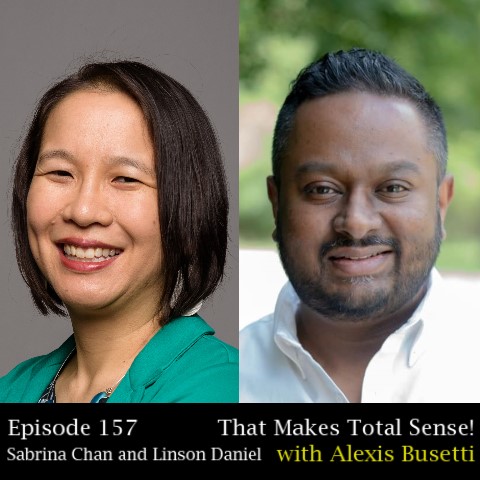
Speaker 0 00:00:07 Welcome to that makes total sense. A podcast dedicated to exploring God's generosity and justice. I'm Alexis, Boetti a Christian aiming to ask good questions and encouraging you to do the same. Every one of us is wired by God to live out generosity and justice, but the how sometimes alludes us that makes total sense is a way for us to get together, posture ourselves as learners and challenge one another to practice generosity and justice in a tangible way every day. Hey everybody, I feel like I almost wish I could have press recorded like five minutes ago because I've been having so much fun with our guests so far today, and they are two of the four authors of an upcoming book learning our names, Asian American Christians on identity, relationships, and vocation. And today I'm joined by Sabrina Chan and Lyson Daniel. Hey guys.
Speaker 2 00:01:05 Hello? Hello.
Speaker 3 00:01:07 Hey, glad to be here.
Speaker 0 00:01:09 Oh my goodness. I'm so glad you guys are here. I feel like there's because I just finished the book this morning. It was beautiful, like over coffee cake and a great latte at my local, at my local place. I almost just wanna rush in and just tell you all of the things that were meaningful to me and all of the places that I wanna hit, but I'm gonna restrain myself this morning. And, um, and ask if we can start by maybe just doing a couple of things. I'll ask you guys to introduce selves to us and your current context, what your current ministry context is. Um, and then we can kind of get into a couple of the places that will go first. I hope, which is, you know, who is this book to? Who did you guys write this book to? And then we can get into, um, yeah, the title, learning our names and kind of, um, those, those places that you guys started for us in the book, if you will. So it doesn't matter to me who goes first, you guys can rock paper scissors for it. We can all see each other. <laugh> um, but why don't you start off by telling us, um, your current, your current context kind of where you're writing from?
Speaker 2 00:02:19 Uh, sure. I can go first since I'm unmuted. Um, I'm Sabrina Chan I'm I guess my ministry context is I'm the national director for Asian American ministries for inter university Christian fellowship. So, uh, campus ministry, um, with thousands of Asian American students participating. And so I get to work with resourcing student leaders and staff and volunteers, um, as we, um, honor and reach Asian American communities on campus, and our hope is to develop disciple and empower distinctly Asian American Christian leaders. Um, inter university AAM actually has a long history of doing that. I mean, that's part of why Winston and I are leaders. Um, ministry leaders has a long history of doing that and, um, legacy and, uh, love my job, getting to, getting to do that. Um, I'm second generation. So my parents are immigrants from Hong Kong and Southern China. Um, and I currently live in Richmond, Virginia. Um, just moved back there after 27 years away. Um, Texas bay area of California, Austin, Houston bay area of California, Durham, North Carolina have all been stopped in between. Um, yeah, so that's, that's a little bit about me Lyson
Speaker 3 00:03:35 Yeah. Um, yeah, a little bit about me. Um, I, I live here in Dallas, Texas, um, and I serve as a pastor here at a church called Metro church. It predominantly serves, uh, south Asians and it reaches out to the south Asian community here in the Dallas Fort worth metroplex. Um, uh, I've, uh, been a pastor for about, uh, two and a half years. Uh, prior to that I worked with inner varsity. Um, and, uh, a funny story about me is if you do the math, I started, uh, March of 2020. And so I was installed as a pastor and then literally the next Sunday, the, the church was closed. Uh, so there's just an ongoing, ongoing joke at church that they installed me and then no one came back
Speaker 0 00:04:23 <laugh> <laugh>.
Speaker 3 00:04:25 So, uh, so it's been quite the journey. Uh, I really, uh, thought I was gonna be doing something else and then the pandemic happened and it really, uh, rose, uh, brought to the surface, a lot of things that were both, uh, going on in my church, in my personal life, in our community, Asian American community at large. And, um, and all the while we were writing this book too. So it, it, a lot of our feelings and emotions are kind of captured in the pages. Um, I'm Indian American. Um, my parents are, uh, from India and they, uh, and I was born here. They're from like the Southern tip of India from a state called Kerala, which, uh, historically where it's, where Christianity started in India. And so I have a, a rich heritage of Christianity in my family. Um, and, uh, yeah, and I'm, I'm married with two kids. Um, and yeah, I'm really excited to be here.
Speaker 0 00:05:21 Thank you so much. Um, can you guys share a little bit about who, um, who this book was written to? I loved the, um, I think it might have been at the, the very beginning kind of the dedication that said something like we, we did our best and, you know, re a call to rewrite this right. When, um, when the time comes. So, uh, so who, who was this book learning our names written to who'd you have in your mind every time you sat down at the computer?
Speaker 2 00:05:55 Yeah. Um, and I talk about this a little bit in the introduction, but a book like this, um, written by Asian Americans really impacted me when I was a college student. Uh, but that was the late nineties and inter varsity press has had a history of writing, uh, having many different authors, um, engaging, uh, ethnic diversity. And so that was an IVP book. And when I became the national director, I thought, I think it's about time. Like we have another one for sure. Um, and I think if I had known how hard it was, maybe I would not have been so flippant as to say, I think it's about time. Like, why haven't we done this? You know, since 20 years, 20 plus years now, I'm like, oh yeah. Now I know what, it's a lot of work. Um, so we started the process, I think November, 2018 is when Lyson myself, LA David met up with, um, Greg and Greg, how and Kathy Kong in Chicago, and just started brainstorming anything about like, what is needed for today.
Speaker 2 00:06:55 And we were really thinking about, uh, this generation of college students and young people. So young alumni and college students, folks we've worked with, um, through the years. Um, and what, what would we wanna say about discernment of what it means to follow Jesus, um, in this time? Right. So, you know, following Jesus, without discerning your parents was a great book and Asian Americas can continue to grow and change and society is continue to grow and change. And, you know, that's the story of the church, right. Is discerning how to follow Jesus from your particular context through the year. So, um, so definitely there were, there were students that I was thinking of, you know, cuz when you try and think too abstract about like, who am I writing to? Like that gets hard. But um, there are definitely students, I was thinking of in different conversations that, you know, we talk about in the book that were folks that we were like, oh, I wish I had had a book like this to hand them, you know, when we were meeting or when we were talking about this particular thing. And so it's written for, for folks today and yeah, exactly like the, the dedication is for future generations, we did our best and we hope you'll rewrite this again when it's time, because you know, just the acknowledgement that things change and discernment, you know, takes, takes work and, and, and um, you wanna adapt to what God's doing. So yeah. Lyson you wanna add?
Speaker 3 00:08:13 I mean maybe the only thing I'll add is, um, as, uh, Sabrina stated, uh, the book following Jesus with, without sign on your appearance was really formative, but the entire time I was reading it, I was doing a little bit of translating because, um, there wasn't really a south Asian voice, um, in that book. And then as society has progressed, we're really seeing the south Asian voice, uh, in society, in, in Christian circles and like really being embraced in the kind of Asian American identity. And, uh, so both, I wish I had this when I was a college student. I wish I had an older south Asian sister or brother speaking to me through a book. Uh, so that's there, but also just to kind of match where society is at, uh, to bring, uh, a south Asian to the kind of greater Asian American discussion, um, felt like it was appropriate.
Speaker 3 00:09:05 And so, um, so we're thinking about all of us together, not just, uh, uh, sometimes we'll say Asian American it's coded as east Asian or maybe even coded further like, uh, David says in his chapter, Chinese American, you know, um, but to really, uh, kind of center some voices that will help a person really feel seen like, oh my goodness, that's very Indian, what he just said, you know, mm-hmm <affirmative> um, and so that's probably another reason I'm and I was thinking of several, uh, south Asian, uh, students and, uh, leaders that I was thinking of them when, when writing parts of the, the book.
Speaker 2 00:09:40 So yeah, that's definitely rightly I, I, um, appreciate you saying that. Definitely when I was inviting authors wanted to be really intentional to include a Filipino American Southeast Asian, so among LA Hm. And then to have Linson write with us it, that was, I think we, I think all of us learned a lot, you know, as we tried to figure out like I'm writing about this. So, so there's parts where we talk about, you know, the Asian American story, right? The book starts with some of David's writing about, you know, what does it mean to be Asian American? What's some of the history, why are we lumped together like this and, and also wanting to draw out our uniqueness, but then also, you know, the sec, two second, two thirds of the book we have to sort of do say some things about Asian American.
Speaker 2 00:10:27 And we, we do sort of like say things more in a group, say things about the communities. Um, but we're always checking with each other, you know, a little bit like, Hey, this is how it feels for us or me or my family do y'all see this, can I say this? You know, we're, you know, we caveat all the time, you know, huge caveats and we're not trying to say, this is what Asian America is, or your story needs to be like this, or you're not Asian enough if like, we're not trying to make any of that, um, normative, but we are trying to speak to speak to our people, you know, and say something that's helpful. Um, but yeah, definitely. Thanks for bringing that once and around the ethnic diversity, for sure.
Speaker 0 00:11:09 Yeah. I think you guys did such a great job of, of, of exactly what you said, Sabrina bringing out the particular voices and making sure there's representation there. Um, but then also like recognizing where there is, um, you know, where there, where there is a lot of commonality, um, in those spaces. And I would say reading it as a, a non-Asian reader, um, you know, one of the things I, I feel like for me, just as a reader, I'll, I'll say it was very helpful for me to gain perspective, right. I definitely learned a lot reading this book, but I also, um, I also felt, uh, a lot of connection in reading this book as well. You know, um, I spent some time, uh, last month with a group of students and there were two Filipino students in the group. And as a Latina, I came in and I was surprised at their Latino sounding last name.
Speaker 0 00:12:14 And so I asked about it, um, and, and his response was a lot of people don't know this, but Filipinos are the Latinos of the Asian <laugh> world. And, um, and I, and so we kinda explored that and he kinda let me ask, you know, ask some questions. And so then I thought it was really interesting. Like, I, I kind of felt like, like a quarter of a step ahead when I was reading David's chapters <laugh>, you know, with some of that, with some of that history. And so, um, and so, yeah, so I was able to kind of relate, you know, I have friends who are also Mexican American, but also, you know, Columbian and Argentinian and, and all of this. And so there are places where yes, like we all kind of fit this and we kind of feel this together. And then there are also places when we sit around the dinner table and we say, oh, when you say that it doesn't mean that where I come from, or when you, when you do that, or no, my parents aren't like that at all. You know? And, and there were kind of some of these, uh, differences as well, and in my context, and so I just wanna kind of name that for me. I learned a, a lot, um, but I also felt a lot of commonality from, uh, from, you know, my experiences as well. And so that was kind of a cool thing, uh, to feel and experience while I was reading it. Um, one place I'm hoping you guys will, will let me take, this is in the beginning chapter, the book is called learning our names.
Speaker 0 00:13:38 And, um, gosh, I, I don't wanna put on you guys what that is supposed to mean, but as an audience member who was not Asian American, I felt it as a call. Right. I felt it as a very distinct invitation to come in and, and learn your names. Um, and so would you give us, uh, in the opening chapter, each author gives their own naming story. Um, would you guys share those with us now?
Speaker 2 00:14:14 Sure. Yeah. Thanks Alexis for saying that, um, there is, it is sort of a double meaning to that title, right? And it's both a, Hey, we are learning our names. We're relearning our names, um, from the ways that they've been mispronounced or, um, miswritten and, um, it's also an invitation for others to learn our names. We wrote with our community in mind, fully knowing others will read this book also. And so what, what could they learn as well? So, um, yeah. Um, yeah, my name is Sabrina. My English name is Sabrina. Um, my parents thought it was their thought. It was the name of the first restaurant. They had their first date at, in Hong Kong. Uh, that's the way I always heard it. Um, but it turns out later they went back, uh, and realized that the name of their, for the first restaurant was actually Salinas.
Speaker 2 00:15:13 No, I'm sorry. Serena's with an R Serena's. And, um, I think they thought it was Sabrina cuz they liked Audrey Hepburn movies and you know, there's that movie Sabrina and like all this stuff, actually the doctor when I was born qued that it's a good thing. They didn't go to Wendy's or something for their first day, which I thought was pretty funny or maybe it was Arby's I don't know one of those, but um, you know, British colonialization in Hong Kong, like there's just Hong Kong itself is a interesting place that has had like a lot of history of yeah. Colonialization east meets west, like all this stuff. So I think the mix up and all of that, um, just sort of, it feels very Hong Kong to me. Um, my Chinese name is sea wing. Um, well our last name Chan is, is Chan in the states.
Speaker 2 00:16:04 Um, my parents always used to say it's like Smith, um, in China, but you know, where I grew, when I grew up in the early eighties, there was har very few Chinese people in Richmond, Virginia. So it definitely did not feel like Smith, you know? Um, and then sea wing means, um, thinking better than others. So all of us have a C as the first, uh, thinking as the, all of my siblings and I have the, that first character of thinking and different kinds of thinking. Um, but yeah, I think they, they had high hopes <laugh> um, that's, that's kind of what I gathered from it as a kid. Um, but yeah, not very many people call me sea wing or a wing is how you would like the endearment. Um, my parents mostly speak English to us now. Um, and I don't get to visit my family in Hong Kong very often. Um, so, so I, I writing about that. I, I was like, oh, I, I missed that actually that very few people call me that anymore. So mm-hmm <affirmative> um, yeah. Mm it's a little bit about me.
Speaker 0 00:17:05 Thanks for sharing that Sabrina Linson do you mind sharing yours?
Speaker 3 00:17:10 Yeah. Um, so, you know, I didn't share this part in the book, so this will be kind of, uh, pretty cool for your audience, but the idea that I even have the wor the name Daniel, uh, even in the, in the, in the, in my world, uh, is the fact that at some point, you know, somebody heard the gospel, uh, in India. So it could have been three, four, even five generations, or it could be even further back than that. It could have been maybe like the whole St Thomas coming to India thing. I'm not sure, but at some point somebody heard the gospel, they were more than likely Hindu and, and to show that they were different from their other Indian counterparts, many of them changed their names. Um, and, and that, that name changed connoted to everyone that something was different about them.
Speaker 3 00:18:05 Like they had made a change. I changed, uh, instead of thinking maybe even Jesus was one among many guys that Jesus had now become ultimate and that, uh, created not Goodwill, <laugh> it, it actually created persecution. There were ostracized and carrying that name, you know, even now, as I think about it, it, it, it, it carries such sacrifice. It carries, um, you know, a lot of stories, you know, and so, you know, coming to a point where my, my dad's name is Thomas Daniel. So he even has now, uh, Christianized, like both of his names are not, you know, he was named Thomas Daniel and Daniels my, the name of my grandfather. Um, so, so, and in, in India, at least in the part where I was, uh, you take on your dad's, uh, first name as your last name. So when they, when my parents immigrated here and then I was born here, uh, since my dad's name is Thomas Daniel, my mom took on his first name as his last name.
Speaker 3 00:19:09 So she became Lily Thomas. And then, so we were all Thomas, except my dad, my dad was Thomas Daniel. And then I did, I mean, of course, you know, you don't know anything. You're just, you know, you're raised in an Indian American home. And so I remember going to school and finding out that everyone's last name was the same as their parents, you know? And they were like, why is your dad named Thomas Daniel? And you're Lyon Thomas, is that, is that not really your dad remember being so like shocked by that, uh, assumption that he was not my dad. So I remember telling my dad, you know, folks don't think you're my dad, because we have different last names that was such a shocker. Like they literally assimilated as fast as they could. They took our family four to the court and changed all of our last names.
Speaker 3 00:19:55 And it was easy for me. They just moved my brother and I, we just moved our last name to our middle name and then add, and then tag down. So now then I became Lyon Thomas Daniel. And, uh, just that story also shows how quickly my parents were trying to assimilate us into the American society and much like Sabrina's parents. They just stopped speaking our language Maum they just spoke to us in English, in their broken English, as best as they could. They learned as quickly as they could, and they taught it to us. Um, so in my name shows, uh, perhaps generations of following Jesus in a very difficult way, it shows assimilation. But then I think I share at some point that people think my name's backwards or like, they usually call me Daniel first and I've gotten so used to that in life that I've just like succumb to it.
Speaker 3 00:20:46 Like, I don't don't even correct anyone anymore. So even at Starbucks, when they're like, what's your name? And I'll just tell 'em Daniel. So like, if you went to Starbucks with me and anyone, anyone, my friends or church folks will let you know, this is true. I just tell 'em my name's Daniel, cuz I don't want to go through the difficulty of spelling it, helping them pronounce it and et cetera. And so even that, in that brief moment of me making that decision shows a lot of trade offs, I'm making to figure out how do I live as the person that I am embodied who I am and I'm making trade offs there and I'm not happy about it. I don't know. I'm still thinking about that, but that's just the reality I live in. And so I'm learning my name and I'm inviting other people into that kind of maybe even existential moment of like, who am I at Starbucks and who am I, am I really, really south Asian church? You know, and who am I like in society? Right. So, yeah,
Speaker 0 00:21:40 Gosh, I could spend like an hour right there. <laugh> you know, really, cuz I think that's um, I don't know. I've just, I feel like I've seen that so much in myself, but also in other authors that I've interviewed and, and um, you know, church folk and community and school folk and even in family, it's like, um, kind of learning how to bring our full selves to these places and recognizing the areas and the spaces where we can't quite do that. And then we have to reflect on how do we feel, right. You know, in, in that, um, you guys mentioned in the book, uh, Chandra Crane's book mixed blessing, which was another one of those like kind of a redo of an, of an old IBP book that she had read that I'm so grateful. Um, and as a mixed woman, I actually asked my husband to read that book when it came out, I said, this is, this is what I want for Christmas is I just want you to read this book because some of that understanding, you know, even not as a mixed person, Lyon, but just as someone you just described, just, you know, a minority trying to live in these majority spaces, what does that, what does that look like?
Speaker 0 00:22:50 It's things that, um, if you've never had to have that experience at Starbucks, you don't think about that. You know, or Sabrina that when I, when I read that you missed that, you know, no one calls you by your, by your given name, like your non-English name, like that, that did something to my heart. Right. When I, when I read that, but, um, it's, you know, at one, at one point we can just say, well, it's a part of life. And another point we can say, yeah, but it's also okay to grieve that part of life or to desire that or to want something more or different or better, or, you know, whatever, um, adjective we might use to describe it at the time. Um, and that wrestling with that, as you said at the beginning, Sabrina is part of learning how to follow Jesus <laugh> and, and how he has made us and who he has, who he has made us to be.
Speaker 0 00:23:40 Um, so thank you guys so much for, for sharing, for sharing your name stories. Um, I wanna, I wanna say, I know David's not here <laugh> but he had this really, I think it, I think it kind of dovetails on what we've just been talking about in, in his chapter, on being Asian American. He had something that really felt significant to me when was talking about culture and how we live that out and how we negotiate our identity. And he said, we've learned to remember what home feels like. Um, and, and, you know, he was talking about making the chicken dish that he, that he makes and the recipes are different and the ingredients are different and all of that, but part of culture and I just love kind of the way phrase that, like we, um, you know, it's, it's part of how we, it's part of how we live out home in a place that isn't home necessarily.
Speaker 0 00:24:53 Um, so I know that wasn't your chapter, but can you guys think of some places where you, that may have been where that may be brought to your attention, maybe like a specific time or something kind of regularly that you think about when you comes to your culture? I know Lyson, you, you, you even talked about kind of reframing or adding that south Asian voice to the book that spoke to you, but at the same time you, you knew that your portion was kind of missing. Um, yeah. So I don't know what, what are some places that you guys can think of specifically in your context, maybe where, where you recognized that as part of your living, living out of your culture.
Speaker 3 00:25:37 Yeah. I mean, first off, um, the, this chapter, that chapter, you talked about that David wrote, I love this chapter, you know, um, it is so historically rich and as he's building like the narrative, I learned so much reading that chapter because I didn't realize like how, um, like just cuz we were, we, we used the term Asian American, we didn't all come to the country the same way. And so our migration journey mixed with how we get racialized here. Like it creates like all kinds of like chaos, like in, in how we're forming our identities. Of course he beautifully ties it together with the, you know, chick chicken adobo, you know, he, he, he does it and I, and I don't wanna ruin it, but the ending is awesome to that chapter. But, um, I feel like when I was reading that I was a couple of things.
Speaker 3 00:26:33 One, it helped me share the greater, um, joys and sorrow of all minorities in, in the country. And there just something about seeing how Asian American stories actually intertwined with so many of the stories happening in America that I didn't need to feel like I'm excluded from conversations that are important in America, that there was this moment that I felt agency to say, I used to think this is, feels like a black, white conversation. So I'm just not gonna be involved. But now I know how so many Asians are intertwined in all of these stories that I, it, it, it makes me feel like I do have a space at the table to talk about that. So that was a new part of, of like, um, rethinking my identity in America is that I'm not, I'm not so foreign, uh, to the American conversation. So I was able to kind of grab a hold of that.
Speaker 3 00:27:31 So that feels external internally. I'm constantly negotiating if I am Indian enough, you know? So I, I cuz especially cuz I pastor at a church that's Indian, there are moments cuz I can't speak my language very well. Um, I can understand it, but I can't speak it very well that I almost feel like I'm like a secondary Indian and then in the world I'm maybe even substandard white, you know, and then in some circles, uh, because of my skin color being Indian, I can be mistaken for being black, but I can't embrace totally the black experience either. So I'm almost honorary black. And so you're like honorary black, maybe substandard white, you know, not Indian enough. And then you kind of just find yourself wondering, well, after I am not any of these things, am I anything left? You know, and I've been learning to cobble things together to realize God didn't make a mistake of me having an Indian heritage immigrating the way I did and being racialized as Asian American, that, that there's something beautiful that God's putting together there that's unique.
Speaker 3 00:28:42 Um, and unique both in terms of other people in the United States, but unique also in my subset of being Indian, you know, that God's doing something special. And uh, so like a, a couple of ways that plays out is learning to like, like, like, um, humor. Humor is definitely one of the ways that I love to work that out. And so instead of like carrying, maybe just sorrow around it, we make fun of everything that we do wrong in the Indian church, right? Like not understanding hierarchy, calling the person the wrong thing. Um, I just make fun of myself in, in sermons and it creates this unity around, you know, what it is messy and he's owning that and uh, like older folks or immigrants or, or, you know, later immigrants get that. They're like, oh my goodness, I see that. And then the folks that feel more assimilator American, like this guy sees me, you know know. Um, and so I've been just owning that and learning, cuz I'm also liked to be a funny guy. So I've been kind of creating a space where, um, helping laughter bring us together. So that's a little bit about me and uh, and, and it's a really good question. There's, there's so much, there's so many ways we could get into that, but I, I hope that helps a little bit. Yeah,
Speaker 2 00:30:00 Yeah, yeah. Yeah. Thank you so much. Yeah, that's really good when um, yeah, I'm trying to think this might not totally speak to your question, but I think it's, um, what I thought of. So, um, you know, as national director of Asian American ministries and as a Chinese American, you know, there's, um, you know, for, for some historical reasons and also just because it's easier for majority culture to sort of imagine Asian America is just one thing. Um, Chinese Americans it's can be easy for us to think that our, our thing is normative for Asian America. Um, and it's not right. Um, and as, but as the director, uh, I'm always trying to keep that in front of me. Right. Like my experience is not the only experience. And in fact it's not the majority experience. Um, and at the same time to, um, navigate how to be me right.
Speaker 2 00:31:02 And be me and my leadership. So how does that work as I, you know, am learn about and try and advocate for other ethnic communities in Asian America? Um, I think it's a, it has given me, um, I'm trying to think of the right word has given me maybe a little more compassion for my, uh, majority culture, white siblings, um, who maybe are trying to figure that out in different ways. Um, and so that's, that's, uh, that's something I'm, I'm continuing to learn and I make mistakes and, um, you know, have to, have to try and learn to do better and, and stuff like that. Um, at the same time, I think, uh, I'm also figuring out how to navigate, um, leadership in a historically white organization as, uh, a Chinese American woman. So I would say that, you know, like most organizations in, in our country, they, you know, dominant white male culture because that's just, you know, that's our country.
Speaker 2 00:32:09 Um, so learning to navigate, right, like business culture or just organizational culture. And how does that work? Um, how do I get heard in a meeting and still be myself, right? Like how does that work? You know, so just, and, and maybe this is connected with what Linson was saying sometimes like, well, maybe I'm not being a very good, how might, how do I know if I'm being a good Asian American woman leader? And then I'm like, well, maybe we're just making this up as we go along. You know what I mean? Like I'm pulling in what I'm learning here and learning there and, you know, talk with some of my sisters who are leading in other spaces and we're just like trading notes and trying to figure out like, yeah, how does this work? I don't know, but I, I think we're just trying to do our best, you know, and follow Jesus and walk with Jesus in it.
Speaker 2 00:32:55 And the good thing is I think that the older I get, the more, I think the more comfortable I'm starting to feel, not, not necessarily like in the sense of like in an arrogant way of like, oh, now I've got it all together and I won't make any mistakes like I did before. It's actually more of, oh man, this is hard and I can rest in. God's love. Um, even as I strive to do better, um, I strive to figure out, like, try and figure out how to, how to be more effective or whatever it is, but I can rest in. God's love more. Um, yeah. So that's what I thought of with your question.
Speaker 0 00:33:34 Gosh, that's so good. No, thank you so much for that's so good. Um, <affirmative> where I'd love to move next. We've kind of danced around it. And I just wanna, and I just wanna talk about it, um, which is this racialization of Asian Americans, uh, Sabrina. This was your chapter. And, um, I'll how about this? I'll just kind of tell you some of the notes I jotted down and then you guys, you guys just feel free to take those wherever you want, add whatever you want. Um, but just some of the places as I'm, you know, trying to come to books like yours, um, as a learner, there were a few things that really hit me, things that I had definitely heard before, but really appreciated how you parse it out. Um, and so in, in the Asian American context, a few of the things that, that I felt like were noteworthy was that there is this, um, feeling or probably feelings, not the right word, but this, um, this sense of acceptance based on performance.
Speaker 0 00:34:46 Um, so I, so I love the story, even that you shared Sabrina, maybe a couple of times in that chapter of, of working hard enough to, um, to be, to be become accepted in the spaces that you were in, where you were, um, where you were the minority, um, Asian American in those spaces, like pre, predominantly white spaces, um, that gosh, some of the, just the historical stuff of immigration and what that had looked like, um, being defined by exclusion, you know, being not white. Um, and, and then, so then resisting that racialization, what that looks like externally and internally. Um, but then also this kind of solidarity, I love the story. I'll let you share it. If you want to, with the Japanese Americans, um, you you're nodding, you know, the, the one I'm talking about, but, um, where there's this solidarity kind of in the face of minorities being pitted against one another in our country?
Speaker 0 00:35:58 Uh, specifically, I think we saw an answer to that from a lot of people inside the Asian American community after, um, the racial uprising in 2020 with George Floyd, where there was a, there was like a public recognition that, um, that African American and Asian American communities had been pitted against one another historically. And I saw, and I was blown away and, and I felt like in the Christian, Asian American community, I saw so many people raising their voices and saying, this is not okay. We recognize that this has been done and this is not okay. Um, and we are our fighting in solidarity with our black brothers and sisters. So, um, so anyway, that, that chapter was so rich. I mean, Sabrina was so, so rich, but both of you, um, yeah, just kind of help us, help us make sense of some of those, some of those bullet points I just threw out.
Speaker 2 00:36:50 Yeah, no, I, yeah. It's fun to hear. I, I don't think I said this earlier, but it's fun to hear someone's reflections on the book. It's been a while since I've gotten to hear someone who just read it, talk about it, you know? Um, so that's, that's really fun. So thanks. Thanks for that. Um, yeah, I mean, I think so I'm glad you picked up on like the, the thing about the conditional acceptance based on, uh, utility. I, I don't say it that way in the book, but that's kind of what I'm saying. Um, uh, it is not, I mean that, I think, uh, obviously sociologists and historians have told us that for a long time in Asian American studies, but I wanted to put it in a way that, uh, that we could, that, that our community could, um, see how it's affected us more.
Speaker 2 00:37:37 You know what I mean, personally, um, our families, um, I think sometimes the insidious nature of that is that then like, it, it, um, you were talking about communities being pit against each other. I think sometimes we inadvertently pit our generations against each other too, because we say like, oh mom and dad, why did you do this? You know, or like, um, my parents actually continue to speak Cantonese to us a lot. But then when my brother was born, we, I think us older siblings mostly spoke English to him. And so then he didn't understand Cantonese. So in order to keep communicating with him, they had had to switch to English, you know, and, and, you know, we, you could judge and say like, oh, why didn't you keep, you know, doing that or give us this or whatever, but, you know, every generation's trying to do what they can and to survive and, um, and these things.
Speaker 2 00:38:29 So I think sometimes, you know, I tell the story in the, in the book about how my mom's advice to me, when somebody was bullying me was, well, you just have to work harder to show that you're just as good, if not better than they are. And that, you know, that really drove, I think a lot of my, um, hard work at school or whatever it was, um, on the soccer field, wherever was like, just that feeling of like, I gotta prove that I belong. And later I, I felt like, oh, mom, that was terrible advice. <laugh>, you know, like, oh man. But then later after that, I realized that's what my mom had to do. Right. Coming to the states, like trying to like work and like proved that she was just as good. She just, she had to keep her head down and like do her best to show that she was a good enough worker to be accepted. And I'm air quoting there. Good enough worker, but that's the story right. Of Asian Americans being brought in often as labor or being allowed to stay, if we're the good kind of minority quote unquote. And that's the pitting right against, um, other communities. Yeah. I don't know. You wanna jump in too?
Speaker 3 00:39:39 No, I just, I wholeheartedly agree with, uh, Sabrina there. The, the way we were told to fit in was to do a good job. And if you did a good job, the here's the irony. Uh, if you, if you did a good job, then you would fit in. But oftentimes we did a really good job and then we would stick out and then we're like, oh my goodness. And then we're like, oh, I don't want to do that either. And so it was, uh, it was often like, I remember being bullied for doing well in school. And then I remember telling my parents, yo, you're advice just backfired, you know? And, and then they're like, oh no, no. And then it became, don't worry about them. You know, we need to get it, we need to get into a good school. And you're like, are you guys moving in with me?
Speaker 3 00:40:27 You know, it's like, uh, it, and it became, uh, you can make it if you just succeed just, and then it went from like, let's look good in front of, um, and you know, much like Sabrina, I grew up pretty much around all white people. And so it went from, let's look good in front of the white people to now let's just succeed at life. And then it kind of just fed this crazy American dream appetite that was kind of in the background, this kind of sub training influences that Sabrina had brought up that were kind of put into our psyche as little kids that fused with the American dream. You, we just kind of, a lot of us just lost ourselves in materialism status success. And, and then it gets even crazier when we married our faith into that, you know? Um, and so, yeah, it, and so I, I appreciate what, um, Sabrina was trying to do.
Speaker 3 00:41:25 She was right. Trying to get us down to the root of that so that we would understand some of the places that we were, um, reasons why we were doing that, you know? Um, and I think that's a part of learning, you know, I know it's, I know we're inviting others to learn, but we're still learning ourselves who we are, you know, and, and the good thing about learning that is I'm, I'm trying to learn as a parent. How much of that am I like doing all over again and how much am I, am I being reactive to that's prob that's not also helpful. So learning about us together has, you know, uh, been quite the journey it's been illuminating. Uh, so yeah,
Speaker 2 00:42:09 Yeah, that's right. I think you've brought up parenting Lynn, since I'll just piggyback on that a little bit. It's been interesting to, like, especially now that we've moved back to my hometown, we just moved three weeks ago to my hometown where, you know, some of the things I wrote about that happened in these mostly white spaces happened there, but to see like my daughter hopefully has more tools, you know, she'll have her own hangups and things she'll go to therapy for and all that stuff. I'm sure. Actually I know, but like, I could probably tell you what some of 'em are right now, but, uh, but she has more in terms of like, uh, ethnic identity and racial awareness and just, uh, vocabulary for things that I'm really grateful to be able to have given her. And, and also like can more in the fact that I didn't have that, you know, um, when I was growing up and also acknowledge my parents didn't have any bandwidth to do that, you know, they were thinking, how do we make a living here?
Speaker 2 00:43:08 Not how do we care for your emotional needs? You know what I mean? Like they're like, how do we feed you? You know? And so there's, um, I think becoming a parent and helping my kids, you know, think about racialization has, has been a whole nother, um, journey in some ways of continuing to learn real recently. It was great. Um, during APA heritage month, this past, uh, may, uh, the, her teacher read, um, eyes that kiss in the corners, it's by, uh, east Asian author. And it was about like the shape of your eyes and how it can be like really beautiful instead of often how it's a bullying thing. And so Dory told me, she's like, oh, teacher read. We read Isaac that kiss in the corners today at school. And we have the book. So she's like, oh, it was really great. I was like, oh, that's cool.
Speaker 2 00:43:54 And then later she mentioned again, she's like, we read eyes that kiss in quarters, but I had to correct the teacher because she said, ma MA's name wrong. <laugh>. And I was like, oh, really? So how'd you do that? She's like, well, I raised my hand. I was like, oh, was it like during the story? I was just super curious, like, is it during the story? Was it later? Was it after she's like, no, I was right when she read it, I was like, oh, okay, well, this is actually why we get you these kind of books. So you feel confident enough to like, raise your hand and say, you're saying that wrong. And I was like, what was she saying? She's like, Nemi. I was like, oh yeah, that's clearly wrong. Like, cuz I was like, are you correcting tones? Cause we don't actually know tones well enough to like, like, you know, she was like, she was saying Mimi.
Speaker 2 00:44:34 I was like, oh, I'm glad you did that. And I was just like inwardly so proud cuz I was like, well one, we didn't even have books like that. Right when I was a kid, but I would've never right. Like tried to correct my teacher cuz it was just too much like don't stick out. Right. Lyson like, don't, don't make a fuss. Like just, I should just be glad they're reading this book, you know like, or I feel weird reading this book cuz I'm the only Asian American and they're reading this book. Like I don't know. But to, to my daughter it was like, well this is, this is what we're doing. I was like, okay, great.
Speaker 0 00:45:06 I love that. I love that so much. And, and, and you're right. Like I feel like when I even, you know, when I was growing up like that wasn't even on the radar of <laugh> like books that included people who looked like us like that wasn't even, that wasn't even on the radar. Right. So to be able to, as a parent now encouraged that and, and have that and see that and, and to, and I think it's, I think it's great. Like your daughter's teacher is trying to do that. And I think your daughter's like kind of assuming that she's also a learner as well. Right. And she would wanna know if she <laugh> mispronounce the name, um, and your, and your daughter's in a position where she can, if she chooses that's, that's kind of the other thing, right? Like if she chooses, she can be in a position where she can help her teacher learn or she can teach her teacher in that, which is yeah. Which is so phenomenal.
Speaker 2 00:46:02 And I, and I hope that continues, you know, as you were saying earlier, like cross racially with solidarity. So we, you know, we have a number of books at our house and, um, it's really fun when she draws the connections, you know? Um, so I think, I can't remember what we were discussing, but I think it must have been a labor, uh, thing. And so we were talking about what was going on and why some people were on strike and she was like, oh, that's like our book. We have this book called, I think it's called. That's not fair. And it's about, um, I might mispronounce the name. I apologize. Emma te Yu, is it te Yuka? I'm not sure. She was in south Texas, a pecan farmer activist. Um, in the early, I think it was in the early first half of the 19 hundreds anyway.
Speaker 2 00:46:49 And, but it was fascinating because I didn't realize she was, she could make the connections herself, you know? Um, and when we start talking about, um, you know, the history of, uh, enslaved people in America or, um, indigenous folks and like these different things, I'm, I'm actually pretty impressed at like how quickly she can make those connections. And I hope that, yeah, not only is she bolstered in her own ethnic identity, but that as we parent and as we, you know, write about in the book of trying to imagine new ways of solidarity, um, in community, not just like individual relationships, but like communities together, you know, I, I, I can't wait to see what God might do, um, as we continue to press in on that.
Speaker 0 00:47:37 Yeah. And I, I know this is like not where we were going, but I am, I am grateful for, um, you know, the schools who are incorporating this right. More and more. I feel like this is, um, hopefully not just trending, right. But it's just becoming more integrated in our educational system. And, um, going back to that, uh, the Japanese solidarity with the, um, migrants who were on the border, um, my daughters were in sixth grade last year and they, one of my daughters did a project on the Japanese internment camps. And so she read, um, she read lot and, and that was the thing. Like there were lots of books available for her at her age that she could read in relationship to that. Right. And, and the other beautiful part that I thought that, that helps breed that solidarity, that we, that we want is, is that they were told not just written kind of for kids her age, but she, I can't remember the name of it.
Speaker 0 00:48:38 I wish she was here. I would ask her. Um, but there was one that she read that was written from the perspective of a girl, her age, um, who had been in the camp with her family. Um, and so she was able to relate to that experience on her own maturity level. Right. And it was something that through reading and her imagination and the facts that she read that went along with it, she was able to make these connections as a middle schooler, you know, um, not just historically what could happen, but you know, it wasn't just like a, oh, that was way back then. But she was able to kind of, it was, it was creating some empathy, right. For her, um, with, um, the community who suffered, you know, who suffered in this way. And so, yeah. Anyway, I know that wasn't kind of on the agenda, but I just love how I think more and more we're seeing that, um, inside of our educational systems where we're trying right to, to do things that will encourage empathy and, and solidarity, and to understand each other's stories and where we come from, because we're not cut off from those things, our experiences now, and how we live now are not cut off from our histories in those ways.
Speaker 0 00:49:58 Um, let's see. Oh, I think Sabrina, did you wanna say about the, the, um, I think it was the, the strings of my
Speaker 2 00:50:08 Oh, the cranes. Yeah, yeah, yeah, yeah, yeah.
Speaker 0 00:50:10 So beautiful.
Speaker 2 00:50:11 Yeah. So, you know, um, amidst the families being separated at the border, the, uh, the Japanese American community. Ooh. I, I wanna say it was in Southern California somewhere, um, uh, was hosting protests at detention centers. And one of the ways they did that, um, was to create, was to do origami cranes, um, and do strings of origami cranes and leave them on the fences outside of the detention center, as a way of saying like, we are witnessing this, we are protesting this and we have not forgotten you as what, how they were trying to communicate as a people who've been incarcerated, um, you know, by the United States government. And, um, we are here and we want to acknowledge this, you know, I, yeah. I just thought that was really powerful. Um, and an example of, um, solidarity, um, in racial justice and, and that's something we, you know, all of us as authors would want to invite, um, our communities into, um, into solidarity.
Speaker 0 00:51:15 So, yeah. Thank you so much. Um, I wanna shift gears a little bit just because this, this part of the book, I know we're, we're kind of running short, but this, this part of the book was just, so, was so powerful for me. And I think this is on both both of your chapter together. You co-wrote this growing our partnerships chapter. And, um, I'll say from my perspective, I think there were, there are kind of two things that stand out to me in this chapter. So this is on specifically on gender partnerships, um, between men and women in ministry. Um, I would say, yes, you come at it from your own perspectives as Asian Americans in ministry, as a man and as a woman, and the way that you named experie circumstances, teachings, uh, culture around this men, women in ministry is so helpful for all of us.
Speaker 0 00:52:21 <laugh>, um, this was, I could read this chapter and say, yes, this was the church that I grew up in that was in a, not rural, but not urban, um, Bible belt, predominantly white setting. Right. And a lot of the things that you guys mention in this chapter, I was like, yeah, like, I, I was almost like, is this like an Asian American thing? Cause I feel like this is kinda like, you know, I was just like, I don't, I don't know, because it felt, it felt too familiar. Right. It felt, it felt completely familiar. Um, but I think that there is, it's, it's kind of like, um, uh, kind of the phrase sometimes like in marketing, like if, if it's for everybody, it's not really for anybody. And so you kind of, you kinda lose it, but I, so I think you guys addressing this topic from your particularity is what made it the most helpful.
Speaker 0 00:53:19 Right. Had you tried to address this, uh, partnership aspect from, from kind of this broad scope? I don't think it would've had the same effect, um, you know, on me as a reader, but as you were able to address it in a, in your particularities, then I felt so much, um, commonality, uh, there in, in those, um, in that chapter and in those spaces, I didn't have to imagine the spaces <laugh> that you guys talked about. Um, cuz I've been in them, uh, a lot and, and for years, especially as a, as a woman. Um, so, so can you guys talk a little bit about that chapter and that aspect of partnering together as men and women, what that has looked like for you as, as men and women in the Asian American Christian community specifically, and then how you feel like you are growing, um, in that area.
Speaker 2 00:54:24 I know you're probably trying to, let me go first, once I'm thinking, I'm like, oh, I gotta, I gotta think for a second. Maybe do you starting?
Speaker 3 00:54:34 Yeah. Um, you know, that's really helpful to hear you say that even though we were really mining our experience from an Asian American space, that it really resonated with you. Um, that's helpful to me to hear that. Um, because this chapter was really hard for us to write. We went through a lot of writing and revision. I mean, <laugh> the, the joint, um, Google doc that we were writing on, we have struck through so much of what we were writing and then we're like, what, wait a second. Is that what we meant? And then even the overall structure of the chapter we were going through and, and at some point, and this is where I really admire Sabrina's leadership. We just, there's just moments. We just stopped to pray. Like we just needed the holy Spirit's guidance, uh, because the, just our, our relationship, uh, between genders, um, it, there's just so much brokenness there and there's so much hurt there.
Speaker 3 00:55:44 And, and there's so much that as I learn more because being a male as I learn more and hear stories, especially as a late for me with Rav Zacharias, like that was, um, that was so like, I, I was, I was, I was reeling, you know, from it. And, um, so that was going on while we were writing this too. And I, I just wanna say like, you know, to anyone listening, you know, like we're, I feel like I'm really sad and sorry. And I lament so many of the things that happen in society and in our churches, especially our Asian American churches. Um, the more I learn about it, like the more I, I just, I don't know what else to do except to turn it to God and, and, and learn and, and start making moves slowly. And I have had, I am so honored and privileged cuz I've had some amazingly strong women around me.
Speaker 3 00:56:52 Sabrina's one of them that has like helped me figure out how do I use my voice as a male, as an Asian American male, um, specifically to help Asian American women and inner varsity has been a place where I've grown in that where I had such great relationships with either people that were leading me or I was leading for them to give me feedback and to say, but like one of the greatest lessons and I shared this was as I was growing in my awareness, I knew what was the right thing to do. Like, Hey, you know, we should probably have a woman on this team, you know, or whatever. And I, I, I know that, but if they weren't in the room, you know, I, I wouldn't say it, but I know that. And, and, and, uh, a woman Asian American woman brought that up during a supervision meeting.
Speaker 3 00:57:40 He's like, she was like, you know, boss, like, you're doing great, you know, love you for that, but blah, blah, blah. But if I'm not in the room to say it, like, are you gonna say it? Are you gonna advocate for me when I'm not there? And it just took my learning to another level and it has now become like a lens of how I view the world. So like, I get invited to speak at conferences a lot, and I immediately look for it. I'm like, what, why is there not like, why don't you have a woman? And of course I realize we all have different theological backgrounds. You know, we get that. We talk about that in the, in the chapter as well, but I'm like, you know, why, why isn't there a woman leading in this aspect or, or, or, and then I will even tell, uh, conference leaders two to the point where I may not get invited back again, but I'll say, Hey, you know, you know, this woman, she can preach, you know, you should consider that the next time around.
Speaker 3 00:58:35 And if not, could I have her contact information? You know? Cause I would love to have her preach at something that I'm at, you know? And again, I learned that from, uh, amazing women in my life. And that's just one example of growing. Like I went from not knowing much to like feeling way, way in the dumps about it. Like, I mean, I just felt like I couldn't trust people. Like I, you know, even being a father to a daughter, I'm like, I can't, I don't want my daughter in the world. You know, I was just overwhelmed to learning now, standing up and saying the thing I need to say. And, and, and not from a place of utility, like we were talking about before, I'm not just saying that this your conference is gonna get better because she's a great preacher. It's not just that it's right.
Speaker 3 00:59:23 You know, it's Shalom, it's, there's something about the inbreaking of the kingdom of God when you hear our voices in tandem, you know? And, uh, that's just kind of been my journey and I kind of felt like some parts of that journey was like unfolding while riding the, the chapter, which made it so hard. There are moments I felt writer's block. Cuz I, now I can go back and look like, look at myself and nose because, uh, it was traumatic, you know, like I, I think I was experiencing some, some of that, so that's kind of my journey around it. I know we didn't get into, I didn't get into too many specifics, but, but there were some like nuggets there that I'd like to share. So, um, yeah. And Sabrina. Yeah.
Speaker 0 01:00:06 Oh Lyon that I, I, I'm sorry, I'm gonna interrupt before we, yeah, sure, sure. Before we hit Sabrina up, but that what you just shared may have been some of the most powerful stuff I read in that chapter. Um, because you know, there was, there's even been a conversation that I've had, you know, with my husband, but also with other women who are, um, who are in ministry spaces. And I grew up in a tradition where women, um, weren't allowed to preach or teach, um, at all, you know, unless it was, um, to children or to other women. Um, and so being a seminary student now <laugh>, I'm having to confront my own right. My own background. But, but my point in that is to say, I've heard from, from a few women who are pastors who have we've kind of lamented together and said, we actually feel called to pastor.
Speaker 0 01:00:57 We feel called to ministry. We don't feel called to defend our call to ministry. Right? Like that's not something that we wanna do on a regular basis. I don't wanna be the woman who always writes about why women should be doing what I'm doing. I just wanna do it. Right. But in order to do it, we have to have men like you <laugh> who you're, your, your supervisee was, was a hundred percent, right? Like we have to have men like you because we're not always getting invited into the rooms. And so we have to have men who are being invited into the rooms to say about the woman who's not invited into the room. Right. And, and not that that's your only calling or not that that's your only thing, but it's much, I don't wanna say easier, but it's kind of like, yeah, but, but you're already there.
Speaker 0 01:01:42 If you just make an aside, you know, if you just say, Hey, what about this? What about this woman? You know, um, you're, you're already there and you're doing something in that space that is really powerful. And for, for the, for the gentleman that you talked about in, in the book, like that was so disruptive in a positive way, right. For him to hear your voice in that space, advocating for that woman. And so I thank you for sharing for sharing that, because that your story in that was so powerful to me. And so encouraging for me as a woman in ministry, it was so encouraging to know that my brothers kind of got my back, you know, um, in that way. Um, and that, that, that's a part of how we learn how to, um, how to walk together. That was a phrasing that I loved in that chapter was that in this friendship, in this partnership, we're, we're, we're pointed in the same direction. We're walking in the same direction, right? We're not, we're not pointed toward each other as in a romantic relationship or a marriage relationship, but we are pointed in the same direction, walking together, kind of shoulder to shoulder, um, in these ways. And, and that imagery was really, was really powerful for me to hear from, um, from one of my brothers in this space. So, so thank you for sharing that in the book and thank you for sharing again here.
Speaker 3 01:03:09 Yeah. And I'm grateful for Sabrina, uh, in that journey. She was really helpful for that. So even the language at the end, you know, around friendship, we were like, Ooh, is this quite the word we wanted? Remember that Sabrina? We
Speaker 2 01:03:21 Were like, yeah, I totally
Speaker 3 01:03:22 Remember. I remember like, and you, you said something like, it's not more, it's more than right. That right. It's like friendship in that same direction. Right. Mm-hmm <affirmative> and we just say said that Alexis, so that was Sabrina. Yeah.
Speaker 0 01:03:33 So good.
Speaker 2 01:03:34 Well, yeah. No, and I, thanks for going firstly and Alexis, I agree. It's helpful to hear that it's, uh, helpful to you. I, I was, I was waiting cuz I was trying to figure out in my head, I was like, oh, how honest do I wanna be about this question that Alexis just asked me? So I'm, I'm gonna go with more honest, um, I was pausing because I was like, to be honest, since we wrote this chapter and turned it in and everything, like, you know, just, it feels like more bad news about partnerships between men and women or abuse, um, of women, especially. Um, and it just feels like there's more and more, you know, even more than what we wrote about that we knew then, you know, in the, when we wrote the chapter and, and there's been times when I thought, you know, we say this like, you know, Shalom partnership, as we describe it in the book, it can't, it can't fix abuse, right.
Speaker 2 01:04:29 That's systems like it's, you know, better interpersonal skills. Aren't gonna fix systems. But you know, I think it's maybe, and, and we were offering, this is what we know that we can tell you that may help you grow your partnerships. It won't fix the system. Somebody else like smarter people or like organizational people and, and accountability and all these things that, you know, we don't have power in, in your local church or in your organization or whatever, but here are the things we can offer. And I'll just say over the last few months, you know, um, as more news has come out, I think there have been times I felt like, man, what we wrote is like, not even gonna touch this, you know what I mean? It's like, it's not enough, you know? And, and it's not right. So it's helpful to like, remember it's not enough, right?
Speaker 2 01:05:22 It's the power of God. It's the spirit it's repentance, it's, you know, all these different things that, you know, a book can't make you do that like a chapter, you know, whatever X number, even the Nu many words we wrote, including the ones we toss at the side, you know, they can't all do that. But I, you know, I think it's encouraging Alexis to hear you say that it, it, it is helpful because it just reminds me like, yeah, we put out, you know, what we have right now, you know, we may, and we, and I appreciate you acknowledging, like how are you learning and growing now because we're just gonna continue to learn and grow and hopefully have more things to say about what partnership, what can help partnership as we grow in our experiences and see things. But it was kind of like, well, this is what we've seen from our years of experience.
Speaker 2 01:06:10 Now working with Asian American Christian leaders, students, pastors, whatever, this is what we can see right now. Um, and we offer it, hopefully God can use that, you know? Um, but yeah, you know, it, I think, I think just more and more of the brokenness has, has been more revealed and I hope that that means that systems will change. Um, that will, um, yeah, I, I hope that's what that means. Um, I pray for that, you know, I pray for, uh, what that might look like. Um, and there's, uh, there's folks in our movement, uh, in our inner university movement who pray for her long for revival and pray for revival and, um, at our, at a recent conference, um, amongst the, I think it was some of the Asian American staff who were gathered, um, from a particular community were saying like, I think revival, one of the big signs of revival for us will be, um, if gender partnerships can really be Shalom partnerships, you know, they didn't say it that way, but it was, it was one of the particular ethnic communities saying like, this is one of the signs of revival for us, and this is what this might be, what it might look like, you know?
Speaker 2 01:07:29 And we don't mean revival necessarily in just the like, um, personal salvation way, but what, what does revival brings like change of systems and change and brings justice and you know, all these different things. So, um, yeah, that's, that's a little bit of what I've been thinking about in relation to the chapter.
Speaker 0 01:07:47 Gosh, Sabrina, that's good. That, that really ministered to me that last part of thinking about that in the, in that context, right. That this will be the part of the evidence, um, of that, you know, because it's broken everywhere. Like, as I mentioned, you know, before it's broken everywhere. And so, so you two speaking to this in your particularity, our ministering to us at large, um, in our different communities and in our different contexts, um, gosh, there's, there's so much more that we can't touch, um, right now. So I'll, I'll say I'm gonna, I'm gonna put the link to pre-order at this point. It will be a pre-order the book, um, in the, in the notes for this episode so that everyone, everyone can find it. Um, we didn't get to gosh, lost chapter on singleness. We didn't get to vocation, which was so huge.
Speaker 0 01:08:33 Right. I mean, like, there's, there's so many things that we could, that we could, that we could touch on, but I just wanna say like, grab it, grab this book. It's, it's incredible. But before, um, before I close this out, um, I wanna give each of you a chance for like a last word, you know, like what would you, what would you want to leave our listeners with? They don't have a copy yet, but hopefully they can grab one. Um, so what would you, what would you like to leave our, our listeners with at the end of this conversation? That if you, if you kind of had them personally, you know, at coffee, what would, what would you tell them?
Speaker 2 01:09:12 I, I think I'd, you know, wanna tell them, yeah, please read the book. We hope it's, you know, helpful, but read it with friends, you know, read it with others, like, so that you could talk about it and like, say like, oh, this connects with me, but this doesn't connect with me. And what do you think of this? Cuz I think that there's a, I think a communal miss. I mean, if you need to read it by yourself, totally. I get that. But like, if you can discuss it with friends, I think that makes it that much more rich. And to say that, you know, community, your local community is who you're gonna discern with is gonna help you discern anyway, you know, so yeah. You know, we, we have ministry experience and da, da, da, da, and we thought about stuff and wrote in a pandemic and all that.
Speaker 2 01:09:57 And we hope we're giving, so we think we have some good things to say, don't get me wrong. But, um, just the reality of your community, your, um, your friends, your, um, local leaders or the folks you trust, um, are great people to process something like this with, we're trying to share our stories of discernment. We're not trying to say your story needs to look exactly like this story. Um, but this is kind of what discernment looked like for us. I don't know what discernment would look like for you, you know, around, um, some of these things. But, um, also that, um, I think sometimes as Asian Americans, we can get a little bit, um, stuck, uh, or, or, um, indecision stuck, um, because it's like, oh, what's the best decision for this thing. I need to figure out all the different, um, variables and, and need to do this.
Speaker 2 01:10:50 I think as I think about discernment and one of the things we say around the discernment piece is that, you know, God can, God can turn you to the right direction. Even if you make a, if you, if you make a misstep quote unquote, right? Like it's actually easier to, to move something that's moving <laugh> than it is to like move something that's stopped. Right. That's the inertia thing or whatever. Um, so I don't mean that in a, like there's a ABC path and if you step off the path, then like, I, I I'm actually not, not quite so, um, uh, I don't know what the right word, I can't, I'm not thinking of the right word. I'm not. So like, God has a perfectly ordained path necessarily. I'm just saying, I think God gives us a lot of invitations and go ahead and try one. And if it isn't, if it isn't a good fit, that doesn't mean it was a waste. You actually, you probably will learn a lot through that and then, you know, figure out what the next piece is, you know? So just a encouragement against perfectionism, I guess, and to embrace, um, a little more of the messiness maybe.
Speaker 3 01:11:54 Um, yeah. Um, yeah. For your listeners that are not Asian American. Um, my suggestion is, is to get the book and, and like Sabrina said, you know, hang out with friends, both Asian and non-Asian, I think one reason we put so many of our personal stories in it. Um, and then stories of our friends is just the idea of like narrative platitude. Like we want a bunch of stories out there so that, um, the richness of like what it means to be Asian American, like, like you just keep adding more to it. And well, you never know, you might run into, uh, an Indian American, you know, and you're like, you're like, you know what, um, I did read this book and I kind of get you, and I I'm understanding like that will, whether they're a Christian or not, you will probably blow their minds, you know, that you have entered into their world like that.
Speaker 3 01:12:49 And you have some narratives that can help them, um, navigate what they're going through or even just feel seen. Um, and if, uh, you're Asian American, I think we're, yeah, we hope that you don't feel like with all the trade offs you have to make like, just what I'd have to do at Starbucks, you know, that, that you're being erased in some way, you know, like, and then on the other side of it, where the world tries to make you sing and dance in a certain way to be Asian American, that you don't, you're not always like foreign either. Like you don't have to be erased. You don't have to be upper perpetual foreigner, but like, God didn't make a mistake. Like this was, this is just all, uh, uniquely something he's designing, um, full of like mystery in front of us. And then lots of meaning as you look backwards.
Speaker 3 01:13:45 Um, but we, we just want people to, uh, you know, one working title we had is we wanted people to feel named and seen. That was like one idea we had. Um, and we really do hope for that. Um, and we hope that engenders trust, like with, with a lot of your friends, it creates a lot of trust and in generous trust with God, like, okay, God, I see you all right, I guess, uh, this, this kind of hodgepodge, this hot mess of my life <laugh> is actually not a mistake. It's actually really cool. And, and thank you, you know, thank you God for making me would be an amazing prayer, um, uh, to pray.
Speaker 0 01:14:20 Mm, thank you so much. This, this has been so much fun. I'm so grateful. I'm so grateful, um, to both of you and to your other co-authors for, uh, for putting this book out here for putting this book out in the world. Um, I just, I hope and pray it is for our generation, what following Jesus was, um, for the generation before us. So again, this is learning our names, Asian American Christians on identity relationships and vocation. It releases on August 30th. And so I will put the link to preor that pre-order that, um, from IBP in the show notes. Thank you, Sabrina. Thank you. Lyson so much.
Speaker 2 01:15:02 Thanks so much, Alexis.
Speaker 3 01:15:03 Yeah. Thanks Alexis.
Speaker 0 01:15:06 The links for all the resources mentioned in today's episode can be found in the show notes, music and podcast production by Seth BTI. Be sure to give us a review on iTunes and subscribe at your favorite podcast listening app, you can also visit
[email protected].