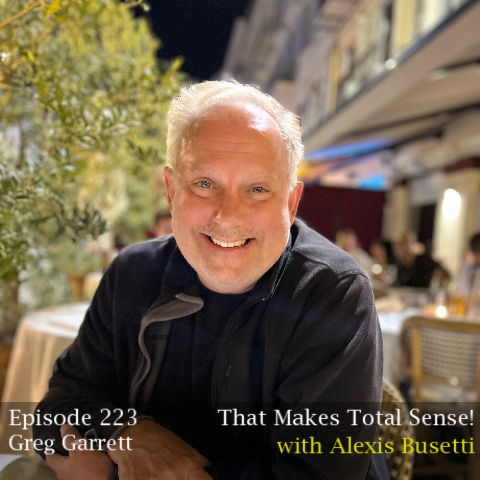
[00:00:07] Speaker A: Welcome to that makes Total Sense, a podcast dedicated to exploring God's generosity and justice. I'm Alexis Busetti, a Christian aiming to ask good questions and encouraging you to do the same.
Every one of us is wired by God to live out generosity and justice.
[00:00:24] Speaker B: But.
[00:00:25] Speaker A: But the how sometimes eludes us that makes total sense is a way for us to get together, posture ourselves as learners, and challenge one another to practice generosity and justice in a tangible way every day.
Okay, Greg, it happens every once in a while. Okay. My husband might call me on that. It happens every once in a while that I tear up even before an interview. And here I am.
We just prayed, and I just finished your book, and we're recording this near the end of October, and I'm listening to stories of what's happening in Israel, Palestine, and it's a heavy time. And your book on Baldwin is one of those tools that's hearing the spirit of Baldwin, if I can say it, is helping me as I process through this. So thanks for joining me in this.
[00:01:31] Speaker B: Journey this morning, Alexis. You're so very welcome, and I love that you made that connection.
Early in the book, I talk about how every age seems to be an age of, you know, the fortunate unfortunate. However we want to think about that is know, every age is an age of outrage. Every age is an age of trauma, an age of violence, an age of injustice. Baldwin witnessed a lot of that personally and served as a witness even to things that he was not personally necessarily needed to be involved in. And so he was able to take the things that he saw to process them, but also to filter them through his childhood belief, which I don't believe ever left him, and to continue to respond to the outrages of the world with this sense of hope and love, which I'm sure that we'll talk more about, because you were talking earlier about the very end of the book.
One of the things that I find most inspiring about him and the reason that the fire next time has never left my backpack is that almost every day, I feel like I need to read Baldwin. And so, yes, I'm a devout Christian. I went to seminary. I preach, I teach, I study the scriptures. But Baldwin is like a secondary scripture for me, and I don't mean anything sacrilegious by that. But if the saints are the people who can help us to understand how we live and how we're supposed to live, then Baldwin is one of those saints for me. And he will always be a part of my thinking process. He'll always be a part of my desire to understand myself and my place in the world and my faith.
[00:03:15] Speaker A: Yeah, thanks, Greg. So I'm chatting today with Greg Garrett, who has written a wonderful book called the Gospel According to James Baldwin. What America's great prophet can teach us about life, love and identity.
And your book has been with me for the past couple of weeks.
To the pool, to the coffee shop this morning in my reading chair at 05:00 a.m.. Nice.
I have found myself.
I'm looking for even the right feel. Maybe this is it. I have felt gratefully accompanied by Baldwin in the past week or so. As I mentioned, this heaviness has come, and it's beautiful. So I want to start with a question that you will not be able to answer in this amount of time, even if we took the whole time.
How's that? Good luck.
So for people who haven't had the novels and the short stories and the screenplays accompanying them and in their backpacks for all of these years, who's James Baldwin?
[00:04:32] Speaker B: And that's one of the most important reasons that I wrote the book. So I'm glad that you kind of launched us into this. And you're right. We could stretch out past an hour just sort of sketching this out. But because I am a trained professional, I'm going to make it short and pungent, because I think that we can hit the highlights very quickly. James Baldwin is first one of America's great writers, and I am long past the kind of reductive thinking where we identify somebody as a woman writer or a black writer or a gay writer. James Baldwin, just very simply, is one of America's great writers. And he was great in so many ways. It reminds me, I'M here in New York as we talked today, and this is a tiny little sort of byline, like just to the side here. But it will make some sense because I was preaching yesterday in a historic Episcopal church in New York City, and I was working on my sermon all weekend. I ended up saving it to my phone, and I got up to the pulpit on Sunday morning, and I accidentally hit something and my iTunes started playing over the microphone. And so quickly I kind of tried to recover. It was like, okay, this is my walk up music. So it's like Aaron Judge walking up to the plate. It wasn't AC DC, thankfully, although it probably ought to be, because afterwards I was thinking, what would my walk up music be?
But as I was thinking about the sermon yesterday, and I was thinking about all the things that Baldwin has to do for us, I've been thinking about it in baseball terms, and I don't know if anybody in your family is a baseball fan, but when you talk about great players, they're people with a multitude of tools. They hit. They hit for power, they run, they steal bases. They have a great arm. Baldwin does everything in the literary canon, and we're just starting mean, this is the first finger. But he wrote short stories, he wrote poetry, he wrote plays, he wrote a screenplay based on the autobiography of Malcolm X. He wrote essays, he wrote literary criticism. He was a journalist, and then beyond that, he was a speaker, a teacher, an activist, a witness to racism and injustice in America and elsewhere. And he know, as I try to make the point in the title of the book, a person of faith who, even though he left organized religion in a way that a lot of people have, perhaps you know that I've written about you, too, another famous set of artists who left organized religion because of the hatred that they found expressed in it, but couldn't leave God behind.
Baldwin is maybe the best known unknown figure from the civil rights era. And one of the conclusions that I've come to in regard to Baldwin is, if you don't know Baldwin, it's probably because he lived so his three most famous contemporaries, and anybody who's seen I am not your Negro, which is maybe the great film introduction to Baldwin. Baldwin was thinking about three of his contemporaries who were killed during the civil rights era. And so we remember Dr. King because Dr. King was assassinated, we remember Malcolm X, we remember Medgar Evers. But Baldwin was a close friend and associate to them. He was a powerful voice. And because we're so distant from it, we just sort of need to be reminded of it. This is the 60 year anniversary of the fire. Next time around this time 60 years ago, that book was the number one book on the New York Times bestseller list, where it remained for 41 weeks. James Baldwin was one of the most famous people in America in 1963. And because he had something of a creative decline in his later years, people began to think of him as irrelevant somehow. But the truth is, as I hope the book demonstrates, is that Baldwin is increasingly relevant for us, that he is always speaking into our times. So just as he was speaking into the age of Kennedy and Johnson and into the age of Trump and now into the age of Biden, he's going to speak into the age of whatever is.
So the quick answer that I would give to folks is that Baldwin is, if you're not familiar with his work, the most eloquent voice of the civil rights era that you don't yet know.
[00:09:05] Speaker A: Wow. Thank you. Yeah.
Like I said, his voice has been accompanying me for the past week or so.
You break this book up into chapters. BalDwIN on XYZ culture, faith, race, justice, identity, and what comes through in that is that I think Baldwin rightfully didn't separate those very well.
[00:09:39] Speaker B: They are interconnected.
When we think about the different chapters, what I discover is that there are things that are interwoven between all of them.
Because Baldwin couldn't talk about justice without talking about race.
He couldn't talk about faith without talking about race and justice. And the last sort of body chapter in the book is on identity. Because one of the primary sort of theological beliefs that Baldwin had was, when the New Jerusalem comes, identity won't matter anymore. I mean, it is primary Christian eschatological teaching.
When we reach that welcome table, when we reach the New Jerusalem, who we are, what we look like, how we love, how we pray, even may not matter at all. If we are so loved by the God who created us, then we're going to arrive at this place. Know none of these little identifiers. I say little. They are so big in our lives, but none of those will matter. And then I chose to start with a chapter about Baldwin as artist and critic because I thought it was really important to establish from the outset that Baldwin was a person who had very definite ideas about what art can and can't do, what it should and shouldn't do, and that mostly he plays those out in his own art, in addition to helping us understand what great art can do for us, in terms of. You used the word earlier, enlarging us. So all of those things were integral to Baldwin's thinking. And when we think about him as one of those, I don't know, five tool baseball guys, they're all the tools, but they're all wearing the same uniform, right? So when Aaron Judge trots out to the center of Yankee field, he does all of these things, but they're not separable.
He ran out there, he's going to catch the ball, he's going to throw it home. And so Baldwin is that sort of one person package who demonstrates to us the interrelated nature of our lives and our lives with each other.
It's really beautiful to see this and to see the ways that he can help us make sense of all these things that we think of maybe sometimes as isolated things. Oh, today I'm going to think about justice. Today I'm going to think about racism. But it's all part of the same package. And Baldwin helps to kind of embody that for us.
[00:12:12] Speaker A: I want you to stay on the art for a moment, because that chapter was really fascinating to me, specifically, Baldwin on bad, like, I think now we might use the term. Baldwin was a know. He did all of these things. He was a creative, but as an artist, he had definite opinions on art, and he wrote critiques on art. And my mother in law was an artist, and I have never been able to relate to artists, if I'm just completely honest. I have never.
[00:12:51] Speaker B: With guitars across the back of your.
[00:12:53] Speaker A: Wall, I would tell you, this is one of the things where I tell my husband, I love you, and I cannot relate to you in some of these ways. Yes, he is the artist in the family, but you in your commentary and Baldwin and talking about what Baldwin talked about on art, about art, talk about art and what it can do for us.
And then when somehow bad art is presented to us, that that has an effect on us as well, specifically sentimentality. And some of these characters that are inhuman in that they are not rounded like Baldwin's characters, and he pointed that out and said, this does something to the audience when they are experiencing this art. I'm thinking about right now movies and novels that, you know, that may have. Know some people. Oh, my. Was this was whatever it was for the time. This was revolutionary. This was this. This is that. And Baldwin still.
[00:14:04] Speaker B: No.
[00:14:04] Speaker A: No, sir. No, ma'am.
[00:14:05] Speaker B: No, sir. No, ma'am. And let me just sort of interject here. I think one of the reasons that I am so drawn to Baldwin is that I try and write in all the areas where he tries to write. I mean, not with the same success, but because I am also a novelist and because I teach creative writing, and I see how bad art can happen perpetrated by people with really good intentions.
So when I came to Baylor 30 plus years ago, and it was almost exclusively a Baptist school, I would get a lot of devout students who wanted to save souls with their fiction. And, I mean, from the very beginning, it was clear to me that this was not working, because basically what was happening was that they were writing this. Protest literature is how Baldwin thinks about it, which reduces the characters, and the characters are the essential part of any kind of imaginative liTerature.
Ideas are important. Baldwin had ideas and he had causes, and he wrote about them, but he wrote about them through the guise of characters who embodied them. And so what Baldwin talked about in his early essays on protest literature, where he sort of savaged Uncle Tom's cabin and Richard Wright's native son and made a lifelong enemy of his one time friend and advocate. Richard Wright was basically the same thinking that I have observed over 30 plus years of teaching creative writing. When all you care about is the protest, then your characters become these stick figures carrying protest signs. And if your readers already agree with the signs, then they'll buy in. But if they don't agree with the signs or if they recognize the human complications.
So we're recording this week in the midst of the repercussions of a heinous attack on Israel by Hamas and an attack on Gaza by Israel. And you can't stick figure protest sign thousands of years of violence in the Middle East. There's too much nuance for that. There are themes that we can absolutely lean into.
The death of any innocent is to be mourned.
But to tell this story, or to tell any story, it's got to be embodied in characters. And so what Baldwin talked about, and you used the word sentimentality earlier, it is easy to take a situation that has inherent dramatic value and use it in a way that communicates, you know, when Uncle Tom, in Uncle Tom's cabin, is savagely beaten to mean, we read that scene and we're like, oh, my God, this is awful. And on his deathbed, he forgives the overseer who has done it. And he's just. He's getting me to heaven this much faster.
But what Baldwin said about Uncle Tom, just as he said about the sort of villainous character in Native sun, was that it was only a tiny piece of humanity that was getting represented. Uncle Tom and Uncle Tom's cabin doesn't have an inner life like you and I know. We live inside ourselves. We are thinking, remembering. We have all of these things that are going on all the time. Uncle Tom is a character, doesn't have an inner life. He exists primarily to forgive this person who kills him.
And that is not a useful dramatic thing because it doesn't represent full humanity. And then in Native sun, the character of Bigger Thomas, who is so brutalized by the racism in American culture that he brutalizes, and, I mean, we understand this as a trope or a know, broken people break other people, but we don't actually get a feel for bigger Thomas's inner life, and we don't get the sense of him as a fully fleshed out human being. And so what I've recognized from my own writing, in my students writing, and certainly from Baldwin's writing, is that we are complicated.
Know.
Whitman says, do I contradict myself very well, then I contradict myself. And so I think about the apostle Paul, who know, reasonably devout, and who also recognized that I do the thing I know I should not do.
And so for Baldwin, as a writer and as a critic, great art exposes our full humanity, our villainy and our heroism. And one of the novels that I return to over and over again in my book is what I think of as maybe his greatest novel, Another country, which is a big epic novel that's set here in New York City and has these characters who want to do the right thing and often fail to, often fall short of it.
So there's nobility and cravenness, there's courage and cowardice, there's love and the failure to love enough, which is one of Baldwin's great artistic themes. As you will remember, he said about Giovanni's room, which was this kind of landmark piece of queer know, the thing is not that he loves another man, the main character, but that he doesn't love him enough.
And so what I love about Baldwin as a creative artist and as a critic, and I talk about this in the book as well, because I often use Baldwin's work of film criticism. The devil finds work in my film classes at Baylor because it's such an exceptional look at good films, bad films, and even where good films fail.
He's such a good critic, and he understands art and the purpose of art.
And the purpose of art ultimately, is to let us walk in the shoes. Moccasins, whatever you think of another human being or a set of other human beings, to see the moral choices they make, the results that come with that, and to find our own humanity enlarged by that.
I wanted to begin with that it was the hardest chapter to write because in some ways, it feels like it doesn't fit with the rest of the book. But it's also the thing that makes the rest of the book possible, because I'm going to come back to Baldwin's own writing over and over and over again and say, if we take as an absolute value that Baldwin wants to tell the truth about the human experience, then he can be a trusted guide for us on race or on identity.
[00:21:06] Speaker A: Right. Baldwin does what many people, especially in the US right now, are lamenting that we seem to not be able to do societally, is live in these complex places and search for the nuance and search for the humanity in one another and in ourselves. And Baldwin wasn't satisfied with flat characters or stick figure with protest signs or extended pamphlets, I think is a paraphrase of one of the phrasings in that chapter and in this age of Baldwin, that's one of the things I think that we need most desperately is a guide who can show us, who can help us look for those places and not to be satisfied when we see the flat, the small, the simplified versions of people or experiences or situations or of ourselves. And I think that the quote I meant to start with, this quote that you come back to a lot in the book is, I know we can all be better than we are. And this is the sum wisdom of my year in all these years. And I think that that's it. It's not a critique for the sake of critique. It's not saying, oh, you could have written him better or you could have presented this situation in a different way. It's saying, if I'm understanding this correctly, it's saying, this does not actually help me to be better. To view someone else in this way, even if it is just a character. To view a situation in this way, to flatten it or to simplify it in this way doesn't actually help me or you to be better. And we can all be better.
[00:23:06] Speaker B: Yeah, because I'm a writer and because I write about art, I have an elevated vision of what art can do and can be. But it's also a theological vision. And I had a chance to talk about this yesterday at the Church of the Incarnation, which is this beautiful, like, mid century church in midtown Manhattan, incredible stained glass from some of the great artists of the 19th century. So I'm surrounded by all this beauty. And during the darkest times of my life, great art was one of the things that saved me, and I didn't understand the theological underpinnings of that. But when I went to seminary, I was increasingly drawn to Augustine, who I'd always thought of like, know, like this just sort know old man who really didn't want anybody to have any, just, you know, interesting. Sidebar.
Calvin's Institutes of Christian Religion does not even really talk about the afterlife very much, but it talks about beauty an awful lot.
And so Augustine was one of the early Church fathers, mothers who had this very real sense that in a kind of platonic sense, when things are true and beautiful in this life, they come from the source of truth and beauty. So if a piece of art is true and beautiful, it comes from God.
So on the day that you two's beautiful day saved my life, when I thought I was going to end myself, that was truth and beauty speaking into my reality.
On the days when go tell it on the mountain teaches somebody about what it means to want to follow God and to pursue community and to try and make sense of the past, that truth and beauty comes from the source of truth and beauty. And so I don't think of art in any of its forms as frivolous.
When you go to a great movie, when you hear a great song, when you stand in front of a painting and you're transported by it, what I always tell my students is that art is one of the most important things that human beings commit themselves to because it changes the lives of other people who view it, see it, hear it. And so Baldwin understood that. I don't know that he understood it in a theological way. His education ended at high school. It was a good public high school. He went with famous writers and artists and photographers.
But I don't have any illusions that Baldwin, with his high school education, knows more about the world than me, with my multiple college degrees. And what he ultimately knows is that we can do better and we can do better as artists, we can do better as people, as politicians, as theologians.
And I mean, for him to say that toward the end of his life, this is the sum total of my mean that will preach.
[00:26:34] Speaker A: I want you to take us to Baldwin on faith. And just so you know, in my mind, when I'm thinking of the chapters, what I'm hoping will hit is faith and identity in the end, because that chapter, especially when you speak on Baldwin and love within, that really kind of wrecked me. Meaning that if we look at the lineup, we may end up kind of skimming over race injustice, though I would say these are things that are when we see Baldwin, when we read Baldwin, hopefully we're not missing race and justice. I don't want to say that they're low hanging fruit. They are. It's deeper than that. This is what we know Baldwin for in, you know, some I and what we also just said, they're interconnected, so we will hit race, we will hit justice. But I do want you to talk about Baldwin on faith and Baldwin on identity, partially because those chapters hit me so deeply, just kind of where I am in my own spiritual formation. And what can I learn from this prophet about faith?
So some may know that Baldwin's stepfather was a preacher. Baldwin was not unfamiliar with the Church by any stretch of the imagination. Yet when people think about Baldwin, that may or may not be the first thing that comes to their mind. So how can you help us explore what Baldwin has to teach us about faith?
[00:28:21] Speaker B: Well, when I was talking about Baldwin yesterday at Church of the incarnation here in New York City.
I sort of asked people to raise their hands if they had been broken by the.
You know, you will not be surprised to know that there were a number of people who raised their hands. I myself was broken by the Church. I was raised Southern Baptist.
It was not a Place for people who asked questions or who believed in truth and beauty.
If you were not interested in sermons on liquor by the drink and paramutual horse bedding, then you did not belong there, and I did not belong there, and James Baldwin didn't belong there. But there was a stretch where for two or three years, he was a renowned preacher as a.
You know, we can imagine this because this is a Person with exceptional gifts of thought and language and depth.
One of the things that he did, his stepfather, the preacher, was abusive.
There was this Love Hate relationship with Baldwin that shaped his life.
And I think one of the things that he wanted to do was to outdo his stepfather, his father, the only father he ever knew.
But I think there was also this drive and this Desire, you know, to find that connection to God.
And it ultimately didn't happen because he was repelled by the exclusion.
One of the stories that BAldwin tells in the fire next time is about his best friend who was Jewish. And his friend came over to visit him, and his father asked him about him, and he said that he's Jewish. And they had this conversation, and Baldwin was wondering, should I be happy that my friend is going to hell?
And so they had a fight. His father slapped him because Baldwin said, he's a better Christian than you are.
And shortly after that, Baldwin left the Church formally.
But I had the opportunity to preach at Wilshire Baptist Church in Dallas last fall on All Saints Sunday. And I preached about Dr. King and Maya Angelou and James Baldwin. And I don't normally quote myself to myself, but this is one of the sentences I've written in recent years that I'm most proud of and believe most intently. I said, if James Baldwin were to stand in front of us here Today at Wilshire Baptist Church, I believe all of us would see the spark of Jesus that was alive in him.
And so he left the Church. But in a multitude of ways, it's clear that he never left faith behind. And so for all those people who raised their hands yesterday in Manhattan, myself included, leaving the church doesn't mean leaving God. It doesn't mean leaving faith. It means leaving some received ways of understanding God and faith.
And when we look at Baldwin's life, his work, his writing, his correspondence over and over again, it's clear that he didn't abandon his faith by abandoning the church. So having done a ton of archival research, and I actually, on Friday, today of this week, I was at the Schomburg center in Harlem reading some letters from Baldwin that I had not read during the process of writing the book. And some people will think that's ridiculous. It's like you're done. It's like, no, I will never be done with James Baldwin. And what I had noticed in the correspondence that I had read previously, and what I saw again on this occasion is that over and over again, Baldwin asks his correspondents to pray for.
You know, I am a theologian, like, professionally, but my theology of prayer is, know, what I was taught was vending machine prayer theology.
You put your quarter in and you get a tab. Except I would put a quarter in and I would get a sprite. And I didn't understand what that meant.
But what I do know is that you don't ask people to pray for you if you don't have some concept that it means something, that those who pray for you are aligning themselves with you and with the God who loves. And so in that correspondence, in the themes of the stories and the essays, in the epigraphs, even almost all of which are drawn from black spirituals, there is this ongoing sense that Baldwin continued to be a person of the church even though he had left the church. And after I had written the book, I found this open letter that Baldwin wrote to Archbishop Desmond Tutu toward the end of his life.
And the Opening sentence of that is really important, because Baldwin was a consummate artist. And he began the letter by saying, I'm not a person of faith. And then he stopped himself. And this is not him speaking. This is him typing.
And then he stops and enlarges, corrects himself. He says, I am not a churchgoer.
And at the end of that letter to Desmond Tutu, he closes it in the faith.
So BAldwin is, I believe, a person who we can look to as somebody who was trying very desperately to see how God could be significant in his daily life, how God could be significant in understanding what was going on in the culture, in pursuing justice, and in Wrestling with the issues of his era, which were also the issues of our era.
In the collection that I found, that Desmond Tutu letter in the introduction says, what I have always believed, Baldwin never stopped being a preacher.
And so in the sort of opening of that chapter, BAldwin is referring to the early Malcolm X. When somebody asks him about Malcolm X during his time with the Nation of Islam. And he says, I could never be that kind of theologian.
And as somebody who is a theologian, who is the canon theologian of a cathedral in Paris, people are always asking me what that means.
And most simply, what being a theologian means is like, we're trying to talk about God.
That's the Greek. That's what the word means. We're trying to talk about God. And in the process, we're trying to talk about what it means to be human, what it means to be part of a beloved community, what it means to seek justice.
[00:36:01] Speaker A: So in trying to talk about God, I also grew up Southern Baptist and experienced a lot of the same things that you did in your upbringing, which makes sense, because not all SBC churches are the same, but in a lot of ways, all SBC churches are the same.
[00:36:19] Speaker B: Right?
[00:36:20] Speaker A: So I also knew what I was not supposed to do, and it included all the things that you just said and drinking and smoking and having.
We don't do any of those things. Right.
But also, one of the things that I learned in my SBC upbringing that thankfully does continue is the short answer of this. God is love.
[00:36:49] Speaker B: Yeah.
[00:36:52] Speaker A: I want to take us to this chapter on identity I'll kind of mention. So, during the pandemic, I began my seminary studies at a time when nothing else was happening in the world. In June of 2020, it was a great time to embark on this new endeavor. I'd done all of the paperwork and been accepted before the first known case of COVID-19 and then here we are.
And during that time, of course, like many of us, I had a lot of time on my hands. I sat and I thought and I studied and I read and I participated with my classmates and my professors online.
And I had a sign made up, kind of like those signs.
You live in Texas, too? I don't know if these are everywhere, but these little signs that you can get. I don't even know, probably 100 for $50 or something. And they might point to a garage sale, or they might point to an open house, or they might say, translators needed, or they might say, I buy houses cheap, or something like that.
[00:38:10] Speaker B: Right?
[00:38:11] Speaker A: And I had one, a singular one, made that on the front, red, I guess, depending upon which way you saw. On the front read, God is love. And on the opposite side it read, God isn't mad at you.
And we put it in the front yard, and we have a street that's not super busy, but probably busier than some of the other ones in the neighborhood.
And I was surprised. We got a couple of notes in the mailbox and a couple of people, we spent a lot of time out in the front yard during the pandemic when the weather was nice.
[00:38:46] Speaker B: Yeah, of course.
[00:38:46] Speaker A: And one woman said to me, what does that mean?
God isn't mad at you?
Oh, honey.
I said, well, it means exactly what it says. And I said, the truth is, I really need to read that, and I really need someone to say that to me. And I thought, maybe if I need to hear that, maybe I'm not the only one.
And turns out I wasn't the only one.
[00:39:25] Speaker B: Right.
[00:39:26] Speaker A: But God isn't mad at you.
God is love.
That hit me something fierce in this identity chapter, because we think about Baldwin as someone who's just trying to talk about God. Like the rest of the.
He's. He's trying to talk about God. And one of the themes, as you mentioned earlier, is love in his art. And two specific scenes that you mentioned in the book, they're kind of threaded. They're mentioned more than once. Also in this last chapter that hit me something fierce.
Are with Tish and Fanny.
[00:40:10] Speaker B: Yes.
[00:40:11] Speaker A: And the response. Right.
The celebratory, the sacrament that came, but also with the couple in Giovanni's room.
The quote in the book is the universal question of loving and not loving enough of what happens to you if you're afraid to love somebody.
[00:40:40] Speaker B: Yeah.
[00:40:41] Speaker A: And so I'm wondering if you can maybe take those two scenes or either one of those scenes and elaborate on.
And again, I want to mention these are in the chapter on identity, which was, the placement of those was also profound to me. It could have been in the chapter on faith. It could have been in the chapter on justice.
It could have been in the chapter on Art and Culture. But to be placed in this chapter on identity also spoke to me.
Can you take those and run with either one or both of those?
[00:41:19] Speaker B: I would be happy to. And just very quickly, I'm going to kind of move us through that chapter, because I tried to address three things about identity.
First is the idea that we think identity matters so much, and most importantly, how we define others.
And so we define people based on how they look, what color their skin is, how they worship, all of these sort of identifiers. And in the opening of the book, I talk about Venn diagrams and how if we were to use Venn diagrams, Mr. Baldwin and I inhabit only, like, this tiny millimeter of shared experience when what Baldwin's writing, teaching life indicates is that we have so much in common, despite what the Venn diagrams might say.
And so the chapter on Identity says, first, people try and assign us identities and we should try and claim our own identities. But what Baldwin leans into is that ultimately, identities are not going to matter. And maybe we'll move to that In a little bit. The two stories that you talk about. So Tish and Fonnie from if Beal street could talk and the main characters in Giovanni's room.
One of the things that Baldwin tried desperately to live into as a person was to love courageously.
And I have said this before, I'm going to quote myself on myself.
I am my best self on the page because I get to revise myself.
My wife, Jeannie, who I love dearly, my last wife, please, God, I do my best and I often fall short, but I love her dearly. And one of the things that has made our relationship possible and fruitful is that I love her even though I know it's going to hurt me when I fall short or when she falls short.
Because when you love someone, you're giving them the key to your heart. There's that great song by Billy Joel. In every heart, there is a room, a sanctuary.
So I will choose to be with you. And even though I know that you can hurt me, because you have the key to my inmost being.
So Baldwin, in his life, struggled to live up to what he did on the page, as we all struggle to.
There was a great love of his life, Lucienne.
And when we talk about identities, this is one of the most beautiful pieces of it. Lucienne was mostly a hetero white male, but he loved James Baldwin. James Baldwin loved him.
I write in the book about the Swiss village where Lucien's family had a chalet where Baldwin went to finish his first novel, came back on several occasions to write.
And when Baldwin died, Lucien was at his side.
And Lucien had married a woman, had children, and none of that mattered in terms of love, right? They loved each other deeply and powerfully. And even though they weren't able to spend their lives together in the way that we hope we will be able to do, there was that sense of love as sacrifice and that powerful, transformative thing that allows us to move forward and to be our best.
So in if Beale street could talk, Tish and Fonnie are boyfriend and girlfriend. Girlfriend and boyfriend. The way that I set that up. Tish is expecting Fonny's baby.
FoNnie has been wrongly imprisoned for a crime he did not commit. And there are a lot of things that if Beal street could talk is about. But I think that just as Giovanni's room is about love and not loving enough, if Beal street could talk is about loving enough, loving extravagantly. So the love that Tish has for funny and her desire to be with him forever, even though he is in prison at this moment, and the love that Tish and Fanny's family have for Fonny as they try and get him out of prison because they know he didn't do the thing that he's accused of.
There is a moment, and you were talking about the sacramental moment, and this is jarring for some of us. Now, I had somebody talk about this in class the other day when a pregnant woman was drinking something, and we didn't know this in the old days, you're not supposed to drink alcohol when you're pregnant. But Tish's mom gets the good brandy down, the brandy that they've been saving for the most special occasion. And when Tish reveals that she's.
You know, there are people in the book who are judgmental and, like, beyond judgmental. Like, forgive my use of the word crazy. I don't often use it, but crazy conservative Christian in connection with how they judge Tish for having Fonny's baby.
But in her family, there is just this awareness that this is a child created out of love, and it is something to be celebrated, and it's a sacramental moment. We're going to bring out the best that we have to honor this.
And there's something that Tish says, and I'm going to mangle the language a tiny bit, but she is sitting with her father, who talks about how proud he is of her and how much he loves her, and there is none of that judgment. How could you do this? How could you let this happen?
And she says, it is an amazing thing to realize that you are loved completely.
And that's my story, and maybe your story. And I hope some of the people listening recognize that as their story, because to be loved in this life is a preview of what it means to be loved in the next lifE.
My friend Rowan Williams wrote something about human relationships and human sexuality, and he was one of the first people in the Church of England to actually talk about same sex relationships and the joy and love that those could preview for us.
But theologically, what we're talking about when we are loved totally and completely, to the best of the ability of the people loving it is a tiny preview of what we're going to see in the New Jerusalem. It's a tiny preview of the unconditional love that God has for us. And so, Alexis, just to come kind of full circle, you and I grew up in a church with angry.
This. I had this sense there was a cross behind the baptismal, not font. It was like, full plunge, because I did the full plunge.
[00:49:23] Speaker A: Oh, yeah, me too.
[00:49:24] Speaker B: But I had the sense that Jesus was on the cross every single day. Maybe he got Easter off, but, like, 364 days a year, Jesus was on the cross. And God was so angry and disappointed with all of us.
And to be loved and to be seen and to be accepted.
I mean, we believe that that's what's going to happen when we encounter God, but it's a taste of it in this life. And Baldwin understood it in his work, and he understood it in the places where he encountered it in his personal life.
There's this very powerful sense in that chapter on identity that someday we're going to arrive at this space in the New Jerusalem, when we come to the welcome table, where the color of our skin, the way we love, the way we pray, the political candidate we support or don't support is not going to matter. We're just going to be seen and accepted and loved. And that, for me, is the great teaching of the church. As somebody who did not feel comfortable in my own skin or comfortable on the planet to have a community of faith love me and tell me that God loved me, to have a human being love me.
All of those things are kind of central to this idea that someday we'll be able to push aside these ridiculous limitations that we put on ourselves because of identity, and we'll be able to live into this space that is just pure love.
[00:51:17] Speaker A: Thanks, Greg.
I want to let you have the final word, but I want to share this in the event that anyone else is in the spot that I was in. A little bit of self disclosure I shared about the sign earlier.
[00:51:35] Speaker B: Right.
[00:51:35] Speaker A: But years and years ago, I was talking with my therapist, and I think maybe she was asking about my prayer life, which you kind of talked about that earlier and how you related to that.
And I don't remember exactly what she was asking me, but it felt very normal for me. And I want to kind of preface this in saying, I'm not saying this is bad for me in this moment. She was asking me to look at something different.
[00:52:07] Speaker B: Right.
[00:52:07] Speaker A: So I said, every day I just pray that I would please God.
And she's pretty good, but I could tell she kind of had this look on her face, and she kind of was taken aback a little bit, and I just thought, this is very normal. What do you mean? Why would she be kind of looking at me that way? And she said, okay, I hear that basically, I'm not going to discount that. I'm not going to say that's bad, but let me ask you, what if, right, you maybe try it for like a week? You can still pray that, but add on to it. Ask God to experience his love that day.
She said, just kind of see what happens.
And I thought, okay, sure.
It was a struggle at first to kind of add that, to change my habit. That may have been around the time that I started praying the Ephesians three over myself, that I would know the depth and breadth, the right of God's love for me, but just that change.
And I feel that echoed in Baldwin's work of that we would just experience the love of God, that we would experience the love of God, God's self, but that we would experience God's presence, but that we would experience love like that through people. As you said, to experience the miracle of being fully loved by someone else and the beauty that that is and that that can be and that we can share is quite remarkable. And I might consider myself a budding theologian. I'm in my penultimate quarter of my MDIV, but I think as someone who's a theologian in training, I think that, to me, feels like one of the most significant things that I might pass on is how to help people feel the courage, maybe if they need it, or the desire to open their eyes or to just close their eyes and open their palms, to experience the love of God every day, whether it's through the sky or through someone's kind words, or through the grass or through a conversation, but that being just one of the most meaningful things that we can do throughout the day. And I felt that very much resonated with me in this chapter on Baltwin, again, because it was in this chapter of identity, this informs this love of God, and how we experience God's love and the love of others informs who we are, and it informs who we believe ourselves to be, which I think is really powerful.
[00:55:16] Speaker B: Yeah.
So one of the surprising things for me about Baldwin, Baldwin wrestled with so many.
You know, Alexis, you and I are white. So I'm a straight, white, middle aged Christian male. Because I'm male, I actually get some things that you.
You know, we were talking earlier about my friend Beth Barr, who writes a lot about complementarianism and about whether or not women can be leaders in the church theologians, of course, they know the first evangelist was a woman, Mary Magdalene. But I walk through my days without any of the things that Baldwin had to wrestle with as a black gay man in exile.
Baldwin's life seems to be a life that would offer a whole lot of opportunities for hatred and resentment, for tallying up the different ways that he's been oppressed and held down.
And the amazing thing for me, and we talked about this before we started the recording, is that Baldwin comes back again and again and again to the primacy of, you know, this is a thing that he had inherited from the early church. We'll talk about this in just a second. His early life in church, but it also has to come out of his lived experience, because if you hear no, no over and over again, then you're going to go like, oh, well, no is the truth.
But it feels like he hears no often. But what he ultimately leans into is yes.
So toward the end of the book, I talked about this sort of strange and not completely successful book that he writes about the Atlanta child murders. He was commissioned by Playboy magazine to follow and to investigate and to write something about this. And it is one of the most horrifying and chaotic stories about race and injustice that I know of.
It turns into a book called the Substance of Things Not Seen, which we know is the Pauline sort of way of talking about faith.
And the incident itself is awful.
20 some young black people, most of them children, but not all of them killed in Atlanta. And a young black man is charged and ultimately sentenced, found guilty for two of those murders. And the justice system says, well, we found him guilty for two, and he's guilty of the rest of them. We're not going to investigate this anymore. Now, my wife is a huge true crime aficionado, and we are watching right now only murders in the building about true crime podcasts.
[00:58:36] Speaker A: I won't spoil the third season for you.
[00:58:39] Speaker B: So one of the things that I think I know about serial killers is they have a profile.
So, like, if you kill little girls, that's your profile.
But there were little girls, little boys, teenage girls, teenage boys, adult men, all of them killed during this period. And some of the recent investigative reporting on this suggests that it's the Klan who was behind this, which will not surprise any of us at all. But Baldwin is in the middle of this and feeling all of this, the hatred and the futility for all that Atlanta talked about itself as a city too busy to hate, the great Southern Mecca for business.
Here are these 20 plus young black people who die. And there is no justice for the parents, for the families. There may be no justice for the person convicted of the crime.
And so the story is all over the place, and he is wrestling hard.
It makes me think about Jacob and the angel, like I am trying to come to some kind of understanding and some kind of ultimate truth, and there is no ultimate truth because at that time, he doesn't have the access to these reports. He doesn't have the interviews with clan members.
And ultimately, where he lands is on love.
And it is so counter instinctive, based on every part of the story he has told up to that point.
But he tells a story toward the end about somebody in his church when he was growing up who died. And he wonders if they could have saved him, if they had loved him better.
And he recalls that in the Church of my youth, I was taught that we were supposed to love everybody.
Whoever else did not believe did.
And so, you know, what I want to sort of say is, against all the ODs, at the end of this trial, at the end of this chaos, this hatred, Baldwin reaffirms love as the most powerful force in the universe.
I mean, it is so Christ like. I don't even need to draw the like. You know, I've had a really bad day. I've been sentenced to death, I've been tortured, I'm hanging on a cross, and yet I'm not going to call down vengeance from the heavens.
I'm here to represent love.
And what I see in Baldwin that is so important is that even after everything he had lived, everything he had witnessed, all he had lost, he comes back to the teachings of his youth, because I believe that they were the teachings that were integral to what allowed him to go on day on day. Baldwin also wrestled with mental illness. He wrestled with depression. I'm going to suggest he wrestled with substance abuse.
On more than one occasion, he thought about killing himself, but there were things that kept him going. And I think ultimately, what he believed is that at the center of this universe is a force of love that is more powerful than hate. At the end of the day, love is going to win.
And in that way, he was so much like Martin Luther King and so much like the later Malcolm X, who realized the brotherhood of all of these people who were traveling to Mecca after he stepped away from the nation of iSlam.
So it is a witness I'm not sure I could represent. I mean, I hope that I could, but given my privilege, given my walking through every day as a white man, I am not faced with the things that James Baldwin was faced with.
And so at the end of his life, at the end of his work, to be able to lean back into these ideas that God is love, that we are loved. And I think you remember that at the end of his life, he was working on a play called the welcome Table.
And it comes from this black spiritual, I'm going to sit at the welcome table one of these days. And so it's one of these sort of eschatological, not now, but soon kinds of teachings. I am not at the welcome table yet, but someday I'm going to sit at the welcome table. And this play, which was never produced, but that I have read at the Schomburg center here in New York City, is a play about all of these people who absolutely should not be sitting at a table together. It's like the worst Thanksgiving dinner of our know, with your crazy Uncle Phil and your grandma who is making all these moral pronouncements, and the kids who are just like, I cannot wait to get away from this table.
So the welcome table was based on his table in the south of France and on Josephine Baker, the great singer, dancer, and it turns out, spy during World War II, who adopted something like 13 kids from different races and cultures.
And in Baldwin's play, although it's not finished and it's not perfect, there is this amazing sense that, as we were saying earlier, we are all so much more alike than we are different. And that the identifiers, whether I'm a privileged Algerian expatriate or whether I'm a maid, whether I'm black or white, whether I'm gay or straight, we all are someday going to sit at the table, and we're going to be surrounded by love and acceptance.
And that, for me, is the thing that carries me through some of these hard days.
So when I talked about Baldwin as sort of secondary scripture for me, it doesn't mean that I care any less about Ephesians three. It doesn't mean that I care any less about the sermon on the Mount. I mean, they are still central to everything that I am, or Matthew 25 when we talk about exactly what it is that Jesus teaches and that God wants from us.
But the amazing thing is that James Baldwin represents those things in his life and in his work.
And despite all of the things that he encountered, the things he know, I talked at the end of the book about Baldwin is a saint, not because he was perfect, but because he got his hands dirty and he leaned deeply into the reality of what it means to be human.
And he continued to hope, and he continued to, you know, end of the day, the saints are the people who teach us how it is that we're supposed to live.
And that is what Baldwin does for me every single day.
[01:06:12] Speaker A: Thanks, Greg. I want to note, if this were a written interview, I would make it a footnote. And so this is how I mean it. But because I'm a budding theologian and because I love analogies, I think we can probably make something of it.
I'm white passing.
Yes.
And it makes a difference. And so what I will say is I'm white passing. I'm mixed Hispanic. I used to not be white passing, but as I have matured, my features have changed. I have an Italian last name now. And so this sounds.
But what I would say is it reminded me because there are a few things that are true about that. Number one, I walk through life with the privilege of a white passing woman, and I am aware of that. But also it feels very, what is our adjective? Baldwinian. How do we say this anyway? But to recognize that in the end we will be accepted for who we are, which I think is what you're saying when you're saying these things don't matter. It's not that the identification of ourselves don't matter. It's that we will be accepted with all of those, one of those things. To me, that's a. Anyway, you talk about how race is a construct. We didn't get to that chapter, but we've done lots of other episodes on that. So people can read all about that wherever they can read about it in your book as well. But it is to say that even with Baldwin, some of these identifiers that we might place on him, and you say this, don't really capture who he is. Right. And so we say, I'm a white passing woman, and this is superficially what people see. And we don't always see those things on the inside that are more complex and complicated and speak of our life experience and our lived experience in those ways.
I didn't mean to set you up. Sometimes I tell people that pre recording, if I think the conversation might go there. I didn't say that to you.
Like I said, this would be a footnote if this were a written interview. But I thought important to say, because A, that is who I am, but also B, because I think it feels to me like a little example, right, of something where we say Baldwin. And I would say there may be people who would say, what does Baldwin have to say to me, he was all these things you said. He was black. He lived in a time that I didn't live in. He was gay. He was an expatriate. I don't have anything in common with Baldwin. We say those things about Baldwin were true, and they don't speak to his whole, the whole of his humanity and his complex nature and who he was and who he expressed himself know. So those identifiers are important, and they don't fully express those ven diagrams. Like you said, you have so much more in common with Baldwin and learn so much from Baldwin, even though your intersection with him is very small. So just on a side note, I just wanted to mention that as we get closing up, but I appreciate those words that you spoke about him and about his experience with writing on that. And to come to love at the end of something heinous and horrible to come to the power of love is very beautiful and very brave.
[01:09:45] Speaker B: Yeah. And it's at the heart of our faith. It's like whatever else is happening, love gets the last word.
[01:09:54] Speaker A: That's right.
[01:09:55] Speaker B: Sin and death are conquered. Love gets the last mean. Thank you so much for sharing that, because I think that's really.
[01:10:07] Speaker A: Yeah, yeah. Thank you so much, Greg. I'm really grateful. I thank you for writing this.
Gosh. To help those of know who haven't read as much Baldwin as you, but might be intrigued now. And this is an invitation, I feel like this is an invitation to allow Baldwin and Baldwin's wisdom and the spirit that he brought into the world to accompany us through these hard times, through this current age of Baldwin. So this is the gospel According to James Baldwin, what America's great prophet can teach us about life, love, and identity by Greg Garrett. And Greg, this is going to be one of the longest mentioned in this episode, but I will link all of the Baldwin works, and so if something caught someone's attention, they'll just be able to pick it up along with your book and hopefully just continue that journey. So thank you so much for being with me.
[01:11:08] Speaker B: You're so very welcome. So grateful for our time together.
[01:11:15] Speaker A: The links for all the resources mentioned in today's episode can be found in the show notes, music and podcast production by Seth Busetti. Be sure to give us a review on iTunes and subscribe at your favorite podcast listening app. You can also visit
[email protected].