Episode Transcript
[00:00:10] Speaker A: Welcome to that Makes Total Sense, a podcast dedicated to exploring God's generosity and justice. I'm Alexis Busetti, a Christian, aiming to ask good questions and encouraging you to do the same.
Every one of us is wired by God to live out generosity and justice, but the how sometimes eludes us. That makes total sense is a way for us to get together, posture ourselves as learners, and challenge one another to practice generosity and justice in a tangible way every day.
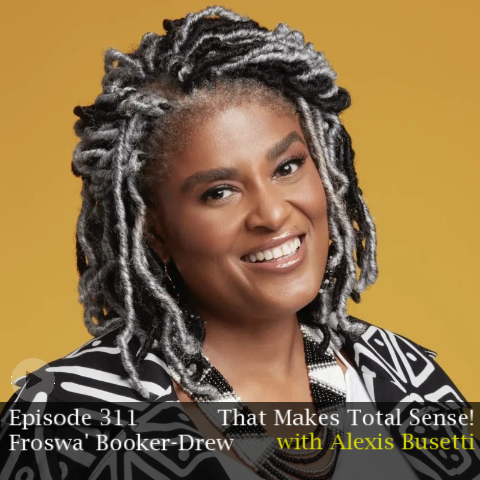
Okay with my guest today, as I feel like as is per the usual on the podcast, we've already had a super fantastic prerecord conversation. In some ways I wish I would have pressed record five minutes ago, but I didn't. So anyway, we're here now. I am with Dr. Francois Booker Drew and her most recent book.
I held it in my hand and said to her, where has this been?
Dr. Boswell? Where has this been? It's called Front Porch Navigating Leadership Pressures and Barriers. As a woman of color, I am a mixed Hispanic woman who has.
I have just struggled with so many of the things that you mentioned in this book. We're going to talk about it, but I mean, exterior stuff, barriers that just exist because of our institutional systemic racism, because of gender issues that continue in this country, but also internal stuff, things that women of color, we just deal with some of these internal struggles too, partially because of the external stuff, partially because of things that we believe about ourselves that we have to unlearn and unbelieve. And I could picture. I could picture myself on the front porch with you. This book was so.
Let me just say there's there's Bible stories, there's prayers, there are stories of women sharing their lived experiences.
And from a PhD this is a well researched book as well. So I just feel like it was the whole package.
Easy to read in the sense that it was readable, but hard to read in some ways too, because it just reminds us of the realities that we face as bipoc women who are living and working in these spaces.
But also really encouraging because you share so much of the wisdom that you have gained. And wisdom, like I said, biblical women and women in various spaces who have learned how to navigate where we are.
Anyways, a long intro, but thank you, thank you. Thank you so much for being here.
[00:03:06] Speaker B: Amen. Thank you for having me. That means so much to me to know that it's having impact, that it's resonating so often when you write. And it's hard, you know, because you're being so vulnerable and transparent and you're given a piece of yourself and you don't know how it's going to be received.
And so it's like, God, I'm giving this to you, hoping that it's going to be a blessing. And even in trusting God, your humanness sets in and you're like, but God, what if they don't like it? What happened? You know? And so thank you for affirming me as I'm trying to affirm others through this book.
[00:03:45] Speaker A: I appreciate that even that was hard. That was one of the ones. We don't have to go there now, but I will. One of the bullet points I had is even women, we just don't self promote as. As well, as well, but as much or maybe as easily as men do. I had this conversation with my co author. We have a Bible study coming out this summer and she's done this before. I haven't done this before. And I was like, it just feels weird.
Like you, I consider myself to be a connector. And so when I see resources or people or their work and I would, I just say, oh my goodness, you've. You've got to have this. It's so great, you know, and. And even my co author has a Bible study coming out in the series that she wrote, and I have copies of that and I can't wait to put that in other people's hands. And even though I know ours is quality and it's good, it still is weird for me to be like, you need this. You know, like, even though it's just fantastic, I can connect someone to your work easier than I can connect someone to mine for some reason. It's just a weird thing.
[00:04:47] Speaker B: But it's because we've been conditioned about humility in a weird way, especially as women and women of color even more so, because you don't want to come in and be assuming and have people look at you and think, oh my God, you think you're all of that. And the reality is, I say this to people, but you are. And if someone is saying that, then they think it too. But I think we've been conditioned to go, I need to lessen.
And we've got this weird idea about humility in diminishing self. It doesn't mean to diminish you. It's also recognizing others and creating space for all of us to be great. But I was telling my friend, I am learning to decolonize my brain because we have been so conditioned to just be quiet, be demure, just don't say anything, let your Words speak for itself. And it's like, but it, it can't do that unless I'm advocating for it too.
So it, it's hard for all of us and it's unlearning behavior that we've been taught that isn't always accurate.
[00:05:59] Speaker A: Yeah, yeah, yeah.
I'd love to back up for just a minute and ask you.
This isn't something. I think it's a common question when we talk about books. It's not a common question that I ask, but I'm going to ask it to you, which is what was maybe I would say your motivation. Obviously we know who your target audience is, but like, maybe why, why now for this book for women of color. And then also when you talk about leadership, this covers so many areas where women are leading, which I was so grateful for. It's not, you know, just C suite women or just church ministers or just nonprofits or, you know, something like that. This is women across the board.
[00:06:54] Speaker B: So.
[00:06:58] Speaker A: What put this book in you to make you want to bring this out?
[00:07:03] Speaker B: What's so interesting is I wasn't initially going to do this book.
I was doing leadership circles for CCDA Christian Community Development association. And they're women of color leadership circles.
And CCDA reached, you know, had been reaching out about, hey, let's do this circle.
And I love framing women of the Bible and making them relevant to our situations today.
And so IVP saw the circle and reached out to me. Now this is what's crazy. The last book, Empowering Charity. I wanted IVP to do it, but it didn't work. Baylor took it.
And then the place that I wanted to work with the most reached out to me, which God is amazing. So IVP approached me and said, we see you doing these leadership circles for women of color. Write a book. Have you thought about writing a book? And I was thinking, no, I really hadn't thought about it, but I want to work with you also. I guess I'm going to be writing a book on women of color and leadership.
It was probably the hardest of all the books I've written. This one was really hard because it wasn't me coming up going, oh, I'm going to write this. It's going to be this. It was more, okay, I really want to do this because I love IVP and the authors that they have and how just forward thinking they are about our faith.
It challenged me to start thinking about my own leadership journey. It's so easy when you're writing dissertations and all the academic work to Focus on what other people have said, but to then do this reflection of your own story and thinking about, wow, what are the things that I've learned and what is it that I want women to be able to take away from my lessons and mistakes? Because I didn't always do everything right.
Framing it in a way where your faith is centered, because so often in leadership books, it doesn't frame our faith as the foundation of who we are and why we do what we do.
It was a challenge for me to figure out how do I bring the nerd part of me and the academic piece in, because that is always there lurking in the background. How do I bring the stories and my own lived experience and my faith into this and make it something that other people could really enjoy and not only learn from, but go, I see myself in this.
[00:09:40] Speaker A: Yeah, I'm so grateful that you did. I thank you. I saw myself in this book over and over and over again. I will say one of the things that I appreciated so much and when I say that this book was well researched and it also contained so many of the stories of women's lived experiences, which just wraps those statistics in flesh and humanity and emotion and respect, respect and honor and all of those things. It's one thing to read, you know, women make such and such sense on the dollar to men, but to hear from the women who are doing the same work and receiving less pay and also doing more work at home and what does their day look like? I mean, just as an example, that's huge. But I would say as a mixed Hispanic woman, I appreciated, and this is something that I've noticed is that a lot of times when we talk about our systemic racism or other racialized issues in the US it can feel very black and white binary.
And then these other people of color who are also being affected by these same, same issues to varying degrees in varying circumstances, we often just kind of get kind of left out of the conversation, you know, there's not always a 10. I would say.
One thing I noticed about your book in particular, and this is coming from someone who grew up in Oklahoma. So it's, you know, kind of, it's always on my mind, I guess, is that Native Indigenous women made your book. And I would say maybe, just maybe, just because of the population being smaller percentage wise, there's an invisibility of Native indigenous women and people in, in the US all over, you know, parts of the country. Probably most visible in places like Oklahoma or certain parts of, you know, maybe New Mexico or other, other Parts of the country that have a focus on. On native life.
But I appreciated seeing those statistics, you know, where they were available. Asian American women, Latinas were included as well as black women were included. And I really, when I say I saw myself in this, I.
It was like I knew if I read something in one paragraph about the experience of a certain group of bipoc women, probably in the next paragraph I was going to read, well, how are Latinas experiencing this? You know, what are the statistics that describe our lives in this. In this, you know, certain part of our work or leadership or home life or, you know, what does that look like? Health even made the book. And so I am just. I just want to say I'm so grateful for that, because when you say navigating leadership pressures and barriers as women of color, I really felt like this was an inclusive project that really not just made the effort, but I think you succeeded in including all of us and not as a just kind of conglomerate, but really focusing on some of those particularities that affect us differently. I mean, can you talk about that? Because like I said, I don't think that's the norm when I've read stuff like this.
[00:13:15] Speaker B: It was hard because I bet it was hard because I'm a black woman.
And I wanted to be very careful not to say I completely understand the experiences of other women of color. There are some very distinct challenges that we all face, and then there's some areas that some of us don't have challenges in regarding language, culture. I mean, there are things that are very distinctively different.
And I wanted to be so sensitive to that and not act as if I'm the expert and going, oh, yeah, I know everything about, you know, because I've got friends and I hear people do that, like, be careful with that, or I've read a book or two and now I'm an expert in this community.
No, you're not. You just read some more information.
I wanted to be careful and I wanted to hold those stories very carefully and honor them, which was so important with the case studies. It was like I needed to make sure that I got my friends and let them share their stories versus me telling this is what it is. Yes, data is important, but to personalize it with not me saying, this is what I've seen and this is my experience.
I can't speak for other groups of people, and I'm very careful about that. I'm careful about that with black women because I understand, even though I'm a black woman, I am from the Deep South. I grew up in Louisiana. It's a very different culture than living here in Texas. I know when I first moved here, I was like, oh, they're very different here. And even though we look alike, it was just some cultural differences.
So I knew that it was important to bring other voices in to share their stories. You know, even with the title of the book, it was intentional because, you know, when I was growing up, the front porch was this place where people gathered, and all the elders in the community sat on the porch and they were watching the neighborhood.
They were also seeing who was going in each other's homes, who probably shouldn't have been, and some other stuff that, you know, there was a gossip train happening, too, with some of that. But it was a place where women gathered and they shared, and it was safe.
And I wanted to write a book that was safe for us and that we could get wisdom. Not just my wisdom, but the wisdom of those other women who are in the book, so that we had this safe space. So to even answer your question about why now, I didn't know that we would transition into the political environment that we found ourselves in.
God is so amazing, because God knew for such a time as this, this kind of book would be needed to help people be seen and heard and to know that their experiences are validated, that it's not ignored, but there's hope. And so that's really. You know, I couldn't have planned this. God knew when this should come out. And so I am hoping that it helps people to your point. And it made me so happy when you said this. You saw yourself. That's all I want is people to be able to see themselves and go, I'm seen, I'm heard, I'm valued. I matter. But more importantly, I matter to God.
I'm not forgotten.
[00:16:48] Speaker A: Yeah.
Braswell. Let's talk about some of these issues that we. That we've seen.
One of my first notes here is that the ceiling is real for women.
[00:17:03] Speaker B: Yes.
[00:17:03] Speaker A: And. And I just.
I want to say a couple of things about that and then just invite you to share whatever it is about that. That you want to, from the book or otherwise, from your experiences or experiences of people that you know. But the ceiling is real for women of color. And you have a section in the book where you go into some of these firsts.
Firsts. For women, first for women of color.
I.
I am so ticked. I mean, I'm like, after. After this most recent election, I'm just going to say it. You can imagine whose Sticker was on my car and his first name did not rhyme with Ronald. But I was so ticked that now, I mean, I was ticked for a lot of reasons. Let's just don't get a twist. I was sick for a lot of reasons. But one of those things that just made my stomach turn was that after all of this time, after 250 years, we still have not had a first for a woman as president of this country.
It made me sick.
And when I see all the ones that you listed in the book and others where you go after all of this time, we're still saying, oh, this is the first black woman to do this. This is the first woman to have this. This is the first Hispanic woman to do such and such. I'm like, really? After we were at. I'm in Texas too, by the way. I'm in Houston and we went to the Space center, the, you know, I forget Johnson or whatever, Space Center. And this summer is the first time we've been in Houston for 15 years. But we just don't do all the touristy stuff. Anyway, so we went and it was really wonderful and great. And there were these pictures still of like now, now I can't quote them because anyway, not that great, that kind of stuff, but, you know, there's like a, a picture of a room, you know, a picture of like, I don't know, four black men maybe. And it was like, this was the first, you know, crew of color in the 80s or something like that.
[00:19:29] Speaker B: I'm like really crazy.
[00:19:30] Speaker A: Like, this is what we're celebrating this. I mean, yes, there is something to be celebrated. And why are we not lamenting this, that like this is the, the first people of color, women of color, woman in general, who has served in any of these roles, who has made these places.
It feels devastating to me. I'll say that one thing. If I'm just going to be on a soapbox, I'll get off in just one second. I'll step down. But I was like, I said, I live in Texas. And I was looking around for church jobs last summer because I thought, well, maybe I could work part time at a church. I have a Master of divinity that makes sense while I'm doing my PhD and if I had a dollar, I feel like you might understand being in Texas. But I'm like, most job descriptions you read, many of them, qualified candidate will have, blah, blah, blah, blah, blah, all these credentials or education, blah, blah, blah. I want to talk about gendered job descriptions for these church things.
Pastor he Will.
Oh, and let's quote. Let's quote it. He will be a husband about one wife. Well, I'm never going to be a husband. Like, I'm never. I'm just. I'm never going to be a husband. So I'm disqualified. Now, we could have a whole other conversation about single men being disqualified from this and all this kind of thing, but so I'm like, so can have a man who is a married man, heterosexual married man who has a high school diploma, and that person is qualified for this position, as opposed to a woman with 20 years of lay ministry experience and a master of divinity.
I can't even get.
[00:21:25] Speaker B: And they're done. It.
Yep. Then they're done.
[00:21:28] Speaker A: Can't even get my foot in the door. I can't even get an interview. I may as well not even turn in a resume to these places. And it wasn't one.
It was over and over and over again. And so anyway, now that little personal. Okay, now we're done. But maybe that's my little vignette in your book. But it's real. The ceilings for us are real.
[00:21:51] Speaker B: It is. And the sad thing is that you have men who are part of a system that's not working for them either. And that was one of the things I wanted to bring up in the book, is that I think sometimes we are so busy trying to hold on to power and wanting to just hoard this ideal of control.
And wouldn't it make more sense to have people who are smarter than you to help you do the work more efficiently and effectively, to have more impact? And if the goal is to make more money, wouldn't you want the smartest people in the room to help you do that?
[00:22:32] Speaker A: Thank you.
[00:22:33] Speaker B: And so it's wild to me that in trying to keep power and control, you exclude people who actually could be the solution for your problem that you want to solve.
It's the weirdest way of thinking, and I don't quite get it.
Sometimes I'm like, there are other conversations that we need to have about power and control and not understanding that when you hoard and keep everything to yourself, you actually, for a little bit, could be working, but ultimately you're creating the path to your demise because you're not one growing people. You're not being grown because you're so busy trying to take control of everything. And so I think even in the book, my concern for women is we're in these environments, and if we're not careful because of conditioning, we then do the exact same thing. To other women, we perpetuate environments that have not been good to us and that don't include us and allow us to have a place at the table to only do that to another woman.
In the leadership circle that I was doing with ccda, we just finished this Monday, but we talked about what happened with Hagar and Sara and. And as much as we focus on, you know, oh, you know, Sarah and you know, the abuse that. That she did, Sarah was the one who said, hey, Abraham, go do this. And when he does it, then she's mad at her. And so she creates this oppressive environment.
And as much as we, you know, don't look at Hagar and you know, how she's the one who met God at the well and called his name and named God and that a nation was birthed out of her. And I talk about in the book how she othered. We don't always talk about a Sarah and how many of us become Sarahs too, and that we become so insecure when we see other women doing well that we then create these same oppressive environments that weren't good for us.
[00:24:46] Speaker A: Man, that's really good.
On that note, let's flip to kind of the inverse of that or the opposite of that. I was intrigued by your talk about mentors, but also sponsors that I would say that kind of relationship is newer to me. I didn't. I'm not really haven't fully really understood that, but. But I will say I'm actually experiencing it to some degree, which is, you know, kind of wild for me. But it's. But it's fun. And.
And because I think there is.
Anyway, there's. There's so much more to.
To this professional mentorship than just skills.
Really is a lot of.
Of navigation there that has to take place. And so can you talk a little bit about being a mentor or being a sponsor and what that looks like for women of color, how you have experienced or what that can look like. And the benefits, I think especially of this, of the sponsor relationship, that felt really big to me.
[00:26:10] Speaker B: You know, I was like you. I didn't really know what a sponsor was, but it was happening for me. And I didn't know what to call it. It was like, oh, there are people that are saying my name in rooms that I'm not in and doors are open, and I'm kind of like, that's cool. I appreciate it. But I didn't know that that was like, a thing. Yeah, I was so used to having mentors and I was talking to a group of young people Tuesday that are in college, and I was sharing with them.
So often we look at mentors as people with titles, and they're in positions and they look important, but you need to be aware of character.
Sometimes there are people that are in positions who didn't necessarily get it the right way, and their character won't keep them there for long.
Or they may stay in that position but never move because of just integrity and other issues.
I'm pushing people to stop just looking at the title and going, I want to be like them and begin to start looking at the fruit. Because if their fruit doesn't reveal honesty and love and charity and these kinds of things, that's not going to work for you. Well, because once you start to shine, that mentor is going to get threatened because their character will not allow them to see you grow and do better.
I think it's important to pay attention to more than that with sponsors, and a sponsor could be a mentor. I've had that happen where they've given me, you know, godly counsel and advice, and they've steered my direction. Often say to folks, I would have never gotten a PhD if it had not been for a group of people who were like, girl, stop playing.
Go back to school. I was like, I'm tired. I've already done this, man. I don't want to go to school anymore.
[00:28:03] Speaker A: It's real.
[00:28:04] Speaker B: And I was. And even now, you know, friends like, you should go to seminary. I'm not.
I'm just not. I don't hear God saying that he's going to have to write, you know, with a finger coming down instead of mini men.
It's going to say seminary, fbd. Then I'll go, okay, maybe then I'll. I'll choose Diva. Yeah, I'm wanting more school. But had it not been for them, I would have been like, you know, I'm not doing that.
It was the mentors who saw something in me and pushed me to do it. But sponsors have showed up in the way of their organizations and groups. I had no idea existed in Dallas. And there were people were saying my name, going, she needs to be in this.
And I got involved. And I was like, oh, my God. I didn't even know that these kinds of organizations are opportunities. My business has been the result of folks saying my name in rooms that I'm not in. It's been the sponsorship that's helped, but it's being open to people doing that. And if you stay closed and you don't allow yourself those Experiences of connecting to people.
It's hard to get those sponsorship opportunities when you're insular. So you got to be willing to put yourself out there and know that quite often things happen. Not always because of what you know, that will keep you there, who, you know, can really open a door.
[00:29:30] Speaker A: And it, you know, I struggle with that. I mean, that is something that I, That I struggle with. I will say I, I live in Texas now. I grew up in Southern Oklahoma.
We used to have a name for that, and we used to call that the good old boy system. Right. And. And I think, you know, and I think because of that, that kind of thing put.
Put just kind of a bad taste in my mouth because I grew up and I didn't have any good old boys in my system to speak my name to.
[00:30:01] Speaker B: None of us did. None of us did all of that.
[00:30:04] Speaker A: But then the more I, when then I got to be a grown up and I'm like, oh, this is just the way it is. You know, it is. It is just the way that it is.
And to your point, one of the gifts that we can give people is saying their names in rooms.
[00:30:23] Speaker B: Yes.
[00:30:23] Speaker A: Where they're not. They're not in, or calling people out in meetings, even coworkers. Oh, my goodness. This person, this person, this person did such a. You know, sometimes you're in a position where your name is at the top of a project, but, you know, you didn't do it. You didn't do. There were, you know, 6 or 10 or 12 or 20 or 100.
[00:30:43] Speaker B: Exactly. So give them.
[00:30:46] Speaker A: That's right. That's right. That's right. Say their names.
[00:30:51] Speaker B: Yes.
[00:30:51] Speaker A: Where you, where you wish people would say your name.
[00:30:54] Speaker B: And you don't have to do everything.
There are opportunities that I am given that I am like, yeah, I'm. I can't do that. It's, you know, but there's someone else who's young, who may not be young, who's gifted, that I want to open the door for them to do that. And so my grandmother would always say, when your hands are closed like this, nothing can get in it. You got to keep your hands open. And I think if we're going to disrupt this good old boy network, then girls have got to start doing that. But being more inclusive and even allowing good men into that network, too, it should be more about the character and integrity of people, that we want to create spaces and look around and go, who's missing? If they're not to check a box, but to be more aware that it's easy to want to pull people in who are just like us. That's familiar, it's comfortable. We have got to move to a place that if we're going to grow, we need different perspectives. And we got a demand that, that people are in rooms so that we're able to get the best out of all that we need their insight and information to be able to do better, bigger, more impactful, I think.
[00:32:08] Speaker A: Yes, yes, and amen. And to clarify my good old voice system comments that came to me while you were talking, that there are differences. What you said is sometimes, to paraphrase what I heard, sometimes it's not what you know, what you know will keep you somewhere, but who you know might get you there. And the good old boy system I grew up with was sometime we called it that and felt some kind of way about it. Because what that meant in the my culture growing up was that some good old boy hired another good old boy who was absolutely not qualified absolutely to.
[00:32:49] Speaker B: Do a thing and excluded other people. Who could have done it.
[00:32:53] Speaker A: Who could have done it, actually had the skills.
[00:32:57] Speaker B: Yes. And said no to them. Because you wanted what was familiar and comfortable to you.
[00:33:02] Speaker A: Right.
[00:33:03] Speaker B: And so you're right. I've seen that all my life. I still see it.
[00:33:07] Speaker A: Yes.
[00:33:08] Speaker B: We've got to disrupt that and create our own networks. You said earlier you're a connector. You're doing that, having this show. You're connecting people to information and resources and ideas. We have to continue to do that because the only way that's going to change is if we insert ourselves in and go. And I tell my daughter this all the time, she's 24. And I tell her, if, you know, you don't have a seat at the table, go get your own table help. Go, excuse my language, Build a building.
Go build a building. Put as many tables in it as you want and bring other people to the table.
And so we have got to begin to start doing, doing those things. The system in itself of connection is a beautiful thing. The problem is, is when we're only doing it and we're not thinking about who else could be here because they can benefit, it should be mutually beneficial.
And it can't just be about continuing to do things the way that we used to do it because we know that it's not working, there's a better way. And God has shown us in his word, if we choose to read it and follow all of it, there's a better way to do this.
[00:34:15] Speaker A: That's right. That's right. And I think part of what I'm hearing you saying about this sponsor and speaking someone's name in a rumor they're not is like someone has a role open. Someone has an opportunity. They just don't know so and so who. I know who would be perfect for that. You know this? Yes. You just haven't met her yet. Let me introduce you. You just haven't met her yet.
[00:34:39] Speaker B: More simple than that, Alexis, is let me send you the information about the job. You didn't even know the job existed.
[00:34:46] Speaker A: That's right, yes.
[00:34:47] Speaker B: I mean, it's as simple as that, is doing things where it's like, I can share information.
It's not always people. Sometimes, you know, the Bible says that people, you know, perish for a lack of knowledge. They don't have the information. And so what does it mean for us not to hoard information and just keep it to our little groups, but to share that, to make sure that people benefit and are given opportunities. I'll never forget years ago, I used to do these email lists. I do it now on LinkedIn more and Facebook. But I would push out all these opportunities. And I was at this college and this lady walks up to me and she goes, you don't know me. She said, but you sent out an email.
And I got it. And it was a scholarship. My kid got that scholarship and got to college because of you sending it out. Thank you. Because you didn't have to send that out. And I thought, oh, my God. I was just trying to, you know, make sure people had access.
[00:35:39] Speaker A: Wow.
[00:35:40] Speaker B: I had no idea that it was just being shared and it actually ended up benefiting somebody. So just doing that makes such an impact and it disrupts that network, that good old boy network that all of us have seen to make sure that people have access.
[00:35:55] Speaker A: Wow, that is. That is huge.
Gosh. I want to. I want to pivot, but really only slightly.
This is making me think of your.
You've got a chapter on it, but really it's all throughout the book. But it's the effects of white supremacy and institutional racism in the workplace. And there's a. An indigenous author and speaker named Mark Charles who has a phrase that he uses that just lives rent free in my head and has for years. And I relate it to this kind of thing. When we talk about white supremacy and institutional racism, one of the things that you bring up at the beginning of that chapter is that when we think about white supremacy, we usually think of groups like the Klan. You know, we're like, this is not the only way that this manifests. But what Mark Charleston, I first heard him say this in the context of the gender pay gap, which we can talk about that too here in a minute.
But he said at the time I think it was 70 cents. Now it's more like 80 to 85. But again, you have the stats for women, women of color, all of that in the book. And he said, you want to know why women earn 70 cents on the dollar to men?
You shouldn't be surprised by that because the Constitution is working.
The Constitution was written by white land owning men for white land owning men. And so when we see things like women earning 70 cents on the dollar to men, we shouldn't be surprised by that because that is an effect of the Constitution working.
Now, he's not specifically saying the Constitution mandates each one of these things, but what he's saying is that white supremacy is foundational to our country.
It lives inside of all of these systems. And so specifically white land owning men. So white men who have assets, who own property, in other words, who have power and the ability to navigate these things in ways that people who don't have those kinds of assets.
And that the Constitution is working phrase.
It takes me to these places because I honestly don't believe that there is a system in the US where white supremacy and institutional racism doesn't exist. That's just me. Like, I can't think of it.
[00:38:32] Speaker B: No, but it's embedded. I was watching a video earlier today where this white female is talking and she said, you have to understand that, that we've been conditioned to be the way that we are. We don't question authority. We don't believe the media is lying to us. We believe that all of these people in positions of power don't do any wrong. So we don't question things when we see that it's injustice toward other people because the condition has been, they must have done something they're not doing enough. It's their fault. And you know, and I'm listening that I'm like, I don't think people recognize how embedded it is even for people of color, that we have hierarchies. And I talk a little bit about that in the book, that we even have these racialized hierarchies of how we see each other and that there's this scarcity mindset that's been at work from the beginning, which allows people to get more while you're fighting with each other over scraps, not paying attention to, you know, who's who continues to hoard power and resources and make decisions over those. And yet you're mad because you think these people are taking low paying jobs from you. That's mind blowing. It works. I mean, when you really think about, and my daughter will get upset, she's like, I don't understand why these things happen. I'm like, it's working.
You're mad about a system that is designed to protect a certain group of people. The reality is, is most of us are not benefiting, including white people.
[00:40:08] Speaker A: Yes.
[00:40:09] Speaker B: And so when you look at, you know, what media says about who's getting welfare, but when you look at what data really says, it's like you're being fed a lie because you don't question what's actually happening. And so then you're made to disagree with another group and think it's not their fault because you're not aware of the truth and what's happening. And so it's so interesting to watch how it is working and it's designed to do exactly what it is doing.
But this is the question we have to ask, is there a better way? And I believe there is. And it doesn't have to be a way that you're seeing now what people are calling it reverse discrimination. People are being excluded. What would happen if we actually said we want everybody to be included? We need your, your brilliance, we need your gifts and talents and the passions that you have. And if you can do this, you deserve to be in this opportunity. Why does it have to be this narrative that says if this person is given an opportunity, I miss out and I'm losing something?
What a crazy way. And yet this is what stuns me is you hear Christians who say that kind of foolishness and yet will quote the scripture about God has a thousand cattle on a thousand hill. Oh, I believe you know that the God is a God of abundance. If you really believe that, then you're not threatened by someone else's success because you know there's enough for all of us and for me.
And I can't deal with folks who don't believe because I have a different belief system. But for those who say they believe in Jesus and believe the word of God, you cannot hate people that you don't know and you've never seen God, never seen him and you love him. But there are people that are the image bearers of God that are here every single day and you hate them because they're different or they're taking something from you. Then you gotta question your theology.
[00:42:23] Speaker A: Yeah, no, that's Right. No, that's right.
Oh. Oh, my goodness.
Francois. I'm like, where. Where do we even go next?
Okay, let's go here. I was. I put it on my. I put it on my sheet and then I was like, do I, don't I. Do I. No, let's go here. Because this was a really interesting thing to me. I have, I have talked to my husband about this to some degree. I think part of it. You mentioned growing up in Louisiana. I grew up in. In Southern Oklahoma. There's cultural things as well as racial and ethnic things that are just different.
And I will say I recognize when I'm code switching. I just spent the weekend with my Oklahoma Mexican American family.
They're very different tones, very different conversation styles. Now, some of it is formal versus informal and things like that, and I get that.
But I would say many bipoc folks that I know, we.
We necessarily code switch.
I think this is one of those, that it applies differently to different racial and ethnic groups, but. And probably also based on region and, you know, things like that, but we necessarily code switch. And I have just kind of always thought of it as survival. You know, it's just a. Yeah, it's just a means of survival. It's. It's. I know that that's how I have to present in certain places and, and all of this. And. And I'm. I mean, I'm pretty decent at it, if I'm really honest.
Growing up culturally mixed, where I had my white kind of a little bit more strict, a little bit more formal, a little bit more Baptist side of the family versus my other side, I just kind of knew when I went even over to that side of the family, my mom and sister and I spoke differently to each other, you know, depending on the grandparents, house, you know, that we were at.
[00:44:48] Speaker B: But.
[00:44:49] Speaker A: And I recognize at home and places like that where.
Or places with that are informal, where I have felt like I couldn't bring my whole self, I have felt that. But when I read in your book about code switching, not allowing people to bring their whole selves into the workplace, that was a really interesting thought to me, like I said, because I've just always seen it as a necessity.
[00:45:25] Speaker B: Yeah.
[00:45:25] Speaker A: So can you. Can you say more about that?
[00:45:29] Speaker B: Yeah. That's interesting that you've normalized it so much. All of us have that. I know that when I go home and I'm with my family, it's a very different. My ex husband would even say, you even sound different your whole conversation. I can't even understand What y' all are saying. I was like, it's not. The southern draw is not that bad. He's like, y' all create words.
[00:45:55] Speaker A: No, my husband say the same thing.
[00:45:57] Speaker B: He just. He was like, I could tell when he would joke if I'm at home more than three days. He was like, it was there.
And I was thinking, I don't. I. That's just so common to me. I think some of it is not only culture, but I think age has a place to.
Because I think as you get older, the comfortableness of self comes in where it's like, I'm not doing all of that anymore.
And so I find that for my daughter. And I'm watching her in the space. My daughter works for me, and I'm watching how she goes on and off with. And it's like, that's very interesting because for me, at this point, I don't find that I.
And it could be, again, age. It could be experience, it could be education, that I'm in a place where now it's like, well, if you like me, great. If. If you don't, that's okay too. God bless you and I wish you well.
It's harder when you're younger to do that because you're trying to fit.
And so you will take on the attributes of wherever you are just to be able to get in.
And I feel so sorry because your identity is core to who you are, and to have to morph into all of these different spaces to fit is exhausting.
And so I, you know, I wanted folks to be aware of it because I don't think we call it out in the workplace that so often, especially for women of color, you know, you having passion can be taken as anger. And I see that for a lot of black women that come in. And, you know, when I'm passionate about something, my voice changes, but it doesn't mean I'm angry, but it can be interpreted that way. So then you have to lessen how you feel about something so that it's not perceived in a way that may be negative toward you, but your intentions were well meaning and positive. And so it's exhausting to be in these spaces and have to do that. And I think we have to have more conversations around how does it happen in the workplace and what does it mean to really create spaces of belonging where people can show up, up in the totality of who they are, you know, without having to diminish their light to fit? We all lose out when that happens.
[00:48:19] Speaker A: Yeah. I mean, it is A. It is a real thing that we can feel.
I remember I read a book for the podcast and interviewed one of the authors years ago.
It had Hermanas in the title. That may have been the title, but she had a shared an anecdote about being at a. Like a surprise birthday party and kind of being surprised by the people around her who were predominantly white women, because the surprise was not very loud. Like, it was just kind of, you know, and she's like, where I'm from, you know, she was like, Latinas, we're just. We're just kind of loud, you know, like, they're probably. There are some quiet ones. I don't know any personally. I don't know that she knew any personally, but I mean, there are some, you know, but we're just kind of like a lot. Many. Many of us are. Are kind of a lot. Not all of us, but many of us are. And I remember for years I. I spent time in a. In a church space of a. Another minoritized group that it also had a lot of introverts and. And it was just a kind of a more. Just a more quiet community.
And I remember saying aloud to my husband, but also just kind of feeling like I'm too much for this space, you know, oh, wow. Coming in as my full self would be very loud and loud felt disruptive, you know, and it's not that I was necessarily saying or doing anything that would be disruptive, you know, you being you. Right. But just like, just, I don't know, even hand motions and stuff, you know, it's just like a lot, you know, like, it's just. There's just like a lot of me. And I remember, like, I just remember feeling every time I walked into that space that I just had to tone down, you know, And I just thought, I don't know how many years I.
[00:50:17] Speaker B: Can do this, you know, how unfortunate of having.
And it's a loss on both sides because people don't get to fully experience you and benefit from all that God has created you to be, but you have to shrink in order to allow other people to take up space.
That's crazy to me. When there is enough space for all of us to be in and show up in the fullness of who God has created us to be.
And it's exhausting to have to.
And I don't think people realize this. We're not in communities of color. How often people are having to put on faces. It's like wearing a mask to be able to go in.
And you're doing that because you want to belong.
That's crazy that we haven't really dismantled that and went, why do we have structures in the workplace? Yes, they're boundaries. We don't want you coming in talking about their toilet paper.
We may not need to know what you use, but if we don't allow you to show up as God created you to be, we're missing out on all that you could possibly offer.
And so I don't think we talk about that enough in the workplace and how we're losing out on the possibilities when we ask people to shrink.
[00:51:32] Speaker A: Well, and I think just to last thing for me on that is that when we encounter folks who are different than us, then we, our. I don't know, our social abilities become in. They just become so much deeper and richer. I think I related to a part in your book where you said that you're an ambivert, but you. But people see you as an extrovert. And when I said, I think I'm an ambivert, two of my family members go, nuh, you're an extrovert. I'm like, no, no, no, listen to that. You know, I'm like, this is me. But to that end, I know that I'm not a true introvert. And so I have had a lot of introvert friends. I've got an introvert child. And I have said to them, can you please help me? Like, I really want to be a good friend to you or I really want to, you know, to be able to parent you. Well, can you help me? Like, what are some of the ways that are meaningful connection and communication for you? Because I recognize those might look different than what I find to be meaningful. And gosh, a hundred years ago, I had a friend who's about 10 years younger than me. She was very much an introvert.
And she said, I really love text messages.
You know, could you, could you text me? And this was, you know, a long time ago, and I wasn't even a great texter back then. That was kind of, kind of a little older than the generation that really started that. And I was like, yeah, like, I can, I can do that. But it wasn't just kind of in my natural thing, especially at the time. But she said, you know, that way and she explained herself to me, and that way I can have time to respond. I can think about something before I want to say it back. And she was meaning not just like a hi, how are you? But even more kind of deep conversation. She really appreciated that over Text that suited her well. Well, if I wasn't interacting with someone who was different than me in that way, I wouldn't have had the opportunity to learn those skills in that way and in a way, right, you know, meaningful for her, you know, but you created space.
[00:53:41] Speaker B: But this is the thing, you created space for them. And I think that that's really at the core of what I want people to take away in the book is how do you create space for yourself, for other people?
What does the front porch look like for you to create these spaces that are inviting, that you don't have to diminish, but you also allow other people to show up in the fullness of who they are as well. And you communicate and you talk through it. One of my friends said, we're getting really close. And she goes, I need to tell you my expectations of a friend. I never had anyone tell me that. She goes, these are things that I expect of you and need from you. And jolted me because I was like, I've never had anyone do that. But wow, what a great way to create space so that I could show up the way that she needed me to show up.
And I could agree or disagree and go, yeah, I'm not able to do that. But it's communicating and making sure that everyone has a place on the front porch. That's what I want and that's what you did.
[00:54:44] Speaker A: Well, I mean, we're all out here trying, right?
Francois, I want to say I, oh, my goodness, I have so many more notes that we're not going to get to. And I'm irritated about it, but I'm also thrilled because that means people can grab the book and they have so many more things that they can read about. I'm here, have their own conversations with their communities and what, you know, talk about on their own front porches. What does this look like for them in their spaces? But I do want to ask you before, before we go, as a woman who has had so much experience in leadership and also in just helping other women to navigate their spaces, I don't know if it's. I would say you've talked about your daughter. You're right about her a little bit in the book. Part of me is curious, like what you would tell her generation as they are coming up. But then I'm 20 years older than her. I really am also curious what you would tell my, you know, my generation, some of these mid life, mid career women who are out here and we're still trying to figure it out, you know, in these spaces, maybe we're embarking on new things, or maybe we're 20 years in our industry or our companies and we're still recognizing there's a ceiling, there's still first happening around us.
What would you share if your daughter and I, you know, women like us were sitting on your front porch this morning?
[00:56:26] Speaker B: Two things. Breathe.
I think that we just don't take things in. We're so busy being busy. And give yourself grace, I think you don't realize that you're going to change and evolve constantly. And what you like at 20 may not be the same at 40, and it definitely won't look like that at 50 and 60.
So how do you give yourself grace to have differences of opinion and give that to other people? I'm always stunned that there are things that I do that I don't like. And I'm like, girl, why did you do that? That's so dumb. And yet we don't have that same grace for other people to know they're going to do stuff, stupid, dumb stuff, too. It just happens. And the more that you're able to go, is this going to be something a year from now that's going to bother me? If that's your, you know, the Bible talks about the plumb line and they use that to measure. We need plumb lines, and that has to be one of them. If this will not mean a thing to you for a year from now, then it's nothing for you to worry about. And too much that we allow into our orbit should not be there.
I tell young women all the time, watch the loads that you're carrying because you could be carrying things that are not designed for you to have. And it is weighing you down in a way that 10 years from now will cause you so much grief. So let go. Stop worrying. It's so easy to say let God, but really, how do you make sure that you are giving it over to God, that you're not trying to be responsible for everything?
That would be the advice that I would get and I give to her is let it go. There's so much that we allow ourselves to stress over and it's not for us to carry. God is there to give that weight to. And so keep evolving, keep have grace for yourself. You'll be fine.
[00:58:33] Speaker A: Thank you. That's so good.
Again, this is Front Porch Navigating Leadership Pressures and Barriers as a Woman of Color by Dr. Francois Booker Drew. This has been so amazing. The link to get this book will be in the show notes as well as empowering charity, which you mentioned. I'll just give a shout out. I own that book as well. It's amazing.
Highly recommend that one for anybody who's involved in fundraising, nonprofit, all of that kind of stuff. It's just a really wonderful resource.
But Frostwell, this has been so delightful for me. Thank you so much for joining me.
[00:59:08] Speaker B: Thank you for blessing me with the opportunity to be here with you.
[00:59:12] Speaker A: The links for all the resources mentioned in today's episode can be found in the show Notes, music and podcast production by Seth Buscetti. Be sure to get us a review on itunes and subscribe at your favorite podcast listening app. You can also visit us@thatmakestotal sense.com Sam.