[00:00:07] Speaker A: Welcome to that Makes Total Sense, a podcast dedicated to exploring God's generosity and justice. I'm Alexis Busetti, a Christian, aiming to ask good questions and encouraging you to do the same.
Every one of us is wired by God to live out generosity and justice, but the how sometimes eludes us. That Makes Total Sense is a way for us to get together, posture ourselves as learners, and challenge one another to practice generosity and justice in a tangible way every day.
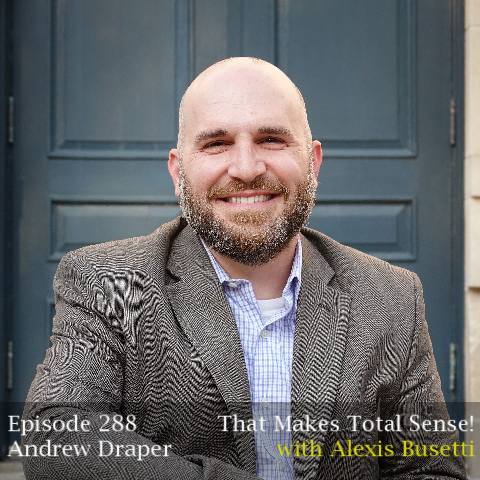
I am super excited on this Friday to first kind of take a deep breath and also welcome my guest today for the podcast, Andrew Draper, who is the co author, one of three co authors of a book called Disabling A Practical Theology for the Broken Body of Christ. Thanks so much for joining me today, Andrew.
[00:01:07] Speaker B: Thank you, Alexis, for the kind invitation.
[00:01:10] Speaker A: I am this is a topic that when it was, when it was first introduced to me, was really intriguing. And when I say the topic, kind of the larger topic of disability theology.
I had seen some things that Dr. Amos Young had thrown out and you guys reference him in this book. But I guess probably like many of these things, it was personal for me.
When I was in middle school, I had an aunt who had a traumatic brain injury. This was a biological thing. It wasn't like a car accident or something like that. And she became disabled as a result of that injury. There was a lot of trauma. It was also obviously physically for her and for our family, but it was also like a dramatic situation because the first phone call we got was that she had died.
And so there obviously there was significant brain injury.
She did, you know, she was in and out of comas and brain surgeries and, and hospitals in different cities and for, for years early on in an assisted living facility. And then our family, our extended family became her caregivers. My grandparents were the most, were the ones, you know, that she lived with them. And then my aunt, her sister, and then the rest of us. We lived in a small town. So from middle school on, this was part of our family culture. It was part of our lifestyle. It's part of our routine. This is what we did, was we helped to care for my aunt and her condition. And I remember one of the conversations when I read Lamar Hardwick's book. He explicitly stated disability is the only basically minority group that we can enter into.
Some of us are not born into the disabled population, but any of us at any time could enter into the disabled population. And I knew that from experience.
But seeing that in writing and in the larger understanding of disability theology, it was a really, it was a welcome topic. You know, how do we think about these kinds of things theologically and what this means for our lives and for the lives of the people that we love and care for. So that was a long introduction on my part. Hopefully that's the longest I'll talk today. But I just wanted to share that at the beginning because this is something that I, I watched in our family, you know, and I remembered what my aunt was before and after the incident that, that caused her disability. And as a, as a family full of Christians, you know, we, we all dealt with this in kind of different ways, and there was a lot of struggle and tension and wrestling and, you know, things like that. And I love that books like yours help us to wrestle with, with the tensions that we experience when we're looking at this kind of theology. So, anyway, so thank you for that.
Now that I've given, given you that long, that long intro that, like I said, hopefully that'll be the longest I talked today. I want to ask before I we go into, like, what your book specifically is about, I'm wondering if you could, for me and the listeners, help situate yourself and your co authors in their absence a little bit. But they give us that in the book, but help us situate yourself as far as this text is concerned. How are you coming at this as an author, as a pastor, as. As a theologian? What's your context?
[00:05:34] Speaker B: Thank you. I'm approaching the topic from a few different perspectives. One, as a member of the disability community and with several family members who are disabled, with co authors who are part of the disability community in various ways. And we can chat about any of these specifics today if that would be helpful. But then also my academic work has been. So my PhD is from the University of Aberdeen, where I studied with Brian Brock and spent time as well with John Swinton, who both have done a lot of work in disability theology and medical ethics. And so even though my dissertation was focused on race and justice and reconciliation, there are a lot of overlapping considerations in those conversations because most centrally, we're talking about theological anthropology, we're talking about identity. What does it mean to be human?
How do we think about who we are, our situatedness, our bodies, our histories, our interconnectedness with one another, and so on. So disability was a natural topic to begin to pursue together in our local church community with my co authors.
So in our, in, in my family, similar to you, early on, I had an. An aunt who was in a coma for several years. That was kind of our entry into Thinking about these kind of questions deeply as a family, I have. I'm textbook obsessive compulsive with at many points in my life, in order to be able to function, there's quite a bit of supports and scaffolding in place for me to interact with others in a robust kind of way, from ways that I've been affected by that, from cognitive behavior therapy to medication to physical therapy that has come about from various ways of carrying some of my cognitive functioning in my body.
So my son, one of our sons, is autistic. My wife has several rheumatological conditions that are unseen disabilities that limit her activity in many ways. And then my mother has dementia. And so in all of these instances, we're constantly living at the center of thinking about medicine and healing and accommodations and accessibility and therapy. And then what does it mean to be human and productivity, and how does that relate to our relationship with Christ and others and our relationship to work and the way that we live in the world? And all of these kind of things are the nexus of disability, kind of holds all of these concerns together. And so since our life has been so profoundly impacted by disability, personally and relationally, we naturally had lots of these conversations and questions in our church community surrounding accessibility, surrounding reconciliation, because we often think of reconciliation in terms of ethnicity or socioeconomic status or gender or cultural diversity or whatever the case might be. And all of those are important components. But at times in the body of Christ, we don't think and live deeply and carefully in regard to a diversity of abilities, a diversity of ways of being in the world, physically, emotionally, mentally, and so on.
So my co authors, neither of whom could be here today, one, my first co author, Jody Michelle, is a locally licensed minister in our congregation, Congregation in which I'm one of the pastors, and Jody is a disability advocate and consultant who has cerebral palsy. And my other co author, Andrea May, is a special educator who has three children with disabilities, neurofibromatosis, down syndrome, and then another sort of constellation of disabilities in her third child. And so between us, each being in leadership in the church in various ways, serving together on committees and boards, and thinking about accessibility and accommodations in the congregation, we realized that the work that we were doing was overlapping.
Our writing work, our publishing work, our consulting work, our advocacy work, overlapped in a lot of ways. And so we realized probably six, seven years ago that we could come to the table together and offer a unique text related to disability theology that hopefully is an addition to the conversation because of the way that we can frame things together and because of the multiplicity of disabilities and perspectives that we're speaking from.
So we started doing the work together.
It's been years ago now and then I've published with IVP before. And so we were in conversation with one of the editors at IVP who connected us with the center for Disability and Ministry at Western Seminary, directed by Ben Connor and Ben and John Swinton, my former professor from the University of Aberdeen, had a practical theology series on disability that they were launching. And so our book got to be the first book in that series from Western Seminary. So it's kind of a co branded series between Western Seminary and IVP Academic. And so that's how I and Jody and Andrea were able to come to the conversation together was through those conversations that we'd had internally and then those connections that we'd formed externally through conversations and relationships in the field of disability theology and disability studies.
[00:13:35] Speaker A: Yeah, thanks for sharing that. And I'm really, I'm really grateful that you, that you brought out this co brandedness between the IVP academic because that, to me, this, this piece of the book that, that I want to talk about next. The literature review felt like a really, really important part of this text to me. And you, you open the, you know, you and your co authors open with, you know, stories about like, you mentioned, like accommodations and accessibility and all these things that I think kind of naturally come to mind when we start to think about the disability community. And those things are super important and the logistics surrounding those things are super important. But what I found myself being most grateful for in this book was the theological foundation not just of the disability theology piece, but also of the leadership piece and that leadership formation piece and like really questioning, kind of interrupting.
What do we mean when we say leadership and what does this look like in the church? What has it historically looked like or traditionally looked like in contemporary times? And kind of is this the way we should be looking at, you know, at things and those, those, that combination of the disability theology piece and the leadership formation piece in that, in that literature review section felt so helpful for me and my helpful for me and my imagination as I was, you know, going through the rest of it. It's like, oh, okay, let's. When I think about this, because my personality, it's really easy for me to kind of go straight to the details or straight to the how do I fix, you know, something? And I don't think that's bad necessarily. But like, man, why am I even like, why do, why does this even need a fix? Or does this need a fix? Or what would a fix look like? Or, you know, I'll use an example. You've used this word already.
One of the things that was first eye opening for me when I started looking at disability theology was disability as diversity, which you've already, you know, alluded to. What would it look like if I just started with a paradigm that looked more like that, you know, disability as a part of diversity rather than xyz? However, I have been kind of trained or taught or what felt.
[00:16:19] Speaker B: Yeah.
[00:16:19] Speaker A: Natural or intuitive for me to think about disability. So I know we can't cover the whole lit review here, but for folks who haven't read the book yet, like, what do you feel like are some of the. Some of the points that you would want to bring out about those theological foundations, both in the disability and in the leadership?
[00:16:39] Speaker B: Yeah, that's a great question. Let me kind of open the door to that crack into that topic by starting with one of the points that you ended on and the phrase disability as diversity.
We are more accustomed as moderns to think about God's gift, God's creative gift of diversity, when we think in terms of ethnicity, culture, gender, language, place, experience, some of those categories.
But an inability to think about disability as diversity suggests that we're probably framing disability as either primarily a liability to be corrected or fixed, or we're taking the other route, which is to view disability perhaps as something superhuman that we overcome, rather than disability as just a constitutive part of who we are as creatures.
So as you mentioned early in our conversation, any one of us can move into being a part of the disability community. And most of us, if we live long enough, will, even though we're not accustomed to thinking about, say, issues that are commonly associated with aging as disability, we know that in most ways, issues associated with aging overlap with issues associated with disability, often cognitively, often in relationship to mobility.
So that's one piece that we can move into the disability community through aging, but we can also move into the disability community, perhaps through a circumstance that happens to us or around us or with someone that we love.
And then finally, I think if we consider disability in the broad kind of way that we try to consider it in the book and within the discipline of disability studies, we recognize that there are many different categories of disability, many different components to our creaturely limitations, and often the category of disability is less a category of.
There is a medical model of disability, right. That looks at diagnoses, and that's Important in many ways because it helps us understand the world we live in. It helps us understand our bodies and minds, and so on and so forth. But the medical model alone is problematic because disability also functions as a social model, a grouping of otherness from what's considered normative, whether we're talking about being able bodied or neurotypical or, or whatever the case might be. And so if you think about disability in a medical model alone, we're accustomed in a medical model to think, well, what do we do to fix these things, right? If I have something going on with my heart, or I have something going on with my brain, or I have something going on with my liver, or something going on with my leg or my neck, you know, I had neck surgery earlier this year for a ruptured disc.
And when those kind of things happen, we tend to think in terms terms of repairing.
And so then when we think about disability only or primarily within a medical model, we think of limitation as something negative as opposed to.
We all know that there is not a magical norm, right? There's not like this ideal way to be human unless you look at sort of.
I mean, sometimes Western theology has looked at what it means to be human in terms of ideals or attributes or capacities. And that's one of the things that we push back on in the book. And specifically then we, we evaluate leadership. And I'll get to that in just a second because I know that that's the question, but I'm. I'm trying to kind of lay a frame here to build on what you're. What you were so wonderfully talking about is, in order to get to the question of leadership, we first have to think carefully about what it means to be human. And if we think that what it means to be human is to share attributes or qualities with God, what's traditionally been known in theology as an analogy of being, we tend to then think about disability as less godlike or less divine, or perhaps less human, or at least less ideally human, right?
And this has powerful ramifications in bioethics and medical ethics. You know, because we think about, for instance, someone in a coma, we might be medically classified as something other than human, like being in perhaps a vegetative state, like. Right. We use words like that because we've associated rationality or ability or normativity with what it means to be human. And that has both scientific and theological roots that are problematic because Western society has thought theologically oftentimes about what it means to be human in a, in a capacity or Attribute sense. Our medical ethics, even when they're thoroughly secular, have often overlapped with that in problematic ways. And so in evaluating what it means to be human, we are then getting at the question of what does it mean then to lead? What does it mean to be used by God in God's mission in the world? To be, to be part of, to be co laborers with, with, with Christ, right? And, and if leadership is a function of skills, attributes, abilities or capacities, we're going to think about leadership in terms of productivity. It's going to be very easily aligned with Western mythology of the self, self made person or you know, or in church life. We see this in, you know, celebrity Christian Christianity or what's the phrase for a particular way of building church. The drawing a blank on it right now. Not the ecclesiology, no, the.
Anyway, let me summarize it without the term because it's just, it's not coming to my mind. But the idea that, oh, an attractional model, that church or community is built based on affinity to certain kind of norms, right? Like, like that lends itself well to marketing, it lends itself well to capitalism, it lends itself well to the myth of the self made human being, all of those things to celebrities for Jesus or whatever the kind of case might be. And what we're trying to ask is how does God's created diversity of human beings show up together in a way that images the diversity of God's own life in a way that's not saying, hey, this, this person over here is more of a leader because she or he conforms more to this traditional understanding of what, what we think about when we use the term leader, which often refers to capacities, skills, attributes, normative ways of being that align with the way we think about what it means to be human and as we mentioned, has, has bleed over into medical ethics and all sorts of things. So that, that's what we're trying to do in the beginning is, is we evaluate leadership literature that's out there, both Christian and secular leadership literature, to ask the question, how do we as west, how have we as Westerners tended to think about what it means to be a leader, what leadership looks like and how leadership functions. And disability throws a wrench in all of that because it's challenging the assumption that we show up in our strengths and capacities primarily. But biblically, right? Like we hear all the time, that's not how God's power is made known in the world, right? God's presence is not made known in the world through our strengths. But through our limitations and ultimately through the cross, you know, which is why Paul and others can talk about boasting of weakness or when we are weak, then we are made strong, or coming in weakness and trembling, or, you know, if. If the presence of God is most known in our strengths, then we are most tempted to be false selves because we are adhering towards some kind of.
We are adhering to some kind of ideal. But when we recognize that the created diversity of human beings and the different ways that we show up in our bodies, mentally, emotionally, physically, and how the presence of God is made known in a diversity of ways, we better appreciate who we are as the body of Christ. And so that's why disability is. Diversity and leadership are important to think about together.
[00:28:33] Speaker A: Yeah, no, I really, I'm so grateful that you took the time to, to step back and build a bit more of that foundation because it really is important when we, when we look at how are we functioning as Christian communities, and I think too, how are we functioning, you know, among our neighbors who may or may not be Christians as well, but just how. How are we functioning in community? And again, I just kind of reiterate for myself because, because I, I'm seeing things where I say, oh, well, well, that. Okay, that's what you can do is you just, you just make this accommodation here, you make this accessible here, or you do this or do that. But this isn't really the primary question you guys are asking. It's really is. It is more broad than that. I think it's deeper than that too, is like, how are we looking at leadership? I think these, these questions are. The more. Are the more interesting questions to me. So not just how do we take someone who's a member of the disability community and kind of see, you know, like, put them in to some sort of system that already exists, but like, what is it about this system that already exists that has excluded people from the disability community in the first place? And, and what. How can we think about, and maybe even build new systems that look more like what we think theologically? Leadership, you know, should or could look like or what was modeled for us.
[00:30:10] Speaker B: Yeah, and that's why the. Sorry, I wasn't trying to interrupt.
[00:30:12] Speaker A: No, it's good. No, I'm done. No, I'm done.
[00:30:14] Speaker B: Okay. I mean, that's why the disability or the diversity frame is helpful. Right? Because what you're saying is similar to the kind of distorted way that we as Christians, I mean, primarily white evangelicals or white evangelical adjacents have tended to Think about frameworks like racial reconciliation, for instance, right? Like a dominant group inviting other folks into their own cultural experiences as opposed to a diversity of cultural experiences, theological languages, histories that are interwoven to create something new that was not there previously.
And if we think about disability in terms of quote, unquote, disability ministry as it's usually been envisioned, we think about it as kind of like, and I'm going to use this term on purpose, not because it's a great term, but we think about it then as like special needs ministry or something, as if there's a group of people who has a constellation of special needs that can be easily defined and set off to one side and then incorporated in a programmatic manner.
[00:31:41] Speaker A: Right?
[00:31:42] Speaker B: And it, I mean, life just doesn't work that way, right? It doesn't work that way with gender, it doesn't work that way with ethnicity. Why would it work that way with ability, Right? So, you know, we, we show up as, as a variety of human beings. And if we take seriously the analogy of the church as a body, then we need to think about body parts, not just in the sense of what they do or what they produce, but in the sense of that all parts of the body are needed for the body to be a body.
I mean, I mean, that's Paul's analogy, right? If the whole body were hands or the whole body were feet, where would the body be? You know, similarly, with disability, we often may not be thinking about what all the parts of our body are contributing at any given moment. We may only pay attention to our appendix, for instance, when it is in pain.
We may not think about our kidneys much until we need a transplant or dialysis.
You know, all of those. You know, we may not think about the way our, our toes distribute the gate of our walk or our weight or whatever the case might be until one of them is hurting, right? And sometimes that's the way disability functions in the church. We don't pay attention, right, until something, someone in this case is in pain or being excluded or whatever the case might be.
And then suddenly we go, oh, well, this is a really important thing to think about, you know, and, and I think, I think disability is kind of like that. If we think about it in a body metaphor that a bunch of eyes or ears do not a body make.
And so therefore, why should we be surprised that in God's creative vision for the world, for the church, that there are a diversity of cognitive, physical, emotional and so on relational ways of being.
[00:34:45] Speaker A: Yeah, I want to hang out on the cultural piece for just a second as it, as it relates to diversity and theology and leadership and, and all of these things.
This isn't a specific example that you brought up in the book, but this week I was having a conversation with some folks who were presented with a piece of art. It was a, a little one act play that was presenting through that art piece, through that play, the, the conflict that was happening in this fictional family.
A mother, a father and a son. And the mother was deaf, the father was not, and the son had developed deafness.
And the conflict was whether or not the sun should have implants, cochlear implants.
And I've, you know, I've had exposure to this conversation before in different ways.
But, but it speaks to, you know, what you've talked about. We've alluded to kind of this, you know, the fixing or we haven't quite said it yet, but the, but the healing, you know, part of it, but, but also this disability as a medical issue only, not as a community or as a, as a diversity piece.
So, you know, thinking about the deaf community, like the mother in this piece was basically arguing this isn't something that needs to be fixed. My son is a member of this community, you know, and so looking at this, you know, her, her, the son's father was looking at this as like a medical condition. You know, we have a fix for this. Why would we not use the fix for this? And, and the mother was, was basically seeing this as something that her son has entered into this community that she's always been a part of. And that it wasn't something that was a, that was a, something that needed a fix. And so, you know, that is an example. Again, it's not something you bring up directly in the book, but it's definitely talked about in different ways. I think especially a lot of the pieces that Jody contributed, you know, really speak to this in her experience as a leader, her experience as a member of the community, and her experience even as having people, you know, approach her and seeing her disability as something that needed to be fixed rather than something that was, you know, a beautiful part of who of, of who she is. And then how in her personhood, including her disability, does she then participate and lead and you know, all of these things in this, in this kind of. To me, that goes into that cultural piece versus just like a medical piece.
[00:37:52] Speaker B: Yeah, that's really interesting. So one of the phrases that comes to mind that I've learned from multiple people in disability communities is the phrase nothing about us without us.
[00:38:09] Speaker A: Yes.
[00:38:11] Speaker B: So the issue, as I understand it, is that a one size fits all approach is simply reproducing some of the same problems that certain conceptions of normativity produce to begin with. So, for instance, we want to and should clearly say that disability in general as. As a theological or sociological category should not be viewed primarily as limitation. At the same time, we understand that there are particular challenges associated with all of our various ways of being in the world. Right. And if that's the case, then accommodations can be very helpful if desired by a particular person or group of people in order to better facilitate community engagement in society and inclusion.
So I think that gets to part of the question that you're raising from this.
This one act play is.
I mean, there's. There's the rub. Exactly. Right.
In this case, the discussion seems to be about what should happen to somebody in this regard. And, you know, if the young person's a minor, you know, maybe that's part of why it's a profound question to be asked in this particular work of art.
But again, hearing from and listening to specific particular people who are part of disability communities about what accommodations may best help for them to best be included, I think is the important step rather than saying should we or should we not fix X, Y or Z?
You know, I have friends with very profound mental illness that absolutely desire to be not affected in as profound of a way as they are.
But that doesn't mean that they're necessarily thinking about it in a traditional medical model, because, you know, many people with profound mental illness know that a medical model has not been empowering or liberating to them. I mean, many people with profound mental illness have experienced great harm in psychiatric hospitals or under the care of doctors or counselors. Again, this is not to cast aspersions on therapists, doctors, the medical profession, any of that, but just to say that just as we recognize that there have been great harms done in group homes and medical ethics over the years, especially along ethnic lines such as Native American boarding schools and medical experiments on African Americans. And, you know, in. In Nazi Germany, we should remember that before the final. The quote, unquote, final solution in the genocide of Jews in mid 20th century Germany, what before that was the emptying out of insane asylums, group homes, and other places where people with a variety of disabilities had been consigned and people with disabilities were often kind of test fodder for all kinds of awful medical experiments and things like that. So the reason I bring this up is to say that the question of healing and fixing is very much a thorny question because it often has more to do with what we. Our view of someone else than their view of themselves or their own experience. Right. Which is Jody's story of being, you know, a little girl in church in her wheelchair, and suddenly people are around her, laying hands on her, praying for her. And as she listens to the prayer, they're praying that she would be able to get up and run around like the other kids. And that was the first time in her life when she considered that maybe there was a problem with her, that.
Right. Like, her desire wasn't to get up and run around with the other kids. Her desire was to be treated kindly by the other kids and to be able to play with the other kids.
You know, similarly with down syndrome. Right.
Do we really say that chromosomal differences are something that needs to be fixed? Like, to what extent does that do violence?
Those kind of conceptions do ideological, but often then real physical violence to people who are very specific, particular human beings who would not be who they are without their own particularities. Just like any of us, right. Like, is the color of our eyes something to be fixed? Is the, is the way we process things? Are.
I mean, those are the kind of questions that come up when you think about disability carefully, you know, and when we project that then on the resurrected body, for instance, right. We, we often think about the resurrected body or heaven in terms of this platonic ideal, as if, you know, we're all going to be this perfect generic age and height with the same ability or whatever, you know, like I'm, I'm a short, middle aged bald man. I'm five foot four, you know, like, is that something that's wrong with me? Like, am I going to get hair implants in heaven? Or am I going to like, sprout another six or eight inches to be the average male height? Am I going to be able to play basketball? Like, I don't know. I don't even know what that means. When people say things like, you know, my loved one is now doing cartwheels on the streets of gold. I'm like, well, maybe, but maybe the ramps are better in heaven, right? Like, or maybe people know how to love people with down syndrome better in heaven. Or, you know, like, Jesus's resurrected body is the picture we have.
Like, the Bible says he's the first fruits.
And his resurrected body was known by the marks of his calling and his limitations.
You know, he was recognized by the nail marks and the imprint in his Side, Right. Well, if we take seriously that the crucifixion actually happened and that the resurrection, there was actually something physical to it, even though he came in through locked doors and we don't know what else according to the Gospel accounts, Like, if we take seriously the biblical accounts of the Resurrection, then we also have to take seriously that Jesus's body probably had some kind of physical limitations to it. Like, if his feet were pierced through, like, how did he walk?
What was his gait? Like, we don't know. But we do know that he was known by people touching his limitations and the marks of his calling. And so are we really just going to say that that's gone in heaven? Like, we see Jesus and there's no more nail marks? Or, like, what if that's how we know him? You know, what if we know one another by the things that are peculiar and particular to us, then disability is not something just to be wiped away or taken away.
But at the same time, if we have a robust eschatology that says all things will be made new and the tears will be wiped away from our eyes, then we do have to also, though, hold on with tension to the idea that pain and suffering and exclusion, what. What causes suffering, the marks of the fall, the curse will be made right and made new. And we just have to be honest that we don't exactly know what that looks like. Like, what does it look like for disability not to be taken away in a way that changes something about our identity, our created identity? Like, we have to take that seriously if we take the resurrection account seriously. But then, on the other hand, obviously, Jesus didn't remain dead, right? And obviously his resurrected body was different in some way. Different and yet recognizable. And so we don't exactly know what that will look like. But what we do know is that we presumably will be recognizable to one another with the marks of our limitations, our callings, our particularities, while at the same time not in suffering.
And so there are components of any disability or limitation that maybe at times cause suffering, that we go, you know what? I want to be healed of that. Like, people came to Jesus all the time and asked him to heal them.
But if you take it in context, it was often because they were excluded based on right.
Somebody who's blind is asking to be healed. Why? Because they've been sitting at the gate begging. They weren't included.
Why is the woman with the issue of blood for 12 years asking to be healed? Well, because she was ceremonially unclean. Right? We wouldn't go so far as to say, well, oh, she's just broken. I mean, today we wouldn't want to look at somebody like that, right? They have a physical issue going on, and they have to be fixed in order to be in community. We wouldn't want to look at it like that, but we often act that way. And so as we think about healing and fixing, it is complex, like you bring up, which is why it generates. The kind of art that you're describing is because there's not a simple answer.
[00:50:05] Speaker A: So I'm super proud of myself for not ruining our audio with a hundred Amens in that section, because I'm, like, nodding my head like crazy, like, yes, yes, yes. And amen. And Amen. And amen to everything that. That you just said.
[00:50:27] Speaker B: Well, and I apologize for being a bit wordy. I kind of. You've given me these prompts.
[00:50:32] Speaker A: Don't apologize.
Don't apologize. I know. I love it. That's what I'm saying. Like, I can. I can. I can see the preacher come out, and I love it. And I wanted to Amen, but I couldn't because then my husband can't get, like, a usable audio that he needs to have. But.
But I want. I want to stay there, like, on that track and maybe ask one more question with. With a little preamble from. Because we.
We've done a lot of what I hoped we would do, which is talk about the. The framing, the foundational stuff, the theological stuff of this. There is a practical side. And, And.
And so the question that I. The last question that I have is. Is leaning towards that. But I. I want to share a little bit of my experience in that first. And, and then you. You guys have a lot of stories in the books and in the book and a lot of things that you've. That you've done, but with this framework, with this foundation in mind. So.
Several years ago, I was diagnosed with an autoimmune disorder disease. And so anyway, so. So as to not be vague, and so this makes sense. I don't mind naming that it is celiac disease. So this is a situation where I can't have gluten. There's all these grains that are included in that. And a lot of different people with celiac disease respond in different ways if their body ingests gluten. And mine is probably gross enough to the point that we don't really want to talk about it here, but it's pretty quick, you know, within. Within. Usually within an hour and a half of accidental ingestion. Boom, I'm in a real bad place.
And when I was diagnosed with it, I, it was a very strange thing that. And I think in the context of this conversation, it makes sense to share. I haven't fully fleshed it out. I'm still kind of processing all of these years later, but I just kind of had this, this feeling.
It was, I don't remember if it was on the day of my diagnosis or right before or right after, but I just had this feeling. And the word that came to my mind was this feels like a gift. Now. Celiac is not fun. I don't think an autoimmune disease is, you know, like, this has felt like a weird word for me to, for that to kind of come to mind. So I'm just, I'll just leave it there. It felt like a strange word.
And around the same time, I had a very well meaning friend of mine. I was sharing my diagnosis with this person and she said basically this, well, you know that God can, can heal you fully and completely of that. And it was this real, you know, like, you know, this, we're gonna do this, you know, kind of similar to, to Jody shares her experience. Amy Kenny, which I'll link her, her episode in her book. In this she shares a similar. Her book is called My Body is Not a Prayer Request. But it was this well meaning friend who was just like you, you know, you know that God can heal you from this. And it was basically like this encouragement to let's pray that God heal you from this.
And I agreed with her. Yes, I do know that at the same time I was wrestling with this tension of having kind of felt this word drop into my mind of, you know, what if this is a gift that, you know, this could be a gift. So anyway, so I'm kind of processing through those things. All of these years later, I have not been healed. If, if someone dropped gluten in my mouth right now, we would barely be able to finish this conversation.
And anyway, so that's the way it is. But I bring that up specifically because today's Friday in two days in churches across the world. What will they be doing?
Taking communion with wafers that I can't eat.
And it feels a, it feels devastating to me every time that I enter into a situation where communion is being served and I can't participate.
On the other hand, I cannot contain my tears when we enter into a situation where communion is being served and I can participate because what that means really is that someone, someone in that community has gone out of their way to provide for people like me.
Yeah, in a very specific and very intentional way.
And so we've been in situations where we visited a number of different churches over, let's say, the last year.
And there have been times when I'm, you know, I'm sitting next to my husband and I'll say, you know, they'll, they'll call for communion to be served and I'll kind of nudge him and I'll say, why don't you go ahead and go up and if there is something for me, come back and let me know. You know, most of the time there's nothing, anything for me. But two places come to mind recently where the first time he went up, he specifically asked the priest in that situation if there was someone, if there was something there. And he came back and he told me, you know, you can go eat it. I started crying from my seat because I felt included. And then there was another situation where the woman in front of us was kind of telling us they also had a difference. You could have either wine or grape juice. She had told us the way to tell the difference. And I thought, oh, maybe I'll just ask her, you know, is there a gluten free option? She said, actually, there is. When I got up to the front, the woman who served it to me, it was individually wrapped because again, cross contamination, all these kinds of things. It was individually wrapped. And she said to me, we started doing this a few years back because my daughter needed this. And it was one ask for me of the pastor. And he immediately said, absolutely, this is no problem. And they started providing this every week. And so every week in the, in the bowl, there are a few individually wrapped wafers that are gluten free.
And you know, so her daughter could participate, and in this case, so so could I.
And it is one of those things that, yes, it is a small thing, but I would say for our community as, as believers, this is a, this is really, is kind of a big deal. I mean, it's a sacramental thing. It's something that we, that we do regularly, that we practice with one another, that we're instructed by Jesus to do. And so even though it's a small thing, it's a wafer, it is a communal thing that I am now able to participate in in some situations because someone has, has thought about it and has intentionally done it. But it also is a catalyst for me to continue thinking about accessibility and accommodation for diversity of many other sorts. You know, there was a, one of the Services that I wasn't able to partake when I noticed, oh, I couldn't. But also so could. There are people who have mobility issues or might be in a wheelchair who also couldn't participate because participation required climbing up a platform, you know, one or two steps. So it wasn't just me who would be left out, it would be someone who was left out, who had, you know, mobility issues as well, or, you know, things like that. I've. I've often thought about, you know, there are people who have. Have struggled with alcoholism who literally even one sip of that communion wine, if it were actual wine, would not be a good situation for them. I was grateful to see this place had the option, you know, of a. Of a grape juice as well, you know, so that offers more participation. But something that you bring out in the book, and I've seen another in other disability theology books as well, is the very real, the reality that accessibility and accommodation actually improves accessibility and accommodation for everyone.
It's not just for someone who has one particular need that when that is opened up, it's opened up for everyone. It's beneficial to everyone for us to think about accommodation and accessibility. And so I'm just wondering if you could comment on that, on that piece of it. You know, the things that you've seen, seen, maybe some of the things that you've tried or the ways in which you've seen, you know, opening that up for a particular community or even for a particular individual, you know, how that spreads and that benefit comes to everybody who's involved.
[00:59:41] Speaker B: Yeah, yeah, that's wonderful.
First, you're grounding it in, in an analogy of an experience of a sacrament is super helpful because it points to the kind of questions that we're getting at, that the reason theology theory frameworks are important and we don't just rush to praxis is because belief and action are intertwined. They're.
They're mutually articulating. It's not like we just get in our mind what we think and then have to apply it. Nor do we just run out and live and then reflect on it.
It's a constant feedback loop. And we experience the truth through tangible physical realities. So that's why sacraments are important. That's why baptism and communion and depending on your tradition, others, whether anointing with oil or feet washing or whatever the case might be, are important. These are physical realities that lead us into an experience of the life of God in profound ways. And when you're excluded from that table, it says something very clearly. About who you are or aren't in that community, whether intentionally or not.
So let me, let me first say that our church is far from perfect in these regards.
We have an older building that we've worked hard to make all kinds of physical adjustments to.
But yet, as you mentioned, there are ways that we miss the necessity of a multi, multiplicity of experiences to include the diversity of Christ's body.
We miss until they're presented to us or until we do the work to learn them and figure them out.
And so, you know, in our book we offer all sorts of practical suggestions about things we've done in the life of our community.
But that's not in order to put our church on a pedestal as a accessible, inclusive community par excellence, but rather to say here are the ways that we as a local church with all our particular limitations are trying to learn from resources and are trying to experiment and put into practice ways of including the diversity of Christ's body, especially people on the margins.
And so that communion analogy is a good one. We do offer gluten free wafer option at our church because of that reality. And we also don't offer communion from the platform. We come down onto the floor when serving the elements. And then we also do ensure that we have stations in various parts of the sanctuary so that people can more easily get to where they're going. I'm not saying we have a separate disability section, I don't mean that, but rather that we want things to be as accessible as possible. We also ensure that a diversity of people serve communion so that people who are part of the disability community in various ways will be part of serving communion. And I can't tell you how meaningful that has been to one of our members who is blind, will regularly lead prayer or serve communion. And the first time she served communion, she came up just sobbing after the service. And just, and she's probably, I think she's in her 60s. And she said, I've never before in my life as a Christian been asked to do something like that.
Now that's not me lifting up our community to say, wow, look at what we got right. Because as we do in the book, we show a whole lot of times when we get it wrong, right, including me personally, where I've had to be, you know, drug into learning things that we were doing wrong, but rather to say to your point, how profoundly impactful it can be when inclusion is offered at the, especially at the points that it should be, the points where it's most important for it to be Such as those practices that we say constitute the very center of our faith and the community of the body of Christ. Right. I mean that's the Didache talks about that, you know, that we are one body because just like the grain from many hills has been ground into flour to make this one loaf, so we too have been brought together from all of these places into one body.
And so if our worship is exclusionary, and by that I mean if we're not at least trying to give thought to what do people with sensory issues do when they experience our sanctuary, our sound, our community, what does. How does someone in a wheelchair engage with all the various components of worship? Can someone in a wheelchair get to the platform? If not, then what we're saying is we don't think people with wheelchairs can be, can serve up front in a pastoral or worship leading or prayer leading or liturgy leading, whatever kind of way. Right.
Whether we want to say that or whether we meant it or not, that is what we're communicating. And I'll hear people say things like, well, we don't have any ministers who are in a wheelchair or we don't have. Well, but that's also a self fulfilling prophecy. It's kind of like saying, well, we don't need an elevator in our church because we don't have anybody who comes who's in a wheelchair. Well, precisely, like maybe that's the problem, right? Like, you know, in our town we don't have public transportation, doesn't run on Sundays. It doesn't run after 6pm so if you need accessible transportation, you can't go anywhere in the evening and you can't go anywhere on Sundays.
The only way is if you hire the local ambulance service who has an accessible vehicle that'll run on Sundays, but it's like eight or nine bucks one way.
So that means if you have a disability that requires you to have accessible transportation, the only way that you can get to church is if you have $18, you know, 16, $18, whatever, to shell out each time to go to church.
And most people with disabilities are very marginalized economically, can't go to someone to many of their friends homes to have to have dinner, to hang out. Maybe because they have to walk, they can't walk up two steps to get in your front door. Or maybe perhaps because accessible transportation doesn't run in the evening when people hang out or whatever the case might be. So not that we could perfectly solve it, but what we could do is we went to our local bus company because they, when, when some of their small accessible vehicles have been in the fleet for a while, they start to sell them. So, so we were able to purchase an accessible bus that we can. One of the ministries in our church is going to pick people up on Sundays and, and to make sure that, that there are ways to get back and forth to other activities in the life of the church.
You know, we have to think through things. One of the issues we always get in is volume, right? Volume of music. I mean, the volume wars are maybe wars in many different churches, but in our church as well, like if you have a sensory issue, I mean, my son who's autistic, he needs a place to go sometimes that isn't just completely overwhelming. So we've had to give thought to and we've done this in our sanctuary. Created spaces that are maybe like an overflow room or a room that is different in sensory ways, where if you want to go and disappear for a little bit but still participate in the service or whatever the case might be. I mean, if we're going to be truly inclusive congregations, we have to think about the way our worship architecture is laid out, the way, you know, what about worship lyrics, right?
If you're blind, how do you sing along? Right? So one of the things we've done at different points in the life of our church is send lyrics beforehand to people who request them electronically so that they can read them through their accessible software. Or, or if you're not willing to do that, like for instance, for board meeting minutes or agendas or other things, then what you are communicating is that if you have certain disabilities, you can't serve in certain ways in the life of the church. So we always have to be thinking about in the life of our church, how are we serving food, are our bathrooms accessible, are we accommodating the broadest possible range of people? And I know that oftentimes the excuse to this is, well, we don't have the money to do that.
And that can be fair when it comes to massive renovation projects. Sometimes a church may not have the funds to do that. But most of these things are low hanging fruit. Like bringing communion down to the floor, ensuring that the platform, a wheelchair can get onto it. These aren't things that cost thousands and thousands of dollars, right? Like sending out worship lyrics or electronic copies of board meeting minutes for people with certain disabilities to be able to access the information, right? Like maybe having the welcome room be a place that opens into the sanctuary in some way, shape or form that someone with sensory issues can disappear into for A little while. Or like, there are a lot of things that we can do, such as offering a gluten free piece of bread on a Sunday or grape juice instead of wine that makes it accessible to everyone, right? So, like, at our church, we don't have wine and grape juice. We only have grape juice. Not because we think there's anything wrong with having wine, but because we have a lot of people in our church who are coming out of addictions.
And the theory of universal design, which we talk about in our book, is just the theory that when you design something to be usable by all, everyone can use it and benefit from it. And it's oftentimes more welcoming to people anyway. Like, because then you're not just, you know, with bathrooms. You're not just stuck into, oh, I have to go to this tiny little stall. But there's bathrooms that are open that families can go to together. People with mobility issues can go to together. People with little kids who might need their diaper changed can go to. And it's not just, oh, we just put the diaper changing table in the women's restroom or whatever crap we do in the church, right? So, like, how can we do these things so that when it's accessible to people on the margins, it's also accessible to everyone? Because then it says, oh, we expect dads to care for children. We expect families to be together. We expect that people actually want to sit together in the sanctuary instead of having a separate disability section. Or we want autistic people to come to church. You know, like not shooting glares at people when their babies cry or when a child with down syndrome vocalizes in a way with the music, that's different, like, but rather explaining to people, here's what we're doing, right? Like when Shiloh, who's Andrea's daughter with down syndrome, at times has either climbed up onto the stage or has vocalized loudly in church, instead of being like, you know, could you take her out? Or could you go to the back? Or could you whatever. Like, how can we explain and model to the congregation that she's worshiping and participating just in. In her own specific way, right? And so I think we as the church often alongside that thing of, of kind of this, this way of thinking about leadership as skills and abilities, when we also think about church as a production or being slick first and foremost, or going off without hiccups or cutting down on transitions or all the other nonsense we talk about in churches as if it's a TV show, what we're Doing is we're excluding people from the body. Like if we say we need the transitions to be real slick, so we can't have her with a wheelchair come up here because it'll take five minutes for her to get up here. And then we can't have her preach because she has a speech impediment and somebody needs to help communicate and therefore it takes twice as long or we can't. Like if those are the reasons we're giving.
What we're saying is we don't want our churches to represent the diversity of the body of Christ.
We want to present a norm, an ideal, and then in that sense it over time becomes a self articulating ideal that verges on idolatry. Right. It's not that different from having an idol in the front of a church like a Greco Roman temple where we say this is what the male form looks like or this is what the female form looks like, or this is what that looks like, or this is, I mean that's what paganism is, you know, that's what, that's what Paul was working against when he was talking about meat sacrifice to idols and temple prostitution and all these kind of things. He was working against a normalized ideal of what it meant to envision God.
And so we as Christians, when we just constantly say let's put this type of person up or let's do this type of activity because it catches the most people, we are in effect saying this is what a human is supposed to be like.
And if that's what we're saying, then we're not doing church anymore. We're doing something different.
[01:16:04] Speaker A: Yeah, yeah, you're right.
[01:16:08] Speaker B: Sorry, I kind of go, you're right. I go into preacher voice. You should never interview a preacher because I love it.
[01:16:14] Speaker A: To the contrary. Talking too much to the contrary. I love interviewing preachers. Preachers and professors are my two favorite. And journalists, I should say that. But that's neither here nor there. But I love, I love it so much. I, I think that that, that felt like the perfect period, you know. Well then we're not doing church anymore, you know, then that's it. Andrew, this has been such a rich conversation and I'm so grateful for your work in the space and also your co authors. Again, Andrew has written with Jody, Michelle and Andrea May, Disabling Leadership, A Practical Theology for the Broken Body of Christ. And I will link this book that's a part of the series that we mentioned already in the show Notes. But I'm so grateful again for your work for what you guys are modeling, albeit imperfectly, as you admit. I really am grateful for, for the thoughtfulness that you are, that you're putting into this and modeling this in your community. And yeah, I look forward to reading and seeing more of what you guys are doing there. So thank you so much.
[01:17:30] Speaker B: Thank you, Alexis. Thank you. And if you do link to the book, also on Amazon, there are electronic versions of the book that are accessible for reader software and things like that, things such as Kindle and other things that can be read for people with auditory impairments or whatever the case might be.
[01:17:54] Speaker A: Perfect. I will do just that.
[01:17:56] Speaker B: I'm sorry, vision impairments. That it can be read out loud in an auditory fashion is what I meant to say.
[01:18:02] Speaker A: That's perfect. Thank you so much. I will find it and link that there. Thank you.
[01:18:06] Speaker B: Okay. Thank you so much, Alexis. Good to talk to you.
[01:18:09] Speaker A: The links for all the resources mentioned in today's episode can be found in the show Notes, music and podcast production by Seth Buscetti. Be sure to give us a review on itunes and subscribe at your favorite podcast listening app. You can also Visit
[email protected].