[00:00:05] Speaker A: Welcome to that Makes Total Sense, a podcast dedicated to exploring God's generosity and justice. I'm Alexis Busetti, a Christian, aiming to ask good questions and encouraging you to do the same.
Every one of us is wired by God to live out generosity and justice, but the how sometimes eludes us. That makes Total Sense is a way for us to get together, posture ourselves as learners, and challenge one another to practice, practice generosity and justice in a tangible way every day.
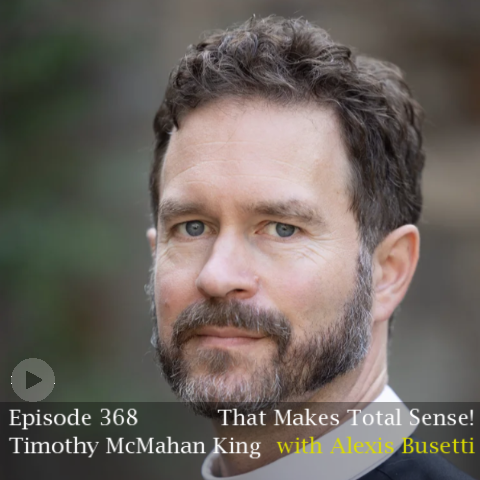
Well, Timothy, I would say, as per the usual on this podcast, I sometimes wish I had pressed record minutes ago when we were just doing our little intro, getting to know each other, talking about the, the topic before, before we actually hit record. But we didn't. So anyway, so here we are. And I have no doubt from those first few minutes that we spent together that this is going to be an incredible conversation. And I'm going to have to discipline myself to watch the clock to make sure that we don't go until lunch my time.
Because I'm just, I'm so, so, so excited to talk about, about this book. So thanks for coming on.
[00:01:29] Speaker B: Thank you for having me.
[00:01:31] Speaker A: So I have Timothy McMahan King with me today and his book that comes out September 15th, I think is what you said is called what Are Drugs?
An exploration of Stolen Fire.
And Timothy, this is a book that I was maybe a chapter in and told my husband, you have to read this.
This is through to the end.
An incredible, I was going to use the same word, exploration. An incredible, incredible look at drugs, history of drugs, even the terminology, why, you know, when we call them drugs even versus narcotics, which you kind of, you know, talk about later in the book, but not just about drugs, about drugs and our society, about drugs and spirituality, I mean, about drugs and our current crisis. A little which I want you to talk about, which is like what you kind of thought the book might be about when you got, when you got started writing it. And I would just say, number one, I'm super impressed. Number two, I'm really grateful because this spurred my thoughts and imagination and I hope is helping me think more critically about a subject that can be so polarizing is one word that comes to mind. Taboo is another word that comes to mind. Scary even is another word that comes to mind. And there are so many. But thank you for putting the work in on this.
[00:03:25] Speaker B: It's great to be with you. And the work was something that changed and challenged me. I could not honestly look at all of the history and the information and keep all of my preconceived Notions. So just as I think the book got better because I allowed myself to be open to new information and new ways of viewing things, I hope that for folks, even if they don't agree with every part of what I'm writing or any conclusion that I draw, that other people will engage in this and allow themselves to be challenged and have a new perspective. Because drugs have been with us since before we were human, and they aren't going anywhere anytime soon.
[00:04:06] Speaker A: Yeah. I mean, there's so many places that we could go, but maybe one of the first.
Maybe one of the first kind of jumping off points that we can have is this idea that I think is.
It's inherent. Like, I, I understand it, but to. To give words to it helped me think about it better, which is when you describe how.
And I'll use an example and then kind of let you go more, more broad if, if that works when, when people maybe first, but even now, encounter drugs, these kind of altering substances, that there is often both. There is this effect that is desirable. Maybe it's pleasurable, maybe it's getting rid of the pain, you know, something like that. But there's also something in the substance that when we encounter, tells us that this is maybe, I don't know, caution. Like, maybe we should have caution. So an example that you use and you use several, but is when we say we've acquired a taste. We've acquired a taste for alcohol. We've even acquired a taste for coffee. You know, I had to acquire a taste. Well, I'd say I had to. But even societally, it's like, yeah, I did, though. I acquired a taste for coffee and for certain kinds of alcohol because I. Because I wanted to. Right. Like, but there is some of that biology that says, oh, this.
This doesn't taste great. Maybe you should use caution or maybe you should think about this before you ingest it. And it's. It's kind of that way more broadly with a lot of these substances that you talk about. So I want to start there and say, what. What can this tell us about kind of who we are as humans and our interaction with these substances? To put a period on it for me, I will say you broadly use this analogy of fire that's in the subtitle, that it can warm us and be used for all sorts of wonderful things as a tool, and it can severely damage and burn us. But it's the same substance.
[00:06:35] Speaker B: Yeah. Too often we as humans aren't very good at ambivalence of holding the both and.
But it is baked into our physiology to take in competing signals.
And that's where we keep coming back to this analogy of fire. Because our societal tendency has been to look for miracle cures and then to be afraid of demon drugs.
But the reality for any psychoactive substance is just like fire in the very thing that it gives us as a benefit is the exact same reason it is dangerous.
And so as we try a drug like alcohol, you're getting two competing signals.
One is it's this acting on your GABA system. So it's down regulating your GABA system, allowing for an increase in endorphins and these dopamine hits. That's telling you this is good. It makes you feel good, it makes you feel connected, it makes you feel better about the world. It eases your stress and your pain. And at the same time, there is the alcohol itself, in its pure form, is a noxious substance.
And the only reason why we do. No one is born liking the taste of whiskey.
It is a reinforcement mechanism that allows us to ignore some of the other warning signs.
And so I try to detail that since the earliest days of what we understand of human society, a drug like alcohol has been both a blessing and a curse, because it can function as an emotional biotechnology that allows people to bond and trust at a rate they would not be able to otherwise. We see this in romantic relationships, to teams bonding over beer together or feeling like a sense of connection with complete strangers at a concert with that mix of music and the chemical stimulation.
And at the same time. Exactly. Because it can bond you is exactly why it can be deceiving.
The ways that you can put your guard down are also inherent dangers.
And so as long as we go to these extremes of good or bad, we're going to continue to get burned. Because we need to, as humans, be able to hold together that the medicine and the poison could be one in the same.
[00:09:19] Speaker A: I wrote down a quote that I'll probably end up using in some of my research later as I. Cultural anthropology is one of my major disciplines in my research. But you wrote culture is at its most powerful when we forget it is culture.
And that I want to just throw that out there early on in the conversation because I brought up coffee and alcohol.
And as we sit here in 2026 in the U.S.
this is a real common. These are both very common. And we know what we're talking about when we talk about those two substances. There are differences. I just learned you and I talked pre record about how I grew up in Oklahoma, and I've noticed that they've become more liberal when it comes to some of their substances and legal things than they were when I was a kid. And I just learned actually that liquor stores are open on Sundays in Oklahoma now. They were not when I was a kid and they are not in Texas.
So you can get wine at a grocery store after 12 on a Sunday, but you can't go to a liquor store on Sunday in Texas because they're all closed because of these laws.
But just as those laws vary from place to place, even inside the US the culture has not always been what we're sitting in right now and what is familiar to us, which is I'm drinking a coffee right now and I will probably have a glass of wine or more this weekend, you know, with my husband.
But one of the things that I love about your book is that you start early on with the word taboo and talking about how those have changed. And so I'd like just like we have now in our heads, okay, we've got this kind of both. And when it comes to these substances, what has been common in some cultures and times and regions isn't common anymore or those things change.
And I think that that's a really, really important to the discussion, not just in this hour, but now when we, when we, you know, and we'll get to kind of our, our some of the crises that we see going on, which is we are, we kind of don't know how to deal with some of these things that are coming up drug wise, but that this is a problem that has gone back and forth for centuries and centuries and centuries.
There were times when drinking coffee in the US Was taboo, completely off limits, especially if you were a certain kind of Christian as an example. But now you go to any mega church and they're probably going to have a coffee bar.
It might even be free.
And so I wonder if you can talk a little bit about maybe one or two examples, but just even again, broadly how those taboos and what was common have changed over the course of time. Gosh, that's a big question, Timothy. That's a really big question. But work with me maybe and give us some, you know, maybe a couple of examples.
[00:13:08] Speaker B: Yeah. One huge thing that shifted is your early temperance leaders all drank beer and wine and cider because they could not imagine life without it. Right. Your early colonists coming over were shocked when they encountered native tribes that did not drink alcohol and were drinking the most feared substance, water.
Now that. Right. And part of a taboo is it comes from a place There was a reason why people were afraid of water is they had experienced what happens when you have bad drinking water. And throughout a lot of the medieval era and up into the early modern era, you would have people brewing at home a light beer or a light cider. And the alcohol in that fermentation process meant it was safer to drink than a lot of drinking water.
And so there had been this idea that you could not drink water and live a healthy life from our earliest temperance reformers. And so the earliest temperance movement was just worried about distilled spirits.
And they did not understand at the time that it was the same underlying intoxicant.
And that's why they could praise beer drinking as something of the industrious and the virtuous. But drinking something like gin was an inherent sign of being a morally depraved person, because if you desire gin, it was an indication of a fundamental flaw inside of you.
And we can also see that with the switch around opium and opium products.
Another famous example here is William Wilberforce. He felt compelled to quit drinking and quit gambling. It was this radical turnaround, and he never quit using his opium.
And that was something that he was dependent on throughout his life. He would talk at various points about how he thought it would make him a better public speaker. And you can see that in the works of different philosophers who would talk about things like wine and opium being in helping the intellect and open up creativity. These were all common things because opium was just something you could get at the corner store. There was not the stigma around it that we have today. So one of the common names for opium was God's own medicine.
It was one of the few things that was effective at treating dysentery. It was one of the few effective pain relievers. It could produce sleep. And so people were killing using opium products on a regular basis, closer to how we might use ibuprofen or Tylenol, because it was effective. And so their primary mental map for opium was, it's a sign that God loves us, that God would provide something that could ease our pain and save so many lives.
And that switch is ultimately hard because we see today the derivatives of opium in the form of illicit fentanyl are still. We're down from 110,000 overdose deaths per year, which is good to know, but we are still at an unprecedented level of overdose deaths every year. That has been one of the driving forces behind a decline in age expectancy in the United States.
And so both things can be held together.
And it makes sense if your primary symbol is that drugs are fire.
But if you want to go to two different extremes, you end up tied up in these knots that you can't undo, and you end up with a lot of snap moral judgments that can lead to terrible consequences, especially people who are already vulnerable to addiction.
[00:17:17] Speaker A: So I'm glad you brought up opium and its. Its nickname, because one of the places where this really challenged me, but more intrigued me, your book is in drugs and spirituality.
So I just want. I don't know if I said at the beginning, this book is dense. Like, there is so much here, it covers so much ground.
It's well written, it's not difficult to read, but it is dense. And so if listeners hear us kind of bouncing around to different places, it's. Because there's a lot. There's a lot to cover in this book, but the spirituality is a thread that goes all the way through.
And. And so I'm glad that you brought that up, because one of the ideas in the historical piece that struck me is when you. When you write that drugs were described spiritually before they were described scientifically.
So what was going through my head when you were talking earlier, and we may get back to it, is that the change in the culture or the stigma isn't just because I could hear myself kind of going, yeah, but we know more now. The science is better or something like that. But it's not just about science or discovering more about effects or things like that. There's a whole lot more to how these drugs are used in viewed than just scientific, you know, discovery or understanding more about biology or substances.
There's a lot more to it than that. And so that kind of brings me then back to when you. When you say even this was. This was God's gift, that drugs historically were described spiritually before they were described scientifically. So can you say what you mean by that and why it's important and maybe give us an example?
[00:19:37] Speaker B: So in looking back, there's a lot of anachronistic work that happens with drugs where we project our models back into history or into different ancient texts.
One area of study that I both engage and have some critiques of is right now psychedelics are popular. So people, there's a lot of scholarship out there. Some of it's good, some of it's not, that's looking for psychedelics in the past.
But I ultimately think that again, is falling into a trap of trying to read our contemporary categories back onto history.
And so I start instead with what we understand about human History past, and our inclinations to this religious impulse, right, we know that this is something universal. If you're a secularist, you think it explains it all away. If you're a person of thought faith, like I am, you think it's like, yeah, that's how God made us. Isn't it amazing?
And so looking back, right, I went into what would have happened the first time an early human picked up an opium poppy, and suddenly they picked up that fruit of the earth. They ate of it, and they felt different inside, and the world around them changed.
And we now know that the reason why we can experience an opioid is because it fits almost perfectly into our endogenous opioid system, our endorphin system, so that there's receptors that are ready to receive the chemicals in that opium poppy. And those are the same chemicals that make us feel a sense of love and connection and intimacy.
So without knowing anything else, except for some common cognitive tendencies, we know that humans are going to assume that there is a purpose to what we find. That's a tendency is to assume we find something that has a purpose.
We tend to ascribe things, theory of mind.
When something's mysterious, we do want to have some sort of narrative conclusion for what it is.
And so the first time someone eats this poppy, they see the world differently, they feel different.
Well, they might very well reach for the language of, the spirit of this poppy is in me. The spirit of this poppy is upon me. It has possessed me or it has given me insight. Not necessarily to say, now I don't see the world accurately, but maybe now I am seeing a truth of the world around me that previously was inaccessible.
This is an opportunity for knowledge and gaining insight that I did not have before.
And if it produced positive outcomes like increased connection and love between people in a tribe or a group, and they end up having benefits as a result, well, they might start to ritualize those experiences.
And so one of the things that we can see in the Hindu tradition and the Vedics and the Vedic tradition is that there has long been this God Soma.
And this God Soma is not just a God. It is also a drink and also a plant. Now, Vedic scholars disagree on what this plant might be. There have been some hypotheses about that Amanita muscarium mushroom, the classic mushroom you might see with a red top and white spots.
Most Vedic scholars have rejected that, even though it's probably the one that's around the most.
There is some reason to believe that it was actually the plant that we derive methamphetamine from.
And so that this was a stocky green plant with red flowers. It fits some of the descriptions that we see.
And this God, Soma, this plant, Soma, this drink, Soma, would then be drunk in a ceremony and would give you the powers of Soma.
And you can see. And I just, in my book, have example after example of gods that have the same name as a plant or a plant that is personified as a God. And it makes perfect sense, from what we understand about our cognitive tendencies and that bring us to this religious impulse, that something that was mysterious and powerful would have been ascribed significant spiritual meaning. And we know that drugs are meaningful and powerful and act on our emotions because it's the exact reason they are addictive.
So as we understand why drugs are addictive, we also understand why they would be understood spiritually.
And this comes all the way up through Carl Jung, who, in a famous letter exchange with Bill Wilson, the founder of aa, they talk about the thirst for alcohol, being as a deer that panteth for the water, and that these are intertwined together, our desire for transcendence, connection. And the drugs that produce an experience that is very much like that, or depending on your belief, is actually possible to create the same spiritual and religious experiences that you might have when you are altering your brain chemistry through smelling incense, through extended periods of singing, through fasting, through chanting, through lots of other spiritual practices that we now understand all have neurological corollaries.
[00:25:44] Speaker A: Thank you for that.
Yeah, this was.
This was kind of wild for me to think about.
And as you continued, and I'm looking at my notes for chapters 4, 5, and 6 now on Wisdom and oil of gladness and the little anointed ones, because we're going more into the area that's more familiar to me, which is Christian theology.
And I put a little note out to the side when I was reading these chapters that said I'm using my theological imagination here. So I kind of want to say that out loud to say I'm using my theological imagination here.
And. But it's.
But it was. But it's interesting and exciting to do that.
And I would say, because even when we. I'm not a biblical scholar, but to think about how when biblical scholars learn more about history and culture, of the times in which texts were written, the audiences for whom. For whom they were written, we learn more about the text itself. And so this was helpful for me in similar ways, again, to kind of use my theological imagination.
But you talk about in first in the time of the ancient Greeks, that drugs were often looked at or could have been looked at as a gateway to wisdom, which is which I'd love for you to talk about. And then I'd love for us also to move into those chapters that follow on how the substances that we just commonly read about in the Bible, specifically anointing oil, the possibilities of what those, you know, kind of could have been, and how that spirituality and the substances and the experiences and even the leadership, you know, could have all been tied in there. But I do think it's important, even as you have it laid out, to kind of first talk about there was a context for drugs and wisdom being connected.
[00:28:27] Speaker B: Yes, you have some fascinating threads of scholarship around the rise of Platonic philosophy in ancient Greece.
And a lot of the image we have of somebody like a Socrates is of this cold rationalist.
And you've got now philosophers like Peter Kingsley, who's saying actually Socrates and Plato are better understood as inheritors of a shamanic tradition.
So we have these shamanic figures that appear across different societies, across the world. And I highlight some hypotheses that the reason why it's so widespread is that shamanism actually has neurobiological roots in our evolutionary history. So this is not just a cultural transmission, but something deeply expressive of the human condition and what brings us together as groups of humans.
And you can see that in the history of these different pre Socratic philosophers. They're described as root cutters, they're described as having these magical powers, they're described as nuclear knowing of these special plants that can do these special things. And importantly, most of these folks were initiated into various mystery traditions, the most well known and famous being the Eleusinian Mysteries.
And we don't know all of what occurred in these Eleusinian Mysteries. There's lots of hypotheses because it involved intense ritual preparation, fasting, a pilgrimage. But then at the end of it was a ceremony at a temple that involved drinking from a cup, a drink called the kikion.
And then these initiates were reported to have these life changing experiences of which they've never then again feared death.
So I'm not too worried about exactly what was in the cup. There's a lot of debate about it, but simply that what we see in those texts and what we read from somebody, like from Plato and Socrates, is both that mania, this talistic mania, this mania that brings you beyond yourself for an ecstatic experience has a proper role, and that it is to align the soul with love and then we come back down to kind of the more normal, human accessible sorts of knowledge, the kinds of things that we can work out for ourself, but that the highest form of knowing comes from something beyond us. And we have every reason to believe. Both Plato and Socrates were initiated into this tradition. But there's also a fun line from Socrates.
So he says, many are the thyrsis bearers. So the thyrsus was the stinging wand of. Of Dionysus, the God of intoxication.
But the mystics are few.
And so there were both. Was this intense, transcendent experience that purportedly allowed people to no longer fear dying, which we see in the death of Socrates. He did not fear death.
He was so certain that it was worse to do harm to another person, that he would allow himself to be killed before he would do an injustice to another or try to escape, because something had assured him that this life was not the end, and he lived that out.
At the same time, it seems to be an implicit critique that a lot of people seem to have these intense, momentary experiences, but not live it out and say, now I got to work it out. And every day in this love of wisdom, not just in the intense ecstatic experience, but in the mundaneness of everyday life, of simply living a life that is seeking the truth and in relationship with others.
[00:32:34] Speaker A: So this is where I'll say, join me in using your theological imagination's invitation to listeners.
One, one. I'll. I'll preface it by saying this.
One thing that's been helpful for me theologically is to say so many of the names or titles that we have for God are.
They're. They're just metaphors because we can't really, you know, so even King and Lord and things like this, they're just. They're. They're ways to help us to think about who God is, because we can't really grasp fully in Jesus. Similar. There are similar titles that help us, that don't encompass all of who Jesus is or was, and.
But can help us, you know, kind of wrap our minds around some of his jobs. And so I remember the first time I heard someone say Jesus was an exorcist. And I was like, okay, you need to stop. Um, but.
[00:33:35] Speaker B: But he was.
[00:33:36] Speaker A: I mean, from the Gospels are like, yeah, that tracks. You know, he. Jesus was an exorcist. Jesus was an itinerant preacher. You know, there are a lot of these. Jesus was unhoused.
And. And in your book, one of the things that I was like, oh, okay.
Could it be helpful to Think about Jesus as a shaman.
You know, you bring up a particular author who does that. But even thinking about some of Jesus activity that's recorded in the gospels and how it is similar when you said that the mystics are, are few, I would say Jesus is Jesus was a mystic. This is one of the ones that I'm more comfortable with than saying Jesus was a shaman. But what if one of the ways that helps us understand Jesus is Jesus was a shaman? He did some shaman like things according to what you bring out in the book.
[00:34:34] Speaker B: This was an accident that I got down this whole road as I was writing my last book about the overdose crisis. And I thought, oh, it would be interesting to find out, is there any mention of opium in the Hebrew or Christian scriptures?
Maybe some, you know, scholars disagree.
But what shocked me was discovering that MER acts on the opioid receptors.
And if you overdose a rat on mer, you can use naloxone, the same drug you'd use to reverse a heroin or fentanyl overdose to reverse a MER overdose.
I'd always wondered these three kings that we know weren't kings, they were the Magi.
And we don't even know if there were three. But there were three gifts. And I always thought it was funny gift for, you know, the Christ child, the king. And one guy brings gold and the other two bring scented candles.
That doesn't, that doesn't make sense.
But if you start to understand, you know, the magi coming out of this tradition of the priests of Zoroaster, who were experts in the knowledge of healing plants and herbs that had the ability to alter consciousness and they were coming to honor a healer.
Well, the language. The closest category we have today would be to say those were shamans who could read the night sky to divine divine, to figure out divine destiny and then show up with gifts to honor one of their own, who they are now saying is above and beyond anything that we will ever accomplish or do.
That's a great honor to a healer.
And this is, you know, that that title of Christ also gets to us of why are we named Christians?
So my guess is your readers are well versed in the fact that we did not start out calling ourselves Christians, we called ourselves people. These early Jesus followers were people of the way.
And it's in Antioch that they start to get the name Christian.
Now I had heard that have an undergraduate degree in biblical studies.
I'm not a scholar, which I think made me stupid enough to say, do we actually know why we are called Christian?
Because one thing that Never has been explained to me with any kind of certainty was why it would be considered an insult, why it says, you know, don't you know, don't be ashamed of being called a Christian.
Why would that be considered mocking? So Theophilus of Antioch, one of the early bishops from that city, he does confirm. He's like, you know, I was called Christian, as if it's a mocking name to bear.
And then he follows it up with, yes, Jesus, the Christ. We are followers of this figure, this person.
But he then says, wherefore we are called Christians on this account because we are anointed with the oil of God.
And one of the radical shifts, if you study any of the early church traditions, is how prominent anointing was in the early church and its liturgical practices and how in many traditions it's disappeared or been sidelined. Anyone who writes an academic book about anointing oil starts with the observation, this used to be central.
Now it in Catholic and episcopal traditions, where we still have it in the orthodox traditions. Orthodox might be the only group that has any kind of central place for anointing. Still, any Catholic scholars that are looking at it or Episcopal scholars are all bemoaning the fact that. That this has been sidelined.
So go back and start to look like, all right, so what's happening here with this oil? You have somebody like Tertullian who talks specifically, this was a custom derived from the Old Testament. Moses anointed Aaron, and that is why Aaron was called a Christ from the Chrism. Another name for this anointing oil or the unction employed, he said, and it was this unction that gave its name to our Lord.
So we see this title of Christ is used Messiah, the anointed ones is used in the Old Testament and now is being used to describe Jesus.
And it's all being derived from the anointing oil.
Well, let's go back to Exodus 30. What's the first ingredient in the anointing oil?
It's myrrh that acts on the opioid receptors that would create a feeling of love, intimacy, and connection.
Now, after myrrh, the ingredients, there's more disagreement.
The primary scholarly consensus for the next two ingredients is it's cinnamon and cassia.
Together, cinnamon and cassia form a perfect, what's called a monoamine oxidase inhibitor.
So it's blocking an enzyme that typically breaks down other chemicals in our blood. So MAOIS used to be prescribed as antidepressants because it would help you uptake more serotonin. They aren't prescribed very often now because they have wide ranging effects. You have a glass of alcohol while you're on an MAOI and it's gonna be like you're having two or three.
So the interaction effects are a reason why they're no longer prescribed.
Now, the final ingredient is much more contentious. The Hebrew word is Kane bossum.
Now, since the 1930s, there was an anthropologist, Sula Bennett, who proposed that the Kane root in those Semitic languages, that's the root for our word, cannabis.
Now, this has been debated.
The arguments go over my head. It's deep philological work, but it still hasn't been accepted by most mainstream biblical scholars.
Your primary consensus right now is that it's not cannabis. It is in fact, the sweet flag or calamus plant.
Now, again, this might be some anachronistic projection that no one wants it to be cannabis because cannabis is stigmatized today.
And I don't know if this will shift the perspective of any scholars when they discover that the calamus plant contains the chemical acerone, which is structurally equivalent to the drug mescaline, which is the active chemical in the peyote cactus held sacred by many tribes in north and Central America.
We've got this. It's still kind of speculative what all the ingredients are.
What I would challenge anyone to do, if you want to challenge your, your prophetic, imaginative, moral imagination right now is then go read the story of Samuel anointing Saul.
And we go back to how would people, early people have described this experience of an alteration of consciousness?
Well, Samuel anoints Saul and what happens? The spirit of God comes upon him strongly.
He is as a new person. God changes his heart. He enters, depending on your translation, a prophetic mania. And even the people around him say, is this still the son of Tish because the change was so recognizable.
And then read that story in thinking of Saul as potentially not just having his consciousness altered by that oil, but maybe potentially beginning to struggle with it.
That what was initially a gift then becomes something that's a part of his own descent into paranoid delusions.
[00:43:21] Speaker A: Yeah, the Saul's story.
Again, just thinking here with my theological imagination, the Saul's story, I think for so many of us, but for me, I'll speak for myself, it has always bothered me. I can't shake. And I think it's supposed to be kind of disturbing. What happened to this king?
You know what, what happened? Why did he.
The translations that I read for a long time would say, why did he go mad? You know, what, what, what happened to him. But to, but to think about it in those terms gives another potential facet to the story that I can appreciate honestly that I can sympathize greater in a greater way with Saul than I could before. And I feel like, even if it's not the accurate conclusion, I'm not ashamed of that result for myself to sympathize with a character like that because of this, you know, this potential situation with Saul.
I'll also just note, and we don't have to necessarily go there, that you do spend some time in these chapters on early Christians as anointed ones and as you said, how it used to be kind of more a part of the common rights for RIT for early Christians, the anointing of oil, and that it was not just like a common olive oil without anything in it, that there were, you know, that there were
[00:45:15] Speaker B: scroll of Jerusalem says, beware of supposing this to be a plain ointment.
[00:45:20] Speaker A: Right?
That ain't it. That ain't it.
Yeah. So it. So that, so that part is was just, again, just really fascinating to me.
I want to move to some topics that might help us with thinking about, thinking about drugs in our current contexts. And this, you know, even, even just laws vary by state contexts do as well. Overdoses for fentanyl, as you mentioned, are higher in some regions of the country than they are in others. There's lots of lots and lots and lots of reasons for that. You do talk about in the book also going back in U.S. history to settler colonialism and, you know, racialized, genderized, you know, all of these things that drugs are not.
They can't be studied in a vacuum, and they can't be. And they haven't been regarded in vacuums either.
As we move to talking about our current era, a couple of things stood out to me. And at first, this may seem like the first one is not related, but it was so fascinating and I think it is.
But you have a significant portion in one of the chapters on.
I don't think I'm going to say the name of this drug correctly.
Pervitin. What is this?
[00:47:06] Speaker B: That Pervitin.
[00:47:07] Speaker A: Pervitin. That was commonly used in Germany pre and I guess probably post World War II.
And that was anyway super, super fascinating to me, specifically Hitler's personal drug use, not just of Pervitin, but of the other substances.
But that societal and personal kind of history anecdotes combined with a concept that you bring up in that chapter. And that's kind of where I think if we can have this in our head as we start to think about this crisis. I think it'll be helpful.
But you talk about how we tend to look at the world pharmacologically and how we view our bodies as machines.
There's gotta be something for this. You use the example of, you know, doctor's offices with signs that say, we're not giving you antibiotics for a cold, you know, and it's because. But we've kind of been trained to think, well, if I. Something's wrong with my body, I'll take something and that will fix it.
I will say I noticed that I think this was even right before I read that chapter, but I thought back on it.
I was switching the radio stations in my car, and One of the DJs was talking about there was some artist recently who had had to cancel maybe three concerts, three shows because he was sick.
And, you know, immediately I start thinking about, oh, my gosh, like, the last time I got sick, you know, thinking, of course not. I couldn't get out of bed. Of course I couldn't perform. If I had that, you know, I wouldn't be able to do anything that required that kind of physicality, you know, and. And even if it wasn't a serious, kind of serious, in quotes, illness. When you're sick, you're sick sometimes, and you just, you know, you go out. And then. And then I started thinking about, don't a lot of celebrities travel with, you know, I don't know about this guy. Don't they travel with physicians? Don't they have people? Right. You know, it's kind of like this. This person isn't supposed to get sick. They're selling out. You know, they're selling out arenas. They're not supposed to get sick. And if they get sick, it. Don't they have someone to help them? Don't they have things that they can take? And then immediately it came back down, and I'm like, no, sometimes it just takes, you know, it just takes time. You know, it just takes. You've got to recover. You've got to just kind of take care of your body. But even just that silly little exercise when I was at a red light, you know, think kind of thinking through that resonated when you brought this up in the book, that we think about the world pharmacologically, and we tend to think about our bodies as if they were machines, that they can kind of just be fixed by some sort of substance that's out there. You know, give me, give me the drug. I have a headache, give me something for it. And then that extends, you know, to all of these, to all of these other things. But I think having that in my head is helpful, even when we start to talk about, you know, even societally, what we're, what we're encountering.
So I know that those two things may not seem terribly connected, but when I read about that drug, especially that a lot of the military was taking, it was fascinating to me. And I started to see some of these connections.
[00:50:52] Speaker B: One of the things that I think the Christian tradition, it's not only a truth of our tradition, but it's something that can be a gift to the world and to non believers is the trinitarian foundation of not needing to choose dualistic extremes.
And so when I think of that, I think of, right, Jesus using mud and spit and sending his disciples out with oil to heal.
Right. Oil was a primary pharmacological technology of the day.
No one would have heard that and thought that you're just got a plain olive oil, right? It would have been a primary mode of pharmacological action.
And if you've got somebody who's called the Anointed One sending out his disciples with anointing oil, where did they learn it? They learned it from their rabbi, their master, their teacher.
And Jesus used the physical things around him as a part of his healing ministry. We do not need to make a divide between the spiritual and the physical. That is so easy for us to do.
And at the same time, with our modern pharmacology, we are tending towards this reductionism of reducing ourselves to the physical, of a broken machine that just needs a little oil or needs a gear fixed, and that we reduce ourselves to that physical aspect and we do it right. In part. And this is. I've had to reflect more on my caffeine consumption and how often. Right. Caffeine doesn't work by giving you energy.
Caffeine works by blocking the body as natural signals that you're tired.
It is a fundamentally deceptive drug that trains us over thousands and thousands of doses over the course of years to view ourselves and our bodies differently, that we always should push a little bit more and a little bit harder. And even that might be morally exemplary to continue to push even when you're tired, Right. We're encouraged for that. It's a coffee culture. It's in people's bios, how much they love coffee.
But it's also evidence of this fundamental dualistic understanding of ourselves as these physic bad machines that just need to be pushed A little harder with. With a whip or a little tase of caffeine or other stimulants.
And so that's where some of these.
I don't ever say that drugs are a technology, therefore they are neutral.
And that's important because we can say. How I define it is that this book is about. Drugs are tools for human flourishing, best known for their powers of destruction.
And I try throughout the book to bring back to what makes the difference.
And one of the big things that can make a difference is the belief that these tools are neutral.
That doesn't mean they're inherently bad.
But left to our own devices, they will begin to distort our view of ourselves and the world just as assuredly as caffeine will do it. Pervitin, this form of methamphetamine that the Nazis were using absolutely did it. Opioids can do it. Something that can be good at a low level in a particular time and place, for a particular purpose is a part of our lives of flourishing. We have never been human without drugs around.
We will never be human without drugs around.
But it requires wisdom and caution.
This is where we've got. We can't forget a doctrine of sin. We are going to tend towards reducing ourselves to our physicality or we will forget about it and try to negate the physicality if left to our own devices.
And this is why I do believe that there is a possibility in our tradition for understanding that there can be pharmacologically aided modes of knowing.
And I am particularly cautious because our culture is not one that is going to set us up well to do that.
It's highly likely going to engender a sense of the worst parts of the evangelical summer camps that I grew up with, of these temporary heightened emotional experiences that give you this sense of assurance that everything's okay, only to go back to exactly the way the things were just a few days before. The thyrsis bearers are many, the mystics are few.
[00:56:12] Speaker A: Amen to that.
I'd like to start to wrap us up with a couple of themes from the last chapters.
The first one is you bring out reverence and justice as ways to relate.
So I'd like to talk about that for a moment and maybe end with.
And this is something that I think.
I mean, I'll. I'll. I'll show my cards here. I wish weren't as controversial as it is. I wish it weren't controversial, but this idea of harm reduction when it comes to helping folks who are dealing with addiction but Harm reduction versus basically a belief that using or that the product itself is just evil.
And I know that you have a lot more knowledge and experience in that area, so I'd love to hear your thoughts on that.
But maybe take us from these ideas of reverence and justice to kind of what are some of the conversations that are happening on the ground when it comes to how we're probably doing well and also doing not so well interacting with folks who are struggling with their relationship to these substances.
[00:58:12] Speaker B: The book opens through a telling of the Promethean myth of stolen fire as through Aeschylus.
And then at the end, it comes back.
And I think mythology is so helpful with this because it doesn't end.
Are exploring it gives us a jumping off point.
And Plato tells the myth of Prometheus a little different.
And so in Plato's telling, you have Prometheus and Epithemus, his brother.
And Epithemus is supposed to give gifts to all the created creatures. And so he gives. Some are fast, some have claws, some have shells. Then he gets to humans and he realized he ran out of gifts.
So Prometheus needs to go steal fire from the workshop of the gods and bring it back down to humans.
So in Aeschylus's telling, what we have, Zeus is just the bad guy.
But in this telling, Prometheus steals fire, right? The symbol of the mechanical arts or technology, kind of the human knowledge that separates us from the animals.
And it doesn't help humans because at first they're all living alone and isolated, and so they're vulnerable to attack.
And so then they come together in cities. But as soon as they live together in cities, they're destroying themselves from within.
And so Zeus says, all right, you stole fire, but fire doesn't benefit you unless you have the gifts of reverence and justice so that you can have the bonds of forgiveness and conciliation among humans.
And so you can see, I think, some big mistakes in society today, right? One can be a laissez faire attitude towards drugs is drugs. What are drugs for? That doesn't mean anything, right? That's an old kind of question. You're assuming some sort of transcendent truth that matters for our lives. All that matters is what we can make of drugs, what we can do, get them to do for us.
And we can see where that got us, right? We.
We improved, quote, unquote, on opium and got morphine.
And then the great hope was that our scientific ingenuity would solve morphinism or the morphine people who are addicted to morphine with this great new German chemical where finally, it was one of the first times humans had taken a molecule and then modified it.
And so they added two acetyl groups to this morphine molecule, they called it. Its technical name today is diamorphine. In German, it was called Korosh because it made humans feel heroic. And it was marketed as a solution for morphine addiction. And in the United States today, we call it heroin.
And so our hubris has continued to make this situation work. And now we have fentanyl and illicit fentanyl. We've got nitosines. Fentanyl is not even going to be the most potent. There's already opioids popping up on the illicit market far stronger than fentanyl is.
There's no reasons why we, in the future, we couldn't see people dying from micrograms of these substances.
And so you have that laissez faire lack of reverence, right?
The failure to understand that we are dealing with something above and beyond ourself that might be powerful.
And that doesn't mean it's evil, but it also doesn't mean it's going to be inherently good.
And so reverence is a fundamental attitude that for Christians comes from a belief in a God, but for others can even just come from a sense of being a part of a larger whole. And if we understand ourselves as being dependent on that which is outside of ourselves in a way that is humble, we will have a better reverence towards these substances, not because we're afraid of them, but because we understand their power.
And on the other end is always the question of justice.
Now, justice probably makes a little more intuitive sense. We can talk about the racism that we see, the disparity in sentencing.
We can talk about the xenophobia of making initial laws that targeted Chinese immigrants for opium smoking. There's a lot of that history in the book.
But what it comes down to, I believe, is the fundamental question of we've established a war against a substance.
And now in any kind of ethical understanding of when you declare war or don't declare declare war, there is always needs to be a sense of the restoration of some sort of right relationship.
But when you make it about a substance and you say that the only end result is complete eradication, then you have removed any idea of what a positive relationship would look like, a world, what justice truly is. And when you remove the possibility for justice for any kind of transcendent truth that we could aspire to, what we have is nihilism it is a removal of the possibility of a moral conversation around these things. And so the only thing left to us is to try to kill as many enemy combatants as we can before. Before we are destroyed ourselves.
And so this is a shift that I hope, if we understand fire and we give ourselves the broad stretch of history going back to people like Aquinas, who do in depth moral analysis of what they would call drunkenness at the time, gives us good perspective because we're not caught up in our taboos of today.
We're able to look back and see how people hundreds of years ago were dealing with these same fundamental human challenges.
And Aquinas brings us back to don't start with harm. You don't. Because someone's doing something that's self harming, don't make it worse.
And that is what I see in today's policy conversations are around harm reduction.
People who are using these drugs and addicted to these drugs don't want something bad, right, that is inherently evil.
They have come to, they desire the good things that we all desire. Transcendence, connection, love, and ease of pain.
And through very powerful substances, their bodies have been trained to get that in a way that is ultimately going to be self destructive. And that's a very different moral challenge than if you are fighting a fight against a substance that is pure evil. And it is shocking to me, but also understandable that one of the earliest heresies Christians fought was this idea that, that the physical world could be intrinsically evil and that it therefore must be rejected. And yet that has come right back up into the powerful symbol of drugs that has gained far more power than it should.
And it functions as if it was an idol.
And it's an idol that we continue to bow down at its own altar. But its name is Molech and it requires human sacrifice.
And we have done that through the caging of millions of humans, through over 1 million dead from drug overdoses in the past 20 years.
And it's because of a fundamental flaw in how we understand the world around us.
And the opportunity is to reclaim the best of our tradition, to go back to what was obvious a few hundred years ago. These are gifts from God and should be retreated with respect.
But just because they are gifts does not mean they are safe.
And so when used with reverence and justice, it can make all the difference.
[01:07:20] Speaker A: Timothy, thank you so much.
I'm really grateful for your perspective on this incredibly important and broad and deep topic.
Again, the name of the book that releases on September 15th is what are Drugs for an exploration of stolen fire.
There will be a link to where folks can grab a copy of this and also pre order it in the show notes. And yeah, again, I just want to say thank you for thinking so deeply about this, for doing the research that you've done, and for prompting in me exactly what you brought up from mythology. This is a jumping off place for exploration now, not a closed book as I shut it. This has opened many possibilities for my theological and societal imagination. So I'm really, I'm really grateful to you for that. Thanks for coming on today.
[01:08:25] Speaker B: Thanks so much for having me.
[01:08:28] Speaker A: The links for all the resources mentioned in today's episode can be found in the show notes. Music and podcast production by Seth Buscetti. Be sure to give us a review on itunes and subscribe at your your favorite podcast listening app. You can also Visit
[email protected].
Sa.