Episode Transcript
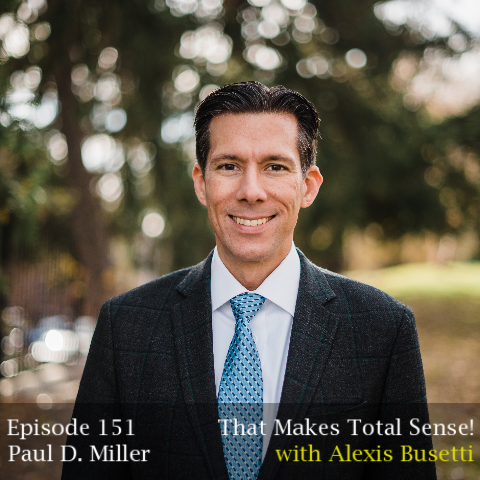
Speaker 0 00:00:07 Welcome to that makes total sense. A podcast dedicated to exploring God's generosity and justice. I'm Alexis, Boetti a Christian aiming to ask good questions and encouraging you to do the same. Every one of us is wired by God to live out generosity and justice, but the how sometimes alludes us that makes total sense is a way for us to get together posture ourselves as learners and challenge one another to practice generosity and justice in a tangible way every day. Everybody, I am so thrilled because I just finished taking a ridiculous amount of notes on a brand new book that is out by Paul D. Miller called the religion of American greatness. What's wrong with Christian nationalism and Paul is here with me today. Hey Paul.
Speaker 2 00:01:01 Um, hi Alexis. Thanks so much for having me on the show.
Speaker 0 00:01:03 Yeah. Thank you so much for coming on. Um, I have to say when I am reading something that a professor has written, then there's always something in me. I'm, I'm a current student right now. And so there's always something in me that makes sure I want to get things right. <laugh> and so, um, <laugh>, if you'll help me, I'm gonna try and let that go in this conversation and just really ask some questions that were spurred in my mind and really even some in my heart, um, about this book that you've written, because I think that, um, the main thing that you have done for me in, in my reading of this book is you've given me language to describe some of the things that I was feeling and seeing, um, over the last several years, um, when it comes to this really difficult topic of Christian nationalism. So I just wanna thank you for how thoughtfully you have, have put this book together and really given, I think not just me, but I think given so many of us language for what we were seeing and experiencing and feeling,
Speaker 2 00:02:06 I appreciate, I appreciate the kind words there. That was my hope and intent in writing the book was, um, I, I didn't know if I would be persuading many people, but I, I thought that as I say, in the book, uh, even the choir needs a good preaching to, and, uh, I think those who feel the stuff in the air could benefit from, uh, uh, the, the clarity I try, I try to bring to a pretty difficult subject, so, yeah.
Speaker 0 00:02:29 Yeah. Um, and I, I wanna just let you, I wanna let you take off here in just a second, but I wanna do wanna say a couple of things about just your work, so that we have a little bit of, of context for where you're coming from. And then I wanna let you expound on that a bit. So you are currently a professor at Georgetown and, um, you have also served in the military. You've served in the white house, um, under, uh, Republican presidents. And then I will say you also were one of the signatures on the open letter on Donald Trump from G O P national security leaders back, um, in 2016, um, when he was in the primaries running for that first election, um, you're also a Christian. And so, um, and so kind of maybe kind of take those bullet points if you would, and help us understand your context, your social location a bit more, because I just have to say Paul, it was so helpful for me to think about where you were writing from when I was reading the book.
Speaker 2 00:03:32 Yeah. Um, so you're asking me to tell my life story <laugh> in,
Speaker 0 00:03:36 In just a few minutes. Yeah.
Speaker 2 00:03:38 <laugh> so in the book, I, I take some time in chapter one to kind of share a bit of that story and I have to say it wasn't entirely comfortable for me to do that. It's not the kind of thing you usually do in a, in a, in a, in a academic book or a, a book that is really an argumentative essay, but I did feel it was important to share with the readers, uh, where I'm writing from, as you say, um, I'm, I'm a Christian. Uh, I have, you know, my parents raised me in the church been going there my whole life. Um, as I share in the book, I, I went to a Billy Graham crusade when I was a teenager. I was baptized in the Willamette river when I was 16 years old, uh, attended Baptist churches, my whole life, um, actually with a dipped, a toe who charismatic church once as well, um, met my wife at, uh, Southern Baptist church in Washington, DC, where we were members for a decade.
Speaker 2 00:04:25 And we still members of a, of a SPBC church in a, in the suburbs of DC. Um, we pull, um, uh, politically was kind of, kind of raised, uh, born and BR into social conservatism and the Republican party, very happy to vote kind of straight line that ticket for forever until until 2016. Um, when, uh, I felt that, um, the political right was moving in a direction that I, I couldn't go and it was, it did not feel to me conservative anymore. It felt like it was something else, something different. Um, and I didn't understand that. And so I had to take a step back and do a lot of reading about American history, about, uh, political theory to kind of wrap my head around where the political right was going. And that's when I found this word nationalism, and it really clicked. It's like, aha, I'm a conservative, but the political right, the Republican party isn't anymore, it's nationalist. And that helped me, uh, you know, maybe put a little bit dis a distance between myself and, and the right. And I could look at it and kind of examine it from somebody who had been on the right my whole life, and now felt, felt myself a bit at odds with it. Uh, and that's kind of where this book, uh, came from.
Speaker 0 00:05:43 Yeah. Thank you so much. That's, that's really helpful. And I think it's gonna be helpful as we continue this conversation. And as, um, people are listening to this to kind of have a grounding, um, from where, where you have been. And I think it's also a connection point, right. Um, I shared with you before we started recording, um, that that really in, in a lot of ways describes my upbringing as well. And so when I was feeling some of the same things that you were feeling, um, it's difficult to try and distinguish, as you're saying, like, why, why do we feel the dissonance now? Maybe we hadn't felt it so much before, but why do we feel it now? And I'll say we, and I'm speaking, speaking for myself in that way. Um, if we could start off because you, you named it and you said, ah, it's nationalism.
Speaker 0 00:06:29 That's what it is. And I'm staring <laugh>. I have on my other screen over here, I've pulled up this, the letter that, um, that you signed in 2016, it's got a big giant on the, on the website. It's got a big, giant picture of Trump. And so I'm, I'm gonna, I'm gonna close that here in a second, but this is what I'm seeing. And I'm imagining in my mind him saying I'm a Patriot, right? Like I'm imagining him in my mind saying I'm a Patriot and calling his, his Maga father's Patriots. And so this is something that's gonna come to our minds of saying, well, yeah. Is it nationalism? Or is it really just patriotism? Cause we, we just, you know, we're recording, uh, at the beginning of June, we just had Memorial day and all through my neighborhood, the boy Scouts have come and they have put up American flags, right. Flying all over our, our little, you know, suburban neighborhood, uh, here in Houston and, and people may already be wrestling with that term in their, in their minds. So how do you define what is, what is kind of the definition that distinguishes those two terms that may get kind of overlapping in some people's minds?
Speaker 2 00:07:33 Yeah, it's a great place to start the conversation. Um, I am a Patriot. Uh, I love, um, I love the United States. Uh, I've lived in nine states in three countries and, and I love being an American. Um, I, I, on Memorial day took my oldest daughter to Arlington national cemetery. We walked around the gravestone there and reflected on the, the sacrifice of those who have protected our freedoms. Um, I've got the American flag flying outside my door, you know, right now, um, I served in the military myself and, and all around CS Lewis has this great discussion about, um, patriotism, where he says it's actually good and healthy and, and necessary for us to cultivate an affection for home for the places that are familiar to us for the ways of life that we've been inducted into. Um, Nigel bigger and Anglican, uh, at Oxford has a similar argument about how important it is to have gratitude for attitude, for the institutions that have brought us up.
Speaker 2 00:08:29 And that includes the institution of the nation of, of the country. Um, and so having that gratitude, that patriotism, that affection I think is actually a good thing. And that's something I would gently remind maybe those on the political left that we shouldn't be embarrassed about. Our patriotism patriotism, I think is, is, is a good, really important thing though, is how you define your country. What is it that you love about your country? And that's where we get into the distinction between patriotism and nationalism. One, I have to add that I did not invent this distinction. This is a pretty conventional distinction by lots of scholars. George Orla wrote a famous essay, uh, notes on nationalism in the 1940s. I think, where he makes this, uh, classic distinction between patriotism and nationalism. Good way to think about the distinction is this, if you ask somebody, what does it mean to be an American and Patriot will probably say, well, I love my country.
Speaker 2 00:09:20 I love what it is. And I love what it stands for. I love the creed, the American creed of equality and Liberty for everyone, maybe the story of the creed as it's lived out in this land, the nationalist is far more likely to answer something about American culture, that they love America, because America has a specific cultural heritage, uh, that we are the people of this kind of this tribe, whatever that tribe may be. And that's a typical nationalist definition of any particular country. They love it because it reflects their own particular cultural heritage. In the American case, the predominant cultural influence has been, uh, what Samuel Huntington called Anglo Protestantism, Anglo Protestantism. Um, and I think Huntington is right, that, that has been the predominant cultural influence in American history. But the nationalists say, because it ha it was our inheritance. We must keep that in the future. And we have to use the government to enforce, uh, Anglo Protestantism to, to ensure that you know, that what at, with the government's coercive powers, we're going to, uh, make sure that we maintain our Anglo Protestant cultural heritage that I think is a good definition of American nationalism and, and Christian nationalism. It's always mixed up with Christian imagery and symbols and rhetoric.
Speaker 0 00:10:48 Okay. So, Paul, I love that distinction. Thank you for, um, thank you for saying that because the truth is that I don't usually make it. It's not my Mo just to read a lot of political theory books. And so I really needed you to make that distinction for me in the book and, and hear, and I'm thankful that you, um, that you have taken the time to do that. I have in my notes, actually, this was, so this was brought out so clearly to me that I just have a little blurb. It says, nationalism is an argument about how we define our country and that how we define is underlined twice. Right? Because when you go into this, in the book, that's one of the places where the light bulbs started going off, right. Where I'm going, that's the smell, that's the smell, right? Like, that's the one that I couldn't put my finger on.
Speaker 0 00:11:42 I couldn't grasp, I knew something didn't feel right. Something doesn't smell. Right. And that's it because in Christian nationalism, in American nationalism, and then specifically in Christian nationalism, people who are adhering to that are defining our country in a different way and then will get into this later. But then the next part is, and, and really trying to enforce it. Right. Right. Yeah. So, um, you already talked about it a little bit and I don't know exactly if this is the next place to go, but this how they're trying to enforce it, they're trying to define it and then enforce it is, is dangerous. <laugh>.
Speaker 2 00:12:26 And, and that is where I think the danger of nationalism, uh, one of the dangers of nationalism comes in, um, and, and the historical record of nationalist governments around the world over the last two centuries is pretty, pretty unanimous that they tend to become authoritarian and oppressive towards, uh, minorities, whether that's cultural, racial, religious minorities, or, or linguistic minorities. Um, if you're gonna define the nation as one predominant cultural influence, then what do you do with the people who don't conform to that? Uh, and there's a more, there's a benign answer where you just kind of treat 'em like second class citizens. And then of course there's a far more oppressive and violent answer to that as well. Um, and so that's a kind of an, an obvious danger to nationalism. I do wanna share another danger for about Christian nationalism. I think that Christian nationalism can be very confusing for American Christians.
Speaker 2 00:13:21 It can, it confuses as to what the gospel really is. Um, the gospel is the message about the life, death and resurrection of Jesus Christ and the good news that we are citizens in his kingdom and, and so forth. Uh, but Christian nationalism it's like it, um, sets a different agenda as if the real purpose of our Christianity was to safeguard America's culture. I I, and that's not really the point of the gospel at all. Um, and if we are to work for justice in the world, I think that's true. We gotta love our neighbors and we gotta love them politically. That's all true, but that's slightly different than saying we have to safeguard the symbolic recognition of Christian power Christian influence in, in American culture. So it can be really, um, uh, kind of a danger or a distraction to Christians confuse us as to what our obligations as Christians really are. And, and that kind of thing.
Speaker 0 00:14:14 Yeah. I mean, this is one of the, one of the places where, um, I haven't read their book, but I follow at Samuel Perry on Twitter. So how so here's that he, he teaches at my Alma mater, but, um, I, this is one of the places where you bring in Perry and Whitehead, uh, statistics. That was really interesting to me. And then, and then you kind of move on from there, just talking about the distinction between Christianity and Christian nationalism. And if I, if I got what I was supposed to out of that section, kind of the refreshing thing to me was that the, I, this isn't how you say it. This is me kind of framing it in a, in a different way, I guess, but kind of the more people are pursuing that gospel message through various, you know, formation, uh, kind of mechanisms, the less likely they are to actually adhere to Christian nationalism. Yeah. And, and kind of vice versa that the Christian nationalism is kind of more of a Christian cultural, uh, identity and less of necessarily, um, a faith identity, if that does that, is that even close to kind of what you were, what you were getting at in that section.
Speaker 2 00:15:23 Yeah. Um, and you'll sometimes hear a debate about what the word evangelical means anymore, and what you're saying tracks pretty closely with this debate. The word evangelical five centuries ago was a theological label. That simply meant a Protestant who wants to share the good news of Jesus Christ, the good news, the Evangel. Um, today, if you ask somebody, what is an evangelical, you're more likely to get a cultural answer, not a theological answer, um, that an evangelical is a politically conservative white American who believes in gun rights and so forth, right. And that's not terribly connected to what the Bible says. Um, and so the word evangelical, even the word Christian sometimes has these multiple meanings, uh, which again, shows you the danger of how it could confuse Christians about what our identity really is rooted in and what it means to be a Christian in America.
Speaker 2 00:16:12 I, I just kind of wanna pause and say it is good and right, and important for Christians to be involved in the public square. Like it's good to advocate for justice. It's good to advocate for right and wrong in the things that we believe in, uh, the pro-life movement, religious Liberty, the end, an end to racism and helping the poor and so forth. Those are good things to advocate for. And that's not Christian nationalism. And I think sometimes right now, uh, some of the maybe harsher critics are using the term in an over way where they are saying essentially, any Christian political activism is Christian nationalism and that's, and that's wrong and bad. So just to make that distinction, uh, there's, there's a difference between kind of good political activism and the nationalism we're talking about.
Speaker 0 00:16:57 Well, and that takes me back to, um, when you are, when you were asking, if you ask, how do you define America? You know, how, and, and, and when you go back to this, this cradle answer from someone who is patriotic with the, you know, the answers from Liberty and justice for all, you know, equality, all of these things, this is something that, yes, there, there is an overlap. I might say that like an American would be an American who is committed to those ideals would, would be advocating for justice for all which means, and to racism, which means systemic equality. Right. Which means all of those things. And as a Christian, we would also advocate for those things because Jesus has instructed us to love our neighbors as ourselves and all of this. But as you mentioned, this is an overall, this is a universal, this is something that we want for everyone, not a protective way.
Speaker 0 00:17:58 And, and, you know, one, one of the ways that I think, um, we've seen that kind of play out, and I don't know if we wanna get into the, the real nitty gritty specifics, and we don't have to, but just a couple of things that come to my mind are, you know, we have this maybe freedom of religion, banner, right. And, and someone who is patriotic would say, yes, absolutely. We, this is one of the American values. We value freedom of religion for everyone, which means for my Muslim neighbor, which means for my son's Buddhist school teacher, which means, you know, for all of this, but a nationalist, a Christian nationalist would say we value. Maybe we value freedom for Christians to be able to practice in the way that they want to practice. And there's not necessarily maybe a universal freedom that's being advocated for. And those are two different things.
Speaker 2 00:18:50 Yeah. And, and you picked a good example here with religious freedom. Uh, it was really eyeopening to me when I realized that religious freedom is probably more well safeguarded in constitutional law today than probably any other time in American history. We have this view, this maybe narrative in our heads, many of us that America used to be nearly perfect, um, you know, in the 19th century. And then there's this sort of decline in fallen narrative that things gradually got worse after the 1960s or whatever. Um, but, uh, that's not true, um, to take this religious freedom, uh, there, uh, a white Christians enjoyed more power in the 19th century, but there was not true religious freedom for all people. Uh, Catholics really enjoyed basically no religious freedom in the 19th century. Um, and black Protestants of course, did not. And the sort of low class denominations, Baptists and Methodists were despised by the culture Baptist used to be in prison for preaching without a license back in the 18th century.
Speaker 2 00:19:52 So our religious freedom, all of us, not just kind of establishment white Protestants, but, uh, but everybody have better safeguards for our religious freedom today. And that's an important story for us to remember. It's not just a simple decline in fall narrative. Um, and of course the, the, the narrative is, um, far more dramatic when you talk about race. Our country is far more Christian today in how we treat people of all races and ethnicities, uh, far more tolerant and loving towards all people than we were a hundred and than we were 50 years ago, a hundred years ago, 200 years ago. And so we need to remember that, um, though, there are parts of our culture that are more challenging to religious faith today. I think that's true. There are also parts of our culture and our legal system that are much, much better. Uh, and we should celebrate that.
Speaker 0 00:20:42 Yeah. Um, man, I, I grasped onto something that you mentioned there, which is going back to the narrative and saying, what, what actually is true is that white Protestants had more power then. And, and I have to tell you, this was the thread that continually I'm gonna be real technical here. That continually made me feel the yuckiest <laugh> when I was, when I was reading your book was just the recognition of the power hungriness, right. Of this. I'm making up all sorts of words, but you know, this, this power thread through, um, through nationalism, it's even, yuckier when we talk about the power thread of Christian nationalism, um, you know, that, that was kind of, one of my takeaways is like big picture. That's what this is about. This is about power who has power. Who's gonna retain the power. How are you gonna retain the power? Who's the power for who does the power benefit? Um, lots and lots of power talk that, um, is really disheartening, um, in this discussion.
Speaker 2 00:21:56 And, and I think Trump was actually very clear about that in the 2016 campaign. If you go back to some of his campaign speeches and his kind of stump speeches, he's very clear at, um, explicitly appealing to Christians and power, right? We will restore Christian power in, in this country. And that's almost a direct quote from Trump. We will restore Christian power and look, white Protestants used to run essentially every single institution in America clear up to the 1960s. So white Protestants have less power today than they used to. That's a true statement, making the restoration of white Protestant power or just Christian power. That's not a, I think, a valid, um, political platform, right? We ought to advocate for justice for all, not for our tribal power and privilege. Um, it was again, eye-opening for me, when I looked at American politics through the eyes of my, uh, you know, I read all this political science stuff about compared to politics and, and society all around the world.
Speaker 2 00:22:55 And it's pretty conventional to, um, uh, analyze ethno religious groups, uh, sort of groups that are defined by combination of ethnicity and religion. And you isolate these groups, you say, oh, well this is a coherent interest group. And so they're gonna act this way and pursue their interests and so forth. Well, when I kind of apply that to, uh, Anglo Protestants in America, it, yeah, it clicked. It's like, oh, well, yeah, maybe this community has long been pursuing its power and privilege despite what the rhetoric is. And the rhetoric has always been, I think, quite admirable, right? Talking about small R republicanism and democracy and equality and Liberty. I agree with all that stuff. But if you look at the behavior, uh, there's a consistent behavior of white Protestants acting like an ethno religious group, uh, pursuing its own its own power. And, and Trump really tapped into that very powerfully.
Speaker 0 00:23:49 Right? I mean, some of the things, um, that I've just barely kept up with lately, um, is, you know, some, when you talk about smaller republicanism and democracy and all that, and you, and you look at the, the power, uh, dynamic and, and thread that we're talking about, it hit me. I think it was really only a couple of years ago. Um, I was having a conversation with my dad who, um, who happens to have studied political science. And it was just, it was one of these aha moments, um, where I was like, oh my goodness. I don't think these people don't actually want a democracy. <laugh> right. Like, whoa, like, you know, mind blowing kind of thing. And then now, you know, a couple of years later, it's, it's coming out and people are talking about, you know, being replaced and you know, all this kind of stuff that seems really farfetched to me. And you, you didn't mention it specifically in your books when I'm not gonna necessarily ask you to go there unless you want to, but it's just like, but that's kind of where the rubber hit the road for me is that it's what we, what we should be advocating for is exactly, as you say, as justice for all, instead of justice, for people who used to be in the majority and are afraid of being in the minority now <laugh>, which is kind of what you're seeing happening, I think.
Speaker 2 00:25:13 Yeah. And, okay, so you're mentioning the anti-democratic tendencies within nationalism that, you know, I just a bit ago, I talked about how nationals governments tend to turn authoritarian over time. Um, I, I wanna be careful here and not impute this to all people on the right or all Republicans or all Trump voters. But I think that we saw the beginnings of that, uh, on January 6th of last year at the, at the capital attack, I, I'm not gonna call it the capital riot anymore because I think it's actually a, a terrorist attack. Um, that was anti-democratic. It was also rooted in conspiracy theories. And you did see elements of Christian nationalism on display. They, they carried the Christian flag in, they were playing Christian worship music. They Carrie the Confederate flag in, um, and if, if you haven't done this, go to YouTube and, and find the prayer they prayed when they reached the floor of the, I can't remember if it was the Senate or the house, and it's remarkable. I, I recognized it. I felt that I, I, that I recognize because they, they explicitly pray in Jesus' name. They invoke Jesus Christ's name and they pray, thank you for letting us take this country back. This country is ours. Uh, it was just remarkable to see that, um, that display, again, I don't want to cast all, uh, Trump voters as, as, as guilty of gens, but it's there. And I think that, that, uh, the potential for more of that is, is alive and well on the political. Right. And it, it, it's scary, I think.
Speaker 0 00:26:49 Yeah. So, so let's go backwards for a minute because one of the things that I really appreciate about your book is that, um, you know, we've mentioned Trump a few times, but, but truthfully, besides the place where you, you mentioned that you were a signature on the letter, Trump doesn't even get a chapter until almost the very end, um, because part of what I love that you've done in this, and I'm hoping that you'll go there with us a little bit today, is that you've kind of said, in my words, like Trump slid into a place that was ready for him. Mm-hmm <affirmative> right. Um, this, this isn't that Trump came on the scene, you know, late 2015, decided he's gonna, you know, he's gonna run. And all of a sudden, now we have this Christian nationalist segment that, you know, has, has come to life in our otherwise, you know, beautifully, perfectly democratic country.
Speaker 0 00:27:41 Like there was a Christian nationalist segment that has been, has been alive and well for a while. Um, and that, you know, Trump came along and did I think that he was a catalyst for a lot of things. I think people would probably argue that, but it wasn't that something started with Trump. And as you just mentioned, it's not that we can anticipate things would end because his presidency ended either. Um, so I don't know if this is a place where you wanna go. One of the, one of the places that made me kind of aha about that was when you talk about Jacksonian in America. Um, and, and that kind of that, like when you were talking about recognizing the prayer, I'm like, oh yeah, like I know <laugh>, I know this, I know these folks, um, right here, but that's just one example you, you do talk about this was, this was definitely way pre-Trump, um, this nationalist thread.
Speaker 2 00:28:33 Yeah. I didn't really wanna write a book about Trump. There's, there's plenty of books written about Trump, uh, because he's a colorful personality. He sells books, he gets clicks. Um, and I, and I really felt that there was something more to say that was both predates him and will outlast him. And I think that that may be the more important message other than just harping on the one guy. Um, I'll, I'll, I'll share this there's, uh, actually 30 or 40,000 words that didn't make it into the book. And it was mostly history where I tried to trace elements of this way of thinking about American identity as far back as I could. And I'm not making this up. I found a promotional pamphlet, uh, trying to recruit British, uh, settlers to come to Virginia in 16, 17 that said, come help build God's kingdom in the new world.
Speaker 2 00:29:25 Um, it's literally as old as European settlement in north America to define our political project in this hemisphere in religious terms. So that way of defining America, it's always been here. It has always been here and I could, we could spend an hour just on this point. I, I think maybe one of my other favorite, um, illustrations of this would be the schooling system in the United States, right? So for a hundred plus years, we had public schools funded by the government that were pretty much, um, Protestant, uh, kind of seminaries or Protestant secretarian schools. That's why Catholics left the school system and created their own parallel parochial school system because they didn't feel welcome there. And, uh, when in the 1960s, uh, the culture had changed enough to no longer want that. We had a couple of big lawsuits about school prayer and, and, and Bible reading of schools.
Speaker 2 00:30:27 Now I get it that today the schooling system is a kind of a disaster and the Supreme court has made some decisions on, you know, on religious Liberty, in the seventies, eighties, that weren't, that weren't great. They've undone them now, but that, uh, Supreme court decision in 1963, uh, I think it's Engle versus vial on school. Prayer was a really important case that helped, um, disentangle that religious understanding of America from, from, from government sponsorship. Uh, up to that point, the government had literally been funding school teachers to pray and read the Bible and teach that view of America to their students. Um, so this stuff, it, it goes all the way back and it's been a deeply ingrained part of American culture. Again, that that part of American culture has been losing influence. And as it does, the people who are in it, the Jacksonians as you, as you highlighted, uh, have felt that loss of power. And that's where Trump was able to step in and say, I'm going to bring your power back. I'm gonna bring your power back. And he casted in religious terms, I'm gonna bring Christian power back. And, uh, that spoke to, I think, deeply rooted, um, say longings and fears that have been going back for decades and decades as a segment of the American population felt this anxiety over the loss of their historical, uh, uh, privilege.
Speaker 0 00:31:53 Yeah. Um, I think I keep, you know, I keep kind of going back to this thing that is, is one, one of the aspects of this that makes it so hard, um, is, and you use that word disentangles specifically in, in that example with, with schools and religion in schools. Um, but this is very, very difficult for American Christians to have this conversation on Christian nationalism, because so much of what happens is exactly as you're talking about is this conflation, like we just, these things get kind of, uh, collapsed onto one another, and it's very difficult to, to pull out one from one from the other. Um, you know, I think about, I know I just said, we're gonna take this away from Trump, but, um, you know, things, things with Trump that, for example, um, there were major Christian leaders who very influential evangelical Christian leaders who made excuses for Trump's moral imoral behaviors who were, um, saying things about former presidents, like Clinton or other, you know, political people.
Speaker 0 00:33:10 And just saying like, this is, this is absolutely not acceptable. We can't have someone like this in office, but then you just kind of go, oh, I don't wanna go there, but you kind of have to go there and you go, yeah, but Clinton, wasn't also, he wasn't promising you power <laugh> and that's really hard, right? Because again, like we, things get conflated and we say, well, I don't wanna think that about my, my, about leaders in this culture. I don't wanna think that about leaders in the faith space. I don't wanna think that about my friends or my neighbors or myself. Um, but it's difficult because these things are so entangled this nationalism, and unfortunately this quest for power is, is entangled with, um, with faith or at least with this kind of profession of, um, faith.
Speaker 2 00:33:56 And I think it is hardest when America's at its best, right? One of the reasons it's hard for American Christians is because America is actually pretty awesome, right? <laugh> and, and I, that gets back to my patriotism. I, I love this country and there's lots to be proud of. You know, this is the country that fought a war to end slavery. This is a country that, uh, that overcame, um, this is a country that, uh, defeated the Nazis and put 'em out on the moon and won the cold war and brought down the Soviet union. These are all true things, and we should take pride in them, but it's precisely because we are comparatively better than most other countries that have ever existed, that we can turn a deaf ear to a needed rebuke when it is justified. Uh, it is our self righteousness. That is our besetting sin because there is a measure of righteousness there. And that can be very deceptive for us to grow up with that sense of, of comparative righteousness, uh, compared to other countries.
Speaker 0 00:34:55 Can you talk about this when we go, we're going back to this, um, quest for power. Um, I'm wondering if you can take a cue of my notes. I was just saying, um, I just have written down that that nationalism makes quest for power into a moral crusade. So what if I, if I read that correctly, <laugh> then can you unpack that for us a bit? Like, what is the meaning of that, that there would be this, this group that would be decidedly on a quest for power and consider that like their moral obligation to, to get it and use it?
Speaker 2 00:35:35 So the, the agenda of the, uh, the Christian, right? Which, you know, a big part of my book is arguing the Christian, right. Was actually always nationalist the agenda of the Christian. Right? If you go back to the early version of it, the 19, you know, twenties and forties and fifties was about public morals. It was about, you know, uh, um, censoring, the airwaves and, um, regulating, drinking and dancing. And, um, and then it was anti communism was a huge part of it. And of course, uh, uh, fighting against the civil rights movement was a big part of it. You move in the 1970s and it's, it's about fighting, uh, the sexual revolution, gender equality, gay rights, um, you know, uh, the public school fighting against public schooling, presuming the right for private schooling, so on and so forth. Okay. So this is the agenda.
Speaker 2 00:36:23 We can agree with parts of it here and there. It's not, you know, it's not all, you know, bad, but as the, uh, movement has grown smaller as its power has shrunk, the story it tells itself is that we must preserve our power in order to, uh, pursue any other of our, of our agenda pursue any other item on our agenda. And so the preservation of our power is just for America's sake, right? America would be lost without us, without us, no voice would be there to advocate for the unborn to advocate for religious freedom to advocate for this and that. And the other thing. And so the most important agenda item is to preserve our power so that we can then advocate for all these other causes. That's how this movement persuades itself, that its own power is a moral cause. And I think that can be again, quite dangerous when you look at power as intrinsically good merely by virtue of the fact of who's wielding that power. It's a very dangerous place to be in spiritually and politically.
Speaker 0 00:37:27 Yeah. So the Christian, right. Just to take it a step further. I mean, what I hear you saying is the Christian, right? Doesn't trust anyone else with that power, right. Will they do the, the quote, will they do the right thing if they have the power? And the, the narrative is probably not the narrative might be certainly not. If someone else were to have this power.
Speaker 2 00:37:50 And, and I think that's why you hear the, the rhetoric today, that the next election, the one, after that, it, the stakes are existential that if the other side wins, the election America's done right back in 2016, we had that famous essay about the flight 93 election, where the author, uh, by analogy was saying that Democrats are akin to Al Qaeda. They were like terrorists, who were hijacking the airliner of America. And that if they won the election, that, uh, America was literally done, it was over. And that's what that SAS said. He said, Americans will be finished as the Democrats win. And there's a certain strain of rhetoric on the right, that looks at political opponents as enemies, uh, treasonous, seditious, enemies of all of America and all that is good. And right. I will say, I think there are actually some on the left who say, who have the same view of the right. So we're in a dangerous place where the extremes on both sides are kind of a mathematizing each other. Um, and yeah, so that's very dangerous place to be in. Uh, and I just remember Lincoln, right? Talking about, we, we must be friends, not enemies, um, or Jefferson. We are all Republicans. We are all Federalists. We must be Americans.
Speaker 0 00:39:05 Yeah. Thank you. Um, gosh, Paul, I feel like you, you did such a, you've done such a great job of outlining this. I mean, one of the, the, the kind of lingering question though, just because we're we're humans, right. Is then like, well then what <laugh> right. Like then what do we do? Like, we see this as dangerous. This is a heritage, right? Like, I mean, that's, that's kind of the freaky part for me is like, like we've inherited this, right. We talk about this, this going back for centuries, we've inherited this, um, it's, it's, it's entangling, you know, how do we move forward? Like what, what should we be looking at? You know, I'm kind of thinking about everything from realizing maybe convictions that we have that line up with Christian nationalism that we didn't know, I'm thinking about our, our friends and our cousins and our, you know, church, uh, you know, our people who sit with us in the pews, but then also just like, you know, big picture things, because it, it matters how we think about these topics, um, because that will guide what we, how we feel and what we do about them.
Speaker 0 00:40:19 And so, um, you know, I'm not asking you to answer everything, uh, but I do, but I do know you've thought about it. So, so where, where would you kind of guide us when we have all of this information? We have all this language now where we can name it, and then it's kind of like, we're left with like, well, now, now what, what do we do?
Speaker 2 00:40:38 Um, you know, maybe one flaw in my book is that I don't end with a program, a 10 point program of things to do. <laugh>,
Speaker 0 00:40:46 Um, you'd have to up the price quite a bit. I think if you, if you could end with
Speaker 2 00:40:50 That, it would take me six more years to write that. Right. Uh, so yeah, I don't have that. Give me a couple years to, to come up with those ideas. Um, I do end with a note to pastors in the book, because I think that churches have a role to play here and a role that many might feel uncomfortable with because this problem has been incubated by churches for much of American history, because this problem involves a misapprehension of what the gospel really is. I think the church can't, but step in and address this problem, because if you hear somebody taking the name of Jesus and saying something wrong with it, the church absolutely has a responsibility to clarify what the name of Jesus really stands for. And so I think pastors need to be aware of that, and they need to be a bit freer to teach, not in a partisan way and not necessarily on an issue by issue way, but to teach a holistic, biblical political theology that teaches us how to be political animals.
Speaker 2 00:41:52 Uh, Americans are, are malformed in this area. We are, uh, not good at the art of politics anymore. We used to be 150 years ago. Here's a decline in fall narrative. I buy into, we we're bad. We're worse today than we used to be at the civic arts at the arts of association. And I think maybe pastors actually have a role to play here in applying the gospel of Jesus Christ to our lives in community with others. What does it look like to be a Christian loving others politically in the public square? Right? Maybe it means once in a while, shutting up and listening and admitting when we're wrong, listening to the rebuke of history, reading books and articles from the other vantage point, these are all good and healthy things to do. Um, and so there's a lot of things we could do. Uh, I don't think there's any silver bullet and there's no, uh, again, I don't have a 10 point program for you. Um, but it's gonna take, uh, a lot of, uh, sort of concerted effort by citizens of Goodwill to undo some of this damage, cuz it's very deeply rooted.
Speaker 0 00:42:54 Thank you, Paul. Um, one more place I'd like to go and then I'll, and then I'll let you have it. Um, and, and I'll let you kind of wrap it up however you want, but, but one more place I do wanna go. That was, um, that was really, really important for me. Um, you kind of open with it and you kind of, uh, end with it in your book as well. And that is that this term that you use of ordered Liberty and, and you use this term ordered Liberty and human dignity and the, and the, in my imagination, I'm putting these terms together. Maybe not quite like a sum, right, but like ordered dig or ordered Liberty and human dignity should be the guide, um, for our, our, our political guide. Um, and this was something that it's, it's kind of like, okay, I'm just, I'm just gonna I'll bet you $10, if you can disagree with that.
Speaker 0 00:43:48 Right. Like I'm like, this should be kind of a, a statement that we can all, um, get on board with, you know, Christian non-Christian Patriot nationalist left. Right. You know, kind of wherever you stand. Um, but there is a lot there. So when you're talking about cuz I think what I heard was the Christian nationalists want to run politics this way. How should we be running politics? Right. It it's kind of like you've, you've <laugh> I say sometimes my husband and I are trying to figure out a place to eat. Right. And he's like, you can't just veto everything. Right. You have to give me an idea. Right. <laugh> so I don't think by any stretch of the imagination that you vetoed everything, but I've kind of set my mind to go, okay, this is what it shouldn't look like, but now I really desperately need someone to tell me maybe what it should look like. Even in a few sentences. So we're saying, okay, that's great. I can discard this. I don't want to live life politically like a Christian nationalist. I want to live in this way where this is what guides me, what would that be?
Speaker 2 00:44:56 Well, I open the book with a preface, talking about a trilogy that I want to write. Uh, this book is volume one, it's a critique of the political right. Volume, two critique of the political left progressivism and volume three would answer your question. It would be a vindication of sort of, I dunno, Christian democracy or something like that. And I'm happy to share that. I actually will be writing these books. I in university was kind enough to actually offer me the contract. So I'll be fantastic. So, so the answer to your question is coming in 2029. <laugh> uh, when I get to volume three, um, I, I, I, I say in this book that there's no alternative to our politics then to some kind of system of ordered Liberty and human dignity. Um, I think of Genesis two 15 where God puts Adam and Eve puts him in the garden and he says 10 and keep the garden.
Speaker 2 00:45:47 If you've done any gardening, you know that gardening involves some order, right? You're gonna, you're gonna put up the trial list. You're gonna till the lines of soil, you're gonna plant things and neat rows, and then you're gonna provide some water and then eat just kind of step back and let nature take its course, you give it freedom. You give it Liberty. Right? Any creative endeavor in all of creation requires that mix providing some order to the kind of raw material of nature and then stepping back and letting things take their course. I think that's good advice for parenting <laugh> I think's good advice if you're a boss at work, I think it's actually a good model for government, right? Government is a process of providing some order and structure for society and then St stepping back and letting things be. And, um, I, I look forward to fleshing out that vision more and coming years I'm I don't have necessarily new ideas.
Speaker 2 00:46:39 I don't think I'm rediscovering something. I think these ideas have been alarm for a long time, but I think every generation needs to reappropriate and re-appreciate these ideas of ordered Liberty, um, and kind of rediscover what it means. It will look different perhaps in our generation, as we adapt to the challenges before us, the challenge of nationalism and progressivism and the challenges overseas, by the way. Uh, so ordered Liberty will look a little different as we tweak it as we need to. Uh, but we each need to kind of prayerfully consider and, and seek the wisdom for how to cultivate ordered Liberty, uh, today and for the next generation.
Speaker 0 00:47:15 Thank you so much. Um, I just, I just really appreciate that picture. Um, I hope that's something, as I was imagining you talk about the garden that I, that I keep with me because I think that's beautiful and I think you're right. I think it applies to so many different things and I'll just extend it and say, as long as I'm here with this microphone, you have an invitation to come and talk about any of those books that you want to <laugh>. Thank you. Because I would love to, I would love to read them as you, as you put them out. No doubt I'll be revisiting this one. My husband has already said, do you have that in hard copy yet? Can I grab that? So I'm like, you can get it as soon as I get it in. Um, the thing, the place I'd like to kind of wrap up is really with you.
Speaker 0 00:47:56 Um, sometimes I mentioned that I'm a student and sometimes when I interview professors, I am aware that there may be something itching in you where you're going, you're looking at the class and going, ah, if they would only ask this question, then I could <laugh>, then I could say this thing. So I just wanna open that up to you. Um, and I might even say open that up to you, Dr. Miller. And if there's anything that you're going, ah, man, I wish she had asked that I would've made this point. Um, please feel free to do that now.
Speaker 2 00:48:29 Thank you for that open invitation. I, first of all, you're a great interviewer and, and I appreciate that you read the book, uh, thoughtfully and had some good questions for it. Um, so I don't think there's any one big thing that's really been missing to our conversation. So there's a place to end. Um, maybe it'll be essentially with some of the ideas in the last chapter, um, where I reflect on American identity. And, uh, I talked at the beginning of our conversation about the American creed. It's important to say that that's not the only element to American identity. I think our history is part of that. And I think that knowing American history, uh, is an important part of being an American. If you don't know the story, uh, you're missing out on something of what it me means to be an American. And, and you're not really practicing that gratitude.
Speaker 2 00:49:15 Well, the appreciation for where you came from, if you don't know the story of where you came from. And so I just encourage people to go out and read a book, American history. We don't all have to agree on that history. We're all gonna come from different places in that history and that's fine. Um, but I think it's important to, to know that story because we Americans and I speaking about Americans now, not Christians, we Americans we're the people of the creed, but more so we are the people of the story of the creed. We have never lived up to the creed perfectly, uh, never will decide of heaven. Um, but we are the people who have continually driven to live up more perfectly to that creed generation after generation. That story is the story worth, cultivating, worth, knowing, appreciating, and worth making your story so that you step into that story and decide I am going to carry this story forward. And that I think is the best understanding of what it means to be an American.
Speaker 0 00:50:12 Wow. Amen. Thank you so much. The book again is the religion of American greatness. What's wrong with Christian nationalism by Paul D. Miller and I will put the link, um, for you to get your hands on a copy of that book in the show notes. Thank you so much for joining me, Paul.
Speaker 1 00:50:28 Thank you, Alexis.
Speaker 0 00:50:31 The links for all the resources mentioned in today's episode can be found in the show notes, music and podcast production by Seth. Boetti be sure to give us a review on iTunes and subscribe at your favorite podcast listening app. You can also visit us at that. Makes total sense.com.