Episode Transcript
Speaker 1 00:00:06 Welcome to That Makes Total Sense. A podcast dedicated to exploring God's generosity and justice. I'm Alexis bti, a Christian aiming to ask good questions and encouraging you to do the same. Every one of us is wired by God to live out generosity and justice. But the how sometimes eludes us that makes total sense is a way for us to get together, posture ourselves as learners, and challenge one another, to practice generosity and justice in a tangible way every day. Dorcus, um, I'm just gonna say that I'm just gonna set the scene for our conversation because I was, I was almost tearing up praying for us before we even got started. <laugh>, I feel like that's like, appropriate because I learned a new name for myself when I was reading your book and we're gonna get to it. That's highly sensitive person. Yeah. So can, can I, as a highly sensitive person welcome another highly sensitive person to the podcast today?
Speaker 2 00:01:09 Yes. Yes. Thank you. I love that. Welcome.
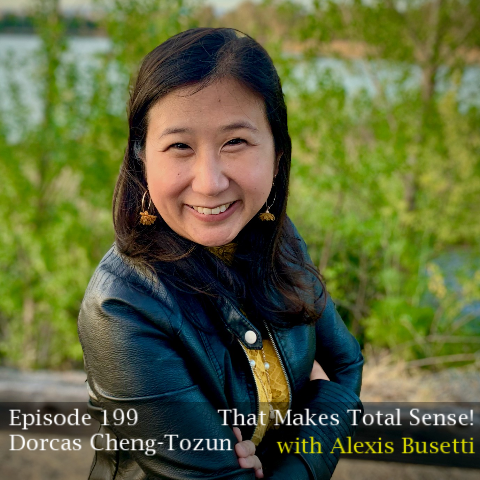
Speaker 1 00:01:12 Yes. You're so welcome. So, I'm here with Dorcus Chang Tosen, and she has written an incredible book called Social Justice for the Sensitive Soul, how to Change the World in Quiet Ways, and I'm gonna do my absolute best to let Dorcus talk the most today, but I just have so much to say because this book, it just felt like, I mean, it felt almost like this. Like you're Paul, you're writing a letter and it's like, dear Alexis <laugh>, I say, you know, like <laugh>, I thank my God upon every, you know, of your sensitive salt. And now listen to what I have to say. You know, I felt like this was, it was a very,
Speaker 2 00:01:52 Yeah, I love that
Speaker 1 00:01:54 Personal book. For me, as I read it, I couldn't help but debrief it with my husband, so I can't wait to chat about it because, you know, on the podcast we talk about God's generosity and justice. Mm. And this, for those of us in the social justice sphere who don't look a lot like other people in the social justice sphere, sphere, this book and message just felt like a, like a breath of fresh air. So, thank you, <laugh>.
Speaker 2 00:02:20 Yeah, that's wonderful. Thanks for sharing that. That's very encouraging.
Speaker 1 00:02:24 Yeah. I'm, I'm really excited, um, for you to share because you're the one who's done the research. You have had, um, you have so much wisdom in this space, and part of it is because you also have experience as <laugh> as someone who's in the social justice world. And you're also sensitive, you're a sensitive soul ca So can you just like, talk about that a bit and like where the, this book came from? You kind of intro that in the book, but I'd love for people to hear, hear that from you this today.
Speaker 2 00:02:54 Yes. Well, I love that your experience of the book was so personal because this is such a personal book for me. And it came out of my own lived experience. Basically, this book is trying to answer a question that I have wrestled with for my entire adulthood, which is that I felt very clearly called toward the work of justice when I have been in those spaces. There has been this sense of like, yes, this is what I was made to do. At the same time, when I have been in those spaces, it has been exhausting. It has been incredibly stressful. It has burned me out over and over again to the point of very severe depression, very severe anxiety. I still live with chronic anxiety today. And, and so I kept trying to reconcile this sense of how is it that the area of work, the vocation that I feel most passionate about, most called to is also the one that is really harming my mental health and, and physical health.
Speaker 2 00:03:59 And it just couldn't quite compute <laugh>. And, um, and so then this specific book came from the summer of 2020. I had been approached by an editor with Broadleaf, which is the publisher of this book, and she had asked me, do you have another book idea in you? So this is my third book. And at the time I said, no, but I'll think about it. So Summer 2020, I think we can all remember what was going on then, right? So the pandemic is hitting and we are seeing, you know, not only of course people getting sick and dying, but all of these social inequities that are being uncovered as a result, right? So inequities in public health in access to resources in, um, digital access, income inequality, race, right? All these things were coming to the fore because of the pandemic. There was a striking rise in anti-Asian racism and hatred and violence toward Asians and Asian Americans, which hit home really close to me.
Speaker 2 00:05:11 Uh, I live in the San Francisco Bay area and a lot of the incidents of violence, especially against the elderly, happened in the Bay Area. And so it, it was a really scary time to be Asian American and just walking on the street, minding your own business and feeling like you could be attacked at any point. And then of course, uh, the other major thing going on was the, the murder of George Floyd had happened in May. And so there were Black Lives matters protests breaking out all over the country. And so it was just a very, very intense time, I think for anybody, but especially for those of us who have a heart for justice, there was this weightiness of there is so much going on, there is so much wrong with the world, and what can I do about it? And of course, we're in a pandemic, so, so our options are limited to some extent.
Speaker 2 00:06:02 But people were marching, people were speaking up, uh, there was a lot of activity on social media. And at the same time I was wrestling with this question of, is there a way for me to engage with these issues I care deeply about that feels more authentic to who I am? And that doesn't just drain and exhaust me, but can actually give me some measure of, of life and energy and hope. And, and so then I was walking on a trail near my home thinking about all these things, thinking about this question of what book would I write if I had another one in me? And, and the, the title like fully formed just popped into my head. It might have been a moment of divine intervention. And I just thought, yeah, social justice for the sensitive soul, that is what I need to figure out. What is that? How is that possible? What can it look like?
Speaker 1 00:06:56 Yeah. Oh, thank you for sharing that. It is, it is all of those things that you just said, like, how can, how can I do this? And, and that is, I think the, the big question for this book that, that you have helped give formation to for so many of us, I think is a wrote on how can we be true to who we are? Which includes our desire to work as social justice activists, right? Like how, how, cuz all of those things are true about us. At the same time, um, when I was quite a bit younger, I was just out of college for a couple of years and I had been, I had been pushing papers at a law firm, like right after I got out of, uh, out of college and I decided, oh, I knew I had always known, but I, I wanted to do work That quote mattered, right? I wanted, I wanted to do something that mattered. I didn't just wanna push paper in this law firm. And, um, and so I decided I was going to apply to do child welfare case work.
Speaker 2 00:08:09 Mm-hmm. <affirmative> <laugh>,
Speaker 1 00:08:10 I was, yeah. 20 nothing, you know? Right. And decided I was going to do that. And my sister voiced what I think everyone around me was thinking, which was, how in the world are you going to do that? Mm-hmm. <affirmative>,
Speaker 1 00:08:24 She said, your, your, your heart is too soft. Mm-hmm. <affirmative> is what she told me. And I, because she's my sister, I could do this. I kind of butted up against her, right. You know, with my words. And I said, this is exactly the kind of people that this work needs as people whose hearts are soft. We don't need these, you know, hardhearted people in this place. What are you thinking? I know it's gonna be hard, but da da da da da. And um, you know, uh, less than two years in, I was ready to be done. Mm-hmm. <affirmative> like entirely. I think the average, the burnout rate at that time for the agency I was with was about 18 months. Mm-hmm. <affirmative>, I mean, and that's, that's, you know, higher to resign. You know, timeframe was about 18 months. I ended up lasting another year, um, and kind of switched around some of the things that I did. Um, but I, I can tell you probably even 10 years after I had resigned very, very occasionally, I still could track that I had dreams mm-hmm. <affirmative> about former clients because it was, it, it, the work impacted who, you know, my person Yes. That much <laugh> Yes. It was, it was crazy. Right.
Speaker 2 00:09:37 Which is the classic description of how a highly sensitive and empathic person operates in the world. Right. I feel like everywhere we go, we take a little piece of it with us and it becomes part of us and we can't ever quite shake it off. Uh, there's something really, really beautiful about that. So I think one of the reasons why people like you and I find ourselves in this conundrum is that as highly sensitive empathic people, we care really deeply. We are, uh, we have a tendency toward idealism. We, uh, because of our sensitivity, we notice what is not right with the world around us. And we notice how people are getting hurt. We notice who is being left out, who is being marginalized, who's being overlooked, and, and we wanna do something about it. And I, and that's a beautiful trait because not everybody will see those things. Um, but then to be aware that whatever space you go into, whether it's a child welfare welfare agency, um, I worked with a youth leadership development program, I did community development, we are fully inhabiting those spaces. Mind, body, heart, soul. You are there. And, um, and so to just be aware that that is going to have a really deep impact on you, positive or negative, or some very complex mix of both, which it usually is.
Speaker 1 00:11:11 Yeah. Which it usually is. And I'm, I'm gonna ask you to, to kind of give us, um, definitions for, for a couple of, a couple of groups of people and just do this in whatever order you want because you already kind of started with the, with the highly sensitive person or the highly empathic. Um, but this is not just like dorky and Alexis talking because we happen to fit some sort of profile. Like you've done the research, other people have done research on this mm-hmm. <affirmative>, you've, you've, you've, you've quoted them in the book. So that's kind of one category. Like who are the people like us? Like what <laugh> what kind of, what defines us? What do we look like, you know, in this, in this sense. But then also, you know, kind of like the reason that my sister said this is because there is also an ideal person who engages in that kind of work. This, I think you call that person like an ideal activist. And she could clearly see without having done this research, just from having known me for, you know, 20 years that I wouldn't that <laugh>. Right. <laugh>, I wasn't that girl. I was a different girl. So, so who, who are those kind of two, those broad definitions of those kind of two groups of people? Why does it sometimes feel incongruent for us?
Speaker 2 00:12:18 Yes. So, uh, the highly sensitive person is a term coined by Dr. Elaine Aaron about 30 to 40 years ago. So it's actually relatively new in psychology and it can be up to 20% of the population, which is pretty significant, you know, so one in five people you meet can be highly sensitive. Of course there's a whole range. You can be highly, highly sensitive or maybe a little bit less so, or somewhere in the middle. But, but folks who are highly sensitive tend to have something called sensory processing sensitivity. So we, it's, it's like our senses are always operating at high alert. And so we see things, we smell things, we hear things, we feel things in, in ways just at, at a more intense level than the other 80% of the population. And, uh, highly sensitive people also tend to be very deep feelers.
Speaker 2 00:13:22 So kind of the, the more common definition of what it is to be sensitive. Right? And so, yes, we are, we are hurt more easily. We can be even physically hurt more easily, like more sensitive to the sensation of physical pain. And, uh, we are deep thinkers. And so there is this tendency toward rumination. If, if you have a hard conversation with somebody, if you have a bad day at work, you will as a highly sensitive person, tend to just think about it over and over and over again. And you wonder, could I have done something differently? Could there have been a different outcome? What happened in this situation? And so it, there is this very intense inner life that highly sensitive people have. That's, that's always going on. You know, I have an, an inner dialogue that's happening in my brain pretty much, you know, every waking moment, <laugh> where I'm talking to myself, I'm processing with myself, I'm trying to understand every, all of the different experiences and stimuli that are coming at me.
Speaker 2 00:14:31 And in terms of empathic people, I don't know that we have a specific percentage of the population, but of very, very highly empathic people. That's probably just around one or 2% of the population. And, and so highly empathic people, uh, well empathic people in general, right? So it's, it's like you, you have this deep connection with, uh, another being or even another thing. Uh, so what we are most familiar with is, uh, people who are empathic towards other people, which, which I think is probably the most common kind of empath. So, uh, if somebody next to you or you're talking to is sad, then you will feel sad. You know, it's, it's like their sadness becomes yours. Or if they're angry, you may, may feel the, the intensity and the stress of that anger in a way that people who are not as empathic wouldn't experience it in the same way.
Speaker 2 00:15:33 Now, the world of activism as we typically see it operating, is oftentimes a world of conflict. It's a world of confrontation, of hostility, of action. And those are not necessarily all bad things, but they are, as you can imagine, um, all things that can cause tremendous stress for somebody who is highly sensitive. And, and so we expect and assume that activists will be very vocal, that they're gonna be out front. They, they will have no issues, challenging authorities speaking to the man, doing whatever it takes to get the job done, being fully dedicated to the cause. 100%, you know, no, nothing else is nearly as important as your desire for justice in this particular area. And, and so there is this incredibly high standard that we hold activists to that I would argue nobody can meet, but especially people who are these deep feelers, deep thinkers, you know, who experience, um, life at this more intense level. It, it's just, it's asking so much of us that it is pretty much inevitable that we will all burn out in a relatively short amount of time.
Speaker 1 00:16:58 Yeah. Thank you. Yeah. I'm just, I don't know, I'm sitting here having deep feelings right now, <laugh> mm-hmm.
Speaker 2 00:17:04 <affirmative>. Yep, me too. <laugh>
Speaker 1 00:17:07 Even as you describe that, because it is, it's just, yeah. It's just so, um, yeah. It's just so real to me. But when in the book, part of what you do, and I, I just really kind of personally love the way that the book is laid out, um, because it kind of, at the, at the beginning you just, you just name a lot of these things, right? Which, which was very helpful for me, not only to have the language, cause I think I've had some of that language for a while cuz I, cuz I have this lived experience to match, but to sometimes it feels like a lonely place, you know, even with 20% being highly sensitive or, you know, highly empathic being, you know, smaller than that. It just kind of feels like a lonely place. Cuz cuz I think maybe even for me, I'll say, so for me, I'm kind of trying to navigate the world at least publicly sometimes as if I'm not a highly sensitive person, because that feels very vulnerable.
Speaker 1 00:17:59 And so I think if other people are doing that, then I may not know, right? That I'm interacting with other people who are all also highly sensitive. So you, you kind of name those things, but then you give us like, questions that we can ask ourselves about the work and the kind of work that we wanna do. You know, a and and who, who should we be working around when is the right season for us to do certain, you know, kinds of things and where, and those are really, really important. And then you kind of move into, um, the last section of the book where you give us, I mean, I'm thinking is it examples, right? Like mm-hmm. <affirmative> ways that people may have be able to work in this justice realm and it doesn't look exactly like what you just described as this, you know, ideal activist.
Speaker 1 00:18:48 And few of those stood out to me, um, you know, like the, the, I forget the social entrepreneur or the, or the record keeper was even, you know, kind of wild, um, to me. So that's kind of where I wanna go is like, if we don't necessarily fit that profile and no one does, but we like, feel like we really don't mm-hmm. <affirmative>, what are some things that we can do, like I said, to be true to ourselves as who we are is experiencing these things deeply, but understanding that that's doesn't have to be incongruent with this work that we feel called to. And, and how can we kind of look at that in creative ways? I mean, you give us a, a lot of examples and I, I can name some, but I don't know, maybe what were some of the ones that kind of stood out to you of people that you saw doing this or groups that you saw doing this in ways that were really like, impactful for you?
Speaker 2 00:19:43 Yeah. So, uh, yeah, there are quite a number of examples and, um, I, I think a good place to start is really understanding yourself. You and I share a lot of traits in terms of both being highly sensitive, both being empathic, but you and I are still very different people. So, so my intent with this book is not to present you with a clear formula of this is who you are, Alexis, this is what you need to do. Because what your, where you can thrive as a social justice activist is going to look very different from how I do it and how other people do it. And so I think that's why I wanted to include so many questions. Well, for one thing at least, sense of people just really like questions and we really like reflecting <laugh>. And, um, but it's also incredible, the
Speaker 1 00:20:42 Podcast host looks at you like what <laugh> we do. We love asking questions,
Speaker 2 00:20:46 <laugh>, yes, we love it. And so it is, um, it's so helpful to take the time and, and I think it's one of those things where, again, in the activist world, everything is always moving so quickly and it can feel like an unnecessary luxury to spend time reflecting on who am I, what are my particular traits, what am I most passionate about? What are the sensitivities that I can tolerate and the sensitivities that I can't? Um, and yet taking time to really think about those questions and try to develop some clarity around them and, and who you are is constantly changing. So, so I would say that this is a lifetime exercise, but to ensure that, that it is something that you're thinking about on a fairly regular basis, that's what you're gonna need to do in order to sustain your engagement in the work of justice.
Speaker 2 00:21:42 Um, because without that knowledge, it is very easy to step into places and organizations and groups and movements that are incredibly unhealthy for you and, and it's just gonna run you into the ground very, very quickly. So, so I think that, that, that is a really important place to start, which is really what the first two sections of the book are about, is please take the time to understand who you are and to be okay with it and to accept it and to recognize that while it can be hard to be a sensitive person in these spaces, it's a beautiful thing and it's a gift. And I really, really hope, if nothing else, I hope that this book encourages more sensitive and empathic people to try it, to step into the arena and give it a shot. I, I, I feel like there must be some number of people who are on the fringes, on the sidelines who just are a little bit too anxious and nervous and worried to actually take action with I, which I completely understand, I completely sympathize with and I have been there myself.
Speaker 2 00:22:50 Um, but, but if we could just, you know, do the work of understanding ourselves, experimenting, giving things a try. If you don't know if something's right for you or not, talk to somebody, do an informational interview, attend one event, walk around the physical space like the office space or the community space of an organization or group, and you as a sensitive person will get a lot of information from doing those exploratory acts. And it will be really helpful for you in understanding what works for you and what doesn't. Um, and, and so in terms of specific examples, I, I loved writing those last six chapters of the book that you're referencing about the six different sort of like, categories of of work. And again, they're just as a means to generate ideas. It is not a prescription of you have to do one of these things.
Speaker 2 00:23:52 Um, but I, uh, went into this project thinking that I might have trouble finding enough people to write about in the book cuz I was like digging through all kinds of history books and biographies and other resource books and trying to find those folks who were kind of behind the scenes, uh, a little bit out of the spotlight. You know, two steps behind the person who was leading the march. And, and yet when I was doing my research, there were so many of them that I couldn't include them all in the book, which was so encouraging to me, this recognition that, you know, for every Dr. Martin Luther King Jr. That you have, there are tens of thousands of people who are also participating in the Civil Rights movement, but just in really different ways and not as public facing, not as vocal. But Dr.
Speaker 2 00:24:47 King's influence is only possible because all of these people have provided this scaffolding and this platform upon which his message and his voice can be amplified. And so in the book I talk about, um, the Highlander Folk School, which was, uh, co-founded by Miles Horton. Um, SEPTA Clarke was a teacher there, so they were teaching and training civil rights activist because none of us are born knowing how to be an activist. We're not born knowing how to engage in non-violent protests, which is extraordinarily difficult, by the way, I would argue much more difficult than violent protests. And so they provided this safe, valuable, integrated, like racially integrated space where white and black and, you know, all other kinds of activists could come and learn how to engage in, uh, meaningful and effective ways. And so the teachers at the Highlander Folk School, I feel like, I mean, they're the people behind the people who then went out and sat at the lunch counters and, um, did boycotts and marched in the streets, right?
Speaker 2 00:26:04 So the most, I think one of the most famous examples of a student at Highlander Folk School is Rosa Parks, who we don't often hear about this part of her story, but four months before she refused to give up her seat on the bus, she had attended a two week training at Highlander Folk School. And it was because of that training that she had the tools and the knowledge and the information, and I think to some extent the courage to do what she ended up doing on that Montgomery bus. There are also, um, there are two psychologists that I highlight in the book who, so there's a whole chapter on researchers, right? So, so like you mentioned earlier, your work in child welfare. So yes, absolutely we need people who are directly working with the children and their families and their communities, and we need people who can really help us understand what's going on.
Speaker 2 00:26:58 Why are we having these challenges around, um, around safe and healthy homes for children and what are effective solutions. And so researchers play a really key role in that, whether they're in academia or they're in think tanks or, you know, there are nonprofit research institutions. Um, they help us uncover the root of what is really going wrong in our societies, where inequality stems from and, and how we can begin to address that. And, and so there, there are a couple of, um, psychologists, a husband and wife team who ran these experiments called the Doll experiments, which are very famous. And they demonstrated that young African-American children who were attending segregated schools, their self-esteem was very significantly negatively impacted because of segregation, right? So they would give these, um, give these young children the option to play with dolls that had white skin or dolls that had brown skin.
Speaker 2 00:28:07 And almost across the board, every single child wanted to play with the white doll, even though they themselves were brown skinned and they associated really negative connotations of being bad, um, with, with the Brown Skin Dolls. And that research, which was replicated multiple times over in different parts of the country, that research ended up coming before the Supreme Court in addition to other research done by other academics around the country. Um, and, and played a pivotal role in the Supreme Court decision of Brown versus Board of Education to say that, you know, school segregation is not constitutional. So, um, so all of these major landmarks that we see in any social movement, uh, it was just so encouraging for me to realize that there are, there were countless individuals contributing to that specific moment in history. And we may or may not remember them, they may or may not be named in history books, but their contributions were very, very significant. Nevertheless.
Speaker 1 00:29:19 Yeah. Thank you for that. I, I knew your experience learning about Rosa Parks was similar to my experience learning about Rosa Parks, where we didn't know kind of about these other parts of her life. And until later, you know, I mean, as adults, I think we learned those things about her. I didn't know about the Highland Folk School, I learned that in your book. But, um, even, you know, her experience, uh, working with the NAACP and all that, you know, it was like those things didn't, weren't highlighted. It sounded like a serendipitous moment, but she was definitely had been trained and was prepared and, um, it was an intentional act mm-hmm. <affirmative> on her part. And I think that's great. So I appreciate you highlighting that. Um, one place I do wanna go real quickly, I laughed out loud when I read this in the contents and then I laughed out loud again when I read it, which was the value of non-sensitive collaborators <laugh>, this title, this chapter title.
Speaker 1 00:30:14 Because I will say like, my husband is going to listen to this because he is gonna edit it, and he is definitely a nonsensitive mm-hmm. <affirmative>, uh, he would be categorized as a nonsensitive collaborator when it comes to this kind of work. I would say I consider this podcast part of my work, so I collaborate with this nonsensitive person who is my husband. Um, but I laughed at that because I'm like, I sometimes I have to remember, not everyone, we don't all think the same, we don't all experience the same, we don't all feel the same way. And even though I agree with you fully, that really this ideal activist is, is a, is a, is an ideal that none of us can really reach there is I had to be reminded that there's value, I can bring value to the table, to the project.
Speaker 1 00:30:58 Um, and not that people who aren't highly sensitive can't bring value, but that we can like work together <laugh> mm-hmm. <affirmative> in this, it doesn't have to be like the separated, okay, you do you and I'll do me. And then we'll, you know, like, because that's kind of how I wanna do sometimes, especially with folks who may not, you know, kind of experiencing, I'm just like, Paige, just, you just go, you do your work. Okay, you go do your work and I'll do mine. And then we'll, you know, maybe we'll meet up somewhere later. But, um, that's not really, I don't think that's really kingdom mindset, <laugh> mm-hmm. <affirmative> community. Um, I'm reading a a a another book right now, upper class where, uh, the author, uh, TZA calls us, uh, body soul unity in community. That's how he like defines uh, personhood is body, soul, unity in community. And so, um, so if you could just to satisfy my little itch, uh, kinda describe a little bit this, uh, value in collaborating with people who don't fit this mold that you and I talking about
Speaker 2 00:31:57 Right now. Yes. There is definitely the temptation to stay within our safe little bubble of other sensitive people because we know that they will be thoughtful in how they communicate and they will take our feelings into consideration when they make decisions. Uh, and and admittedly, I think every once in a while we all kind of need to retreat to that space and we need friends and, and peers who, who can be those people for us at the same time. And Dr. Aaron talks about this as well, uh, sometimes if we insulate ourselves too much, we become a bit more beholden to our sensitivities in ways that are not necessarily healthy. And so to begin to manage your sensitivity in a, uh, in a more balanced way and to kind of, you know, even the, the learning that we were talking about earlier of as you grow and and mature, you recognize that, um, I don't always have to be thinking about something for a very long time.
Speaker 2 00:33:03 I, um, or, you know, I, I work in publishing so I get rejected all the time and I can let myself just be sad for one day and then I can move on. I don't need to be sad for weeks on end, which I did at the beginning when I was first started as, as a writer. Um, and, and so it is to some extent a a habit forming exercise of can I put myself out there? Can I stretch myself? Can I interact with people who are different from me so that I can grow and change and mature? Um, cuz otherwise the temptation is just to kind of stay the same. And, and I think that what makes life meaningful for all of us, right? Is, is the sense of am I becoming more and more like who God intended me to be? Like very best form of myself.
Speaker 2 00:33:57 And I do feel like our non-sensitive family members, friends, collaborators, they play a really important role in that because they give us a different perspective, right? So I, I've worked with my husband before we worked for his social enterprise startup, um, together. And, and I remember, so, so one thing that highly sensitive people do is that we, we tend towards perfectionism because we notice every little thing that's wrong and it drives us absolutely nuts. And we want everything to just line up perfectly and look really wonderfully, you know, wonderful before we present it to the world. And what I learned from my husband is that there is such a thing as good enough, it doesn't need to be perfect, it could just be good enough. And, and that's totally fine. And that was a really, really healthy thing for me to learn because I would be paralyzed sometimes in my work, in my personal life because I wanted things to be so perfect.
Speaker 2 00:34:53 And life just is not perfect. And that's an unrealistic expectation I think in the world of justice. I love this. Um, you know, there's this part in the book where I talk about how I feel like nonsense nonsensitive people, they kind of can come at issues of injustice. Like they just hammer it from the front, right? They just attack it head on. Uh, but you know, if we have any like war buffs, like war history buffs out there, right? You know, that, that that most effective war strategies and, um, this may not be the best word picture I'm using, but, but it, um, it involves a lot of different approaches, right? Like attacking something head on is just one thing. I mean, then you have the, the covert ops, you have the people coming, you know, from the back for the, and so, so I think of the, the highly sensitive, um, justice workers as the people who are, they are in sort of that covert ops. They're the ones coming from the rear or from the side. Um, and, and we need, we need folks coming from all angles to address these big thorny social challenges that, that are not just going to go away because packet head on over and over again, right? And so it gives us the opportunity to collaborate in, um, really diverse ways and, and try to address the same problem from different angles. And I think we need all of those approaches together in order to actually have social progress happen.
Speaker 1 00:36:28 Yeah. No, that's really good and I appreciate you, um, you mentioning that. I think it's, it's both, it's for, it's for our growth, it's for the g the social good as you said. Um, and it's also for the, the growth of our community, right? I think, you know, being married to, to a non-sensitive person, we have benefited one another mm-hmm. <affirmative> by working through some of these problems together, right? Because then, you know, I've noticed like, oh, he's become a little bit more sensitive mm-hmm. <affirmative>, you know, in some of these areas and I've been able to kind of brush some things off, you know, kind of like you mentioned there's a good enough, right? Or there's a, there's a place where I, I've learned from him, you know, kind of to, to brush stuff off and it's, and it ends up being kind of a both and we're not going to become, they're not gonna fully converge and become the same type of person or the same personality, right? Right. But some of the good traits, you know, from each of us who can Yes, yes. You know, gather,
Speaker 2 00:37:21 I think there's this lovely sense of balance that comes, it's sort of like having introverts and extroverts together, right? You don't necessarily want a room full of extroverts that would just be way too much. And maybe I'm saying that cuz I'm an introvert, but, uh, <laugh>, but I think similar with, with highly sensitive and non highly sensitive people, um, there, there is so much that we benefit from being together. You know, the, uh, the sensitive person might have a tendency to, to be paralyzed, to like spend so much time thinking that they don't act. And so they might need the nonsense person to kind of help, help them take action. Whereas the, the nonsense person might be prone to rash action <laugh> and they, they would need their, their more sensitive counterpart to kind of remind them of, Hey, let's think about this. Let's do a little planning. Let's, let's be intentional and careful before we just charge into the fray. And, and so I think we are all healthier when we take into consideration the different approaches, different perspectives that, that people bring regardless of the level of sensitivity that they operate with.
Speaker 1 00:38:28 Yeah. Thanks so much. Um, Dous as we start to wrap up, I'm gonna ask you, um, at fir first I just wanna thank you again for the book and I realize there's, there's like so much here that we, we've, we've barely touched on. Um, but what, what's, what's the question I didn't ask you today? Like, like what is it that's in you that you're like, oh man, if, if, if we could just talk about, you know, I kind of had this burning in me still or I really wanted to bring this like, um, I wanna say like, what's the question I didn't ask and then give you the opportunity to ask it and answer it as we wrap up.
Speaker 2 00:39:05 I would love to speak a little bit to current activist culture, which I feel like is a bit of a reflection of larger culture in general. So in the book I do talk about how, uh, sociologists and other social scientists have named that we are in what they call an age of anger. And you just have to be on social media for two minutes <laugh> to be able to recognize that, right? We are in a time when there is so much hostility, there is so much mistrust and division. And I see that reflected among social activists as well, that we have oftentimes forgotten that the person that we vehemently disagree with who is on the complete opposite side of an issue than we are, that despite that that person is still a human and that person still has real emotions and a heart and a soul that deserve dignity and care and respect.
Speaker 2 00:40:22 And, and as people who care deeply about justice, I think the core of, of what is fueling us right is ultimately the sense of love and care and the desire for equality and opportunity and dignity for everybody. And so if you truly believe that, and if you truly want to live with integrity as someone who cares about social justice, then you will want that even for people that you disagree with. And, and I think, um, so often that we forget, you know, in the midst of the many, many incredible teachings we receive from Dr. King, uh, I, one that I feel like does not get enough air time is his sense of beloved community. That if you have, you know, worked really hard and you've gotten the, the legal decision or the policy passed or, or the, um, elected official in place that you wanted, that is going to move justice forward.
Speaker 2 00:41:30 But in the process you have engaged in such a way where people have, um, have been hurt, where people have, um, been mid marginalized where you have kind of pushed and dis pushed aside and disregarded a lot of people along the way re despite where they were on the issue. Um, either they're, they're your friends or your quote unquote enemies. If you leave this trail of hurt behind you and you get the job done, have you really done what you set up to do? Um, that ultimately our goal is not about a specific piece of legislation or about, you know, rights for one specific group of people, which are important things. They're absolutely important things, but the ultimate goal that we should all be striving toward is this beloved community where everybody has a place, everybody is respected and heard and has opportunity and equality.
Speaker 2 00:42:36 Um, and I think we can only do that when we learn to approach, um, our activist work in kinder, gentler, more considerate ways. That's really hard to do. It's really, really hard to do. I think we have to be incredibly grounded ourselves. Uh, we have to practice things that are not fun to practice, like forgiveness <laugh> and letting things go and, um, trying to see the humanity, the image of God in the person in front of us, regardless of who they are and what they think and how they're behaving. Um, but, but I do think that, um, that that is a particular gift that sensitive and empathic people can bring to our social movements because their tendency is toward seeing others as human first and to treat people with kindness and gentleness. Um, and, and I think that if, if they, if we as sensitive people can, can kind of bring that, that way of being and operating into the activist and social justice sphere, I think that there's so much that we could all accomplish together and in a way that will, that will lift all boats that, that everybody within the community will be able to benefit together.
Speaker 1 00:44:03 Hmm. Thank you so much, DOIs. That's wonderful. Um, again, the book is Social Justice for the Sensitive Soul, how to Change the World in Quiet Ways It Releases on June 20th. I will include in the show notes a link where people can grab a copy of this. And again, I just wanna say just a personal thank you for this book, for the message, um, for what this brings to me and other sensitive folks, um, who seek to engage in this work it, this book and um, and your work is a real gift Doist. So thank you.
Speaker 2 00:44:38 Thank you so much Alexis. That means a lot and it's been such a delight to be in this conversation with you.
Speaker 1 00:44:45 The links for all the resources mentioned in today's episode can be found in the show notes, music and podcast production by Seth Bus. Be sure to give us a review on iTunes and subscribe at your favorite podcast listening app. You can also visit us at. That makes total sense com.