[00:00:07] Speaker A: Welcome to that makes total sense, a podcast dedicated to exploring God's generosity and justice. I'm Alexis Busetti, a Christian aiming to ask good questions and encouraging you to do the same.
Every one of us is wired by God to live out generosity and justice. But the how sometimes eludes us that makes total sense is a way for us to get together, posture ourselves as learners, and challenge one another to practice generosity and justice in a tangible way every day.
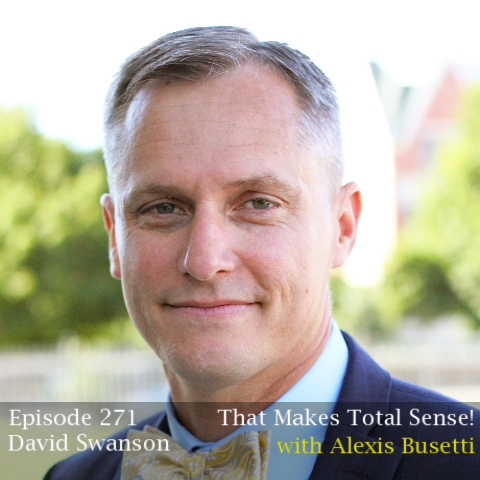
Okay, so, I'm online right now with one of my favorite people to be on Zoom with, honestly, David Swanson. And, David, when does this book come out? I totally forgot to ask you before we pressed record.
[00:00:53] Speaker B: I think it's the first week in October, maybe October 8, somewhere in that ballpark, right?
[00:00:57] Speaker A: October ish, and we're not quite there yet.
This was so good. Okay, so I'm going to say the name of it, and then we can get into it. This book is called plundered the tangled roots of racial and environmental injustice.
And it's got a gorgeous cover. I like feeling it in my hands, and I put on my stories. I was at the optometrist's office, and I read a. The first page, and I had already underlined something, and I was like, crap, this is gonna be.
This is gonna be a ride. And it was. And it was wonderful, and I loved it. And so thank you so much for the book, first of all, and for being here to chat about it.
[00:01:46] Speaker B: Thank you.
[00:01:49] Speaker A: I I'm not. I'm not gonna start with, where did this book come from? Cause we'll get there. Um, where I want to start is probably in an. In an odd place, and that is, I kind of want to start talking close to where you ended the book.
And the. The reason is this, um.
I feel like you ended this book, and in a way that I would say is very on brand for David Swanson. And what I mean by that is this. You don't give the reader a list of things to do, which I think would be the tempt. It would be a temptation. If I were writing this, I think it would be the temptation. Look, I've made a case. I'm trying to show you what. What is. What's going on, and now, as the reader, you understand more, and here's what you can do about it.
And so you kind of give us a. Here's what we can do about it. But I can tell the listener what it's not. It's not recycle more.
[00:02:52] Speaker B: That's right.
[00:02:53] Speaker A: It's not sign a petition or email your congressman.
It's not, you know, start composting.
It's not any of those things. What I took from this is how can we, a, begin to shift paradigms from where we have been to different places? How can we live together, together better in the spaces that we inhabit?
[00:03:25] Speaker B: That's right. Yeah.
[00:03:26] Speaker A: And this is hard because I live in a big city. You live in a big city. A lot of times those big cities are surrounded by suburbs. And I say that because they're kind of intended to be anywhere. You know, like, I can look at this house in this store on this highway, and you take a snapshot of it and it could be in Houston suburb, it could be in Chicago suburb or Detroit or San Francisco or whatever. Whatever. And in that way, in the US, at least in our context, we're almost, by design separated from our spaces on purpose.
[00:04:00] Speaker B: That's right.
[00:04:00] Speaker A: And David Swanson says, let's not let that happen to us. So can you talk about that? A, is this even close? Because we haven't really chatted about this, and then b, what about that?
[00:04:11] Speaker B: Yeah, no, I think that's absolutely right. My wife and I joke about that. If we're traveling somewhere, you know, in certain settings, you're like, you just wouldn't know where you are. Even you're trying to find some landscape landmark that might tell you, because the stores around you wouldn't do that. Or the way that the housing developments are laid out or their architecture wouldn't tell you that.
And I think we've taken that for granted in contemporary american life, that this is just kind of how it is. And you might like it, you might not like it, but it's just kind of our reality, our status quo.
And, yeah, I think, I'm wanting to say in this book that certainly that's not the focus, but that our separation from our places, from the particularities of our places, our inability to speak with any kind of real wisdom about our places. Right. Like the people who came before us in those places, who shaped them, who cared for them, the watershed that our homes are in, the ways that climate has changed over the past generation, what sorts of agricultural processes might be good for your place as opposed to my place?
Who is it that is benefiting from the organization of our place and who is not? These are things that most of us don't have much to say about.
We've been removed in some really fundamental ways from that kind of lived experience and wisdom.
And that is strange. That is very, very different now. It doesn't feel strange to us because we've been accommodated to this way of life. But I think for most of us, you go back a handful of generations, and our ancestors wouldn't recognize our disposition toward our places.
They wouldn't recognize our almost complete disinterest in the health of our places, right? Like, as long as I'm able to feed my family, as long as I'm able to kind of live in a protected place, I don't really have to care beyond that. And I think that would be just so, so strange. Took to the folks who came before us that distancing that separation has the force of intention behind it, and it has served to make us rather oblivious to ecological injustice and racial injustice. That kind of detachment serves to distract us from the way that those infrastructures benefit some while harming others and treat creation itself as a resource to be exploited. And so I'm hoping that one of the things that happens in this book is that people get more curious, curious about their places, kind of open up their eyes to go like, oh, I don't just live somewhere, I live here. And this here is beautiful, and it's complicated, and its history is fraught like every place's history is. And as Christians, it's our responsibility to know these things. It's our great privilege to steward these stories and these histories, to be the folks who don't forget to be the people committed to understanding how these things work together.
And it's my strong belief that as we do this, as local communities grow in this, we have the capacity to address these twinned injustices in a way that doesn't burn us out, in a way that doesn't require us to leave everything behind and become climate activists. Like, yeah, we probably need some of us to do that, but that actually allows very normal, average people like me to live alongside of other people in a kind of worshipping way that really does move the needle on these injustices.
[00:08:32] Speaker A: Yeah.
One thing I want to bring up as we continue the conversation is the systems. You know, you said we've just been accommodated to this. And a couple, I had a couple of thoughts come through as I was thinking about this book and pondering it.
One I'll mention really briefly, which was, well, both, I'll mention briefly, one was 100 years ago when I used to work in social work, and I did, like, casework stuff.
I won't get into the works because they were controversial back then, but I thought found some of it to be helpful. But this woman was talking about class and culture. So middle class poverty class and kind of elite, high, rich class. But one of the things that stuck with me that I could see to be true just from observing around me was that middle class values generally, of course, middle class values like upward mobility, and with that, upward mobility, those promotions and things like that, often come the actual geographic mobility. And so you see, see folks moving from their families, where their families live, to different spaces. So this, we fall into that category. We live in a city where we don't have any extended family whatsoever. And we moved here for career purposes. And this is just the way, again, we've been accommodated to this kind of thing. And even where both my husband and I are from, it's like the kind of career specifically that he was drawn into, there's just not space for that. There's the industry, isn't there, in the places where we grew up. So it was like a given that we would be moving somewhere eventually, and we're not the anomaly. I mean, I could, of all my friends, I don't, I have maybe could count on one hand the ones who actually have family in Houston. And of course, because Houston is a very large city with lots of different industry, it attracts talent, young talent, professionals, you know, this kind of thing. And so I definitely think that I could just see that I was drawn back to that and saying that contributes because, and then this is the thing. Every politician wants to have a much bigger middle class, right? So then you have lots of people who are then just like, moving families, moving, individuals moving, and we're getting more and more detached from space.
The other thing was, you have a, I think in here, statistics on farm, on farms. And I come from, I grew up in Oklahoma, where each of my grandparents, they married one another, and they met because their family farms were next to each other.
And I'm like, okay, they're different families, but they have family farms, and they only, each died. My grandmother just passed away five years ago, my grandfather just a few years before her. And so, you know, you're saying a few generations ago, this would be strange, but I think we can look. I can look and say for my grandparents, this was on the verge of strange. Now, they did move or a job away from those family homes, but that was not how they grew up. They grew up with their literal hands in the dirt.
My grandfather went to school for at, it used to be Oklahoma A and m back then, agriculture. Agriculture and mechanics.
And this was what, you know, they did. And so even just in that skipping one generation, I feel like we can see some of that transition and that strangeness of the separation. So those are two kind of footnotes. But I want for you to talk a little bit about the systems you say at the beginning of the book, and I love it.
If you don't already buy into this, to some degree, this book is not trying to convince the reader, that's right.
That these things exist. But I do want you to talk. So, so for those of us who say, yeah, we're here, but we don't necessarily understand some of that, like, what do you see in some of these systems? Maybe examples or broad strokes to help us kind of understand these systems that perpetuate this injustice?
[00:12:37] Speaker B: Yeah, no, I think that's important because we have a growing percentage of people, and I'm interested, particularly Christians as a pastor, who do believe that racism is real, that do believe that climate change is real, and other know, manifestations of kind of our ecological disaster.
But we struggle to see the connections between them, right. We see them as sort of discrete realities. And so then our understanding of what's behind them is limited. And so then our response to them is also limited.
As an example, if we think that racism is mostly about kind of personal prejudice, then our response is going to look a certain kind of way and it's not necessarily going to get at the level of structures and societal norms and the causational realities behind systemic racism. So for me, it was important to say, look, there is a common thread here. It's not particularly complicated. It's greed. As christians, we have language for this. We have a way of talking about this stuff. It's just that evil is really good at making itself look more complicated than it actually is. But, but we have language, we have memory for this.
Greed lies behind the exploitation of people. It lays behind the racialization of people.
Race ends up being the justifying narrative to allow greed to remain unopposed, taking people, treating them as resources, extracting wealth from them. And similarly with how we've treated creation.
If we look at european expansion and the ways that people come to North America, for example, and see a blank slate, a blank canvas ready to be taken, ready to be extracted wealth, to have wealth extracted from it and sent back to Europe, this common sin behind these two, you know, global systems is something that christians have something to say about.
It's a material reality. It has material impact. It's not just in the realm of thought. Like, if I can just get you to think differently about creation, like, hey, don't you know that creation, that God made it, and so we should care about creation.
We need to be more precise than that to see actually our way of life is built on something here. And so our way of life would fundamentally have to change. I don't just have to think differently about people. I don't have to just like creation more. The way we live together is going to need to be fundamentally different. It's going to be built not on the assumptions of greed and theft, but on caretaking, on harmony. And that's just going to require a completely different logic for local communities to begin to build around. Now, I think that's actually really exciting. I love that. I love and believe in the kind of spirit generated creativity that's available to local christian communities.
I just am not sure that we've thought about ourselves in that kind of way. Right. Like we haven't imagined ourselves as being able to live in such a different creative kind of way. In part because that system that you're talking about has just been allowed to remain kind of in the background, humming along. And we do some racial reconciliation programs here and there and creation care Sunday and so on, all the while continuing to live along the grain of a very exploitative and extractive status quo.
[00:16:39] Speaker A: I wonder if youll, for some, this will be a reminder, for many, this will be new.
One of the early places where we see these systems converge and this greed, all this come together is the, I can use air quotes, but nobody will see it. So I'm just going to say the air quotes, the discovery air quotes of the new world, right. And you line it out in such a way that I think is very clear of a so kind of the mandate. So again, this christian mandate of coming to discover in quotes and then also what was discovered when they got here, namely, oh my goodness, these native peoples are not doing what they should be, again, with the land. So I think we see that racism and this environmental exploitation coming together in that space. Can you talk about that a little bit more?
[00:17:47] Speaker B: Yeah, I mean, if the assumption is that God has given us this place to take as much from it as possible, to not just take enough, but to take as much as we possibly can, that lens then impacts how you see the place and those who have cared for that place, certainly this wouldn't have been true for everybody. We know historically there are exceptions to this, but there does seem to be this norm where european colonialists, settlers, pilgrims come to North America. And the way they experience this is as a sort of free for all this thing that's just been opened up to them in wealth themselves or those back in Europe. And like you say, that gets applied both to the land, the forests, the minerals and so on, but then also to the people. And so sometimes the people are interpreted through their decimation. God has cleared these people by way of viruses like smallpox or something else. Other times, the justification is more like you said, they've not turned this land into the kind of agricultural system that we would assume they ought to have done. They haven't mowed down the forest, for example.
And so they miss how the indigenous people are, in fact, caring for the land and have been for a very, very long time. And so they use this as justification. Well, you weren't working the land to its full possibility. You weren't taking everything that could be taken. And so it's our responsibility to do that.
Behind both of these is greed, is taking more than we need and then finding a way to justify that. Those assumptions are still with us today as we kind of listen to the debates happening about housing, about who gets access to that housing, as we hear debates about whether, I mean, the last presidential debate I counted, it was like climate change got something like 360 words total during the entire debate from both candidates.
So the same kind of assumptions that creation, both people and place are available for our benefit, that thing is still there in the background. And I think a lot of us american christians have kind of assumed that's right, and that's true for us as well.
[00:20:45] Speaker A: Yeah. And that's where I think that context is important, because we come from somewhere, and those paradigms come from somewhere, and they've been fostered and they've been nurtured and they've grown intentionally, I would say, because those kinds of paradigms benefit the folks who are in power and want to stay in power.
And so then we just kind of slide into those, or we're born into those and we come into those, and we don't really think about it as being different.
I want to pivot just for a minute because. Because part of what was so intriguing to me about the book, and we've known each other for a few years, and I could not stop smiling, reading some of your own personal background.
Seth came home from work the other day and I was like, did you know David Swanson wanted to be a park ranger? And you know what he said? I want to be a park ranger.
[00:21:49] Speaker B: I mean, who doesn't want to be a park ranger? Come on.
[00:21:53] Speaker A: Me first of all. But, you know, I mean, of course.
[00:21:55] Speaker B: There are urban park rangers.
[00:21:57] Speaker A: There are. That might have to be me if I was going to go that route. As Seth, of course, you know, is a geologist. And he always says, you know, as geologists, we say a bad day in the field is better than a good day in the office.
[00:22:12] Speaker B: There you go.
[00:22:12] Speaker A: And so that's his, you know, that's his kind of normative thing. Speaking of space and place, I would say just mentioning Seth, that actually was one of the really hard things. And I want you to tell kind of a little bit of your story, too, moving from different places to where you were in Chicago. But even for Seth, he was in. Grew up in Colorado, went to a little school in Golden, a university in golden, which is, you know, if anybody's seen a coors commercial, right? This is in the Rockies.
And he grew up, you know, in college. He was, of course, a geology. He was geological engineering major. And so they were in the field a lot. They were camping a lot, doing all these things. And then poor guy moves to Oklahoma to do his grad work, and he is like, the landscape is completely different. Yeah, stores may be the same, but he is not. You know, I joked with him. I'm like, you. He knew the direction. He learned his cardinal directions growing up driving, because he knew if he was facing west, he could see them mountains, you know, and I'm like, this is ridiculous. In Oklahoma, there's no such thing. And then after, you know, almost a decade there, we move here. And we have joked, I'm like, babe, if you had, if your move was straight from Colorado to Houston, I think it would have killed you. You know, like, I don't think you could have made it. Oklahoma's not a great interim space, but at least there's a little. A little rock formations, a little move, you know, some. Some kind of movement in those planes.
Anyway, Houston is just a different animal. But he, because of the time that he spent outside and because of how meaningful that was for him, it made a huge difference for him, for his person when he moved from place to place and what he was seeing, what he was surrounded with and also the differences in what he could do, you know, what he felt like he could do. So, you know, just kind of an aside there. I've kind of watched that over our couple of decades together and going, wow, this is. I didn't. I grew up in one spot, and so it didn't, you know, everything was, this was just what the outside looked like, you know, so it was very different. But when I was reading about your education in the outside and then, and then your movements, I'm just, I would just like for you to share a little bit of that, because I think it gives us context of who are we reading, who are we listening to? Not just a pastor in urban Chicago. Right.
But you have. You have kind of always had this flowing through your veins.
[00:24:43] Speaker B: Yeah, I think that's right. I mean, I think I'm a missionary kid, and so lots of moving around as a child, and then four years of high school in southern California, four years of college in North Carolina before moving to Illinois, where we still are. And we've lived here now for a lot of years, 20 something years. But I think because of that background, I just always imagined a pretty transient life, and I thought that was actually a little bit unique. I think I assumed that other people had more. More stability in their lives. And it was really only in probably in graduate school when we moved to a larger suburbs of Chicago. And I was starting to meet a lot of people who had had very similar experiences, not missionary kids, but just had moved around a lot and just assumed that they would continue to do so. I recognized, like, oh, actually, this is not unique at all. This is how many of my peers have actually experienced the world. Maybe the number of moves have been different, but the assumption of transience, of mobility as either a good or just, again, the status quo, not really seeing it as a lamentable fact at all, just the way that the world works. I think, as you mentioned earlier, particularly in middle class spaces, it's aspirational. It signals something. Right? Like, you're not tethered, you're not tied.
I hear people in my community sometimes kind of, not disparagingly, but maybe a twinge of that. The people back home who never left, we don't tend to think as highly of them. We think that somehow it speaks to our virtue or our capacity or our education, if we were able to leave, if we were able to escape. Again, these are just all. This is just the currency of american middle class culture. I think for me, it was a long conversion, and I still have that restlessness. There's times where it's just, I want to be somewhere else. Just because it was a long process of recognizing how strange that way of life is, that assumed mobility and transience is rather innovative.
Historically, it would not have been seen necessarily as a good to pursue.
It wasn't how communities, and certainly christian communities, organized themselves in their particular places where churches kept the memory of their place, where clergy served as parish caretakers and so on. And so as I started to wake up to the weirdness of this I recognized, well, I'm going to have to be converted here in the level of my own desires. If I think this is actually right and true and it's happened. It's happened slowly fits and starts. But I don't want to be anywhere else. I don't want to move. I love visiting places. I love hearing why other people love their places, but I genuinely do love my place, and I hope I get to be here for the rest of my life.
And I love learning from people who have been in their places and who have loved their place as well. I don't know a lot of those people, honestly, but when I meet them, it doesn't matter what the context is. It can be radically different than my own. They could be a farmer talking about stuff that really just goes over my head, but you hear the affection and the attention in their voice, and I'm absolutely captivated by that.
And that's the kind of thing that I hope comes through in this book as a possibility.
Not a likely possibility, frankly, because everything pushes us in a different direction. But my sense is there's enough tired and exhausted people and people who have kind of agreed to the rules of the status quo and have just been chewed up and spit out by it, and who really do hunger for something kind of more rooted, more stable, which allows for a participation in righteousness that's not faddish, that's not just kind of one campaign or social media scroll after another, but is, to borrow a Eugene Peterson phrase, like a long rooted obedience in the same direction. I do think there are people who are hungry and thirsty for that, but it does require a conversion of desires. I think that has to be initiated somewhere deep inside, because probably no one else is going to ask it of us.
[00:29:39] Speaker A: I'm going to ask more because one of the things you talk about in the book is you talk a lot about your place, and I'm grateful for that. But part of how you frame this is my paraphrasing here and my understanding. I'm going to talk about my place with the hopes that it will make you think about your place.
[00:30:04] Speaker B: Yes, that's right.
[00:30:05] Speaker A: So if we can imagine, and I did as a reader, if I can imagine this is some of what David place and space and community looks like, then this gets me thinking, oh, yeah. And in my place it looks like this, or my people it looks like this. So I want to name a couple of things that I read that I thought were really cool, and then see if you can elaborate on some of those things so in the, in the place where you live, and we don't, I have to imagine for those of us who follow you on instagram, we can see the pictures of the birds.
[00:30:44] Speaker B: That's right.
[00:30:45] Speaker A: It's one of my favorites. So I'm imagining, okay, God has put something in David Swanson that really appreciates nature, this park ranger ness inside of David that loves the nature, the outdoors, the lake, the birds, these creatures. And this is a way that David can really connect with God. And so from your place, you have found a way to get there easily, and you make it a habit. You walk to the lake regularly also, and I hope this is not, like, too blunt, but I also felt like I read the place where you live, the place where you pastor, which is a mile from where you live, is a place where some people, when you have said, this is where I live. This is where I've pastor, I, pastor, have at least alluded to, maybe directly said this. I'm surprised that you live in that place because I'm looking at you and you don't look like what I would imagine person living in that place would look like. So you have also taken the steps because this isn't, wasn't your home base. You weren't born there, raised there.
[00:32:01] Speaker B: That's right.
[00:32:01] Speaker A: You have taken steps to learn the history of this place that you love and that you have been planted.
So again, you talk about your place in context, I think with the hopes that we would imagine what these things might look like in our place and context. Meaning how do I connect with God? What can I do in the place where I live right now? Also, if I wasn't born here, even if I was, how can I learn more about the history? So I am more embedded in where I am. So could you elaborate a little bit, you know, as much as you want to on the personal parts of that, but then also what your hope is for the reader as we start to investigate where we are currently.
[00:32:44] Speaker B: Yeah, yeah. And I'll say, you know, all of this is, is both just good, period. I do think it is the best way to live. I think it's how God created us to live in this kind of harmony with our places and in the service of being the sorts of people whose lives are undermining systems of exploitation and extraction. Right. It's not just an interesting project. It's not just you'll sleep better at night if you get some time in nature.
The scope, I think, is much bigger than that for me.
I feel incredibly thankful to live in our neighborhood. It's a walkable neighborhood, a bikeable neighborhood. I can take public transportation very easily. Lake Michigan is about a ten or 15 minutes walk away. Jackson park is similarly located. Close. Now, these are urban spaces, right? It's not like I'm out in some national park. I can always hear traffic. Always. There's always evidence of pollution, always. I don't tend to include that in the bird photos I take and post on social media, but it's always there.
Reminders of the urban environment that we're in. And then I have access to the sociological history of our community as well. There's lots been written about our particular area. And so as someone who is not native born to this place, I have been able to learn a lot.
And then I hope that our church community becomes the kind of place, whereas when other newcomers come, there's a community that's available to. To invite them in to a similar experience and knowledge. So it's not just on their own to figure some of that stuff out, that there's a community of both newcomers and old timers who are able to say together, like, hey, we're learning what it means to live in a friendly way with our place, to befriend our place, and to acknowledge how this place has been caring for us.
I've loved that. I've loved that process.
I am okay being a beginner and be okay saying, there's a whole lot I don't know. There's so much that I have to learn.
I could speak way more about what I don't know about our place and what I have come to learn about our place over the years.
That would be my hope, is that people would read this and say, I think I'm curious about my place now. I do think that part of that curiosity needs to be finding tangible, visceral, practical ways to be in relationship with the place itself.
I don't know any other way to say this than that our places are meant to benefit from our presence, and they don't. Our places suffer under our presence. Our places are used up under our presence. And this ought to offend the Christian. This ought to absolutely offend the person who understands their caretaker. Their vocation is being a caretaker of this place. And so that is going to involve reacquainting ourselves with the natural world to some extent, even in urban spaces. And it doesn't have to be, you don't have to become a park ranger. Right? Like, it can be learning. Like, oh, yeah. In Houston, we've had these increased weather events and I'm going to learn a little bit about that. I'm also going to learn about my neighbors who are suffering in the flood zones of that. Now, I'm speaking a little out of turn. I've read a little bit about your place, but, like, why is it that they're there and maybe I'm not there? And that's gonna become. That's gonna get in me in a way that changes how I live in this place and changes how I talk about. About my place.
I'm not able to say that I don't live in Houston. Right. I don't live in Oklahoma. I don't live in these places. And I don't need to, like, I need to be in my place. And then trust that there are people like yourself and others who are coming to love their place in very similar kinds of ways, such that justice and harmony are being worked into the fabric of those places.
[00:36:58] Speaker A: I'm really intrigued. I'm hoping that this will stick with me, but that the space, it's meant to benefit from our presence.
[00:37:05] Speaker B: That's right.
[00:37:08] Speaker A: I hope that lives rent free up here, at least for the rest of the day.
Longer, I hope. But so that, that made me think, yes.
And also these systems. So if I have power, I can come in. And some people have defined racism very, very simplistically, or maybe briefly is better word of prejudice, with power. So if I have power, I can say my place is benefiting from me because I'm able to take the things that I. The waste from the things that I extract and put it in somebody else's place. So the other evening, our kids and I really like doing as many games as possible on the new York Times app as we can. And one of them is the mini. And one of the, one of the answers to the mini was the. The acronym for yes in my backyard. But my kids didn't know what that was. And so then, of course, first I had to explain, no, not in. Not in my backyard. To yes, in my backyard. Yeah. That's not in my backyard. Versus yes, in my backyard. And we had those conversations, and you talk about that. And I, and I know this is like, some of those things, like kind of Erin Brockovich. Okay. I just completely dated myself. There's people who. Anyway, it's fine. Look it up as Julia Roberts. It's great. But you know, who have heard of this? Like, everyone knows Flint, but also, you know, areas where they've heard, oh, I think the cancer rates might be higher, asthma rates might be higher, or things like that. But you do talk about that some in the book. Another place where we see these. These. These systems intersect, these systems of injustice intersect. And so, gosh, that got me thinking about that, because our. The place doesn't benefit from our presence if all we do with our presence is move that harmful stuff.
[00:39:08] Speaker B: That's right.
[00:39:09] Speaker A: That's often, you know, as a result of our exploitation and extraction, we move it to someone else's place. This is nothing, what we mean.
[00:39:18] Speaker B: That's right.
[00:39:18] Speaker A: The place benefiting from our presence.
[00:39:21] Speaker B: No, that's right. I think it's Daniel Castillo, a theologian, who describes zones of extraction and zones of accumulation and how the globe has been divided up into these different zones. And this is true back to the time of colonialism and remains true for us today. And you're absolutely right. Those of us with enough resources could structure our lives in such a way as to appear green, as to appear ecological friendly. We can put the racial justice signs in our front yards or whatever, and yet those zones remain undisturbed. That there are places and people who get to accumulate, and then there are others from whom wealth continues to be extracted, labor continues to be extracted.
I think that's right, actually, I do think that you can understand the way much of our world is organized through these different zones of accumulation and extraction. And so, for those of us who do have a level of power and privilege, it's really important that we're honest about where we're located, and it doesn't mean that we shouldn't some of us be located in zones of accumulation, but it does mean that we're honest about that. It does mean that our way of life is being sustained by the destruction of the planet. And we just got to be really like we are.
Our 401 ks are growing because the planet is being destroyed, because our neighbors are being destroyed.
And again, it doesn't mean that we can't be in those spaces, but we have to at least begin by being honest about the nature of those spaces, which I think is then going to require us to live against the grain in those spaces, which is really hard to do. Like, it's just really, really hard to do. Which is one of the reasons why I suggest in this book that the only way forward for christians is to do this together. I am just not strong enough. I'm not righteous enough.
I will succumb time and time again. But if I'm with a people who are developing an imagination for this together, I talk about thrift a little bit in the book.
If you're a part of a community that values repairing things rather than just throwing them away.
Who values passing on hand me down clothes to families as their children are a little bit younger than yours. This is a kind of silly example, but if the community has norms around this, then it's a lot easier for me to resist the prevailing winds of a consuming culture.
So I think a big part of this is just being very, very honest about the ground that we walk on, the systems that we're deeply, deeply implicated in. And it's so easy to become overwhelmed by that. I understand why we don't want to think about that. I understand why it's easy to kind of just pursue my sort of individual, personal virtue in the middle of that and call it a day.
But I do think it is not just theoretically better on paper, theologically better, but experientially better when you get to be a part of the people who are. Who've decided that the status quo doesn't have to have the final, the final say.
[00:42:46] Speaker A: I think, too, doing so in community, just practically speaking, offers a few things.
Number one, I think we don't have to. I hate using this phrase because how it's going to be. We don't have to do all the research, you know.
[00:43:06] Speaker B: No, that's my research.
[00:43:08] Speaker A: Right. We don't have to do all the research.
So I think that's part of it. I'm even thinking now about apps I use, you know, for certain things, and, you know, my kids asking, is that why we, when we need this kind of shoes, that we. We get this brand instead of this brand? Yes, because I try, you know, to look up these things. How are they treating the people who work for them?
What about the environment? You know, these kinds of things. So we're, you know, doing that. We don't have to be experts in everything. We don't have to do all.
We can't be.
And then also, you know, taking that and owning that that we can't be, and then encouraging people in the places where they. Where some things really come easily to them and where something may not come as easily for me. And then also looking at that and saying, just like I can't be an expert in everything, I can't do everything either, but this person might be super great at this. And so maybe we can partner in some ways. Maybe I can say, look, I I would love to be able to pass along these clothes, but some of them need to be mended or some of them need to be whatever. Well, maybe there's a lady in my church for whom this comes really easily, she loves doing it. We can, you know, help each other out, and then I can do something else, you know, with her, for her. So anyway, I'm just thinking practically about that. But also, like you said, there is the aspect of just. Just we're just not strong enough to do it. No, the other part that I really loved. You talk a lot in the book about the churches and schools, community garden.
And I think about the results, the consequences, the beautiful things that come from doing these things in community that it's like, yes, you're helping doing something positive for creation, and you're building relationships and you're, you know, so I don't know, can you? Because, you know, for all. For all of us, again, our space doesn't look like your space. Exactly. Contextually, I can't keep a house plant alive longer than a week and a half. So maybe a community garden is probably not going to be my gig. At least I'm not going to be the one they're going to trust, attend to anything. Maybe I can greet people. Maybe I can do something else if that were happening in our space. But I'm curious if you can talk about some of the things that you've seen. Oh, goodness, David. They've seen grow surrounding that community garden effort. Like, you know, where it came from. But then maybe unexpected things that you've seen from the challenge and the dedication to do that thing communally.
[00:46:00] Speaker B: Right? And the point isn't to say everybody should do that. I don't know. It could be a bad idea in somebody else's place. Right?
We were asked to do it by the local school that we were in relationship with. And so on that invitation, year after year, just taking additional steps in relationship with the school and the school's needs and then the community's involvement and so on. And so, in a strange way, no one can really take credit for the garden because it was just one invitation after the next. But those invitations come in the context of relationships, relationship and presence.
I think if something differentiates the garden that we get to take care of, it's that we didn't come with this idea, hey, we should have an urban garden, because that's a thing that is necessary and needed here.
It was at the behest of our friends and neighbors. And now, all these years later, if you visit the garden on a Saturday during the summer, the fall, it's just so fun. It's just a fun place to be. It's joyful.
It's joy embodied in many ways. There's a lot of work, but it's fun, it's relational, it's cross generational. It's meeting a genuine need. There's a senior building close by where senior citizens make their way over, and we'll sit on the bench and we'll tell stories, and we'll get the produce that. That they might not have access to otherwise. And then volunteers from the church in the neighborhood who are building those friendships and building those relationships.
I don't know if I write about this in the book or not, but it's right across from a convenience store that attracts a lot of folks who kind of hanging out, and those folks get involved in the community as well, and kind of woven in in their own ways. Right now, some of the guys who hanged out pretty regularly outside the garden or taking care of a little cat that has made its home in the garden, they've named the cat 43rd after the street that the garden and the school are on. And so this is, I think, the kind of thing that can happen as a community learns to actually see its place, to actually see its place in a way that I just think a lot of us don't have.
We see certain things that we need that will benefit us. But coming to really see your place, see the detail of the place, see the history of the place, see what the place is offering, see what the place requires to begin discerning our obligations to that place, our responsibilities to that place as those who benefit from it. The kinds of possibilities that open up, I think, I mean, we can't predict what they're going to be for us. This has been one of those. But when those possibilities do open up, it's going to be for everybody's good, right? It's not going to be like, okay, here's this thing I have to do now, and it's really hard, and it means I don't get to be in charge of my life or, you know, move whenever I want to for a climate that's a little bit more like, no, you're going to actually like this because your heart's going to be changed by it. Like, you're going to find yourself loving in a way that you weren't able to love before and to receive love from people who you just wouldn't be in relationship with otherwise. I've been reading a lot of Kathleen Knorr's lately, and she writes about the Dakotas and kind of her place in this really stark landscape.
And it's this wonderful example of someone who, over time, comes to see their place in such a way that she's able to. To receive love from. From this place that others of us, from a distance, would go. Like, why would you ever want to live in North Dakota? It's just so boring. It's so flat. It's so cold. It's so. Whatever, right? But. But the person who's come to actually see the place, I mean, why would you ever want to live on the south side of Chicago? As a violent housing displacement, gentrification, blah, blah, blah. But you see it, and then you. And then you love it because it's loving you. Actually, before you were ever able to love it, the place has been loving you. It's God's creation, literally, was made to care for you, to provide for your needs, to give you air to breathe and water to drink, and so on. And so how can you not help but love it back? This is, in a sense, what we're missing out on right now. We're missing out on receiving the love of God's creation and then returning our own love back to it.
[00:50:43] Speaker A: Okay, so, penultimate question. I say this because I'm going to let you end it wherever you want. I almost never do this, but this short paragraph I'm going to read and then ask you to talk about it a little bit. It.
I mean. Okay, a star with an exclamation point, David. And I don't even know. There's not even a key for that in my annotations because it, anyway, never gets it. But this was fabulous, this, for me. And so I just. I want to read it and then ask you to elaborate on it just a bit.
Idealists know what they are building, so, as will always happen when things don't go according to plan, they must exert dominating power to keep their vision alive.
Caretakers, on the other hand, understand that Shalom in any particular place will only slowly reveal itself with time, tenderness of relationships, and affection for the community of creation.
Our places, imbued as they are with the creator's good intention, know the conditions for their flourishing. It is we who have forgotten who, through the grace of the creator and recreator, are waking up to our priestly vocation.
[00:52:06] Speaker B: Yeah, that's not bad.
[00:52:08] Speaker A: No, that's not bad.
[00:52:11] Speaker B: Someone else probably wrote that, but that's really. Yeah, I like that.
[00:52:13] Speaker A: That's not bad. I mean, I will tell you first, before I ask you, when I read that, first of all, I reread it. And then I thought to myself, a thought experiment, what would happen?
And maybe this is meaningful for me, especially because I can definitely tend toward idealism. I test one on the enneagram. You know, we want justice. We want things done the right way. You know, we took a different personality test 100 years ago, and Seth always quotes me because he was his. His personality test showed that if things get done, you want him done the fun way.
But if things get. No, his was, he wants him done my way. Sorry. He probably wouldn't want me to say that mine is because they need to be done the right way. Yeah, we did this before we have kids. And I was like, our kids are there. There's no hope for them. We have a dad who wants things done my way, mom who wants things done the right way. Anyway. He's also the fun way. But this was me, this tendency toward idealism. But I thought, what if I took that assignment seriously of caretaker? And what if I did that, and then I started thinking about all of these aspects of my life. What if I did that with my family being a little vulnerable here, right. Instead of, this is what I want things to look like. But what if I said I'm a caretaker trying to listen.
[00:53:41] Speaker B: That's right.
[00:53:42] Speaker A: To my families, how God has created each member of my family. Our family is a unit.
All of these things. What if I looked at this with these organizations that I'm a part of? What if I looked at this with the ground that I run on? You know, what if with my church community? What if I started looking at myself and challenging myself to have the eyes and the ears and the hands of a caretaker instead of an idealist?
Like, what would change? I think it just became this kind of, like, awe, like, moment of awe for me. Like, oh, my goodness. What if I were to actually try to practice that?
What might that look like for me? So that's where I was. That's why it struck me.
[00:54:32] Speaker B: So, yeah. Yeah. I mean, I recognize that there are plenty of people who are not idealists, right? Who are kind of going with the flow of how things are.
But I tend to run in idealist circles. I know how we're wired, and I know where that can lead.
And so one of the ways that I describe creation in this book is that it's sacramental, that it points beyond itself to the creator. And that doesn't make the creation less valuable. It makes it more valuable. Right? Like, the bread and the wine do not become less valuable because they're pointing to Christ. They become more valuable because they're pointing us this visible sign of Christ's grace for us.
So if that's true, right? If creation is sacramental, then the idea of imposing our will on creation is a kind of sacrilege, is a kind of diminishing of.
Of the creator to say, we know what's best, actually.
And so if we can set that aside, if we can set those tendencies aside, and again, far more likely in community, where these norms are encouraged, rather than seen as a liability, which is what they would often be seen as, then we can slow down enough to start to pay attention, to start to be curious, how long does it take a farmer to really understand his or her land? I mean, I have to imagine it's the work of generations, right? It's what their grandparents and great grandparents told them about the land that's now being passed down to them.
That's how I formed my understandings of my place. It's been from the generation or two before me, telling me about my place, telling about what it used to look like and why it looks differently now than it did, than it did before.
And they entrust that knowledge and those stories with me with the hope that I will see more accurately than I would be able to. Otherwise, I'll be less prone to impose my assumptions onto this place and instead be interested in aligning myself along the grain of this place in more spiritual language, along the work of what the spirit has been doing in this place.
And as we do that, the places are going to tell us what's required of them. And this is why the context is so important, because Houston just needs different things than Chicago does, right? Your literal neighborhood just has benefits and obligations that mine doesn't.
And that's what will happen to us over time, is we'll actually have a little bit of wisdom around these things, rather than being sort of the oblivious consumers, the rather ignorant consumers. We'll actually have a little bit of wisdom about our places and the people sustained by our places to share with others. But that only comes, I think, from a kind of right relationship with the place itself, which is humble and probably a little quiet and definitely slow and deeply collaborative and so on. And again, I think, just better, just way better at the end of the day.
[00:58:15] Speaker A: Okay, so I'm going to end this in a place where I often do with guests, which is. Is I want you to share. Sometimes I frame it like this. What question didn't I ask? But, you know, what would. What would you like to share that we didn't quite get to? While you're thinking about that, I want to say this I'm thrilled with where this conversation has gone.
And I wish we had another hour because I will say there were, there are a lot specifically for me, and this doesn't mean your final comment needs to adjust to this. Just saying for me, in the back of my head, I keep thinking, oh, I wish we, I wish, let's explicitly name, and we didn't explicitly name a lot of the racial stuff for me, and that's really heavy. It is definitely, throughout the book, we tended to lean toward, and I think it's probably because I would say maybe even for many of us, especially since 2020, the creation stuff, it's like we're kind of just now getting into it. I think maybe especially even as christian communities where we're like, oh, yeah, this climate change stuff really is real and it really is impacting people and what are we going to do, you know? And I think, and so I think maybe that's something where the ground is being tilled for that in us as communities, as christian communities. And so there is much, much work to be done in those spaces, in the spaces where they interact. I think I, if we had another hour, I would talk really explicitly about the racial parts of this.
So I want to say that, to say the book delves into that in ways that this conversation didn't quite get to. Again, I'm thrilled with the places that we went, but I really just want to name that for folks that. The racial injustice piece is very heavy in the book, and so it's worth the read to get that perspective. So if that's fair.
[01:00:29] Speaker B: Yeah, no, I didn't have something to say at the end, so I can linger on that for a moment. One of the things that drives me bananas about sort of environmental movements is the way that they often get framed as being very, very white or very middle class.
Green movements, organic produce, farmers markets, these things all get coded as white or as wealthy.
One of the real gifts to me in this book was getting to look into some of this and learn some of the histories, both from what I read. But the conversation, conversations with friends as well, about previous generations, mostly here, african Americans who were, by our standards, deeply ecologically friendly and concerned, very engaged with caring for the earth in a way that was holy, in a way that was disruptive to patterns of exploitation and racism in ways that are almost hard to get my mind around.
I think we experience and talk about systemic racism and white supremacy as being this totalizing force, and yet there are these testimonies of these black women and men who describe a relationship with the land that undermine those totalizing claims. And that is a holy kind of testimony that, that you kind of have to pause in front of and let sort of seep into you. And so that's one of my deep hopes and longings in our own church community, in our own neighborhood, is a kind of remembering of that faithfulness of that kind, that way of life in harmony with the land which was not racialized as white, which was in some ways a counter force to whiteness, to racial exploitation. And that testimony is for all of us, that bearing witness to what creation can do for you is incredible to me and one that I hope will be really formative to our own church community as we're learning. What does it look like for this multiracial group of people to live in harmony with our place, an urban setting? I think those saints have something really, really important to say to all of us right now.
[01:03:06] Speaker A: I'm so grateful that you brought that up. I didn't know how to get there, but that was the most prominent thought that I was, especially because that also is, you talk about that in the migration chapter pretty heavily, is what was happening when African Americans were moving largely from the south to places in the north. And that connection and disconnection to space, that was really tragic in a lot of ways because of what they had fostered with the earth itself, which was so beautiful and yes, formative, if we will learn about it and allow it to be. Yeah. So I'm so grateful for that, David, thank you so much for that word.
Again. This is, I had so much fun reading this book. I was challenged in a lot of ways, and I learned a lot. I just learned a lot reading this. And so I'm just so grateful and appreciative. I'm really excited for this to come out and to get into the hands of individuals and mostly communities. You also have some questions in the back that relate to the chapters for people to talk about, discussion, starter style questions. And so I think that's worth noting before I name it again. Anything else worth noting about the book? Maybe the release date again and then, yeah, October 8.
[01:04:36] Speaker B: And my personal website is dwswanson.com. and so if there's other things related to this, they'll probably get linked there in some way. But, you know, one of my great hopes for the book is that I'll get to just hear from other people who are living this stuff out in their own places, because that'll change than how I'm doing the same in my place.
[01:04:59] Speaker A: Thanks so much, David. Again, it's plundered the tangled roots of racial and environmental injustice. Thanks so much for coming on.
[01:05:07] Speaker B: Thanks for having me.
[01:05:09] Speaker A: The links for all the resources mentioned in today's episode can be found in the show notes, music and podcast production by Seth Buscetti. Be sure to give us a review on iTunes and subscribe at your favorite podcast listening app. You can also visit
[email protected] dot.